

Taxes
Greece’s New Crypto Tax Rules for 2027: What Investors Need.

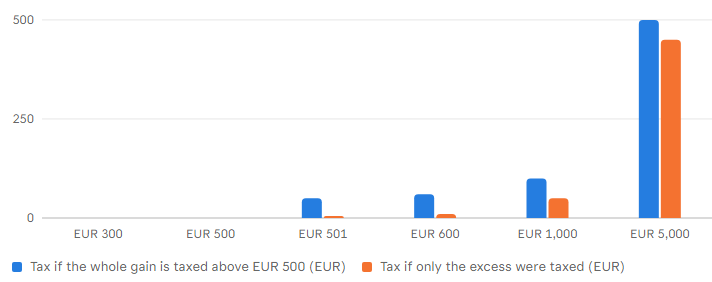
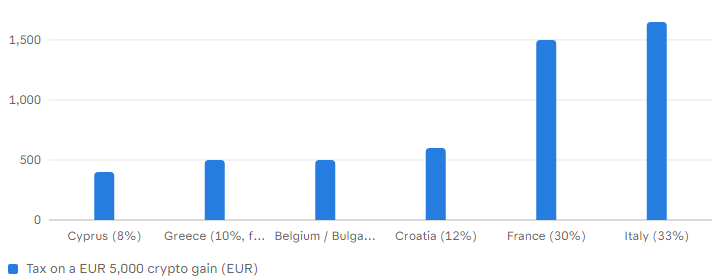
The law: approved by Greece’s parliament on November 5, 2026; effective January 1, 2027; 10% on annual net crypto gains (cut from a 15% rate floated earlier); no tax at €500 or less, and above €500 the 10% applies to the whole gain; 15% on staking, lending and DeFi income; losses above €500 carry forward five years against crypto gains; a 12-month window to declare past gains. Comparison (rates as reported): Cyprus 8%; Greece, Belgium and Bulgaria 10%; Croatia 12%; France 30%; Italy 33%; Germany and Portugal 0% for crypto held over a year; European range about 8% to 30% per Reuters. My arithmetic: a €500 gain owes €0, but €501 owes €50.10 (a cliff); €600 owes €60 (not €10); €2,000 realized in one year owes €200 versus €0 if split into four years of €500 (a legal timing question to check); on a €5,000 gain, Greece €500, France €1,500, Italy €1,650, Cyprus €400.
The headline is simple: a 10% tax on crypto gains and a 15% levy on staking and similar income. The details are less simple, especially a €500 line that works like a cliff and open questions about swaps and reporting. This guide explains what was approved, shows worked examples, compares Greece with other European countries and lists what is unclear. I could not retrieve the law’s text, so confirm details with a Greek tax professional.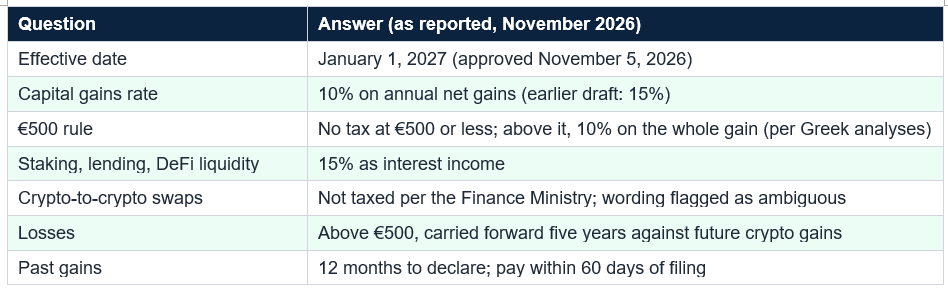
Three kinds of event are taxable, as reported: exchanging crypto for money, paying for goods or services with it and putting it into a company’s capital (Article 48, per Bitcoin.com). Paying in crypto is a trap for people who think only sales count: if you buy a bicycle with Bitcoin that has risen in value, the difference between the bicycle’s value and your cost is a taxable gain, subject to the €500 rule. From 2027, buying crypto is also placed under Greece’s source-of-funds checks, as with shares, but it is not a separate tax.
The numbers: Greece: 10% on annual net crypto gains (draft was 15%); no tax at €500 or less, above it the whole gain is taxed; 15% on staking, lending and DeFi income; losses above €500 carry forward 5 years; 12 months to declare past gains; effective January 1, 2027. Example: €500 gain = €0 tax; €501 = €50.10; €600 = €60.
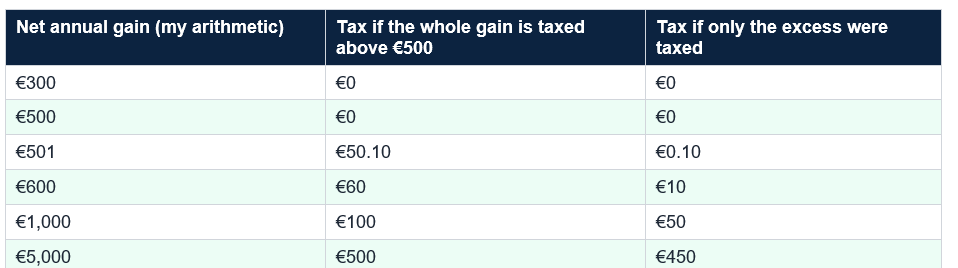
The difference is large near the line. With a €500 gain the tax is zero; with a €501 gain it is €50.10 under the whole-gain reading, about €50 for one extra euro, versus €0.10 under an allowance reading, and a €600 gain costs €60, not €10 (my arithmetic). The effect fades as gains grow: €1,000 costs €100 against €50 under an allowance, and €5,000 costs €500 against €450. For small investors the line is a cliff; for large ones it is mostly irrelevant. Because accounts differ, confirm the final wording when guidance is published.
There are open questions. The reports I found do not say whether the €500 threshold applies to staking income, how rewards are valued when received or what happens when rewards are later sold, which could create both income and a gain. Mining is another gap: a Greek official told Reuters in June that individual mining would not be taxed while mining by registered companies would be, but I did not find this confirmed in the final text. If you stake, lend or provide liquidity, keep careful records of what you received, when and at what value.
Spending crypto is clearer. In my illustration, buying a €1,000 item with Bitcoin bought for €600 gives a €400 gain, under the €500 line and so untaxed; if the Bitcoin had cost €450 the gain would be €550 and the tax €55 under the whole-gain reading. Bitcoin.com says gifts and inheritances receive clarified treatment, though I did not find the details. Every disposal needs a record of its date, value and cost.
I could not find the rate that applies to past gains under the disclosure window or its conditions, so I give no numbers for it, and the reports are not specific on when the 12 months run. A Greek tax professional can tell you whether your past activity qualifies and what you would owe. Keep in mind that EU platform reporting, described next, makes undeclared activity easier for authorities to see.
The tax comes with transparency. Since January, the EU’s DAC8 rules have required crypto platforms to send user and transaction data to national tax authorities, per Bitcoin Magazine, and Greece has written reporting tools into domestic law. From 2027, buying crypto is also treated as an asset purchase, like buying shares, which places it under the country’s existing source-of-funds checks. That is not a separate tax on purchases, but you may need to show where the money came from.
Enforcement is a challenge: Greece’s finance minister reportedly noted that Greek traders use overseas platforms, which makes the revenue hard to estimate. DAC8 reporting changes that over time, so the sensible assumption is that your activity will be visible to the tax authority and that accurate records and declarations are the safest approach. I did not retrieve the details of Greek reporting forms or deadlines.
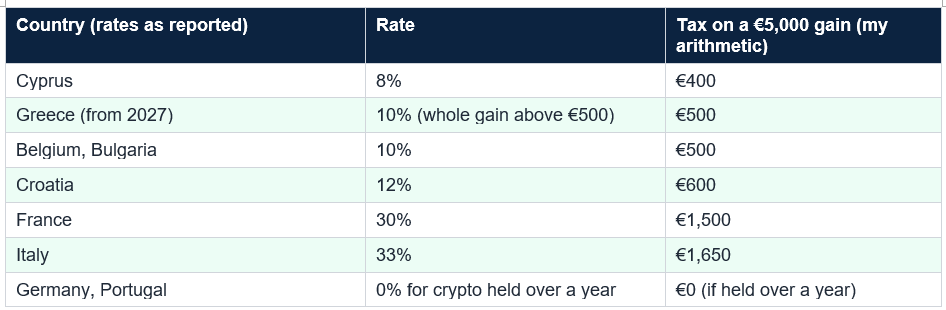
On a €5,000 gain, in my simplified arithmetic, Greece takes €500, Cyprus €400, France €1,500 and Italy €1,650, while a long-term holder in Germany or Portugal pays nothing. These comparisons ignore allowances, social charges and residency rules, and rates change, so they are a rough guide, not a basis for moving. Greece has no holding-period exemption in the reports I found, so a long-term holder is taxed like a short-term trader.
Other steps are less controversial: reconstruct your transaction history and cost basis for every wallet and exchange, decide whether to declare past gains in the 12-month window, keep records of staking rewards and watch for the implementation directives, which should clarify the open points. Each person’s situation, including residency, is different.
Export your transaction history from every exchange and wallet now, then list for each disposal the date, euro value and cost. Bring that to a Greek tax professional before January 1 and ask how the €500 threshold and past-gains declaration apply to you.
Common mistakes include assuming the first €500 is always tax-free, assuming swaps are safe before guidance, forgetting that spending crypto is taxable, ignoring staking rewards, losing records of acquisition cost, missing the 12-month disclosure window and relying on foreign platforms to stay invisible when EU reporting applies.
The rules still leave questions: swaps, staking thresholds, past-gains terms and treatment of companies. Records are the best preparation: rebuild your cost basis, track staking income and decide about disclosure with a professional, since official guidance is expected soon and details may change.
On January 1, 2027. Greece’s parliament approved the bill on November 5, 2026, as part of a broader law on loan oversight, debt protection and financial market regulation. Implementation directives, which should explain the practical details, were reported to be coming in the following weeks. Gains realized before 2027 are not taxed under the new capital gains rate, but the law gives a 12-month window to declare past gains.
What is the tax rate and what is the €500 rule?
Individuals pay 10% on annual net crypto gains. If your net gain for the year, after losses, is €500 or less, no tax is due. Above €500, several Greek-law analyses say the 10% applies to the whole gain, not just the part above €500, so a €600 gain means €60 of tax rather than €10. Some news reports describe it simply as an exemption for the first €500, so confirm the final guidance.
Is staking taxed differently?
Yes. Income from staking, crypto lending and providing liquidity to decentralized finance protocols is treated as interest income and taxed at 15%, according to the Finance Ministry as reported by CoinDesk. That is higher than the 10% rate on capital gains. I did not find whether the €500 threshold applies to this income, so check with a tax adviser.
Is swapping one crypto for another taxable?
The Finance Ministry says swaps are not taxed, and the reported text says swapping creates no taxable gain. But parliament’s Scientific Service warned that the bill’s wording could cover such trades, so some uncertainty remains until official guidance arrives. Selling crypto for euros, paying for goods or services with it, or contributing it to a company’s capital are taxable events.
What should I do before 2027?
Gather your transaction history and cost basis, since the tax is based on the sale price minus the acquisition price. Consider whether to declare any past gains within the 12-month window. Think about the timing of sales around the €500 threshold. Consult a Greek tax professional, since the details and the official guidance are still being clarified. This is general education, not personal tax or legal advice.
Table of Contents
- What Changed
- The Short Answer
- How the Tax Works
- The €500 Rule: A Threshold, Not an Allowance
- Staking, Lending and DeFi at 15%
- Swaps, Spending and Other Taxable Events
- Losses and Past Gains
- Reporting, Source of Funds and DAC8
- How Greece Compares
- Planning Considerations
- What Is Still Unclear
- Common Mistakes
- Conclusion
- Frequently Asked Questions
The EUR 500 cliff: Greek crypto tax on net annual gains of EUR 300 to EUR 5,000 (EUR)
Tax due (EUR) by Author's arithmetic at the 10% rate from 2027; CoinDesk, IMI Daily, Bitcoin Magazine and BigGo say the whole gain is taxed once net gains pass EUR 500 (first series), while some outlets describe a sim
Where Greece sits: tax on a EUR 5,000 crypto gain across European countries (EUR)
Tax due (EUR) by Author's simplified arithmetic from rates reported by CryptoDiffer (via CryptoSlate), Decrypt and Bitcoin Magazine; ignores allowances, social charges and residency rules; Germany and Portugal exempt
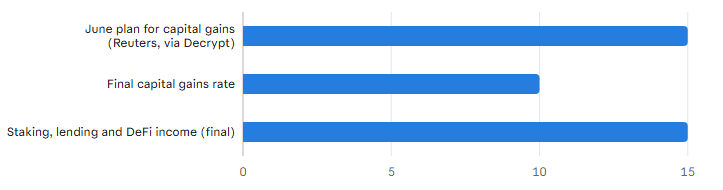
Two rates under Greece's new law: capital gains vs. staking and DeFi income (%)
Tax rate (%) by CoinDesk, Decrypt and other reports of the law approved November 5, 2026, effective January 1, 2027: capital gains 10% (a 15% rate was floated in June); staking, lending and liquidity income taxed at
What Changed
For years, anyone in Greece holding Bitcoin, Ether or other digital assets faced a gray area: Greece had no comprehensive legal framework for taxing crypto, as Reuters reported. That ended on November 5, 2026, when the Hellenic Parliament passed the country’s first dedicated crypto tax rules, part of a broader law on loan oversight, debt protection and financial market regulation. The rules take effect on January 1, 2027, about seven weeks from now.The headline is simple: a 10% tax on crypto gains and a 15% levy on staking and similar income. The details are less simple, especially a €500 line that works like a cliff and open questions about swaps and reporting. This guide explains what was approved, shows worked examples, compares Greece with other European countries and lists what is unclear. I could not retrieve the law’s text, so confirm details with a Greek tax professional.
From 2027, individuals in Greece pay 10% on net annual crypto capital gains, but only if the year’s net gain is above €500; if you pass that line, several Greek-law analyses say the 10% applies to the entire gain, not just the excess. Income from staking, lending and DeFi liquidity is taxed separately at 15%. Selling for euros, paying for goods or services with crypto and contributing crypto to a company’s capital are taxable; swapping one crypto for another is not, per the Finance Ministry, though parliament’s Scientific Service warned the wording is ambiguous. Losses above €500 carry forward five years, and past gains can be declared within 12 months.
How the Tax Works
The tax is on realized gains, not on holding: per CoinCentral’s reading of the Finance Ministry’s position, simply holding crypto creates no liability. A gain is the transfer price minus the acquisition price (IMI Daily), so what you paid matters, and the framework puts more emphasis on documenting acquisition costs. Net gains for the year, after deducting losses, are taxed at 10% once they pass the €500 line. The law applies to individuals; I did not retrieve how companies and professional traders are treated.Three kinds of event are taxable, as reported: exchanging crypto for money, paying for goods or services with it and putting it into a company’s capital (Article 48, per Bitcoin.com). Paying in crypto is a trap for people who think only sales count: if you buy a bicycle with Bitcoin that has risen in value, the difference between the bicycle’s value and your cost is a taxable gain, subject to the €500 rule. From 2027, buying crypto is also placed under Greece’s source-of-funds checks, as with shares, but it is not a separate tax.
The numbers: Greece: 10% on annual net crypto gains (draft was 15%); no tax at €500 or less, above it the whole gain is taxed; 15% on staking, lending and DeFi income; losses above €500 carry forward 5 years; 12 months to declare past gains; effective January 1, 2027. Example: €500 gain = €0 tax; €501 = €50.10; €600 = €60.
The €500 Rule: A Threshold, Not an Allowance
The most misunderstood part of the law is the €500 line. Many headlines say the first €500 of gains is “exempt,” which sounds like a tax-free allowance, where you pay tax only on the part above the line. Greek-law analyses say otherwise: CoinDesk reports that once the threshold is crossed the full gain is taxable; IMI Daily says no tax applies when the net gain after losses is €500 or less but above that the tax applies to the whole gain; and Bitcoin Magazine and BigGo agree. Reuters-based accounts simply say gains up to €500 are exempt, which is consistent but less precise.The difference is large near the line. With a €500 gain the tax is zero; with a €501 gain it is €50.10 under the whole-gain reading, about €50 for one extra euro, versus €0.10 under an allowance reading, and a €600 gain costs €60, not €10 (my arithmetic). The effect fades as gains grow: €1,000 costs €100 against €50 under an allowance, and €5,000 costs €500 against €450. For small investors the line is a cliff; for large ones it is mostly irrelevant. Because accounts differ, confirm the final wording when guidance is published.
Staking, Lending and DeFi at 15%
Crypto earned rather than sold is treated differently. Returns from staking, crypto lending and providing liquidity to DeFi platforms are treated as interest income and taxed at 15%, per the Finance Ministry as reported by CoinDesk, higher than the 10% on capital gains: €2,000 of staking rewards would owe €300, against €200 if it were a capital gain (my arithmetic).There are open questions. The reports I found do not say whether the €500 threshold applies to staking income, how rewards are valued when received or what happens when rewards are later sold, which could create both income and a gain. Mining is another gap: a Greek official told Reuters in June that individual mining would not be taxed while mining by registered companies would be, but I did not find this confirmed in the final text. If you stake, lend or provide liquidity, keep careful records of what you received, when and at what value.
Swaps, Spending and Other Taxable Events
Crypto-to-crypto swaps are the biggest unsettled point. The Finance Ministry says swapping one cryptocurrency for another will not trigger tax, and the reported text says a swap creates no taxable gain, but parliament’s Scientific Service warned that the bill’s wording could cover such trades. If swaps are untaxed, an investor can move between coins and only face tax when converting to euros; if they are taxed, active traders face far larger liabilities. Until official guidance is published, treat swaps as a risk to clarify rather than a safe assumption.Spending crypto is clearer. In my illustration, buying a €1,000 item with Bitcoin bought for €600 gives a €400 gain, under the €500 line and so untaxed; if the Bitcoin had cost €450 the gain would be €550 and the tax €55 under the whole-gain reading. Bitcoin.com says gifts and inheritances receive clarified treatment, though I did not find the details. Every disposal needs a record of its date, value and cost.
Losses and Past Gains
The law offers two relief provisions. First, investors with annual crypto losses above €500 can carry them forward for five years against future crypto gains only, per CoinDesk; I did not find whether the whole loss or only the part above €500 carries forward. Second, a 12-month window lets investors declare previously unreported crypto gains without late-filing fines or interest, subject to conditions, with tax due within 60 days of filing: a significant opportunity for people who traded without declaring to get compliant on better terms.I could not find the rate that applies to past gains under the disclosure window or its conditions, so I give no numbers for it, and the reports are not specific on when the 12 months run. A Greek tax professional can tell you whether your past activity qualifies and what you would owe. Keep in mind that EU platform reporting, described next, makes undeclared activity easier for authorities to see.
The tax comes with transparency. Since January, the EU’s DAC8 rules have required crypto platforms to send user and transaction data to national tax authorities, per Bitcoin Magazine, and Greece has written reporting tools into domestic law. From 2027, buying crypto is also treated as an asset purchase, like buying shares, which places it under the country’s existing source-of-funds checks. That is not a separate tax on purchases, but you may need to show where the money came from.
Enforcement is a challenge: Greece’s finance minister reportedly noted that Greek traders use overseas platforms, which makes the revenue hard to estimate. DAC8 reporting changes that over time, so the sensible assumption is that your activity will be visible to the tax authority and that accurate records and declarations are the safest approach. I did not retrieve the details of Greek reporting forms or deadlines.
How Greece Compares
Greece’s 10% sits toward the lower end of Europe. Reuters reports rates from about 8% to 30% across member states, with Greece below France and above Cyprus. Cyprus is at 8%, Belgium and Bulgaria at 10%, Croatia at 12%, France at 30% and Italy at 33%, according to CryptoDiffer and Decrypt, while Germany and Portugal exempt crypto held for more than a year and the Netherlands is moving toward a realized-gains tax from 2028. Greece’s earlier draft rate was 15%.On a €5,000 gain, in my simplified arithmetic, Greece takes €500, Cyprus €400, France €1,500 and Italy €1,650, while a long-term holder in Germany or Portugal pays nothing. These comparisons ignore allowances, social charges and residency rules, and rates change, so they are a rough guide, not a basis for moving. Greece has no holding-period exemption in the reports I found, so a long-term holder is taxed like a short-term trader.
Planning Considerations
Planning matters most near the €500 line. In my illustration, an investor with €2,000 of gains who sells everything in one year owes €200, while one who realizes €500 a year over four years owes nothing under the whole-gain reading, and using losses to bring a year’s net gain under €500 can also remove the tax. I could not verify whether such timing is respected or whether anti-avoidance rules apply, so take professional advice before relying on it, and remember markets can move against you while you wait.Other steps are less controversial: reconstruct your transaction history and cost basis for every wallet and exchange, decide whether to declare past gains in the 12-month window, keep records of staking rewards and watch for the implementation directives, which should clarify the open points. Each person’s situation, including residency, is different.
Export your transaction history from every exchange and wallet now, then list for each disposal the date, euro value and cost. Bring that to a Greek tax professional before January 1 and ask how the €500 threshold and past-gains declaration apply to you.
What Is Still Unclear
Several points remain open: whether the €500 line applies to staking income, how rewards are valued, how swaps are finally treated, whether the loss carryforward uses the whole loss or only the excess, what rate and conditions apply to past gains and how the law treats companies, miners and professional traders. Prices also complicate planning: Bitcoin traded near $71,800 on November 12, down about 3.6% that day, and near $75,700 days earlier. The implementation directives expected in the coming weeks should settle some of these.Common mistakes include assuming the first €500 is always tax-free, assuming swaps are safe before guidance, forgetting that spending crypto is taxable, ignoring staking rewards, losing records of acquisition cost, missing the 12-month disclosure window and relying on foreign platforms to stay invisible when EU reporting applies.
Conclusion
Greece’s parliament approved its first comprehensive crypto tax on November 5, 2026, effective January 1, 2027: 10% on annual net gains, 15% on staking, lending and DeFi income, with a five-year loss carryforward and a 12-month window to declare past gains. The €500 line is the detail to understand: it appears to work as a threshold, so a €500 gain is untaxed but a €501 gain owes €50.10, and a €600 gain owes €60 rather than €10. At 10%, Greece sits toward the low end of Europe, above Cyprus’s 8% and below France’s 30%.The rules still leave questions: swaps, staking thresholds, past-gains terms and treatment of companies. Records are the best preparation: rebuild your cost basis, track staking income and decide about disclosure with a professional, since official guidance is expected soon and details may change.
Frequently Asked Questions
When do Greece’s new crypto tax rules start?On January 1, 2027. Greece’s parliament approved the bill on November 5, 2026, as part of a broader law on loan oversight, debt protection and financial market regulation. Implementation directives, which should explain the practical details, were reported to be coming in the following weeks. Gains realized before 2027 are not taxed under the new capital gains rate, but the law gives a 12-month window to declare past gains.
What is the tax rate and what is the €500 rule?
Individuals pay 10% on annual net crypto gains. If your net gain for the year, after losses, is €500 or less, no tax is due. Above €500, several Greek-law analyses say the 10% applies to the whole gain, not just the part above €500, so a €600 gain means €60 of tax rather than €10. Some news reports describe it simply as an exemption for the first €500, so confirm the final guidance.
Is staking taxed differently?
Yes. Income from staking, crypto lending and providing liquidity to decentralized finance protocols is treated as interest income and taxed at 15%, according to the Finance Ministry as reported by CoinDesk. That is higher than the 10% rate on capital gains. I did not find whether the €500 threshold applies to this income, so check with a tax adviser.
Is swapping one crypto for another taxable?
The Finance Ministry says swaps are not taxed, and the reported text says swapping creates no taxable gain. But parliament’s Scientific Service warned that the bill’s wording could cover such trades, so some uncertainty remains until official guidance arrives. Selling crypto for euros, paying for goods or services with it, or contributing it to a company’s capital are taxable events.
What should I do before 2027?
Gather your transaction history and cost basis, since the tax is based on the sale price minus the acquisition price. Consider whether to declare any past gains within the 12-month window. Think about the timing of sales around the €500 threshold. Consult a Greek tax professional, since the details and the official guidance are still being clarified. This is general education, not personal tax or legal advice.
0 Comments
Be the first to share your thoughts on this article.