
Hustle
House Flipping Singapore: BTO to Landed? Complete Guide

The complete 2026 guide to Singapore’s property upgrade ladder — equity building, MOP rules, stamp duties, and the true cost of reaching landed

The aspiration is one of the most common in Singapore: use a subsidised BTO flat as a springboard, build equity, and eventually own a landed property — a terrace house, a semi-detached, or even a bungalow. Given Singapore’s land scarcity and the premium attached to landed living, the landed home is the pinnacle of the residential property ladder for many Singaporean families. And in 2026, with 18,000 BTO flats completing their build in 2025 and 13,484 flats reaching their Minimum Occupation Period, the largest wave of potential upgraders in recent history is deciding exactly this question.
The honest answer is: yes, the journey from BTO to landed is possible for Singapore Citizens — but it is not a quick flip. It requires a minimum of five years before the first step (selling the BTO), another potential holding period at the condo stage, very significant stamp duty costs at multiple junctures, and the financial capacity to service a mortgage on a property starting at S$2 million at the lower end of the landed market. It is a long game, not a two-move play.
This guide maps the complete pathway from BTO purchase to landed property ownership in 2026, with specific reference to the MOP rules, stamp duty obligations, ABSD sequencing, and current market pricing that determine whether and when the numbers can work.
Disclaimer: This article is for general informational and educational purposes only. It is not financial, legal, or tax advice. Singapore property rules, stamp duties, and HDB regulations change regularly. Always consult a licensed property agent, conveyancing solicitor, and financial adviser for guidance specific to your situation. Verify current rules at HDB.gov.sg and IRAS.gov.sg.
Propkaki’s May 2026 analysis explains the mechanism precisely: BTO prices are set by HDB using a subsidy model that decouples them from open-market resale valuations. Buyers who secure a BTO flat effectively receive an implied subsidy, which materialises as capital appreciation at the point of resale after MOP.
Example: a four-room BTO flat in a non-mature estate purchased in 2019 for S$380,000 might command S$650,000 to S$750,000 in the resale market after MOP in 2024–2025, generating S$270,000 to S$370,000 in gross appreciation. After repaying CPF accrued interest (the key deduction from cash proceeds) and agent commissions (approximately 2 percent of sale price), the net cash available for reinvestment is typically S$100,000 to S$250,000 depending on the CPF usage and the original loan quantum.
The practical implication for the BTO-to-landed pathway:
This context means that HDB upgraders in 2026 and 2027 are selling into a more competitive resale market than existed in 2022–2024. The scarcity premium that sellers previously enjoyed has diminished. The flip side: this also means more choices and less urgency for buyers. Equity has been built; the question is how much.
The CPF accrued interest deduction is the most frequently underestimated factor in calculating actual sale proceeds. CPF rules require that the amount withdrawn from CPF (principal plus accrued interest at 2.5 percent per year) must be returned to the CPF account before any cash profits are computed. A household that used S$200,000 in CPF over 10 years will have a CPF refund obligation of approximately S$250,000 to S$260,000, leaving only the excess above this figure as actual cash for reinvestment in the next property.
The typical condo upgrade in 2026:
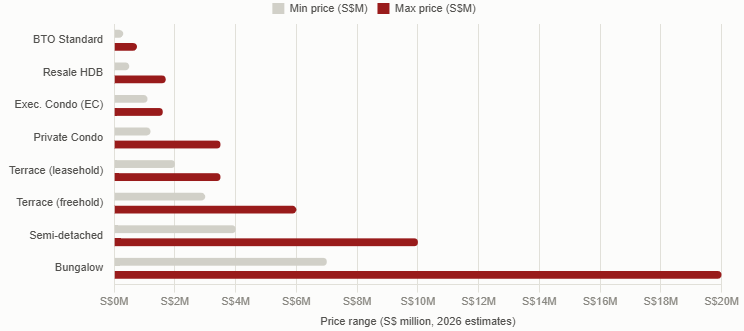
For the BTO-to-landed upgrader, the terrace house is the realistic entry point. A leasehold terrace in an established non-prime estate (Serangoon, Upper Serangoon, Kembangan, Bedok, Tampines) at S$2.5 to S$3.5 million is the achievable first landed property for a household that has completed the BTO-condo-landed sequence with careful financial management.
Strategy: For most HDB upgraders, the sell-first approach is simpler and safer. Missing the 6-month ABSD remission window — which has happened to households due to delayed HDB completions or sale complications — means the ABSD (20% of the new property price) is permanently forfeited. Sell first; buy with certainty.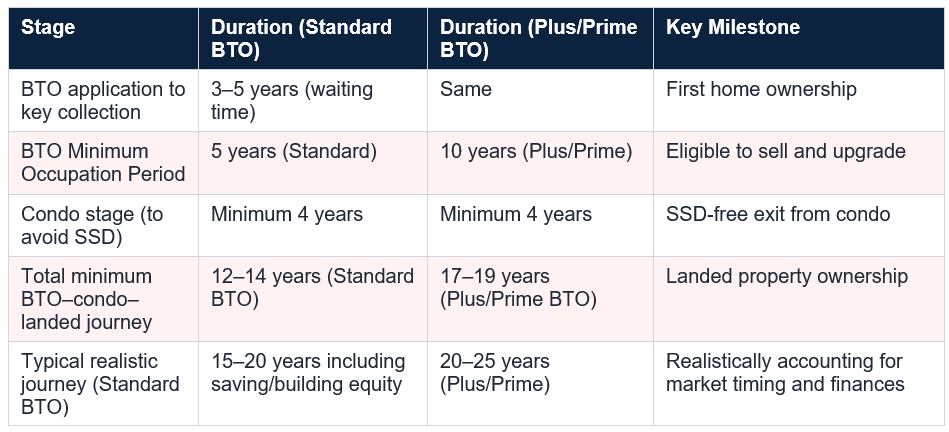
The table illustrates why the BTO-to-landed journey is a generational aspiration rather than a decade-long plan. For a Singaporean couple who bought a Standard BTO at age 28, the realistic landed property ownership window opens at approximately age 43 to 48, assuming the condo stage proceeds smoothly. For Plus or Prime BTO buyers, the timeline extends to the mid-50s. This is not a criticism of the pathway; it is a realistic framing that allows for genuine financial planning.
But the timeline is long. For a Standard BTO buyer, the minimum realistic journey to landed property ownership is 12 to 14 years; a more typical well-managed journey is 15 to 20 years. For Plus and Prime BTO buyers, the 10-year MOP extends the timeline by five years or more. The stamp duties at each stage are substantial — BSD at every purchase, ABSD at the condo stage unless carefully sequenced, and SSD if any private property is sold within four years.
The 2026 market provides specific opportunities: the lowest new launch competition in years, the largest wave of BTO equity unlocks in recent history, and borrowing costs at or near their cycle low. For the household that has completed the MOP on a Standard BTO and is financially positioned to make the move, 2026 is a strategic window. The ladder is real. The conditions are favourable. The patience requirement is significant. Plan accordingly.
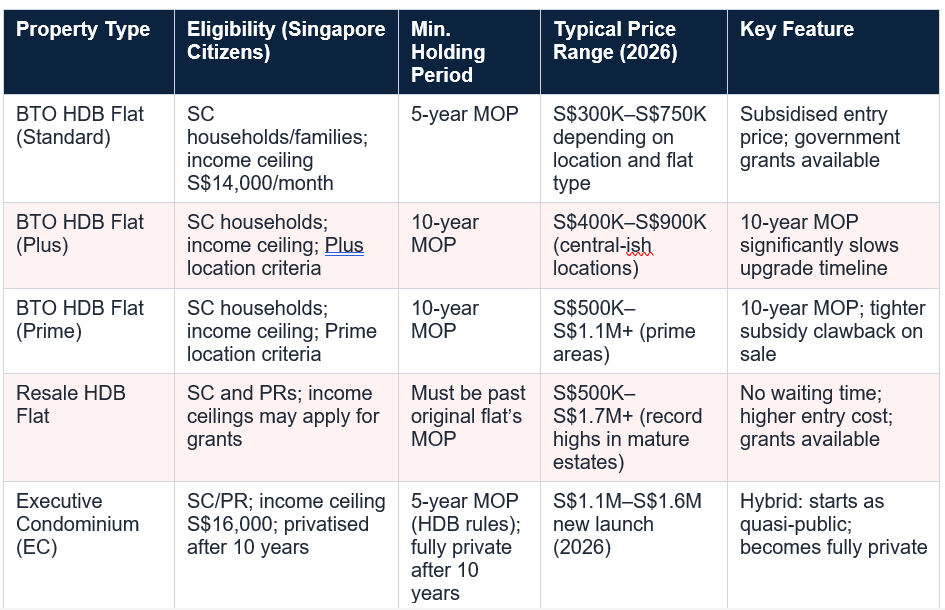
The MOP for Standard BTO flats is 5 years from the date of key collection. From the October 2024 BTO classification system change, Plus and Prime category BTO flats have a 10-year MOP. The MOP applies to the flat as a whole — you cannot sell or rent out the entire flat before MOP expires. SSD does not apply to HDB flats; MOP serves the equivalent market-cooling function. Verify current MOP rules at HDB.gov.sg.
How do I avoid ABSD when upgrading from HDB to private property?
Singapore Citizens can pay zero ABSD on an HDB-to-private upgrade by completing the HDB flat sale before exercising the Option to Purchase (OTP) for the private property. With the HDB sold and no longer owning any residential property, the private property purchase counts as a first property (0% ABSD for SC first property). Alternatively, SC couples can exercise the OTP, pay 20% ABSD, then sell the HDB within 6 months to obtain ABSD remission — but this requires upfront cash and strict adherence to the 6-month window. Consult a licensed property agent and conveyancing solicitor for guidance.
What is the Seller’s Stamp Duty (SSD) on private property in Singapore in 2026?
For private residential properties purchased on or after 4 July 2025: SSD is 16% if sold within Year 1, 12% in Year 2, 8% in Year 3, and 4% in Year 4. No SSD after 4 years. For properties purchased before 4 July 2025: SSD was 12%/8%/4% over 3 years (older rule). SSD does not apply to HDB flats. Source: Propkaki (June 2026), IRAS.gov.sg.
Can I jump directly from a BTO to a landed property without buying a condo?
Yes, it is legally possible for a Singapore Citizen who has completed MOP on a Standard BTO and has sufficient equity and income. The mathematical challenge is bridging the gap between BTO resale proceeds (typically S$600,000–S$900,000 after CPF refund in mature estates) and landed property entry prices (S$2 million+ for a terrace). The shortfall typically requires significant savings accumulated during the BTO holding period. For most households, an intermediate condo stage is the practical route because it allows for additional capital building before committing to a landed purchase.
What ABSD do I pay to buy a landed property in Singapore?
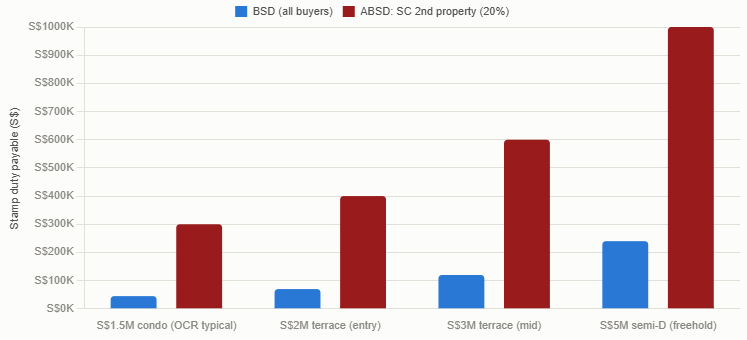
As a Singapore Citizen buying your first residential property (having sold your HDB or condo first), the ABSD on a landed purchase is 0%. If it is your second property (you still own the HDB or condo), ABSD is 20% of the full purchase price. At a landed property price of S$3 million, 20% ABSD = S$600,000 — a very significant cost that underscores why sequencing the sale before the purchase is critical. ABSD rates are set by IRAS and can be verified at IRAS.gov.sg.
Is landed property restricted to Singapore Citizens?
For most landed residential property types (terrace houses, semi-detached, bungalows outside Sentosa Cove and certain other designated areas), ownership is restricted to Singapore Citizens. Permanent Residents and foreigners may apply to the Singapore Land Authority (SLA) for approval, but such approvals are rare and require demonstration of exceptional economic contribution. Within Sentosa Cove, foreigners may purchase landed property but still pay 60% ABSD. Good Class Bungalows are restricted to Singapore Citizens only.
Stamp Duties By Property Price
Property Ladder Prices Ranges
Table of Contents
- The Dream and the Reality
- Singapore’s Property Ladder: How It Actually Works
- Stage 1: The BTO — Where the Journey Begins
- The MOP Trap: Why the New BTO Classifications Change Everything
- Stage 2: Unlocking BTO Equity After MOP
- Stage 3: The Condo Bridge — From HDB to Private Property
- Stage 4: Reaching Landed — The Numbers You Need to Know
- The Stamp Duty Reality Check
- The ABSD Playbook: How to Legally Minimise the Bill
- The Seller’s Stamp Duty: Why Flipping Is Extremely Expensive
- How Long Does the BTO-to-Landed Journey Take?
- What the 2026 Market Means for Upgraders
- The Realistic Financial Profile of a BTO-to-Landed Upgrader
- Is ‘House Flipping’ Even Legal in Singapore?
- Conclusion: The Ladder Is Real, But It Requires Patience
- Frequently Asked Questions
The Dream and the Reality
The aspiration is one of the most common in Singapore: use a subsidised BTO flat as a springboard, build equity, and eventually own a landed property — a terrace house, a semi-detached, or even a bungalow. Given Singapore’s land scarcity and the premium attached to landed living, the landed home is the pinnacle of the residential property ladder for many Singaporean families. And in 2026, with 18,000 BTO flats completing their build in 2025 and 13,484 flats reaching their Minimum Occupation Period, the largest wave of potential upgraders in recent history is deciding exactly this question.The honest answer is: yes, the journey from BTO to landed is possible for Singapore Citizens — but it is not a quick flip. It requires a minimum of five years before the first step (selling the BTO), another potential holding period at the condo stage, very significant stamp duty costs at multiple junctures, and the financial capacity to service a mortgage on a property starting at S$2 million at the lower end of the landed market. It is a long game, not a two-move play.
This guide maps the complete pathway from BTO purchase to landed property ownership in 2026, with specific reference to the MOP rules, stamp duty obligations, ABSD sequencing, and current market pricing that determine whether and when the numbers can work.
Disclaimer: This article is for general informational and educational purposes only. It is not financial, legal, or tax advice. Singapore property rules, stamp duties, and HDB regulations change regularly. Always consult a licensed property agent, conveyancing solicitor, and financial adviser for guidance specific to your situation. Verify current rules at HDB.gov.sg and IRAS.gov.sg.
Singapore’s Property Ladder: How It Actually Works
Singapore’s residential property market is structured in a hierarchy that is more defined than almost any other housing market in the world, because it is governed by a combination of eligibility rules, subsidies, and cooling measures that are explicit rather than market-driven. Understanding the structure is the prerequisite for any upgrade strategy.
Stage 1: The BTO — Where the Journey Begins
The BTO is the most financially favourable entry point on the Singapore property ladder specifically because it is priced below open market value. This is the design intent of the public housing system: the implied subsidy — the gap between the BTO price and what the equivalent flat would cost on the resale market at the same location and time — is the foundation of the upgrade pathway. At the point of resale after MOP, this implied subsidy materialises as capital appreciation.Propkaki’s May 2026 analysis explains the mechanism precisely: BTO prices are set by HDB using a subsidy model that decouples them from open-market resale valuations. Buyers who secure a BTO flat effectively receive an implied subsidy, which materialises as capital appreciation at the point of resale after MOP.
Example: a four-room BTO flat in a non-mature estate purchased in 2019 for S$380,000 might command S$650,000 to S$750,000 in the resale market after MOP in 2024–2025, generating S$270,000 to S$370,000 in gross appreciation. After repaying CPF accrued interest (the key deduction from cash proceeds) and agent commissions (approximately 2 percent of sale price), the net cash available for reinvestment is typically S$100,000 to S$250,000 depending on the CPF usage and the original loan quantum.
The MOP Trap: Why the New BTO Classifications Change Everything
The most significant change to the upgrade timeline in recent years is the October 2024 revision to the BTO classification system, which introduced Plus and Prime flat categories alongside the existing Standard category. The MOP for Plus and Prime flats is 10 years, double the five-year MOP for Standard flats. PropertyGuru’s analysis of the Sembawang 2026 BTO launch noted this explicitly: if you prioritise liquidity and the ability to upgrade sooner, focus your efforts on Standard projects.The practical implication for the BTO-to-landed pathway:
- Standard BTO buyer (2024): MOP in 2029 at the earliest. Realistically selling after five years puts the condo upgrade in 2029–2030. A landed upgrade after another five-year condo ownership minimum would be 2034–2035.
- Plus BTO buyer (2024): MOP not until 2034. The entire timeline extends by five years. The BTO-to-landed journey from a Plus flat could take 20+ years if an intermediate condo stage is included.
- Prime BTO buyer (2024): MOP also 10 years (2034). Prime flats have additional subsidy clawback provisions on resale, which may further reduce the net proceeds available for reinvestment.
Stage 2: Unlocking BTO Equity After MOP
When the MOP is met, the BTO owner has a decision to make: sell and upgrade now, or hold and wait for further appreciation. The 2026 market provides important context. HDB’s resale price index declined 0.1 percent quarter-on-quarter in Q1 2026 — the first quarterly drop since Q2 2019 — following the wave of 13,484 flats reaching MOP, which has increased resale supply significantly. PropertyNet.SG’s April 2026 analysis notes that resale price growth is expected to hover between 2 and 4 percent for the year.This context means that HDB upgraders in 2026 and 2027 are selling into a more competitive resale market than existed in 2022–2024. The scarcity premium that sellers previously enjoyed has diminished. The flip side: this also means more choices and less urgency for buyers. Equity has been built; the question is how much.
The CPF accrued interest deduction is the most frequently underestimated factor in calculating actual sale proceeds. CPF rules require that the amount withdrawn from CPF (principal plus accrued interest at 2.5 percent per year) must be returned to the CPF account before any cash profits are computed. A household that used S$200,000 in CPF over 10 years will have a CPF refund obligation of approximately S$250,000 to S$260,000, leaving only the excess above this figure as actual cash for reinvestment in the next property.
Stage 3: The Condo Bridge — From HDB to Private Property
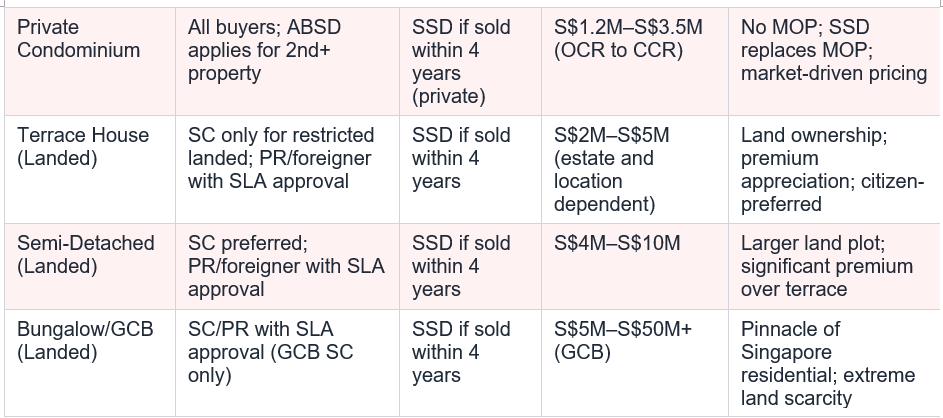
The condo stage is the middle step on the BTO-to-landed ladder for most upgraders. Jumping directly from an HDB resale to landed property is mathematically possible for households with sufficient equity, but the gap in quantum (from HDB resale proceeds to a S$2 million+ terrace entry price) typically requires an intermediate stage in the private property market to further build capital.The typical condo upgrade in 2026:
- • Sell the HDB flat (post-MOP). CPF refund deducted from proceeds. Net cash plus CPF OA available for the condo downpayment.
- • Buy an OCR (Outside Central Region) private condo at S$1.2 million to S$1.8 million as a first property. As a Singapore Citizen buying their first private property, ZERO ABSD applies. BSD on S$1.5 million = S$44,600.
- • Hold the condo for a minimum of four years (to avoid SSD under the July 2025 rules) or ideally longer to benefit from appreciation and reduce outstanding mortgage.
- • Sell the condo, repay any outstanding mortgage, and use the accumulated equity plus savings to make the down payment on a landed property.
- PropertyNet.SG’s June 2026 landed property guide advises HDB upgraders to consider starting with a well-located terrace house in an established estate at the S$2 to S$4 million range as an entry point, noting this provides good entry while offering genuine landed living benefits.
Stage 4: Reaching Landed — The Numbers You Need to Know
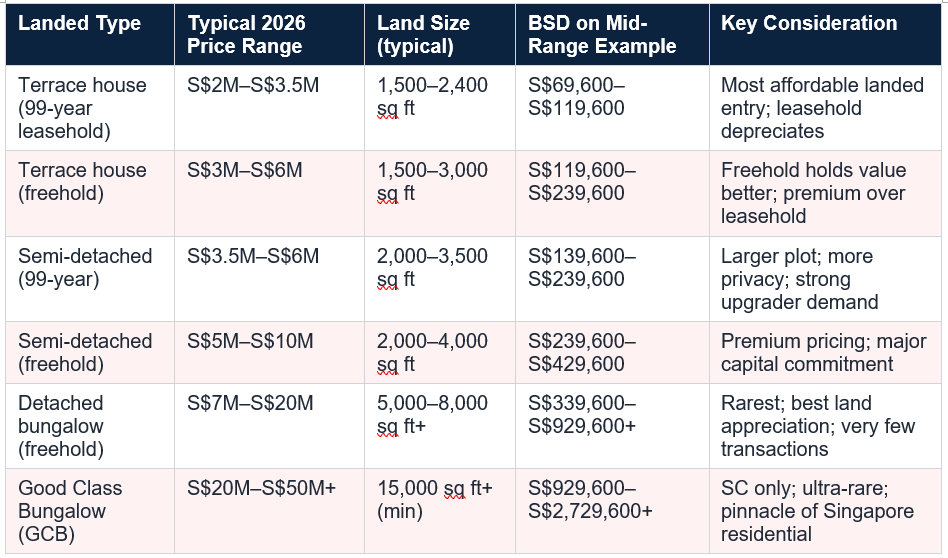
Landed property in Singapore is a fundamentally different market from the HDB and condominium segments. It is scarcer, more expensive, more illiquid, and — for most types — restricted to Singapore Citizens (or Permanent Residents and foreigners with Singapore Land Authority approval).For the BTO-to-landed upgrader, the terrace house is the realistic entry point. A leasehold terrace in an established non-prime estate (Serangoon, Upper Serangoon, Kembangan, Bedok, Tampines) at S$2.5 to S$3.5 million is the achievable first landed property for a household that has completed the BTO-condo-landed sequence with careful financial management.
The Stamp Duty Reality Check
Stamp duties are the single largest variable cost in the BTO-to-landed journey, and they are where the most significant financial decisions are made. In 2026, three stamp duties apply across the upgrade ladder:Buyer’s Stamp Duty (BSD)
BSD is payable by every buyer of every property type in Singapore at every stage of the upgrade. It cannot be avoided; it can only be minimised by buying lower-priced properties or by timing purchases to qualify for the most favourable rate tier. BSD on a S$3 million landed property is S$119,600 for a first-time buyer (no ABSD). BSD rates are tiered from 1% on the first S$180,000 to 6% on amounts above S$3 million (as of 2026).Additional Buyer’s Stamp Duty (ABSD)
ABSD is the most strategically significant duty in the upgrade sequence. The 2026 ABSD rates (unchanged since April 2023) for Singapore Citizens: 0% on the first property, 20% on the second, 30% on the third and above. The critical implication: if you buy a private property before selling your HDB flat, you are buying a second property and must pay 20% ABSD on the full purchase price. On a S$1.5 million condo, that is S$300,000 — on top of S$44,600 BSD.Seller’s Stamp Duty (SSD)
SSD applies to private residential properties sold within four years of purchase (for properties bought from 4 July 2025). The rates are 16% in year one, 12% in year two, 8% in year three, and 4% in year four. SSD does not apply to HDB flats — the MOP serves the same market-cooling purpose. The July 2025 tightening of SSD (extending from three to four years and raising the year-one rate from 12% to 16%) has made short-term private property flipping extremely expensive in 2026.The ABSD Playbook: How to Legally Minimise the Bill
The single most important strategic decision in the BTO-to-condo upgrade is sequencing. Propkaki’s and SG Realty’s analysis of Singapore’s stamp duty framework identifies two legitimate approaches for HDB upgraders:The Sell-First Approach (Zero ABSD)
Sell the HDB flat first, completing the sale before exercising the Option to Purchase for the private property. Because you are now a property-owning household with zero residential properties, the private property purchase is treated as a first property for ABSD purposes. Zero ABSD payable. This is the most financially optimal approach and is recommended by virtually all Singapore property advisers for the HDB-to-private upgrade. The challenge: you must arrange temporary accommodation during the gap between HDB sale completion and private property key collection. Rental for six to twelve months is the typical solution.The Buy-First, ABSD Remission Approach (Reclaim ABSD)
For SC couples, an alternative is to buy the private property first (paying 20% ABSD), then sell the HDB flat within six months of purchase (or six months from TOP of the new property, whichever is earlier). Upon selling the HDB within the qualifying window, ABSD is remitted — effectively returned. This approach avoids the rental gap but requires the cash flow to pay ABSD upfront (which can be hundreds of thousands of dollars) and the discipline to complete the HDB sale within six months.Strategy: For most HDB upgraders, the sell-first approach is simpler and safer. Missing the 6-month ABSD remission window — which has happened to households due to delayed HDB completions or sale complications — means the ABSD (20% of the new property price) is permanently forfeited. Sell first; buy with certainty.
The Seller’s Stamp Duty: Why Flipping Is Extremely Expensive
The question in this article’s title is ‘House Flipping Singapore’ — and the answer to genuine short-term flipping is that Singapore’s SSD framework makes it one of the most expensive property markets in the world for rapid turnaround strategies. Consider the cost of selling a S$2 million private condo within one year of purchase (bought from July 2025):- BSD paid at purchase: approximately S$69,600.
- SSD payable on sale within Year 1: 16% × S$2,000,000 = S$320,000.
- Agent commission on sale: approximately 1–2%, or S$20,000–S$40,000.
- Total transaction costs on exit: approximately S$409,600 or more.
How Long Does the BTO-to-Landed Journey Take?
The table illustrates why the BTO-to-landed journey is a generational aspiration rather than a decade-long plan. For a Singaporean couple who bought a Standard BTO at age 28, the realistic landed property ownership window opens at approximately age 43 to 48, assuming the condo stage proceeds smoothly. For Plus or Prime BTO buyers, the timeline extends to the mid-50s. This is not a criticism of the pathway; it is a realistic framing that allows for genuine financial planning.
What the 2026 Market Means for Upgraders
The 2026 market presents a specific set of conditions that affect the upgrade calculation in both directions:Opportunities for upgraders in 2026
- Fewer new private launches (17 projects, approximately 8,100 units — a 30 percent drop from 2025) mean less competition for resale private properties and greater negotiating leverage for buyers.
- SORA expected to bottom out around Q2 2026, creating a refinancing and purchase window before rates rise again. Lower borrowing costs reduce the monthly mortgage burden on private property.
- The large wave of MOP completions (13,484 in 2026, then 15,000 in 2027 and 19,500 in 2028) means the HDB equity unlock is substantial and sustained across multiple cohorts of upgraders.
- Private home prices projected to rise a moderate 3 percent in 2026 (URA flash estimates for Q1 2026: +0.3% QoQ) — not a runaway market, but steady appreciation that rewards early entry.
Challenges for upgraders in 2026
- The HDB resale market saw its first quarterly price decline since Q2 2019 in Q1 2026 (-0.1% QoQ), reflecting the increased supply from MOP completions. Sellers into the 2026 resale market face more competition and more moderate price growth than 2022–2024.
- The URA Non-Landed Property Price Index rose from 203.4 in Q4 2024 to 208.1 in Q4 2025, creating a widening affordability gap between HDB resale prices and private property prices that upgraders must bridge.
- GLS land costs of S$1,463 psf ppr (February 2026) keep new launch private property prices elevated, maintaining the premium gap between HDB and private property.
The Realistic Financial Profile of a BTO-to-Landed Upgrader
Based on the stamp duty rates, property price ranges, and financing rules described above, a realistic financial profile for a Singaporean couple completing the full BTO-to-landed journey:- Household income: S$14,000 to S$20,000 per month combined (below HDB income ceiling for BTO; above it enough to service a landed mortgage).
- BTO purchase: S$400,000 Standard BTO (4-room or 5-room non-mature estate), funded with CPF and HDB loan.
- After 5-year MOP: sell BTO for S$620,000–S$700,000. Repay CPF accrued interest (approximately S$260,000). Net cash + CPF OA available: approximately S$150,000–S$200,000.
- Condo purchase (sell-first approach, 0% ABSD): OCR 3-bedroom condo at S$1.4 million. BSD: S$41,600. 25% downpayment: S$350,000 (S$150,000 cash + S$200,000 CPF). Bank loan: S$1.05 million. Monthly repayment at 3.5% over 25 years: approximately S$5,260.
- After 4–7 years of condo ownership: sell condo at S$1.7–1.9 million (3–5% annual appreciation). Repay outstanding mortgage (approximately S$850,000–S$900,000). Net cash + CPF equity after repayment and CPF refund: approximately S$400,000–S$600,000.
- Landed terrace purchase: S$3 million leasehold terrace. BSD: S$119,600. 25% downpayment: S$750,000. Household equity of S$400,000–S$600,000 + additional savings + top-up required. Bank loan: S$2.25 million. Monthly repayment at 3.5% over 25 years: approximately S$11,200.
Is ‘House Flipping’ Even Legal in Singapore?
The term ‘house flipping’ carries different meanings in different property markets. In the US context, it typically refers to buying, renovating, and selling quickly for profit. In Singapore, the concept requires significant qualification:- HDB flats cannot be flipped in the short term. The MOP exists precisely to prevent speculative resale of subsidised public housing. Selling before MOP is only permitted in very limited circumstances (financial hardship, divorce, death). There is no financial incentive to hold an HDB flat beyond MOP except as part of a planned upgrade strategy.
- Private residential property flipping is legal but extremely punitive. SSD at 16% in Year 1, 12% in Year 2, 8% in Year 3, and 4% in Year 4 (for properties bought from July 2025) makes any quick sale of private property financially devastating. The break-even holding period for most investors is now well beyond three years.
- The GrowthHQ analysis of Singapore’s 2026 housing market is explicit: the government’s extension of SSD holding periods to four years and rate hike of 4 percentage points further disincentivises speculative transactions. For buyer-owners making genuine, long-term domestic plans, the framework is supportive. For short-term profit-takers, it is prohibitive.
Conclusion
The answer to the question in this article’s title — can you go from a BTO to a landed property in Singapore? — is yes, for Singapore Citizens, with the right starting conditions and a genuinely long-term plan. The BTO provides a subsidised entry point and the implicit equity that eventually funds the upgrade to private property. The private property stage builds further capital. The landed property is the destination.But the timeline is long. For a Standard BTO buyer, the minimum realistic journey to landed property ownership is 12 to 14 years; a more typical well-managed journey is 15 to 20 years. For Plus and Prime BTO buyers, the 10-year MOP extends the timeline by five years or more. The stamp duties at each stage are substantial — BSD at every purchase, ABSD at the condo stage unless carefully sequenced, and SSD if any private property is sold within four years.
The 2026 market provides specific opportunities: the lowest new launch competition in years, the largest wave of BTO equity unlocks in recent history, and borrowing costs at or near their cycle low. For the household that has completed the MOP on a Standard BTO and is financially positioned to make the move, 2026 is a strategic window. The ladder is real. The conditions are favourable. The patience requirement is significant. Plan accordingly.
Frequently Asked Questions
What is the Minimum Occupation Period (MOP) for a BTO flat in Singapore?The MOP for Standard BTO flats is 5 years from the date of key collection. From the October 2024 BTO classification system change, Plus and Prime category BTO flats have a 10-year MOP. The MOP applies to the flat as a whole — you cannot sell or rent out the entire flat before MOP expires. SSD does not apply to HDB flats; MOP serves the equivalent market-cooling function. Verify current MOP rules at HDB.gov.sg.
How do I avoid ABSD when upgrading from HDB to private property?
Singapore Citizens can pay zero ABSD on an HDB-to-private upgrade by completing the HDB flat sale before exercising the Option to Purchase (OTP) for the private property. With the HDB sold and no longer owning any residential property, the private property purchase counts as a first property (0% ABSD for SC first property). Alternatively, SC couples can exercise the OTP, pay 20% ABSD, then sell the HDB within 6 months to obtain ABSD remission — but this requires upfront cash and strict adherence to the 6-month window. Consult a licensed property agent and conveyancing solicitor for guidance.
What is the Seller’s Stamp Duty (SSD) on private property in Singapore in 2026?
For private residential properties purchased on or after 4 July 2025: SSD is 16% if sold within Year 1, 12% in Year 2, 8% in Year 3, and 4% in Year 4. No SSD after 4 years. For properties purchased before 4 July 2025: SSD was 12%/8%/4% over 3 years (older rule). SSD does not apply to HDB flats. Source: Propkaki (June 2026), IRAS.gov.sg.
Can I jump directly from a BTO to a landed property without buying a condo?
Yes, it is legally possible for a Singapore Citizen who has completed MOP on a Standard BTO and has sufficient equity and income. The mathematical challenge is bridging the gap between BTO resale proceeds (typically S$600,000–S$900,000 after CPF refund in mature estates) and landed property entry prices (S$2 million+ for a terrace). The shortfall typically requires significant savings accumulated during the BTO holding period. For most households, an intermediate condo stage is the practical route because it allows for additional capital building before committing to a landed purchase.
What ABSD do I pay to buy a landed property in Singapore?
As a Singapore Citizen buying your first residential property (having sold your HDB or condo first), the ABSD on a landed purchase is 0%. If it is your second property (you still own the HDB or condo), ABSD is 20% of the full purchase price. At a landed property price of S$3 million, 20% ABSD = S$600,000 — a very significant cost that underscores why sequencing the sale before the purchase is critical. ABSD rates are set by IRAS and can be verified at IRAS.gov.sg.
Is landed property restricted to Singapore Citizens?
For most landed residential property types (terrace houses, semi-detached, bungalows outside Sentosa Cove and certain other designated areas), ownership is restricted to Singapore Citizens. Permanent Residents and foreigners may apply to the Singapore Land Authority (SLA) for approval, but such approvals are rare and require demonstration of exceptional economic contribution. Within Sentosa Cove, foreigners may purchase landed property but still pay 60% ABSD. Good Class Bungalows are restricted to Singapore Citizens only.
0 Comments
Be the first to share your thoughts on this article.