

Investing
How Investing the Smart Way Can Help You Build Wealth

The Forbes 400 richest Americans underperformed the S&P 500 in 8 of the past 10 years. The average investor earns 6.8% annually vs the index’s 10.2%. The gap on $10,000 over 30 years: $118,000. The principles that close it are not complicated. They are just not exciting. Most investing content is built around complexity. New strategies. Hot sectors. Emerging technologies. The implication is always that wealth requires expertise, timing, and access to information most people don’t have. The data says the opposite. The DALBAR Quantitative Analysis of Investor Behavior — the most rigorous annual study of how real investors actually perform — found that the average equity investor earned 6.8% annually over 30 years while the S&P 500 returned 10.2%. That 3.4% annual gap costs the average investor $118,000 on a single $10,000 investment over 30 years, as MyETFJourney calculated in June 2026 using DALBAR 2024 data. The gap is not caused by a lack of information or access. It is caused by behaviour — buying enthusiastically near peaks and selling anxiously near troughs. The Forbes 400 richest Americans, with armies of investment professionals at their disposal, underperformed the S&P 500 in 8 of the past 10 years (iTiger September 2026, citing Forbes 400 2026 data). If the wealthiest people alive cannot consistently beat a simple index, the question is not how to beat it. It is how to match it — and capture the full 10.2% that the market has historically delivered. This article explains five principles that answer that question.
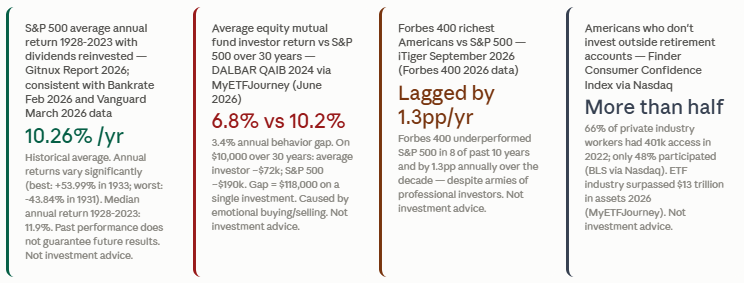
DALBAR QAIB 2024 via MyETFJourney June 2026: S&P 500 30-year return ~10.2% vs average investor ~6.8% = 3.4% annual behavior gap = $118,000 difference on $10,000 over 30 years. Gitnux 2026: average investor 5.5% vs market. 66% had 401k access; only 48% participated (BLS via Nasdaq). More than half Americans don't invest outside retirement (Finder via Nasdaq). Not financial advice.
Set up an automatic monthly investment into your chosen fund on a fixed date. The specific date and amount matter less than the consistency. If contributing to a workplace pension or 401k already, you are dollar-cost averaging. Consider extending the same discipline to an ISA or IRA for additional wealth-building.
Three combined strategies (Money.com April 2025): (1) index fund investing; (2) dollar-cost averaging; (3) dividend reinvestment. 'Capable of producing eye-catching results over the long term.' NBC 2025: 'Do this for as long as you can and you will be a multimillionaire.' S&P 500 ~10.26% average annual return 1928-2023 with dividends reinvested (Gitnux 2026).
The behavior gap is the difference between the return the market produces and the return the average investor actually earns. DALBAR's Quantitative Analysis of Investor Behavior 2024, cited by MyETFJourney in June 2026, found that over the 30 years ending in 2023, the S&P 500 returned approximately 10.2% annually while the average equity mutual fund investor earned only 6.8% annually — a 3.4% annual gap. Compounded over 30 years, this gap costs the average investor more than $118,000 on a single $10,000 investment (S&P 500 would produce ~$190,000; average investor ~$72,000). The gap is largest in sector funds, international funds, and aggressive growth funds — where emotional reactions to volatility are strongest.
Do index funds really beat actively managed funds over the long term?
The evidence is consistent across decades of research. iTiger's September 2026 analysis of the Forbes 400 2026 data found that the richest Americans — with access to the best investment professionals — underperformed the S&P 500 in 8 of the past 10 years and lagged it by 1.3 annualised percentage points over the past decade. Vanguard's March 2026 research paper shows the Vanguard 500 Index Fund tracking the S&P 500 benchmark closely over 15+ years (14.00% 15-year, 11.90% 10-year). Active fund expense ratios average 0.56% compared to 0.015%-0.04% for top index funds (Bankrate February 2026; Vanguard March 2026). The compounded fee difference alone produces a material return gap over a 30-year horizon.
What is dollar-cost averaging and does it work?
Dollar-cost averaging (DCA) means investing a fixed amount at regular intervals regardless of market conditions. When prices are high, the fixed amount buys fewer shares. When prices fall, it buys more. Over time, the average purchase price reflects neither peak enthusiasm nor trough panic — the source of the behavior gap. Money.com's April 2025 guide identifies DCA as one of three core 'boring' wealth-building strategies. NBC's 2025 millionaire investing tips: 'You're more likely to find long-term success with time-tested strategies like diversifying your investments, maintaining appropriate risk and making consistent contributions.' If you contribute to a workplace 401k or pension from every paycheck, you are already dollar-cost averaging.
How much does a low expense ratio actually matter?
More than most investors realise. Bankrate's February 2026 guide shows top S&P 500 index funds charging 0.015% (Fidelity FXAIX) to 0.04% (Vanguard VFIAX) compared to 0.56% for the average active fund (Vanguard March 2026 research). On a £100,000 portfolio, the difference is approximately £540 per year — which doesn't go to the investor's compound growth but to the fund's operating costs. Over 30 years, that £540/year compounds against you rather than for you. On £500,000 it's £2,700/year. The Vanguard research paper calculates how much investors have collectively saved due to index fund costs being lower than what active funds would have charged.
When is the best time to start investing?
NBC Los Angeles/New York's 2025 self-made millionaire investing guide identifies the core answer: 'When it comes to building wealth, the one asset you can truly never get back is time.' The Nasdaq/GOBankingRates compound interest guide (featuring Khwan Hathai CFP) confirms: 'To maximize the power of compound interest and supercharge your savings, invest as early and for as long as possible.' The most significant compound growth occurs in the later years of a long investment — which means starting early puts you on the right side of those years. Whether you start with £25/month or £2,500/month matters less than whether you start at all. Consult a qualified financial adviser for your specific circumstances.
Table of Contents
- The Gap That Changes Everything: Why Most Investors Leave Wealth on the Table
- Principle 1 Start Early: Time Is the Asset You Can Never Buy Back
- Principle 2 Index Funds: The Strategy That Beats Most Experts
- Principle 3 Dollar-Cost Averaging: Remove Emotion, Add Automation
- Principle 4 Dividend Reinvestment: Let the Income Compound
- Principle 5 Diversification: Don't Let One Bad Bet Define the Outcome
- The Three Strategies That Work Together
- The Complete Smart Investing Comparison: Active vs Passive, Complex vs Simple
- Conclusion: The Boring Truth About Building Wealth
- Frequently Asked Questions
The Gap That Changes Everything: Why Most Investors Leave Wealth on the Table
The most important data point in investing is not the S&P 500’s historical return. It is the gap between that return and what the average investor actually captures. MyETFJourney’s June 2026 analysis of DALBAR’s Quantitative Analysis of Investor Behavior 2024 quantifies it with precision: over the 30 years ending in 2023, the S&P 500 returned approximately 10.2% annually while the average equity mutual fund investor earned only 6.8%. That 3.4% annual gap, compounded over 30 years, costs the average investor more than $118,000 on a single $10,000 investment. Not through bad luck. Not through bad companies. Through behaviour — buying near peaks, selling near troughs, chasing sectors that recently performed well and abandoning ones that recently struggled. Gitnux’s 2026 investing statistics report puts it more starkly: the average investor return is 5.5% versus broader market returns. And the Nasdaq’s smart investing guide identifies the scale of the participation problem: more than half of Americans do not invest outside their retirement accounts, and 66% of private industry workers had access to a 401k in 2022 but only 48% chose to participate. The smart investing question is therefore not ‘which stock should I buy?’ It is ‘how do I capture the return the market produces, in full, without behaviour eroding it?’ The five principles that follow answer that question.DALBAR QAIB 2024 via MyETFJourney June 2026: S&P 500 30-year return ~10.2% vs average investor ~6.8% = 3.4% annual behavior gap = $118,000 difference on $10,000 over 30 years. Gitnux 2026: average investor 5.5% vs market. 66% had 401k access; only 48% participated (BLS via Nasdaq). More than half Americans don't invest outside retirement (Finder via Nasdaq). Not financial advice.
Principle 1 Start Early: Time Is the Asset You Can Never Buy Back
The single most agreed-upon insight in personal finance is not which stocks to buy, which fund manager to trust, or which sector to overweight. It is when to start. NBC Los Angeles and NBC New York published a 2025 guide to investing tips from self-made millionaires, and the framing is the clearest available: ‘When it comes to building wealth, the one asset you can truly never get back is time. Starting to invest as early as you can may be the most agreed-upon financial advice out there because money pros know compound interest is one of the most powerful ways to grow your money.’ The Nasdaq/GOBankingRates analysis of compound interest, featuring Khwan Hathai CFP and other experts, explains the mechanism: ‘Compound interest works by earning interest on the interest already earned. When you invest, the money you put in earns interest. Those gains are added to your principal and you earn interest on all of it.’ Hathai adds the timing dimension that makes the difference between a comfortable outcome and a life-changing one: ‘It’s important to maintain a patient and long-term perspective, as the most significant growth in compound interest often occurs in the later years of an investment.’ This last point is critical and counterintuitive to first-time investors. Compound growth is back-weighted. A portfolio that has grown for 25 years does more in its 26th year than it did in its first ten years combined. The investor who starts at 25 and stops contributing at 35 will, in many scenarios, accumulate more than the investor who starts at 35 and contributes the same amount until 65. Time beats contribution size. NBC Los Angeles/New York 2025 (self-made millionaire investing tips): 'the one asset you can truly never get back is time.' DALBAR 2024 via MyETFJourney June 2026: $10,000 growing at 10.2% (S&P 500 historical) for 30 years = ~$190,000; at 6.8% (average investor) = ~$72,000. 3.4% annual gap = $118,000 difference on a single $10,000 investment. Not financial advice. Past performance does not guarantee future results. Open a tax-advantaged account (ISA in the UK, Roth IRA or 401k in the US) and start with whatever amount you can automate. The amount matters less than the start date. Automate the contribution so it happens without a decision each month.Principle 2 Index Funds: The Strategy That Beats Most Experts
The Vanguard March 2026 research paper on how index funds help Americans build wealth identifies the historical case with a data point that has been reproduced by every major investment research firm: a $10,000 investment in the Vanguard 500 Index Fund Investor Shares from December 31, 1976 through March 31, 2026 grew substantially — tracking a benchmark that has returned 14.16% annualised over 15 years, 12.06% over 10 years, and 17.80% over one year as of March 2026. The case for index funds over active stock picking is not just historical performance. It is the finding that expert stock pickers, with every informational and analytical advantage available, consistently fail to beat the index. The iTiger.com September 2026 analysis of the Forbes 400 2026 data makes the point with unusual clarity: ‘The 400 richest Americans would collectively have performed better over the past 12 months had they invested their net worths in an S&P 500 index fund.’ These are individuals with armies of high-paid investment professionals managing their money. Their combined wealth grew approximately 21% — slightly less than the S&P 500’s 21.7% total return. Over the past decade, the Forbes 400 lagged the S&P 500 by 1.3 annualised percentage points. The expense ratio advantage compounds this case: top S&P 500 index funds in 2026 charge 0.015% to 0.04%, compared to 0.56% for the average active fund (Vanguard March 2026; Bankrate February 2026). On £100,000, that difference is £540 per year going to fees rather than to compounding. Not investment advice. Past performance does not guarantee future results. Forbes 400 richest Americans underperformed S&P 500 in 8 of past 10 years; lagged by 1.3pp annually over decade (iTiger September 2026/Forbes 400 2026). Vanguard 500 Fund: 14.00% 15-year; 11.90% 10-year annualised to March 2026. Index fund expense ratios: 0.015%-0.04% vs 0.56% active average (Bankrate February 2026; Vanguard March 2026). A low-cost S&P 500 or global index fund (e.g., Vanguard, Fidelity, or Schwab in the US; global trackers in the UK) held inside a tax-advantaged account is the starting point for most long-term wealth builders. The Bankrate February 2026 guide identifies the top S&P 500 index funds as SWPPX (0.02%), FXAIX (0.015%), and VFIAX (0.04%).Principle 3 Dollar-Cost Averaging: Remove Emotion, Add Automation
The behavior gap identified by DALBAR and cited by MyETFJourney in June 2026 is one of the most important findings in investing research: over 30 years ending in 2023, the average equity investor earned 6.8% annually while the S&P 500 returned 10.2%. That 3.4% gap is not explained by fees alone. It is explained by behaviour — specifically, by investors buying at market peaks when enthusiasm is high and selling at troughs when fear is elevated. The gap is largest in sector funds, international funds, and aggressive growth funds — exactly the categories where emotional reactions are strongest. Dollar-cost averaging is the structural antidote to this behaviour problem. It means investing a fixed amount at regular intervals regardless of market conditions — every month, every quarter, every payday. When prices are high, the fixed amount buys fewer shares. When prices fall, it buys more. Over time, the average purchase price reflects neither peak enthusiasm nor trough panic. Money.com’s April 2025 guide identifies DCA as the second of three core ‘boring’ but proven strategies: ‘If you contribute a portion of each of your paychecks to a 401(k) plan, you’re already using this simple strategy for building long-term wealth.’ Most people who contribute to a workplace pension or 401(k) are already dollar-cost averaging without knowing it. DALBAR QAIB 2024 via MyETFJourney June 2026: average investor earns 6.8% vs S&P 500 10.2% over 30 years. 3.4% annual gap = $118,000 on a single $10,000 investment over 30 years. Gap largest in sector/aggressive funds. Dollar-cost averaging removes emotional timing decisions. Not financial advice. Past performance does not guarantee future results.Set up an automatic monthly investment into your chosen fund on a fixed date. The specific date and amount matter less than the consistency. If contributing to a workplace pension or 401k already, you are dollar-cost averaging. Consider extending the same discipline to an ISA or IRA for additional wealth-building.
Principle 4 Dividend Reinvestment: Let the Income Compound
The third leg of Money.com’s April 2025 three-part ‘boring millionaire’ strategy is dividend reinvestment — and the mechanism deserves explanation because it is often the least understood component of long-term compound growth. When a fund or stock you own pays a dividend, you have a choice: take the cash, or reinvest it to buy more shares. The Nasdaq/GOBankingRates compound interest analysis is direct: ‘To be really smart about compound interest, the idea is that you keep reinvesting the interest you earn.’ The S&P 500’s historical return figures — the 10.26% average annual return cited by Gitnux’s 2026 report, the Vanguard fund’s 14.00% 15-year return — are calculated on a total return basis with dividends reinvested. Without dividend reinvestment, the long-term return figure is materially lower. The dividend component of the S&P 500’s total return has historically accounted for approximately 30-40% of the total cumulative return. A portfolio that captures price appreciation but not dividends is systematically leaving a significant portion of its potential return on the table. Most modern index funds and ETFs held inside tax-advantaged accounts (ISA, Roth IRA) make dividend reinvestment automatic. S&P 500 10.26% annual average return 1928-2023 is calculated with dividends REINVESTED (Gitnux 2026). Vanguard 500 Fund 14.00% 15-year and 11.90% 10-year returns include dividends reinvested (Vanguard March 2026). Nasdaq/GOBankingRates: 'keep reinvesting the interest you earn.' Money.com April 2025: 'three strategies capable of producing eye-catching results over the long term. Check whether your fund or ETF is 'accumulating' (reinvests dividends automatically) or 'distributing' (pays them out). For long-term wealth building, accumulating funds or DRIP (Dividend Reinvestment Plan) arrangements maximise compound growth. Most ISA and retirement account fund choices offer this option.Principle 5 Diversification: Don't Let One Bad Bet Define the Outcome
The NBC 2025 guide to investing tips from self-made millionaires identifies diversification as a core component of time-tested strategy alongside consistent contributions: ‘You’re more likely to find long-term success with time-tested strategies like diversifying your investments, maintaining appropriate risk and making consistent contributions.’ The Nasdaq smart investing guide explains why index funds are the most practical diversification tool for non-professional investors: ‘Regular investors can take much of the legwork — and anxiety — out of choosing stocks by investing in low-cost index funds, like those that track the S&P 500 or other market indexes. Index funds provide broad market exposure through a single purchase, which helps diversify a portfolio and limit risk.’ The S&P 500 alone holds 500 stocks across multiple sectors. A global index fund extends that across thousands of companies in dozens of countries. The practical implication: the failure of any individual company, sector, or even country to grow does not define the portfolio’s outcome. A single stock position could go to zero; a global index fund cannot. Bankrate’s February 2026 guide puts the benefit plainly: ‘These index funds offer immediate diversification, reducing the risk of investing in individual stocks. Nasdaq smart investing: 'index funds provide broad market exposure through a single purchase, helps diversify and limit risk.' NBC 2025 millionaire tips: 'diversifying investments, maintaining appropriate risk and making consistent contributions' most likely to produce long-term success. Bankrate February 2026: 'immediate diversification, reducing the risk of individual stocks. A global equity index fund (covering the US, Europe, Asia-Pacific, and emerging markets) provides the broadest diversification in a single product. Adding a bond allocation (smaller for younger investors, larger approaching retirement) provides further cushion in market downturns. Asset allocation should reflect your timeline and risk tolerance — consult a qualified adviser.The Three Strategies That Work Together
Money.com’s April 2025 guide to the ‘most boring way to become a millionaire’ identifies how the five principles above converge into three specific strategies that, when combined, produce the long-term results that no single approach achieves alone. Strategy 1: index fund investing in S&P 500 or global market trackers provides the diversification, market-matching return, and low-cost structure that replaces the need for stock picking or market timing. Strategy 2: dollar-cost averaging — contributing a consistent amount at regular intervals regardless of market conditions — removes emotional timing decisions and systematically buys more shares when prices are lower. If you already contribute to a 401k or workplace pension, you are already doing this. Strategy 3: dividend reinvestment — automatically reinvesting distributions rather than taking them as cash — activates the full compounding power of the portfolio. The S&P 500’s historical 10.26% average annual return (Gitnux 2026) is calculated with dividends reinvested. Without reinvestment, the return is materially lower. Money.com’s conclusion: ‘When combined, these three strategies are capable of producing eye-catching results over the long term.’ The NBC 2025 guide confirms the Ramsey framework’s echo: ‘Do this for as long as you can and you will be a multimillionaire.’ None of these strategies require professional knowledge, active monitoring, or extraordinary income. They require time, automation, and the discipline not to undo them when the news gets alarming.Three combined strategies (Money.com April 2025): (1) index fund investing; (2) dollar-cost averaging; (3) dividend reinvestment. 'Capable of producing eye-catching results over the long term.' NBC 2025: 'Do this for as long as you can and you will be a multimillionaire.' S&P 500 ~10.26% average annual return 1928-2023 with dividends reinvested (Gitnux 2026).
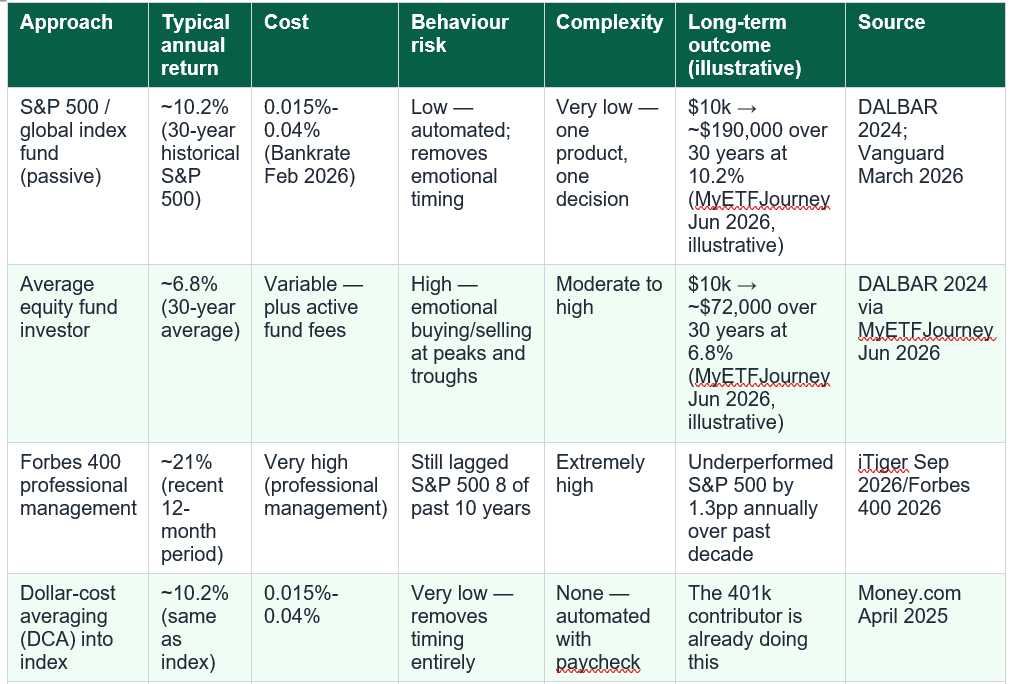
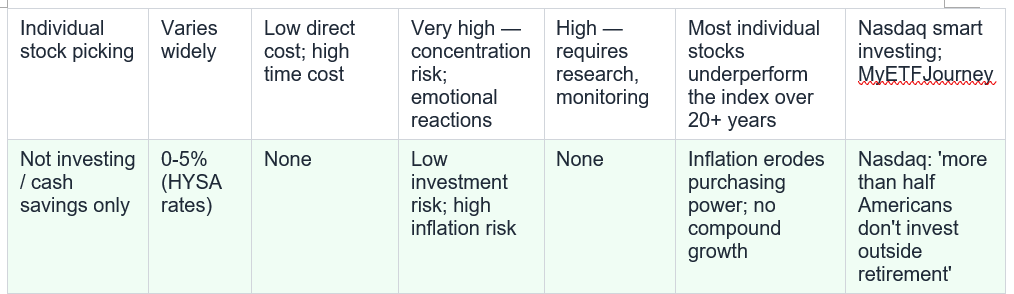
The Complete Smart Investing Comparison: Active vs Passive, Complex vs Simple
Sources: DALBAR QAIB 2024 via MyETFJourney June 2026; Bankrate February 2026; Vanguard March 2026; iTiger/Forbes 400 September 2026; Nasdaq smart investing; Money.com April 2025. All investing involves risk. Past performance does not guarantee future results.
Conclusion
The data from every source in this article points to the same conclusion, expressed in different ways. DALBAR: the average investor earns 3.4% less per year than the market because of emotional behaviour. The Forbes 400: the wealthiest Americans with the best investment professionals still can’t beat the S&P 500 index. Vanguard’s March 2026 research: $10,000 in a simple index fund from 1976 has grown to a substantial sum tracking a 14% 15-year annualised return. NBC’s 2025 millionaire tips: ‘Do this for as long as you can and you will be a multimillionaire.’ Money.com’s April 2025 conclusion: the three boring strategies — index funds, dollar-cost averaging, dividend reinvestment — are ‘capable of producing eye-catching results over the long term.’ Smart investing is not complicated. It is simple strategies maintained over long periods without the emotional interventions that erode most investors’ returns. The principles are not secret. The data has been publicly available for decades. The challenge is not finding the right information. It is building the habits and automation that turn these principles from things you know into things your money actually does, every month, for thirty years. Not financial, investment, or tax advice. All investing involves risk including possible loss of principal. Past performance does not guarantee future results. Always consult a qualified, regulated financial adviser.Frequently Asked Questions
What is the behavior gap and how much does it actually cost?The behavior gap is the difference between the return the market produces and the return the average investor actually earns. DALBAR's Quantitative Analysis of Investor Behavior 2024, cited by MyETFJourney in June 2026, found that over the 30 years ending in 2023, the S&P 500 returned approximately 10.2% annually while the average equity mutual fund investor earned only 6.8% annually — a 3.4% annual gap. Compounded over 30 years, this gap costs the average investor more than $118,000 on a single $10,000 investment (S&P 500 would produce ~$190,000; average investor ~$72,000). The gap is largest in sector funds, international funds, and aggressive growth funds — where emotional reactions to volatility are strongest.
Do index funds really beat actively managed funds over the long term?
The evidence is consistent across decades of research. iTiger's September 2026 analysis of the Forbes 400 2026 data found that the richest Americans — with access to the best investment professionals — underperformed the S&P 500 in 8 of the past 10 years and lagged it by 1.3 annualised percentage points over the past decade. Vanguard's March 2026 research paper shows the Vanguard 500 Index Fund tracking the S&P 500 benchmark closely over 15+ years (14.00% 15-year, 11.90% 10-year). Active fund expense ratios average 0.56% compared to 0.015%-0.04% for top index funds (Bankrate February 2026; Vanguard March 2026). The compounded fee difference alone produces a material return gap over a 30-year horizon.
What is dollar-cost averaging and does it work?
Dollar-cost averaging (DCA) means investing a fixed amount at regular intervals regardless of market conditions. When prices are high, the fixed amount buys fewer shares. When prices fall, it buys more. Over time, the average purchase price reflects neither peak enthusiasm nor trough panic — the source of the behavior gap. Money.com's April 2025 guide identifies DCA as one of three core 'boring' wealth-building strategies. NBC's 2025 millionaire investing tips: 'You're more likely to find long-term success with time-tested strategies like diversifying your investments, maintaining appropriate risk and making consistent contributions.' If you contribute to a workplace 401k or pension from every paycheck, you are already dollar-cost averaging.
How much does a low expense ratio actually matter?
More than most investors realise. Bankrate's February 2026 guide shows top S&P 500 index funds charging 0.015% (Fidelity FXAIX) to 0.04% (Vanguard VFIAX) compared to 0.56% for the average active fund (Vanguard March 2026 research). On a £100,000 portfolio, the difference is approximately £540 per year — which doesn't go to the investor's compound growth but to the fund's operating costs. Over 30 years, that £540/year compounds against you rather than for you. On £500,000 it's £2,700/year. The Vanguard research paper calculates how much investors have collectively saved due to index fund costs being lower than what active funds would have charged.
When is the best time to start investing?
NBC Los Angeles/New York's 2025 self-made millionaire investing guide identifies the core answer: 'When it comes to building wealth, the one asset you can truly never get back is time.' The Nasdaq/GOBankingRates compound interest guide (featuring Khwan Hathai CFP) confirms: 'To maximize the power of compound interest and supercharge your savings, invest as early and for as long as possible.' The most significant compound growth occurs in the later years of a long investment — which means starting early puts you on the right side of those years. Whether you start with £25/month or £2,500/month matters less than whether you start at all. Consult a qualified financial adviser for your specific circumstances.
0 Comments
Be the first to share your thoughts on this article.