

Spending
How the 'Pause Before You Pay' Rule Protects Gen Z

66% of Gen Z BNPL users have experienced problems. 77% say BNPL encouraged them to spend more than they can afford. 30 million are doom-spending their way into debt. The pause rule is not about willpower. It is about pre-committed friction.
Here is a scenario that plays out millions of times a day among Gen Z. You are scrolling at 11pm. An algorithm-curated video shows a creator with an aesthetic apartment, a specific lamp, or a particular trainers colourway. The item appears directly purchasable. It is £85, but the BNPL split makes it appear as four payments of £21.25. You have bought it before you have finished watching the video. This is not a character defect. It is the intended outcome of a system designed with billions of dollars of engineering to produce exactly this result. The ‘Pause Before You Pay’ rule is not a moral framework. It is not about saving more or spending less as an abstract virtue. It is a behavioural mechanism that inserts deliberation into a purchase pathway that has been specifically engineered to eliminate it. This article examines the data on Gen Z’s relationship with money, BNPL, and impulse spending — the evidence is striking — and then explains how the pause rule works, what to do during the pause, and what the pause actually saves in real numbers.
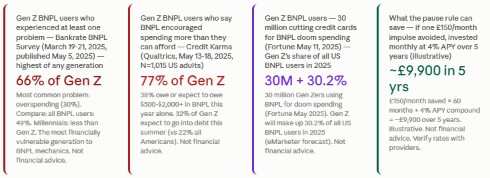
Gen Z did not invent impulse buying. Every generation has bought something it did not need because it was right there and seemed like a good idea at the time. What Gen Z inherited is a particularly hostile environment for impulse resistance: infinite scrolling social media feeds algorithmically optimised to surface products you are likely to want, seamlessly connected to frictionless payment infrastructure that removes every traditional obstacle between wanting something and buying it. The result is predictable, and the data confirms it. Fortune’s May 2025 investigation found that some 30 million Gen Zers are cutting up their credit cards and opting for Buy Now Pay Later services to fund their ‘doom spending habits’ — a term that describes the pattern of making purchases as a coping mechanism for the anxiety, uncertainty, and inflation stress of the current economic moment. Bankrate’s March 2025 BNPL survey found that 66% of Gen Z BNPL users reported at least one problem with the payment method — the highest rate of any generation. Their most common problem: overspending, reported by 30%. The Intuit Credit Karma survey of May 2025 added a striking specific figure: 77% of Gen Z BNPL users say BNPL has encouraged them to spend more than they can afford. Not a minority having a bad experience — 77% of the users. This is not a personal finance problem peculiar to bad decision-makers. It is a systems problem: the architecture of modern digital commerce is explicitly designed to convert impulse into purchase before reflection can intervene. The ‘Pause Before You Pay’ rule is the simplest available friction-restoration device. It does not require discipline in the moment of temptation. It requires a pre-committed rule applied before the moment of temptation arrives.
30 million Gen Zers using BNPL for 'doom spending' (Fortune May 2025). 66% of Gen Z BNPL users experienced at least one problem — highest of any generation (Bankrate March 2025). 30% overspent using BNPL — their most common problem (Bankrate March 2025). 77% of Gen Z BNPL users say BNPL encouraged spending more than they can afford (Credit Karma May 2025).
38% of Gen Z owe or expect to owe $500-$2,000+ in BNPL purchases this year (Credit Karma May 2025). 63% of Gen Z fear covering unexpected expenses (Splitit/PYMNTS 2025). Median emergency expense: $605. BNPL debt does not impact credit score — removing natural overextension warning (Fortune May 2025). 49% of ALL BNPL users have experienced at least one problem (Bankrate March 2025).
77% of Gen Z BNPL users say BNPL encouraged overspending (Credit Karma May 2025). Economina journal August 2026: financial literacy and sound decision-making moderate BNPL-financial distress relationship. 50% of all consumers made unplanned purchases last year (Splitit/PYMNTS 2025). The pause rule works by restoring the friction BNPL deliberately removes.
Credit Karma May 2025: 'The pressure to make the most of summer can often lead to justifying overspending' (Courtney Alev, consumer financial advocate). Fortune May 2025: BNPL used as 'a mask for a dangerous game of overspending.' Splitit/PYMNTS 2025: half of consumers made unplanned purchases last year despite financial caution.
15% of BNPL users regret a purchase (Bankrate March 2025). 30% of Gen Z overspent using BNPL (Bankrate March 2025). 63% of Gen Z fear unexpected expenses (Splitit/PYMNTS 2025). 32% of Gen Z expect to go into debt this summer (Credit Karma May 2025). Potential annual pause saving: £1,800 if one £150/month impulse avoided.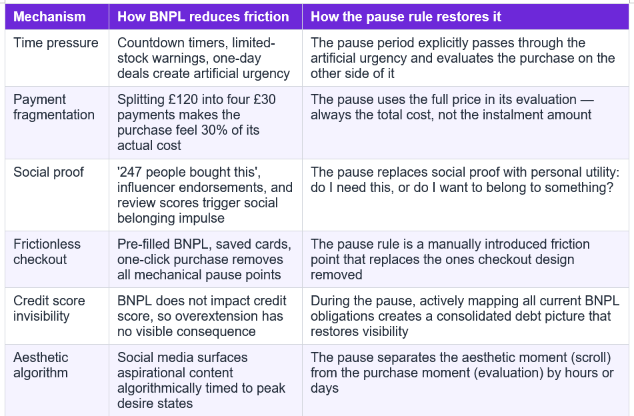
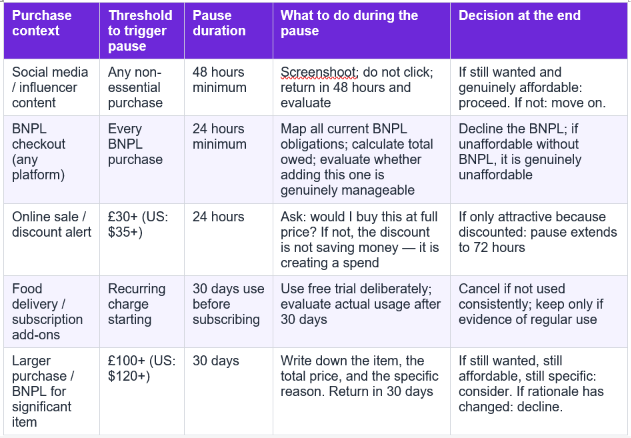
The Pause Before You Pay rule is a personal finance behaviour strategy: before completing any non-essential purchase above a personally defined threshold, you impose a mandatory waiting period and apply a structured set of questions before deciding. The pause duration scales with the purchase size: typically 24 hours for smaller purchases (£30-£100), 48-72 hours for mid-range (£100-£300), and 30 days for larger items (£300+). The mechanism it disrupts is the dopamine-reward loop that drives impulse buying — particularly in the BNPL checkout and social media scroll-to-purchase pipeline. The Economina journal research (August 2026) confirms that financial skills and sound decision-making moderate the relationship between BNPL usage and financial distress. The pause rule is a practical implementation of that moderation.
Is BNPL really a problem for Gen Z, or is the data overstated?
The data is consistent across multiple independent sources. Bankrate's March 2025 survey (fieldwork March 19-21, 2025) found that 66% of Gen Z BNPL users reported at least one problem — the highest of any generation — with 30% reporting overspending as their most common issue. Credit Karma's May 2025 survey (Qualtrics, N=1,015 US adults) found 77% of Gen Z BNPL users say BNPL encouraged spending more than they could afford, and 38% owe $500-$2,000+ in BNPL this year. Fortune's May 2025 investigation found 30 million Gen Zers using BNPL for doom spending with financial experts warning of a cycle trap. The Economina journal research (August 2026) academically confirmed the BNPL-impulse buying-financial distress link for Gen Z. Whether any individual Gen Z person is affected depends on their specific usage patterns — but the population-level data shows significant and consistent financial harm from current BNPL behaviour patterns.
Does the pause rule mean never using BNPL?
No. The Bankrate March 2025 survey's conclusion is actually nuanced: 'the study suggests that people can use BNPL strategically, but it's best used as a helpful financial tool when paired with good financial habits.' BNPL used for a large, planned, necessary purchase — spreading the cost of a laptop or an appliance that you would have bought anyway — is a different use case from BNPL used to fund an impulse purchase that would not have been made without the instalment option. The pause rule specifically targets the second category. If, after the pause period, the purchase is still clearly the right decision and BNPL genuinely helps manage the cash flow on an item you planned to buy, BNPL may be appropriate. The Fortune May 2025 reporting frames the expert guidance simply: 'people should save up for the things they want to purchase.
What does doom spending mean and why do Gen Z do it?
Doom spending is the pattern of making purchases as a coping mechanism for financial anxiety, economic uncertainty, or general stress — spending for the temporary emotional relief of acquisition rather than for the genuine utility of the item. Fortune's May 2025 investigation describes Gen Z as 'doom spending their way through inflation stressors.' Credit Karma's Courtney Alev describes the YOLO mindset around spending that leads to 'justifying overspending, even if it's not in your best interest long-term.' The Economina August 2026 research identifies the hedonic lifestyle as a moderating factor in BNPL-driven financial distress: spending as emotional management rather than need fulfilment. The pause rule's question 'What is this purchase actually solving?' is specifically designed to surface the emotional driver behind a doom spending impulse, which often removes the urgency once named.
How much could the pause rule realistically save?
The savings depend entirely on the individual's current impulse spending rate. If the pause rule prevents one impulse purchase per month that would otherwise not have been questioned — say one £150 BNPL purchase — the annual saving is £1,800. Given that 30% of Gen Z BNPL users report overspending and 38% owe up to $2,000 in BNPL this year, a £1,800 annual saving is conservative for heavy BNPL users. Placed in a cash ISA earning 4% APY, £150 per month grows to approximately £1,854 after one year. Over five years at that saving rate, compound interest produces approximately £9,900. Over ten years: approximately £21,700. These are illustrative calculations only and not financial projections. The actual saving depends on whether the paused purchases would have been made without the rule. Not financial advice. Verify ISA rates and terms directly with providers.
Here is a scenario that plays out millions of times a day among Gen Z. You are scrolling at 11pm. An algorithm-curated video shows a creator with an aesthetic apartment, a specific lamp, or a particular trainers colourway. The item appears directly purchasable. It is £85, but the BNPL split makes it appear as four payments of £21.25. You have bought it before you have finished watching the video. This is not a character defect. It is the intended outcome of a system designed with billions of dollars of engineering to produce exactly this result. The ‘Pause Before You Pay’ rule is not a moral framework. It is not about saving more or spending less as an abstract virtue. It is a behavioural mechanism that inserts deliberation into a purchase pathway that has been specifically engineered to eliminate it. This article examines the data on Gen Z’s relationship with money, BNPL, and impulse spending — the evidence is striking — and then explains how the pause rule works, what to do during the pause, and what the pause actually saves in real numbers.
Table of Contents
- The Doom Scroll to the Doom Spend: Why Gen Z’s Money Is Under Pressure
- The BNPL Trap: Debt Without a Credit Score Warning
- What the ‘Pause Before You Pay’ Rule Actually Is
- The Five Questions to Ask During the Pause
- What Pausing Actually Saves: The Real Numbers
- The Pause Rule Vs the BNPL Algorithm: A Practical Comparison
- UK and US Application: How to Build the Pause Into Your Life
- Conclusion: Pre-Committed Friction Over In-the-Moment Willpower
- Frequently Asked Questions
The Doom Scroll to the Doom Spend: Why Gen Z's Money Is Under Pressure
Gen Z did not invent impulse buying. Every generation has bought something it did not need because it was right there and seemed like a good idea at the time. What Gen Z inherited is a particularly hostile environment for impulse resistance: infinite scrolling social media feeds algorithmically optimised to surface products you are likely to want, seamlessly connected to frictionless payment infrastructure that removes every traditional obstacle between wanting something and buying it. The result is predictable, and the data confirms it. Fortune’s May 2025 investigation found that some 30 million Gen Zers are cutting up their credit cards and opting for Buy Now Pay Later services to fund their ‘doom spending habits’ — a term that describes the pattern of making purchases as a coping mechanism for the anxiety, uncertainty, and inflation stress of the current economic moment. Bankrate’s March 2025 BNPL survey found that 66% of Gen Z BNPL users reported at least one problem with the payment method — the highest rate of any generation. Their most common problem: overspending, reported by 30%. The Intuit Credit Karma survey of May 2025 added a striking specific figure: 77% of Gen Z BNPL users say BNPL has encouraged them to spend more than they can afford. Not a minority having a bad experience — 77% of the users. This is not a personal finance problem peculiar to bad decision-makers. It is a systems problem: the architecture of modern digital commerce is explicitly designed to convert impulse into purchase before reflection can intervene. The ‘Pause Before You Pay’ rule is the simplest available friction-restoration device. It does not require discipline in the moment of temptation. It requires a pre-committed rule applied before the moment of temptation arrives.30 million Gen Zers using BNPL for 'doom spending' (Fortune May 2025). 66% of Gen Z BNPL users experienced at least one problem — highest of any generation (Bankrate March 2025). 30% overspent using BNPL — their most common problem (Bankrate March 2025). 77% of Gen Z BNPL users say BNPL encouraged spending more than they can afford (Credit Karma May 2025).
Section 2: The BNPL Trap: Debt Without a Credit Score Warning
One of the most structurally dangerous aspects of BNPL for Gen Z is identified clearly by the experts cited in Fortune’s May 2025 investigation: BNPL users can accumulate debt without it impacting their credit score. This removes one of the primary natural feedback mechanisms that historically signalled when someone was overextended. With traditional credit card debt, a deteriorating credit score is a visible warning. With multiple concurrent BNPL loans, that warning is absent. The eMarketer analysis from July 2026 cites Ted Rossman of Bankrate, who described how BNPL creates the ‘illusion’ of making purchases easier to manage by stretching out cash flow — ‘especially for non-essential purchases.’ The Credit Karma survey found that 38% of Gen Z say they owe or expect to owe $500 to $2,000+ in BNPL purchases this year alone. A generation that is also contending with 63% reporting fear about covering unexpected expenses (Splitit/PYMNTS 2025) — when the median emergency expense is $605 — is carrying BNPL obligations that may directly compete with their ability to cover actual emergencies. Fortune’s May 2025 reporting notes that ‘shoppers who sign up for more than one concurrent BNPL loan can quickly get into complicated financial trouble, especially considering there are now a half dozen popular BNPL companies.’ The fragmented nature of BNPL — each provider operating in a separate silo with no cross-reporting — means a person can have simultaneous obligations to Klarna, Afterpay, Affirm, Sezzle, and others, with no consolidated view of what they owe. The pause rule’s specific value in the BNPL context is not just delaying the purchase. It is the act of mapping current BNPL obligations before adding another.38% of Gen Z owe or expect to owe $500-$2,000+ in BNPL purchases this year (Credit Karma May 2025). 63% of Gen Z fear covering unexpected expenses (Splitit/PYMNTS 2025). Median emergency expense: $605. BNPL debt does not impact credit score — removing natural overextension warning (Fortune May 2025). 49% of ALL BNPL users have experienced at least one problem (Bankrate March 2025).
Section 3: What the 'Pause Before You Pay' Rule Actually Is
The ‘Pause Before You Pay’ rule is a behavioural money strategy, not a budgeting system. It does not require spreadsheets, apps, or financial literacy beyond a basic level. It requires one decision: before any non-essential purchase above a personally defined threshold, you impose a mandatory waiting period before completing the purchase. The mechanism it disrupts is the dopamine loop that drives impulse buying. When you see a product — particularly on social media, in a sale, or in a BNPL-enabled checkout — a reward anticipation response begins. The faster you can complete the purchase, the more the reward response dominates the decision. The delay breaks that loop. By the time the pause period ends, the dopamine spike has faded. The purchase is evaluated with a cooler cognitive state. In many cases, it is simply not made. The academic research published in the Economina journal in August 2026 found that ‘financial skills, digital financial literacy, and sound decision-making’ moderate the relationship between BNPL usage and financial distress. The pause rule is a practical mechanism for introducing sound decision-making into a process specifically designed to eliminate it. The rule is scalable by purchase size: a 24-hour pause for purchases between £30-£100, a 48-hour pause for £100-£300, and a 30-day pause for anything above £300 that is not a planned essential. The act of writing down the purchase — the item, the price, and the reason for wanting it — at the start of the pause period adds a second layer of deliberation. Returning to that note after the pause period often produces a different answer than the moment of impulse produced.77% of Gen Z BNPL users say BNPL encouraged overspending (Credit Karma May 2025). Economina journal August 2026: financial literacy and sound decision-making moderate BNPL-financial distress relationship. 50% of all consumers made unplanned purchases last year (Splitit/PYMNTS 2025). The pause rule works by restoring the friction BNPL deliberately removes.
Section 4: The Five Questions to Ask During the Pause
The pause period has the most impact when it is structured rather than open-ended. Sitting with ‘I’ll think about it’ is less effective than returning to a specific set of questions. These five questions, asked at the end of the pause period rather than at the moment of purchase impulse, produce the deliberate evaluation that the pause is designed to enable. Not financial advice. 1. Do I already own something that does this job well enough? The most common driver of impulse purchases is the fantasy of a slightly better version of something you already have. The question is not whether the new item is better — it usually is. The question is whether the difference is worth the cost. 2. Can I genuinely afford this without BNPL or credit? If the honest answer is that this purchase requires a payment plan, the question becomes whether the purchase is actually affordable at all, or whether the payment plan is creating the illusion of affordability for something out of reach. Fortune’s May 2025 reporting specifically names this pattern: BNPL as ‘a mask for a dangerous game of overspending.’ 3. Will I still want this in 30 days? For fashion, homeware, gadgets, and experience-adjacent purchases driven by aesthetic content — the primary category of Gen Z impulse spending — the answer is frequently no. Trends cycle. The item that looked perfect on a creator’s feed on Monday often looks ordinary by the following Friday. 4. What is this purchase actually solving? Doom spending, as described by Fortune, is a coping response to anxiety. The purchase is not really about the item — it is about the temporary relief of acquiring something. Naming the emotional driver behind the impulse is often enough to redirect the response. 5. What does this cost in actual work hours? Translating every purchase from dollars/pounds into time worked is one of the most reliably effective spending recalibration tools in behavioural finance. At £12 per hour, a £120 impulse purchase is 10 hours of your working life. The item looks different with that conversion applied.Credit Karma May 2025: 'The pressure to make the most of summer can often lead to justifying overspending' (Courtney Alev, consumer financial advocate). Fortune May 2025: BNPL used as 'a mask for a dangerous game of overspending.' Splitit/PYMNTS 2025: half of consumers made unplanned purchases last year despite financial caution.
Section 5: What Pausing Actually Saves: The Real Numbers
The Bankrate March 2025 BNPL survey found that 15% of BNPL users regretted a purchase. For Gen Z specifically, the regret rate and the overspend rate are higher than any other generation. These are not theoretical losses. They are real money spent on items that, by the buyer’s own assessment, should not have been bought. If 30% of Gen Z BNPL users overspent and 38% owe $500-$2,000+ in BNPL this year, the annual cost of the impulse gap is concrete. The Credit Karma May 2025 survey found that 32% of Gen Z expect to go into debt this summer specifically — compared to 22% of all Americans. The Splitit/PYMNTS research found that 63% of Gen Z fear unexpected expenses — yet a significant portion of that same cohort is depleting the buffer that would cover those expenses through impulse spending and BNPL accumulation. The pause rule does not require eliminating discretionary spending. It requires slowing it down enough to distinguish between purchases that genuinely contribute to wellbeing and purchases that discharge an anxiety response in the moment and produce regret shortly after. If the pause rule prevents one £150 impulse purchase per month — a conservative estimate based on the overspend rates above — the annual saving is £1,800. In an ISA earning 4-5% APY (current competitive rates), that £1,800 grows to approximately £1,890 in year one. Over five years at £1,800 per year, the compound total is approximately £9,900.15% of BNPL users regret a purchase (Bankrate March 2025). 30% of Gen Z overspent using BNPL (Bankrate March 2025). 63% of Gen Z fear unexpected expenses (Splitit/PYMNTS 2025). 32% of Gen Z expect to go into debt this summer (Credit Karma May 2025). Potential annual pause saving: £1,800 if one £150/month impulse avoided.
The Pause Rule Vs the BNPL Algorithm: A Practical Comparison
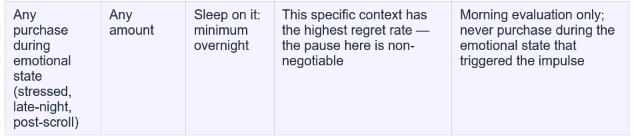
UK and US Application: How to Build the Pause Into Your Life
Conclusion
The research cited in this article paints a consistent picture. Gen Z is not financially irresponsible by nature — 63% of them are genuinely worried about covering unexpected expenses (Splitit/PYMNTS 2025). But they are operating in a spending environment that is more specifically engineered against their financial interests than any previous generation faced. The algorithmic feed, the seamless BNPL checkout, the social proof, the doom spend as anxiety coping mechanism — none of these are neutral. They are intentional. The ‘Pause Before You Pay’ rule works because it does not attempt to overcome impulse with willpower in the moment of maximum desire. Willpower is finite and context-dependent. It loses against a well-designed product page at 11pm every time. The pause rule works by pre-committing to a delay before the impulse arrives — installing friction into a process that has had friction deliberately removed. The data makes the case directly: 15% of BNPL users regret a purchase (Bankrate March 2025). Thirty percent of Gen Z overspent using BNPL. Seventy-seven percent of Gen Z BNPL users say BNPL encouraged them to spend more than they could afford. The regret rate and the overspend rate are the post-purchase evidence of what the pause rule prevents pre-purchase. The rule is not complicated. The only skill it requires is setting the rule before temptation arrives.Frequently Asked Questions
What exactly is the 'Pause Before You Pay' rule?The Pause Before You Pay rule is a personal finance behaviour strategy: before completing any non-essential purchase above a personally defined threshold, you impose a mandatory waiting period and apply a structured set of questions before deciding. The pause duration scales with the purchase size: typically 24 hours for smaller purchases (£30-£100), 48-72 hours for mid-range (£100-£300), and 30 days for larger items (£300+). The mechanism it disrupts is the dopamine-reward loop that drives impulse buying — particularly in the BNPL checkout and social media scroll-to-purchase pipeline. The Economina journal research (August 2026) confirms that financial skills and sound decision-making moderate the relationship between BNPL usage and financial distress. The pause rule is a practical implementation of that moderation.
Is BNPL really a problem for Gen Z, or is the data overstated?
The data is consistent across multiple independent sources. Bankrate's March 2025 survey (fieldwork March 19-21, 2025) found that 66% of Gen Z BNPL users reported at least one problem — the highest of any generation — with 30% reporting overspending as their most common issue. Credit Karma's May 2025 survey (Qualtrics, N=1,015 US adults) found 77% of Gen Z BNPL users say BNPL encouraged spending more than they could afford, and 38% owe $500-$2,000+ in BNPL this year. Fortune's May 2025 investigation found 30 million Gen Zers using BNPL for doom spending with financial experts warning of a cycle trap. The Economina journal research (August 2026) academically confirmed the BNPL-impulse buying-financial distress link for Gen Z. Whether any individual Gen Z person is affected depends on their specific usage patterns — but the population-level data shows significant and consistent financial harm from current BNPL behaviour patterns.
Does the pause rule mean never using BNPL?
No. The Bankrate March 2025 survey's conclusion is actually nuanced: 'the study suggests that people can use BNPL strategically, but it's best used as a helpful financial tool when paired with good financial habits.' BNPL used for a large, planned, necessary purchase — spreading the cost of a laptop or an appliance that you would have bought anyway — is a different use case from BNPL used to fund an impulse purchase that would not have been made without the instalment option. The pause rule specifically targets the second category. If, after the pause period, the purchase is still clearly the right decision and BNPL genuinely helps manage the cash flow on an item you planned to buy, BNPL may be appropriate. The Fortune May 2025 reporting frames the expert guidance simply: 'people should save up for the things they want to purchase.
What does doom spending mean and why do Gen Z do it?
Doom spending is the pattern of making purchases as a coping mechanism for financial anxiety, economic uncertainty, or general stress — spending for the temporary emotional relief of acquisition rather than for the genuine utility of the item. Fortune's May 2025 investigation describes Gen Z as 'doom spending their way through inflation stressors.' Credit Karma's Courtney Alev describes the YOLO mindset around spending that leads to 'justifying overspending, even if it's not in your best interest long-term.' The Economina August 2026 research identifies the hedonic lifestyle as a moderating factor in BNPL-driven financial distress: spending as emotional management rather than need fulfilment. The pause rule's question 'What is this purchase actually solving?' is specifically designed to surface the emotional driver behind a doom spending impulse, which often removes the urgency once named.
How much could the pause rule realistically save?
The savings depend entirely on the individual's current impulse spending rate. If the pause rule prevents one impulse purchase per month that would otherwise not have been questioned — say one £150 BNPL purchase — the annual saving is £1,800. Given that 30% of Gen Z BNPL users report overspending and 38% owe up to $2,000 in BNPL this year, a £1,800 annual saving is conservative for heavy BNPL users. Placed in a cash ISA earning 4% APY, £150 per month grows to approximately £1,854 after one year. Over five years at that saving rate, compound interest produces approximately £9,900. Over ten years: approximately £21,700. These are illustrative calculations only and not financial projections. The actual saving depends on whether the paused purchases would have been made without the rule. Not financial advice. Verify ISA rates and terms directly with providers.
0 Comments
Be the first to share your thoughts on this article.