

Retirement
How the Sandwich Generation Can Protect Their Retirement

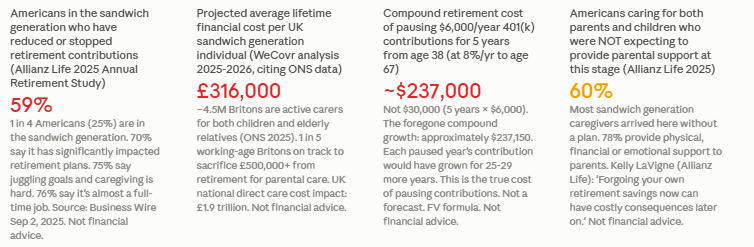
1 in 4 Americans is in the sandwich generation — caring for both children and ageing parents at the same time. 59% of them have already reduced or stopped contributing to their retirement savings. 70% say it has had a significant impact on their retirement plans. In the UK, the average lifetime financial cost is projected to reach £316,000 per individual. The pressure is real, the consequences are compound, and the window to act is narrowing. This article covers the practical steps to protect your retirement while still caring for the people who need you. Not financial advice.
The scale of the problem is substantial and growing. According to the 2025 Annual Retirement Study from the Allianz Center for the Future of Retirement, 1 in 4 Americans (25%) now have a child under 18 and a living parent — the dual responsibility that defines the sandwich generation. In the UK, the Office for National Statistics projected approximately 4.5 million Britons are now active carers for both children under 18 and elderly relatives (WeCovr analysis, 2025–2026). The trend is being driven by two structural forces: people are having children later in life (meaning their children are still at home when their parents are in their 70s and 80s), and medical advances mean parents are living longer, often with complex health needs that require sustained support.
And the sandwich generation is not only Gen X any more. The 401(k) Specialist has specifically noted: ‘Sandwich Generation Now Includes Millennials.’ Adults in their 30s with young children and parents in their 60s or 70s are encountering caregiving demands at an age where the compound cost to their retirement fund is the highest it can be. The earlier the retirement contributions are paused, the more compounding is lost. Not financial advice.
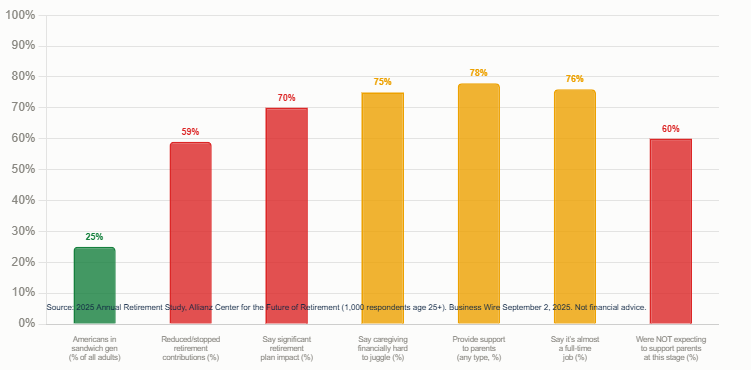
1 in 4 Americans (25%) are in the sandwich generation (Allianz Life 2025 Annual Retirement Study, 1,000 respondents aged 25+). 59% have reduced or stopped retirement contributions due to dual caregiving costs. 70% say it has significantly impacted their retirement plans. 75% say juggling financial needs with caregiving is hard. 78% provide physical, financial or emotional support to parents. 76% say caring for both is 'almost like a full-time job.' 60% were not expecting to support parents at this stage. UK: ~4.5 million active carers for both generations (ONS 2025 projections). UK: average lifetime financial cost projected at £316,000 per individual (WeCovr 2025-2026). Sources: Business Wire September 2, 2025; BenefitsPro September 4, 2025; WeCovr 2025-2026. Not financial advice.
In the UK, the financial burden is equally visible and quantified differently. WeCovr’s analysis (updated through 2026) projects that the combined lifetime cost of supporting adult children and elderly parents, plus lost earnings and pension contributions, will reach an average of £316,000 per sandwich generation individual. The national aggregate of direct care costs alone is estimated at £1.9 trillion. Approximately 1 in 5 working-age Britons are on track to sacrifice over half a million pounds from their retirement funds to cover parental long-term care costs (WeCovr, August 7, 2026).
The mechanism is not only direct financial transfers. Jackson Financial (December 12, 2025) specifically notes that ‘sandwich-generation households are more likely to withdraw from retirement savings to fund caregiving.’ Withdrawing from a 401(k) before retirement age incurs income tax and a 10% early withdrawal penalty, meaning a $20,000 withdrawal to cover a parent’s care costs might generate only $12,000–14,000 in after-tax funds while permanently removing $20,000 from the compound growth engine. The cost is not just the withdrawal; it is the compounding on that withdrawal foregone for the remaining 15–20 years of the account’s life. Not financial advice.
Kelly LaVigne, VP of Consumer Insights at Allianz Life, makes this explicit: ‘Forgoing your own retirement savings now can have costly consequences later on.’ Brock Jolly of Veritas Financial (cited by MassMutual, May 2026) adds the generational dimension: ‘The age of the sandwich generation caregiver can also affect their future financial well-being, with younger adults experiencing a potentially greater opportunity cost.’ A Millennial who pauses 401(k) contributions at age 38 for five years to cover caregiving costs does not simply lose five years of contributions. They lose the compound growth on those contributions from age 38 to their retirement at 67 — a 29-year growth window on each paused year’s contribution.
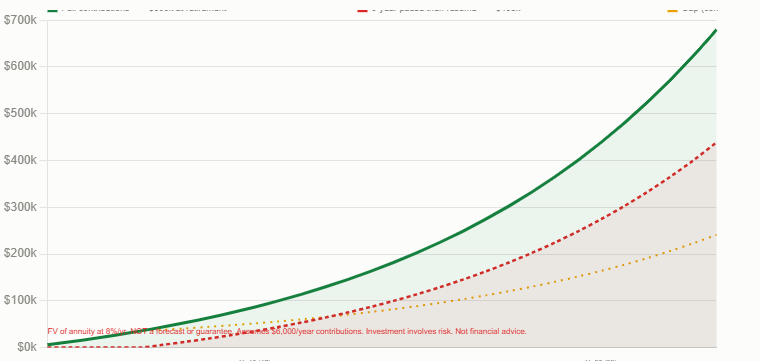
The Numbers: The compound cost of a paused contribution year: $6,000 annual 401(k) employee contribution paused at age 38; investment growth 8%/yr; retiring at age 67 (29 years of compounding foregone). Terminal value of one paused year: $6,000 × (1.08^29) = approximately $47,430. Five years of paused contributions: approximately $237,150 in terminal portfolio value permanently lost. This is not $30,000 (5 years × $6,000) but $237,150 -- because each paused year's contribution would have compounded for 25-29 more years. The sandwich generation's retirement penalty is measured not in paused amounts but in foregone compound growth. Not a forecast. FV of single sum formula. Not financial advice.
Automation is the structural enforcement of this priority. When 401(k) contributions are deducted automatically from payroll before the paycheck reaches the bank account, the decision not to contribute requires an active choice to opt out — a much higher behavioural bar than the passive decision to simply not contribute. The Grimesco Financial guide (2025–2026) frames the logic clearly: the retirement fund is not a discretionary expense to be cut when caregiving pressures increase. It is the fund that prevents you from eventually becoming a financial burden on your own children — perpetuating the very cycle you are experiencing.
Practical implementation: in the US, ensure 401(k) contributions are at least sufficient to capture the full employer match (free money that no caregiving cost can justify leaving on the table). Use auto-escalation to increase contributions by 1% per year so that raises are partially redirected to retirement before lifestyle or caregiving costs absorb them. In 2026, the catch-up contribution limit for ages 50–59 is $32,000; ages 60–63 under SECURE 2.0 can contribute up to $35,750. In the UK, maintain at least the auto-enrolment minimum (8% total including employer) and protect the employer match above all other financial decisions. Not financial advice.
Automation action: this week, log in to your 401(k) or workplace pension portal and verify your contribution rate. If you have reduced it due to caregiving costs: increase it back to at least the employer match threshold. If your plan offers auto-escalation: activate it (1% per year increases). If you are over 50 in the US: confirm you are using the catch-up contribution limit. If you have temporarily paused contributions: calculate the compound cost of continuing the pause (see Section 3). The maths of restoration is always better than continued pause. Not financial advice.
What the conversation should cover: parents’ income sources (pension, Social Security, savings), whether they have long-term care insurance or equivalent provision, their housing preferences as care needs increase, estate planning documents (will, power of attorney, healthcare directive), and what specific financial support they are expecting from family. Grimesco Financial (2025–2026) recommends including ‘income sources, savings, insurance coverage, debt, housing preferences, estate documents, and long-term care plans.’
In the UK context: does the parent have a will? Have they registered a Lasting Power of Attorney (LPA) while they still have capacity? Do they qualify for means-tested local authority care funding? Have they explored Attendance Allowance (a non-means-tested benefit for over-65s with care needs, paying £61.85 or £92.40 per week in 2025/26)? Many families are funding care privately when publicly funded options or benefits have not been explored. The honest conversation is not just about money — it is about mapping what support already exists before the sandwich generation fills the gap from their own retirement savings. Not financial advice.
Money conversation action: schedule a specific family meeting (in person or video call) with parent(s) to discuss: (1) What income and savings do they have? (2) Do they have LTC insurance or an equivalent plan? (3) Do they have a will, power of attorney, and healthcare directive? (4) What are their housing plans if care needs increase? (5) What specific financial support, if any, are they expecting from family? Use a neutral facilitator (solicitor, financial planner) if direct conversations are difficult. Not financial advice.
What financial boundaries look like in practice: a specific monthly dollar or pound amount that you are able to contribute to parental care without compromising your retirement contributions; clarity on what forms of support you are able to provide (time, logistics, coordination) vs what forms you are not (direct cash, housing); agreements with siblings about shared financial responsibilities so the burden does not fall exclusively on the most financially available family member; and a clear statement to adult children that your retirement savings are not available as a parental loan or subsidy, however well-intentioned the request.
The psychological dimension: many sandwich generation members feel profound guilt about setting limits on support for parents or adult children. Grimesco Financial addresses this directly: ‘Many people feel guilty prioritizing their retirement when a parent or child needs support right now.’ The framing that helps: funding your own retirement is not a selfish act. It is the act that prevents you from becoming financially dependent on the same children you are currently supporting — creating the multi-generational cycle that WeCovr identifies as perpetuating ‘intergenerational financial strain.’ Not financial advice.
Boundary-setting framework: (1) Calculate your true sustainable care budget: total monthly income minus fixed expenses (mortgage/rent, utilities, food, transport) minus retirement contribution (NON-NEGOTIABLE) minus emergency fund contribution. The remainder is the maximum available for caregiving costs. (2) Communicate this amount clearly and early -- not after a crisis has already committed funds. (3) For UK readers: calculate whether parents qualify for Attendance Allowance, local authority care funding, Carer's Allowance, or NHS continuing healthcare before committing personal funds. (4) For US readers: explore whether parents qualify for Medicaid, VA benefits (if applicable), Medicare home health benefits, or state care programmes before paying privately. Not financial or legal advice.
The HSA is particularly powerful and underused. In 2026, HSA contribution limits are $4,400 for self-only coverage and $8,750 for family coverage. HSA contributions are tax-deductible, grow tax-free, and can be withdrawn tax-free for qualified medical expenses — now or in retirement, where they can also cover Medicare premiums and long-term care insurance premiums. A 65-year-old in the US may need approximately $172,500 in after-tax savings to cover healthcare expenses in retirement (2025 Fidelity Retiree Health Care Cost Estimate). An HSA invested in index funds over a working career is one of the most tax-efficient tools available to address this gap. Fidelity: ‘A health savings account (HSA) may be another tax-advantaged way to save for retirement as well.’
For UK sandwich generation members: salary sacrifice pension contributions save both income tax and National Insurance (NI). On a £30,000 salary, a £100 pension contribution via salary sacrifice costs approximately £80 net (after 20% income tax and 8% NI savings combined). The employer also saves NI; some employers pass this saving directly to the employee’s pension. Checking whether the employer does this is a 10-minute administrative task that can add hundreds of pounds to the annual pension pot at zero cost to the employee. Not financial or tax advice. Verify with HMRC, IRS, and qualified advisers.
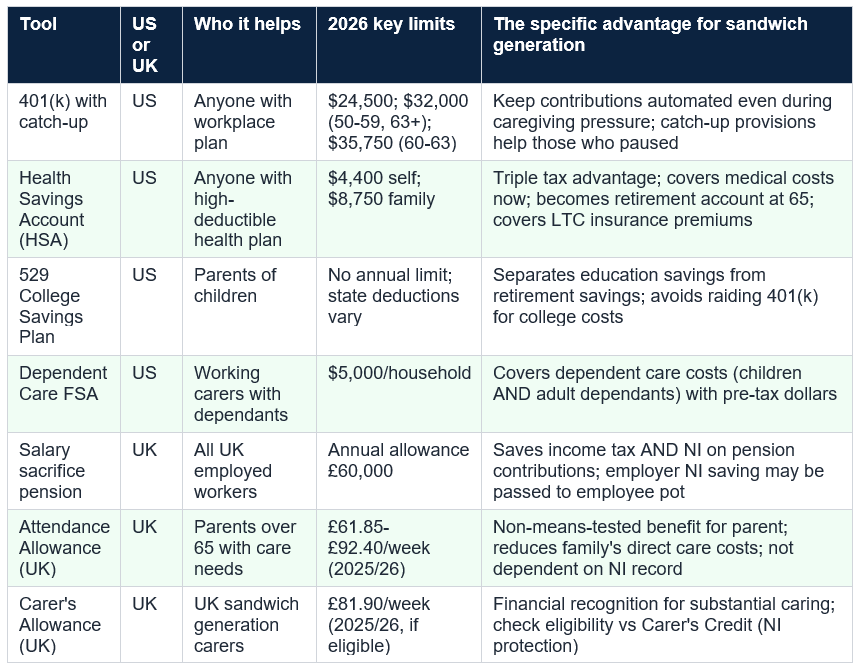
US figures: IRS 2026; Fidelity 2026. UK figures: GOV.UK 2025/26. Not tax, benefit, or financial advice. Always verify current rates, limits, and eligibility from official sources (IRS.gov, GOV.UK, HMRC). Individual circumstances vary significantly.
In the US: Medicare covers home health care services for homebound individuals meeting specific criteria; Medicaid (income and asset means-tested) covers long-term care for eligible individuals; the National Care Planning Council provides a directory of senior services; the Eldercare Locator (eldercare.acl.gov) is a free government service connecting families to local resources; Area Agencies on Aging provide free case management, meals, transportation and caregiver support; VA benefits may cover care for eligible veterans; and many employers now offer Employee Assistance Programmes (EAPs) with caregiver support resources. Not financial or legal advice.
In the UK: NHS Continuing Healthcare funding is available for individuals with complex healthcare needs (and may cover full care costs, not just nursing); local authority care assessments (via the council) determine whether means-tested care funding applies; Carers UK’s helpline (0808 808 7777) provides guidance on all available entitlements; Age UK provides community support, befriending, and navigation services; and Attendance Allowance (for parents over 65, non-means-tested, £61.85–£92.40/week in 2025/26) is significantly underutilised. Not legal or benefits advice. Verify entitlements with official sources or a qualified benefits adviser.
Care resource audit: before committing personal retirement funds to parental care, complete a resource audit: (US) contact your local Area Agency on Aging; check Medicare.gov for covered home health services; consult an elder law attorney about Medicaid planning; ask employer HR about EAP caregiver resources. (UK) request a local authority needs assessment for the parent; apply for Attendance Allowance (GOV.UK/attendance-allowance); contact Carers UK helpline (0808 808 7777); check NHS Continuing Healthcare eligibility. This audit should happen BEFORE family funds are committed, not after. Not financial, legal, or benefits advice.
The care cost contingency fund serves a specific purpose: absorbing acute and unplanned care costs (a parent’s hospital discharge requiring immediate home adaptations; a sudden increase in care hours; a care home deposit) without triggering a 401(k) or pension withdrawal, a high-interest loan, or a reduction in retirement contributions. The fund is held in a high-yield savings account — liquid, accessible, and separate from other savings to protect it from being absorbed into routine expenses.
How to size the care cost contingency fund: assess the most likely acute care events for parents in the next 2–3 years (based on their health status and current care arrangements), estimate the out-of-pocket cost of each, and target a fund that covers the largest likely single event plus three months of ongoing care costs above current provision. This is not a precise calculation — care needs are by definition unpredictable — but having $5,000–15,000 (US) or £5,000–10,000 (UK) specifically earmarked for care contingencies prevents those costs from detonating the retirement plan. Not financial advice.
Income protection insurance is the structural financial tool that addresses this risk. If the sandwich generation carer becomes unable to work — through illness, injury, or the combination of caregiving demands that forces reduced hours or career interruption — income protection pays a percentage of salary (typically 50–60% in the UK, up to 60–70% through employer plans in the US). Without income protection, the household’s retirement contributions, mortgage payments, and caregiving commitments all become simultaneously threatened by a single health event. Jackson Financial (December 12, 2025) explicitly includes ‘Protect more: Have proper insurance coverage’ as one of the core sandwich generation strategies.
The specific insurance review for sandwich generation members: income protection (most important); critical illness cover (UK: pays a lump sum on diagnosis of specified serious illness); life insurance if dependants remain (both children and potentially parents depending on the care arrangement); and for the parents themselves — long-term care insurance, which transforms from a future-planning tool to a present-crisis-prevention tool. If parents do not have LTC insurance and cannot afford care, the cost falls to the sandwich generation. Not financial or insurance advice. Consult a qualified protection adviser.
The sibling conversation should establish: who provides what type of support (time, logistics, financial contribution, care coordination); whether financial contributions are to be equal, proportional to income, or structured differently; how decisions about parental care will be made if siblings disagree; whether the contributing sibling’s extra time and financial outlay will be recognised in inheritance arrangements; and whether a care advocate or mediator is needed to facilitate the conversation. These are not easy discussions, but they are substantially less painful than the alternative: one sibling bearing the full retirement cost of a parent’s care while others are not engaged.
John Boitnott (Substack, 2025) frames the goal of the family financial conversation as: ‘Initiate frank discussions about monetary contributions, inheritance expectations, and long-term financial planning.’ The earlier this conversation happens — ideally before a care crisis has already committed resources — the more options remain available. Not financial or legal advice.
The specific moments that warrant professional advice: before making any retirement account withdrawal or loan to fund care costs; before agreeing to major ongoing financial commitments for parental support (a monthly care contribution, a home adaptation, a care home deposit); when considering a career change, reduction in hours, or early retirement to accommodate caregiving; when parents’ care costs are approaching or exceeding what can be managed on current income; and when significant assets (house, savings) are involved in care planning, where inheritance tax, gifting rules, or Medicaid/local authority means-testing may be affected.
T. Rowe Price’s Confident Conversations podcast (2025) pairs ‘setting boundaries with adult children’ explicitly with ‘planning for long-term care costs’ as the two primary topics where professional guidance produces the most concrete financial protection for the sandwich generation. For US investors: seek a CERTIFIED FINANCIAL PLANNER® (CFP) or elder law attorney. For UK investors: seek an FCA-registered independent financial adviser (IFA) with specific experience in later-life planning. Not financial advice.
The seven steps in this article are not about choosing your own financial future over the people you love. They are about recognising that the only way you can sustainably support both generations is if your own financial foundation remains intact. Fidelity makes the feedback loop explicit: ‘If you don’t use your retirement savings to support your kids or parents, that could eventually force you to depend on your children for financial support in retirement’ — completing the cycle and passing the burden forward. Breaking that cycle requires the same difficult but loving decision that the airline safety announcement has always recommended: secure your own oxygen mask before assisting others.
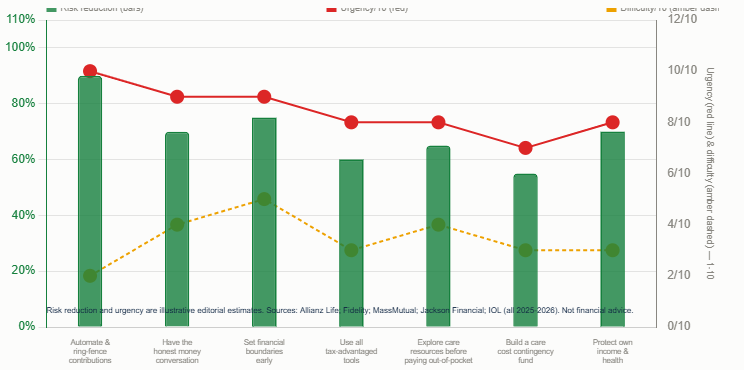
Automate your contributions. Have the honest conversation with your parents. Set financial boundaries. Use every tax-advantaged tool. Explore every care resource before paying out of pocket. Build a contingency fund. Protect your own income and health. And bring in a professional before a crisis commits your retirement to someone else’s care bill. Not financial advice. Consult a qualified financial adviser.
The sandwich generation describes adults who are simultaneously supporting their own dependent children AND their ageing parents. It does not require that care be full-time or that financial support be large -- even occasional financial contributions to a parent combined with ongoing responsibility for children's needs qualifies. According to the 2025 Allianz Life Annual Retirement Study (Business Wire, September 2, 2025), 1 in 4 Americans (25%) are in the sandwich generation. In the UK, approximately 4.5 million people meet this description (ONS 2025 projections, cited by WeCovr). The trend now includes Millennials as well as Gen X -- if you have a child under 18 and a parent who is ageing with any level of care needs, you are potentially in the sandwich generation. Not financial advice.
How do I stop the sandwich generation squeeze from destroying my retirement?
The evidence-based priorities (from Allianz Life, Fidelity, MassMutual, Jackson Financial, T. Rowe Price, and independent financial planners): (1) Automate and protect retirement contributions -- making them stop requires an active decision, not a passive drift. (2) Have the honest money conversation with parents early -- understanding their financial position before a crisis arrives dramatically reduces the cost to the sandwich generation. (3) Set financial boundaries with both generations -- know the maximum you can provide without compromising retirement, and communicate it clearly. (4) Use every tax-advantaged tool: 401(k) catch-up contributions (US); HSA; salary sacrifice pension (UK); check parent's benefit entitlements (Attendance Allowance UK; Medicare home health US). (5) Explore all public and charitable care resources before paying privately. (6) Build a separate care contingency fund. (7) Protect your own income (income protection insurance). Not financial advice.
Can I use my 401(k) to help pay for my parents' care?
Technically yes -- you can take a loan or early withdrawal from your 401(k). But both are costly and generally discouraged. An early withdrawal (before age 59.5) incurs income tax at your marginal rate PLUS a 10% penalty -- meaning a $20,000 withdrawal might deliver only $12,000-$14,000 in usable funds while permanently removing $20,000 from your compound growth engine. A 401(k) loan avoids the penalty but must be repaid, typically within 5 years, often with payroll deductions that effectively double-fund the account while you have less disposable income. Fidelity is explicit: 'If at all possible, don't use your retirement savings -- whether through loans or early withdrawals -- to support your kids or parents. That could eventually force you to depend on your children for financial support in retirement.' Before touching a 401(k), exhaust all public, employer, and care-benefit resources. Consult a qualified financial adviser. Not financial advice.
What government help is available for parents who need care?
US: Medicare covers home health care services for homebound individuals meeting specific criteria (check Medicare.gov). Medicaid (means-tested) covers long-term care for eligible individuals and may include nursing home costs. The Eldercare Locator (eldercare.acl.gov) connects to local resources. Area Agencies on Aging provide free case management, meals, and transportation. VA benefits may apply if the parent is a veteran. UK: Local authority needs assessment can determine means-tested care funding (contact the parent's local council). NHS Continuing Healthcare (CHC) may fund full care costs for individuals with complex healthcare needs (not means-tested). Attendance Allowance is a non-means-tested benefit for over-65s with care needs (£61.85-£92.40/week in 2025/26; claim via GOV.UK). Carer's Allowance and Carer's Credit (protecting NI record) for the carer. Age UK (ageuk.org.uk) and Carers UK (carersuk.org) provide free helplines and benefit navigation. Not legal or benefits advice. Verify current entitlements with official sources.
How do I talk to my parents about money and care planning?
MassMutual (May 2026) and Grimesco Financial (2025-2026) both recommend initiating this conversation proactively -- before a crisis, not during one. The conversation should be framed as practical planning, not as a statement of limited willingness to help. Key topics: what income and savings do parents have? Is it enough to cover their own care? Do they have a will? Power of attorney (lasting, UK; durable, US)? Healthcare directive? Long-term care insurance? What are their housing preferences as care needs increase? What specific support are they expecting from family? If siblings exist: is this conversation happening with all of them? Using a neutral facilitator -- a financial planner, solicitor, or care specialist -- can help if direct conversations are difficult. MassMutual: 'The objective is not to pry, but to be sure that their family member has their financial house in order.' Not financial or legal advice.
Table of Contents
- What Is the Sandwich Generation, and Why Is It Getting Worse?
- The Financial Consequences: What the Data Says
- The Compound Cost: How Paused Contributions Destroy Retirement Wealth
- Step 1 — Automate and Ring-Fence Your Retirement Contributions
- Step 2 — Have the Honest Money Conversation With Your Parents
- Step 3 — Set Financial Boundaries Early and Enforce Them
- Step 4 — Use Every Tax-Advantaged Tool Available
- Step 5 — Explore Every Care Resource Before Paying Out of Pocket
- Step 6 — Build a Care Cost Contingency Fund
- Step 7 — Protect Your Own Income and Health
- The Sibling Conversation: Sharing the Load
- When to Bring in a Financial Professional
- Conclusion: You Cannot Pour From an Empty Pot
- Frequently Asked Questions
The sandwich squeeze — retirement impact by the numbers
The compound cost — what paused contributions really cost
7 protection steps — risk reduction at each stage
What Is the Sandwich Generation, and Why Is It Getting Worse?
The sandwich generation describes adults who are simultaneously supporting their own children and their ageing parents — typically during the years of their career when retirement savings most needs their attention. The name captures the dynamic precisely: the middle generation is pressed from above (ageing parents) and below (dependent children), while their own financial future is the filling that gets compressed.The scale of the problem is substantial and growing. According to the 2025 Annual Retirement Study from the Allianz Center for the Future of Retirement, 1 in 4 Americans (25%) now have a child under 18 and a living parent — the dual responsibility that defines the sandwich generation. In the UK, the Office for National Statistics projected approximately 4.5 million Britons are now active carers for both children under 18 and elderly relatives (WeCovr analysis, 2025–2026). The trend is being driven by two structural forces: people are having children later in life (meaning their children are still at home when their parents are in their 70s and 80s), and medical advances mean parents are living longer, often with complex health needs that require sustained support.
And the sandwich generation is not only Gen X any more. The 401(k) Specialist has specifically noted: ‘Sandwich Generation Now Includes Millennials.’ Adults in their 30s with young children and parents in their 60s or 70s are encountering caregiving demands at an age where the compound cost to their retirement fund is the highest it can be. The earlier the retirement contributions are paused, the more compounding is lost. Not financial advice.
1 in 4 Americans (25%) are in the sandwich generation (Allianz Life 2025 Annual Retirement Study, 1,000 respondents aged 25+). 59% have reduced or stopped retirement contributions due to dual caregiving costs. 70% say it has significantly impacted their retirement plans. 75% say juggling financial needs with caregiving is hard. 78% provide physical, financial or emotional support to parents. 76% say caring for both is 'almost like a full-time job.' 60% were not expecting to support parents at this stage. UK: ~4.5 million active carers for both generations (ONS 2025 projections). UK: average lifetime financial cost projected at £316,000 per individual (WeCovr 2025-2026). Sources: Business Wire September 2, 2025; BenefitsPro September 4, 2025; WeCovr 2025-2026. Not financial advice.
The Financial Consequences: What the Data Says
The Allianz Life 2025 Annual Retirement Study provides the most comprehensive picture of what the sandwich generation’s caregiving costs are doing to retirement savings. 59% of those in the sandwich generation have reduced or stopped contributing to their retirement accounts. Not paused for one month. Reduced or stopped. Among a generation that is typically in their 40s and early 50s — the years when 401(k) and pension contributions have the longest remaining runway for compound growth.In the UK, the financial burden is equally visible and quantified differently. WeCovr’s analysis (updated through 2026) projects that the combined lifetime cost of supporting adult children and elderly parents, plus lost earnings and pension contributions, will reach an average of £316,000 per sandwich generation individual. The national aggregate of direct care costs alone is estimated at £1.9 trillion. Approximately 1 in 5 working-age Britons are on track to sacrifice over half a million pounds from their retirement funds to cover parental long-term care costs (WeCovr, August 7, 2026).
The mechanism is not only direct financial transfers. Jackson Financial (December 12, 2025) specifically notes that ‘sandwich-generation households are more likely to withdraw from retirement savings to fund caregiving.’ Withdrawing from a 401(k) before retirement age incurs income tax and a 10% early withdrawal penalty, meaning a $20,000 withdrawal to cover a parent’s care costs might generate only $12,000–14,000 in after-tax funds while permanently removing $20,000 from the compound growth engine. The cost is not just the withdrawal; it is the compounding on that withdrawal foregone for the remaining 15–20 years of the account’s life. Not financial advice.
The Compound Cost: How Paused Contributions Destroy Retirement Wealth
The single most damaging financial consequence of the sandwich generation squeeze is not the direct costs paid to care for parents or children. It is the paused retirement contributions — and the compound growth on those contributions that is permanently lost.Kelly LaVigne, VP of Consumer Insights at Allianz Life, makes this explicit: ‘Forgoing your own retirement savings now can have costly consequences later on.’ Brock Jolly of Veritas Financial (cited by MassMutual, May 2026) adds the generational dimension: ‘The age of the sandwich generation caregiver can also affect their future financial well-being, with younger adults experiencing a potentially greater opportunity cost.’ A Millennial who pauses 401(k) contributions at age 38 for five years to cover caregiving costs does not simply lose five years of contributions. They lose the compound growth on those contributions from age 38 to their retirement at 67 — a 29-year growth window on each paused year’s contribution.
The Numbers: The compound cost of a paused contribution year: $6,000 annual 401(k) employee contribution paused at age 38; investment growth 8%/yr; retiring at age 67 (29 years of compounding foregone). Terminal value of one paused year: $6,000 × (1.08^29) = approximately $47,430. Five years of paused contributions: approximately $237,150 in terminal portfolio value permanently lost. This is not $30,000 (5 years × $6,000) but $237,150 -- because each paused year's contribution would have compounded for 25-29 more years. The sandwich generation's retirement penalty is measured not in paused amounts but in foregone compound growth. Not a forecast. FV of single sum formula. Not financial advice.
Step 1: Automate and Ring-Fence Your Retirement Contributions
The single most important protection available to the sandwich generation is deceptively simple: automate your retirement contributions so they happen before discretionary spending decisions are made. Fidelity’s guidance for sandwich generation members is direct: ‘If you’re in the sandwich generation, it’s even more important to save as much as possible.’ And equally direct: ‘If at all possible, don’t use your retirement savings — whether through loans or early withdrawals — to support your kids or parents. That could eventually force you to depend on your children for financial support in retirement.’Automation is the structural enforcement of this priority. When 401(k) contributions are deducted automatically from payroll before the paycheck reaches the bank account, the decision not to contribute requires an active choice to opt out — a much higher behavioural bar than the passive decision to simply not contribute. The Grimesco Financial guide (2025–2026) frames the logic clearly: the retirement fund is not a discretionary expense to be cut when caregiving pressures increase. It is the fund that prevents you from eventually becoming a financial burden on your own children — perpetuating the very cycle you are experiencing.
Practical implementation: in the US, ensure 401(k) contributions are at least sufficient to capture the full employer match (free money that no caregiving cost can justify leaving on the table). Use auto-escalation to increase contributions by 1% per year so that raises are partially redirected to retirement before lifestyle or caregiving costs absorb them. In 2026, the catch-up contribution limit for ages 50–59 is $32,000; ages 60–63 under SECURE 2.0 can contribute up to $35,750. In the UK, maintain at least the auto-enrolment minimum (8% total including employer) and protect the employer match above all other financial decisions. Not financial advice.
Automation action: this week, log in to your 401(k) or workplace pension portal and verify your contribution rate. If you have reduced it due to caregiving costs: increase it back to at least the employer match threshold. If your plan offers auto-escalation: activate it (1% per year increases). If you are over 50 in the US: confirm you are using the catch-up contribution limit. If you have temporarily paused contributions: calculate the compound cost of continuing the pause (see Section 3). The maths of restoration is always better than continued pause. Not financial advice.
Step 2: Have the Honest Money Conversation With Your Parents
60% of sandwich generation members were not expecting to support their parents at this stage in life (Allianz Life, 2025). This means the costs arrived without planning and without conversation. Brock Jolly of Veritas Financial (cited by MassMutual, May 2026) identifies the honest money conversation with parents as one of the most important protective actions available. The objective, as MassMutual frames it, is to ensure ‘their family member has their financial house in order, including adequate savings, estate planning documents, and instructions for end-of-life care when the time comes.’What the conversation should cover: parents’ income sources (pension, Social Security, savings), whether they have long-term care insurance or equivalent provision, their housing preferences as care needs increase, estate planning documents (will, power of attorney, healthcare directive), and what specific financial support they are expecting from family. Grimesco Financial (2025–2026) recommends including ‘income sources, savings, insurance coverage, debt, housing preferences, estate documents, and long-term care plans.’
In the UK context: does the parent have a will? Have they registered a Lasting Power of Attorney (LPA) while they still have capacity? Do they qualify for means-tested local authority care funding? Have they explored Attendance Allowance (a non-means-tested benefit for over-65s with care needs, paying £61.85 or £92.40 per week in 2025/26)? Many families are funding care privately when publicly funded options or benefits have not been explored. The honest conversation is not just about money — it is about mapping what support already exists before the sandwich generation fills the gap from their own retirement savings. Not financial advice.
Money conversation action: schedule a specific family meeting (in person or video call) with parent(s) to discuss: (1) What income and savings do they have? (2) Do they have LTC insurance or an equivalent plan? (3) Do they have a will, power of attorney, and healthcare directive? (4) What are their housing plans if care needs increase? (5) What specific financial support, if any, are they expecting from family? Use a neutral facilitator (solicitor, financial planner) if direct conversations are difficult. Not financial advice.
Step 3: Set Financial Boundaries Early and Enforce Them
The IOL Financial Planning guide (March 2026) is direct on this point: ‘The key lies in setting boundaries early and communicating them clearly with both generations.’ John Boitnott’s Substack (2025) identifies boundary-setting as ‘a critical first step.’ T. Rowe Price’s 2025 Confident Conversations on Retirement podcast dedicated an episode specifically to ‘setting boundaries with adult children’ as one of the primary financial protection strategies for sandwich generation members.What financial boundaries look like in practice: a specific monthly dollar or pound amount that you are able to contribute to parental care without compromising your retirement contributions; clarity on what forms of support you are able to provide (time, logistics, coordination) vs what forms you are not (direct cash, housing); agreements with siblings about shared financial responsibilities so the burden does not fall exclusively on the most financially available family member; and a clear statement to adult children that your retirement savings are not available as a parental loan or subsidy, however well-intentioned the request.
The psychological dimension: many sandwich generation members feel profound guilt about setting limits on support for parents or adult children. Grimesco Financial addresses this directly: ‘Many people feel guilty prioritizing their retirement when a parent or child needs support right now.’ The framing that helps: funding your own retirement is not a selfish act. It is the act that prevents you from becoming financially dependent on the same children you are currently supporting — creating the multi-generational cycle that WeCovr identifies as perpetuating ‘intergenerational financial strain.’ Not financial advice.
Boundary-setting framework: (1) Calculate your true sustainable care budget: total monthly income minus fixed expenses (mortgage/rent, utilities, food, transport) minus retirement contribution (NON-NEGOTIABLE) minus emergency fund contribution. The remainder is the maximum available for caregiving costs. (2) Communicate this amount clearly and early -- not after a crisis has already committed funds. (3) For UK readers: calculate whether parents qualify for Attendance Allowance, local authority care funding, Carer's Allowance, or NHS continuing healthcare before committing personal funds. (4) For US readers: explore whether parents qualify for Medicaid, VA benefits (if applicable), Medicare home health benefits, or state care programmes before paying privately. Not financial or legal advice.
Step 4: Use Every Tax-Advantaged Tool Available
The sandwich generation has access to a specific set of tax-advantaged accounts that can reduce the effective cost of caregiving while preserving retirement savings. Fidelity specifically recommends three: the 401(k) (or equivalent workplace pension), the Health Savings Account (HSA), and the 529 college savings plan. Used correctly, all three reduce the tax burden on cash flows while building toward the competing financial demands of the sandwich generation.The HSA is particularly powerful and underused. In 2026, HSA contribution limits are $4,400 for self-only coverage and $8,750 for family coverage. HSA contributions are tax-deductible, grow tax-free, and can be withdrawn tax-free for qualified medical expenses — now or in retirement, where they can also cover Medicare premiums and long-term care insurance premiums. A 65-year-old in the US may need approximately $172,500 in after-tax savings to cover healthcare expenses in retirement (2025 Fidelity Retiree Health Care Cost Estimate). An HSA invested in index funds over a working career is one of the most tax-efficient tools available to address this gap. Fidelity: ‘A health savings account (HSA) may be another tax-advantaged way to save for retirement as well.’
For UK sandwich generation members: salary sacrifice pension contributions save both income tax and National Insurance (NI). On a £30,000 salary, a £100 pension contribution via salary sacrifice costs approximately £80 net (after 20% income tax and 8% NI savings combined). The employer also saves NI; some employers pass this saving directly to the employee’s pension. Checking whether the employer does this is a 10-minute administrative task that can add hundreds of pounds to the annual pension pot at zero cost to the employee. Not financial or tax advice. Verify with HMRC, IRS, and qualified advisers.
US figures: IRS 2026; Fidelity 2026. UK figures: GOV.UK 2025/26. Not tax, benefit, or financial advice. Always verify current rates, limits, and eligibility from official sources (IRS.gov, GOV.UK, HMRC). Individual circumstances vary significantly.
Step 5: Explore Every Care Resource Before Paying Out of Pocket
One of the most expensive mistakes the sandwich generation makes is reaching for their own savings before exhausting the care resources available from public systems, charitable organisations, and employer benefits. Jackson Financial (December 12, 2025) identifies exploring these ‘efficiencies’ as a direct tool to ‘free up resources and help make a solid retirement possible for the sandwich generation.’In the US: Medicare covers home health care services for homebound individuals meeting specific criteria; Medicaid (income and asset means-tested) covers long-term care for eligible individuals; the National Care Planning Council provides a directory of senior services; the Eldercare Locator (eldercare.acl.gov) is a free government service connecting families to local resources; Area Agencies on Aging provide free case management, meals, transportation and caregiver support; VA benefits may cover care for eligible veterans; and many employers now offer Employee Assistance Programmes (EAPs) with caregiver support resources. Not financial or legal advice.
In the UK: NHS Continuing Healthcare funding is available for individuals with complex healthcare needs (and may cover full care costs, not just nursing); local authority care assessments (via the council) determine whether means-tested care funding applies; Carers UK’s helpline (0808 808 7777) provides guidance on all available entitlements; Age UK provides community support, befriending, and navigation services; and Attendance Allowance (for parents over 65, non-means-tested, £61.85–£92.40/week in 2025/26) is significantly underutilised. Not legal or benefits advice. Verify entitlements with official sources or a qualified benefits adviser.
Care resource audit: before committing personal retirement funds to parental care, complete a resource audit: (US) contact your local Area Agency on Aging; check Medicare.gov for covered home health services; consult an elder law attorney about Medicaid planning; ask employer HR about EAP caregiver resources. (UK) request a local authority needs assessment for the parent; apply for Attendance Allowance (GOV.UK/attendance-allowance); contact Carers UK helpline (0808 808 7777); check NHS Continuing Healthcare eligibility. This audit should happen BEFORE family funds are committed, not after. Not financial, legal, or benefits advice.
Step 6: Build a Care Cost Contingency Fund
The Grimesco Financial guide (2025–2026) recommends a specific financial protection step: ‘Build or protect your emergency fund so one family need does not create a larger financial setback.’ For the sandwich generation, the standard emergency fund (3–6 months of essential living expenses) needs a specific additional layer: a dedicated care cost contingency fund, separate from the personal emergency fund and separate from the retirement account.The care cost contingency fund serves a specific purpose: absorbing acute and unplanned care costs (a parent’s hospital discharge requiring immediate home adaptations; a sudden increase in care hours; a care home deposit) without triggering a 401(k) or pension withdrawal, a high-interest loan, or a reduction in retirement contributions. The fund is held in a high-yield savings account — liquid, accessible, and separate from other savings to protect it from being absorbed into routine expenses.
How to size the care cost contingency fund: assess the most likely acute care events for parents in the next 2–3 years (based on their health status and current care arrangements), estimate the out-of-pocket cost of each, and target a fund that covers the largest likely single event plus three months of ongoing care costs above current provision. This is not a precise calculation — care needs are by definition unpredictable — but having $5,000–15,000 (US) or £5,000–10,000 (UK) specifically earmarked for care contingencies prevents those costs from detonating the retirement plan. Not financial advice.
Step 7: Protect Your Own Income and Health
MassMutual’s May 2026 article on sandwich generation financial planning identifies a specific and often overlooked risk: ‘Adult children who provide care to an aging parent, particularly those who have suffered a cognitive or physical decline that demands hands-on care, often neglect their own health care and report feeling socially isolated, leaving them more vulnerable to developing health conditions of their own.’ The sandwich generation carer who becomes ill or exhausted is no longer able to provide care to anyone — and has also reduced their own earning capacity and retirement contributions.Income protection insurance is the structural financial tool that addresses this risk. If the sandwich generation carer becomes unable to work — through illness, injury, or the combination of caregiving demands that forces reduced hours or career interruption — income protection pays a percentage of salary (typically 50–60% in the UK, up to 60–70% through employer plans in the US). Without income protection, the household’s retirement contributions, mortgage payments, and caregiving commitments all become simultaneously threatened by a single health event. Jackson Financial (December 12, 2025) explicitly includes ‘Protect more: Have proper insurance coverage’ as one of the core sandwich generation strategies.
The specific insurance review for sandwich generation members: income protection (most important); critical illness cover (UK: pays a lump sum on diagnosis of specified serious illness); life insurance if dependants remain (both children and potentially parents depending on the care arrangement); and for the parents themselves — long-term care insurance, which transforms from a future-planning tool to a present-crisis-prevention tool. If parents do not have LTC insurance and cannot afford care, the cost falls to the sandwich generation. Not financial or insurance advice. Consult a qualified protection adviser.
The Sibling Conversation: Sharing the Load
The IOL Financial Planning guide (March 2026) identifies sibling coordination as essential: ‘If there are multiple siblings in the sandwich generation, they all need to be on board with sharing the emotional, physical and financial burden of care.’ The most common failure mode in family caregiving is the informal default — the sibling who lives closest, or has the most flexible schedule, or is perceived as the most financially capable, ends up absorbing a disproportionate share of the cost. This informal default is not an agreement. It is not a plan. And it is often not equitable.The sibling conversation should establish: who provides what type of support (time, logistics, financial contribution, care coordination); whether financial contributions are to be equal, proportional to income, or structured differently; how decisions about parental care will be made if siblings disagree; whether the contributing sibling’s extra time and financial outlay will be recognised in inheritance arrangements; and whether a care advocate or mediator is needed to facilitate the conversation. These are not easy discussions, but they are substantially less painful than the alternative: one sibling bearing the full retirement cost of a parent’s care while others are not engaged.
John Boitnott (Substack, 2025) frames the goal of the family financial conversation as: ‘Initiate frank discussions about monetary contributions, inheritance expectations, and long-term financial planning.’ The earlier this conversation happens — ideally before a care crisis has already committed resources — the more options remain available. Not financial or legal advice.
When to Bring in a Financial Professional
Kelly LaVigne (VP Consumer Insights, Allianz Life) is explicit: ‘A financial professional can help you create a strategy to balance current responsibilities with your financial future.’ Jackson Financial (December 2025) frames the adviser role for sandwich generation clients as helping them ‘set priorities and spending thresholds to avoid eroding their retirement savings.’ Grimesco Financial (2025–2026) recommends: ‘Include your advisor before making major commitments, especially around care costs, housing changes, or large gifts.’The specific moments that warrant professional advice: before making any retirement account withdrawal or loan to fund care costs; before agreeing to major ongoing financial commitments for parental support (a monthly care contribution, a home adaptation, a care home deposit); when considering a career change, reduction in hours, or early retirement to accommodate caregiving; when parents’ care costs are approaching or exceeding what can be managed on current income; and when significant assets (house, savings) are involved in care planning, where inheritance tax, gifting rules, or Medicaid/local authority means-testing may be affected.
T. Rowe Price’s Confident Conversations podcast (2025) pairs ‘setting boundaries with adult children’ explicitly with ‘planning for long-term care costs’ as the two primary topics where professional guidance produces the most concrete financial protection for the sandwich generation. For US investors: seek a CERTIFIED FINANCIAL PLANNER® (CFP) or elder law attorney. For UK investors: seek an FCA-registered independent financial adviser (IFA) with specific experience in later-life planning. Not financial advice.
Conclusion
The sandwich generation faces a financial challenge that is both structurally unavoidable and genuinely dangerous to long-term retirement security. 59% have already paused or reduced retirement contributions. 70% say the impact on their retirement plans has been significant. In the UK, the projected lifetime financial cost is £316,000 per person. These are not small numbers, and they are not reversible if the compound growth window closes.The seven steps in this article are not about choosing your own financial future over the people you love. They are about recognising that the only way you can sustainably support both generations is if your own financial foundation remains intact. Fidelity makes the feedback loop explicit: ‘If you don’t use your retirement savings to support your kids or parents, that could eventually force you to depend on your children for financial support in retirement’ — completing the cycle and passing the burden forward. Breaking that cycle requires the same difficult but loving decision that the airline safety announcement has always recommended: secure your own oxygen mask before assisting others.
Automate your contributions. Have the honest conversation with your parents. Set financial boundaries. Use every tax-advantaged tool. Explore every care resource before paying out of pocket. Build a contingency fund. Protect your own income and health. And bring in a professional before a crisis commits your retirement to someone else’s care bill. Not financial advice. Consult a qualified financial adviser.
Frequently Asked Questions
What is the sandwich generation and am I in it?The sandwich generation describes adults who are simultaneously supporting their own dependent children AND their ageing parents. It does not require that care be full-time or that financial support be large -- even occasional financial contributions to a parent combined with ongoing responsibility for children's needs qualifies. According to the 2025 Allianz Life Annual Retirement Study (Business Wire, September 2, 2025), 1 in 4 Americans (25%) are in the sandwich generation. In the UK, approximately 4.5 million people meet this description (ONS 2025 projections, cited by WeCovr). The trend now includes Millennials as well as Gen X -- if you have a child under 18 and a parent who is ageing with any level of care needs, you are potentially in the sandwich generation. Not financial advice.
How do I stop the sandwich generation squeeze from destroying my retirement?
The evidence-based priorities (from Allianz Life, Fidelity, MassMutual, Jackson Financial, T. Rowe Price, and independent financial planners): (1) Automate and protect retirement contributions -- making them stop requires an active decision, not a passive drift. (2) Have the honest money conversation with parents early -- understanding their financial position before a crisis arrives dramatically reduces the cost to the sandwich generation. (3) Set financial boundaries with both generations -- know the maximum you can provide without compromising retirement, and communicate it clearly. (4) Use every tax-advantaged tool: 401(k) catch-up contributions (US); HSA; salary sacrifice pension (UK); check parent's benefit entitlements (Attendance Allowance UK; Medicare home health US). (5) Explore all public and charitable care resources before paying privately. (6) Build a separate care contingency fund. (7) Protect your own income (income protection insurance). Not financial advice.
Can I use my 401(k) to help pay for my parents' care?
Technically yes -- you can take a loan or early withdrawal from your 401(k). But both are costly and generally discouraged. An early withdrawal (before age 59.5) incurs income tax at your marginal rate PLUS a 10% penalty -- meaning a $20,000 withdrawal might deliver only $12,000-$14,000 in usable funds while permanently removing $20,000 from your compound growth engine. A 401(k) loan avoids the penalty but must be repaid, typically within 5 years, often with payroll deductions that effectively double-fund the account while you have less disposable income. Fidelity is explicit: 'If at all possible, don't use your retirement savings -- whether through loans or early withdrawals -- to support your kids or parents. That could eventually force you to depend on your children for financial support in retirement.' Before touching a 401(k), exhaust all public, employer, and care-benefit resources. Consult a qualified financial adviser. Not financial advice.
What government help is available for parents who need care?
US: Medicare covers home health care services for homebound individuals meeting specific criteria (check Medicare.gov). Medicaid (means-tested) covers long-term care for eligible individuals and may include nursing home costs. The Eldercare Locator (eldercare.acl.gov) connects to local resources. Area Agencies on Aging provide free case management, meals, and transportation. VA benefits may apply if the parent is a veteran. UK: Local authority needs assessment can determine means-tested care funding (contact the parent's local council). NHS Continuing Healthcare (CHC) may fund full care costs for individuals with complex healthcare needs (not means-tested). Attendance Allowance is a non-means-tested benefit for over-65s with care needs (£61.85-£92.40/week in 2025/26; claim via GOV.UK). Carer's Allowance and Carer's Credit (protecting NI record) for the carer. Age UK (ageuk.org.uk) and Carers UK (carersuk.org) provide free helplines and benefit navigation. Not legal or benefits advice. Verify current entitlements with official sources.
How do I talk to my parents about money and care planning?
MassMutual (May 2026) and Grimesco Financial (2025-2026) both recommend initiating this conversation proactively -- before a crisis, not during one. The conversation should be framed as practical planning, not as a statement of limited willingness to help. Key topics: what income and savings do parents have? Is it enough to cover their own care? Do they have a will? Power of attorney (lasting, UK; durable, US)? Healthcare directive? Long-term care insurance? What are their housing preferences as care needs increase? What specific support are they expecting from family? If siblings exist: is this conversation happening with all of them? Using a neutral facilitator -- a financial planner, solicitor, or care specialist -- can help if direct conversations are difficult. MassMutual: 'The objective is not to pry, but to be sure that their family member has their financial house in order.' Not financial or legal advice.
0 Comments
Be the first to share your thoughts on this article.