

Travel & holidays
How To Book Your Vacation and Save Money.

Table of Contents
- 2026 Is the Most Expensive Year to Travel -- But the Savings Are Bigger Than Ever If You Know Where to Look
- The 2026 Travel Cost Landscape: What You're Up Against
- The Vacation Savings Timing Guide: When to Book Everything
- 8 Proven Tips to Book Your Vacation and Save Money in 2026
- The Complete Vacation Savings Toolkit: Tools, Cards, and Hacks
- Common Vacation Booking Mistakes That Cost You Money
- Conclusion
- Frequently Asked Questions (FAQ)
2026 Is the Most Expensive Year to Travel -- But the Savings Are Bigger Than Ever If You Know Where to Look
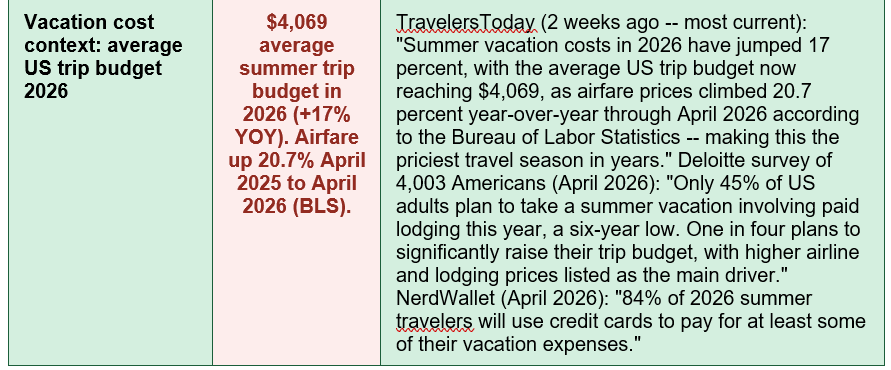
The numbers are not easy reading for anyone planning a vacation in 2026. TravelersToday (published two weeks ago -- most current): 'Summer vacation costs in 2026 have jumped 17 percent, with the average US trip budget now reaching $4,069, as airfare prices climbed 20.7 percent year-over-year through April 2026, according to the Bureau of Labor Statistics -- making this the priciest travel season in years.' A Deloitte survey of 4,003 Americans conducted in April 2026 found that only 45% plan to take a summer vacation involving paid lodging -- a six-year low -- with higher airline and lodging prices listed as the primary reason.Yet the data also contains a different story. Expedia's 2026 Air Hacks Report found that August flights are 29% cheaper than December flights -- a saving of roughly $120 per ticket. Flights on Tuesdays are 14% cheaper than Sundays. January and February fares run 10-19% below average. Hotels booked within a week of arrival are 35% cheaper for domestic travel. Shoulder-season hotel rates are up to 40% lower than peak. Travel rewards credit cards are offering sign-up bonuses worth over $2,000. And the free tools available to any traveller -- Google Flights price alerts, Hopper's predictive pricing, Going's mistake-fare alerts -- have never been more powerful.
The gap between what most people pay for their vacation and what the best-informed travellers pay for the same trip is real, measurable, and larger in 2026 than in most previous years. This guide closes that gap. It covers exactly when to book flights and hotels for the lowest prices, the free tools that do the hard work for you, the credit card strategies that can fund an entire trip in points, the timing and destination tricks that cut costs without cutting the quality of the holiday, and the common mistakes that cost travellers hundreds of dollars every year. The 2026 travel market is expensive -- but it is navigable, and the savings are there for those who know how to find them.
The 2026 Travel Cost Landscape: What You're Up Against
Before looking at how to save, it is worth understanding precisely what has driven costs up in 2026 and what the data shows about smart spending patterns.TravelersToday (two weeks ago): airfare climbed 20.7% from April 2025 to April 2026, according to the Bureau of Labor Statistics. The average US summer trip budget has reached $4,069 -- a 17% increase on the previous year. One in four travellers who are still taking a summer vacation in 2026 plans to significantly raise their budget compared to last year. NerdWallet (April 2026): 84% of 2026 summer travellers will use credit cards to pay for at least some of their vacation travel expenses -- making cards the most popular payment method for travel by a wide margin.
The good news within these numbers: the price increases are not uniform. Airlines charge dramatically different fares depending on when you book, which day you fly, which month you travel, and which tools you use to find the cheapest seats. The spread between the highest and lowest prices for the same flight on the same day can be 100% or more -- meaning a traveller who books at the wrong time pays twice what a well-informed traveller pays for the same seat. Understanding the timing patterns is the single most impactful thing you can do to reduce vacation costs in 2026.
The 2026 travel cost reality: Average US vacation budget: $4,069 (+17%). Airfare up 20.7% YOY. But: August flights 29% cheaper than December. Tuesday flights 14% less than Sunday. Hotels last-minute: 35% cheaper. — TravelersToday (2 weeks ago -- most current): 'Average US trip budget $4,069, airfare climbed 20.7% April 2025-April 2026 (BLS).' Expedia 2026 Air Hacks: 'August most affordable month -- 29% cheaper than December, saving ~$120/ticket. Tuesday cheapest domestic departure day at 14% less than Sunday.' WalletHub (Jan 2026): 'Hotels booked within a week of stay are 35% cheaper for domestic travel.' Deloitte (April 2026 survey of 4,003 Americans): 'Only 45% plan a summer vacation with paid lodging -- a 6-year low.'
The Vacation Savings Timing Guide: When to Book Everything
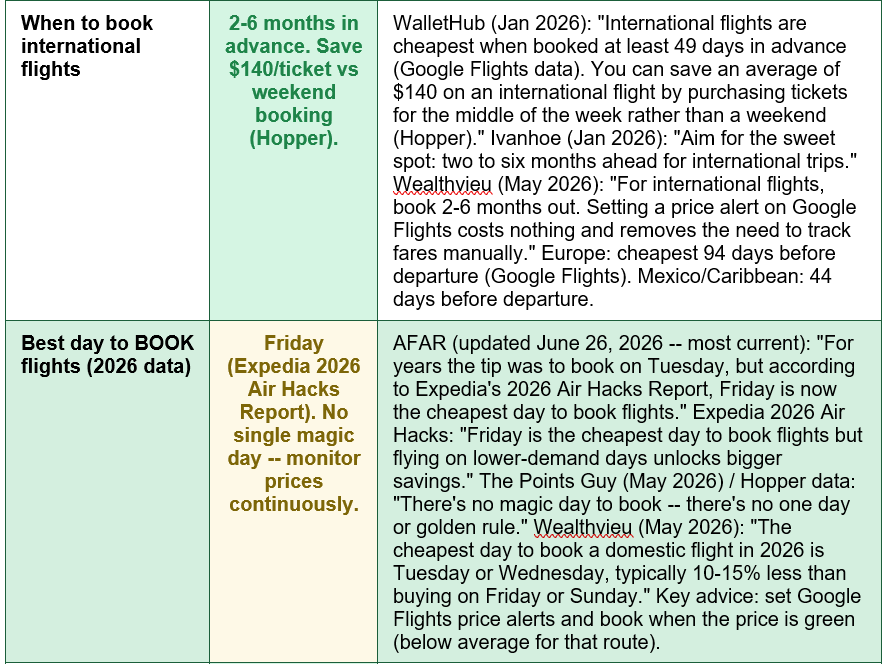
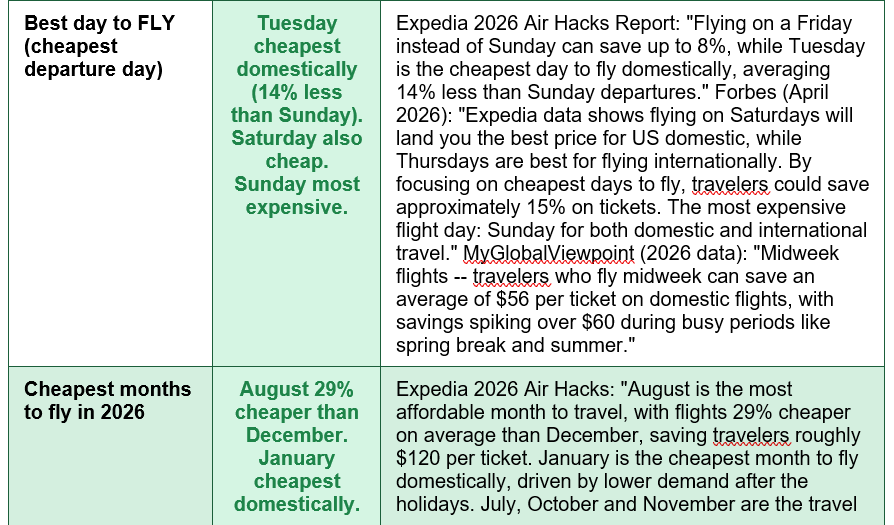
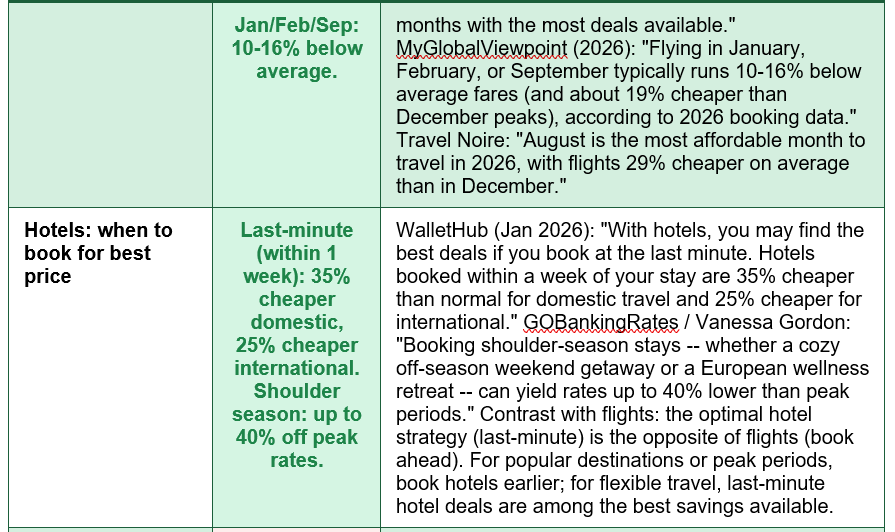
Timing is the most powerful single lever available to any traveller. The following table maps the optimal booking windows and departure days for maximum savings, based on the most current 2026 data: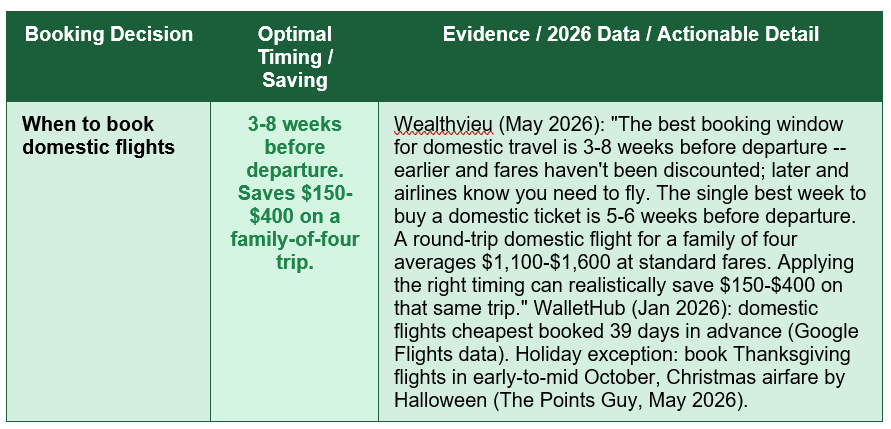
8 Proven Tips to Book Your Vacation and Save Money in 2026
TIP #1: SET GOOGLE FLIGHTS PRICE ALERTS THE MOMENT YOU DECIDE TO TRAVEL | The free tool that does all the monitoring for you
The single most impactful free action any traveller can take is setting a Google Flights price alert immediately after deciding on a destination and rough travel window. Wealthvieu (May 2026): 'Setting a price alert on Google Flights costs nothing and removes the need to track fares manually. The price graph view shows how the current fare compares to historical prices for that route and date range -- green means cheap, red means expensive.' How it works: visit flights.google.com, search your route (you can use flexible dates or a calendar view), and click 'Track prices.' Google will email you automatically when the fare rises or falls significantly. The price graph view is particularly valuable because it shows at a glance whether you are looking at a historically cheap or expensive fare for that specific route and dates -- removing all the guesswork. For maximum effectiveness: set the alert as soon as possible (ideally months before travel for international, weeks before for domestic), use the 'flexible dates' view to see the cheapest travel days in a calendar format, and set alerts for multiple nearby airports if relevant. The price chart colour system (green = cheap relative to historical, red = expensive) alone is worth the setup time.TIP #2: FLY ON THE RIGHT DAYS -- THE DAY YOU FLY MATTERS MORE THAN THE DAY YOU BOOK | Tuesday saves 14% vs Sunday on domestic US flights
The most consistent finding across 2026 booking data is that the day you fly has a larger impact on price than the day you book. Expedia's 2026 Air Hacks Report: 'Tuesday is the cheapest day to fly domestically, averaging 14% less than Sunday departures. Flying on a Friday instead of Sunday can save up to 8%.' Forbes (April 2026): 'A 2024 Hopper study found midweek departures are a good way to save, with tickets on Tuesdays through Thursdays generally a better deal, especially within the United States. By focusing on the cheapest days to fly, travelers could save approximately 15% on their tickets. The most expensive flight day: Sunday for both domestic and international travel.' MyGlobalViewpoint (2026 data): 'Travelers who fly midweek can save an average of $56 per ticket on domestic flights, with savings spiking over $60 during busy periods like spring break and summer.' Additionally, early morning flights are both cheaper and more reliable: Ivanhoe (Jan 2026): 'For fewer delays and cheaper fares, choose early morning flights. Research shows they have the highest on-time arrival rates and they're often cheaper.' The practical takeaway: if your schedule has any flexibility on departure day, choosing Tuesday or Wednesday over Sunday can save a family of four $200+ on domestic flights alone.TIP #3: TRAVEL IN THE RIGHT MONTHS -- SHOULDER SEASON IS WHERE THE SAVINGS LIVE | 40% off hotels and 19% off flights vs December peaks
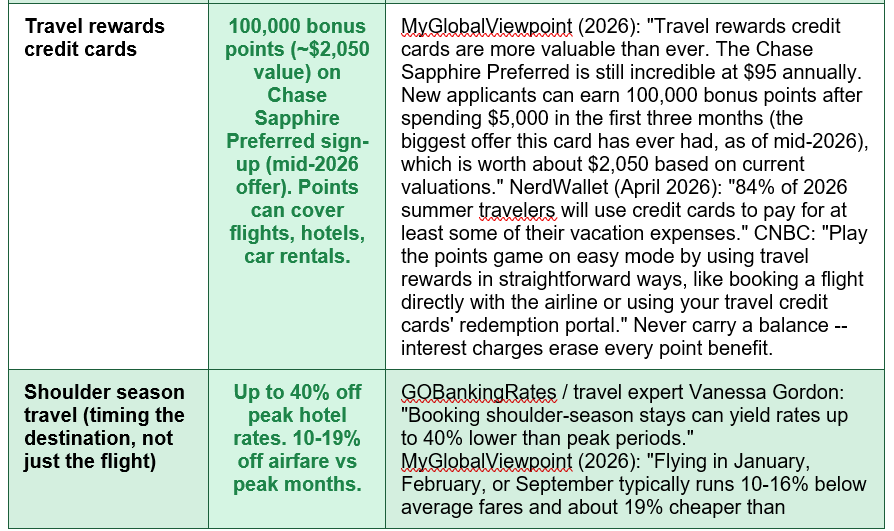
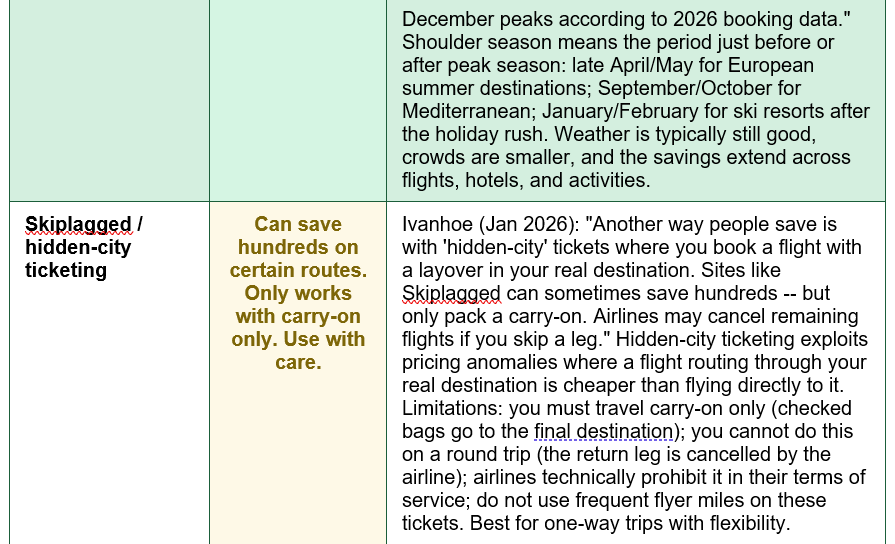
Month of travel is the largest single timing variable affecting both flight and hotel prices. Expedia 2026 Air Hacks: 'August is the most affordable month to travel, with flights 29% cheaper on average than December, saving travelers roughly $120 per ticket. January is the cheapest month to fly domestically. July, October and November are the travel months with the most deals available.' MyGlobalViewpoint (2026 booking data): 'Flying in January, February, or September typically runs 10-16% below average fares, and about 19% cheaper than December peaks.' For hotels, the savings in shoulder season are even more dramatic: travel expert Vanessa Gordon (GOBankingRates): 'Booking shoulder-season stays can yield rates up to 40% lower than peak periods.' Shoulder season means different things for different destinations: for European summer destinations, late April, May, and September/October offer ideal weather with significantly lower prices than July and August; for Caribbean resorts, the shoulder window between spring break and hurricane season (May/June) and after hurricane season (late November) offers excellent value; for ski resorts, January after the holiday rush and March after spring break are significantly cheaper than the peak holiday periods. The key insight: the experience is often better in shoulder season (fewer crowds, better service) and the savings are real and large.TIP #4: BOOK FLIGHTS AND HOTELS SEPARATELY -- AT DIFFERENT TIMES | Opposite strategies for flights and hotels unlock maximum savings
One of the most counterintuitive but well-evidenced findings in 2026 travel data is that the optimal booking strategy for flights and hotels is opposite. For flights: book ahead. WalletHub (Jan 2026 / Google Flights data): 'Domestic flights are cheapest when booked 39 days in advance. International flights are cheapest when booked at least 49 days in advance.' For hotels: consider last-minute. WalletHub (Jan 2026): 'Hotels booked within a week of your stay are 35% cheaper than normal for domestic travel and 25% cheaper for international.' The reason for this difference is structural: airlines price-up as seats fill, incentivising early booking; hotels, on the other hand, face a perishable inventory problem -- an empty room generates zero revenue on the night in question, incentivising last-minute discounting to fill it. The practical approach: book your flights as soon as you know your dates (ideally 5-8 weeks out for domestic, 2-6 months for international). For hotels, if your accommodation choice is flexible and the destination is not during peak season, waiting until the week before can secure dramatically lower rates. If your preferred accommodation is likely to sell out (popular hotels in peak season, boutique properties, major event weekends), book early to secure availability, but set a reminder to check rates again closer to your stay -- many hotels will match lower prices if available.TIP #5: UNLOCK THE POWER OF TRAVEL REWARDS CREDIT CARDS | 100,000 points worth $2,050 on the best current sign-up offers
For regular travellers, travel rewards credit cards represent the highest-value legal arbitrage available in personal finance. MyGlobalViewpoint (2026): 'Travel rewards credit cards are more valuable than ever. The Chase Sapphire Preferred is still incredible at $95 annually. New applicants can earn 100,000 bonus points after spending $5,000 in the first three months -- the biggest offer this card has ever had as of mid-2026 -- which is worth about $2,050 based on current valuations.' NerdWallet (April 2026): 84% of 2026 summer travellers will use credit cards to pay for at least some of their vacation expenses. NerdWallet: 'Play the points game on easy mode by using travel rewards in straightforward ways, like booking a flight directly with the airline or using your travel credit cards' redemption portal to book accommodations.' The key principles for maximising travel rewards: (1) concentrate all spending on your rewards card to accumulate points faster; (2) use the sign-up bonus -- most of the value in the first year comes from the bonus, not the ongoing earn rate; (3) use points for flights and hotels (highest redemption value) not cash back or merchandise; (4) never carry a balance -- interest charges at 20%+ APR will immediately erase all points value. For UK travellers: the equivalent products are American Express Preferred Rewards Gold (0 annual fee year 1), and the British Airways American Express card, both of which offer significant sign-up bonus miles.TIP #6: USE PACKAGE DEALS -- AND KEEP MONITORING AFTER YOU BOOK | Bundles save 15-30% -- but your job isn't done at checkout
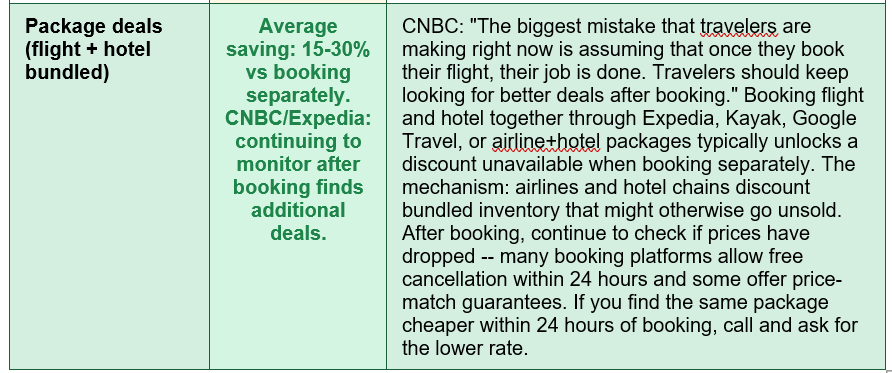
Booking flight and hotel together as a package deal typically saves 15-30% compared to booking each element separately -- because airlines and hotel chains discount bundled inventory to move seats and rooms that might otherwise go unsold. The major booking platforms (Expedia, Kayak, Google Travel, and airline direct sites that offer hotel bundles) all offer package pricing, and the savings are most significant for popular short-haul and European routes where both flight and hotel inventory is high. CNBC (1 month ago): 'The biggest mistake that travelers are making right now is assuming that once they book their flight, their job is done.' After booking, continue to monitor prices for both your flight and your hotel. Many airlines offer free cancellation and rebooking within 24 hours of booking at no charge -- if you find a lower price the day after booking, call and request the adjustment. For hotels, if you booked a flexible rate (refundable), set a calendar reminder to check the price again two to three weeks before your stay -- hotels regularly reprice their remaining inventory downward as the date approaches, and you can cancel and rebook at the lower rate with no financial penalty.TIP #7: BE STRATEGIC WITH YOUR DESTINATION AND DATE FLEXIBILITY | Shifting travel by two days saved one traveller almost $300
Destination and date flexibility are the two most powerful levers available to a budget-conscious traveller -- and in 2026, the tools to exploit them have never been better. MyGlobalViewpoint (2026): 'I recently saved almost $300 by shifting a weekend trip to Georgia by just two days.' Google Flights' 'Explore' view allows you to search for flights from your home airport to 'everywhere' and see prices across all destinations on a map -- ideal for identifying the cheapest destinations from your base at any given time. Skyscanner's 'Everywhere' search works similarly for international flights. The Expedia 2026 Air Hacks Report explicitly endorses date flexibility: 'Business travelers head home earlier in the week these days, so new opportunities are opening up for leisure travelers to save by choosing smarter travel days.' For UK travellers, the specific opportunity in 2026 is European rail: budget operators including Italo in Italy and Iryo in Spain are making high-speed rail travel significantly more affordable. Passes like the Deutschland-Ticket (one month on regional German trains for under €70) and the liO TER ticket in southern France (€10/day) make rail-based European travel highly competitive with budget flying when the full door-to-door journey time and cost are considered.TIP #8: CUT COSTS AT THE DESTINATION -- ACCOMMODATION, FOOD, AND LOCAL TRANSPORT | The holiday budget doesn't start when you land
The savings available on flights and hotels are significant, but costs at the destination often determine the final vacation bill just as much as transport and accommodation. WalletHub (Jan 2026): 'To save money on food costs, you can cook one or two of your meals a day instead of eating out for all your meals. This is easier to do if you are staying at a vacation rental with a kitchen. If you are not, look for a hotel that offers free breakfast, so you already have one of your meals taken care of.' Accommodation type makes a significant difference to at-destination costs: a vacation rental with a kitchen allows self-catering of one or two daily meals, which for a family of four can save $50-100 per day over a 10-day trip. WalletHub: 'When you reach your travel destination, you can save money by walking or taking public transportation rather than renting a car or paying for rideshares. It's a great way to get a feel for the area, too.' Local SIM cards or eSIMs for data abroad (typically $15-30 for a week's data) are dramatically cheaper than roaming charges. City tourism cards (London, Paris, Amsterdam, Rome all offer them) bundle transport and major attractions at significant discounts versus paying individually. Free walking tours (available in virtually every major city globally) provide excellent local insight at no mandatory cost (though tipping is standard).The Complete Vacation Savings Toolkit: Tools, Cards, and Hacks
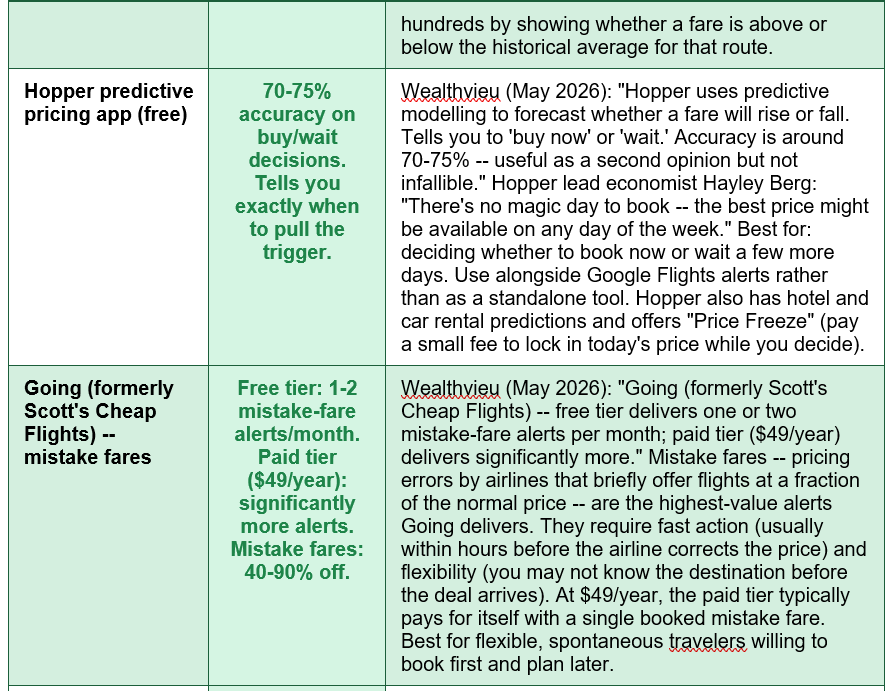
The following table maps every major tool and strategy available to save money when booking a vacation in 2026, with specific savings estimates and how each one works: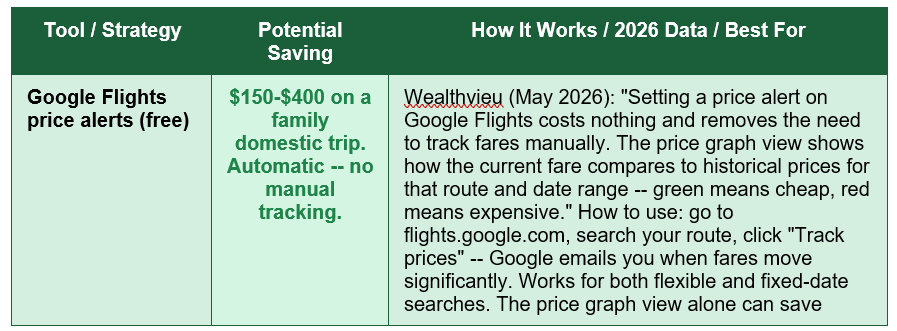
Common Vacation Booking Mistakes That Cost You Money
FIVE VACATION BOOKING MISTAKES THAT COST TRAVELLERS HUNDREDS IN 2026: (1) BOOKING FLIGHTS ON SUNDAY OR SATURDAY. Forbes (April 2026): 'The most expensive flight day: Sunday for both domestic and international travel.' Expedia 2026: flying on Friday instead of Sunday saves up to 8%; Tuesday is 14% cheaper than Sunday for domestic US flights. For a family of four booking $400 round-trip tickets, flying on Tuesday instead of Sunday saves approximately $224 on domestic flights. (2) BOOKING HOTELS TOO FAR IN ADVANCE. Unlike flights, hotels get cheaper closer to the date. WalletHub: 'Hotels booked within a week of your stay are 35% cheaper for domestic travel.' If your dates and destination are flexible, last-minute hotel bookings in 2026 are one of the best savings opportunities available. (3) NOT SETTING GOOGLE FLIGHTS PRICE ALERTS. The price alert function is free, automatic, and sends you an email when fares change significantly for your route. There is no reason not to set one the moment you start thinking about a trip. Wealthvieu (May 2026): the price graph alone -- showing green (cheap) vs red (expensive) for the current fare relative to historical prices -- can prevent paying above-average prices. (4) CARRYING A CREDIT CARD BALANCE WHILE TRYING TO EARN TRAVEL POINTS. NerdWallet: 'Interest charges from carrying credit card debt can significantly increase your summer vacation expenses.' A 20%+ APR on a $2,000 balance costs $400/year in interest -- far more than any sign-up bonus is worth. Travel rewards cards only make financial sense if the balance is paid in full every month. (5) BOOKING PEAK SEASON WITHOUT CHECKING SHOULDER ALTERNATIVES. The difference in price between peak season (July-August for Europe, December for domestic US) and shoulder season (May, September-October for Europe; January-February for domestic US) can be 20-40% for flights and up to 40% for hotels. Before confirming peak-season dates, check whether shifting by two to four weeks changes the cost dramatically -- MyGlobalViewpoint reported a near-$300 saving from a two-day date shift on a single domestic trip.The mistake-fare mindset: why the best deals require a different kind of planning. Going (formerly Scott's Cheap Flights) and similar services alert subscribers when airlines accidentally price flights far below their intended rate -- sometimes 40-90% off the normal fare. These deals require a different mindset: you do not plan a trip and then look for a flight; instead, the flight price triggers the trip plan. A subscriber might receive an alert for a $180 round-trip flight to Rome and decide to go based on the price rather than the other way around. This approach consistently produces the lowest-cost travel available -- but it requires flexibility in dates and destinations. At $49/year for Going's paid tier (or free for the basic tier), the tool pays for itself with a single booked mistake fare. Wealthvieu (May 2026): 'Mistake fares require fast action (usually within hours before the airline corrects the price) and flexibility -- you may not know the destination before the deal arrives.' For travellers with any flexibility in their vacation plans, subscribing to mistake-fare alerts is the single highest-return low-effort action available.
THE COMPLETE VACATION BOOKING CHECKLIST FOR 2026: STEP 1 -- DECIDE AND SET ALERTS IMMEDIATELY: As soon as you have a rough destination and travel window in mind, set a Google Flights price alert. It is free and requires no ongoing effort -- Google emails you when prices move. Also download Hopper (free) for a predictive buy/wait signal on specific fares. STEP 2 -- CHOOSE YOUR TRAVEL DATES STRATEGICALLY: Fly Tuesday or Wednesday (14% cheaper than Sunday domestically). Avoid Sunday departures (most expensive). Book domestic flights 5-8 weeks out, international 2-6 months out. Consider January, February, August, or September over July, August peak, or December. STEP 3 -- CONSIDER A PACKAGE DEAL: Check Expedia, Kayak, and Google Travel for flight-plus-hotel bundles -- they typically save 15-30% vs booking separately. After booking, keep monitoring: check whether prices have dropped and rebook if possible. STEP 4 -- CHECK HOTEL PRICING LAST: If your accommodation dates are flexible and the destination is not peak-season, check hotel prices again 3-7 days before your trip. Hotels booked within a week of stay can be 35% cheaper domestically (WalletHub). STEP 5 -- OPTIMISE YOUR CREDIT CARD STRATEGY: If you have a travel rewards card, book all travel on it (maximise points). If you do not, research current sign-up offers (MyGlobalViewpoint: Chase Sapphire Preferred offering 100,000 bonus points worth ~$2,050 as of mid-2026). NEVER carry a balance. STEP 6 -- PLAN DESTINATION SPENDING: Book a vacation rental with a kitchen to enable self-catering; research public transport options; buy a local SIM or eSIM for data; check for city tourism cards. DESTINATION TOOLS: Google Flights free at flights.google.com | Hopper free app | Going goingcom.com (free tier or $49/year) | Skyscanner skyscanner.com | Kayak kayak.com.
Conclusion
2026 is objectively a more expensive year to travel than most recent years -- with airfare up 20.7% year-on-year and the average US vacation budget reaching $4,069. It is also a year in which the tools, data, and strategies available to informed travellers have never been more powerful. The same 2026 data that reveals the cost increases also shows that August flights are 29% cheaper than December, Tuesday departures save 14% over Sunday, shoulder-season hotels are up to 40% below peak rates, and last-minute hotel bookings are 35% cheaper for domestic travel.The gap between what an informed traveller pays and what an uninformed traveller pays for the same trip has never been wider -- or more worth closing. Google Flights price alerts are free. Hopper's predictive app is free. Going's mistake-fare alerts start free. The timing data from Expedia, Hopper, and Google Flights is publicly available and clear. A family of four that applies the strategies in this guide to a domestic summer trip can realistically save $400-600 on flights alone -- more than the cost of a hotel night.
The 45% of Americans who have opted out of a 2026 summer vacation due to cost are making a choice based on the sticker price of poorly timed, poorly optimised bookings. The same vacation, booked with the right timing, on the right days, with the right tools, typically costs significantly less. The best investment you can make in your 2026 vacation budget is 30 minutes setting up Google Flights alerts, downloading Hopper, and subscribing to Going -- before you do anything else. Everything else in this guide builds on that foundation.

0 Comments Comments