

Insurance
How to Lower Home Insurance Amid Climate Change

Home insurance used to be one of those bills you paid without thinking too hard about it. A few hundred dollars a month, renewed automatically, filed away. That era is over. Nationwide home insurance rates have risen more than 44% since 2019, according to the Home Buying Institute. The average American is now paying $3,520 annually — and that’s projected to rise another 8% in 2026 and 8% more in 2027. In Louisiana and Nebraska, premiums already exceed $6,000 a year. Allstate and State Farm have stopped writing new policies in California and parts of Florida. More than 6 million American homes have no coverage at all. The driving force behind most of this is climate change — making disasters more frequent, more severe, and more expensive for insurers to cover. But you are not powerless. This article explains what’s driving the crisis and the nine specific strategies that can meaningfully reduce your premium without leaving you dangerously underinsured
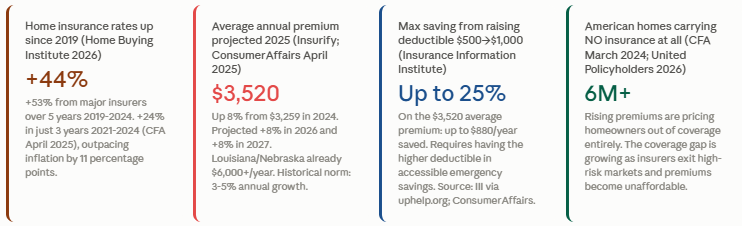
The Home Buying Institute’s 2026 analysis puts the nationwide total starkly: home insurance rates have increased by more than 44% since 2019. That is not a gradual drift. It is a structural repricing of risk that is fundamentally changing the economics of homeownership. Americans collectively paid approximately $21 billion more in homeowners insurance premiums in 2024 than in prior years, per CFA data cited by United Policyholders in July 2026. And costs are rising while coverage is simultaneously shrinking: average deductibles rose 22% in 2025, meaning homeowners are paying more and getting less.
Crucially, this is not just a coastal or high-risk-state phenomenon. As nonprofit United Policyholders described in a June 2026 CNBC report: ‘The skyrocketing price of insurance premiums is deepening the housing crisis from Salt Lake City to…’ everywhere. More than 6 million American homes carry no insurance at all, per CFA’s March 2024 research — a number that grows as premiums price people out. Not financial or insurance advice.
Home insurance premium crisis (2024-2026): +24% nationwide 2021-2024, outpacing inflation by 11% (CFA April 2025). Average annual premium: $3,520 projected 2025; $3,259 in 2024 (Insurify; ConsumerAffairs April 2025). +8% projected 2026 and again in 2027 (Home Buying Institute; Insurify). +44% since 2019 nationwide (Home Buying Institute). +53% from major insurers over 5 years 2019-2024 (Home Buying Institute). Deductibles up 22% in 2025 (Home Buying Institute). $21B extra premiums paid in 2024 (CFA; United Policyholders July 2026). 6M+ homes uninsured (CFA March 2024). Louisiana/Nebraska: $500+/month ($6,000+/yr) (Bankrate February 2025). Sources cited. Not insurance advice.
Climate change is the most discussed driver, and for good reason. Extreme weather events — hurricanes, wildfires, flooding, severe hailstorms, tornadoes — are increasing in both frequency and severity. Insurance companies have no choice but to factor this into their risk models. The Invading Sea’s September 2024 analysis of the insurance-climate nexus notes that there is a saying: to get someone to pay attention to climate change, put a price on it. Home insurance is now doing exactly that. The price of a climate-exposed property is increasingly visible not just in flood zone maps but in the monthly premium.
Construction costs are the second driver. Rebuilding a house that burned down or was flattened by a hurricane costs significantly more per square foot than it did five years ago, due to the same supply chain disruptions, labour shortages, and materials price increases that have affected the entire construction industry. When the payout on a claim rises, so does the premium needed to fund it. The third driver is reinsurance — the insurance that insurance companies buy to protect themselves from catastrophic losses. When global reinsurers raise their rates in response to record-breaking natural disaster years, those costs flow directly through to homeowners. As the Home Buying Institute explains: ‘When reinsurers raise rates, those costs flow directly through to homeowner premiums.’ Trump’s tariffs may also raise premiums further: sustained tariffs on building materials could make 2025 and 2026 Insurify projections conservative, per ConsumerAffairs’ April 2025 analysis. Not insurance advice.
California’s wildfire risk has triggered a similar dynamic. Both Allstate and State Farm have stopped providing coverage to new customers in California, citing the combination of rising wildfire risk and increasing construction costs. In Florida, the state-backed Citizens Insurance — the insurer of last resort for those who cannot find private coverage — is requesting a 2.6% rate decrease for 2026, which the Home Buying Institute describes as ‘a stunning reversal’ after years of increases, potentially reflecting some stabilisation in the Florida market after significant legislative reform.
But the key point from United Policyholders and others is that this is not only a coastal or high-risk-state issue. Rates are rising across all 50 states. The specific risk drivers differ by location — wildfires in the West, hurricanes in the Southeast, flooding in the Midwest, hailstorms in Texas and Nebraska — but the systemic repricing of climate risk is a nationwide phenomenon. As the uphelp.org December 2024 analysis puts it: ‘Though certain areas are more at risk for the effects of climate change, this is a national issue.’ Not insurance advice.
The trade-off is simple but important: a higher deductible means more money out of your own pocket if something goes wrong. The strategy only makes sense financially if you have an emergency fund that can cover the higher deductible amount without stress. Do not raise your deductible beyond what you could realistically pay in an emergency. If your current savings cannot cover a $2,500 or $5,000 deductible, raising to that level creates a different kind of financial vulnerability. The sweet spot for most homeowners is finding the highest deductible you could genuinely afford to pay in a bad month. Not insurance or financial advice.
Deductible savings: raising from $500 to $1,000 can save up to 25% annually. On the $3,520 average premium, that’s up to $880/year. Raising to $2,500 or $5,000 saves more but requires having that amount accessible in emergency savings. Rule: never raise your deductible above what you could pay without going into debt. Source: Insurance Information Institute (cited uphelp.org July 2026; ConsumerAffairs April 2025). Not insurance advice.
The actual saving depends on your specific insurer and state, but the discount is widely available and requires only a phone call or online quote request to investigate. The secondary benefit of bundling is simplicity — one insurer, one renewal date, one contact for claims. The caution: bundling means you have one relationship with one insurer, which means switching carriers for a better rate on either policy requires unbundling both. Do the maths every couple of years to ensure the bundle discount still beats the savings from switching. Not insurance advice.
United Policyholders and their financial expert Heller, quoted in the organisation’s December 2024 guide, recommend a three-channel approach: research online through comparison platforms, get a quote directly from a brand-name insurer, and also work with an independent insurance agent who can access multiple carriers simultaneously. The independence of the third-party agent is valuable: unlike a captive agent who represents only one insurer, an independent agent can identify the carrier that prices your specific risk profile most favourably.
The misconception that loyalty is rewarded in insurance is worth dispelling directly. Many insurers offer their most competitive rates to new customers. Long-standing customers who renew without shopping often pay a ‘loyalty penalty’ — a higher rate than a new customer would receive for the same policy. In a market where rates are rising 8% annually, the loyalty penalty compounds quickly. Shopping annually protects against it. Not insurance advice.
Annual shopping checklist: (1) 60 days before renewal, get three quotes for the same coverage level: one online, one from a brand-name carrier, one from an independent agent. (2) Compare the dwelling coverage limit (replacement cost, not market value), the deductible, and the exclusions — not just the premium. (3) Check the insurer's claims handling reputation (AM Best rating; J.D. Power satisfaction scores) alongside the price. (4) If you find a better rate: call your current insurer first — they may match it to retain you. (5) Switch if they won’t match. Source: uphelp.org December 2024 (Heller recommendations); United Policyholders July 2026. Not insurance advice.
For hurricane-prone areas: storm shutters, impact-resistant windows and doors, and a reinforced roof (especially a hip roof rather than a gable roof) all reduce the likelihood of catastrophic hurricane damage. The Insurance Institute for Business & Home Safety (IBHS) has developed a specific fortification standard for wind and hail resistance, and homes certified to this standard can qualify for significant discounts in participating states. For wildfire-prone areas: defensible space clearing, Class A fire-resistant roofing materials, non-combustible siding, and ember-resistant vents can reduce both damage risk and insurance costs.
The uphelp.org July 2026 analysis notes that physical improvements to strengthen a home against weather damage can lower premiums over time. The Insurance Information Institute adds security improvements to the list: installing burglar alarms, dead-bolt locks, smoke detectors, and fire sprinklers can all produce premium reductions. These are not just safety measures — they are investments in a lower insurance cost basis for as long as you own the home. Not insurance advice.
Fortification ROI: a new impact-resistant roof that qualifies for an IBHS Fortified designation can reduce hurricane/hail premiums by 20-40% in participating states (Alabama Fortified Home program, for example, reports average discounts of 25-40%). Defensible space around your home in wildfire zones can affect insurability itself in California and other western markets. Document all improvements with photos and receipts for your insurer. Source: IBHS; uphelp.org July 2026; Insurance Information Institute. Not insurance advice.
CNBC’s businessreport.com 2025 analysis lists avoiding small claims as one of the key strategies for managing insurance costs. The mechanism works like this: every claim you file is recorded in the CLUE (Comprehensive Loss Underwriting Exchange) database, which insurers check when pricing your policy or deciding whether to renew it. A homeowner with two or three claims in three years may face steep rate increases, a higher deductible requirement, or even non-renewal — particularly in markets where insurers are already reducing their exposure.
The practical rule: treat your home insurance like catastrophic coverage and pay for minor repairs out of pocket. If a storm damages your fence and the repair costs $800, and your deductible is $1,000, paying it yourself keeps your record clean. If a tree falls on your roof and the damage is $25,000, file the claim — that is exactly what insurance is for. The line depends on your specific policy, premium, and claims history, but the principle is consistent. Not insurance advice.
The small claims trap: a single $1,500 claim can trigger a $200-$500/year premium increase that persists for 3-5 years, costing you $600-$2,500 in total extra premiums — more than the claim paid out. Worse, multiple claims in a short window can make you uninsurable in your current market, forcing you into a state insurer of last resort at significantly higher cost. The CLUE database records your claims history for 7 years. Source: CNBC; businessreport.com 2025; CLUE database (LexisNexis). Not insurance advice.
CNBC’s report cited by businessreport.com 2025 specifically lists improving your credit score as one of the seven strategies for reducing homeowners insurance costs. The practical actions: check your credit report for errors and dispute any inaccuracies (free at AnnualCreditReport.com); pay down revolving credit balances to improve your credit utilisation ratio; avoid opening multiple new credit accounts in a short period. Not every state allows credit scoring in insurance — California, Maryland, Hawaii, and Massachusetts restrict or prohibit it. If you live in a state that permits it, improving your credit is one of the few strategies that improves both your borrowing costs and your insurance costs simultaneously. Not financial or insurance advice.
The most common underinsurance: failing to update the dwelling replacement cost as construction costs rise. If your home was insured for $300,000 to rebuild five years ago, and construction costs have risen 25-40% in your area, your current insurance limit may be $75,000-$120,000 short of what it would actually cost to rebuild. Being underinsured is far more dangerous than overpaying on a premium, because you discover it at the worst possible moment — after a disaster, when you need every dollar the policy provides.
Other right-sizing actions: remove scheduled personal property coverage for items you no longer own; review detached structure coverage if you have demolished or no longer use an outbuilding; check whether a home office endorsement or business liability coverage is needed (or not needed). The goal is neither the cheapest policy nor the most expensive one — it is the most accurately matched one. Not insurance advice.
At the federal level, FEMA’s BRIC program (Building Resilient Infrastructure and Communities) and the Hazard Mitigation Grant Program can provide funding for qualifying improvements in disaster-declared areas. These programs are not always widely publicised, and eligibility varies by location and program cycle. Checking with your state insurance commissioner’s office and your county emergency management agency is the most reliable way to find currently available programs. The improvements that qualify for these programs — wind-resistant roofing, flood-resistant construction, wildfire defensible space — also tend to produce the most significant insurance discounts. Not financial or insurance advice.
CNBC’s businessreport.com 2025 analysis lists ‘weighing insurance costs when buying a home’ as one of the key strategies for managing homeowners insurance costs. The practical step: before making an offer, request an insurance quote for the specific property. Your mortgage broker or real estate agent may be able to help identify properties in risk zones, but an actual quote from two or three insurers gives you the real number. In markets where major insurers have withdrawn — parts of California, Florida, and coastal areas generally — you may find that the only available coverage is through the state insurer of last resort at significantly elevated cost. That cost belongs in your affordability calculation. Not financial or insurance advice.
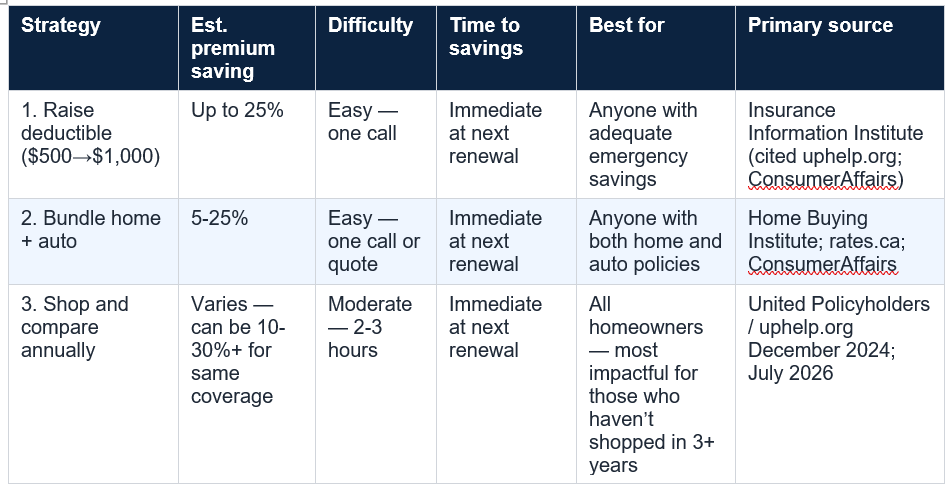
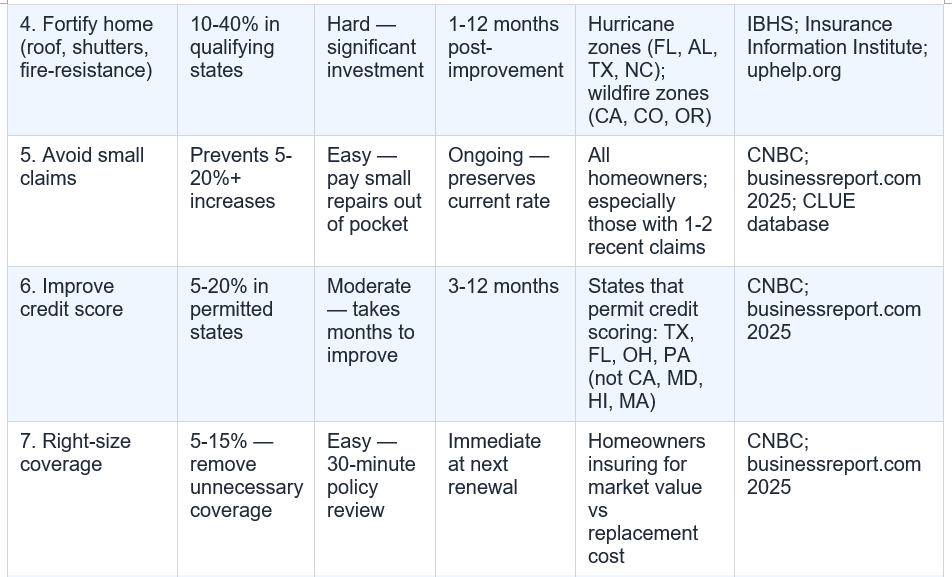
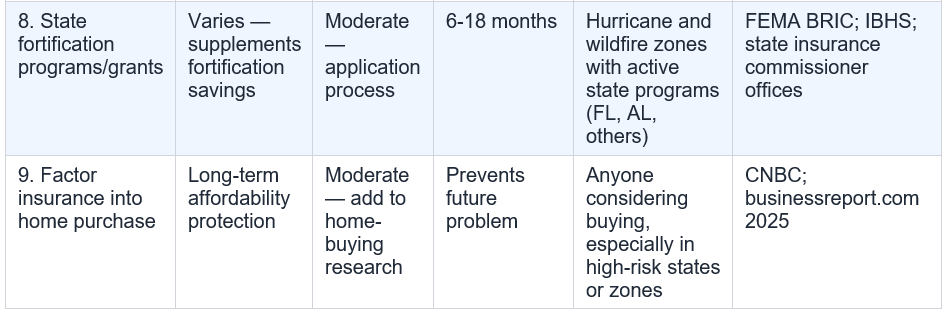
But the levers available to reduce your premium are real and significant. Raising your deductible, bundling your policies, shopping annually, and fortifying your home can combine to produce savings that are meaningful even in a market where structural forces are pushing costs upward. The fortification strategies are particularly important because they address both the premium and the risk — a stronger roof doesn’t just lower your insurance bill, it reduces the probability that you will need to use it.
The nine strategies in this article range from actions you can take this week (call your insurer, raise your deductible, get three competing quotes) to longer-term investments (IBHS roof certification, window and shutter upgrades) that pay dividends in lower premiums for years. None of them will take your bill back to what it was in 2019. But together they represent the full available toolkit for managing the cost of protecting your most valuable asset in a climate-changed world. Not financial or insurance advice. Consult a licensed insurance professional for guidance specific to your property and state.
Three forces are simultaneously driving premiums upward. First and most significant: climate change. Extreme weather events — hurricanes, wildfires, floods, and hailstorms — are increasing in frequency and severity, raising insurer payouts and forcing a systematic repricing of climate risk. Second: construction costs. Rebuilding damaged homes costs significantly more per square foot than it did five years ago, due to materials price increases and labour costs. Third: reinsurance costs. Insurance companies buy reinsurance to protect themselves against catastrophic losses; when global reinsurers raise their rates in response to record-breaking disaster years, those costs flow directly to homeowner premiums. Nationwide, premiums rose 24% between 2021 and 2024 (Consumer Federation of America April 2025), increasing more than 44% since 2019 (Home Buying Institute). Premiums are projected to rise another 8% in 2026 and 2027 (Insurify/Home Buying Institute). Trump's tariffs on building materials may add further upward pressure (ConsumerAffairs April 2025). Not insurance advice.
How much can raising my deductible save on home insurance?
Raising your home insurance deductible from $500 to $1,000 can lower your annual premium by up to 25%, according to the Insurance Information Institute, cited by both uphelp.org and ConsumerAffairs. On the current average annual premium of approximately $3,520, that represents a potential saving of up to $880 per year. Raising to $2,500 or $5,000 saves more — but requires having that amount in emergency savings that you could genuinely access without going into debt if a claim occurred. The strategy only makes financial sense if you have adequate savings to cover the higher deductible. Never raise your deductible beyond what you could realistically pay during a difficult month. In some hurricane-prone states, insurers now offer separate deductibles for wind/hurricane damage, which can be 2-5% of the dwelling coverage amount regardless of any standard deductible. Read the policy carefully. Not insurance advice.
Does bundling home and auto insurance actually save money?
Yes, in most cases. Bundling home and auto insurance with the same insurer can save between 5% and 25% on premiums (Home Buying Institute; rates.ca). The actual saving depends on your specific insurer, state, and policies. To verify the saving: get separate quotes for each policy from multiple insurers, then request a bundled quote from the same carriers. Compare the total cost of separate policies at the best individual rates against the bundled quote. In some cases, the bundle discount with one insurer is smaller than the saving from buying the best individual policies from two different insurers — so the maths is worth doing rather than assuming bundling always wins. Not insurance advice.
What home improvements lower insurance premiums the most?
The improvements with the greatest premium impact depend on your region and primary risk, but the most consistently cited include: (1) A new impact-resistant roof certified to IBHS Fortified standards — in participating states like Alabama, this can produce discounts of 25-40% from participating insurers; in hurricane zones generally, a storm-resistant roof is one of the biggest single rating factors. (2) Impact-resistant windows and storm shutters in hurricane zones. (3) Defensible space clearing and Class A fire-resistant roofing materials in wildfire zones. (4) Security improvements: burglar alarms, smoke detectors, fire sprinklers, and dead-bolt locks can all produce modest premium reductions (Insurance Information Institute). (5) Upgraded electrical, plumbing, and HVAC systems in older homes can reduce the risk of fire and water damage claims and may improve insurability in markets with age-related eligibility restrictions. All improvements should be documented with photos and receipts and reported to your insurer to ensure the discount is applied. Sources: Insurance Information Institute; IBHS; uphelp.org. Not insurance advice.
What should I do if my insurer drops me or significantly raises my rate?
First: don't panic, and don't wait. You have options, and acting quickly gives you the most of them. Steps to take: (1) Request an explanation from your insurer of the specific reason for non-renewal or rate increase — you have the right to know. (2) Shop immediately with independent insurance agents who represent multiple carriers; explain your situation; they can often find coverage where captive agents cannot. (3) Check whether your state has a FAIR Plan (Fair Access to Insurance Requirements) — these are state-supported insurers of last resort that must provide basic coverage to eligible homeowners who cannot find private insurance. (4) Contact your state insurance commissioner's office — they can provide a list of all licensed carriers in your state and often have consumer assistance resources for homeowners having coverage difficulties. (5) Consider the fortification strategies in this article, which can make your home more insurable and may open up additional market options. In California and Florida specifically, legislative changes in recent years have been aimed at stabilising the private market — Citizens Insurance in Florida requested a rate decrease for 2026, which may signal improving market conditions. Sources: uphelp.org; homebuyinginstitute.com; state insurance commissioner offices. Not insurance advice.
Table of Contents
- Why Your Home Insurance Bill Keeps Going Up
- The Three Forces Driving the Crisis
- The States Hit Hardest — And What’s Happening to Coverage
- Strategy #1: Raise Your Deductible Strategically
- Strategy #2: Bundle Home and Auto Insurance
- Strategy #3: Shop and Compare Every Year
- Strategy #4: Fortify Your Home Against Climate Risk
- Strategy #5: Avoid Small Claims — They Cost More Than You Think
- Strategy #6: Improve Your Credit Score
- Strategy #7: Review and Right-Size Your Coverage
- Strategy #8: Look Into State Fortification Programs and Grants
- Strategy #9: Factor Insurance Into Your Next Home Purchase
- The Complete Premium Reduction Comparison Table
- Conclusion: The Climate Changed. Your Insurance Strategy Has to Also.
- Frequently Asked Questions
Why Your Home Insurance Bill Keeps Going Up
If your home insurance renewal arrived this year and you did a double-take, you are in very large company. Homeowners insurance premiums climbed 24% nationwide between 2021 and 2024, according to the Consumer Federation of America’s April 2025 ‘Overburdened’ report — outpacing overall inflation by 11 percentage points. The average annual premium hit $3,303 across that period and has been projected to reach $3,520 in 2025 (Insurify). Premiums are projected to rise another 8% in both 2026 and 2027 (Home Buying Institute). Over five years from 2019 through 2024, premiums from major insurers increased by an average of 53%.The Home Buying Institute’s 2026 analysis puts the nationwide total starkly: home insurance rates have increased by more than 44% since 2019. That is not a gradual drift. It is a structural repricing of risk that is fundamentally changing the economics of homeownership. Americans collectively paid approximately $21 billion more in homeowners insurance premiums in 2024 than in prior years, per CFA data cited by United Policyholders in July 2026. And costs are rising while coverage is simultaneously shrinking: average deductibles rose 22% in 2025, meaning homeowners are paying more and getting less.
Crucially, this is not just a coastal or high-risk-state phenomenon. As nonprofit United Policyholders described in a June 2026 CNBC report: ‘The skyrocketing price of insurance premiums is deepening the housing crisis from Salt Lake City to…’ everywhere. More than 6 million American homes carry no insurance at all, per CFA’s March 2024 research — a number that grows as premiums price people out. Not financial or insurance advice.
Home insurance premium crisis (2024-2026): +24% nationwide 2021-2024, outpacing inflation by 11% (CFA April 2025). Average annual premium: $3,520 projected 2025; $3,259 in 2024 (Insurify; ConsumerAffairs April 2025). +8% projected 2026 and again in 2027 (Home Buying Institute; Insurify). +44% since 2019 nationwide (Home Buying Institute). +53% from major insurers over 5 years 2019-2024 (Home Buying Institute). Deductibles up 22% in 2025 (Home Buying Institute). $21B extra premiums paid in 2024 (CFA; United Policyholders July 2026). 6M+ homes uninsured (CFA March 2024). Louisiana/Nebraska: $500+/month ($6,000+/yr) (Bankrate February 2025). Sources cited. Not insurance advice.
The Three Forces Driving the Crisis
Home insurance premiums do not rise in isolation. Insurers are responding to three converging cost pressures that are simultaneously making them riskier to write policies and more expensive to settle claims. Understanding all three matters because only some of them are within a homeowner’s control.Climate change is the most discussed driver, and for good reason. Extreme weather events — hurricanes, wildfires, flooding, severe hailstorms, tornadoes — are increasing in both frequency and severity. Insurance companies have no choice but to factor this into their risk models. The Invading Sea’s September 2024 analysis of the insurance-climate nexus notes that there is a saying: to get someone to pay attention to climate change, put a price on it. Home insurance is now doing exactly that. The price of a climate-exposed property is increasingly visible not just in flood zone maps but in the monthly premium.
Construction costs are the second driver. Rebuilding a house that burned down or was flattened by a hurricane costs significantly more per square foot than it did five years ago, due to the same supply chain disruptions, labour shortages, and materials price increases that have affected the entire construction industry. When the payout on a claim rises, so does the premium needed to fund it. The third driver is reinsurance — the insurance that insurance companies buy to protect themselves from catastrophic losses. When global reinsurers raise their rates in response to record-breaking natural disaster years, those costs flow directly through to homeowners. As the Home Buying Institute explains: ‘When reinsurers raise rates, those costs flow directly through to homeowner premiums.’ Trump’s tariffs may also raise premiums further: sustained tariffs on building materials could make 2025 and 2026 Insurify projections conservative, per ConsumerAffairs’ April 2025 analysis. Not insurance advice.
The States Hit Hardest — And What’s Happening to Coverage
Some states are experiencing the insurance crisis in a particularly acute form. Louisiana and Nebraska now have average premiums exceeding $500 per month — more than $6,000 annually — according to Bankrate’s February 2025 report. Florida and Texas, two states disproportionately exposed to hurricanes, flooding, and severe storms, have seen some of the largest increases and the most significant market disruptions, including major insurers refusing to write new policies or pulling out of the market entirely.California’s wildfire risk has triggered a similar dynamic. Both Allstate and State Farm have stopped providing coverage to new customers in California, citing the combination of rising wildfire risk and increasing construction costs. In Florida, the state-backed Citizens Insurance — the insurer of last resort for those who cannot find private coverage — is requesting a 2.6% rate decrease for 2026, which the Home Buying Institute describes as ‘a stunning reversal’ after years of increases, potentially reflecting some stabilisation in the Florida market after significant legislative reform.
But the key point from United Policyholders and others is that this is not only a coastal or high-risk-state issue. Rates are rising across all 50 states. The specific risk drivers differ by location — wildfires in the West, hurricanes in the Southeast, flooding in the Midwest, hailstorms in Texas and Nebraska — but the systemic repricing of climate risk is a nationwide phenomenon. As the uphelp.org December 2024 analysis puts it: ‘Though certain areas are more at risk for the effects of climate change, this is a national issue.’ Not insurance advice.
Strategy #1: Raise Your Deductible Strategically
The deductible is the amount you pay out of pocket when you file a claim before the insurance coverage kicks in. Raising it is one of the fastest ways to reduce your annual premium, and the savings can be substantial. The Insurance Information Institute, cited by both uphelp.org and ConsumerAffairs, notes that raising your deductible from $500 to $1,000 can lower your annual premium by up to 25%. That is a meaningful reduction on a $3,520 average premium — potentially $880 per year saved.The trade-off is simple but important: a higher deductible means more money out of your own pocket if something goes wrong. The strategy only makes sense financially if you have an emergency fund that can cover the higher deductible amount without stress. Do not raise your deductible beyond what you could realistically pay in an emergency. If your current savings cannot cover a $2,500 or $5,000 deductible, raising to that level creates a different kind of financial vulnerability. The sweet spot for most homeowners is finding the highest deductible you could genuinely afford to pay in a bad month. Not insurance or financial advice.
Deductible savings: raising from $500 to $1,000 can save up to 25% annually. On the $3,520 average premium, that’s up to $880/year. Raising to $2,500 or $5,000 saves more but requires having that amount accessible in emergency savings. Rule: never raise your deductible above what you could pay without going into debt. Source: Insurance Information Institute (cited uphelp.org July 2026; ConsumerAffairs April 2025). Not insurance advice.
Strategy #2: Bundle Home and Auto Insurance
Bundling your home and auto insurance with the same insurer is one of the simplest, most reliable premium-reduction strategies available — and it requires no changes to your home or your coverage. Most major insurers offer a multi-policy discount when you combine home and auto under the same policy umbrella. The Home Buying Institute cites a possible 5-25% discount on premiums from bundling. The rates.ca climate insurance guide similarly lists bundling as a primary cost-reduction strategy.The actual saving depends on your specific insurer and state, but the discount is widely available and requires only a phone call or online quote request to investigate. The secondary benefit of bundling is simplicity — one insurer, one renewal date, one contact for claims. The caution: bundling means you have one relationship with one insurer, which means switching carriers for a better rate on either policy requires unbundling both. Do the maths every couple of years to ensure the bundle discount still beats the savings from switching. Not insurance advice.
Strategy #3: Shop and Compare Every Year
Most homeowners renew their insurance automatically and let the rate drift upward year after year. This is one of the most expensive passive financial habits you can have in a rapidly rising insurance market. Shopping for the same level of coverage with competing insurers every year — or at minimum every two to three years — is consistently cited by experts as one of the most impactful premium-reduction strategies available.United Policyholders and their financial expert Heller, quoted in the organisation’s December 2024 guide, recommend a three-channel approach: research online through comparison platforms, get a quote directly from a brand-name insurer, and also work with an independent insurance agent who can access multiple carriers simultaneously. The independence of the third-party agent is valuable: unlike a captive agent who represents only one insurer, an independent agent can identify the carrier that prices your specific risk profile most favourably.
The misconception that loyalty is rewarded in insurance is worth dispelling directly. Many insurers offer their most competitive rates to new customers. Long-standing customers who renew without shopping often pay a ‘loyalty penalty’ — a higher rate than a new customer would receive for the same policy. In a market where rates are rising 8% annually, the loyalty penalty compounds quickly. Shopping annually protects against it. Not insurance advice.
Annual shopping checklist: (1) 60 days before renewal, get three quotes for the same coverage level: one online, one from a brand-name carrier, one from an independent agent. (2) Compare the dwelling coverage limit (replacement cost, not market value), the deductible, and the exclusions — not just the premium. (3) Check the insurer's claims handling reputation (AM Best rating; J.D. Power satisfaction scores) alongside the price. (4) If you find a better rate: call your current insurer first — they may match it to retain you. (5) Switch if they won’t match. Source: uphelp.org December 2024 (Heller recommendations); United Policyholders July 2026. Not insurance advice.
Strategy #4: Fortify Your Home Against Climate Risk
This is the strategy that addresses the root cause of rising premiums rather than just the pricing mechanics. Physical improvements that reduce the likelihood and severity of weather-related damage lower the insurer’s risk — and many insurers will reward that reduced risk with a lower premium. The specific improvements that carry the most weight depend on your region and the primary climate risks you face.For hurricane-prone areas: storm shutters, impact-resistant windows and doors, and a reinforced roof (especially a hip roof rather than a gable roof) all reduce the likelihood of catastrophic hurricane damage. The Insurance Institute for Business & Home Safety (IBHS) has developed a specific fortification standard for wind and hail resistance, and homes certified to this standard can qualify for significant discounts in participating states. For wildfire-prone areas: defensible space clearing, Class A fire-resistant roofing materials, non-combustible siding, and ember-resistant vents can reduce both damage risk and insurance costs.
The uphelp.org July 2026 analysis notes that physical improvements to strengthen a home against weather damage can lower premiums over time. The Insurance Information Institute adds security improvements to the list: installing burglar alarms, dead-bolt locks, smoke detectors, and fire sprinklers can all produce premium reductions. These are not just safety measures — they are investments in a lower insurance cost basis for as long as you own the home. Not insurance advice.
Fortification ROI: a new impact-resistant roof that qualifies for an IBHS Fortified designation can reduce hurricane/hail premiums by 20-40% in participating states (Alabama Fortified Home program, for example, reports average discounts of 25-40%). Defensible space around your home in wildfire zones can affect insurability itself in California and other western markets. Document all improvements with photos and receipts for your insurer. Source: IBHS; uphelp.org July 2026; Insurance Information Institute. Not insurance advice.
Strategy #5: Avoid Small Claims — They Cost More Than You Think
Home insurance exists to protect you from catastrophic, unaffordable losses. It is not designed to be used for every leaky faucet or dented gutter. Filing small claims — anything under $2,000-3,000 depending on your premium and deductible — can cost you far more in premium increases at renewal than the claim was worth. And in high-risk markets, a pattern of claims can make you non-renewable.CNBC’s businessreport.com 2025 analysis lists avoiding small claims as one of the key strategies for managing insurance costs. The mechanism works like this: every claim you file is recorded in the CLUE (Comprehensive Loss Underwriting Exchange) database, which insurers check when pricing your policy or deciding whether to renew it. A homeowner with two or three claims in three years may face steep rate increases, a higher deductible requirement, or even non-renewal — particularly in markets where insurers are already reducing their exposure.
The practical rule: treat your home insurance like catastrophic coverage and pay for minor repairs out of pocket. If a storm damages your fence and the repair costs $800, and your deductible is $1,000, paying it yourself keeps your record clean. If a tree falls on your roof and the damage is $25,000, file the claim — that is exactly what insurance is for. The line depends on your specific policy, premium, and claims history, but the principle is consistent. Not insurance advice.
The small claims trap: a single $1,500 claim can trigger a $200-$500/year premium increase that persists for 3-5 years, costing you $600-$2,500 in total extra premiums — more than the claim paid out. Worse, multiple claims in a short window can make you uninsurable in your current market, forcing you into a state insurer of last resort at significantly higher cost. The CLUE database records your claims history for 7 years. Source: CNBC; businessreport.com 2025; CLUE database (LexisNexis). Not insurance advice.
Strategy #6: Improve Your Credit Score
In most US states, insurers are permitted to use credit-based insurance scores as a factor in setting homeowners insurance premiums. A higher credit score is associated with lower insurance claims rates in actuarial studies, and insurers price this accordingly. Homeowners with excellent credit scores (typically 750+) generally pay lower premiums than those with fair or poor credit for otherwise identical policies.CNBC’s report cited by businessreport.com 2025 specifically lists improving your credit score as one of the seven strategies for reducing homeowners insurance costs. The practical actions: check your credit report for errors and dispute any inaccuracies (free at AnnualCreditReport.com); pay down revolving credit balances to improve your credit utilisation ratio; avoid opening multiple new credit accounts in a short period. Not every state allows credit scoring in insurance — California, Maryland, Hawaii, and Massachusetts restrict or prohibit it. If you live in a state that permits it, improving your credit is one of the few strategies that improves both your borrowing costs and your insurance costs simultaneously. Not financial or insurance advice.
Strategy #7: Review and Right-Size Your Coverage
Many homeowners are paying premiums on coverage they don’t need and simultaneously underinsured on the coverage they do. A coverage review — done every two to three years or whenever major life or property changes occur — can identify both problems. The most common overpayment: insuring for the market value or purchase price of your home rather than the dwelling replacement cost. Market value includes land, which cannot burn down or blow away. If your home’s replacement cost is $350,000 but you’re insuring for a $550,000 market value, you are overpaying on your premium.The most common underinsurance: failing to update the dwelling replacement cost as construction costs rise. If your home was insured for $300,000 to rebuild five years ago, and construction costs have risen 25-40% in your area, your current insurance limit may be $75,000-$120,000 short of what it would actually cost to rebuild. Being underinsured is far more dangerous than overpaying on a premium, because you discover it at the worst possible moment — after a disaster, when you need every dollar the policy provides.
Other right-sizing actions: remove scheduled personal property coverage for items you no longer own; review detached structure coverage if you have demolished or no longer use an outbuilding; check whether a home office endorsement or business liability coverage is needed (or not needed). The goal is neither the cheapest policy nor the most expensive one — it is the most accurately matched one. Not insurance advice.
Strategy #8: Look Into State Fortification Programs and Grants
Some states have recognised that retrofitting homes for climate resilience is both a personal and a public benefit, and have created programs to help homeowners do it. The best-known example is Alabama’s FORTIFIED Home program, which provides a pathway for homeowners to certify their homes against wind damage and qualify for insurance discounts from participating carriers. Some states offer outright grants or low-interest loans for qualifying improvements.At the federal level, FEMA’s BRIC program (Building Resilient Infrastructure and Communities) and the Hazard Mitigation Grant Program can provide funding for qualifying improvements in disaster-declared areas. These programs are not always widely publicised, and eligibility varies by location and program cycle. Checking with your state insurance commissioner’s office and your county emergency management agency is the most reliable way to find currently available programs. The improvements that qualify for these programs — wind-resistant roofing, flood-resistant construction, wildfire defensible space — also tend to produce the most significant insurance discounts. Not financial or insurance advice.
Strategy #9: Factor Insurance Into Your Next Home Purchase
This strategy applies to anyone considering buying a home in the current market: the insurance cost of a property should be part of the purchase decision alongside the mortgage payment and property taxes. A home in a flood zone, a wildfire-prone area, or a hurricane corridor may be priced attractively on the listing — but the insurance cost that comes with it can fundamentally change whether the total housing cost is affordable.CNBC’s businessreport.com 2025 analysis lists ‘weighing insurance costs when buying a home’ as one of the key strategies for managing homeowners insurance costs. The practical step: before making an offer, request an insurance quote for the specific property. Your mortgage broker or real estate agent may be able to help identify properties in risk zones, but an actual quote from two or three insurers gives you the real number. In markets where major insurers have withdrawn — parts of California, Florida, and coastal areas generally — you may find that the only available coverage is through the state insurer of last resort at significantly elevated cost. That cost belongs in your affordability calculation. Not financial or insurance advice.
The Complete Premium Reduction Comparison Table
The table below summarises all nine strategies with estimated savings, difficulty level, and the primary source for each. Not all strategies apply to every homeowner or state. Verify estimated savings with your specific insurer. Not insurance advice.
Conclusion
The home insurance market has been fundamentally repriced by climate change, and that repricing is not finished. Premiums are projected to rise another 8% in 2026 and 8% more in 2027. Average deductibles are rising simultaneously. Insurers are pulling out of the highest-risk markets entirely. The era of renewing automatically and paying without thought is over for most American homeowners.But the levers available to reduce your premium are real and significant. Raising your deductible, bundling your policies, shopping annually, and fortifying your home can combine to produce savings that are meaningful even in a market where structural forces are pushing costs upward. The fortification strategies are particularly important because they address both the premium and the risk — a stronger roof doesn’t just lower your insurance bill, it reduces the probability that you will need to use it.
The nine strategies in this article range from actions you can take this week (call your insurer, raise your deductible, get three competing quotes) to longer-term investments (IBHS roof certification, window and shutter upgrades) that pay dividends in lower premiums for years. None of them will take your bill back to what it was in 2019. But together they represent the full available toolkit for managing the cost of protecting your most valuable asset in a climate-changed world. Not financial or insurance advice. Consult a licensed insurance professional for guidance specific to your property and state.
15. Frequently Asked Questions
Why are home insurance rates rising so fast in 2025 and 2026?Three forces are simultaneously driving premiums upward. First and most significant: climate change. Extreme weather events — hurricanes, wildfires, floods, and hailstorms — are increasing in frequency and severity, raising insurer payouts and forcing a systematic repricing of climate risk. Second: construction costs. Rebuilding damaged homes costs significantly more per square foot than it did five years ago, due to materials price increases and labour costs. Third: reinsurance costs. Insurance companies buy reinsurance to protect themselves against catastrophic losses; when global reinsurers raise their rates in response to record-breaking disaster years, those costs flow directly to homeowner premiums. Nationwide, premiums rose 24% between 2021 and 2024 (Consumer Federation of America April 2025), increasing more than 44% since 2019 (Home Buying Institute). Premiums are projected to rise another 8% in 2026 and 2027 (Insurify/Home Buying Institute). Trump's tariffs on building materials may add further upward pressure (ConsumerAffairs April 2025). Not insurance advice.
How much can raising my deductible save on home insurance?
Raising your home insurance deductible from $500 to $1,000 can lower your annual premium by up to 25%, according to the Insurance Information Institute, cited by both uphelp.org and ConsumerAffairs. On the current average annual premium of approximately $3,520, that represents a potential saving of up to $880 per year. Raising to $2,500 or $5,000 saves more — but requires having that amount in emergency savings that you could genuinely access without going into debt if a claim occurred. The strategy only makes financial sense if you have adequate savings to cover the higher deductible. Never raise your deductible beyond what you could realistically pay during a difficult month. In some hurricane-prone states, insurers now offer separate deductibles for wind/hurricane damage, which can be 2-5% of the dwelling coverage amount regardless of any standard deductible. Read the policy carefully. Not insurance advice.
Does bundling home and auto insurance actually save money?
Yes, in most cases. Bundling home and auto insurance with the same insurer can save between 5% and 25% on premiums (Home Buying Institute; rates.ca). The actual saving depends on your specific insurer, state, and policies. To verify the saving: get separate quotes for each policy from multiple insurers, then request a bundled quote from the same carriers. Compare the total cost of separate policies at the best individual rates against the bundled quote. In some cases, the bundle discount with one insurer is smaller than the saving from buying the best individual policies from two different insurers — so the maths is worth doing rather than assuming bundling always wins. Not insurance advice.
What home improvements lower insurance premiums the most?
The improvements with the greatest premium impact depend on your region and primary risk, but the most consistently cited include: (1) A new impact-resistant roof certified to IBHS Fortified standards — in participating states like Alabama, this can produce discounts of 25-40% from participating insurers; in hurricane zones generally, a storm-resistant roof is one of the biggest single rating factors. (2) Impact-resistant windows and storm shutters in hurricane zones. (3) Defensible space clearing and Class A fire-resistant roofing materials in wildfire zones. (4) Security improvements: burglar alarms, smoke detectors, fire sprinklers, and dead-bolt locks can all produce modest premium reductions (Insurance Information Institute). (5) Upgraded electrical, plumbing, and HVAC systems in older homes can reduce the risk of fire and water damage claims and may improve insurability in markets with age-related eligibility restrictions. All improvements should be documented with photos and receipts and reported to your insurer to ensure the discount is applied. Sources: Insurance Information Institute; IBHS; uphelp.org. Not insurance advice.
What should I do if my insurer drops me or significantly raises my rate?
First: don't panic, and don't wait. You have options, and acting quickly gives you the most of them. Steps to take: (1) Request an explanation from your insurer of the specific reason for non-renewal or rate increase — you have the right to know. (2) Shop immediately with independent insurance agents who represent multiple carriers; explain your situation; they can often find coverage where captive agents cannot. (3) Check whether your state has a FAIR Plan (Fair Access to Insurance Requirements) — these are state-supported insurers of last resort that must provide basic coverage to eligible homeowners who cannot find private insurance. (4) Contact your state insurance commissioner's office — they can provide a list of all licensed carriers in your state and often have consumer assistance resources for homeowners having coverage difficulties. (5) Consider the fortification strategies in this article, which can make your home more insurable and may open up additional market options. In California and Florida specifically, legislative changes in recent years have been aimed at stabilising the private market — Citizens Insurance in Florida requested a rate decrease for 2026, which may signal improving market conditions. Sources: uphelp.org; homebuyinginstitute.com; state insurance commissioner offices. Not insurance advice.
0 Comments
Be the first to share your thoughts on this article.