

Retirement
How to Retire at 50: The Complete Guide

Key Statistics & Figures: The FIRE rule: accumulate 25x your annual expenses; withdraw 4% per year. If spending $40,000/year: FIRE number = $1,000,000. If spending $60,000/year: FIRE number = $1,500,000. Retiring at 50 in the US means you cannot access 401(k) penalty-free until 59½ (or 55 with Rule of 55); Social Security not available until 62 (reduced) or 67 (full). Retiring at 50 in the UK means 7 years before pension access at 57 (rising to 57 from 2028); 16 years before State Pension at 66. UK State Pension 2026/27: £221.20/week (£11,502/year) — requires 35 NI qualifying years. UK Pension access age: currently 55, rising to 57 in 2028. UK ISA annual allowance: £20,000/year. UK SIPP annual allowance: up to £60,000 (or 100% of earnings). US 401(k) 2026 limit: $23,500 ($31,000 for age 50+). US IRA 2026 limit: $7,000 ($8,000 for age 50+). T. Rowe Price: a 15% savings rate works for retiring at 65; to retire at 50, most FIRE followers save 50%+ of income. Savings rate determines retirement date more than any other variable. 40-year-old saving £2,000/month at 7%: reaches £1,000,000 in approximately 16 years (at 56). Mintos (June 2026): FIRE followers typically save 25–50% of income.
The FIRE movement — Financial Independence, Retire Early — has documented in significant detail the specific financial steps that make leaving full-time work at 50 achievable for people on ordinary incomes. Not lottery winners. Not tech executives with equity packages. People who make deliberate decisions about savings rate, investment allocation, account structure, and lifestyle cost, starting in their 20s or 30s, and execute those decisions consistently.
According to Mintos’ June 2026 FIRE analysis, thousands of FIRE followers save between 25 and 50 percent of their income and generate passive income streams from investments that fund their lifestyle. T. Rowe Price is specific about the savings rate threshold: a 15 percent savings rate is appropriate for someone targeting retirement at 65. To retire at 50, most FIRE followers save 30 percent or more. Many save 50 percent or higher.
This guide provides the complete framework for retiring at 50: the FIRE number calculation, the pension gap problem, the savings rate required, the exact account structure for UK and US residents, the investment approach, and the risks to plan for. It is not a shortcut. It is a map.
The FIRE application of this finding:
FIRE Number: Annual expenses × 25 = FIRE Number. Your FIRE number is the total invested portfolio you need to retire. You then withdraw 4% per year, which equals your annual expenses.
Example: you spend $48,000 per year. $48,000 multiplied by 25 equals $1,200,000. That is your FIRE number. When your invested portfolio reaches $1.2 million, you can withdraw $48,000 per year (4% of $1.2 million) and, based on historical data, your portfolio should last indefinitely.
Important caveats noted by UKCalc’s May 2026 FIRE analysis: the 4% rule was derived from a 30-year retirement period. Someone retiring at 50 has a potential 40 to 50-year retirement. For longer retirement durations, a more conservative 3.5% or even 3.25% withdrawal rate is often recommended, which increases the FIRE number to 28.5 or 30.8 times annual expenses respectively.
The Pocketwise UK FIRE guide (April 2026) also identifies the three key variables that affect the FIRE number in practice: what your actual expenses are (most people underestimate); how long you will live (longer life requires a larger number); and investment returns and inflation, particularly the sequence-of-returns risk — the danger of poor market performance in the early years of retirement permanently depleting a portfolio.
Current annual spending is the starting point, but retirement spending differs from working-year spending in specific ways: work-related costs (commuting, work clothing, professional costs, childcare) disappear; housing costs may change if you downsize or relocate; healthcare costs must be explicitly budgeted; and leisure spending may initially increase in the active early years of retirement.
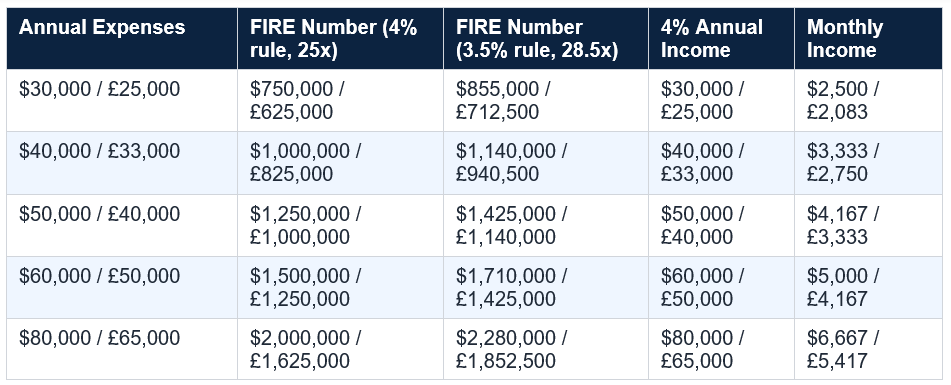
The table uses approximate exchange rates and is for illustrative purposes. The most important insight from the table: the FIRE number is entirely determined by your lifestyle cost. Reducing annual expenses from $60,000 to $40,000 reduces your FIRE number by $500,000 — a saving that could represent three to five years of additional working time. Lifestyle cost management is not a sacrifice. It is a lever that directly controls the retirement date.
Action Step: Write down every monthly expense. Multiply by 12. Add any irregular annual costs. This is your current annual spend. Subtract work-related costs that will disappear at retirement. Add any new retirement costs (healthcare, travel, hobbies). Multiply the result by 25. That is your FIRE number.
In both the UK and the US, pension and retirement accounts are specifically designed to be accessed in later life. Accessing them early carries penalties (US) or is not possible at all until a minimum age (UK). Retiring at 50 without having a plan for the pension gap means discovering that a significant portion of your accumulated wealth is locked away for another 7 to 17 years.
The FIRE solution to the pension gap is the bridge: a portfolio of non-pension assets (ISAs in the UK, Roth IRAs and taxable brokerage accounts in the US) that fund the years between retirement and pension access, after which the pension takes over as the primary income source.
Action Step: If you retire at 50 with fewer than 35 NI qualifying years, check the cost of filling the gap through voluntary Class 3 NI contributions. Each additional qualifying year is currently approximately £824 and adds approximately £300 per year to your State Pension. That is a 36% annual return — one of the best guaranteed returns available to UK residents.
The relationship between savings rate and years to retirement is counterintuitive because a higher savings rate has a double effect: it increases the amount you invest each year, and it simultaneously reduces your annual expenses — which reduces your FIRE number. A household that saves 50% of its income is both accumulating faster and needs a smaller portfolio to retire, because it has demonstrated the ability to live comfortably on half its income.
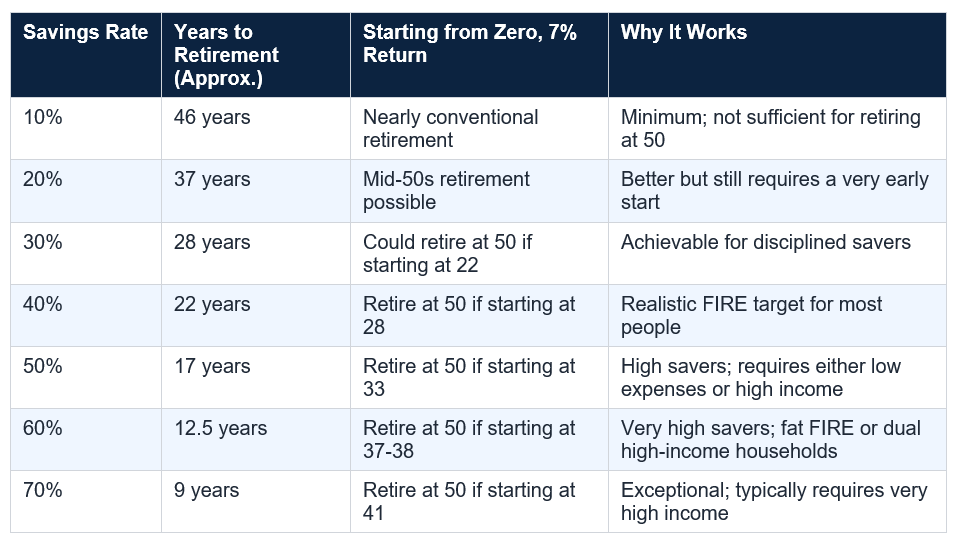
The table assumes a 7% real return (approximately 10% nominal minus 3% inflation) and starting from zero. It confirms that retiring at 50 is most achievable for people who start saving aggressively in their late 20s or early 30s and maintain a savings rate of 40 to 50% consistently. Starting later requires either a higher savings rate or a higher income (or both).
To reach £1,000,000 by age 50 from the same starting point (40 years old, £100,000 saved), the required monthly contribution at 7% return is approximately £3,500 to £4,000 per month — achievable for dual-income households with controlled expenses, but demanding for single-income households with typical mortgage and living costs.
The maths is not designed to discourage. It is designed to calibrate. Retiring at exactly 50 is one target. Retiring at 55, at 52, or at 53 are equally valid targets that require progressively less savings intensity. The FIRE framework is a spectrum, not a binary. Every year earlier than conventional retirement represents years of freedom that have genuine financial and psychological value.
Action Step: Use a compound interest calculator with your current savings, your monthly contribution, your estimated investment return, and your FIRE number to calculate your specific retirement date. MoneySavingExpert (UK) and Bankrate (US) both have free, accessible calculators. Run the calculation with your actual numbers, not hypothetical ones.
The solution in both the UK and the US is a layered approach: fill the most tax-efficient accounts first (pension/SIPP/401(k)), then fill the most flexible accounts (ISA/Roth IRA), then use general taxable accounts for any surplus. The order of this waterfall determines both the tax efficiency of accumulation and the flexibility of access at retirement.
The core investment approach:
The specific debt priorities before retirement at 50:
The steps are clear: calculate your FIRE number (25 times annual expenses); understand and plan for the pension gap; achieve a savings rate of 40 to 50 percent; use the most tax-efficient account structure available in your country (ISA and SIPP in the UK; Roth IRA and 401(k) in the US); invest in low-cost globally diversified index funds; eliminate debt before retirement; and build at least one income stream beyond pure portfolio withdrawal.
None of this is guaranteed. Markets fluctuate. Laws change. Life is unpredictable. But the FIRE framework is the most evidence-based approach to early retirement available, and thousands of people globally have followed it to exactly the outcome this article describes. The road is long. The maths is not complicated. The start is the only step that requires a decision rather than a continuation.
Using the 4% rule (FIRE framework), you need 25 times your expected annual retirement expenses. If you plan to spend $50,000 per year in retirement, your FIRE number is $1.25 million. For a 40-plus-year retirement (from 50 to 90+), a more conservative withdrawal rate of 3.5% is often recommended, which means 28.5 times annual expenses — $1.425 million for $50,000 annual spending. In the UK, the State Pension (£11,502/year in 2026/27) reduces the portfolio withdrawal you need from age 66, which meaningfully reduces the total FIRE number for UK residents.
Can I access my pension at 50?
In the US, traditional 401(k) and IRA withdrawals before age 59½ incur a 10% early withdrawal penalty plus income tax. Exceptions include Roth IRA contribution withdrawals (penalty-free at any age), the Rule of 55 (for certain 401(k)s if you leave employment at 55+), and the SEPP/72(t) rule which allows penalty-free equal periodic payments from any retirement account at any age. In the UK, the minimum pension access age is currently 55, rising to 57 in 2028. Retiring at 50 means funding the years from 50 to 57 from ISA or other non-pension assets in the UK.
What savings rate do I need to retire at 50?
T. Rowe Price’s early retirement analysis finds that a 15% savings rate is sufficient for retiring at 65; retiring at 50 typically requires 30% or more. Mintos’ June 2026 FIRE analysis found that most FIRE followers save 25 to 50% of income. A household that starts saving aggressively at 28 and maintains a 50% savings rate for 22 years can reach most FIRE targets. Starting later or at a lower savings rate is possible but requires either a higher income or acceptance of a later FIRE date.
What is the pension gap and how do I bridge it?
The pension gap is the period between early retirement (age 50) and the age at which pension income becomes accessible — 57 in the UK (from 2028) and 59½ in the US. During the gap years, you must fund your lifestyle entirely from non-pension assets. In the UK, the ISA (no access age restriction) is the primary bridge account. In the US, Roth IRA contributions (which can be withdrawn at any age without penalty), HSA funds, taxable brokerage accounts, and SEPP/72(t) withdrawals from retirement accounts are the main bridge strategies
What is the FIRE movement?
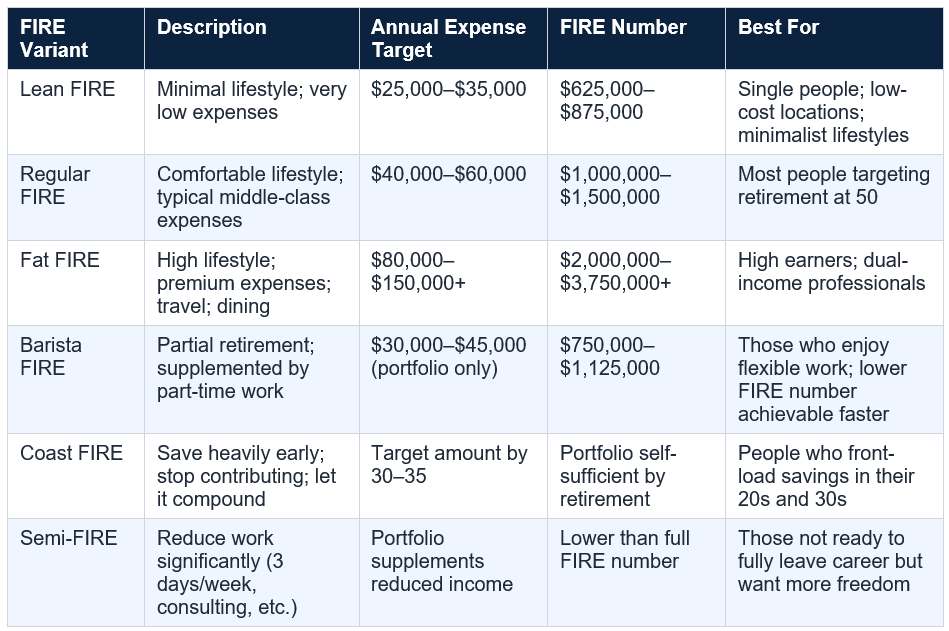
FIRE stands for Financial Independence, Retire Early. It is a movement and financial planning framework built around accumulating 25 times your annual expenses (the FIRE number) and then withdrawing 4% per year, historically a sustainable withdrawal rate. FIRE followers typically save 25 to 50% of their income and invest in low-cost index funds. The movement includes variants: Lean FIRE (low expenses, smaller target), Fat FIRE (high expenses, larger target), Barista FIRE (partial retirement supplemented by part-time work), and Coast FIRE (front-load saving early and let it compound).
What is the biggest risk of retiring at 50?
For US residents, the biggest practical risks are healthcare costs (15 years of private insurance before Medicare) and sequence-of-returns risk (a severe market decline in the first decade of retirement can permanently reduce portfolio longevity). For UK residents, the key risks are longevity (a 40-to-50-year retirement is significantly longer than the 30-year period the 4% rule was designed for), tax and pension rule changes, and the challenge of maintaining sufficient NI contributions for the full State Pension. For both: all projections are hypothetical and past performance is not indicative of future results.
Do I need a financial adviser to plan for retiring at 50?
Working with a qualified financial adviser is strongly recommended for early retirement planning. The complexity involves pension access rules, tax planning across multiple account types, healthcare planning (particularly in the US), estate planning, and the construction of a sustainable drawdown strategy. The Pocketwise UK FIRE guide (April 2026) and the Campaign for a Million UK guide (April 2026) both explicitly note that FIRE planning involves complex long-term projections and professional advice is worthwhile. This article provides the framework; a qualified adviser provides the personalised implementation.
Table of Contents
- Retiring at 50 Is Not a Fantasy
- The FIRE Framework: The Only Retirement Maths You Need
- Step 1: Calculate Your FIRE Number
- Step 2: Understand the Pension Gap Problem
- The Pension Gap — UK Specifics
- The Pension Gap — US Specifics
- Step 3: Calculate the Savings Rate You Actually Need
- The Savings Rate Table: How Long Will It Take?
- Step 4: Build the Right Account Structure
- UK Account Stack: SIPP, ISA, and GIA
- US Account Stack: 401(k), Roth IRA, and Taxable Brokerage
- Step 5: Invest in the Right Things
- Step 6: Eliminate Debt Before You Retire
- Step 7: Build Multiple Income Streams
- The FIRE Variants: Which One Is Right for You?
- The Risks: What Could Go Wrong
- Conclusion: The Road Is Long. The Start Is Now.
- Frequently Asked Questions
Retiring at 50 Is Not a Fantasy
Retiring at 50 is not what most people’s financial plans look like. The conventional timeline — work until 65, draw a pension, receive Social Security or the State Pension, live on the combined income — is built around a retirement age that is 15 years later than what this article addresses. Fifteen years is a long time. It is also a choice.The FIRE movement — Financial Independence, Retire Early — has documented in significant detail the specific financial steps that make leaving full-time work at 50 achievable for people on ordinary incomes. Not lottery winners. Not tech executives with equity packages. People who make deliberate decisions about savings rate, investment allocation, account structure, and lifestyle cost, starting in their 20s or 30s, and execute those decisions consistently.
According to Mintos’ June 2026 FIRE analysis, thousands of FIRE followers save between 25 and 50 percent of their income and generate passive income streams from investments that fund their lifestyle. T. Rowe Price is specific about the savings rate threshold: a 15 percent savings rate is appropriate for someone targeting retirement at 65. To retire at 50, most FIRE followers save 30 percent or more. Many save 50 percent or higher.
This guide provides the complete framework for retiring at 50: the FIRE number calculation, the pension gap problem, the savings rate required, the exact account structure for UK and US residents, the investment approach, and the risks to plan for. It is not a shortcut. It is a map.
The FIRE Framework: The Only Retirement Maths You Need
The mathematical foundation of the FIRE movement is elegant in its simplicity. It derives from the 4% rule — a finding from the US Trinity Study (1998) which examined historical equity and bond portfolio performance and concluded that a portfolio could sustain annual withdrawals of 4% of its starting value indefinitely, adjusted for inflation, without being depleted over a 30-year period.The FIRE application of this finding:
FIRE Number: Annual expenses × 25 = FIRE Number. Your FIRE number is the total invested portfolio you need to retire. You then withdraw 4% per year, which equals your annual expenses.
Example: you spend $48,000 per year. $48,000 multiplied by 25 equals $1,200,000. That is your FIRE number. When your invested portfolio reaches $1.2 million, you can withdraw $48,000 per year (4% of $1.2 million) and, based on historical data, your portfolio should last indefinitely.
Important caveats noted by UKCalc’s May 2026 FIRE analysis: the 4% rule was derived from a 30-year retirement period. Someone retiring at 50 has a potential 40 to 50-year retirement. For longer retirement durations, a more conservative 3.5% or even 3.25% withdrawal rate is often recommended, which increases the FIRE number to 28.5 or 30.8 times annual expenses respectively.
The Pocketwise UK FIRE guide (April 2026) also identifies the three key variables that affect the FIRE number in practice: what your actual expenses are (most people underestimate); how long you will live (longer life requires a larger number); and investment returns and inflation, particularly the sequence-of-returns risk — the danger of poor market performance in the early years of retirement permanently depleting a portfolio.
Step 1: Calculate Your FIRE Number
Calculating your personal FIRE number requires two inputs: your annual expenses in retirement and your chosen withdrawal rate. Most people find that calculating their actual annual expenses honestly is the most revealing step in the process.Current annual spending is the starting point, but retirement spending differs from working-year spending in specific ways: work-related costs (commuting, work clothing, professional costs, childcare) disappear; housing costs may change if you downsize or relocate; healthcare costs must be explicitly budgeted; and leisure spending may initially increase in the active early years of retirement.
The table uses approximate exchange rates and is for illustrative purposes. The most important insight from the table: the FIRE number is entirely determined by your lifestyle cost. Reducing annual expenses from $60,000 to $40,000 reduces your FIRE number by $500,000 — a saving that could represent three to five years of additional working time. Lifestyle cost management is not a sacrifice. It is a lever that directly controls the retirement date.
Action Step: Write down every monthly expense. Multiply by 12. Add any irregular annual costs. This is your current annual spend. Subtract work-related costs that will disappear at retirement. Add any new retirement costs (healthcare, travel, hobbies). Multiply the result by 25. That is your FIRE number.
Step 2: Understand the Pension Gap Problem
The most underappreciated challenge in retiring at 50 — and the one that catches the most people unprepared — is not the size of the FIRE number. It is the pension gap: the years between age 50 and the age at which you can access pension funds without penalty.In both the UK and the US, pension and retirement accounts are specifically designed to be accessed in later life. Accessing them early carries penalties (US) or is not possible at all until a minimum age (UK). Retiring at 50 without having a plan for the pension gap means discovering that a significant portion of your accumulated wealth is locked away for another 7 to 17 years.
The FIRE solution to the pension gap is the bridge: a portfolio of non-pension assets (ISAs in the UK, Roth IRAs and taxable brokerage accounts in the US) that fund the years between retirement and pension access, after which the pension takes over as the primary income source.
The Pension Gap — UK Specifics
For UK residents, retiring at 50 creates the following specific timeline challenges, as documented by Pocketwise (April 2026) and UKCalc (May 2026):- Pension access age: currently 55 (Minimum Pension Age), rising to 57 in 2028 and scheduled to track 10 years below State Pension age thereafter. Retiring at 50 means 5 to 7 years before pension access, even on the minimum pension access date.
- State Pension age: 66, rising to 67 by 2028. To receive the full new State Pension of £221.20 per week (£11,502 per year) in 2026/27, you need 35 qualifying years of National Insurance contributions. Retiring at 50 with 20 NI qualifying years means you will not have the full 35 years at 66 unless you make voluntary NI contributions during retirement.
- ISA (Individual Savings Account): up to £20,000 per year, no access age restriction, all growth and income tax-free. This is the primary bridge account — the source of income from age 50 to age 57 (pension access) and potentially beyond.
- SIPP (Self-Invested Personal Pension): up to £60,000 per year (or 100% of earnings), access from 57 in 2028. The most tax-efficient wealth-building vehicle because of 20 to 45% tax relief on contributions, but locked until 57. For a 40-year-old, this is still 17 years of compound growth before access.
- GIA (General Investment Account): for savings above the ISA and SIPP allowances. Subject to CGT on gains (18%/24% after the 2024 Budget). Use only after maxing ISA and SIPP.
Action Step: If you retire at 50 with fewer than 35 NI qualifying years, check the cost of filling the gap through voluntary Class 3 NI contributions. Each additional qualifying year is currently approximately £824 and adds approximately £300 per year to your State Pension. That is a 36% annual return — one of the best guaranteed returns available to UK residents.
The Pension Gap — US Specifics
For US residents, retiring at 50 creates the following specific timeline challenges:- 401(k) early withdrawal penalty: withdrawals from a traditional 401(k) before age 59½ incur a 10% early withdrawal penalty plus ordinary income tax. This effectively makes most 401(k) funds inaccessible without significant cost from age 50 to 59½.
- The Rule of 55 exception: if you leave your employer in the calendar year you turn 55 or later, you can withdraw from that employer’s 401(k) without the 10% penalty. This does not apply to IRAs and applies only to the current employer’s plan. For a retirement at 50, this exception does not help.
- Roth IRA contributions (not earnings) can be withdrawn at any age without penalty or tax: this is a critical distinction. If you have made Roth IRA contributions of $50,000 over the years, you can withdraw those $50,000 at any age. Only the earnings within the Roth are subject to the 5-year rule and age restrictions.
- SEPP (Substantially Equal Periodic Payments / Rule 72(t)): allows penalty-free withdrawals from any retirement account at any age, provided you take a series of substantially equal payments for at least 5 years or until age 59½, whichever is longer. This is a legitimate bridge strategy for US early retirees, but it requires careful structuring and locks in the payment amount once started.
- Social Security: not available until age 62 (at a permanent reduction) or age 67 (full retirement age for those born after 1960). Retiring at 50 means at least 12 years before any Social Security income.
- Health insurance: the most significant practical challenge for US early retirees. Medicare is not available until age 65. From 50 to 65, early retirees must fund private health insurance, which can cost $500 to $1,500 or more per month for an individual.
Step 3: Calculate the Savings Rate You Actually Need
The savings rate is the single variable that most determines when you retire. Not your income. Not your investment return. Your savings rate. T. Rowe Price’s early retirement analysis is precise: while a 15% savings rate makes sense for those aiming to retire at 65, to achieve FIRE you may need to save 30% or more. Most people achieving retirement at 50 save 40 to 60% of their income.The relationship between savings rate and years to retirement is counterintuitive because a higher savings rate has a double effect: it increases the amount you invest each year, and it simultaneously reduces your annual expenses — which reduces your FIRE number. A household that saves 50% of its income is both accumulating faster and needs a smaller portfolio to retire, because it has demonstrated the ability to live comfortably on half its income.
The table assumes a 7% real return (approximately 10% nominal minus 3% inflation) and starting from zero. It confirms that retiring at 50 is most achievable for people who start saving aggressively in their late 20s or early 30s and maintain a savings rate of 40 to 50% consistently. Starting later requires either a higher savings rate or a higher income (or both).
The Savings Rate Table: How Long Will It Take?
The Pocketwise UK FIRE guide’s example is instructive: a 40-year-old with £100,000 already saved, contributing £2,000 per month gross, targeting a FIRE number of £1,000,000, at a 7% average annual return, reaches their FIRE number in approximately 16 years — at age 56. Not 50, but still 9 years before conventional retirement.To reach £1,000,000 by age 50 from the same starting point (40 years old, £100,000 saved), the required monthly contribution at 7% return is approximately £3,500 to £4,000 per month — achievable for dual-income households with controlled expenses, but demanding for single-income households with typical mortgage and living costs.
The maths is not designed to discourage. It is designed to calibrate. Retiring at exactly 50 is one target. Retiring at 55, at 52, or at 53 are equally valid targets that require progressively less savings intensity. The FIRE framework is a spectrum, not a binary. Every year earlier than conventional retirement represents years of freedom that have genuine financial and psychological value.
Action Step: Use a compound interest calculator with your current savings, your monthly contribution, your estimated investment return, and your FIRE number to calculate your specific retirement date. MoneySavingExpert (UK) and Bankrate (US) both have free, accessible calculators. Run the calculation with your actual numbers, not hypothetical ones.
Step 4: Build the Right Account Structure
The account structure for retiring at 50 must solve two problems simultaneously: maximising tax efficiency during the accumulation phase, and ensuring accessible, tax-efficient income from age 50 before pension and State Pension income becomes available.The solution in both the UK and the US is a layered approach: fill the most tax-efficient accounts first (pension/SIPP/401(k)), then fill the most flexible accounts (ISA/Roth IRA), then use general taxable accounts for any surplus. The order of this waterfall determines both the tax efficiency of accumulation and the flexibility of access at retirement.
UK Account Stack: SIPP, ISA, and GIA
The Campaign for a Million’s April 2026 UK FIRE guide, authored by Alpesh Patel OBE, describes the UK account structure precisely:- Priority 1 — SIPP (Self-Invested Personal Pension): maximise contributions every year for 20 to 45% tax relief, which is an immediate, guaranteed return on contributions. The SIPP is the most efficient wealth-building vehicle. For someone retiring at 50, the SIPP is building toward a large income source that begins from age 57. Cannot access until 57 (from 2028).
- Priority 2 — Stocks and Shares ISA: fill the £20,000 annual ISA allowance every year. No access age restriction. All growth and income is tax-free. For early retirees, the ISA is the primary bridge income source from retirement to age 57 — covering the years before SIPP access becomes available. The ISA is the cornerstone of the UK early retiree’s pre-57 income strategy.
- Priority 3 — GIA (General Investment Account): for any savings above the annual SIPP and ISA allowances. Subject to CGT on gains. Minimise GIA holdings by maximising SIPP and ISA first. Use a bed-and-ISA strategy each April (selling and repurchasing in the ISA) to gradually shelter GIA gains.
US Account Stack: 401(k), Roth IRA, and Taxable Brokerage
The US early retirement account structure mirrors the UK’s three-tier approach:- Priority 1 — 401(k) to the employer match: the immediate 50 to 100% return from employer matching is irreplaceable. The 2026 contribution limit is $23,500 ($31,000 for age 50+). Traditional 401(k) contributions reduce current-year taxable income; Roth 401(k) contributions provide tax-free growth and withdrawals from 59½. For a 40-year-old targeting retirement at 50, a Roth 401(k) is often preferable because it will be accessible later tax-free — though not until 59½ without penalty.
- Priority 2 — Roth IRA: the 2026 contribution limit is $7,000 ($8,000 for age 50+). Contributions (not earnings) can be withdrawn at any age without tax or penalty, making the Roth IRA the US equivalent of the UK ISA as a bridge account for early retirees. Contributions over a 20-year career of $7,000 per year total $140,000 of accessible, penalty-free capital from day one of retirement.
- Priority 3 — Taxable brokerage account: no annual limit. Long-term capital gains rates (0%, 15%, or 20% depending on income) apply to investment gains held more than one year. For early retirees with low taxable income in retirement, the 0% long-term capital gains rate may apply to a significant portion of withdrawals — making a taxable brokerage account potentially very tax-efficient in retirement.
- Health Savings Account (HSA): triple tax-advantaged (pre-tax contributions, tax-free growth, tax-free withdrawals for medical expenses). After age 65, functions as a traditional IRA for non-medical withdrawals. For early retirees, the HSA can fund health insurance costs between 50 and 65, when healthcare is the largest and most unpredictable expense.
Step 5: Invest in the Right Things
The investment approach for retiring at 50 follows the same evidence-based principles that apply to all long-term investing, with one specific consideration: sequence-of-returns risk is significantly higher for someone with a 40-year retirement than for someone with a 20-year one.The core investment approach:
- Globally diversified, low-cost equity index funds as the foundation: the S&P 500, FTSE All-World, MSCI World, or a total market index fund provides broad exposure to global economic growth at minimal cost. For someone still 10 to 20 years from retirement, an equity-heavy allocation (80 to 100% equities) is historically optimal.
- Bond allocation increases as retirement approaches: in the five years before the target retirement date, gradually increasing bond or fixed income allocation to 20 to 40% reduces the risk of a major market downturn destroying the portfolio in the critical final years before retirement.
- Cash buffer in retirement: maintaining 1 to 2 years of expenses in cash or short-term bonds at retirement allows the equity portfolio to recover from temporary downturns without being forced to sell at depressed prices. This directly mitigates sequence-of-returns risk.
- Real estate as an optional diversifier: rental property provides income and inflation protection but adds illiquidity, management responsibility, and concentration risk. REITs (Real Estate Investment Trusts) provide real estate exposure within a standard index fund structure without direct property management.
Step 6: Eliminate Debt Before You Retire
Retiring at 50 with significant high-interest debt is not retirement. It is changing the source of financial stress from employment income to investment income, while still managing an unresolved debt burden. Kiplinger’s May 2026 guide is specific: retiring early at 50 doesn’t demand the extreme savings measures used by those who aim to leave the workforce in their 30s or 40s, but it does require careful spending — and debt-free living is a prerequisite of careful spending.The specific debt priorities before retirement at 50:
- Mortgage: ideally, the mortgage on a primary residence is paid off or close to paid off by age 50. A paid-off home dramatically reduces the annual expenses that determine your FIRE number and eliminates the largest single fixed expense from your retirement budget.
- Consumer debt: all credit card balances, car finance, personal loans, and any other high-interest debt must be eliminated before retirement. Consumer debt at 15 to 25% APR is incompatible with living off a 4% portfolio withdrawal.
- Student loans: in the UK, income-contingent student loans are automatically discharged at 40 years post-qualification or at age 65, whichever is earlier. For most FIRE followers retiring at 50, these may simply be written off at retirement. In the US, student loans require specific payoff or income-driven repayment strategies.
Step 7: Build Multiple Income Streams
Pure portfolio withdrawal is not the only income model for retiring at 50. The most resilient early retirement strategies combine portfolio income with one or more additional income sources that reduce the required withdrawal rate and extend portfolio longevity:- Rental property income: one or two rental properties generating net income of $1,000 to $2,000 per month reduces the portfolio withdrawal requirement by $12,000 to $24,000 per year, materially reducing the required FIRE number.
- Part-time or passion-based work: Barista FIRE — one of the FIRE variants described in the next section — involves continuing to do some paid work in retirement, not from financial necessity but from personal interest. Even $15,000 to $20,000 per year from flexible work reduces portfolio withdrawal needs significantly and extends portfolio longevity by years.
- Online business, royalties, or licensing: digital products, books, courses, and intellectual property can generate ongoing income with minimal ongoing time investment. This category has grown significantly as a realistic passive income stream for early retirees with specific knowledge or skills.
- Dividend income: a portfolio structured around dividend-paying stocks or dividend-focused ETFs generates income directly without requiring asset sales, potentially reducing the psychological difficulty of watching portfolio values fluctuate in retirement.
The FIRE Variants: Which One Is Right for You?
The Risks: What Could Go Wrong
A complete and honest guide to retiring at 50 must address the genuine risks that can derail even a well-constructed plan:- Sequence-of-returns risk: a severe market decline in the first 5 to 10 years of retirement can permanently reduce a portfolio’s longevity, even if long-term returns are normal. The 2022 bear market — which declined 18 percent in the S&P 500 and nearly as much in bonds simultaneously — was precisely the kind of event that tests early retirees’ plans. Mitigations: cash buffer of 1 to 2 years’ expenses; flexible spending in early retirement; willingness to return to part-time work temporarily.
- Healthcare cost inflation: in the US, healthcare inflation consistently outpaces general inflation. A 50-year-old retiring in 2026 faces 15 years of private health insurance before Medicare eligibility. Health insurance costs of $500 to $1,500 or more per month represent a potentially significant retirement budget item that many early retirees underestimate.
- Unexpected longevity: retiring at 50 and living to 95 means a 45-year retirement. The 4% rule was designed for 30-year retirements. Using a more conservative 3.5% or 3.25% withdrawal rate (FIRE number of 28.5x or 30.8x) builds in longevity protection.
- Inflation above historical averages: the 2022 to 2024 inflationary episode, which reached 9.1% CPI in the US, demonstrates that inflation can erode purchasing power faster than historical averages assume. A diversified portfolio that includes inflation hedges (equities, real estate, inflation-linked bonds) provides meaningful protection.
- Tax law and pension rule changes: pension access ages in the UK are already scheduled to change. Tax relief rates, ISA allowances, and retirement account rules can change with government policy. Regular review of the retirement plan as rules change is essential.
Conclusion
Retiring at 50 is achievable for people who start early, save aggressively, invest correctly, and plan specifically for the pension gap between 50 and the age at which state and pension income begins. It is not achieved through a single dramatic financial move. It is achieved through a savings rate maintained consistently for 15 to 25 years, compounding in the right accounts, and a lifestyle that is deliberately designed to cost less than it could.The steps are clear: calculate your FIRE number (25 times annual expenses); understand and plan for the pension gap; achieve a savings rate of 40 to 50 percent; use the most tax-efficient account structure available in your country (ISA and SIPP in the UK; Roth IRA and 401(k) in the US); invest in low-cost globally diversified index funds; eliminate debt before retirement; and build at least one income stream beyond pure portfolio withdrawal.
None of this is guaranteed. Markets fluctuate. Laws change. Life is unpredictable. But the FIRE framework is the most evidence-based approach to early retirement available, and thousands of people globally have followed it to exactly the outcome this article describes. The road is long. The maths is not complicated. The start is the only step that requires a decision rather than a continuation.
Frequently Asked Questions
How much money do I need to retire at 50?Using the 4% rule (FIRE framework), you need 25 times your expected annual retirement expenses. If you plan to spend $50,000 per year in retirement, your FIRE number is $1.25 million. For a 40-plus-year retirement (from 50 to 90+), a more conservative withdrawal rate of 3.5% is often recommended, which means 28.5 times annual expenses — $1.425 million for $50,000 annual spending. In the UK, the State Pension (£11,502/year in 2026/27) reduces the portfolio withdrawal you need from age 66, which meaningfully reduces the total FIRE number for UK residents.
Can I access my pension at 50?
In the US, traditional 401(k) and IRA withdrawals before age 59½ incur a 10% early withdrawal penalty plus income tax. Exceptions include Roth IRA contribution withdrawals (penalty-free at any age), the Rule of 55 (for certain 401(k)s if you leave employment at 55+), and the SEPP/72(t) rule which allows penalty-free equal periodic payments from any retirement account at any age. In the UK, the minimum pension access age is currently 55, rising to 57 in 2028. Retiring at 50 means funding the years from 50 to 57 from ISA or other non-pension assets in the UK.
What savings rate do I need to retire at 50?
T. Rowe Price’s early retirement analysis finds that a 15% savings rate is sufficient for retiring at 65; retiring at 50 typically requires 30% or more. Mintos’ June 2026 FIRE analysis found that most FIRE followers save 25 to 50% of income. A household that starts saving aggressively at 28 and maintains a 50% savings rate for 22 years can reach most FIRE targets. Starting later or at a lower savings rate is possible but requires either a higher income or acceptance of a later FIRE date.
What is the pension gap and how do I bridge it?
The pension gap is the period between early retirement (age 50) and the age at which pension income becomes accessible — 57 in the UK (from 2028) and 59½ in the US. During the gap years, you must fund your lifestyle entirely from non-pension assets. In the UK, the ISA (no access age restriction) is the primary bridge account. In the US, Roth IRA contributions (which can be withdrawn at any age without penalty), HSA funds, taxable brokerage accounts, and SEPP/72(t) withdrawals from retirement accounts are the main bridge strategies
What is the FIRE movement?
FIRE stands for Financial Independence, Retire Early. It is a movement and financial planning framework built around accumulating 25 times your annual expenses (the FIRE number) and then withdrawing 4% per year, historically a sustainable withdrawal rate. FIRE followers typically save 25 to 50% of their income and invest in low-cost index funds. The movement includes variants: Lean FIRE (low expenses, smaller target), Fat FIRE (high expenses, larger target), Barista FIRE (partial retirement supplemented by part-time work), and Coast FIRE (front-load saving early and let it compound).
What is the biggest risk of retiring at 50?
For US residents, the biggest practical risks are healthcare costs (15 years of private insurance before Medicare) and sequence-of-returns risk (a severe market decline in the first decade of retirement can permanently reduce portfolio longevity). For UK residents, the key risks are longevity (a 40-to-50-year retirement is significantly longer than the 30-year period the 4% rule was designed for), tax and pension rule changes, and the challenge of maintaining sufficient NI contributions for the full State Pension. For both: all projections are hypothetical and past performance is not indicative of future results.
Do I need a financial adviser to plan for retiring at 50?
Working with a qualified financial adviser is strongly recommended for early retirement planning. The complexity involves pension access rules, tax planning across multiple account types, healthcare planning (particularly in the US), estate planning, and the construction of a sustainable drawdown strategy. The Pocketwise UK FIRE guide (April 2026) and the Campaign for a Million UK guide (April 2026) both explicitly note that FIRE planning involves complex long-term projections and professional advice is worthwhile. This article provides the framework; a qualified adviser provides the personalised implementation.
0 Comments
Be the first to share your thoughts on this article.