

Business
How to Start and Run a Marketing Agency in Complete Guide

Table of Contents
- Why a Marketing Agency Is One of the Best Businesses to Start in 2026
- Types of Marketing Agency: Choose Your Niche Before You Launch
- The 7-Step Framework to Start a Marketing Agency in 2026
- Pricing Your Agency Services: The Complete 2026 Model Guide
- Revenue Milestones: What a Marketing Agency Can Realistically Earn
- Using AI to Run Your Agency in 2026: What Every Agency Needs to Know
- Conclusion
- Frequently Asked Questions (FAQ)
Why a Marketing Agency Is One of the Best Businesses to Start in 2026
FoundersPie (May 5, 2026) states it plainly: 'Marketing agencies are one of the best businesses to start in 2026. Low startup costs, high margins, no inventory, no physical location required, and a near-infinite pool of small businesses that need help getting customers.' The global digital marketing market is expected to reach $786 billion in 2026 with projected annual growth of 17.6% (Reply.io, September 2025). Email marketing alone generates $42 for every $1 spent, according to Statista. Businesses are spending more on marketing than ever before -- and the vast majority of small and medium-sized businesses lack the in-house expertise to do it effectively.This creates a structural opportunity for skilled individuals to build service businesses that solve a real, ongoing problem for clients who have both the budget and the motivation to pay for solutions. Unlike product businesses, a marketing agency requires no manufacturing, no inventory, no warehouse, and often no office. A laptop, an internet connection, a developed skill set, and a clearly defined service offering are the primary inputs. The margins on well-run agency services typically exceed 50-70% once established.
But 'accessible' does not mean 'easy'. The agencies that succeed in 2026 share specific characteristics: they pick a defined niche rather than trying to serve everyone; they build repeatable systems and processes from day one; they charge what their work is worth rather than undercutting out of anxiety; they use AI tools to multiply their output; and they focus relentlessly on delivering measurable client results in the first year. This guide walks through every step -- from choosing your niche to pricing your services, finding your first clients, building operational systems, and scaling beyond the founder's own capacity.
Types of Marketing Agency: Choose Your Niche Before You Launch
The first and most important decision when starting a marketing agency is not what to name it or how to design the logo -- it is what specific marketing services you will offer and to whom. Reply.io: 'There are more than a dozen types of agencies, and this varies according to the kind of services they offer.' The following table maps the five main agency types with startup difficulty, typical pricing, and 2026 demand context: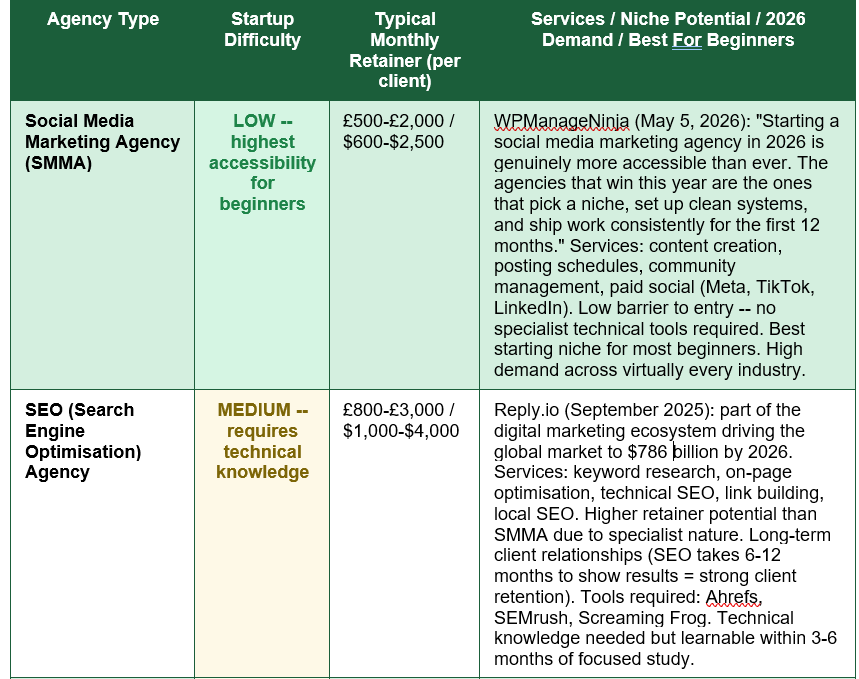
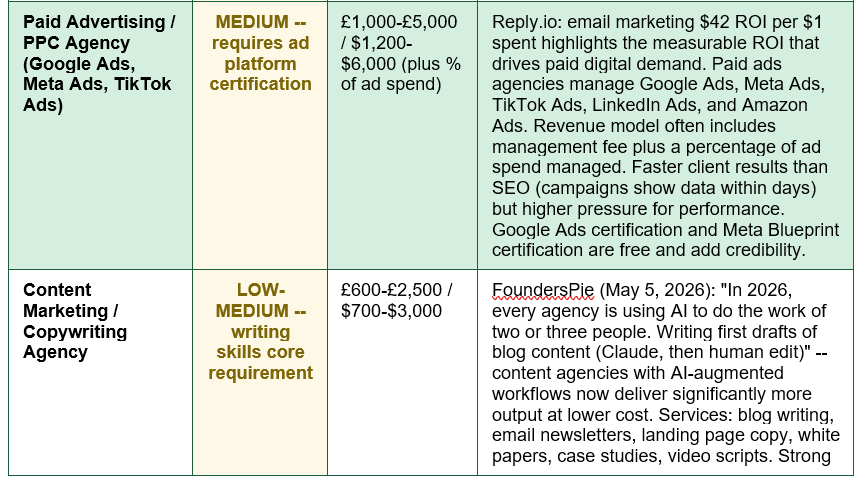
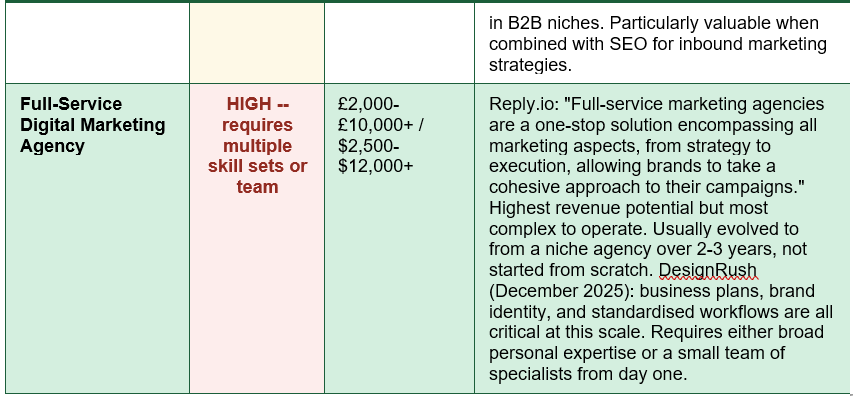
The niche principle -- the most important decision you will make: FoundersPie (May 2026): 'Stay in your niche.' WPManageNinja (May 2026): 'The agencies that win in 2026 are the ones that pick a niche, set up clean systems, and ship work consistently for the first 12 months.' A niche is not just a service type -- it is a combination of service and industry. A social media marketing agency that serves 'businesses' is undifferentiated. A social media marketing agency that serves 'UK independent restaurants' or 'US e-commerce health supplement brands' is positioned to become the specialist choice for that market. Clients in specific industries pay more to agencies that visibly understand their sector, their customers, and their specific marketing challenges. Nicheing reduces competition, increases pricing power, and makes referrals far more likely.
The 7-Step Framework to Start a Marketing Agency in 2026
STEP 1: Choose Your Niche and Define Your Service Offer | The Foundation Everything Else Rests On
Before registering a company, building a website, or designing a logo -- choose your niche. Gainapp (February 2026): 'The first step when starting a digital marketing agency is identifying your target market. Think about who your ideal customer is and what services they may need. Ask yourself: what types of businesses can benefit from digital marketing services? Which industries are currently underserved in the digital space? Who are the decision-makers within these businesses?' Define both the service (what you do) and the industry/audience (who you serve). Examples: Facebook and Instagram ads for UK e-commerce brands; SEO for US healthcare clinics; email marketing for SaaS companies; LinkedIn content for B2B professional services firms. Your niche should sit at the intersection of three things: skills you already have or can develop quickly; an industry where businesses spend money on marketing; and a service type where you can clearly demonstrate ROI. Start with one or two core services -- not everything -- and add services only when the first ones are operating smoothly and profitably.STEP 2: Build Your Business Legally and Set Up Operations | Do This Right -- It Protects You and Signals Professionalism
Register the business appropriately for your jurisdiction. In the UK: register as a sole trader (simplest, immediate, free via HMRC) or form a limited company via Companies House (£12 online, provides liability protection, more professional for B2B). In the US: register an LLC in your state (varies by state, typically $50-$500). Open a dedicated business bank account -- never mix personal and business finances. Get a business email address on your own domain (not a Gmail address). Register for VAT in the UK once turnover exceeds £90,000 (2026 threshold) or consider voluntary registration earlier if serving VAT-registered B2B clients. DesignRush (December 2025): 'Creating a comprehensive business plan is a vital step in starting a marketing agency. Aside from helping you define your competitive advantage and set realistic goals, a solid business plan will guide your actions and attract potential investors or partners. After all, 71% of businesses have strategic plans in place.' Key business plan elements: executive summary; services and pricing; target market; competitive analysis; financial projections (month 1-12 revenue targets, startup costs, break-even calculation). Get professional indemnity insurance (PI insurance) before your first paying client -- it covers claims arising from advice or services provided. In the UK, check if any specific FCA or professional body requirements apply to your planned services.STEP 3: Build Your Agency Website and Digital Presence | Your Website Is Your Most Important Sales Tool
WPManageNinja (May 2026): 'Start by setting up your agency website, since everything else flows through it.' Gainapp (February 2026): 'Creating a website for your digital marketing agency is an important step in getting your business off the ground. Having a website gives potential customers a place to learn more about what you offer and why they should choose you over other agencies. It also allows you to showcase your work and services, which can help build trust with potential leads.' Your agency website must accomplish five things: (1) Clearly state what you do and who you serve -- within 5 seconds of landing on the page, a visitor should know your service and niche. (2) Show social proof -- case studies, results, testimonials. Even if you are starting out, offer a free trial or reduced-rate initial project to generate your first case study. (3) Include a clear contact and enquiry mechanism. (4) Demonstrate your expertise through a blog, resources, or portfolio. (5) Load fast and work well on mobile. If you are a digital marketing agency, your own website is your most visible proof of concept. An agency with poor SEO, no social presence, or a badly designed website signals exactly the opposite of what clients want to hire. Use your own channels as a live demonstration of what you can do for clients.STEP 4: Set Your Pricing and Service Packages | Charge What the Work Is Worth -- From Day One
Pricing is where most new agency owners make their most costly mistake -- undercharging out of fear that they will not get clients at higher prices. WPManageNinja (May 2026): 'Most new agencies either undercharge out of fear or overcomplicate things and create confusion.' The monthly retainer model is recommended as the primary pricing structure. FoundersPie (May 2026): '$10,000 in monthly recurring revenue -- that is roughly 3 to 5 retainer clients. At that point, you have proven the model.' To calculate a sustainable retainer rate: estimate the hours of work a client account requires per month; multiply by your target effective hourly rate (£75-£150/hour for a UK specialist; $80-$200/hour for a US specialist); add a 30% overhead buffer; and round to the nearest clean number. For a UK social media marketing client requiring 15 hours per month: 15 hours x £100/hour = £1,500 base, plus 30% overhead = £1,950 -- round to £2,000/month retainer. Do not price below your cost of delivery. Do not offer unlimited revisions. Scope every retainer in a written agreement.STEP 5: Find and Sign Your First Clients | The Revenue That Proves the Model
Finding the first 3-5 clients is the hardest part of starting an agency -- and the only part where there is no shortcut. FoundersPie (May 2026) recommends the outbound approach: 'Researching prospects before sales calls' using AI tools to personalise outreach. Gainapp (February 2026): 'Getting on social media channels is a great way to spread the word about your digital marketing agency and reach potential clients. Not only can you use social media to share content, but it is also an effective tool for building customer relationships.' Five proven first-client acquisition channels for new agencies: (1) Personal network: tell everyone you know what you are now offering. Former colleagues, employers, and contacts often become first clients or make introductions. This is the single fastest route to a first client. (2) LinkedIn outreach: identify the decision-makers in your target industry (marketing directors, business owners, CEOs of relevant companies) and send personalised connection requests followed by value-led messages -- not sales pitches. Share content demonstrating expertise. (3) Offer a paid pilot: rather than offering free work (which undervalues your skills and attracts poor-quality clients), offer a fixed-scope, time-limited paid pilot project at a reduced rate in exchange for a detailed case study and testimonial. £500-£1,000 for a 30-day pilot is better than free. (4) Cold email with case study: once you have a result to show, a cold email to 50 well-researched prospects in your niche will outperform a generic blast to 5,000. (5) Referral partnerships: approach complementary businesses (web designers, accountants, business coaches) who serve your target client and arrange mutual referral agreements.STEP 6: Build Operational Systems and Use AI to Scale Output | How the Best Agencies in 2026 Deliver More With Less
DesignRush (December 2025): 'Develop streamlined processes for client onboarding, project management, reporting, and communication. These standardized processes will improve productivity, enhance client satisfaction, and facilitate scalability. When establishing your workflows, leverage time-saving software to facilitate daily tasks.' FoundersPie (May 2026) on AI in 2026: 'Every agency is using AI to do the work of two or three people. If you are not, you are charging less and delivering slower than your competitors. Where to use AI in an agency: drafting ad copy and email campaigns (ChatGPT, Claude); generating creative assets (Midjourney, Runway); writing first drafts of blog content (Claude, then human edit); researching prospects before sales calls; building reporting dashboards (Looker Studio with AI summaries).' Core operational tools for a new marketing agency in 2026: project management (Asana, Trello, Monday.com, Notion); client communication (Slack, email with shared inboxes); reporting (Google Looker Studio, AgencyAnalytics); social media scheduling (Buffer, Later, Hootsuite); time tracking (Toggl, Harvest -- essential for knowing which clients are profitable); contracts and invoicing (HelloSign/DocuSign for contracts; Xero, FreshBooks, or QuickBooks for invoicing). A client onboarding document, a project brief template, a monthly reporting template, and a service level agreement (SLA) should be created before the first client starts -- not after.STEP 7: Retain Clients, Measure Results, and Scale | The Work That Determines Whether the Agency Survives
Client retention is the financial foundation of any agency. A client who stays for 24 months is worth 24 times more than a client who stays for 1 month -- and costs nothing in acquisition to retain. The primary driver of retention is results. Every client relationship should have clear, agreed, measurable KPIs defined at the start: website traffic growth, follower counts, lead volume, conversion rates, email open rates, ad ROAS (return on ad spend). DesignRush (December 2025): 'Develop streamlined processes for client onboarding, project management, reporting.' Monthly reporting -- a clean, well-designed summary of results against agreed KPIs -- is one of the most powerful retention tools available. It demonstrates value continuously and makes the case for the retainer without requiring the client to ask whether the work is worthwhile. Scaling the agency follows a predictable path: solo founder to £5,000-£10,000 MRR on 3-5 clients; hire first support (freelancer or part-time account executive) to expand capacity; systematise and document every process so it can be delegated; target 10-15 clients at higher retainer rates with a small team; potentially expand services or niches once the first model is stable. WPManageNinja (May 2026): 'The process is actually a series of small, manageable steps. Once you break it down, the path becomes much clearer.'Pricing Your Agency Services: The Complete 2026 Model Guide
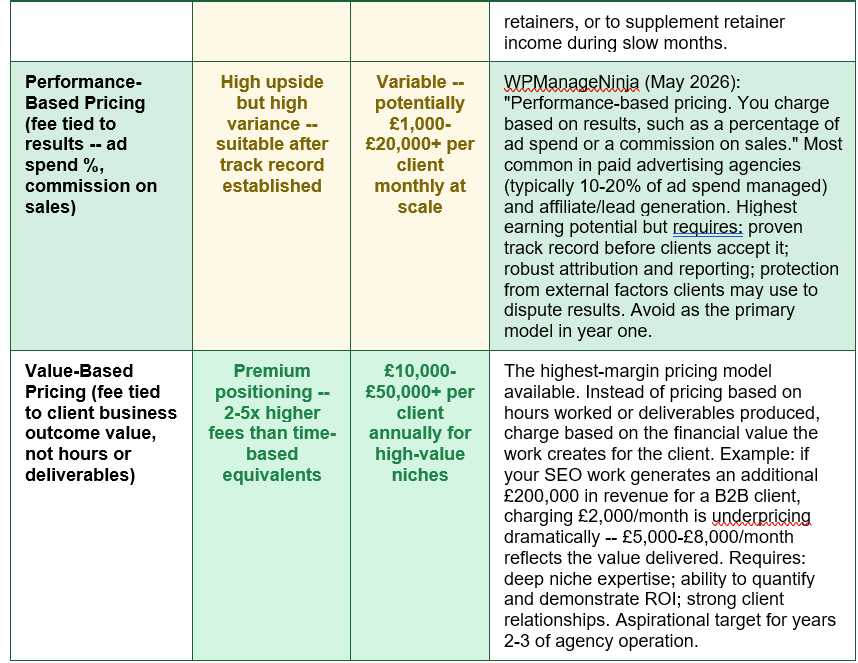
How you price your services determines not just how much you earn but whether you attract the right clients, how stable your revenue is, and how hard you have to work to maintain it. The following table maps every major pricing model with its revenue potential and the context for choosing it: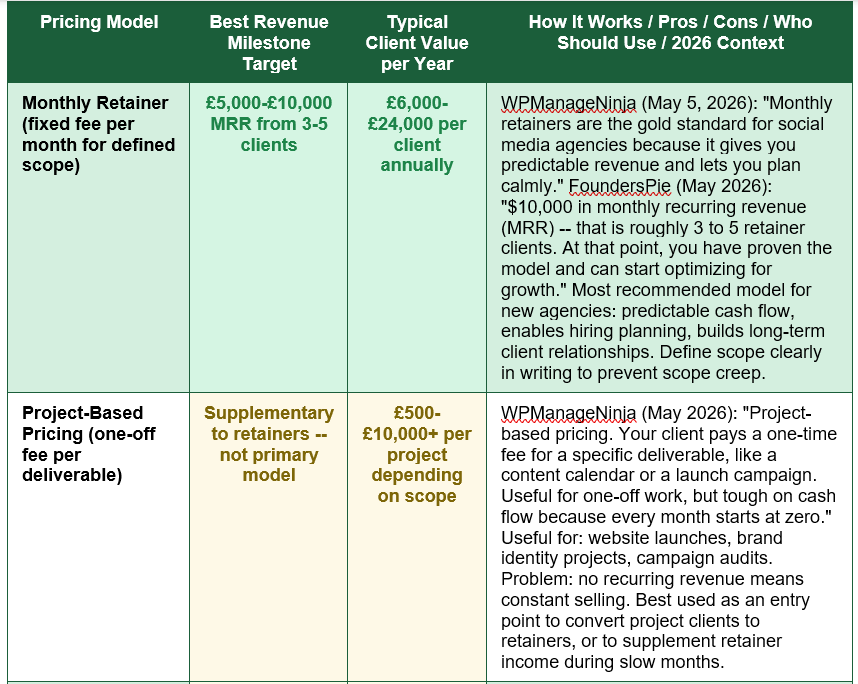
Revenue Milestones: What a Marketing Agency Can Realistically Earn
FoundersPie (May 2026) provides the clearest benchmark: '$10,000 in monthly recurring revenue -- that is roughly 3 to 5 retainer clients. At that point, you have proven the model and can start optimizing for growth.' Understanding the realistic revenue trajectory helps avoid both over-optimism and premature discouragement: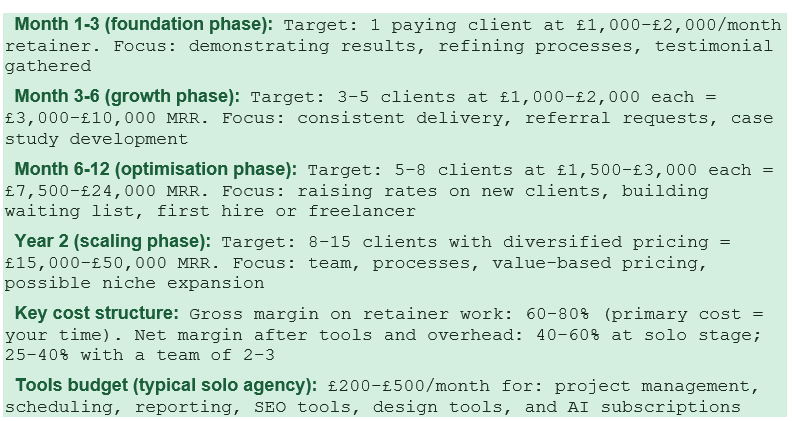
Using AI to Run Your Agency in 2026: What Every Agency Needs to Know
The competitive landscape for marketing agencies changed fundamentally in 2023-2025 with the arrival of capable AI tools that can draft copy, generate images, analyse data, and build reports at a fraction of the time the same work previously required. FoundersPie (May 2026): 'In 2026, every agency is using AI to do the work of two or three people. If you are not, you are charging less and delivering slower than your competitors.'The most impactful AI applications for a marketing agency in 2026 are: content production (AI-generated first drafts of blog posts, email sequences, ad copy, and social media captions -- then human edited for voice, accuracy, and brand alignment); creative asset generation (AI image tools for social media graphics, ad creatives, and content illustrations); prospect research (AI tools that rapidly compile information about a prospect's business, their competitors, and their market before a sales call or pitch); reporting automation (Looker Studio with AI summaries; AgencyAnalytics AI report generation); and process automation (AI-powered tools that handle client communication acknowledgment, task creation from email, and reporting reminders). The essential principle for agency AI use in 2026 is augmentation, not replacement: AI handles the volume production and research tasks; the human agency team provides strategy, brand judgment, client relationships, and quality control.
MARKETING AGENCY LAUNCH CHECKLIST -- 2026: BEFORE LAUNCH: (1) Define niche (service + industry combination -- not just service type). (2) Register business legally (UK: Companies House or HMRC sole trader; US: LLC in your state). (3) Open dedicated business bank account. (4) Get professional indemnity insurance before first client. (5) Build agency website: clear niche statement, services listed, contact mechanism. (6) Set up professional email (name@youragency.com -- not Gmail). FIRST 30 DAYS: (7) Contact personal network -- tell everyone what you now offer. (8) Build LinkedIn presence and start sharing niche content daily. (9) Create service package documentation and a standard contract template. (10) Identify 50 target prospects in your niche and begin personalised outreach. (11) Sign first client -- even a paid pilot at reduced rate is better than free. (12) Set up project management tool and build onboarding document before they start. FIRST 90 DAYS: (13) Deliver exceptional results for first client -- this is the case study that sells the next client. (14) Ask for referral from first client at 60-day mark. (15) Build first reporting template and deliver first monthly report. (16) Sign second and third client -- target £3,000-£6,000 MRR by end of month 3. AI IN 2026: (17) Integrate AI tools (Claude/ChatGPT for copy drafts; Midjourney for visuals) into workflow from week one -- not as an afterthought.
FIVE MARKETING AGENCY MISTAKES THAT PREVENT GROWTH: (1) PICKING NO NICHE OR A NICHE THAT IS TOO BROAD. 'Digital marketing for everyone' is not a positioning -- it is an invitation to be compared only on price with every other generalist agency. A niche that is too broad cannot be the top-of-mind choice for any specific type of client. Niche to a specific service AND a specific industry -- then stay there for at least 12 months before expanding. (2) UNDERCHARGING TO GET FIRST CLIENTS AND NEVER RAISING RATES. WPManageNinja (May 2026): 'Most new agencies either undercharge out of fear.' Low rates attract clients who do not value the work, who micromanage constantly, and who leave at the first sign of anything not going perfectly. They also make the agency unscalable -- you cannot hire help if the margins do not support it. Price at market rate from the start. (3) TAKING ON ANY CLIENT IN ANY NICHE TO MAKE ENDS MEET IN EARLY MONTHS. Accepting off-niche clients for cash feels like a good decision in month two and feels like a disaster in month six -- they take as much time as niche clients, produce no useful case studies, generate no referrals in your target market, and dilute your positioning. Turn off-niche enquiries into referrals to other agencies. (4) NOT DOCUMENTING RESULTS AND BUILDING CASE STUDIES. No result documented = no marketing asset for the next sale. Every client engagement should end with a case study: what the client's challenge was, what you did, what the measurable result was. This is the single most powerful sales tool available. (5) TRYING TO SCALE BEFORE THE FOUNDATION IS STABLE. Hiring team members before processes are documented means the founder becomes the process -- every question comes back to them. Document every workflow before delegating it.
Conclusion
Starting and running a marketing agency in 2026 is one of the most accessible and potentially rewarding business decisions available to anyone with marketing skills and a willingness to operate as a business rather than a freelancer. The global digital marketing market at $786 billion and growing at 17.6% annually creates an enormous demand pool. The low startup costs, high margins, and scalability with AI tools make the economics compelling. And the structural need -- small businesses everywhere need marketing expertise they cannot afford to hire full-time -- means the market is not going away.The seven steps in this guide provide the complete framework: choose a specific niche and service combination; register and structure the business correctly from the start; build a website that demonstrates your expertise; price services for sustainability, not just to get initial clients; use every channel available to find the first 3-5 clients; build operational systems and AI-augmented workflows from day one; and focus obsessively on delivering measurable results that generate case studies, referrals, and long-term retention. FoundersPie (May 2026): '$10,000 MRR is roughly 3 to 5 retainer clients. At that point, you have proven the model.'
WPManageNinja (May 2026) captures the right mindset for starting out: 'None of these steps is complicated on its own. Your next move is the easiest one. Start by setting up your agency website, since everything else flows through it. The first step is always the hardest, but once you take it, the rest becomes much easier than it looks today.' The market opportunity is real. The tools are available. The skills are learnable. The path from zero to a profitable marketing agency in 12 months is not a fantasy -- it is a documented, repeatable process for anyone willing to commit to niche, systems, and consistent delivery.
Frequently Asked Questions (FAQ)
How much does it cost to start a marketing agency?Starting a marketing agency has among the lowest startup costs of any service business. FoundersPie (May 5, 2026): 'Low startup costs, high margins, no inventory, no physical location required.' The core startup costs are: business registration (UK: Companies House £12; UK sole trader: free; US: LLC filing varies by state, typically $50-$500); business bank account (many free business accounts available in UK -- Starling, Monzo Business, Tide); professional email and website domain (£10-£15/month for hosting and email); agency website build (£0-£500 using Squarespace, Wix, or WordPress templates); core software tools (project management, scheduling tools, reporting -- £100-£300/month for a starter stack); professional indemnity insurance (£200-£600/year for a solo UK agency depending on revenue); and AI tool subscriptions (£20-£50/month for ChatGPT Plus, Claude Pro, etc.). Total realistic startup investment: £500-£2,000 for the first three months before any client revenue. This compares to tens of thousands for most product businesses. The primary investment in a marketing agency is time -- developing skills, building the website, doing outreach, and delivering client work -- rather than capital.
How do I find my first marketing agency clients?
Finding the first clients is consistently cited as the hardest part of starting a marketing agency -- but the methods are well established and proven. Gainapp (February 2026): 'Getting on social media channels is a great way to spread the word about your digital marketing agency and reach potential clients. Posting regularly and sharing your expertise builds visibility and trust.' The five most reliable methods for getting first clients are: (1) Personal network activation -- tell every former colleague, employer, friend, and contact what you now offer and ask for referrals or introductions. Most first clients come through someone who already knows you; (2) LinkedIn content and outreach -- post niche-relevant content daily, engage with target clients' content, and send personalised messages (not cold pitches -- value-led conversations); (3) Paid pilot offer -- offer a 30-day paid pilot project at a reduced rate for a well-researched target client, with the explicit objective of producing a case study and testimonial; (4) Cold email to researched prospects -- 50 personalised emails to well-matched prospects outperform 5,000 generic ones; (5) Referral partnerships -- approach web designers, accountants, and business coaches who serve your target clients and build mutual referral relationships. The critical principle: do not try all five simultaneously. Focus on personal network and LinkedIn for the first 60 days -- these produce the fastest results with no media budget required.
How much should I charge for marketing agency services?
Pricing is the most consequential decision after niche selection for a new marketing agency. WPManageNinja (May 5, 2026): 'Your social media marketing agency pricing decides how predictable your revenue will be in the first year. Most new agencies either undercharge out of fear or overcomplicate things and create confusion.' The monthly retainer model is strongly recommended as the primary pricing structure: WPManageNinja: 'Monthly retainers are the gold standard for social media agencies because it gives you predictable revenue and lets you plan calmly.' Realistic retainer ranges for a solo UK agency: social media management: £800-£2,500/month; SEO: £1,000-£3,500/month; paid advertising management: £1,000-£4,000/month plus ad spend percentage; content marketing: £600-£2,500/month. US equivalents are typically 20-40% higher. FoundersPie (May 2026): '$10,000 in monthly recurring revenue -- that is roughly 3 to 5 retainer clients.' Calculate your minimum viable rate by: (total monthly costs + desired monthly income) divided by maximum monthly billable hours = minimum hourly rate. Then package services into monthly retainers that reflect the value delivered, not just the hours. Do not start below your minimum viable rate -- it is easier to raise rates on new clients than to raise them on existing ones.
Do I need experience to start a marketing agency?
You need demonstrated competence in the services you plan to sell -- but this does not require years of agency employment. Many successful agency founders start immediately after acquiring skills through courses, certifications, and self-directed practice. What matters most to clients is not your CV but your ability to produce results. The fastest path to credibility for a new agency founder is: (1) Earn relevant certifications that are free and widely recognised -- Google Ads certification, Meta Blueprint, HubSpot Content Marketing, Google Analytics certification. These signal competence and are free to obtain. (2) Build a portfolio through practice work -- volunteer your skills for a local business, a charity, or a personal project that demonstrates your ability to produce results. Document the results. (3) Develop a detailed knowledge of your chosen niche by reading industry publications, studying successful campaigns in that sector, and understanding the specific challenges and vocabulary of your target clients. (4) FoundersPie (May 2026) identifies the key entry-level starting point: social media marketing agencies (SMMA) are the most accessible starting point for new agency founders with no track record, because they require no specialist tools, the skills are learnable quickly, and almost every business needs social media support. Experience is an accelerant, not a prerequisite -- but skill demonstration is non-negotiable from the first client conversation.
How do I scale a marketing agency beyond just myself?
Scaling a marketing agency beyond the founder requires two things: documented processes that other people can follow, and enough margin to pay for help before you desperately need it. DesignRush (December 2025): 'Develop streamlined processes for client onboarding, project management, reporting, and communication. These standardized processes will improve productivity, enhance client satisfaction, and facilitate scalability.' The scaling sequence that works consistently: (1) Systematise before hiring -- document every process (client onboarding, content production, reporting, account review) before delegating it. A process that only you know how to do is not delegatable. (2) Use AI to extend your capacity first -- FoundersPie (May 2026): 'Every agency is using AI to do the work of two or three people.' AI tools can double or triple your deliverable output without hiring costs. (3) Hire part-time or freelance support for the most time-consuming deliverable tasks (content writing, graphic design, scheduling) before hiring a full account manager. (4) Use the freed time from delegation to sell more and manage client relationships better -- not to do other production work. (5) The target milestone before considering a permanent hire: £8,000-£12,000 MRR generating enough margin to cover a part-time salary and maintain your own income. At £20,000+ MRR, a first full-time hire becomes viable. WPManageNinja (May 2026): 'Slowly growing your team' -- patience at this stage is not slow; it is disciplined

0 Comments Comments