

Taxes
IRS 2027 Tax Credits: What Will Change for Families, Workers

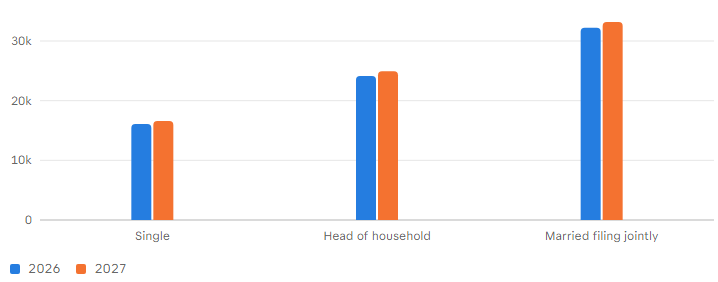
Several key family tax breaks are getting a boost. Here is what you may be able to claim next year. Child tax credit $2,300 (from $2,200); refundable part $1,800 (from $1,700); EITC maximum $8,496 for 3+ children (from $8,231); standard deduction $33,200 joint, $16,600 single, $24,925 head of household; inflation adjustment about 3.2%
On 5 November 2026 the IRS published its annual inflation adjustments for tax year 2027. The headline numbers for families are straightforward: the child tax credit goes up by $100 per child to $2,300, the refundable part rises to $1,800, the largest earned income tax credit climbs to $8,496, and the standard deduction rises for every filing status.
That sounds like a pay rise, and in a small way it is. But before you plan a holiday around it, keep two facts in mind. First, these are mostly inflation adjustments of about 3.2%. Second, they apply to income you earn in 2027 and report on a return you file in 2028, not to the return you will file this coming spring. In this post I walk through each credit, show the old and new numbers side by side, give a few worked examples, and point out the things that are not rising. Where my figures come from a secondary source, I say so.
Key takeaway: The 2027 changes are real but modest. For most families they keep pace with prices rather than raise their purchasing power, and some popular breaks are not indexed at all.
The size of the move is set by inflation. The AP reports that many of the increases are routine and track how much prices climbed, which for 2027 is about 3.2%. Keep that number in mind, because it is the yardstick for every other figure below. One practical note: the IRS page itself warns that news items may not be updated after release, so check the figures against Rev. Proc. 2026-35 before relying on them. I follow that advice in the source notes at the end.
What does that mean for a household? A family with three qualifying children could see a maximum of $6,900 (3 times $2,300) against $6,600 under the 2026 level, an extra $300 (my calculation). Whether you receive the full amount depends on your income and other rules, so treat these as ceilings, not promises. "Refundable" means that if the credit is larger than the tax you owe, you can get some of it back as a refund. That refundable cap matters most for lower-income working families, who often owe little income tax. The refundable portion is also limited by your earnings under the rules in force, which I have not re-checked here, so look at the IRS instructions for your situation.
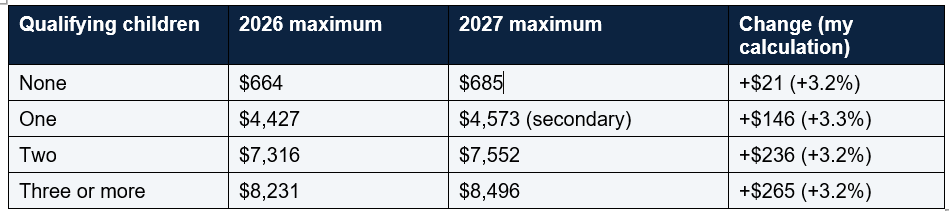
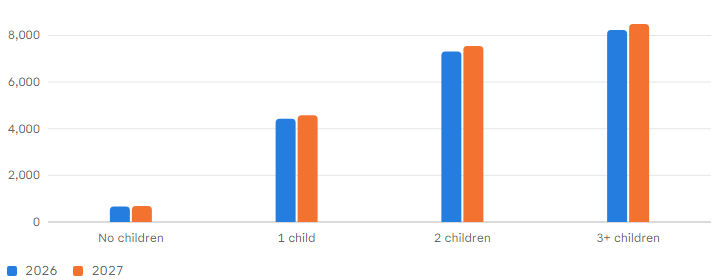
Notice that every tier rises by roughly 3.2%, which matches the inflation rate. This is a cost-of-living adjustment, not a policy expansion. The childless credit stays tiny: $685 is a nice bonus but it is only a fraction of what a family with children can receive. There is also an investment income test. For 2026 the limit is $12,200. Two secondary sources give $12,600 for 2027, though one labels it projected and the IRS page I retrieved did not list it. The test is a cliff: one dollar over the limit can disqualify you for the year, so a small amount of interest or dividends matters.

The 2026 figures are from the IRS 2026 release for joint filers, singles and heads of household. A bigger deduction does not mean a refund of that size. My calculation: an extra $1,000 of deduction saves at most $100 at the 10% rate, $120 at 12%, and $220 at 22%. Brackets also move. The 37% rate applies above $661,375 for single filers and $793,650 for joint filers.
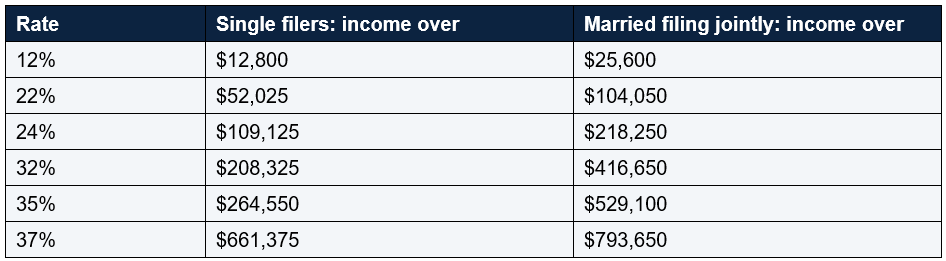
2027 bracket thresholds from the IRS release. The 10% rate applies to income up to $12,800 (single) or $25,600 (joint). The rates themselves do not change. Only the income bands move up, which stops inflation-driven pay rises from pushing people into higher brackets.
Bigger-ticket items also move. The annual gift exclusion rises to $20,000 from $19,000, and the estate tax exclusion to $15.48 million from $15 million. These affect fewer households, but they matter to grandparents helping with a deposit or tuition. I did not find the dependent care credit or the child and dependent care limits in the sources I retrieved, so I do not cover them here. Check the full revenue procedure if that matters to you.
By my calculation, those savings are about 1.8% and 1.4% of the old tax bills (136 divided by 7,640, and 68 divided by 5,020). They are real, but small. For a family at the top of the EITC and CTC ranges, the theoretical ceiling is larger. With two children, the maximum EITC of $7,552 plus two child tax credits of $2,300 gives $12,152 for 2027, against $11,716 using the 2026 amounts of $7,316 and $2,200 each (my calculation). That is up to $436 more. Few families qualify for the maximum of both at the same income, so most will see less.
The AP also makes the point that workers whose pay rises with inflation will see their tax bills stay roughly unchanged. The adjustment protects you from "bracket creep". It is not a windfall.
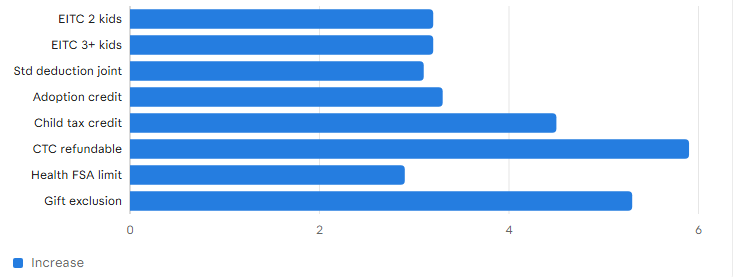
The IRS headline says credits are "increased", and that is true in dollar terms. In real terms the picture is different. The EITC tiers rise by about 3.2%, the same as inflation, so a worker's purchasing power from that credit stays about the same. The child tax credit rises 4.5%, a little faster than inflation, which gives a small real gain (my calculation). The standard deduction rises about 3.1%, similar to inflation.
Context helps. For 2026, Axios noted that the increases looked modest, about 2.2%, because they built on higher 2025 deductions set by the 2025 law [14]. So 2027 is a bit larger than 2026 in percentage terms, yet still an inflation story, not a new tax cut. Fair summary: good news if you worried the credits would lose value, but not a reason to expect a bigger refund on its own.
Do not expect the new amounts in your next refund. If you are planning your finances for 2027, however, you can use them to estimate your take-home pay and your credits.
General education, not advice. Here are practical steps. Check your withholding. If you use a Form W-4 at work, compare your expected 2027 credits with your withholding in the new year. Many people over- or under-withhold because they set it once and forget. Keep your records. For the EITC and child tax credit you need valid taxpayer identification numbers and proof that your children live with you for the required time. Gather school and medical records early.
Watch investment income. If you are near the EITC limit, which may be $12,600 for 2027, consider the timing of selling investments or taking interest. Small amounts can matter.
Use the FSA wisely. With a $3,500 limit and a $700 carryover, estimate your real medical costs and avoid over-funding. Consider free help. The IRS runs free tax-prep programmes for lower-income filers (general knowledge, check eligibility), which can help you claim credits correctly.
Remember the timing: these rules apply to 2027 income and the return you file in 2028. And remember what is not rising, including the tips, overtime and senior deductions, which are not indexed and end after 2028 unless extended. Plan with the real numbers, check the IRS source, and ask a tax professional about your own situation. This post is education only, not tax advice.
The maximum is $2,300 per qualifying child, up $100 from $2,200, with up to $1,800 refundable.
What is the maximum EITC for 2027?
$8,496 for three or more qualifying children, up from $8,231. The AP gives $685 for no children and $7,552 for two.
What is the 2027 standard deduction?
$33,200 for married couples filing jointly, $16,600 for single filers and married filing separately, and $24,925 for heads of household.
Will these changes affect my tax return this spring?
No. The 2027 amounts apply to income earned in 2027 and returns filed in 2028. Your return filed in 2027 uses 2026 figures.
Are the tips and overtime deductions going up?
No. They are not adjusted for inflation, and they end after the 2028 tax year unless Congress extends them.
Table of Contents
- What the IRS actually announced
- The child tax credit
- The earned income tax credit
- The standard deduction and brackets
- Adoption, FSA and other family breaks
- What it means in dollars
- What is not rising
- Which tax year does this affect?
- Mistakes to avoid
- Gaps and caveats about the sources
- Conclusion
- FAQ
Maximum EITC by number of children, 2026 vs 2027 ($)
Maximum credit ($) by Source: IRS, AP, NerdWallet; 2027 one-child figure from a secondary site
Standard deduction by filing status, 2026 vs 2027 ($)
Deduction ($) by Source: IRS (2026 and 2027 releases)
Percentage increase, 2026 to 2027 (%)
% change by My calculation from IRS figures; inflation adjustment was about 3.2%On 5 November 2026 the IRS published its annual inflation adjustments for tax year 2027. The headline numbers for families are straightforward: the child tax credit goes up by $100 per child to $2,300, the refundable part rises to $1,800, the largest earned income tax credit climbs to $8,496, and the standard deduction rises for every filing status.
That sounds like a pay rise, and in a small way it is. But before you plan a holiday around it, keep two facts in mind. First, these are mostly inflation adjustments of about 3.2%. Second, they apply to income you earn in 2027 and report on a return you file in 2028, not to the return you will file this coming spring. In this post I walk through each credit, show the old and new numbers side by side, give a few worked examples, and point out the things that are not rising. Where my figures come from a secondary source, I say so.
Key takeaway: The 2027 changes are real but modest. For most families they keep pace with prices rather than raise their purchasing power, and some popular breaks are not indexed at all.
What the IRS actually announced
The IRS release, numbered IR-2026-133 and based on Revenue Procedure 2026-35, adjusts almost 70 tax provisions for 2027, including tax rate schedules and the standard deduction. The changes generally apply to returns filed in 2028. The agency frames the changes as part of what it calls the "Working Families Tax Cuts", the rebranded name Republicans use for the 2025 tax law formally known as the One Big Beautiful Bill Act. IRS Chief Executive Officer Frank Bisignano said taxpayers will see those credits and deductions increase with this adjustment.The size of the move is set by inflation. The AP reports that many of the increases are routine and track how much prices climbed, which for 2027 is about 3.2%. Keep that number in mind, because it is the yardstick for every other figure below. One practical note: the IRS page itself warns that news items may not be updated after release, so check the figures against Rev. Proc. 2026-35 before relying on them. I follow that advice in the source notes at the end.
The child tax credit
The child tax credit is the headline item for most families. The maximum rises to $2,300 per qualifying child for 2027, up from $2,200 in 2026, and the refundable portion rises to $1,800 from $1,700. The AP notes that the 2025 law set the credit at $2,200 and tied future increases to inflation. In percentage terms, my calculation is that the credit rises 4.5% (100 divided by 2,200) and the refundable part 5.9% (100 divided by 1,700). Both are faster than the 3.2% inflation figure.What does that mean for a household? A family with three qualifying children could see a maximum of $6,900 (3 times $2,300) against $6,600 under the 2026 level, an extra $300 (my calculation). Whether you receive the full amount depends on your income and other rules, so treat these as ceilings, not promises. "Refundable" means that if the credit is larger than the tax you owe, you can get some of it back as a refund. That refundable cap matters most for lower-income working families, who often owe little income tax. The refundable portion is also limited by your earnings under the rules in force, which I have not re-checked here, so look at the IRS instructions for your situation.
The earned income tax credit
The earned income tax credit, or EITC, is aimed at low- and moderate-income workers. The IRS gives the 2027 maximum for taxpayers with three or more qualifying children as $8,496, up from $8,231. The AP adds the figures for workers with no children, $685 from $664, and for two children, $7,552 from $7,316. The one-child amount was not on the IRS page I retrieved. A secondary calculator site gives $4,573 for 2027, against $4,427 for 2026. Treat the $4,573 as unconfirmed until you see it in the revenue procedure.Notice that every tier rises by roughly 3.2%, which matches the inflation rate. This is a cost-of-living adjustment, not a policy expansion. The childless credit stays tiny: $685 is a nice bonus but it is only a fraction of what a family with children can receive. There is also an investment income test. For 2026 the limit is $12,200. Two secondary sources give $12,600 for 2027, though one labels it projected and the IRS page I retrieved did not list it. The test is a cliff: one dollar over the limit can disqualify you for the year, so a small amount of interest or dividends matters.
The standard deduction and brackets
The standard deduction is the amount of income you can exclude from tax without itemising. For 2027 it is $33,200 for married couples filing jointly, $16,600 for single filers and married people filing separately, and $24,925 for heads of household.The 2026 figures are from the IRS 2026 release for joint filers, singles and heads of household. A bigger deduction does not mean a refund of that size. My calculation: an extra $1,000 of deduction saves at most $100 at the 10% rate, $120 at 12%, and $220 at 22%. Brackets also move. The 37% rate applies above $661,375 for single filers and $793,650 for joint filers.
2027 bracket thresholds from the IRS release. The 10% rate applies to income up to $12,800 (single) or $25,600 (joint). The rates themselves do not change. Only the income bands move up, which stops inflation-driven pay rises from pushing people into higher brackets.
Adoption, FSA and other family breaks
Beyond the big three, several other family-related limits rise. The adoption credit goes to $18,250 from $17,670, with $5,280 refundable. The monthly transportation and parking benefit goes to $350 from $340. For health flexible spending accounts, the salary reduction limit rises to $3,500 from $3,400, and the carryover maximum to $700 from $680. If your employer offers an FSA, that is slightly more pre-tax money for medical costs.Bigger-ticket items also move. The annual gift exclusion rises to $20,000 from $19,000, and the estate tax exclusion to $15.48 million from $15 million. These affect fewer households, but they matter to grandparents helping with a deposit or tuition. I did not find the dependent care credit or the child and dependent care limits in the sources I retrieved, so I do not cover them here. Check the full revenue procedure if that matters to you.
What it means in dollars
Let me turn the percentages into pounds-and-pence thinking, or rather dollars. The AP ran two examples assuming unchanged income and the standard deduction. A married couple earning $100,000 would see tax fall to $7,504 from $7,640, a saving of $136. A single filer earning $60,000 would see tax fall to $4,952 from $5,020, a saving of $68.By my calculation, those savings are about 1.8% and 1.4% of the old tax bills (136 divided by 7,640, and 68 divided by 5,020). They are real, but small. For a family at the top of the EITC and CTC ranges, the theoretical ceiling is larger. With two children, the maximum EITC of $7,552 plus two child tax credits of $2,300 gives $12,152 for 2027, against $11,716 using the 2026 amounts of $7,316 and $2,200 each (my calculation). That is up to $436 more. Few families qualify for the maximum of both at the same income, so most will see less.
The AP also makes the point that workers whose pay rises with inflation will see their tax bills stay roughly unchanged. The adjustment protects you from "bracket creep". It is not a windfall.
What is not rising
Not everything is indexed. Several breaks from the 2025 law are not adjusted for inflation. Workers can still deduct up to $25,000 in tip income and up to $12,500 in overtime pay, or $25,000 for joint filers. The AP adds that neither deduction is adjusted for inflation and both end after the 2028 tax year unless Congress extends them. People aged 65 and older can claim an extra $6,000 deduction, also not adjusted and also set to end after 2028. The practical lesson is to be careful with the word "increase". Some figures rise with prices. Others stay frozen, so their real value falls every year. And several are time-limited, which makes long-term planning harder.The IRS headline says credits are "increased", and that is true in dollar terms. In real terms the picture is different. The EITC tiers rise by about 3.2%, the same as inflation, so a worker's purchasing power from that credit stays about the same. The child tax credit rises 4.5%, a little faster than inflation, which gives a small real gain (my calculation). The standard deduction rises about 3.1%, similar to inflation.
Context helps. For 2026, Axios noted that the increases looked modest, about 2.2%, because they built on higher 2025 deductions set by the 2025 law [14]. So 2027 is a bit larger than 2026 in percentage terms, yet still an inflation story, not a new tax cut. Fair summary: good news if you worried the credits would lose value, but not a reason to expect a bigger refund on its own.
Which tax year does this affect?
Timing causes more confusion than anything else. These 2027 figures apply to income you earn during 2027, and you will file that return in 2028. The return you file in early 2027 is for tax year 2026, which uses the 2026 numbers: a $2,200 child tax credit, EITC maximums of $664, $4,427, $7,316 and $8,231, and a $12,200 investment income limit.Do not expect the new amounts in your next refund. If you are planning your finances for 2027, however, you can use them to estimate your take-home pay and your credits.
General education, not advice. Here are practical steps. Check your withholding. If you use a Form W-4 at work, compare your expected 2027 credits with your withholding in the new year. Many people over- or under-withhold because they set it once and forget. Keep your records. For the EITC and child tax credit you need valid taxpayer identification numbers and proof that your children live with you for the required time. Gather school and medical records early.
Watch investment income. If you are near the EITC limit, which may be $12,600 for 2027, consider the timing of selling investments or taking interest. Small amounts can matter.
Use the FSA wisely. With a $3,500 limit and a $700 carryover, estimate your real medical costs and avoid over-funding. Consider free help. The IRS runs free tax-prep programmes for lower-income filers (general knowledge, check eligibility), which can help you claim credits correctly.
Mistakes to avoid
Mistakes I see often: using 2027 figures for your 2026 return; assuming a larger credit means a larger refund of the same size; counting on a credit you do not qualify for because of income, residency or identification rules; forgetting that the EITC has an investment income cliff; and relying on one website for numbers. On that last point, a few outlets get it wrong. One El Cronista article is headlined as if the EITC rises to $8,231 in 2027, but $8,231 is the 2026 amount and the IRS gives $8,496 for 2027. Another site says the 2027 EITC figures are projected, not official, which is out of date now that the IRS has published them.Gaps and caveats about the sources
A few source caveats. My anchor is the IRS release, supported by the Journal of Accountancy and AP reports. Together these cover the child tax credit, three-plus-children EITC, standard deduction, brackets, adoption and FSA numbers. The IRS page I retrieved did not list the EITC amounts for no, one and two children, nor the investment income limit. I took the zero- and two-child amounts from the AP. The one-child amount and the $12,600 limit come from secondary sites and need confirming against the revenue procedure. I also did not retrieve income phase-out thresholds for the EITC or child tax credit, since the AP piece does not give them. So I cannot tell you who is eligible for the maximum. Use the IRS tools for that.Conclusion
The 2027 changes are a steady, inflation-sized lift. The child tax credit moves to $2,300 with $1,800 refundable, the EITC reaches $8,496 at the top, and the standard deduction rises to $33,200 for couples. For most families that means a modest saving, such as the AP's $136 for a couple earning $100,000.Remember the timing: these rules apply to 2027 income and the return you file in 2028. And remember what is not rising, including the tips, overtime and senior deductions, which are not indexed and end after 2028 unless extended. Plan with the real numbers, check the IRS source, and ask a tax professional about your own situation. This post is education only, not tax advice.
FAQ
How much is the child tax credit for 2027?The maximum is $2,300 per qualifying child, up $100 from $2,200, with up to $1,800 refundable.
What is the maximum EITC for 2027?
$8,496 for three or more qualifying children, up from $8,231. The AP gives $685 for no children and $7,552 for two.
What is the 2027 standard deduction?
$33,200 for married couples filing jointly, $16,600 for single filers and married filing separately, and $24,925 for heads of household.
Will these changes affect my tax return this spring?
No. The 2027 amounts apply to income earned in 2027 and returns filed in 2028. Your return filed in 2027 uses 2026 figures.
Are the tips and overtime deductions going up?
No. They are not adjusted for inflation, and they end after the 2028 tax year unless Congress extends them.
0 Comments
Be the first to share your thoughts on this article.