
Finance
LeBron James 76ers Signing: Economic Impact

Table of Contents
- The $8 Million Deal Worth $430 Million to Philadelphia
- The Deal: What LeBron Signed and Why He Signed It
- The Economic Impact Scorecard: $250-430 Million and Counting
- 6 Economic Impacts Already in Motion -- With the Numbers
- The 76ers Business: Before and After LeBron
- The LeBron Effect: Historical Context and Comparable Sports Moves
- LeBron's History of Franchise Transformation
- The Shohei Ohtani Comparison: Sports Megastars as Economic Events
- The Risks: What Could Limit the Economic Impact
- Conclusion
- Frequently Asked Questions (FAQ)
The $8 Million Deal Worth $430 Million to Philadelphia
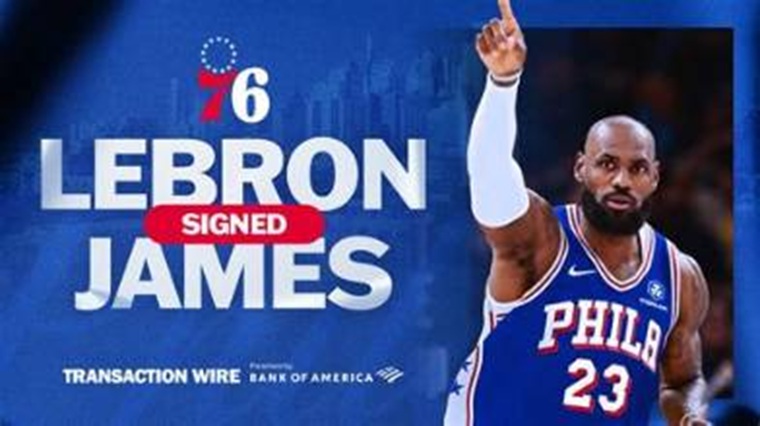
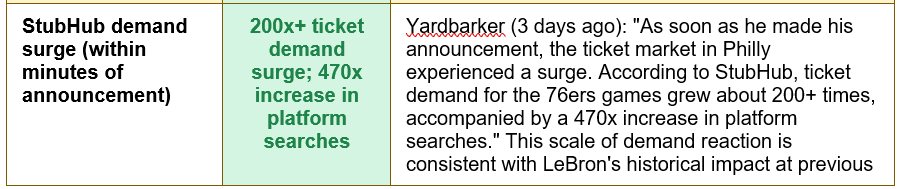
On July 24, 2026, LeBron James announced on social media that he would sign with the Philadelphia 76ers, calling the move his 'last decision.' Three days later, on July 27, 2026, the signing became official. Within minutes of the announcement, Philadelphia's economy started moving. Ticket prices on StubHub surged more than 200 times over. Platform searches jumped 470 times. On SeatGeek, the get-in price for the Sixers' first preseason home game climbed from $107 to $540 in under an hour. Official jerseys sold out on Fanatics before many fans had finished reading the announcement.The numbers behind the signing are almost absurd in their contrast. LeBron James -- the NBA's all-time leading scorer, four-time champion, four-time MVP, 22-time All-Star, and the most commercially valuable basketball player on the planet -- signed a two-year, $8 million deal with a player option. His salary in 2026-27: $3,876,529. His previous salary with the Lakers: $52.6 million. He accepted a pay cut of approximately $48.7 million in a single year to chase a fifth championship on his fourth franchise, at age 41, in what he described as his 'last decision.'
The Philadelphia 76ers and the city of Philadelphia did not pay $52 million for LeBron James. They paid $3.9 million. And what consulting firm The Boyd Company projects they will receive in return is between $250 million and $430 million in regional economic activity in the first season alone -- a return of more than 100 times the investment. This guide examines every dimension of that economic impact: the immediate market reactions already confirmed in data, the projected impacts across tickets, merchandise, media, tourism, and franchise valuation, the historical precedent from LeBron's previous moves, and what the signing means for the business of Philadelphia sports in 2026 and beyond.
The Deal: What LeBron Signed and Why He Signed It
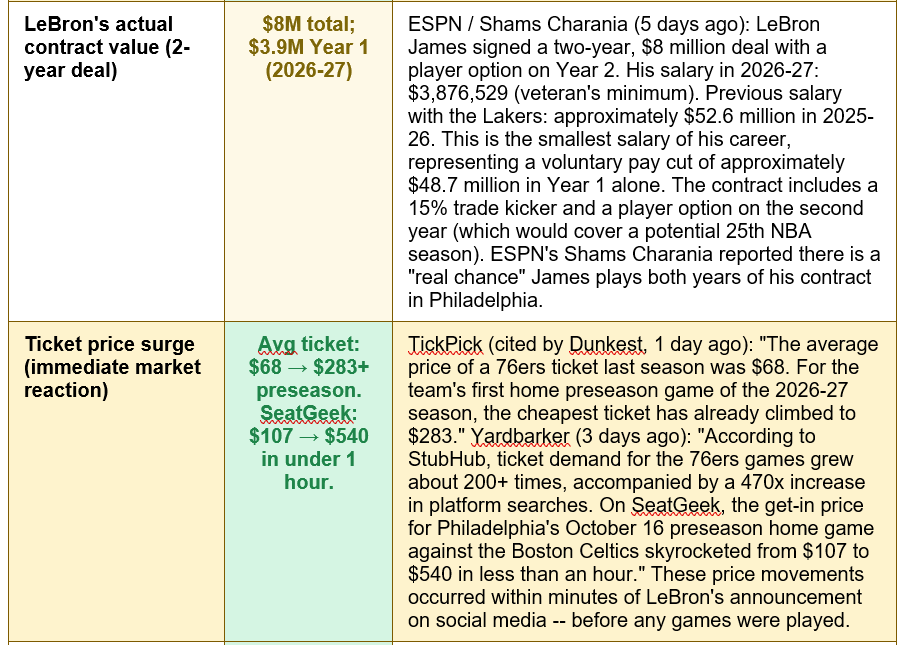
ESPN's Shams Charania and Klutch Sports CEO Rich Paul confirmed the contract details: a two-year, $8 million deal with a player option on the second year (which would cover a potential 25th NBA season) and a 15% trade kicker. LeBron's 2026-27 salary is $3,876,529 -- the veteran's minimum for a player of his experience level, and the smallest salary of his career.The motivation was explicitly stated by LeBron himself in a series of posts on social media: 'I was honest at that last press conference when I said I needed to look at myself and decide if I still love this game. After deciding I still truly love this game... I still want to sacrifice. I still want to work. I still want to grind. I still want to compete, to win and to have a chance at the feeling of winning another championship. I believe I can help make the Philadelphia 76ers a championship team and I am so excited to energize a new fan base and start this incredible journey one last time.' ESPN: 'A source familiar with LeBron James' thinking told ESPN that LeBron's choice hinged on the pursuit of a championship. After weighing his options, he believes that Philly gives him the best chance of doing that.'
The 76ers had assembled a compelling case. Earlier in the offseason they acquired Jaylen Brown -- described by Bleacher Report as 'an upgrade' over the departed Paul George -- in a trade widely viewed as a significant win. The roster Burnham has joined alongside -- Jaylen Brown, Joel Embiid, Tyrese Maxey, and VJ Edgecombe -- is described across multiple outlets as 'loaded.' Managing Partner Josh Harris welcomed James in terms that made the franchise's investment clear: 'One of the greatest players in NBA history and one of the best athletes ever... I cannot wait to see LeBron alongside Jaylen Brown, VJ Edgecombe, Joel Embiid, Tyrese Maxey, and our talented roster as we work to deliver a championship for Philly.'
The deal in numbers: $3.9M salary in Year 1. $48.7M pay cut from previous year. $250-430M projected economic impact. 100x ROI for Philadelphia in Year 1. — ESPN (5 days ago): 'LeBron James signing a two-year, $8 million contract with a player option; Klutch Sports Group CEO Rich Paul confirmed.' The Boyd Company (July 25, 2026): '$250-430M in regional economic activity as early as next season.' Yahoo Sports (2 days ago): 'The city of Philadelphia could see a 100x return on the 76ers' investment.' NBC Sports Philadelphia (1 day ago): 'LeBron James is officially a Philadelphia 76er. The NBA's transactions log on Sunday featured the Sixers' two-year, $8 million deal.'
The Economic Impact Scorecard: $250-430 Million and Counting
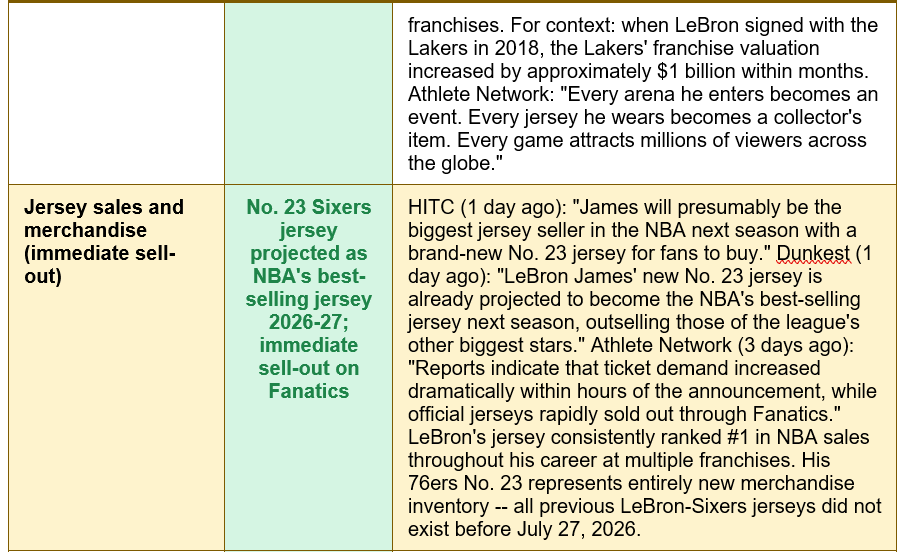
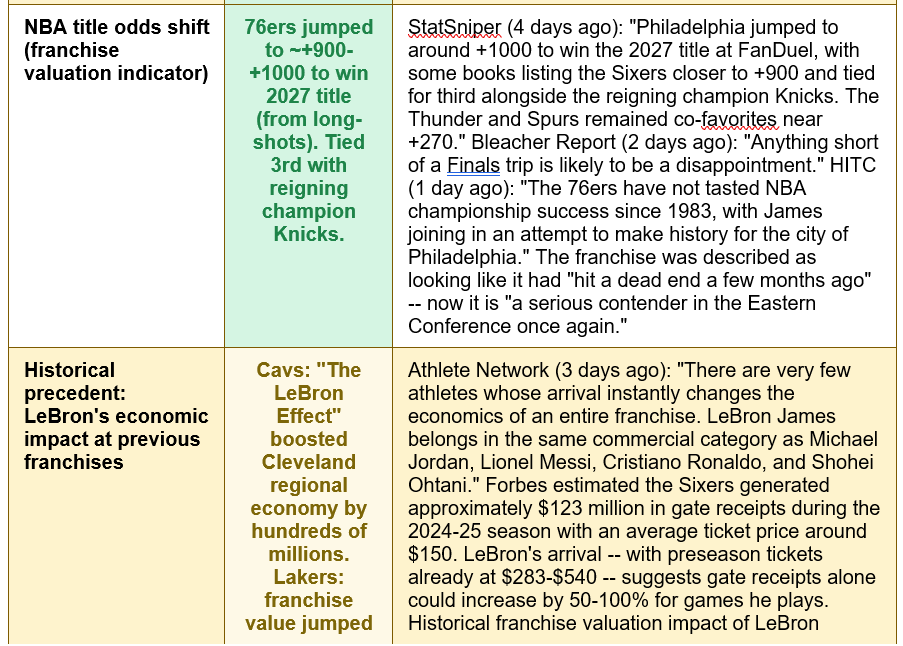
The following table maps every confirmed and projected economic impact of LeBron's signing, sourced from the most current data available as of 29 July 2026: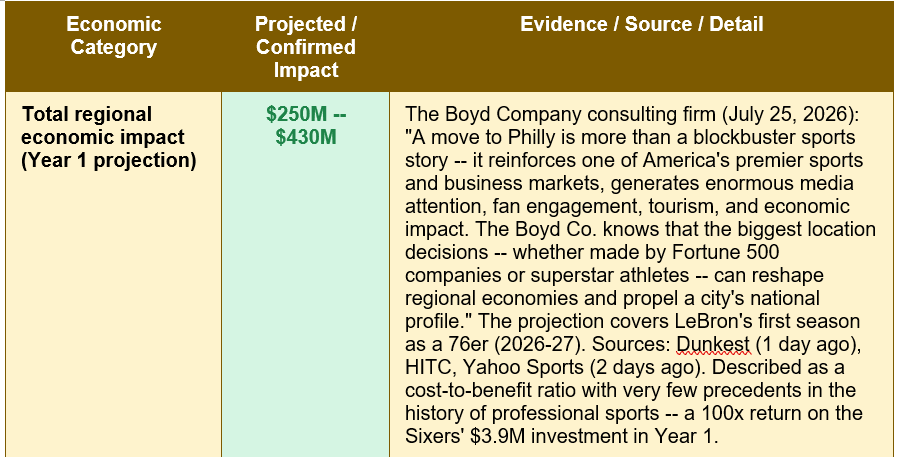

6 Economic Impacts Already in Motion -- With the Numbers
IMPACT #1: TICKET MARKET EXPLOSION | The most immediate and measurable economic signal
The ticket market reaction to LeBron's signing was instantaneous and dramatic. Yardbarker (3 days ago): 'According to StubHub, ticket demand for the 76ers games grew about 200+ times, accompanied by a 470x increase in platform searches. On SeatGeek, the get-in price for Philadelphia's October 16 preseason home game against the Boston Celtics skyrocketed from $107 to $540 in less than an hour.' TickPick data (cited by Dunkest, 1 day ago) provides the before-and-after: 'The average price of a 76ers ticket last season was $68. For the team's first home preseason game of the 2026-27 season, the cheapest ticket has already climbed to $283.' This is a 315% increase in the floor price for a preseason game -- before a single regular season game has been scheduled or a single minute of LeBron in a Sixers uniform has been played. Forbes estimated the Sixers generated approximately $123 million in gate receipts in 2024-25. If average ticket prices double across the regular season -- and the preseason data suggests they will for any game LeBron plays in -- gate revenue increases of $60-130 million per season are plausible. Every home game at the Wells Fargo Center becomes a premium event. Every visiting team's arena adds a game to their marquee schedule. Tickets for Sixers road games in other cities -- particularly the opening games and rivalry matchups -- are also surging as fans in those markets rush to see LeBron play live.IMPACT #2: MERCHANDISE AND JERSEY REVENUE | A new No. 23 jersey that did not exist five days ago is already sold out
Before July 27, 2026, a LeBron James Philadelphia 76ers jersey did not exist. Within hours of the signing announcement, it sold out on Fanatics. HITC (1 day ago): 'James will presumably be the biggest jersey seller in the NBA next season with a brand-new No. 23 jersey for fans to buy.' Dunkest (1 day ago): 'LeBron James' new No. 23 jersey is already projected to become the NBA's best-selling jersey next season, outselling those of the league's other biggest stars.' LeBron James has been the NBA's top jersey seller at every franchise he has played for. His commercial profile -- the brand of LeBron, separate from any particular team identity -- is what drives this. When fans from across the country (and globally) who follow LeBron rather than any particular team purchase a Sixers jersey because LeBron now wears one, that represents entirely new merchandise revenue for the franchise that would not have existed otherwise. Beyond jerseys: Sixers-branded merchandise of all kinds -- T-shirts, hats, hoodies, phone cases, memorabilia -- has surged. Athlete Network (3 days ago): 'Ticket demand increased dramatically within hours of the announcement, while official jerseys rapidly sold out through Fanatics.' Local Philadelphia sports retailers and arena merchandise stands will capture a significant share of this demand in person.IMPACT #3: TOURISM AND HOSPITALITY BOOST | The LeBron tourism effect -- fans travel to see him, not just Sixers fans
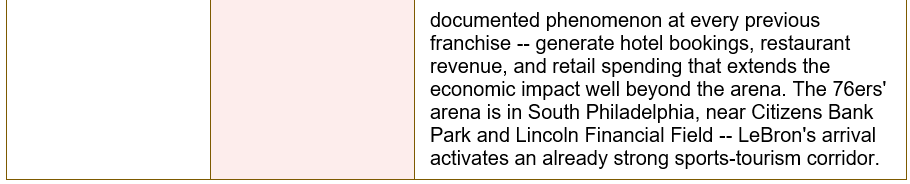
One of the most economically significant and least-discussed aspects of LeBron's career is the documented phenomenon of fans traveling to cities specifically to see him play in person -- not because they are fans of the home team, but because they are LeBron fans. This has been observed at every franchise he has played for. In Cleveland during his second tenure, visiting fan spending noticeably increased in proportion to games LeBron played in. In Los Angeles, road teams reported higher-than-average visiting fan representation at LeBron games. The Boyd Company (July 25, 2026) specifically names tourism as a component of the $250-430M projection: the estimate covers 'media attention, fan engagement, tourism, and economic impact.' Philadelphia is already a strong sports tourism destination -- home to the Eagles (Lincoln Financial Field), Phillies (Citizens Bank Park), Flyers, and the 76ers at the Wells Fargo Center, all in the South Philadelphia sports complex. LeBron's arrival activates this corridor more intensively. Hotels within two miles of the Wells Fargo Center, restaurants on Broad Street and throughout Center City, and the retail economy of central Philadelphia all stand to benefit from increased game-night and game-weekend foot traffic driven by fans who would not otherwise have visited the city.IMPACT #4: MEDIA EXPOSURE AND NATIONAL TV VALUE | The 76ers become the NBA's top marketing draw overnight
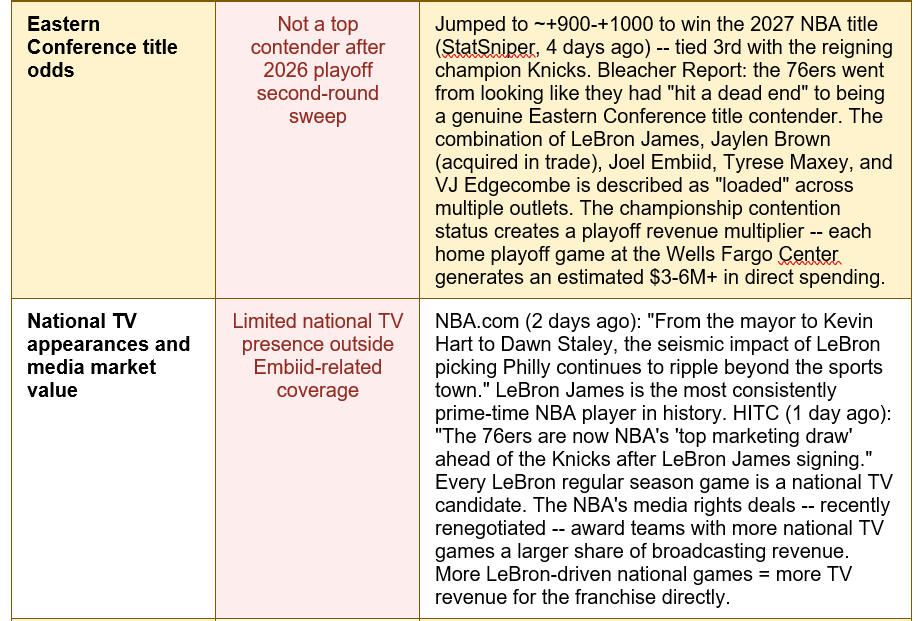
HITC (1 day ago): 'The 76ers are now the NBA's "top marketing draw" ahead of the Knicks after LeBron James signing.' NBA.com (2 days ago): 'From the mayor to Kevin Hart to Dawn Staley, the seismic impact of LeBron picking Philly continues to ripple beyond the sports town.' LeBron James is the most consistently prime-time NBA player in the modern era. His games generate national TV ratings that competitors cannot match. Every game LeBron plays is a potential national broadcast candidate -- on ESPN, ABC, TNT, or NBC (which returned to NBA broadcasting as part of the recent media rights package). The NBA's current media rights deals allocate national TV games partly on the basis of market appeal. A team with LeBron James gets more national games. More national games means more direct TV revenue under the league's revenue-sharing structure. More national exposure also means more sponsor visibility -- and the 76ers' jersey patch, arena naming rights, and broadcast partnerships all increase in commercial value when LeBron wears the uniform. The secondary media effects are equally significant: every major sports media outlet -- ESPN, The Athletic, Bleacher Report, Barstool -- generates LeBron-76ers content, all of which carries Philadelphia branding to audiences that extend globally.IMPACT #5: FRANCHISE VALUATION AND INVESTMENT APPEAL | Historical precedent: LeBron moves add hundreds of millions to franchise values
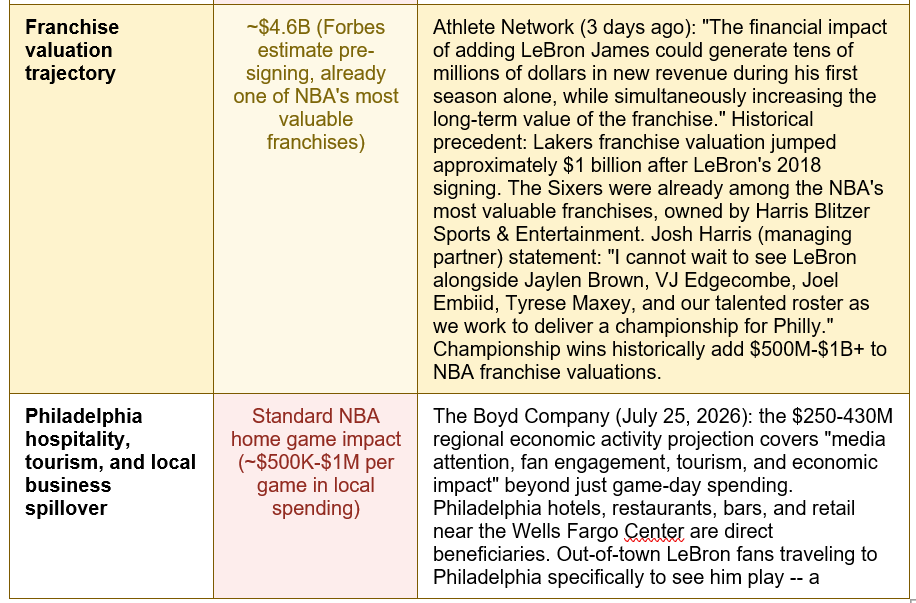
Athlete Network (3 days ago): 'The financial impact of adding LeBron James could generate tens of millions of dollars in new revenue during his first season alone, while simultaneously increasing the long-term value of the franchise.' The historical record of LeBron signings and franchise valuations is instructive. When LeBron James signed with the Los Angeles Lakers in 2018, the Lakers franchise valuation increased by approximately $1 billion within months of the announcement. The Lakers were already the NBA's most valuable franchise before LeBron arrived -- his presence accelerated an already upward trajectory. The Philadelphia 76ers, owned by Harris Blitzer Sports & Entertainment (managing partner Josh Harris, the same Josh Harris who owns the Washington Commanders NFL franchise), are already one of the NBA's most valuable franchises. LeBron's arrival -- particularly combined with the already-acquired Jaylen Brown and the existing roster of Embiid, Maxey, and Edgecombe -- creates a championship contention context that drives franchise valuation upward through multiple channels: higher gate receipts compound over multiple seasons; higher merchandise volumes sustain over the contract period; playoff appearances generate additional direct revenue per game; and the 'LeBron premium' on franchise valuation reflects the long-term brand association between one of sports' greatest-ever commercial figures and the Sixers brand. StatSniper (4 days ago): 'Philadelphia jumped to around +1000 to win the 2027 title at FanDuel, with some books listing the Sixers closer to +900 and tied for third alongside the reigning champion Knicks.'IMPACT #6: PLAYOFF REVENUE MULTIPLIER | Every home playoff game worth $3-6M+ -- the Sixers haven't had this lever in years
Bleacher Report (2 days ago): 'This was an organization that looked to hit a dead end a few months ago. Suddenly, the 76ers are a serious contender in the Eastern Conference once again.' The economic significance of playoff contention for an NBA franchise is substantial and often underestimated. Each home playoff game at the Wells Fargo Center generates direct arena revenue -- ticket sales, food and beverage, merchandise -- estimated at $3-6 million or more per game at current premium price levels. A full playoff run (three rounds of home games in the Eastern Conference) could generate $50-100 million in incremental revenue that simply does not exist without playoff participation at this level. The 76ers were swept in the second round of the 2026 playoffs -- primarily due to Joel Embiid's health issues (Bleacher Report: 'Embiid has played in fewer than 40 games for three straight seasons'). LeBron James' presence on the roster -- as a player with documented late-season playoff performance longevity -- gives the 76ers a different ceiling. Beyond direct game revenue, a deep playoff run in 2027 generates national TV exposure, merchandise sell-through, corporate partnership renewals at premium rates, and a positive cycle of fan engagement that sustains ticket and merchandise demand into subsequent seasons. The Boyd Company's $250-430M projection almost certainly includes an expectation of playoff participation in the model.The 76ers Business: Before and After LeBron
This table maps the key business metrics of the Philadelphia 76ers franchise before and after the LeBron James signing: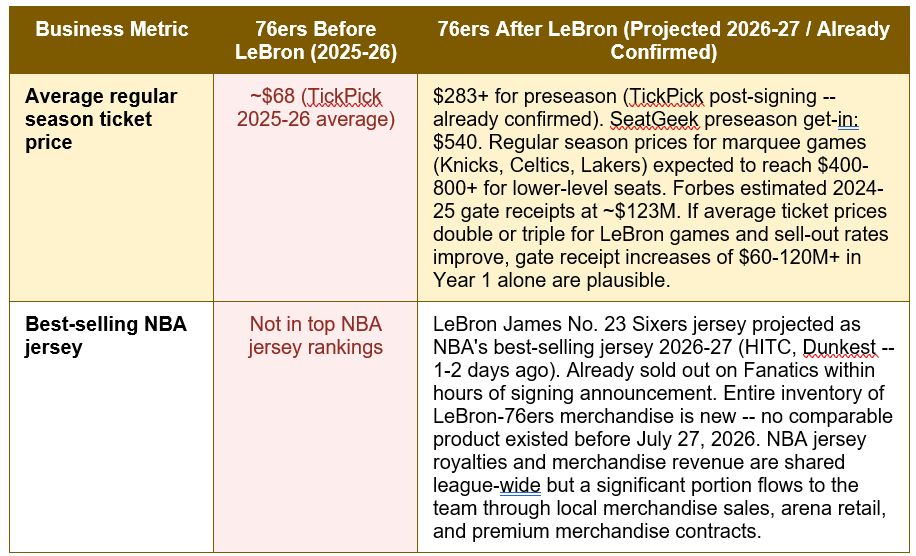
The LeBron Effect: Historical Context and Comparable Sports Moves
To understand what LeBron James' arrival means for Philadelphia in economic terms, it helps to situate this within the broader history of superstar athlete economic impacts. Athlete Network (3 days ago): 'There are very few athletes whose arrival instantly changes the economics of an entire franchise. LeBron James belongs in the same commercial category as Michael Jordan, Lionel Messi, Cristiano Ronaldo, and Shohei Ohtani.'LeBron's History of Franchise Transformation
LeBron James has now signed major free-agent deals with four franchises: the Cleveland Cavaliers (twice), the Miami Heat, the Los Angeles Lakers, and now the Philadelphia 76ers. Each move generated significant economic activity at the destination franchise. His return to Cleveland in 2014 was credited with a measurable boost to the Greater Cleveland economy -- culminating in the 2016 NBA championship, which generated an estimated $50 million in direct economic impact for Cleveland in the championship celebration period alone. His 2018 move to the Lakers increased the franchise's valuation, intensified national media coverage, and produced multiple playoff appearances. The financial structure of his Sixers deal -- the smallest salary of his career, taken voluntarily -- is the clearest possible signal of what LeBron himself believes about the commercial opportunity. He did not need $53 million from the Sixers. He took $3.9 million because the title opportunity and the commercial platform of a new city were sufficient compensation in non-monetary terms.The Shohei Ohtani Comparison: Sports Megastars as Economic Events
Athlete Network draws the comparison to Shohei Ohtani's 2023 move to the Los Angeles Dodgers -- a $700 million contract that transformed the Dodgers' commercial profile, drove jersey sales to record levels, opened new Asian markets for the franchise, and contributed to the Dodgers' 2024 World Series championship. The structural similarity to LeBron's 76ers move is striking: a generational athlete, late in career but still performing, joining a contending roster, taking a commercially motivated decision that maximises their legacy. LeBron's pay cut mirrors Ohtani's decision to defer the majority of his contract payments -- both decisions prioritising outcomes (championship, commercial legacy) over short-term salary maximisation.The difference in favour of Philadelphia's economics: LeBron's contract cost is $3.9 million in Year 1, not $70 million (even with deferrals). The Boyd Company's $250-430M projection against a $3.9M salary cost produces a cost-benefit ratio that is genuinely exceptional by any measure in professional sports economics. Dunkest (1 day ago): 'A cost-to-benefit ratio with very few precedents in the history of professional sports.'
The 'LeBron premium' on everything: how one athlete moves markets. NBA.com (2 days ago): 'From the mayor to Kevin Hart to Dawn Staley, the seismic impact of LeBron picking Philly continues to ripple beyond the sports town.' The economic impact of LeBron James' signing is not limited to the Wells Fargo Center and the 76ers balance sheet. The mayor of Philadelphia has been quoted on the signing. Kevin Hart -- himself a Philadelphia native and one of the highest-earning entertainers in the world -- commented publicly. Dawn Staley, the legendary Philadelphia-born basketball coach, responded. These are not sports stories; they are civic and cultural stories with economic implications. Every media mention of Philadelphia in the context of LeBron James -- and there will be tens of thousands of such mentions over the coming season -- is a form of destination marketing for the city. Tourism, business location decisions, event scheduling, and investment are all influenced by the perception of a city as vibrant, successful, and nationally significant. LeBron choosing Philadelphia -- over other options including reported interest from the Golden State Warriors -- is a signal about the city that extends well beyond basketball. The Boyd Company explicitly names this: 'It reinforces one of America's premier sports and business markets... and propel[s] a city's national profile.'
The Risks: What Could Limit the Economic Impact
The $250-430M economic projection and the extraordinary market reactions of the first 48 hours should be understood in context. Several factors could limit or compress the actual economic outcome:- 1. Joel Embiid's health remains the central uncertainty: Bleacher Report (2 days ago): 'So much of the 76ers' championship hopes rest on the health of Joel Embiid. He has played in fewer than 40 games for three straight seasons, and the 2026 playoffs told a familiar story as a hobbled Embiid couldn't help his team avoid a second-round sweep.' If Embiid again misses significant regular season and playoff games, the 76ers' ceiling drops sharply regardless of LeBron's presence. A team that underperforms expectations generates less ticket demand, fewer national TV appearances, and earlier playoff exits -- all of which reduce the economic multiplier. LeBron plus a healthy Embiid is a Finals contender. LeBron plus an injured Embiid is a competitive team that may not reach the Finals.
- 2. LeBron's own age and health (41 years old entering the season): LeBron averaged 20.9 points, 7.2 assists, and 6.1 rebounds across 60 games in 2025-26 -- his lowest scoring output and lowest usage rate of his career. StatSniper (4 days ago): 'Philadelphia is not paying for the 30-point version. It is paying for the playmaking, the late-game decision-making and the floor-raising that a contender leans on in May.' The economic impact is still significant even if LeBron plays a reduced role -- but the ceiling of impact (playoff runs, national TV appearances, championship potential) depends on his remaining at a high competitive level.
- 3. Pre-season ticket pricing may not sustain through the regular season: The 315% increase in preseason ticket floor prices is a demand signal, not a contractual revenue commitment. Secondary market prices will normalise once initial demand is satisfied, games prove to be regular season events rather than historic occasions, and the initial novelty effect fades. Regular season average ticket prices will likely be significantly higher than last season's $68 average -- but probably not at the $283-540 preseason level for all games.
- 4. Economic projections are models, not guarantees: Dunkest (1 day ago) notes that the Boyd Company projection is an 'estimate.' Economic projections of sports signing impacts are inherently uncertain -- they depend on assumptions about attendance, ticket price levels, merchandise volume, TV appearances, and playoff success. The $250M floor and $430M ceiling represent a range, not a precise forecast. Actual outcomes could fall within this range, above it (if the 76ers win the championship), or below it (if significant health issues affect Embiid or LeBron).
FOUR THINGS TO UNDERSTAND ABOUT THE LEBRON-76ERS ECONOMIC STORY: (1) THE $250-430M IS A PROJECTION, NOT A GUARANTEE. The Boyd Company figure is a modelled estimate from a consulting firm, not an audited financial result. Economic impact studies of sports events and signings are legitimate analytical tools but involve significant assumptions. The actual impact will depend on team performance, player health, consumer demand, and factors that cannot be predicted. That said, the immediate market data -- 200x demand surge on StubHub, 315% ticket price increase in 48 hours, jersey sell-outs -- provide real-time evidence that demand fundamentals support a very large economic response. (2) THE $3.9M SALARY IS NOT THE FULL PICTURE FOR LEBRON. LeBron James earns approximately $50-80M per year from brand endorsements, his SpringHill production company, his Fenway Sports Group stake (Liverpool FC), his pizza franchise investments (Blaze Pizza), and other business interests. The $3.9M veteran minimum salary is his basketball salary -- a fraction of his total earnings. His decision to take the minimum was explicitly about competitive positioning for a championship, not financial necessity. LeBron's off-court business empire -- worth an estimated $1B+ -- benefits from the platform and exposure that a Philadelphia signing and potential championship run provides. (3) THE LOS ANGELES ECONOMIC LOSS IS REAL. While Philadelphia gains, Los Angeles and the Lakers absorb the reverse of many of these economic effects. The Lakers lost their marquee player, their highest-profile jersey seller, and significant national TV game scheduling. This is the zero-sum dimension of superstar athlete free agency -- economic value transfers between cities along with the athlete. (4) THE CHAMPIONSHIP IS NOT GUARANTEED. StatSniper (4 days ago): 'The Thunder and Spurs remained co-favorites near +270' -- meaning the 76ers at +900-1000 are significant underdogs to win the 2027 title despite the improvements. LeBron James joining does not guarantee an NBA championship. It significantly raises the probability ceiling and creates the contention context that drives all of the economic projections -- but the actualisation of the top end of those projections requires a deep playoff run and ideally a championship.
Conclusion
LeBron James signing with the Philadelphia 76ers on July 27, 2026 is, in economic terms, one of the most asymmetric value events in professional sports history. The Sixers paid $3,876,529. The Boyd Company projects the return: between $250 million and $430 million in regional economic activity in the first season alone. The initial market reactions -- 200-times ticket demand surge on StubHub, 470-times platform search increase, preseason ticket floors rising from $107 to $540 in under an hour, and immediate jersey sell-outs on Fanatics -- provide real-time confirmation that the demand fundamentals support the magnitude of the projection.The economic impact operates across six channels: ticket market repricing, merchandise and jersey revenue (LeBron's No. 23 Sixers jersey projected as the NBA's best-selling jersey in 2026-27), tourism and hospitality spillover, national media exposure and TV value (the 76ers are now the NBA's top marketing draw), franchise valuation uplift, and the playoff revenue multiplier that accompanies the 76ers' transformation from a team that 'looked to hit a dead end a few months ago' to a legitimate Eastern Conference title contender.
The risks are real -- primarily Embiid's health, LeBron's age, and the inherent uncertainty in economic projections. But as Athlete Network notes, LeBron James belongs in 'the same commercial category as Michael Jordan, Lionel Messi, Cristiano Ronaldo, and Shohei Ohtani.' His arrival in Philadelphia is not just a basketball story. It is an economic event. And for a city that has not celebrated an NBA championship since 1983, the prospect that LeBron James' 'last decision' might end with a parade down Broad Street is the variable that makes every economic projection in this guide, if anything, conservative.

0 Comments Comments