

Investing
Roth IRA Plans Limits, Rules, Strategies, and Tips: Explained

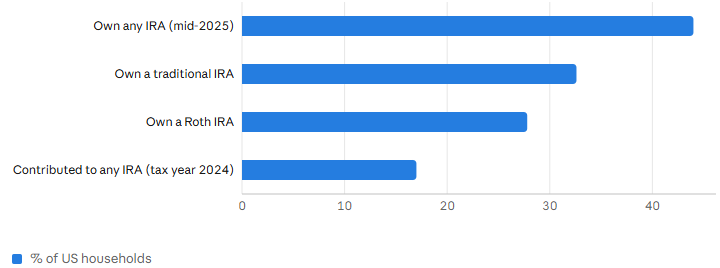
2026 limits: $7,500 ($8,600 at 50+); Roth phase-out $153,000–$168,000 (single) and $242,000–$252,000 (joint); contribution deadline April 15, 2027; Roth 401(k) limit $24,500. ICI (mid-2025): 44% of US households own an IRA; 27.8% (37.5 million) own a Roth IRA and 32.6% a traditional IRA; only 17% of households contributed to an IRA in tax year 2024. Fidelity (Q4 2025): Gen Z directed 95% of IRA contributions to Roth, Millennials 75%, Gen X 66%. IRS data: average Roth IRA about $57,450 vs about $225,400 for traditional IRAs. Illustration: $7,500 a year at 7% grows to about $103,600 in 10 years, $307,500 in 20 and $708,500 in 30, on $225,000 contributed over 30 years (author’s arithmetic; end-of-year contributions).
That gap is the opportunity. A Roth IRA is not complicated, but it has rules about income, timing and withdrawals that trip people up. This guide covers the 2026 numbers, five ways to build a Roth plan, the five-year rules in plain English and a six-step way to begin.
Many retirees like Roth money for another reason: qualified Roth withdrawals are not counted when the IRS decides how much of your Social Security to tax, according to Kiplinger. You also need earned income to contribute: wages or self-employment income. Investment income and Social Security do not count, and your contribution cannot exceed what you earned.
Your income determines whether you can contribute directly. For single filers, the phase-out runs from $153,000 to $168,000 of modified adjusted gross income. For married couples filing jointly, it runs from $242,000 to $252,000. Within the range, your allowed contribution shrinks proportionally, and if the formula gives you less than $200, you can still contribute $200. A spouse with little or no income can still have a Roth IRA through a spousal contribution, as long as the couple’s combined earned income covers both contributions.
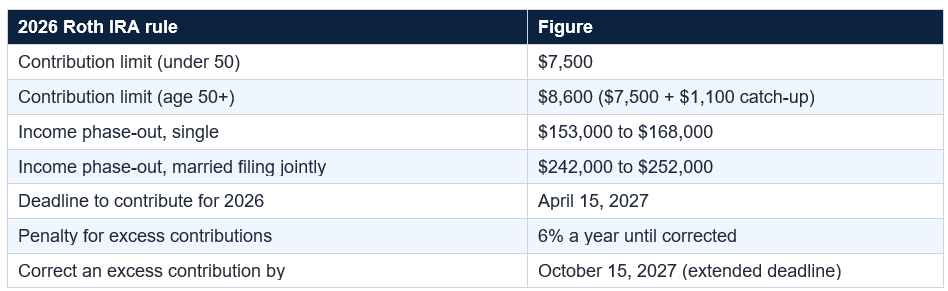
Keep in mind: Contributing more than you are allowed triggers a 6% excise tax each year until you fix it. If you realize you went over, withdraw the excess (and any earnings) or recharacterize it by the extended filing deadline.
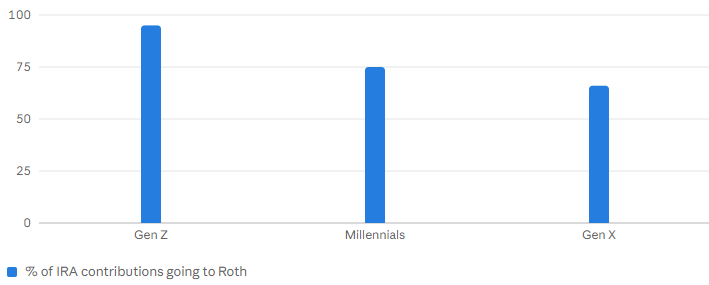
Younger savers seem to agree. ICI found that households younger than 45 were more likely to own Roth IRAs than traditional ones. Fidelity reported that in the fourth quarter of 2025 Gen Z directed 95% of IRA contributions to Roth, Millennials 75% and Gen X 66%. Among households that contributed to an IRA for tax year 2023, 56% put money only into a Roth, according to ICI data cited by YTS Wealth. Many people also split: tax diversification, meaning having both pre-tax and Roth money, gives you options in retirement.
ICI (mid-2025): 27.8% of US households own a Roth IRA versus 32.6% a traditional IRA; households under 45 favor Roth. Fidelity Q4 2025: Gen Z 95%, Millennials 75%, Gen X 66% of IRA contributions went to Roth.
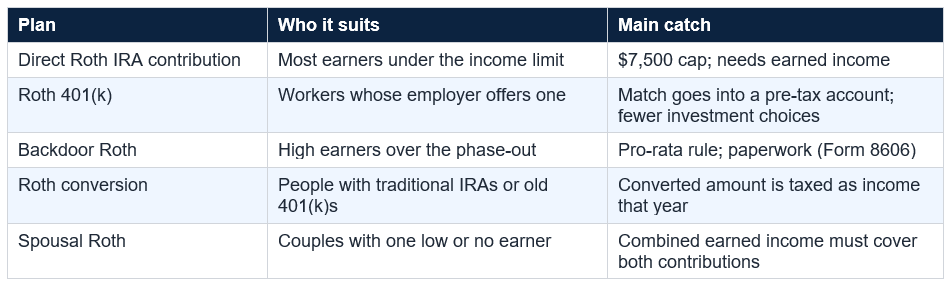
The second is a Roth 401(k) through your employer, if offered. The 2026 limit is $24,500, much higher than the IRA limit, and I understand there is no income cap on contributions. Capture any employer match first, since it is free money. The third is the backdoor Roth for higher earners: make a nondeductible contribution to a traditional IRA, then convert it to a Roth. A backdoor Roth does not create a separate limit; it uses the regular IRA limit. The catch is the pro-rata rule: existing pre-tax balances in traditional, SEP or SIMPLE IRAs make part of the conversion taxable, based on your total balance at December 31.
The fourth is a Roth conversion, moving money from a traditional IRA or old 401(k) into a Roth. The converted amount counts as ordinary income that year, but there is no income cap on conversions, and many people convert in lower-income years and spread conversions over time. The fifth is the spousal Roth, which lets a nonworking or low-earning spouse have an account funded from the couple’s earnings.
The second clock applies to conversions. Each conversion has its own five-year timer for avoiding the 10% penalty on converted principal if you are under 59½. Your original contributions are never subject to either rule, since you can take them out any time without tax or penalty. The safe approach: treat the account as untouchable, and know that contributions are your last-resort backstop.
A caution: leaving contributions in cash is a quiet mistake. At some brokers, uninvested cash inside an IRA earns little or nothing. Robinhood, for example, pays no interest on IRA cash, according to Finder. Invest contributions promptly, or hold them in a money market fund while you decide, because idle cash loses ground to inflation, which was 3.7% in September.
The tax-free part is what makes the Roth special. In the 7% example over 30 years, about $483,500 of the $708,500 is investment growth. In a taxable account, that growth could face capital gains tax along the way. At a 15% long-term rate, that would be roughly $72,500 on those gains, an illustration that ignores dividends and other complications. In a Roth, qualified withdrawals are generally tax-free.

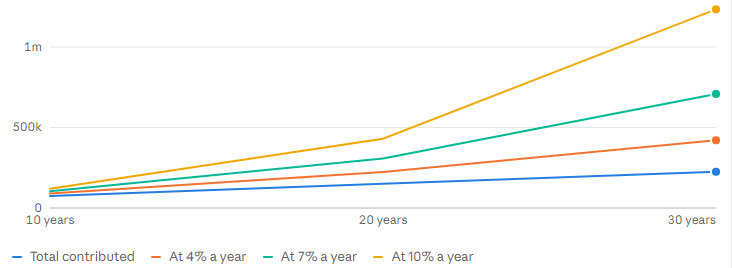
The numbers: $7,500 a year for 30 years at 7%: about $708,456, on $225,000 contributed. About $483,456 is growth that could be tax-free in a Roth. Constant-rate illustration only; returns are not guaranteed.
There is no single perfect Roth plan. A direct contribution, a Roth 401(k), a backdoor Roth, a conversion or a spousal account may each suit different people. What works is picking one, funding it regularly, investing in low-cost diversified funds and leaving it alone. A tax professional can tailor the details to your situation.
The limit is $7,500, up from $7,000 in 2025, plus a $1,100 catch-up for people 50 and older, for a total of $8,600. That limit applies across all your IRAs combined, traditional and Roth, and you cannot contribute more than you earned. You have until April 15, 2027 to make a 2026 contribution.
Can I contribute if I earn too much?
Direct contributions phase out between $153,000 and $168,000 of modified adjusted gross income for single filers and $242,000 to $252,000 for married couples filing jointly in 2026. Above those levels, some people use a backdoor Roth: a nondeductible traditional IRA contribution followed by a conversion. The pro-rata rule can make part of the conversion taxable, so consult a tax professional.
Can I take money out of a Roth IRA early?
You can withdraw your own contributions at any time without tax or penalty. Withdrawing earnings before age 59½ and before meeting the five-year rule can trigger income tax and a 10% penalty, with exceptions. Treat a Roth as retirement money first and an emergency backstop only as a last resort.
Roth IRA or Roth 401(k)?
A Roth 401(k) is offered through an employer, has a much higher limit ($24,500 in 2026) and, as I understand the rules, has no income cap on contributions. A Roth IRA has a lower limit and income limits but usually offers more investment choices. Many people use both, capturing any employer match in the 401(k) first.
Is a Roth IRA better than a traditional IRA?
Neither is better for everyone. A Roth makes sense when you expect your tax rate in retirement to be equal or higher than today’s, or when you value tax-free withdrawals and no required distributions. A traditional IRA may suit you if you want the deduction now. Younger savers lean Roth: at Fidelity, Gen Z put 95% of IRA contributions into Roth accounts.
Table of Contents
- The Account People Love and Underuse
- What a Roth IRA Actually Is
- The 2026 Rules at a Glance
- Roth or Traditional? How to Think About It
- Five Ways to Build a Roth Plan
- The Five-Year Rules, Demystified
- What to Put Inside Your Roth
- What a Maxed-Out Roth Can Grow To
- Where to Open One
- Mistakes That Cost People Money
- A Simple Six-Step Roth Plan
- Conclusion
- Frequently Asked Questions
A maxed-out Roth: $7,500 a year at constant returns ($)
Account value ($) by Years of contributions (author's illustration, end-of-year contributions)
IRA ownership vs. actually contributing (% of US households)
% of households by Source: Investment Company Institute, June 2026
Roth is the young saver's account: share of IRA contributions to Roth (%)
% of IRA contribution dollars to Roth by Source: Fidelity Q4 2025 retirement analysis
The Account People Love and Underuse
The Roth IRA idea is irresistible: you pay tax once, today, and then your investments grow without further tax, and qualified withdrawals in retirement are tax-free. And yet, according to the Investment Company Institute’s June 2026 report, only 17% of US households contributed to any IRA in tax year 2024. About 37.5 million households, or 27.8%, owned a Roth IRA in mid-2025. Owning one and funding one are not the same thing.That gap is the opportunity. A Roth IRA is not complicated, but it has rules about income, timing and withdrawals that trip people up. This guide covers the 2026 numbers, five ways to build a Roth plan, the five-year rules in plain English and a six-step way to begin.
What a Roth IRA Actually Is
A Roth IRA is an individual retirement account funded with money you have already paid tax on. In return for skipping the upfront tax deduction, qualified withdrawals, including all the growth, are generally federal income tax-free. Empower summarizes the main features: contributions can be withdrawn at any time without taxes or penalties, while specific rules apply to earnings. And unlike a traditional IRA, a Roth IRA has no required withdrawals for the original owner, which makes it useful for people who want to leave money invested.Many retirees like Roth money for another reason: qualified Roth withdrawals are not counted when the IRS decides how much of your Social Security to tax, according to Kiplinger. You also need earned income to contribute: wages or self-employment income. Investment income and Social Security do not count, and your contribution cannot exceed what you earned.
The 2026 Rules at a Glance
For 2026, the IRS raised the combined IRA contribution limit to $7,500 from $7,000, with an extra $1,100 catch-up for those 50 and older, for a total of $8,600. The limit applies across all your traditional and Roth IRAs combined. You have until the tax-filing deadline, April 15, 2027, to make a 2026 contribution, and a tax extension does not extend the contribution deadline.Your income determines whether you can contribute directly. For single filers, the phase-out runs from $153,000 to $168,000 of modified adjusted gross income. For married couples filing jointly, it runs from $242,000 to $252,000. Within the range, your allowed contribution shrinks proportionally, and if the formula gives you less than $200, you can still contribute $200. A spouse with little or no income can still have a Roth IRA through a spousal contribution, as long as the couple’s combined earned income covers both contributions.
Keep in mind: Contributing more than you are allowed triggers a 6% excise tax each year until you fix it. If you realize you went over, withdraw the excess (and any earnings) or recharacterize it by the extended filing deadline.
Roth or Traditional? How to Think About It
The core question is simple: do you want your tax break now or later? With a traditional IRA, you may deduct contributions today and pay tax on withdrawals in retirement. With a Roth, you pay now and withdraw tax-free later. On a $7,500 contribution, the upfront tax is $900 at a 12% bracket and $1,650 at 22%. The Roth is attractive when your tax rate today is low relative to what you expect later, or when you value flexibility.Younger savers seem to agree. ICI found that households younger than 45 were more likely to own Roth IRAs than traditional ones. Fidelity reported that in the fourth quarter of 2025 Gen Z directed 95% of IRA contributions to Roth, Millennials 75% and Gen X 66%. Among households that contributed to an IRA for tax year 2023, 56% put money only into a Roth, according to ICI data cited by YTS Wealth. Many people also split: tax diversification, meaning having both pre-tax and Roth money, gives you options in retirement.
ICI (mid-2025): 27.8% of US households own a Roth IRA versus 32.6% a traditional IRA; households under 45 favor Roth. Fidelity Q4 2025: Gen Z 95%, Millennials 75%, Gen X 66% of IRA contributions went to Roth.
Five Ways to Build a Roth Plan
There is more than one route into a Roth. The first is the direct contribution: open a Roth IRA and fund it each year, up to $7,500. It fits most people under the income limit, and about $625 a month reaches the full limit.The second is a Roth 401(k) through your employer, if offered. The 2026 limit is $24,500, much higher than the IRA limit, and I understand there is no income cap on contributions. Capture any employer match first, since it is free money. The third is the backdoor Roth for higher earners: make a nondeductible contribution to a traditional IRA, then convert it to a Roth. A backdoor Roth does not create a separate limit; it uses the regular IRA limit. The catch is the pro-rata rule: existing pre-tax balances in traditional, SEP or SIMPLE IRAs make part of the conversion taxable, based on your total balance at December 31.
The fourth is a Roth conversion, moving money from a traditional IRA or old 401(k) into a Roth. The converted amount counts as ordinary income that year, but there is no income cap on conversions, and many people convert in lower-income years and spread conversions over time. The fifth is the spousal Roth, which lets a nonworking or low-earning spouse have an account funded from the couple’s earnings.
The Five-Year Rules, Demystified
The five-year rule confuses almost everyone, so here is the short version. There are two separate clocks. The first applies to earnings: for withdrawals of earnings to be tax-free, you generally must be at least 59½ and your first Roth IRA must have been open for at least five tax years. The clock starts on January 1 of the tax year of your first contribution, according to Kiplinger and others, so funding early starts it sooner.The second clock applies to conversions. Each conversion has its own five-year timer for avoiding the 10% penalty on converted principal if you are under 59½. Your original contributions are never subject to either rule, since you can take them out any time without tax or penalty. The safe approach: treat the account as untouchable, and know that contributions are your last-resort backstop.
What to Put Inside Your Roth
A Roth IRA is a container, not an investment. What you buy inside matters enormously. For long-term savers, broad, low-cost index funds or a target-date fund are the usual starting point. Top S&P 500 index funds charge 0.015% to 0.04% a year, according to Bankrate, and Fidelity offers ZERO funds with a 0.00% expense ratio, per Finder. Because Roth growth is tax-free, many people place their highest-growth, long-term investments there, though the right mix depends on your timeline and risk tolerance.A caution: leaving contributions in cash is a quiet mistake. At some brokers, uninvested cash inside an IRA earns little or nothing. Robinhood, for example, pays no interest on IRA cash, according to Finder. Invest contributions promptly, or hold them in a money market fund while you decide, because idle cash loses ground to inflation, which was 3.7% in September.
What a Maxed-Out Roth Can Grow To
To see why it pays to start, here is an illustration of my own. Suppose you contribute the full $7,500 each year, at the end of the year, and earn a constant return. At 7%, you would have about $103,600 after 10 years, about $307,500 after 20 and about $708,500 after 30, on total contributions of $75,000, $150,000 and $225,000. At 4%, those figures are about $90,000, $223,300 and $420,600. At 10%, about $119,500, $429,600 and $1.23 million. Real returns will vary and are not guaranteed.The tax-free part is what makes the Roth special. In the 7% example over 30 years, about $483,500 of the $708,500 is investment growth. In a taxable account, that growth could face capital gains tax along the way. At a 15% long-term rate, that would be roughly $72,500 on those gains, an illustration that ignores dividends and other complications. In a Roth, qualified withdrawals are generally tax-free.
The numbers: $7,500 a year for 30 years at 7%: about $708,456, on $225,000 contributed. About $483,456 is growth that could be tax-free in a Roth. Constant-rate illustration only; returns are not guaranteed.
Where to Open One
You can open a Roth IRA at most major brokers. NerdWallet’s 2026 rankings named Fidelity its Best Broker for Beginners and Charles Schwab its best online broker for IRA investors. Fidelity offers $0 minimums and zero-expense-ratio funds. Robinhood offers an IRA match of 1%, or 3% with Gold at $50 a year, worth up to $225 a year at the 2026 limit, but Financer notes the match can be clawed back if you leave within five years and there is a $100 transfer-out fee. Compare fees, investment choices and support, and avoid choosing only for a sign-up bonus.Mistakes That Cost People Money
The most common errors are avoidable. People contribute more than the limit or without earned income, forget the income phase-out, leave contributions in cash, withdraw earnings too early and trigger taxes and a penalty, or do a backdoor Roth without considering the pro-rata rule. And they wait: each year of delay is a year of tax-free growth missed.A Simple Six-Step Roth Plan
First, check eligibility: do you have earned income, and is your modified adjusted gross income below $168,000 (single) or $252,000 (joint)? Second, capture any employer 401(k) match before funding a Roth. Third, open a Roth IRA at a reputable broker. Fourth, set an automatic monthly contribution, such as $625 to reach $7,500, or less if that is not affordable. Fifth, invest in broad, low-cost funds rather than leaving cash idle. Sixth, review once a year, adjust contributions when your income rises and consider conversions in low-income years with a tax professional.Conclusion
A Roth IRA is one of the most flexible tools in retirement planning. The 2026 rules let you contribute up to $7,500, or $8,600 if you are 50 or older, with direct contributions available below $153,000 of income if single or $242,000 if married filing jointly. Qualified withdrawals are tax-free, your contributions are accessible and you are not forced to withdraw in retirement. Yet only 17% of households contributed to any IRA in 2024, so for many people the main step is simply starting.There is no single perfect Roth plan. A direct contribution, a Roth 401(k), a backdoor Roth, a conversion or a spousal account may each suit different people. What works is picking one, funding it regularly, investing in low-cost diversified funds and leaving it alone. A tax professional can tailor the details to your situation.
Frequently Asked Questions
What is the Roth IRA contribution limit for 2026?The limit is $7,500, up from $7,000 in 2025, plus a $1,100 catch-up for people 50 and older, for a total of $8,600. That limit applies across all your IRAs combined, traditional and Roth, and you cannot contribute more than you earned. You have until April 15, 2027 to make a 2026 contribution.
Can I contribute if I earn too much?
Direct contributions phase out between $153,000 and $168,000 of modified adjusted gross income for single filers and $242,000 to $252,000 for married couples filing jointly in 2026. Above those levels, some people use a backdoor Roth: a nondeductible traditional IRA contribution followed by a conversion. The pro-rata rule can make part of the conversion taxable, so consult a tax professional.
Can I take money out of a Roth IRA early?
You can withdraw your own contributions at any time without tax or penalty. Withdrawing earnings before age 59½ and before meeting the five-year rule can trigger income tax and a 10% penalty, with exceptions. Treat a Roth as retirement money first and an emergency backstop only as a last resort.
Roth IRA or Roth 401(k)?
A Roth 401(k) is offered through an employer, has a much higher limit ($24,500 in 2026) and, as I understand the rules, has no income cap on contributions. A Roth IRA has a lower limit and income limits but usually offers more investment choices. Many people use both, capturing any employer match in the 401(k) first.
Is a Roth IRA better than a traditional IRA?
Neither is better for everyone. A Roth makes sense when you expect your tax rate in retirement to be equal or higher than today’s, or when you value tax-free withdrawals and no required distributions. A traditional IRA may suit you if you want the deduction now. Younger savers lean Roth: at Fidelity, Gen Z put 95% of IRA contributions into Roth accounts.
0 Comments
Be the first to share your thoughts on this article.