

Savings
Save Thousands a Year Without Living on a Tight Budget

Table of Contents
- The Saving Myth That Stops Most People Before They Start
- The Savings Opportunity: Where the Money Is Already Going That You Are Not Enjoying
- Where the Savings Come From: Category-by-Category Breakdown
- 8 Strategies to Save Thousands Without Feeling Like You Are Living on a Budget
- Conclusion: Thousands Saved Without a Single Act of Sacrifice
- Frequently Asked Questions (FAQ)
The Saving Myth That Stops Most People Before They Start
Most people believe that saving money means sacrifice. It means giving up the coffee, cancelling the holidays, cooking from scratch every night, and measuring every penny against a rigid monthly allowance. This belief -- that saving requires suffering -- is the reason most people never start, or start and give up within a month. Black Moon Blog (May 30, 2026): 'Many people believe that saving money requires extreme sacrifices, strict budgets, and giving up everything they enjoy. Unfortunately, this belief often causes people to avoid saving altogether.'The evidence points in a different direction. Frugal for Less (published two weeks ago -- most current): 'The people saving the most money don't feel deprived. They've just found cheaper ways to get what they want. The strategies in this section are about restructuring how you live so your biggest expenses shrink without you noticing.' And more pointedly: 'What most people miss: the biggest savings don't come from deprivation. They come from knowing systems -- deal stacking, cash-back layering, bill negotiation scripts, and timing hacks that take five minutes to set up and save you money for years.'
The average American household spends over $72,000 per year according to the Bureau of Labor Statistics. Cutting that by just 10-15% -- without any reduction in deliberate enjoyment -- means $7,000 to $10,000 more per year. The key phrase is 'deliberate enjoyment.' Most of the spending that this guide helps identify and redirect is not money being enjoyed. It is money leaving on autopilot: the subscriptions that converted from free trials and were never cancelled, the food that is bought and thrown away, the insurance policies that renew without comparison, the savings sitting in accounts paying 0.62% when 5.00% accounts are available. None of this is sacrifice. It is simply optimisation. And the result, applied consistently, is thousands saved per year while feeling exactly as comfortable as before.
The Savings Opportunity: Where the Money Is Already Going That You Are Not Enjoying
Before strategies, it helps to understand the specific categories where spending that produces no enjoyment is most concentrated. The data from current research is consistent: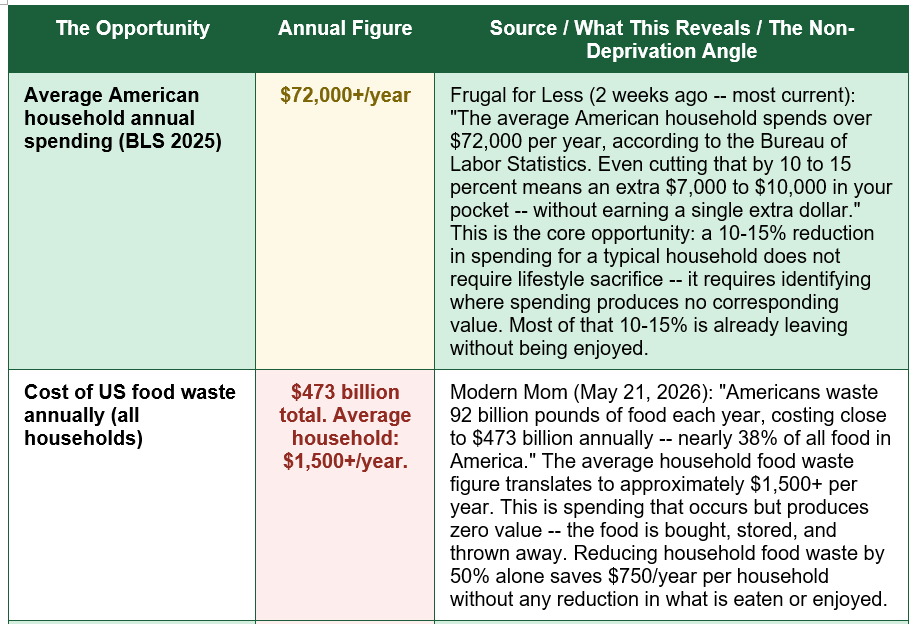
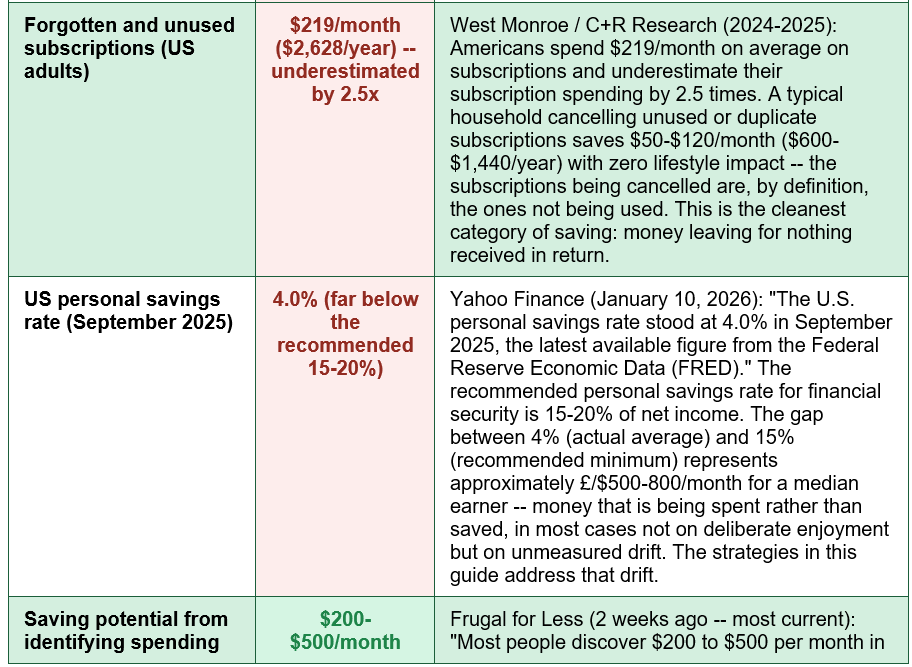
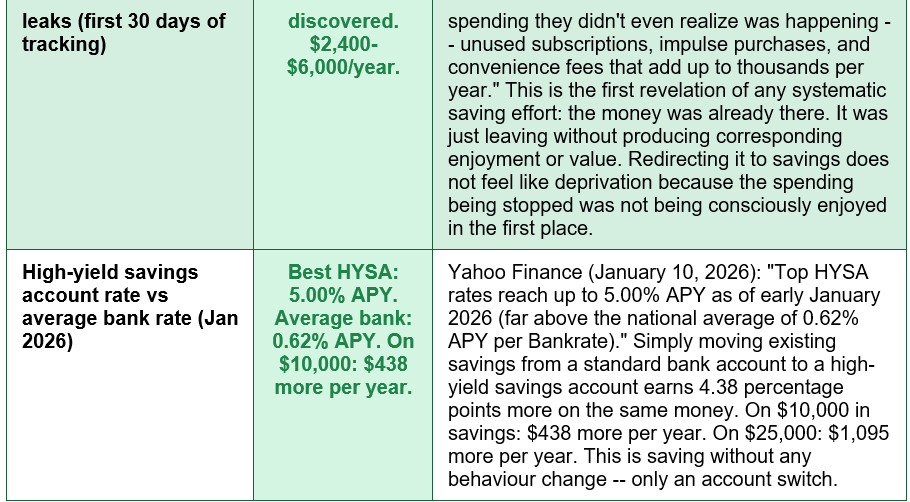
The savings opportunity in 2026: $7,000-$10,000/year from 10-15% spending cut. $200-500/month in first-month leaks. $1,500+/year in food waste. $2,628/year in subscriptions (underestimated 2.5x). — Frugal for Less (2 weeks ago -- most current): 'Average American household spends over $72,000/year. Cut 10-15% = $7,000-$10,000 more without earning extra.' BLS 2025 data. West Monroe/C+R Research: '$219/month on subscriptions underestimated 2.5x.' Modern Mom (May 2026): '$473 billion in annual US food waste -- nearly 38% of all food.' Yahoo Finance (Jan 2026): 'HYSA rates 5.00% APY vs average 0.62%.' Frugal for Less: '$200-500/month in first-month leak discoveries.'
Where the Savings Come From: Category-by-Category Breakdown
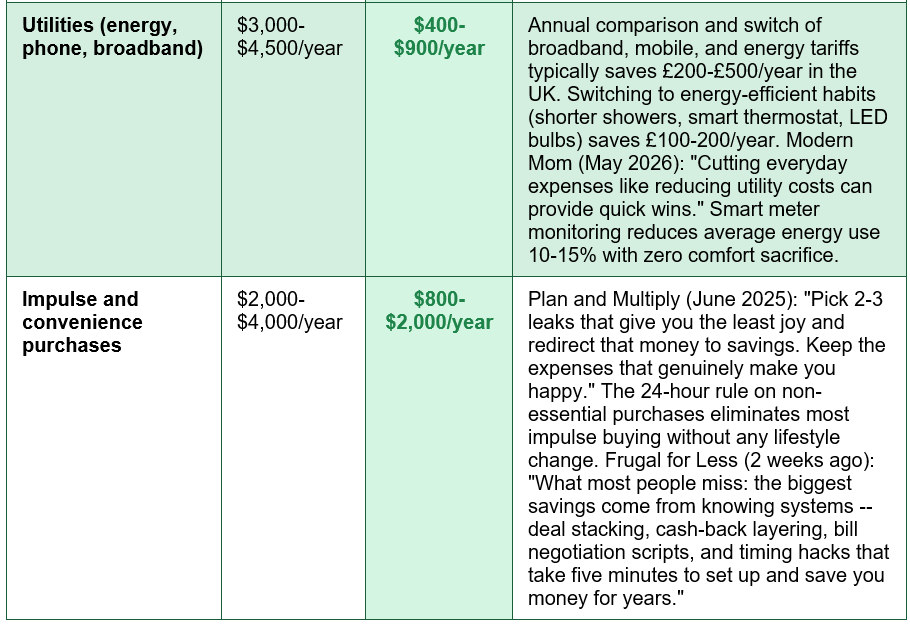
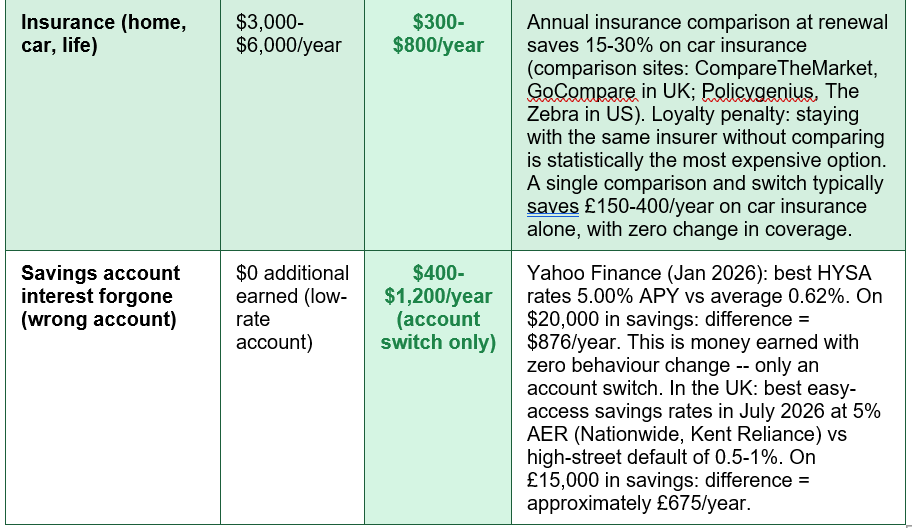
The following table maps realistic annual savings by spending category using strategies that involve no lifestyle sacrifice -- only stopping spending that was not being enjoyed: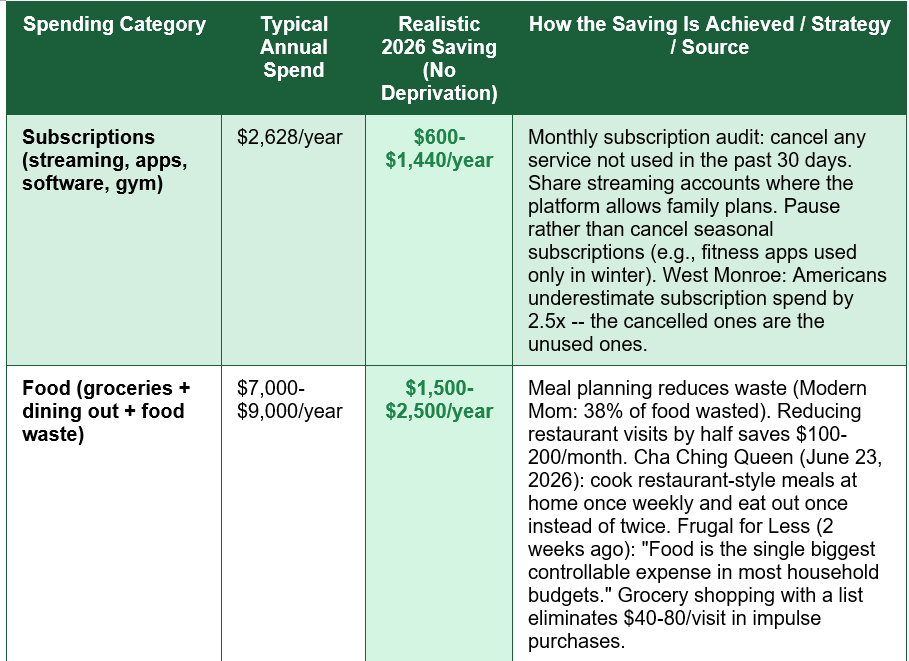
8 Strategies to Save Thousands Without Feeling Like You Are Living on a Budget
STRATEGY #1 AUTOMATE YOUR SAVINGS BEFORE YOU HAVE THE CHANCE TO SPEND THEM | The strategy that removes willpower from the equation entirely
Plan and Multiply (June 2025): 'For most people, the best first step is to set up an automatic savings transfer for your next payday. It takes 2 minutes and works on autopilot from then on. Start with an amount so small it feels effortless -- even $25/month. You won't miss it, and the psychological win of watching your savings grow creates momentum to increase the amount.' Black Moon Blog (May 30, 2026): 'One of the simplest saving strategies is automation. Instead of relying on willpower, schedule automatic transfers to savings accounts. Because the transfer happens automatically, saving becomes effortless.' Yahoo Finance (January 10, 2026): 'Financial experts stress that realistic habits -- starting small and automating where possible -- can help build a buffer against unexpected expenses.' The mechanism: on payday, before any spending decisions are made, a fixed amount transfers automatically to a separate savings account (ideally at a different bank, making it psychologically harder to access). The saving happens before the spending decision. The person who saves by automation is not more disciplined than the person who tries to save from what is left at the end of the month. They simply have a better system. The amount to start with: whatever feels genuinely painless. Even £25 or $25 per week. Then increase it by £10 or $10 per month until you notice the constraint. The first amount that feels slightly uncomfortable is the optimal starting rate.Automation annual saving: Annual saving: $300-$3,600+/year (£25-300/month). depending on starting amount and increase schedule. The real value is the compounding of the habit -- the amount that feels impossible at month 1 becomes normal by month 6.
STRATEGY #2 RUN A MONTHLY SUBSCRIPTION AUDIT -- AND CUT THE ONES YOU DON'T ACTIVELY USE | Every unused subscription is a direct debit for nothing
West Monroe Partners and C+R Research data (2024-2025): Americans spend $219/month on average on subscriptions and underestimate that figure by 2.5 times. Which means most people who think they spend $80/month on subscriptions are actually spending $200. The subscriptions causing this gap are overwhelmingly the ones not being actively used: the streaming service signed up for one series that finished three months ago, the app that came with a deal and was never cancelled, the news subscription clicked through from a link and forgotten, the cloud storage plan that duplicates another paid service. PFCU (January 6, 2026): 'Set a specific target for 2026 rather than a vague goal.' Applied to subscriptions: the specific target is to cancel every service not actively used in the past 30 days. Plan and Multiply (June 2025): 'Pick 2-3 leaks that give you the least joy and redirect that money to savings. Keep the expenses that genuinely make you happy.' How to run the audit: log into your bank and credit card statements and search for all recurring charges. List every one with the amount and frequency. Mark each one: 'Used regularly', 'Used occasionally', or 'Not used in the last 30 days.' Cancel every item in the third category immediately. Negotiate or downgrade the second category where possible. Keep the first category without guilt. The entire audit takes 30-45 minutes and produces an average saving of £50-£120 per month.Subscription audit annual saving: Annual saving: $600-$1,440/year (£50-120/month). from cancelling unused subscriptions only. Zero lifestyle reduction -- only stopping payment for things not being used.
STRATEGY #3 TACKLE FOOD WASTE AND MEAL PLANNING -- THE SINGLE BIGGEST CONTROLLABLE EXPENSE | $1,500+ per year is leaving the average household in the form of food thrown away
Modern Mom (May 21, 2026): 'Americans waste 92 billion pounds of food each year, costing close to $473 billion annually -- nearly 38% of all food in America.' Frugal for Less (2 weeks ago): 'Food is the single biggest controllable expense in most household budgets.' Cha Ching Queen (June 23, 2026): 'Love dining out? Cook one restaurant-style meal at home per week and eat out once instead of twice -- you'll save $100-200/month.' Modern Mom (May 2026): 'Grocery shopping is a significant expense for most families, with prices expected to increase by 3.2% in 2025 -- finding the best ways to save here is more important than ever.' The specific strategies that save the most without sacrificing enjoyment: meal planning for 4-5 weeknight dinners (shop from a list, reduce impulse purchases by £40-80/visit, eliminate mid-week 'what shall we have tonight' takeaway orders); the 'shop the fridge first' rule (before any grocery trip, use up what is already in the fridge and freezer -- this reduces food waste by 30-50% within the first month); buying store brands for commodities (pasta, rice, cleaning products, canned goods) where the product is functionally identical; and reducing restaurant dining by one visit per week. None of these strategies require giving up food you enjoy. They require buying what you will eat and eating what you buy.Food planning annual saving: Annual saving: $1,500-$2,500/year (£125-210/month). from meal planning, reduced food waste, and one fewer restaurant visit per week. The food eaten is identical. The food bought matches what is eaten.
STRATEGY #4 SWITCH YOUR SAVINGS TO A HIGH-YIELD ACCOUNT -- EARN MORE ON MONEY YOU ALREADY HAVE | This is saving without changing any behaviour. Just moving where the money sits.
Yahoo Finance (January 10, 2026): 'Parking small savings in a high-yield savings account, where top rates reach up to 5.00% APY as of early January 2026 (far above the national average of 0.62% APY per Bankrate), allows modest amounts to grow faster.' The difference between 0.62% and 5.00% on $20,000 in savings is $876 per year -- money earned with zero behaviour change, only an account switch. In the UK as of July 2026: the best easy-access savings rates are 5% AER (Nationwide, Kent Reliance, Atom Bank) against a typical high-street default of 0.5-1.5%. On £15,000 in savings, the difference is approximately £525-£675/year. Black Moon Blog (May 2026): 'Saving money does not mean eliminating fun. Instead, look for lower-cost alternatives.' Switching savings accounts is the ultimate lower-cost alternative -- the cost is zero, the effort is 20 minutes of account opening, and the annual gain is hundreds of pounds or dollars. For US accounts: compare high-yield savings rates at Bankrate (bankrate.com/banking/savings), NerdWallet, or MagnifyMoney. For UK accounts: MoneySavingExpert (moneysavingexpert.com/savings) and MoneyfactsCompare (moneyfactscompare.co.uk) publish daily rate tables. The rule: always compare at least once a year and switch if a better rate is available. The first switch takes 20 minutes. All subsequent ones can be done in under 10.High-yield account annual saving: Annual saving: $400-$1,200+/year (£33-100/month). from switching savings to the best available rate. No behaviour change. Same money. Different account.
STRATEGY #5 COMPARE AND SWITCH INSURANCE EVERY YEAR WITHOUT EXCEPTION | Loyalty is the most expensive financial choice you can make with insurance
Insurance providers consistently charge more to renewing customers than to new customers -- a practice sometimes called the loyalty penalty. The data is consistent: staying with the same insurer without comparing at renewal is statistically the most expensive option in every insurance category. Frugal for Less (2 weeks ago): 'Bill negotiation scripts and timing hacks take five minutes to set up and save money for years.' For car insurance: comparison sites (CompareTheMarket, GoCompare, MoneySuperMarket in the UK; The Zebra, Policygenius, NerdWallet in the US) run a full market comparison in approximately five to ten minutes. The saving from switching versus auto-renewing is typically 20-40% on the annual premium. For a typical UK driver, this represents £150-£400 saved. For a typical US driver: $200-$600. Home insurance comparison at renewal produces similar savings. Life insurance: reviewing coverage when circumstances change (income increase, new mortgage, new child) often reveals either overinsurance or better rates elsewhere. The specific action: set a calendar reminder for four weeks before each insurance policy renews. Run a comparison on renewal day. Switch if a better price is available. Never allow an insurance policy to auto-renew without this check. PFCU (January 2026): 'Here's why most financial resolutions fail: they're wishes disguised as goals. Clarity matters more than motivation.' Set a specific date for each annual insurance comparison and treat it as a non-optional financial appointment.Insurance switching annual saving: Annual saving: $400-$1,200/year (£33-100/month). across car and home insurance. Same coverage. Lower price. Annual comparison is the only habit required.
STRATEGY #6 SPEND INTENTIONALLY -- CUT WASTE, NOT PLEASURE | The philosophy that makes all other saving strategies sustainable
Plan and Multiply (June 2025): 'The goal isn't deprivation. It's optimization. Spend less on things that don't matter much to you, so you can spend freely on things that do. This selective approach to saving feels natural, not forced. Over time, many people find they actually prefer their cheaper alternatives -- home-cooked meals taste better, thrift finds feel more unique, and homemade coffee becomes a morning ritual they enjoy.' Black Moon Blog (May 30, 2026): 'The goal is not to eliminate spending entirely. Instead, it is to spend intentionally while reducing waste and prioritizing what truly matters. In 2026, saving money has become more important than ever. Rising living costs, subscription services, online shopping, and lifestyle inflation can make it difficult to build savings consistently. However, sustainable saving strategies focus on balance rather than deprivation.' PFCU (January 6, 2026): 'Money management isn't about deprivation or tracking every penny obsessively. It's about creating systems that align your spending with what actually matters to you while building protection against life's inevitable surprises.' The intentional spending framework is simple: for any category where you are cutting spending, ask whether the spending is producing genuine enjoyment or just happening by habit. Habit-spending (the daily coffee you do not actually enjoy but buy because it is there, the restaurant meal ordered from convenience rather than desire, the streaming service playing in the background while you scroll) is the target. Genuine enjoyment spending is protected. The result: more money available for the things that genuinely make life better, less leaving on autopilot for things that do not.Intentional spending annual saving: Annual saving: $800-$2,500/year (£67-210/month). from identifying and redirecting habit-spending. The spending reduced is, by definition, spending that was not being enjoyed.
STRATEGY #7 AVOID LIFESTYLE INFLATION WHEN INCOME RISES | Every pay rise is a saving opportunity disguised as a spending invitation
Black Moon Blog (May 30, 2026): 'Lifestyle inflation occurs when spending increases every time income rises. Avoiding lifestyle inflation is one of the most effective ways to increase long-term savings.' This is the most powerful and most commonly missed saving strategy for people with rising incomes. The mechanism: when income increases (a promotion, a bonus, a pay rise), spending typically increases to match it within three to six months. The felt sense of financial tightness returns to the previous level. Net result: higher income, same financial stress, no change in savings rate. Modern Mom (May 21, 2026): 'The goal is to be intentional about your spending rather than feeling deprived. Saving money is definitely a journey, not a destination. Small steps truly lead to big results.' The asymmetric rule: when income increases, redirect a minimum of 50% of the increment to savings or investment before lifestyle adjusts to the new income level. The other 50% can genuinely improve quality of life. Applied consistently: a person on $50,000 who receives a $5,000 raise redirects $2,500/year to savings and improves lifestyle by $2,500/year. Over five years of similar raises, the saving accumulation is dramatically higher than if the entire increment had been absorbed by lifestyle. Cha Ching Queen (June 23, 2026): 'Research shows that spending on experiences, like trips or shared activities, creates more happiness than material purchases.' Directing lifestyle-improvement spending toward experiences rather than possessions produces both greater happiness and lower long-term spending -- experiences end, possessions require maintenance, insurance, and eventual replacement.Anti-lifestyle-inflation annual saving: Annual saving: $1,000-$3,000+/year (£83-250/month). from directing 50% of each income increase to savings before lifestyle adjusts. Compounds with every subsequent income increase.
STRATEGY #8 USE THE 24-HOUR RULE AND DEAL-STACKING FOR PURCHASES OVER £/$50 | The pause that saves hundreds per year on impulse purchases
Frugal for Less (2 weeks ago -- most current): 'What most people miss: the biggest savings don't come from deprivation. They come from knowing systems -- deal stacking, cash-back layering, bill negotiation scripts, and timing hacks that take five minutes to set up and save you money for years.' The 24-hour rule: for any non-essential purchase above £50 or $50, wait 24 hours before buying. Research consistently shows that this pause eliminates 30-50% of impulse purchases, because the desire that was driving the purchase diminishes significantly within 24 hours. For the purchases that survive the 24-hour test, deal-stacking reduces the cost: (1) search for a cashback opportunity (TopCashback, Quidco, Rakuten) before completing the purchase; (2) check for discount codes (VoucherCodes.co.uk, RetailMeNot, Honey browser extension); (3) compare prices across retailers (Google Shopping, CamelCamelCamel for Amazon price history); (4) check whether the item has a seasonal sale approaching (electronics in November, furniture in January, clothing at end of season). None of this requires deprivation -- if the purchase is genuinely wanted and the budget allows, it goes ahead. The strategies reduce what the purchase costs, not whether the purchase is made. PFCU (January 2026): 'When you know exactly what you're working toward and can measure progress weekly, staying on track becomes dramatically easier.' The 24-hour rule is a system, not a restriction.24-hour rule and deal-stacking annual saving: Annual saving: $400-$1,500+/year (£33-125/month). from reduced impulse purchases and lower prices on planned purchases. No enjoyment foregone -- only paused.
The compounding effect: what happens when all eight strategies work together. Frugal for Less (2 weeks ago -- most current): 'Even cutting household spending by 10 to 15 percent means an extra $7,000 to $10,000 in your pocket -- without earning a single extra dollar.' When all eight strategies in this guide are applied simultaneously, the combined annual saving is typically £4,000-£8,000 or $5,000-$10,000+ per household -- depending on current spending patterns, income level, and starting position. The specific breakdown: automation builds the saving habit (£300-£3,600+); subscription audit stops the leaks (£600-£1,440); food planning eliminates waste (£1,200-£2,400); high-yield account switch earns more (£400-£1,200); insurance comparison saves on renewals (£400-£1,200); intentional spending redirects habit-spending (£800-£2,500); anti-lifestyle-inflation captures income growth (£1,000-£3,000+); deal-stacking reduces purchase costs (£400-£1,500+). None of these savings require giving up anything genuinely enjoyed. They require stopping payment for things not being used, eating the food that is bought, comparing prices once a year, and pausing before impulse purchases. Black Moon Blog (May 2026): 'Successful saving strategies focus on intentional spending, realistic budgets, strong habits, and meaningful financial goals. Instead of making extreme sacrifices, concentrate on reducing waste, improving awareness, and building sustainable habits.
FIVE SAVING TRAPS THAT FEEL SMART BUT COST YOU MONEY: (1) STAYING LOYAL TO BANKS, INSURERS, AND SERVICE PROVIDERS. Loyalty is financially penalised in virtually every service category. Auto-renewing insurance without comparison, keeping savings in a high-street account at 0.62% APY, staying with the same broadband provider without checking new-customer deals -- each of these loyalty choices costs hundreds per year. Set annual comparison reminders for every recurring service contract. (2) CUTTING THE ENJOYABLE SMALL THINGS INSTEAD OF THE UNJOYABLE LARGE THINGS. The most common budgeting mistake: sacrificing £4 coffees (the thing you enjoy) while keeping £120/month in subscriptions you never use (the thing you forgot about). Plan and Multiply (June 2025): 'Keep the expenses that genuinely make you happy.' Cut the forgotten ones. (3) SAVING IN A LOW-INTEREST ACCOUNT WHILE PAYING HIGH-INTEREST DEBT. Yahoo Finance (Jan 2026): best HYSA 5.00% APY. Average credit card APR: 20-22%. Keeping savings in a 5% account while carrying credit card debt at 22% is losing 17 percentage points per year on the debt balance. High-interest consumer debt should be eliminated before savings are maximised, because the guaranteed return from debt elimination exceeds any available savings rate. (4) MAKING SAVING ALL-OR-NOTHING. Black Moon Blog (May 2026): 'Rigid budgets often create frustration. Instead, create a budget that includes room for enjoyment.' An all-or-nothing approach -- saving perfectly for three weeks and then abandoning the plan when one week goes over -- produces zero long-term saving. A flexible system that allows occasional over-spending in one category while maintaining the overall saving direction is far more sustainable than perfection-or-nothing. (5) NOT CONNECTING SAVINGS TO SPECIFIC GOALS. PFCU (Jan 2026): 'Saving more money isn't a goal. Saving $200 per month by packing lunch three days a week is a goal. The difference is specificity.' Vague saving intentions consistently fail. Specific, named goals -- emergency fund, holiday, home deposit, investment account milestone -- produce consistent saving because they provide motivation that 'spending less' does not.
YOUR SAVINGS SYSTEM -- IMPLEMENT THIS WEEK: DAY 1 -- AUTOMATION (10 minutes): Open a high-yield savings account (US: Ally, Marcus, SoFi -- search current best rates at bankrate.com. UK: Nationwide, Atom Bank, Chase -- check moneysavingexpert.com/savings). Set up an automatic transfer of £/$50 from your main account to the HYSA on the day after payday. Done. This single action starts the saving habit and earns more on your money immediately. DAY 2 -- SUBSCRIPTION AUDIT (30 minutes): Download last month's bank and credit card statements. Search for all recurring charges. Cancel every service not used in the past 30 days. Estimate the monthly saving. Transfer that amount to your savings on the same day. DAY 3 -- INSURANCE COMPARISON (15 minutes): Check the renewal date on your car and home insurance. Set a calendar reminder for four weeks before each renewal date. On that date, run a full comparison (comparethemarket.com / gocompare.com in UK; the zebra / policygenius in US). Switch if cheaper. WEEK 1 -- FOOD PLANNING: Plan five weeknight dinners before the weekly grocery shop. Buy only what those five meals require, plus breakfast and lunch essentials. Estimate the saving versus an unplanned shop. Direct the saving to your HYSA. WHEN INCOME NEXT INCREASES: Immediately increase your automated savings transfer by 50% of the increment before lifestyle adjusts. FREE GUIDANCE: UK: MoneyHelper 0800 138 7777 | MoneySavingExpert.com. US: CFPB consumerfinance.gov | Frugal for Less: frugalforless.com.
Conclusion
The average American household has $7,000 to $10,000 per year available to save without earning any additional income and without giving up anything genuinely enjoyed. The money is already there. It is leaving on autopilot, through subscriptions not being used, food being thrown away, insurance not being compared, savings accounts paying a fraction of available rates, and impulse purchases made in moments that 24 hours later would not have been made.Black Moon Blog (May 30, 2026): 'The goal is not to eliminate spending entirely. Instead, it is to spend intentionally while reducing waste and prioritizing what truly matters. Successful saving strategies focus on intentional spending, realistic budgets, strong habits, and meaningful financial goals.' Plan and Multiply (June 2025): 'The goal isn't deprivation. It's optimization.' Frugal for Less (two weeks ago): 'The people saving the most money don't feel deprived. They've just found cheaper ways to get what they want.'
The eight strategies in this guide address the specific categories where spending most commonly exits without corresponding enjoyment: automation captures the saving before spending decisions compete for it; subscription audits stop the forgotten direct debits; food planning eliminates the 38% of bought food that is wasted; high-yield account switching earns more on what is already saved; insurance comparison stops the loyalty penalty; intentional spending redirects habit-spending to genuine enjoyment or savings; anti-lifestyle-inflation captures income growth; and the 24-hour rule and deal-stacking reduce the cost of purchases that genuinely are made. None of these is a tight budget. All of them save thousands. Start with one. Add another. The compounding is financial and habitual -- and both improve over time.
Frequently Asked Questions (FAQ)
Can I really save thousands a year without a strict budget?Yes -- and the evidence strongly supports it. Frugal for Less (two weeks ago -- most current): 'The average American household spends over $72,000 per year. Even cutting that by 10 to 15 percent means an extra $7,000 to $10,000 in your pocket -- without earning a single extra dollar.' The key insight is that 10-15% of most household spending is not producing corresponding value or enjoyment -- it is leaving on autopilot. Subscriptions not being used. Food being thrown away. Insurance auto-renewing without comparison. Savings earning 0.62% when 5.00% accounts are available. Impulse purchases that would not have been made with a 24-hour pause. None of the strategies that capture this spending require restriction or sacrifice. Black Moon Blog (May 30, 2026): 'Successful saving strategies focus on intentional spending, realistic budgets, strong habits, and meaningful financial goals.
Instead of making extreme sacrifices, concentrate on reducing waste, improving awareness, and building sustainable habits.' PFCU (January 2026): 'Money management isn't about deprivation or tracking every penny obsessively. It's about creating systems that align your spending with what actually matters to you.' The tight budget approach fails because it requires sustained willpower against the grain of habit and desire. The system approach works because it removes waste without removing enjoyment, and automates the saving so it happens without ongoing effort.
What is the single biggest saving most people overlook?
There are two that consistently produce the largest saves with the smallest effort. The first is the high-yield savings account switch. Yahoo Finance (January 10, 2026): 'Top HYSA rates reach up to 5.00% APY as of early January 2026, far above the national average of 0.62% APY.' On $20,000 in savings, the difference is $876 per year. On $50,000: $2,190 per year. This requires no behaviour change -- only a 20-minute account opening and a transfer. Most people have never made this switch simply because they opened their savings account at their main bank and never looked at alternatives. The second is the annual insurance comparison. Insurance providers charge loyalty penalties to renewing customers. Staying with the same insurer at renewal without comparing is typically 20-40% more expensive than switching. A full comparison on all insurance policies takes approximately 30 minutes per year and saves an average of $400-$1,200 annually in the US and £300-£700 in the UK. Neither of these requires any lifestyle change, any reduction in enjoyment, or any ongoing effort beyond the initial setup and the annual reminder. Together they save $1,300-$3,400 per year for many households -- purely from optimising where money is held and how recurring services are purchased.
How do I save money on food without giving up restaurants or meals I enjoy?
The saving on food comes from reducing waste, not from reducing enjoyment. Modern Mom (May 21, 2026): 'Americans waste 92 billion pounds of food each year, costing close to $473 billion annually -- nearly 38% of all food in America.' The food waste is the target, not the food enjoyment. The specific strategies: meal planning for weeknight dinners (plan five meals, buy only what those meals require, eliminate the unplanned grocery top-up visits that are mostly impulse purchases); the shop-the-fridge-first rule (before any grocery trip, use up what is already in the refrigerator and freezer -- this alone reduces food waste by 30-50% in most households); buying store brand for commodities where the product is identical (pasta, rice, canned goods, cleaning products, cooking oils -- typically 20-40% cheaper than branded equivalents with no quality difference); and reducing restaurant dining by one visit per week without eliminating it. Cha Ching Queen (June 23, 2026): 'Love dining out? Cook one restaurant-style meal at home per week and eat out once instead of twice -- you'll save $100-200/month.' Plan and Multiply (June 2025): 'Over time, many people find they actually prefer their cheaper alternatives -- home-cooked meals taste better, thrift finds feel more unique.' The goal is not fewer enjoyable meals. It is buying what is eaten and eating what is bought -- eliminating the 38% that goes from shop to bin without passing through a plate.
How much should I automate and where should the money go?
The automation amount and destination depend on your current financial position, but the structure is consistent regardless of starting point. Plan and Multiply (June 2025): 'Start with an amount so small it feels effortless -- even $25/month. You won't miss it, and the psychological win of watching your savings grow creates momentum to increase the amount.' Yahoo Finance (January 2026): 'Parking small savings in a high-yield savings account, where top rates reach up to 5.00% APY, allows modest amounts to grow faster.' The structure in priority order: (1) automate a minimum monthly transfer to an emergency fund (target: 3-6 months of essential expenses) in a high-yield savings account. Start with whatever amount is genuinely painless, and increase by a small amount each month. (2) Once the emergency fund reaches one month of expenses, also automate a contribution to an investment account (ISA in the UK, Roth IRA or 401(k) in the US) -- even £25 or $25 per month into a global index fund starts the compounding process. (3) Automate the capture of each income increase: when salary rises, increase the savings transfer by 50% of the increment before lifestyle adjusts. The specific accounts: US: high-yield savings at Ally, Marcus by Goldman Sachs, SoFi, or CIT Bank (compare current best rates at bankrate.com/banking/savings). UK: easy-access savings at rates competitive with the market leaders (moneysavingexpert.com/savings publishes a real-time best-buy table). The transfers should happen the day after payday, automatically, to a separate account -- ideally at a different institution from your main bank, creating slight friction against casual withdrawal.
How do I make sure savings habits stick long-term?
The research on financial habit formation is consistent: habits stick when they are automated, specific, and connected to meaningful goals. PFCU (January 6, 2026): 'Here's why most financial resolutions fail: they're wishes disguised as goals. "Save more money" isn't a goal. "Save $200 per month by packing lunch three days a week" is a goal. The difference is specificity, and it matters more than motivation. According to Fidelity's 2025 Financial Resolutions Study, people who successfully kept their resolutions cited having clear, specific goals as the top reason for their success. Not willpower. Not discipline. Clarity.' Black Moon Blog (May 30, 2026): 'Saving becomes easier when connected to clear goals. Specific goals provide motivation and make saving purposeful.' Plan and Multiply (June 2025): 'Saving for a $5,000 emergency fund feels overwhelming. But saving your first $500? That's exciting. Break your goal into milestones: $100, $500, $1,000, $2,500, $5,000. When you hit a milestone, do something small to celebrate -- a nice dinner, a movie night. Positive reinforcement makes the habit stick long-term.' The three habit-sustaining practices: (1) automation (saving happens without a decision every month -- the habit runs without willpower); (2) named goals with specific dollar amounts and target dates (the saving is for something specific, not abstract); (3) milestone celebration (each financial milestone reached is acknowledged with something enjoyable, creating positive reinforcement for the saving behaviour). Wisconsin Extension Financial Education: 'Be realistic about the amount you can save for your financial goals without feeling deprived during the month.' The saving rate that persists is the one that does not require suffering to maintain.

0 Comments Comments