

Financial Literacy
Should Your 2027 Goal Be Saving, Investing, or Debt Paydown?

Borrowing rates: credit cards about 20%–20.9%; personal loans 12.36% average (19.24% in one offer dataset); federal student loans 6.52% undergraduate, 8.07% graduate, 9.07% PLUS (2026–27); new-car loans 7.06% (60 months); 30-year mortgage 7.24%; inflation 3.7%. Saving and investing: top savings 4.35% (average 0.59%); 1-year CD up to 4.65%; 5-year CD 5.00%; 52-week T-bill about 4.46%; new I bond 5.51%; SPY about 11% a year over 20 years; only 46% of Americans could cover three months of expenses; 19.5% of 401(k) savers have a loan. My arithmetic: $10,000 earns about $2,090 a year of avoided interest on a 20.9% card, vs about $435 at 4.35% savings or about $700 at an assumed 7% return; on a $6,000 card with $700 a month, paying debt first leaves about $41,100 of net worth after five years, versus about $39,400 splitting $200 and $500, and about $33,200 investing everything and ignoring the debt.
This guide gives you a simple ladder, backed by this week’s numbers. It compares what you pay on debt with what you earn on savings and might earn from investing, explains where the answer is clear and where it is a judgment call and walks through a worked example, to help you choose a 2027 goal you can stick to.
On the other side, top high-yield savings accounts paid about 4.35% in early November against a 0.59% national average, the best one-year CD about 4.65%, five-year CDs 5.00%, a 52-week Treasury bill about 4.46% and the new I bond 5.51% for six months. Stocks are different: SPY returned about 11% a year over the past 20 years, with no guarantee and deep drops along the way. Inflation was 3.7% in September, the bar your savings must clear to keep their buying power.
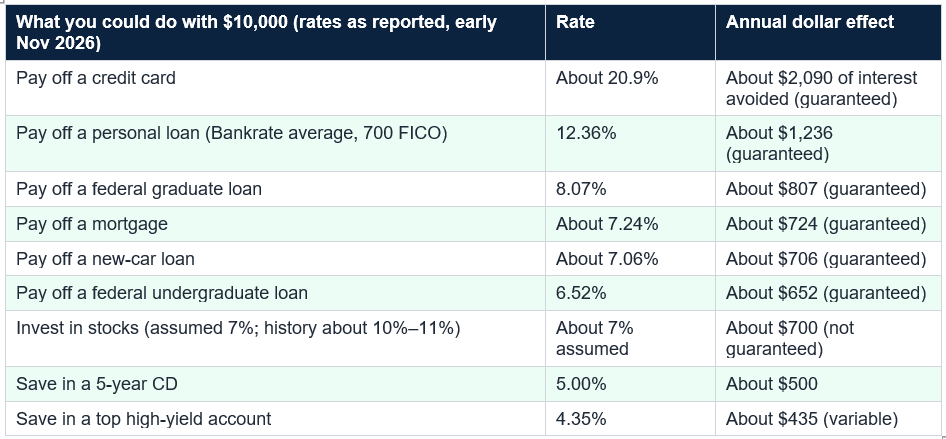
Debt payoff is a guaranteed return: about 20.9% on a card, 12.36% on an average personal loan, 6.5%–9.1% on federal student loans, about 7.1% on a new-car loan and 7.24% on a mortgage. Savings pay 4.35% (top account) to 5.00% (5-year CD). Stocks have averaged around 10%–11% over long periods but with no guarantee.
Why not skip straight to paying debt? Without a cushion, every surprise forces you back into debt and undoes your progress. The starter fund can be built in a few months, after which you can attack high-interest debt with confidence.
Be careful not to borrow from the plan: Fidelity found 19.5% of 401(k) savers have a loan outstanding, and loans take money out of compounding and can cause problems if you change jobs. Contributing enough for the match and then paying down expensive debt is usually better than maxing the account while carrying a 20% balance.
There are two standard methods. The avalanche pays the highest interest rate first and minimizes total interest; the snowball pays the smallest balance first and builds momentum. Math favors the avalanche, psychology sometimes the snowball, and either works if you stick with it (a general point, not a retrieved finding). Pay minimums on everything, send every extra dollar to one target and avoid new balances, and consider consolidation only if the rate is clearly lower and you will not run the cards up again.

An insured high-yield savings account is the simplest home for it, with CDs or Treasury bills for the portion you will not need soon. The top savings rate was 4.35% in early November while the average account paid 0.59%, so check what yours pays, and do not invest your emergency fund in stocks: its job is to be there when needed, not to grow.
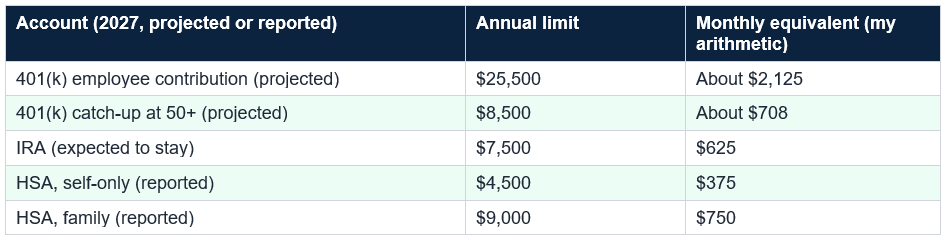
Factors that tilt the decision include your risk tolerance, since a guaranteed 7% can beat a risky 10% for some people; whether interest is tax-deductible, which can lower the effective cost of a mortgage or student loan (a general point, not retrieved); whether the debt is federal, with protections such as income-driven repayment; and how close you are to retirement. Many people split the money. Above about 8%, lean toward paying down; under about 5%, lean toward investing.
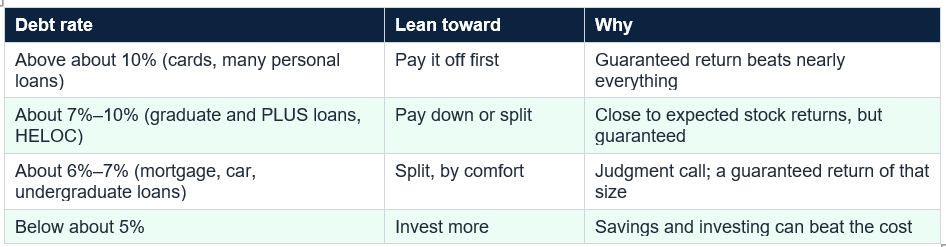
Fill the accounts in a sensible order: the match, an HSA if eligible, an IRA, more 401(k) and then a taxable account. A projected $25,500 401(k) limit is about $2,125 a month. Choose low-cost diversified funds and stay in: DALBAR found the average investor earned 6.8% a year over 30 years against 10.2% for the S&P 500, largely from badly timed trades. In my illustration, $500 a month for 30 years at a constant 7% grows to about $610,000, and $700 a month to about $854,000.
After five years, Path A leaves about $41,100 invested and no debt, Path B about $39,400 and no debt, and Path C about $50,100 invested but a card balance of about $16,900, a net of about $33,200. Paying the card first leaves you about $1,700 ahead of splitting and about $7,900 ahead of ignoring the debt, in this simplified case. If investments earned far more than 7%, Path C could look better, but you would need returns above 20.9% a year to win, which history does not support as a reliable expectation.

On a $6,000 card at 20.9% with $700 a month and a 7% return, after five years: pay the card first about $41,100; split $200/$500 about $39,400; invest everything and ignore the card about $33,200 net. Paying off the card first wins by about $1,700 and $7,900.
Pick a goal you can sustain, since the best plan is the one you keep following, and a small early win, like paying off a small balance, can help. In one sentence: protect yourself, capture free money, kill expensive debt, build the cushion and then invest. Your situation may justify a different order.
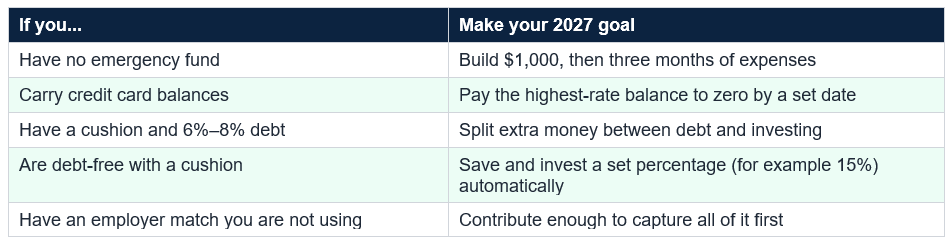
Write down every debt with its interest rate and balance, your emergency fund total and your employer match. Then circle which step of the ladder you are on and make that your 2027 goal. Common mistakes include investing while carrying a 20% card balance, skipping the starter emergency fund, ignoring the employer match, draining the cushion to pay down a low-rate loan, borrowing from a 401(k), picking a goal without a number and date, giving up after one slip and running the card up again after paying it off. Automate, keep the starter fund and revisit the ladder each year.
In my worked example, paying a $6,000 card first and then investing leaves you about $1,700 ahead of splitting and about $7,900 ahead of ignoring the card after five years, at a constant 7%. Pick the step you are on, write it as a number and a date and automate it, and check the IRS notice for the final 2027 limits in November. A qualified adviser can help you decide.
Build a small emergency fund first, then pay off high-interest debt, then build a full cushion. A starter fund of about $1,000 keeps surprises off your card, and paying off a card at about 20% is a guaranteed return that beats any savings account, which paid about 4.35% at the top in early November. Keep paying minimums on everything else while you do it.
Is it better to invest than pay off a 7% loan?
It is closer. Paying off a 7% loan is a guaranteed 7% return, while stocks have averaged around 10% historically but with no guarantee and big swings. Many people split their extra money, especially if the loan is a mortgage at about 7.24% or an auto loan at about 7.06%. The right answer depends on your risk tolerance, your taxes and whether you already capture any employer match.
How much should I have in an emergency fund?
A common range is three to six months of essential spending in an insured savings account. Bankrate found only 46% of Americans could cover three months of expenses and 27% six months. If three months feels far away, start with $1,000 and build from there. Top high-yield savings accounts paid about 4.35% in early November, so the cushion earns something.
Should I invest if I have credit card debt?
Capture any employer 401(k) match, because it is an immediate return, but otherwise pay off the card first. At roughly 20% to 21% interest, a card balance grows faster than most investments can reliably earn. In my worked example, putting $700 a month toward a $6,000 card balance first and then investing leaves you about $7,900 ahead after five years than investing everything and ignoring the debt.
What are the 2027 401(k) and IRA limits?
The IRS had not announced them as of late October. Milliman projects a 2027 401(k) limit of $25,500, up from $24,500, with a catch-up of $8,500 for ages 50 and over, and sources expect the IRA limit to stay at $7,500, though one formula-based page suggests $8,000. HSA limits for 2027 are reported as $4,500 for self-only and $9,000 for family coverage. Check the IRS notice, due in November. This is general education, not personal advice.
Table of Contents
- The Wrong Question, and the Right One
- The Short Answer: A Ladder
- What Your Next Dollar Earns Today
- Step 1: A Starter Emergency Fund
- Step 2: Capture the Employer Match
- Step 3: Pay Off High-Interest Debt
- Step 4: Build the Full Cushion
- Step 5: The Gray Zone, About 6% to 8%
- Step 6: Invest for the Long Term
- A Worked Example: $6,000 and $700 a Month
- Picking Your 2027 Goal
- Common Mistakes
- Conclusion
- Frequently Asked Questions
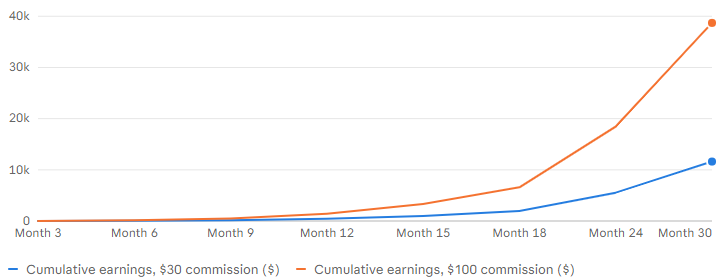
A hypothetical traffic model: cumulative affiliate earnings by month ($)
Cumulative earnings ($) by Author's hypothetical model: 2% click-through, 2.5% conversion, traffic ramping from 200 visitors (month 3) to 80,000 (month 30); cumulative $1,000 at about month 16 ($30) or 11 ($100); not typical or a forecast
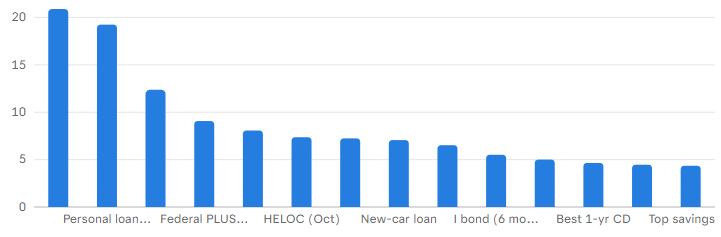
What your next dollar earns: debt interest avoided vs. savings rates, Nov 2026 (%)
Rate (%) by Bankrate, NerdWallet, Education Data Initiative, TreasuryDirect; mortgage, HELOC and card APR from earlier research; paying off debt is a guaranteed return, savings rates are variable
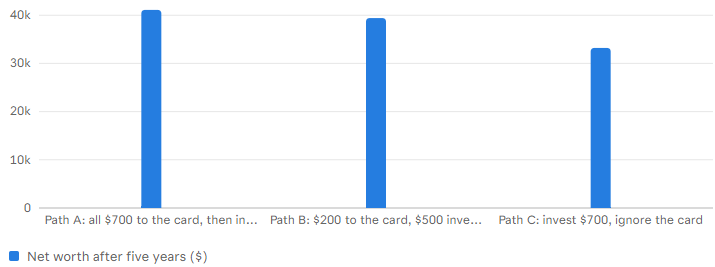
Worked example: $6,000 card at 20.9% and $700 a month, five-year net worth ($)
Net worth ($) by Author's hypothetical illustration at a constant 7% return, end-of-month contributions; Path C ends with about $50,100 invested but about $16,900 of card debt; not a forecast
The Wrong Question, and the Right One
Every January, people set a money goal, and most frame it as a contest: should I save, invest or pay down debt? It sounds like a choice between three good things, but in practice it is a question of order. All three are worth doing, but each dollar can only go to one place at a time, and the places pay very different returns.This guide gives you a simple ladder, backed by this week’s numbers. It compares what you pay on debt with what you earn on savings and might earn from investing, explains where the answer is clear and where it is a judgment call and walks through a worked example, to help you choose a 2027 goal you can stick to.
The Short Answer: A Ladder
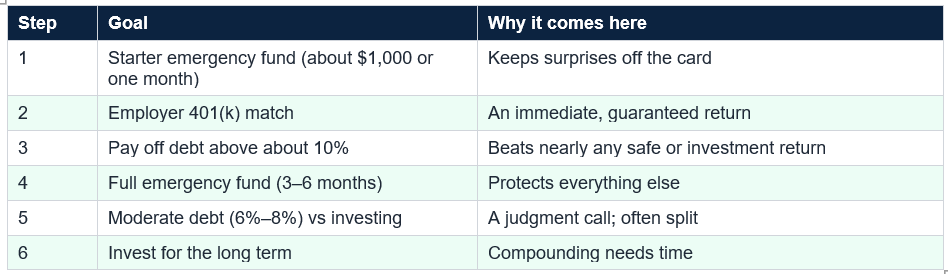
For most people, the order is: a small emergency fund so a surprise does not go on a credit card; any employer retirement match, an immediate return; pay off high-interest debt, such as cards at about 20% and personal loans at 12% or more; build a full three-to-six-month cushion; decide between extra debt payments and investing for moderate-rate debt around 6% to 8%; and invest for the long term in tax-advantaged accounts. If you are already past a step, skip it. The ladder is a guide, not a law.
What Your Next Dollar Earns Today
Rates decide most of the answer. Paying off debt earns a guaranteed return equal to the interest rate you stop paying. Credit cards cost about 20% to 20.9%, personal loans averaged 12.36% for a borrower with a 700 FICO score on Bankrate (NerdWallet reports 19.24% across offers to users with good credit), federal student loans for 2026 to 2027 carry 6.52% for undergraduates, 8.07% for graduate students and 9.07% for PLUS loans, new-car loans averaged 7.06% and the 30-year mortgage was about 7.24%.On the other side, top high-yield savings accounts paid about 4.35% in early November against a 0.59% national average, the best one-year CD about 4.65%, five-year CDs 5.00%, a 52-week Treasury bill about 4.46% and the new I bond 5.51% for six months. Stocks are different: SPY returned about 11% a year over the past 20 years, with no guarantee and deep drops along the way. Inflation was 3.7% in September, the bar your savings must clear to keep their buying power.
Debt payoff is a guaranteed return: about 20.9% on a card, 12.36% on an average personal loan, 6.5%–9.1% on federal student loans, about 7.1% on a new-car loan and 7.24% on a mortgage. Savings pay 4.35% (top account) to 5.00% (5-year CD). Stocks have averaged around 10%–11% over long periods but with no guarantee.
Step 1: A Starter Emergency Fund
Make sure a surprise does not become more debt. Bankrate found only 47% of Americans could cover a $1,000 emergency from savings and only 46% three months of expenses. A starter fund of about $1,000, or one month of essentials, is enough to stop a flat tire or a medical bill from landing on a card at 20%. Keep it in a high-yield savings account, where it earns about 4.35% at the top, and touch it only for real emergencies.Why not skip straight to paying debt? Without a cushion, every surprise forces you back into debt and undoes your progress. The starter fund can be built in a few months, after which you can attack high-interest debt with confidence.
Step 2: Capture the Employer Match
If your employer matches retirement contributions, contribute enough to get the full match before almost anything else. It is an immediate return no debt payoff can beat: a 50% match on the first 6% of a $64,064 salary is about $1,922 a year, a 50% return. Treat the match as part of your pay and collect all of it, barring an emergency that threatens your housing or food.Be careful not to borrow from the plan: Fidelity found 19.5% of 401(k) savers have a loan outstanding, and loans take money out of compounding and can cause problems if you change jobs. Contributing enough for the match and then paying down expensive debt is usually better than maxing the account while carrying a 20% balance.
Step 3: Pay Off High-Interest Debt
Here the arithmetic is clearest. A card at about 20.9% costs $2,090 a year on $10,000, a guaranteed cost that no savings account and few investments can offset, and a personal loan at 12% to 19% is similar in spirit. Paying these off is the best risk-free return available, which is why most planners put it ahead of investing beyond the match. In my illustration, a $5,000 balance at 20.9% paid at $200 a month takes about 34 months and costs about $1,622 in interest.There are two standard methods. The avalanche pays the highest interest rate first and minimizes total interest; the snowball pays the smallest balance first and builds momentum. Math favors the avalanche, psychology sometimes the snowball, and either works if you stick with it (a general point, not a retrieved finding). Pay minimums on everything, send every extra dollar to one target and avoid new balances, and consider consolidation only if the rate is clearly lower and you will not run the cards up again.
Step 4: Build the Full Cushion
Once the expensive debt is gone, build a full emergency fund of three to six months of essential spending. At $3,000 a month, three months is $9,000, which at 4.35% earns about $392 a year. That is modest, but a cushion means a job loss does not force you to sell investments at a bad time or borrow at a high rate, and only 27% of Americans could cover six months, per Bankrate.An insured high-yield savings account is the simplest home for it, with CDs or Treasury bills for the portion you will not need soon. The top savings rate was 4.35% in early November while the average account paid 0.59%, so check what yours pays, and do not invest your emergency fund in stocks: its job is to be there when needed, not to grow.
Step 5: The Gray Zone, About 6% to 8%
Moderate-rate debt is a judgment call. A mortgage at about 7.24%, a new-car loan at 7.06%, a federal undergraduate loan at 6.52% and a graduate loan at 8.07% cost about as much as a reasonable estimate of stock returns and more than you can earn safely, since the best CD paid 5.00% and a top savings account 4.35%. Paying them off offers a guaranteed return in that range; investing offers a higher expected return, historically around 10%, but not guaranteed.Factors that tilt the decision include your risk tolerance, since a guaranteed 7% can beat a risky 10% for some people; whether interest is tax-deductible, which can lower the effective cost of a mortgage or student loan (a general point, not retrieved); whether the debt is federal, with protections such as income-driven repayment; and how close you are to retirement. Many people split the money. Above about 8%, lean toward paying down; under about 5%, lean toward investing.
Step 6: Invest for the Long Term
When expensive debt is gone and the cushion is in place, investing is where long-term wealth comes from, and the earlier you start the better. Use tax-advantaged accounts first. The 2026 401(k) limit is $24,500; the IRS had not announced 2027 limits as of late October, but Milliman projects $25,500 with an $8,500 catch-up for ages 50 and over, the IRA limit is expected to stay at $7,500 (one formula-based page suggests $8,000) and 2027 HSA limits are reported as $4,500 self-only and $9,000 family. Check the IRS notice, due in November.Fill the accounts in a sensible order: the match, an HSA if eligible, an IRA, more 401(k) and then a taxable account. A projected $25,500 401(k) limit is about $2,125 a month. Choose low-cost diversified funds and stay in: DALBAR found the average investor earned 6.8% a year over 30 years against 10.2% for the S&P 500, largely from badly timed trades. In my illustration, $500 a month for 30 years at a constant 7% grows to about $610,000, and $700 a month to about $854,000.
Worked Example: $6,000 and $700 a Month
In my worked example, you have a $6,000 card balance at 20.9% and $700 a month to allocate between the card and investing, with a constant 7% return. In Path A you put all $700 toward the card until it is paid off, about 10 months, then invest $700 a month. In Path B you pay $200 a month to the card and invest $500 from the start. In Path C you ignore the card and invest the full $700, letting the balance grow at 20.9%.After five years, Path A leaves about $41,100 invested and no debt, Path B about $39,400 and no debt, and Path C about $50,100 invested but a card balance of about $16,900, a net of about $33,200. Paying the card first leaves you about $1,700 ahead of splitting and about $7,900 ahead of ignoring the debt, in this simplified case. If investments earned far more than 7%, Path C could look better, but you would need returns above 20.9% a year to win, which history does not support as a reliable expectation.
On a $6,000 card at 20.9% with $700 a month and a 7% return, after five years: pay the card first about $41,100; split $200/$500 about $39,400; invest everything and ignore the card about $33,200 net. Paying off the card first wins by about $1,700 and $7,900.
Picking Your 2027 Goal
Start with where you are. With no emergency fund, make that the goal: $1,000 first, then three months. With a card balance, make the goal to be debt-free on it by a date. With a cushion and moderate debts, set a split, such as half of extra money to debt and half to investing. Debt-free with a cushion, make the goal a savings rate, such as 15% of income. Write it as a number and a date, automate it and review it quarterly.Pick a goal you can sustain, since the best plan is the one you keep following, and a small early win, like paying off a small balance, can help. In one sentence: protect yourself, capture free money, kill expensive debt, build the cushion and then invest. Your situation may justify a different order.
Write down every debt with its interest rate and balance, your emergency fund total and your employer match. Then circle which step of the ladder you are on and make that your 2027 goal. Common mistakes include investing while carrying a 20% card balance, skipping the starter emergency fund, ignoring the employer match, draining the cushion to pay down a low-rate loan, borrowing from a 401(k), picking a goal without a number and date, giving up after one slip and running the card up again after paying it off. Automate, keep the starter fund and revisit the ladder each year.
Conclusion
Should your 2027 goal be saving, investing or paying down debt? Usually all three, in the right order: a small emergency fund, the employer match, high-interest debt, a full cushion, a decision between extra payments and investing for moderate-rate debt and then long-term investing. The rates explain the order: cards at about 20% and personal loans at 12% or more cost far more than savings earn at about 4.35% or stocks have averaged, while mortgages at 7.24%, car loans at 7.06% and student loans at 6.52% to 9.07% are a closer call.In my worked example, paying a $6,000 card first and then investing leaves you about $1,700 ahead of splitting and about $7,900 ahead of ignoring the card after five years, at a constant 7%. Pick the step you are on, write it as a number and a date and automate it, and check the IRS notice for the final 2027 limits in November. A qualified adviser can help you decide.
Frequently Asked Questions
Should I pay off debt or save first?Build a small emergency fund first, then pay off high-interest debt, then build a full cushion. A starter fund of about $1,000 keeps surprises off your card, and paying off a card at about 20% is a guaranteed return that beats any savings account, which paid about 4.35% at the top in early November. Keep paying minimums on everything else while you do it.
Is it better to invest than pay off a 7% loan?
It is closer. Paying off a 7% loan is a guaranteed 7% return, while stocks have averaged around 10% historically but with no guarantee and big swings. Many people split their extra money, especially if the loan is a mortgage at about 7.24% or an auto loan at about 7.06%. The right answer depends on your risk tolerance, your taxes and whether you already capture any employer match.
How much should I have in an emergency fund?
A common range is three to six months of essential spending in an insured savings account. Bankrate found only 46% of Americans could cover three months of expenses and 27% six months. If three months feels far away, start with $1,000 and build from there. Top high-yield savings accounts paid about 4.35% in early November, so the cushion earns something.
Should I invest if I have credit card debt?
Capture any employer 401(k) match, because it is an immediate return, but otherwise pay off the card first. At roughly 20% to 21% interest, a card balance grows faster than most investments can reliably earn. In my worked example, putting $700 a month toward a $6,000 card balance first and then investing leaves you about $7,900 ahead after five years than investing everything and ignoring the debt.
What are the 2027 401(k) and IRA limits?
The IRS had not announced them as of late October. Milliman projects a 2027 401(k) limit of $25,500, up from $24,500, with a catch-up of $8,500 for ages 50 and over, and sources expect the IRA limit to stay at $7,500, though one formula-based page suggests $8,000. HSA limits for 2027 are reported as $4,500 for self-only and $9,000 for family coverage. Check the IRS notice, due in November. This is general education, not personal advice.
0 Comments
Be the first to share your thoughts on this article.