

Holiday shopping
Stop These 7 Summer Money Habits to Save More

Table of Contents
- The Accountant's Uncomfortable Summer Truth
- Why Summer Is the Season Most Likely to Wreck Your Annual Budget
- The Summer Spending Creep Tracker: Where the Money Actually Goes
- 7 Things to Stop Doing This Summer to Save More
- The Summer Savings Swap: Stop This, Start That
- The Accountant's Summer Budget Framework
- Conclusion
- Frequently Asked Questions (FAQ)

The Accountant's Uncomfortable Summer Truth
Every year in late summer, millions of people look at their bank statements and feel the same bewildering combination of guilt and confusion. The holidays were wonderful. The barbecues were genuinely fun. The coffees and ice creams were small and justifiable pleasures. And yet somehow the account is £800 lower than expected -- or $1,200 lower -- and a credit card that had been almost clear in April is now carrying a balance again. The summer, in financial terms, happened to them rather than being chosen by them.Current (July 20, 2026): 'Between outdoor happy hours, music festivals, sporting events, trips out of town, and even rising air conditioning bills, there is a lot you may be spending your money on this summer.' A 2025 Savings.com survey found that 35% of parents say summer is the most expensive season of the year. PwC's spring 2026 survey of roughly 2,000 adults found that Americans planned to spend more than $2,800 on summer travel alone. And LendEdu's survey of seasonal spending found that 48% of respondents who anticipated spending more in summer expected to use credit cards to cover the additional costs.
Here is the accountant's premise: you do not need a pay rise to save more this summer. You need to stop doing specific things that are draining money in ways you have not consciously chosen. The difference between a summer that sets you back financially and one that does not is not income -- it is the seven habits identified in this guide. Each one is costing you money right now, quietly, without requiring your explicit agreement. Stopping them requires no sacrifice of the summer experiences that actually matter to you. It requires only the decision to stop funding the experiences that don't.
Why Summer Is the Season Most Likely to Wreck Your Annual Budget
The accountant's view of summer spending is not moralistic -- it is structural. Summer creates conditions that are uniquely hostile to financial discipline, regardless of income level or financial sophistication. Understanding the structural causes of summer overspending is the first step to preventing it.The first structural problem is what financial commentators call 'spending creep' -- small, individually justified purchases that accumulate without ever being counted as a budget category. Current (July 2026) identifies this pattern precisely: 'Some of that splurging could be happening without you fully realising its impact on your savings goals.' A coffee at the beach, an ice cream at the park, a round at the outdoor bar, a concert ticket bought spontaneously on a Thursday evening because the weather is good -- none of these is a significant individual decision. Together they represent a category of spending that in winter might total £50 or $60 per month and in summer can reach £200 or $250, with the person concerned having made no conscious decision to increase that budget.
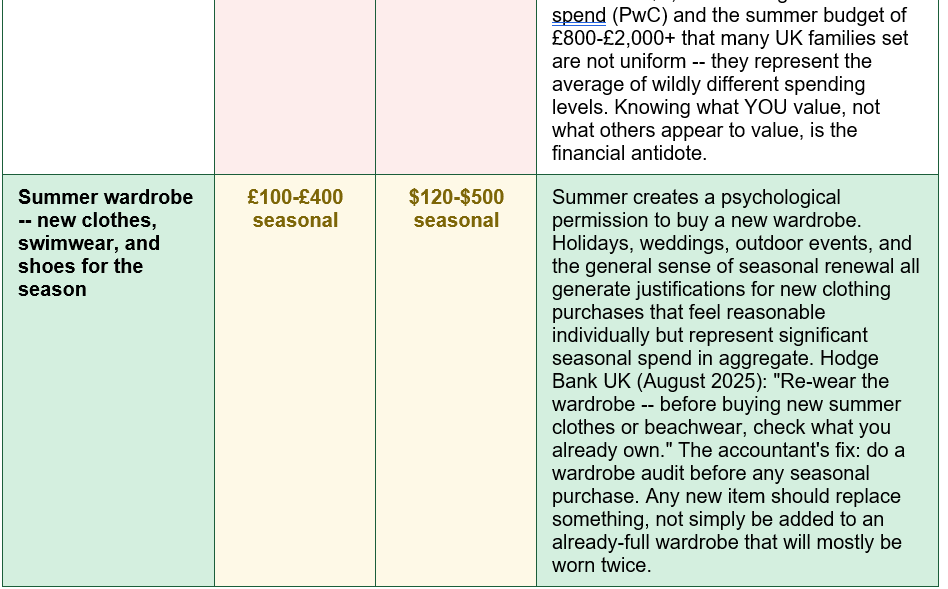
The second structural problem is social comparison. Truist: 'Like keeping up with the Joneses, comparing your summer to others can trigger overspending.' Summer is the most visually documented season -- social media timelines in July and August are saturated with holidays, outdoor events, and experiences. The curated highlight reel of others' summers creates an implicit benchmark against which people measure their own, and often find it lacking. The response -- booking a trip that was not in the budget, attending events that do not genuinely excite them, upgrading accommodations to produce Instagram-worthy content -- represents spending driven by comparison rather than by personal value. The third structural problem is the absence of routine. Summer disrupts the patterns -- work schedules, school timetables, meal planning, exercise routines -- that provide natural financial friction throughout the year. Without the routine structure, impulsive decisions fill the gaps.
Summer spending in 2026 -- the data: 35% of parents say summer is their most expensive season. $2,800+ planned on travel (PwC). 48% expected to use credit cards for summer costs. — Current/WPXI (July 20, 2026): 'In the spring, PwC surveyed roughly 2,000 adults and found that Americans planned to spend more than $2,800 on travel. A 2025 survey from Savings.com found that 35% of parents say summer is the most expensive season.' LendEdu seasonal spending survey: 'Summer is the second most expensive season -- average spend $2,229. 43% anticipate summer as their most costly season. 48% expect to take on credit card debt to cover summer expenses.' Truist: 'During the summer, we tend to spend the most on clothes, travel, and entertainment.'
The Summer Spending Creep Tracker: Where the Money Actually Goes
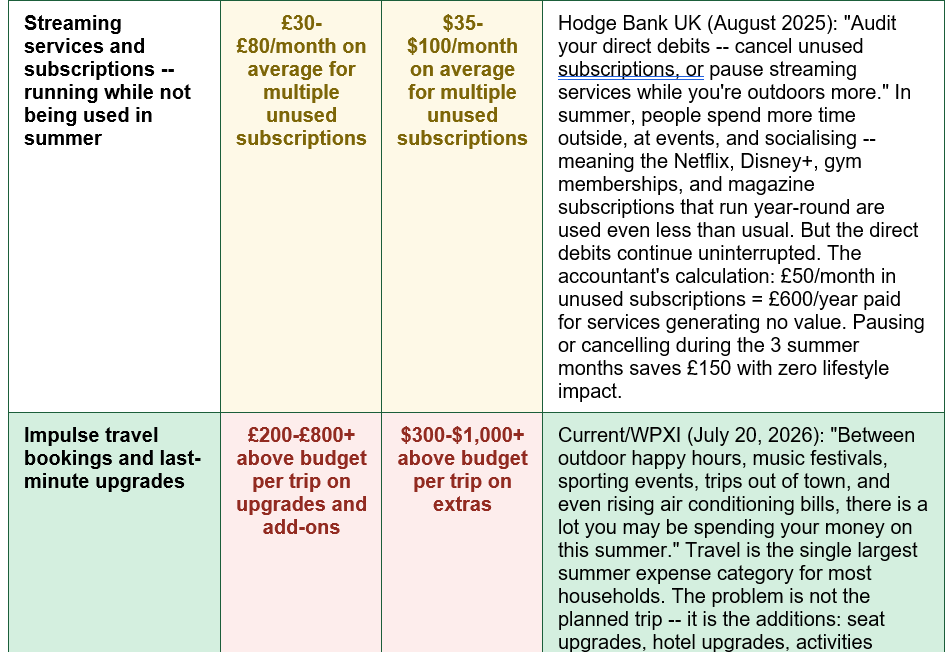
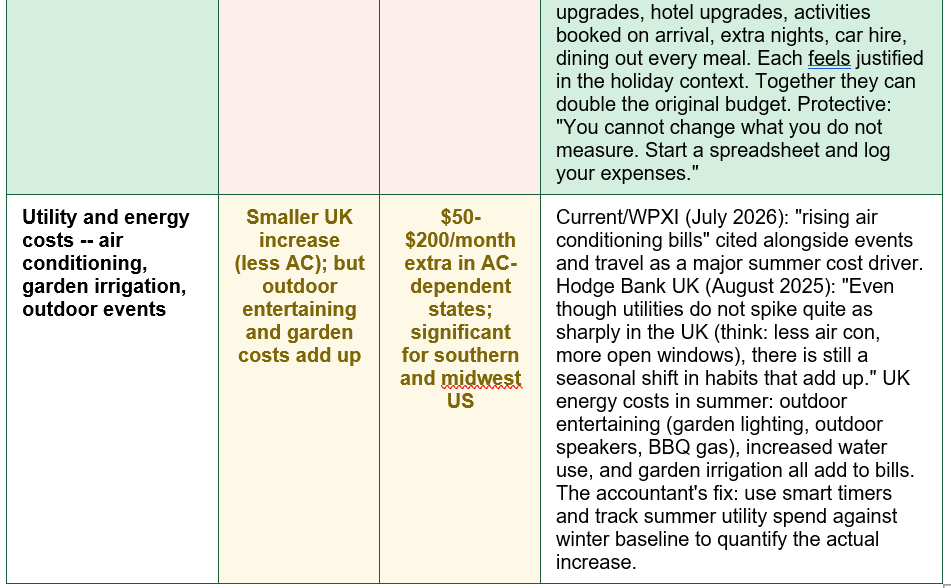
Before addressing what to stop, it helps to see the full picture of where summer spending actually increases compared to the rest of the year. The following table maps the six biggest summer spending categories with their typical costs and the accountant's specific reduction strategy for each: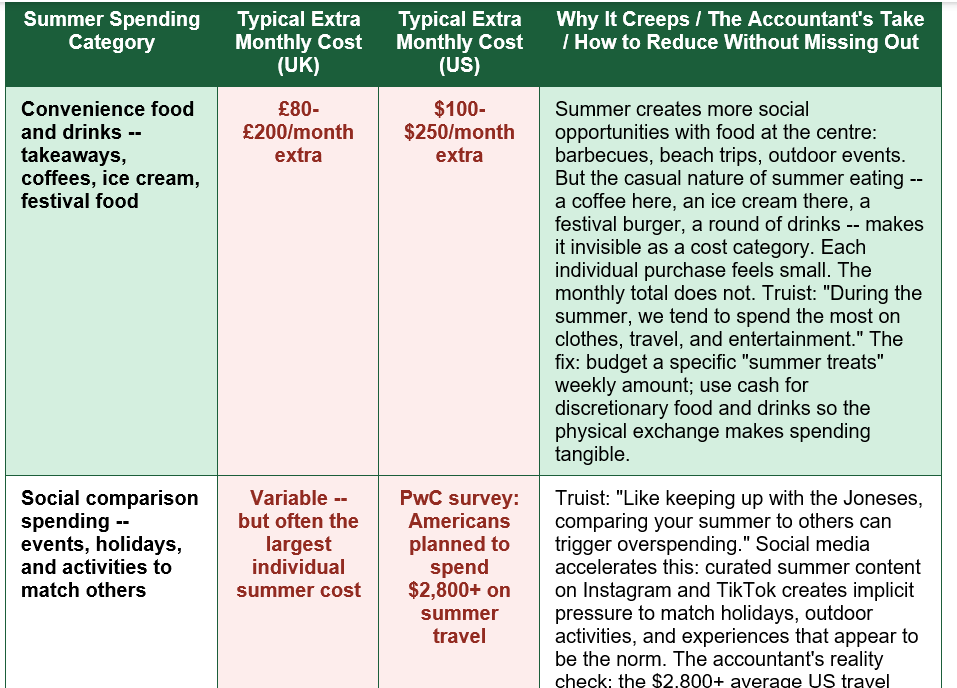
7 Things to Stop Doing This Summer to Save More
STOP #1: Stop Buying Coffee and Convenience Food at Venue Prices | The Invisible £300-£500 Summer Habit
The accountant's calculation on daily convenience purchases is simple and brutal. A daily coffee bought at a cafe, event, or beach kiosk costs £3.50-£5.00 in the UK and $5-$7 in the US. Paired with a snack or light lunch bought on the go, the daily convenience food spend rises to £8-£15 or $10-$18 per day. Over 13 summer weeks at 5 days per week, that is £520-£975 or $650-$1,170 on food and drink consumed on the move. This is not money spent on experiences or memories -- it is money spent on the same coffee you would make at home for £0.40 or $0.60, in a different cup. The accountant's action: before leaving the house this summer, consider the day's plan and what you will eat and drink while out. Pack a reusable flask with coffee or cold brew. Carry a supermarket bottle of water rather than buying individual ones. Grab snacks from the supermarket at supermarket prices. This is not asceticism -- it is directing the same money toward the summer experiences that genuinely matter, rather than losing it to the nearest convenience outlet. Hodge Bank UK (August 2025) specifically recommends: 'Meal plan for BBQ season -- reduce waste, avoid over-buying and make your weekly shop stretch further.' Apply the same logic to all outdoor and event eating: plan it, price it, and bring it when possible.STOP #2: Stop Saying Yes to Every Social Invitation Without a Budget Check | The Permission Trap That Empties Accounts
Summer creates a permission structure for social spending that does not exist in quite the same way in other seasons. The weather is good. The mood is lighter. The opportunities are abundant. And the social expectation to participate in every birthday barbecue, work leaving do, festival weekend, and spontaneous evening out feels almost impossible to decline without appearing like the person who never wants any fun. The accountant's observation: 35% of parents describe summer as their most expensive season (Savings.com 2025), and a significant driver is reactive social commitment -- saying yes to things because they appear rather than because they were planned and valued. Truist: 'Knowing what you value can make it easier to enjoy summer while staying on budget.' The practical fix is a simple monthly social budget -- a specific amount you have decided is appropriate for social activities this month. When that budget is spent, any additional invitation gets a polite alternative rather than an automatic yes. 'I cannot make the festival this weekend but I would love to do the free concert in the park next week' costs nothing and maintains the relationship. The budget is not about missing out -- it is about being deliberate about what you attend, so that what you do spend on is what you actually enjoy rather than what happened to come up.STOP #3: Stop Buying a New Summer Wardrobe Every Season | The Annual Refresh That Your Wardrobe Does Not Need
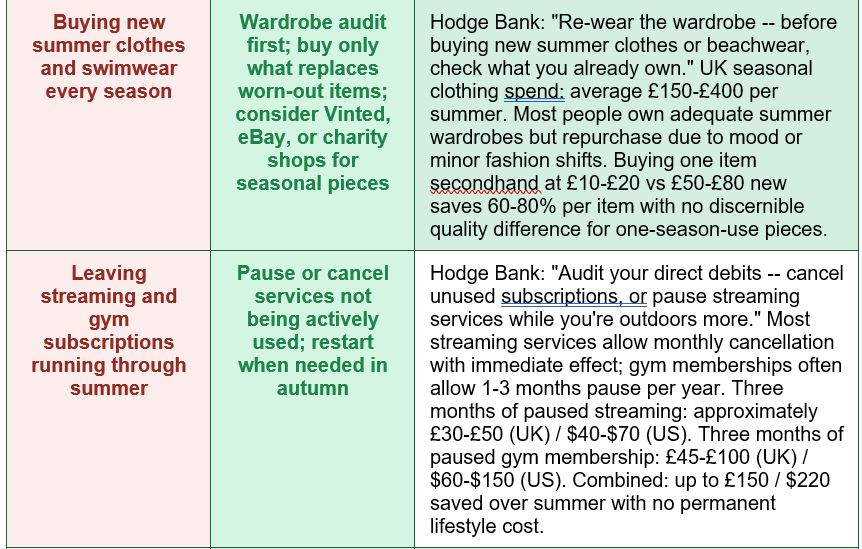
Summer clothing purchases represent one of the most consistent patterns of unnecessary seasonal spending. The psychological mechanism is straightforward: warm weather, holiday anticipation, and the visibility of new season fashion in every shop window combine to create a perception that new clothes are required for summer to be properly enjoyed. They are not. Hodge Bank UK (August 2025): 'Re-wear the wardrobe -- before buying new summer clothes or beachwear, check what you already own.' The accountant's instruction: before purchasing any single item of summer clothing this year, open your wardrobe and physically locate last summer's equivalents. In most cases, they are there. If the item genuinely needs replacing because it is worn out or damaged, replace it. If it does not need replacing but a newer version exists in a shop window, that is not a need -- it is a purchase being justified by the season. UK average seasonal clothing spend: £150-£400 per summer. A disciplined approach to the existing wardrobe (supplemented by Vinted, eBay, or charity shops for genuinely needed pieces at a fraction of new prices) can reduce this to £30-£60 while maintaining full functionality. The money saved -- £120-£340 -- is available for actual summer experiences.STOP #4: Stop Leaving Subscriptions Running Through the Summer Unused | The £150-£200 That Leaves Your Account for Nothing
This is, from an accountant's perspective, the cleanest and most straightforward money saving action available to almost every household this summer. Hodge Bank UK (August 2025): 'Audit your direct debits -- cancel unused subscriptions, or pause streaming services while you are outdoors more.' In summer, streaming platform usage falls as people spend more time outdoors, at events, and with friends. Gym attendance falls for many people who switch to outdoor exercise or are away on holiday. Magazine and news app subscriptions continue being charged regardless of whether they are read. The action: open your banking app right now and go to the direct debits section. List every subscription. For each one, ask: did I use this service in the last four weeks? If no -- pause or cancel. Netflix, Disney+, Amazon Prime, Apple TV+, Spotify: all allow monthly cancellation and can be restarted in October. Gyms: many allow pause requests of 1-3 months. The calculation: £50/month in genuinely unused subscriptions cancelled for 3 summer months = £150 recovered. That is money that was leaving your account for literally nothing, and will continue to leave until you stop it. This action takes 20 minutes and requires no willpower, no sacrifice, and no change in how your summer feels.STOP #5: Stop Comparing Your Summer to What You See on Social Media | The Most Expensive Habit That Costs Nothing to Break
Truist: 'Like keeping up with the Joneses, comparing your summer to others can trigger overspending.' Current (July 2026): 'Some of that splurging could be happening without you fully realising its impact on your savings goals.' The specific mechanism by which social media comparison costs money is well-documented: exposure to curated summer content creates aspirational benchmarks that feel like norms. The person looking at a colleague's Amalfi Coast holiday feels that a UK staycation is somehow less valid. The person seeing festival content on Instagram books a last-minute ticket that was not in the budget. The accountant's point: the $2,800 average summer travel spend (PwC) and the Instagram highlights that appear on every timeline are not the same thing -- the average masks enormous variation, the highlights show no costs or debts, and comparison produces spending driven by performance rather than pleasure. The practical fix: for this summer, decide your own summer plan based on what you have available to spend and what genuinely excites you. Write it down. Refer to it when spontaneous spending opportunities arise. Truist's advice: 'One way you can stay out of credit card debt is to automatically save $100 eight months out of the year, then pull that $800 out for the summer.' Know your own summer budget, spend within it, and stop using other people's apparent summers as the reference point.STOP #6: Stop Booking Travel Without a Complete All-In Budget First | How Add-Ons and Upgrades Double the Cost of Every Trip
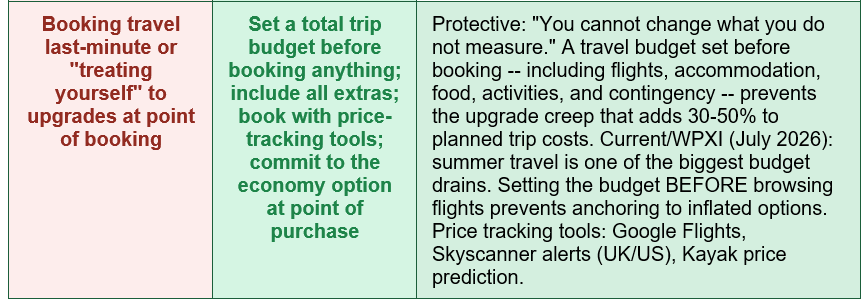
The accountant's most consistent observation about summer travel spending is the gap between the booked cost of a trip and the actual total cost. The flight is £180 each. The apartment is £600 for the week. Budget: £960 for two. Actual spend: £1,800. The difference -- £840 -- is the accumulation of: checked baggage (£50); airport parking or taxi (£60); a seat upgrade that seemed worth it at booking (£40 each); dining out every meal (£40-£60/day); one nice dinner (£80); activities and excursions (£150); drinks and ice creams (£120); a souvenir that seemed necessary (£40); and one unavoidable extra night due to flight change (£120). None of these individually seems unreasonable in the holiday context. Together they represent an 88% budget overrun. Protective: 'You cannot change what you do not measure. Start a spreadsheet and log your expenses. This will make you more aware of your summer spending habits and highlight where there is room for improvement.' The fix: before booking any trip, create a complete all-in budget including every category. Not just flights and accommodation -- but food, activities, travel within the destination, drinks, shopping, and a 15% contingency. Only book if the all-in number is within what you have decided to spend. Decline the upgrade at the point of booking, not at the moment of temptation on the website.STOP #7: Stop Funding Summer on Credit Without a Clear Repayment Plan | The Debt That Waits for You in September
LendEdu's seasonal spending survey found that 48% of respondents who anticipated spending more in summer expected to use credit cards to cover the additional costs. This is the habit that transforms summer from a budget challenge into a year-round debt problem. Summer spending funded on credit cards at UK rates of 24.65% (Bank of England, December 2025 average) or US rates averaging 22-25% APR does not end in September -- it compounds monthly until the balance is cleared. A £1,000 or $1,000 summer on a credit card that is only minimum-paid through autumn: the debt is still at £840-£900 by December, having cost £160-£200 in interest on top of the original spend. Truist: 'One way you can stay out of credit card debt is to automatically save $100 eight months out of the year, then pull that $800 out for the summer.' This advice is simple and correct: fund your summer in advance, not in arrears. If the summer you want costs more than the money you have saved for it, the accountant's answer is not to charge the difference to a credit card -- it is to adjust the summer plan to fit the money available. The experiences that genuinely matter are almost always available at a lower cost than first assumed. The ones that require credit to fund are almost always not worth the interest cost they generate.The Summer Savings Swap: Stop This, Start That
The seven habits above are not replaced by austerity -- they are replaced by smarter equivalents that deliver the same (or better) actual enjoyment at lower cost. The following table maps the stop-this / start-that swap for each: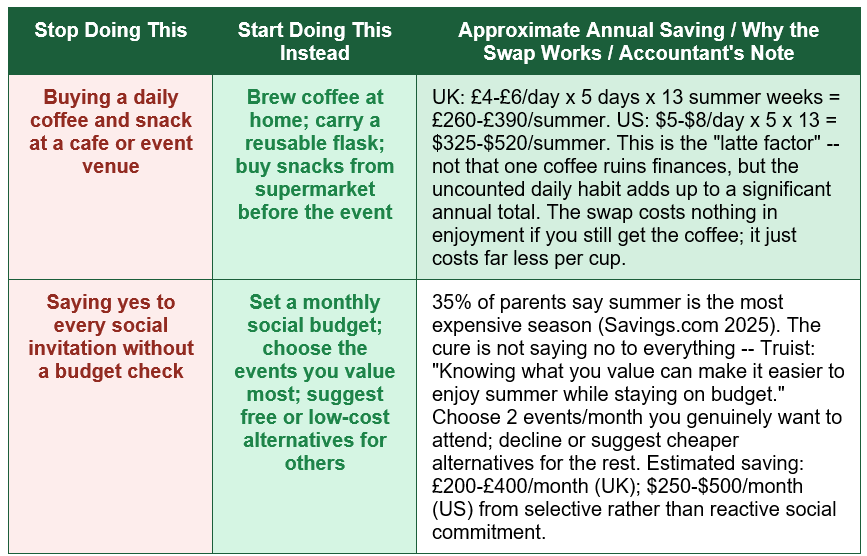
The Accountant's Summer Budget Framework
Stopping the seven habits above is most effective when combined with a simple positive framework for what the money is for instead. The accountant's summer budget operates in four pots:- Pot 1 -- Must-haves: Bills, rent or mortgage, groceries, transport, utilities. These are non-negotiable and should be met from income before any other category is considered. In summer, this pot should be monitored carefully -- utility bills can increase with air conditioning or outdoor entertaining; grocery bills can increase with barbecue entertaining and feeding visiting family.
- Pot 2 -- Planned summer experiences: The specific experiences you have decided matter to you this summer -- the one holiday, the two concerts, the outdoor cinema trip. These are budgeted in advance and funded from savings if possible. Hodge Bank (August 2025): 'You might shift a little more into the wants pot for the next few months, and dial it back later in the year.' This pot is not unlimited -- it has a defined ceiling determined by what you have saved or can afford from current income without debt.
- Pot 3 -- Weekly discretionary float: A fixed weekly amount for spontaneous summer spending: the ice cream, the cold drink, the weekend activity that was not planned. The float creates a budget for spontaneous pleasures without making every spontaneous decision a potential budget crisis. When the week's float is spent, the week's spontaneous spending stops. This is not joyless -- it is structured permission to enjoy within a defined space.
- Pot 4 -- Savings (automated, payday first): Protective: 'Give yourself peace of mind by automating a bank withdrawal to your savings account each month.' The automatic transfer from current to savings on payday -- before any discretionary spending occurs -- is the single most reliable mechanism for building summer savings without willpower. Hodge Bank: 'If you have got a savings account that is easy access but still pays interest, even better.' Even £50 or $50 per week automated to savings generates £650 or $650 over 13 summer weeks -- a meaningful buffer against September's reckoning with the summer bank statement.
The accountant's most important summer money insight: the experiences you remember most from summer are rarely the ones that cost the most. Research on experienced wellbeing consistently shows that social connection, novelty, time spent outdoors, and meaningful shared activities generate more positive memory than luxury hotel rooms, business class flights, or expensive restaurants. The best financial summers are often the ones where money is allocated to relationships and experiences rather than status signals or spontaneous consumption. This is not a moral observation -- it is an observation about what generates the positive retrospective assessment of the summer that makes it feel worth the cost. A picnic in the park with people you love costs £10. An expensive restaurant with people you feel obliged to impress costs £80 per head. The picnic generates better memories and costs 87% less. The accountant's summer challenge: identify the three experiences you want to remember from this summer. Budget for those three specifically. Spend the rest more carefully.
YOUR SUMMER SAVINGS ACTION PLAN -- DO THESE TODAY: RIGHT NOW (20 MINUTES): (1) Open your banking app and go to Direct Debits/Recurring Payments. List every subscription. Cancel or pause anything you have not actively used in the last 4 weeks. Estimated saving: £50-£150/month over summer. (2) Set up ONE automated transfer from current account to savings account, timed for the day after payday. Start with even £25/$25 per week. Do not adjust it for 3 months. THIS WEEK: (3) Do a wardrobe audit before buying any single item of summer clothing. Physically locate last summer's equivalents in your wardrobe. (4) Create a total all-in budget for any planned summer trip -- include EVERY category. Only book if the total fits what you have decided to spend. (5) Set a weekly social budget and communicate it to yourself clearly. Choose the events you actually value; decline or suggest free alternatives for others. ONGOING: (6) Track summer spending weekly -- Protective: "You cannot change what you do not measure. Start a spreadsheet and log your expenses." (7) When spontaneous spending urges arise, ask: "Is this something I would have budgeted for if I had thought about it in advance?" If no -- it is spending creep, not spending. UK FREE HELP: MoneyHelper 0800 138 7777 | StepChange 0800 138 1111. US FREE HELP: NFCC 1-800-388-2227.
THE FIVE SUMMER FINANCIAL MISTAKES THE ACCOUNTANT SEES EVERY SEPTEMBER: (1) FUNDING A SUMMER YOU CANNOT AFFORD ON CREDIT CARDS. LendEdu: 48% expected to use credit cards for summer expenses. The interest cost on £1,000/$1,000 of summer credit card debt at 24%+ APR running for 6 months is £120-£150/$120-$150 -- money paid for something you already spent and can no longer enjoy. Fund summer in advance or resize the summer to fit what you have. (2) NOT TRACKING SPENDING BECAUSE SUMMER IS 'A TIME TO ENJOY.' Protective: 'You cannot change what you do not measure.' Not tracking summer spending is not relaxing -- it is how the August bank statement produces a shock that creates a September of anxiety and austerity. Weekly tracking takes 10 minutes and reveals the specific habits to stop. (3) TREATING ALL SUMMER SPENDING AS TEMPORARY. 'I will spend less in September.' September brings its own costs: back-to-school expenses, autumn wardrobe, heating bills returning, Christmas saving beginning. Summer debt rarely has a simple resolution. (4) IGNORING THE SUBSCRIPTION AUDIT. Hodge Bank (August 2025): 'Audit your direct debits -- cancel unused subscriptions.' This action takes 20 minutes, requires no willpower, and saves real money. The number of people who do not do it is staggering. If you do nothing else from this guide, do this. (5) COMPARING YOUR SUMMER TO SOCIAL MEDIA AND SPENDING TO KEEP UP. Truist: 'Comparing your summer to others can trigger overspending.' The curated Instagram summer is not real and carries no actual cost information. Your summer, funded within your means and spent on what genuinely matters to you, is the better financial -- and experiential -- choice.
Conclusion
The accountant's argument in this guide is simple: saving more in summer does not require a pay rise, a second job, or a summer of saying no to everything enjoyable. It requires stopping seven specific habits that drain money in ways that were never consciously chosen and generate little or no genuine enjoyment in return. Stopping the daily convenience coffee and buying it from home. Choosing social events deliberately rather than reactively. Re-wearing last summer's wardrobe. Pausing subscriptions that sit unused through the warmer months. Ignoring the social media comparison that drives aspirational spending. Building an all-in travel budget before booking anything. And refusing to fund summer on credit that will follow you into autumn.Current (July 20, 2026): 'Some of that splurging could be happening without you fully realising its impact on your savings goals.' The key word is 'realising.' Most summer overspending is not a deliberate choice -- it is the accumulation of small, unconsidered decisions that individually feel too minor to worry about and collectively represent hundreds or thousands of pounds or dollars that did not need to be spent. Protective puts the solution simply: 'You cannot change what you do not measure.' This summer, measure it. The seven habits in this guide give you the specific things to look for.
Hodge Bank UK (August 2025) captures the right mindset: 'It seems we are ready to spend, just not wastefully. Finding the right balance -- so we can make summer plans but make them smarter -- is where the sweet spot lies.' This summer, make your plans smarter. Spend on what matters. Stop spending on what doesn't. You do not need more money to have a better summer -- you need to stop the specific things that are quietly taking the money you already have.
Frequently Asked Questions (FAQ)
Why is summer the most expensive season for many households?Summer creates a unique combination of spending pressures that do not exist to the same degree in other seasons. Current (July 20, 2026): 'Between outdoor happy hours, music festivals, sporting events, trips out of town, and even rising air conditioning bills, there is a lot you may be spending your money on this summer.' Savings.com (2025) survey found that 35% of parents describe summer as the most expensive season. LendEdu's seasonal spending survey found that Americans spend an average of $2,229 in summer, making it the second most expensive season. The drivers are structural: more social opportunities with spending attached (events, festivals, outdoor dining); travel and holiday costs concentrated in peak-season pricing; warmer weather creating more convenience purchases (cold drinks, ice cream, casual eating); greater social comparison through summer-focused social media content; and the disruption of normal spending-limiting routines (work patterns, school schedules, meal planning). Truist: 'During the summer, we tend to spend the most on clothes, travel, and entertainment.' The combination of these factors means summer spending increases happen across multiple categories simultaneously, making the aggregate impact much larger than any individual category increase suggests.
What is summer spending creep and how does it affect savings?
Summer spending creep is the process by which small, individually justified purchases accumulate over the summer months into a total that significantly exceeds the household's planned spending without any single large decision being made. Current (July 2026): 'Some of that splurging could be happening without you fully realising its impact on your savings goals.' The mechanism is psychological: each individual purchase in summer (a coffee at the beach, a round of drinks, a spontaneous concert ticket, an ice cream for the walk home) feels too small to represent a financial decision. The cumulative effect across 13 summer weeks is not small. A daily convenience coffee at £4/day, five days a week, for 13 weeks = £260. A spontaneous social event every two weeks at £40 average = £260. Two wardrobe refreshes at £100 each = £200. These three categories alone represent £720 in spending that was never budgeted for and occurred through small, individually unconsidered decisions. Protective: 'You cannot change what you do not measure. Start a spreadsheet and log your expenses. This will make you more aware of your summer spending habits and highlight where there is room for improvement.' Tracking spending weekly -- even informally in a notes app -- makes spending creep visible and therefore stoppable.
How can I save money in summer without missing out on fun?
The seven habits in this guide are specifically chosen because stopping them does not require reducing genuine enjoyment -- only reducing spending that was not generating genuine enjoyment in the first place. The key framing is Truist's: 'Knowing what you value can make it easier to enjoy summer while staying on budget.' The accountant's practical approach: (1) Identify the three to five summer experiences that genuinely matter to you -- the holiday, the specific festival, the garden gatherings with people you love. Budget for these explicitly. Spend on these without guilt. (2) Stop the spending that was not chosen but accumulated: the daily convenience purchases, the subscription services running while unused, the reactive social commitments to events that do not genuinely excite you, the social media-driven aspirational spending. (3) Set a weekly spontaneous spending float -- a specific amount (£30-£50/week or $40-$60/week) for unplanned summer pleasures. When the float is spent, wait until next week. This creates permission for spontaneous enjoyment without unlimited accumulation. Hodge Bank UK (August 2025): 'It is not about being rigid -- it is about being intentional.' The summer that is planned and financed is consistently more enjoyable than the summer that is merely experienced and then regretted in September.
Should I cancel all my subscriptions in summer to save money?
The subscription audit is specifically targeted at services you are not actively using during summer -- not at services you use regularly or which provide genuine value. Hodge Bank UK (August 2025): 'Audit your direct debits -- cancel unused subscriptions, or pause streaming services while you are outdoors more.' The process: review every recurring charge in your bank account's direct debit or standing order list. For each one, ask: 'Did I use this service in the last 4 weeks?' If yes and you plan to continue using it -- keep it. If no, or if your summer pattern means you will not use it for the next 3 months -- pause or cancel it. Practical targets for summer pausing: streaming services (Netflix, Disney+, Apple TV+) -- all allow monthly cancellation and restart; gym memberships -- many allow 1-3 month pauses per year on request; magazine or newspaper subscriptions -- most allow pause; specialist app subscriptions -- cancel if not actively used. The point is not blanket cancellation -- it is stopping payment for services delivering zero value during the months when your lifestyle makes them redundant. The saving is real and the sacrifice is zero, because you were not using them anyway.
What is the best way to budget for a summer holiday without going into debt?
Truist: 'One way you can stay out of credit card debt is to automatically save $100 eight months out of the year, then pull that $800 out for the summer.' This is the accountant's preferred model: fund holidays in advance through dedicated saving, not by charging to credit cards that will be minimum-paid through autumn. The specific steps: (1) Decide the total all-in budget for your summer holiday before looking at any specific options -- not just flights and accommodation but food, activities, transport within destination, drinks, shopping, and a 15% contingency. (2) Only browse options that fit within that all-in budget. Booking a cheap flight to a destination where you will then spend heavily to keep up with the surrounding environment does not save money -- it moves the cost into a less visible category. (3) At the point of booking, decline all upgrades. Seat upgrades, luggage add-ons, and flexible booking changes all feel low-cost at point of sale; combined they regularly add 15-30% to the headline trip cost. (4) If the total budget for the trip you want exceeds what you have saved, the accountant's answer is to either wait until you have saved enough or to plan a different, more affordable trip. LendEdu: 48% of consumers expecting to spend more in summer planned to use credit cards for the extra costs. The interest cost of that decision makes the holiday 15-20% more expensive in real terms.
0 Comments
Be the first to share your thoughts on this article.