

Investing
The Best All-in-One ETFs for a Simple Portfolio: Explained

One fund, stocks and bonds, automatic rebalancing. Here is what five popular all-in-one ETFs cost, how they behave, and the tax question most people forget. Five funds, expense ratios 0.15% to 0.40%, AOR $3.7B assets, 2.6% SEC yield, Asset location can add up to 0.30% a year (Vanguard), Average target-date mutual fund fee 0.27% in 2025, AOR fell 15.64% in 2022.
Most of us do not want a hobby, we want a portfolio that works while we get on with life. That is the pitch for all-in-one ETFs: one ticker that holds stocks and bonds, spreads them around the world and rebalances itself. Kiplinger's recent roundup of the best all-in-one ETFs picks five, from the iShares Core 60/40 Balanced Allocation ETF (AOR) to the Cambria Global Asset Allocation ETF (GAA). The cheapest of the five charges 0.15% a year and the dearest 0.40%. So the first answer is simple: any of them can simplify your investing, and the differences are mostly about cost, style and how hands-on the manager is.
The second answer is the one people miss. Where you hold the fund matters almost as much as which fund you hold. Kiplinger puts it plainly: placing the right investments in the right accounts can meaningfully improve after-tax returns over time. An all-in-one ETF bundles stocks and bonds together, which changes how you can use that idea.
Key takeaway: Pick the fund for its mix, fee and style. Then think about which account it lives in, because a single wrapper means one location for everything inside it.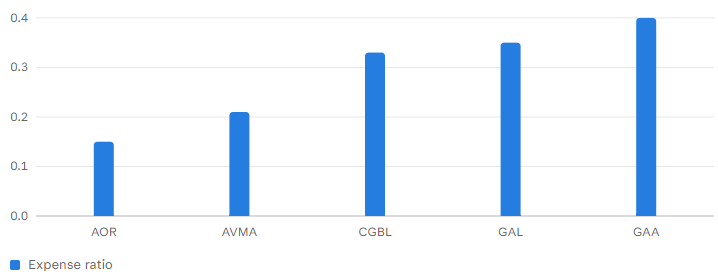
There is a tax angle on the wrapper too. Kiplinger notes that with mutual funds, investor redemptions and portfolio turnover can trigger taxes for everyone holding the fund, while ETFs are structured differently. The Oblivious Investor blog reached a similar conclusion when comparing iShares allocation ETFs with Vanguard's LifeStrategy mutual funds: held in a taxable account, the ETFs are somewhat more tax-efficient.
The usual rule of thumb is to put tax-inefficient investments in tax-advantaged accounts and tax-efficient ones in taxable accounts. Schwab and Fidelity both describe it that way, with index funds, ETFs and municipal bonds as the relatively tax-friendly options for a taxable account. Kiplinger's Wealth Wise column lists taxable bonds, money market funds and REITs as natural fits for a traditional IRA or 401(k), and growth-oriented stock funds for a Roth. How much does it matter? Vanguard's simulations suggest asset location can add up to 30 basis points (0.3%) a year in after-tax returns for certain well-diversified investors. For early-career savers with most money in a 401(k), the value may be modest at first, and it grows as balances spread across account types. T. Rowe Price adds a useful sanity check: a Roth account is almost always preferable to a taxable one, given its tax-free qualified withdrawals [8]. A guardrail from Vanguard: Keep your strategic asset allocation as the priority, because compromising it for tax efficiency can do more damage than imperfect asset location.
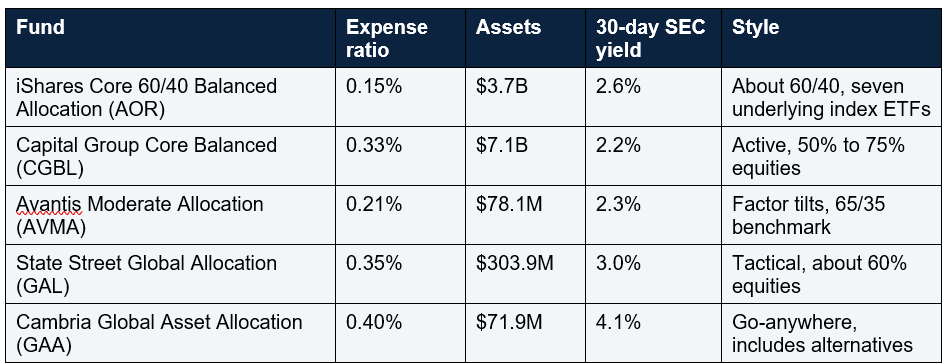
Assets and yields change daily. AOR is the plain one. Erneroy highlights its low cost, a median bid-ask spread of 0.01%, a three-year equity beta of 0.63 and a three-year standard deviation of 8.89%. It is the closest thing here to a set-and-forget classic.
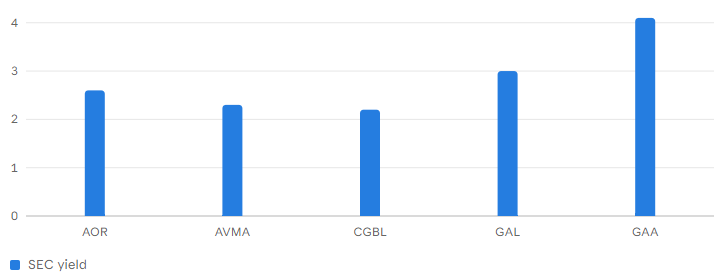
CGBL is the active choice. It flexes between 50% and 75% equities with up to 15% international, run by a multimanager team, and its one-year NAV return was 19.9% against 19.5% for its 60/40 benchmark, after fees. That is one year, so treat it as a data point rather than proof. AVMA adds factor tilts toward smaller companies, lower-value stocks and higher profitability, and returned 24.9% over one year against 20.8% for its benchmark. GAL holds 18 underlying ETFs including TIPS, senior loans, high-yield and emerging market debt and REITs, with at least 30% outside the US. GAA aims for roughly 45% equities, 45% fixed income and 10% alternatives across up to 30 ETFs, and nearly all its expense ratio comes from acquired fund fees. One naming note. Kiplinger calls AOR the iShares Core 60/40 Balanced Allocation ETF, while the data sites I used list the same ticker as the Core Growth Allocation ETF. I assume that is one fund under two names, but please confirm on the issuer's page.
The dollar difference on a typical balance looks like this.
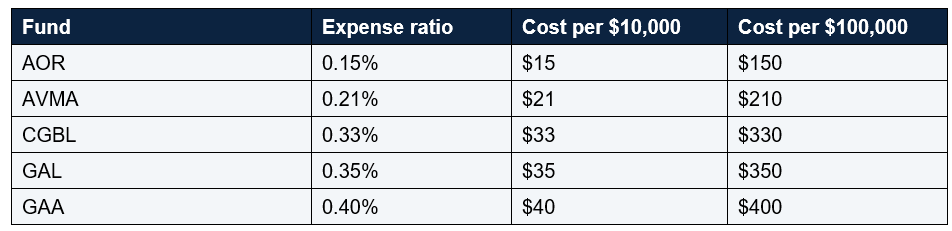
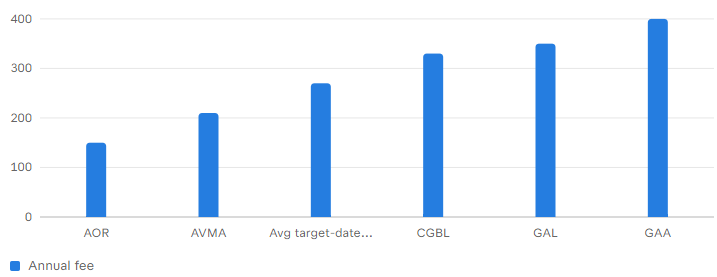
My calculation from the expense ratios. Fees are taken from fund assets, so you will not see a bill. On $100,000, the gap between the cheapest and dearest pick is $250 a year (my calculation), before any difference in performance. How does that compare with the other all-in-one option, the target-date fund? Morningstar found the asset-weighted average expense ratio of target-date mutual funds fell to 27 basis points in 2025, down from 29 in 2024, and has roughly halved in a decade. By that yardstick, AOR is below the average and GAA is above it (my comparison). Source conflict: Kiplinger and the Oblivious Investor blog put the AOR family at 0.15%, but PortfoliosLab and Minafi list AOR at 0.25%. The aggregators may be out of date. Always check the issuer's fact sheet for the current fee.
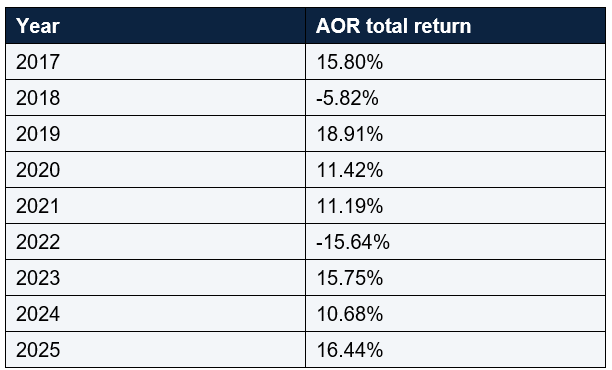
Source: PortfoliosLab. Returns are adjusted for dividends. Past performance does not predict future results. Two things jump out. First, a 60/40 fund is not a safe harbor. In 2022, when stocks and bonds fell together, AOR lost 15.64%. Many people assume bonds always cushion stocks, and that year showed they do not. Second, patience was rewarded. Compounding those nine yearly figures turns $10,000 into about $20,200, roughly 8.1% a year (my calculation from the table, ignoring fees beyond those already in the returns). That path included two down years.
That trade-off is usually worth it for simplicity, but it has consequences. If the fund sits in a taxable account, the bond income gets taxed each year at ordinary rates. Kiplinger's table shows 30-day SEC yields from 2.2% to 4.1%. Higher-yielding funds such as GAA will tend to throw off more taxable income than lower-yielding ones (my inference, since SEC yield is not the same as actual distributions).
A practical approach, in plain terms:
First, if you have a 401(k), IRA or Roth IRA that can hold the fund, that is the natural home, because dividends and interest are not taxed each year inside it. Second, if it must live in a taxable account, the ETF structure helps compared with a mutual fund, and lower-yield funds tend to create smaller annual tax bills (my inference). Third, remember the scale. Vanguard's research puts the potential gain at up to 0.3% a year and calls it modest for early-career savers [4], so do not let tax tinkering stop you investing.
Target-date funds are enormous. Morningstar reports Vanguard oversees $1.8 trillion, about 37% of all target-date assets, and the five largest providers control roughly 80%. Fees have fallen to an asset-weighted average of 0.27% for mutual funds. Morningstar also acknowledges the criticism that they can be "one size fits none" and feature only the house brand of funds.
Mistake one is chasing one year of returns. AVMA's 24.9% looks great, but one year says little about what comes next. Mistake four is assuming bonds will protect you. AOR's 15.64% loss in 2022 is the reminder. Diversification reduces risk, it does not erase it.
Do not stop at choosing the fund. Where you hold it can add up to 0.3% a year in after-tax return in some cases, and a single wrapper means one location for both the stock and bond parts. Keep your allocation first, then put the fund in the most tax-friendly account available. If simplicity is the goal, pick one fund you understand, put it in the right account, automate your contributions, and then leave it alone. That is general education, not advice, and I am not a financial adviser. Check live fund details before investing.
There is no single best one. Kiplinger picked five: AOR, CGBL, AVMA, GAL and GAA, with expense ratios from 0.15% to 0.40%. The best fit depends on your mix, budget and tax situation.
What is the difference between asset allocation and asset location?
Allocation is the mix of investments you hold, such as stocks and bonds. Location is which account holds them, such as a 401(k), Roth IRA or taxable account.
Where should I hold an all-in-one ETF?
Because it contains both stocks and bonds, a tax-advantaged account such as an IRA, 401(k) or Roth is usually simplest, since income is not taxed each year inside them (my reasoning). Tax rules vary, so check your own situation.
Are all-in-one ETFs cheaper than target-date funds?
Sometimes. The average target-date mutual fund charged 0.27% in 2025, while AOR charges 0.15% and GAA 0.40% according to Kiplinger.
Can an all-in-one ETF lose money?
Yes. AOR returned -15.64% in 2022 and -5.82% in 2018. A mixed fund reduces risk but does not remove it.
Table of Contents
- The quick answer
- What an all-in-one ETF actually is
- Asset allocation vs asset location
- The five funds Kiplinger picked
- Fees: what simplicity costs
- How AOR behaved: the 2022 lesson
- The tax catch: one wrapper, one location
- All-in-one ETF vs target-date fund vs DIY
- Rebalancing: the quiet benefit
- How to choose one
- Conclusion
- FAQ
Most of us do not want a hobby, we want a portfolio that works while we get on with life. That is the pitch for all-in-one ETFs: one ticker that holds stocks and bonds, spreads them around the world and rebalances itself. Kiplinger's recent roundup of the best all-in-one ETFs picks five, from the iShares Core 60/40 Balanced Allocation ETF (AOR) to the Cambria Global Asset Allocation ETF (GAA). The cheapest of the five charges 0.15% a year and the dearest 0.40%. So the first answer is simple: any of them can simplify your investing, and the differences are mostly about cost, style and how hands-on the manager is.
The second answer is the one people miss. Where you hold the fund matters almost as much as which fund you hold. Kiplinger puts it plainly: placing the right investments in the right accounts can meaningfully improve after-tax returns over time. An all-in-one ETF bundles stocks and bonds together, which changes how you can use that idea.
Key takeaway: Pick the fund for its mix, fee and style. Then think about which account it lives in, because a single wrapper means one location for everything inside it.
Expense ratios of the five all-in-one ETFs (%)
What an all-in-one ETF actually is
An all-in-one, or asset allocation, ETF is a fund of funds. It holds other ETFs or securities in a set mix of stocks, bonds and sometimes other assets, then looks after the mix for you. AOR, for example, aims for about 60% stocks and 40% bonds using seven underlying iShares index ETFs. The shared benefit is that these funds remove most of the ongoing portfolio decisions from the investor's hands. Kiplinger has long made the same point about simple investing in general, noting you can build a diversified stock and bond mix with just one to three funds.There is a tax angle on the wrapper too. Kiplinger notes that with mutual funds, investor redemptions and portfolio turnover can trigger taxes for everyone holding the fund, while ETFs are structured differently. The Oblivious Investor blog reached a similar conclusion when comparing iShares allocation ETFs with Vanguard's LifeStrategy mutual funds: held in a taxable account, the ETFs are somewhat more tax-efficient.
Asset allocation vs asset location
These two phrases sound alike and get mixed up constantly. Morningstar's version is the cleanest: asset allocation is the mix of investments you choose, such as stocks, bonds or cash, while asset location is which account you use for each one. Why bother with location? Because accounts are taxed differently. Kiplinger describes three buckets. Pretax accounts such as a traditional 401(k) give a deduction now, grow tax-deferred and are taxed as income on withdrawal. Brokerage accounts tax interest, dividends and realized gains each year. Roth accounts use after-tax money, and growth and qualified withdrawals are tax-free.The usual rule of thumb is to put tax-inefficient investments in tax-advantaged accounts and tax-efficient ones in taxable accounts. Schwab and Fidelity both describe it that way, with index funds, ETFs and municipal bonds as the relatively tax-friendly options for a taxable account. Kiplinger's Wealth Wise column lists taxable bonds, money market funds and REITs as natural fits for a traditional IRA or 401(k), and growth-oriented stock funds for a Roth. How much does it matter? Vanguard's simulations suggest asset location can add up to 30 basis points (0.3%) a year in after-tax returns for certain well-diversified investors. For early-career savers with most money in a 401(k), the value may be modest at first, and it grows as balances spread across account types. T. Rowe Price adds a useful sanity check: a Roth account is almost always preferable to a taxable one, given its tax-free qualified withdrawals [8]. A guardrail from Vanguard: Keep your strategic asset allocation as the priority, because compromising it for tax efficiency can do more damage than imperfect asset location.
The five funds Erneroy picked
Here are the five funds, with the figures as Erneroy reported them. These are Erneroy's picks, not my ranking, and all five had to be globally diversified, hold both stocks and bonds, and carry an expense ratio of 0.40% or less.Assets and yields change daily. AOR is the plain one. Erneroy highlights its low cost, a median bid-ask spread of 0.01%, a three-year equity beta of 0.63 and a three-year standard deviation of 8.89%. It is the closest thing here to a set-and-forget classic.
30-day SEC yield of the five funds (%)
% yield by Source: The figures at time of its articleCGBL is the active choice. It flexes between 50% and 75% equities with up to 15% international, run by a multimanager team, and its one-year NAV return was 19.9% against 19.5% for its 60/40 benchmark, after fees. That is one year, so treat it as a data point rather than proof. AVMA adds factor tilts toward smaller companies, lower-value stocks and higher profitability, and returned 24.9% over one year against 20.8% for its benchmark. GAL holds 18 underlying ETFs including TIPS, senior loans, high-yield and emerging market debt and REITs, with at least 30% outside the US. GAA aims for roughly 45% equities, 45% fixed income and 10% alternatives across up to 30 ETFs, and nearly all its expense ratio comes from acquired fund fees. One naming note. Kiplinger calls AOR the iShares Core 60/40 Balanced Allocation ETF, while the data sites I used list the same ticker as the Core Growth Allocation ETF. I assume that is one fund under two names, but please confirm on the issuer's page.
Fees: what simplicity costs
Simplicity costs something, and Kiplinger is upfront that allocation ETFs are generally pricier than plain index ETFs because they hold other ETFs. For perspective, the Vanguard Total World Stock ETF, a one-ticket global stock fund, charges 0.06%, though it holds no bonds, so it is not a like-for-like swap.The dollar difference on a typical balance looks like this.
My calculation from the expense ratios. Fees are taken from fund assets, so you will not see a bill. On $100,000, the gap between the cheapest and dearest pick is $250 a year (my calculation), before any difference in performance. How does that compare with the other all-in-one option, the target-date fund? Morningstar found the asset-weighted average expense ratio of target-date mutual funds fell to 27 basis points in 2025, down from 29 in 2024, and has roughly halved in a decade. By that yardstick, AOR is below the average and GAA is above it (my comparison). Source conflict: Kiplinger and the Oblivious Investor blog put the AOR family at 0.15%, but PortfoliosLab and Minafi list AOR at 0.25%. The aggregators may be out of date. Always check the issuer's fact sheet for the current fee.
How AOR behaved: the 2022 lesson
Fees are only half the story. The other half is how a fund behaves when markets get ugly. AOR's calendar-year returns, as listed by PortfoliosLab, make the point nicely.Source: PortfoliosLab. Returns are adjusted for dividends. Past performance does not predict future results. Two things jump out. First, a 60/40 fund is not a safe harbor. In 2022, when stocks and bonds fell together, AOR lost 15.64%. Many people assume bonds always cushion stocks, and that year showed they do not. Second, patience was rewarded. Compounding those nine yearly figures turns $10,000 into about $20,200, roughly 8.1% a year (my calculation from the table, ignoring fees beyond those already in the returns). That path included two down years.
Annual fee on $100,000 vs average target-date fund ($)
$ per year by My calculation from Morningstar expense ratios
The tax catch: one wrapper, one location
Here is the part most roundups skip. Kiplinger's article lays out the three account types but does not give specific tax guidance for each ETF on the list. So what follows is my own reasoning, flagged as such. The textbook advice is to place bonds in a traditional 401(k) or IRA and growth stocks in a Roth or taxable account. Vanguard's guidelines say to place taxable bonds in tax-advantaged accounts first . But an all-in-one ETF holds both in one wrapper. You cannot send the bond slice to the 401(k) and the stock slice to the brokerage account, because the fund is one position. Whichever account you choose gets the whole mix.That trade-off is usually worth it for simplicity, but it has consequences. If the fund sits in a taxable account, the bond income gets taxed each year at ordinary rates. Kiplinger's table shows 30-day SEC yields from 2.2% to 4.1%. Higher-yielding funds such as GAA will tend to throw off more taxable income than lower-yielding ones (my inference, since SEC yield is not the same as actual distributions).
A practical approach, in plain terms:
First, if you have a 401(k), IRA or Roth IRA that can hold the fund, that is the natural home, because dividends and interest are not taxed each year inside it. Second, if it must live in a taxable account, the ETF structure helps compared with a mutual fund, and lower-yield funds tend to create smaller annual tax bills (my inference). Third, remember the scale. Vanguard's research puts the potential gain at up to 0.3% a year and calls it modest for early-career savers [4], so do not let tax tinkering stop you investing.
All-in-one ETF vs target-date fund vs DIY
The obvious rival to an all-in-one ETF is the target-date fund. Both bundle stocks and bonds into one product, but they work differently. A target-date fund shifts toward bonds as the retirement year nears. A fixed-mix fund such as AOR stays put, so you decide when to change it (my comparison). The Oblivious Investor describes the iShares allocation funds as offering a static, diversified allocation.Target-date funds are enormous. Morningstar reports Vanguard oversees $1.8 trillion, about 37% of all target-date assets, and the five largest providers control roughly 80%. Fees have fallen to an asset-weighted average of 0.27% for mutual funds. Morningstar also acknowledges the criticism that they can be "one size fits none" and feature only the house brand of funds.
Rebalancing: the quiet benefit
Kiplinger highlights something easy to miss: the rebalancing premium. Because asset classes do not move in perfect lockstep, periodically trimming winners and adding to laggards can systematically sell high and buy low . The catch is behavioral. Many investors struggle to follow a rebalancing plan, which is exactly what asset allocation ETFs automate. Schedules vary by issuer, from monthly to annually, or when allocations drift beyond set tolerance bands.How to choose one
Here is a short checklist I would run through, building on Kiplinger's own screens. First, the fee. Kiplinger capped its picks at 0.40%. Ask whether an active or tactical approach is worth paying extra for, remembering that one-year outperformance figures are a thin basis . Then check the size, and where it will live. AOR has $3.7 billion in assets and CGBL $7.1 billion, but AVMA and GAA hold roughly $78 million and $72 million. Smaller funds can be more exposed to closure, which would force a sale (my reasoning, not a prediction for any of these). If you can hold the fund in an IRA, 401(k) or Roth, the tax picture gets simpler.Mistake one is chasing one year of returns. AVMA's 24.9% looks great, but one year says little about what comes next. Mistake four is assuming bonds will protect you. AOR's 15.64% loss in 2022 is the reminder. Diversification reduces risk, it does not erase it.
Conclusion
All-in-one ETFs deliver exactly what they promise: a diversified mix of stocks and bonds in one low-maintenance holding. Kiplinger's five picks range from a plain 0.15% 60/40 fund to active and tactical options costing up to 0.40%. The right choice depends on how much you value cost, style and a manager's judgment.Do not stop at choosing the fund. Where you hold it can add up to 0.3% a year in after-tax return in some cases, and a single wrapper means one location for both the stock and bond parts. Keep your allocation first, then put the fund in the most tax-friendly account available. If simplicity is the goal, pick one fund you understand, put it in the right account, automate your contributions, and then leave it alone. That is general education, not advice, and I am not a financial adviser. Check live fund details before investing.
FAQ
What is the best all-in-one ETF?There is no single best one. Kiplinger picked five: AOR, CGBL, AVMA, GAL and GAA, with expense ratios from 0.15% to 0.40%. The best fit depends on your mix, budget and tax situation.
What is the difference between asset allocation and asset location?
Allocation is the mix of investments you hold, such as stocks and bonds. Location is which account holds them, such as a 401(k), Roth IRA or taxable account.
Where should I hold an all-in-one ETF?
Because it contains both stocks and bonds, a tax-advantaged account such as an IRA, 401(k) or Roth is usually simplest, since income is not taxed each year inside them (my reasoning). Tax rules vary, so check your own situation.
Are all-in-one ETFs cheaper than target-date funds?
Sometimes. The average target-date mutual fund charged 0.27% in 2025, while AOR charges 0.15% and GAA 0.40% according to Kiplinger.
Can an all-in-one ETF lose money?
Yes. AOR returned -15.64% in 2022 and -5.82% in 2018. A mixed fund reduces risk but does not remove it.
0 Comments
Be the first to share your thoughts on this article.