

Investing
The Fastest Way To Make $2,400 Per Month in Dividends

There is no secret trick. There is arithmetic, a few smart levers and a handful of traps. $2,400 a month = $28,800 a year, About $920,000 at a 3.13% yield, About $1.2 million at 2.4%, S&P 500 yield about 1.1%, JEPI distribution fell 37% from June 2025 to February 2026.
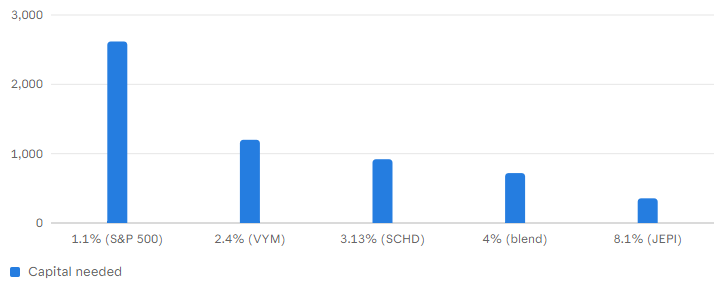
Here is the uncomfortable truth first. The fastest way to make $2,400 a month in dividends is not a clever stock pick. It is putting in more money, sooner. A yield is just a percentage, and $28,800 a year divided by a realistic yield means a large pile of capital. At the yield of a popular dividend ETF such as SCHD, about 3.13%, you need roughly $920,000 (my calculation). At a lower yield like the S&P 500's 1.1%, you would need about $2.6 million. Chase a much higher yield, around 8%, and the number falls to roughly $356,000, but the risks go up too.
Key takeaway: Speed comes mostly from how much you save each month and how early you start, not from picking the highest yield. A very high yield can shrink your target but also shrink your income and your capital.
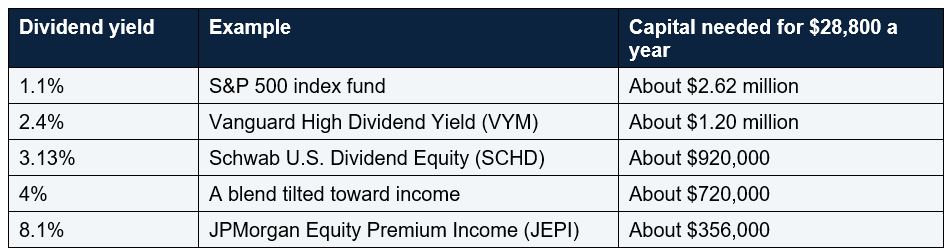
My calculation, $28,800 divided by yield. Yields from Schwab Asset Management, Mitrade (Motley Fool) and 24/7 Wall St.; they change daily. Two notes. First, these figures are before tax, and your own tax bill could raise the amount you need. Second, they ignore inflation. I come back to both below. There is also no free lunch in a higher yield. Funds that pay more usually do so by owning different kinds of companies, or by selling away part of the stock's upside, which I explain in section 6.
SCHD's distribution yield was 3.13% for the 12 months to 31 July 2026. StockAnalysis showed 3.19% with a trailing dividend of $1.05. Here is a subtlety. SCHD's price was $36.00 on 12 November, near its 52-week high of $36.38. At that price, a $1.05 trailing dividend works out to about 2.9% (my calculation), so today's yield is probably a little lower than the summer figures. Prices up means yields down. Schwab's research page also shows a 30-day SEC yield of 3.21% for SCHD.
JEPI paid a trailing yield of about 8.2% in June, and a different 24/7 Wall St. piece cited 8.10% with an annual dividend of $4.57 a share. It charges 0.35% net, against 0.06% for SCHD. The gap between 1% and 8% is wide, and it exists for a reason. The next sections look at what you give up for each.

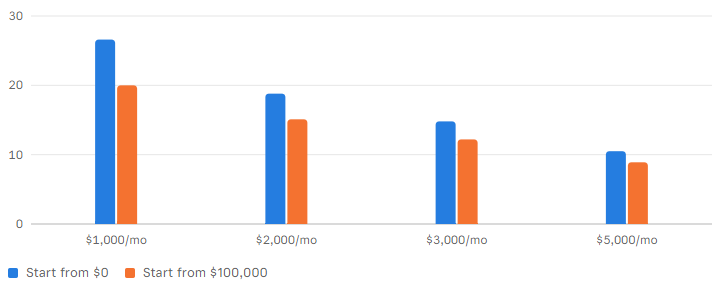
My calculation, 7% constant annual total return, monthly compounding, no tax, no inflation adjustment. 7% is an assumption; the S&P 500 real long-run figure is 6.64%. Look at the pattern. Doubling your monthly contribution from $1,000 to $2,000 saves about eight years. A $100,000 head start saves about two to seven years depending on the contribution. Nothing else you can do moves the date as much, and no yield tweak matches it.
The Motley Fool puts the S&P 500's long-run compound return at 9.92% nominal and 6.64% after inflation. A 7% assumption sits close to that real figure, so it is a reasonable middle case. If returns are lower, the dates move out. So the honest answer to "fastest" is: raise your savings rate, raise it early, and then let reinvested dividends work. You can also increase your starting capital by selling assets you no longer need, though only you can judge that.
These funds also pay quarterly, not monthly. If you want $2,400 to land every month, you can combine funds or use a cash buffer. A fund's dividend can also change from one quarter to the next, so your income is a range, not a fixed number. SCHD is worth a look at the taxes too. 24/7 Wall St. says its dividends are generally qualified, taxed at 0% to 20%, while JEPI's are taxed as ordinary income at up to 37%. I come back to that below.
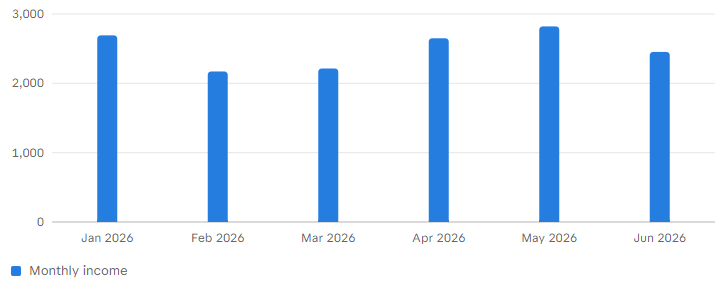
Here is the catch: the monthly amount moves. JEPI's payouts ranged from $0.34 in February 2026 to $0.45 in May, with a high of $0.54 in June 2025. On 6,302 shares, that is a range of about $2,170 to $2,820 in the 2026 months shown, and about $3,400 at the 2025 high (my calculation). One article found payouts fell 37% from June 2025 to February 2026.
There is also the total-return cost. Yahoo Finance reported JEPI returned 8.49% over a year when the S&P 500 returned 13.47%. 24/7 Wall St. says the S&P-linked VOO returned nearly three times more than JEPI in 2023. High income can come at the price of slower growth of your capital. And the tax bill is heavier. JEPI's payouts are generally taxed as ordinary income, which can reach 37%, against 0% to 20% for qualified dividends. My take: A high-yield fund can shorten the capital target, but it can also shorten your capital. If you use one, size it as part of the income, not all of it, and never plan around the best month.
Taxable income is after deductions, and your dividends count towards it. So $28,800 of qualified dividends on top of a salary will likely be taxed at 15% for many readers, though the exact bill depends on your situation. As a rough illustration, 15% of $28,800 is $4,320, which would leave about $24,480 or $2,040 a month (my calculation). To net $2,400 a month, you would need roughly $33,900 of gross dividends, or about $1.08 million at a 3.13% yield (my calculation).
Where you hold the fund matters. In a tax-advantaged retirement account, dividends may be sheltered or deferred, depending on the account rules. I do not know which accounts you have, so check with a tax professional.
This is the case for dividend growth, not just dividend yield. A fund that raises its payout over time can help your income keep pace, though no source I found guarantees it. If a payout stays flat or falls, as JEPI's did, inflation bites twice. A practical step: when you plan, test the target at today's prices and at an inflation-adjusted figure. If the second number scares you, that is useful information, not a reason to give up.
Step three: set your monthly contribution using the table in section 4. If $2,000 a month feels possible, plan for around 15 to 19 years in the 7% model.
Step four: use tax-advantaged accounts first where you can, and hold funds that generate heavier ordinary income there rather than in a taxable account.
Step five: reinvest dividends until you reach the target, then switch the payouts to cash. The model assumes reinvestment, which is why income only starts near the end. Step six: review once or twice a year. Check whether yields, fees and your target still make sense. Do not check daily.
Ignoring total return. A fund can pay a lot and still lose value over time. Judge income and price together. Using borrowed money to speed things up. I did not research margin or leverage for this post, but it raises risk sharply, so I would not use it for an income plan. Forgetting the tax bill. Two funds with the same yield can leave you with different amounts after tax.
If you remember one thing, make it this: plan on the low month, not the high one, and plan after tax and inflation. This post is general education, and I am not a financial adviser. Please check current yields and consider professional advice for your situation.
$2,400 a month is $28,800 a year, so divide by the yield: about $920,000 at 3.13%, $1.2 million at 2.4%, or about $356,000 at 8.1% (my calculation). The higher the yield, the higher the risk.
What is the fastest way to get there?
Increase how much you contribute and start early. In my 7% model, $3,000 a month reaches about $920,000 in roughly 15 years, against 27 years at $1,000 a month (my calculation). Yield picks matter less.
Is JEPI a safe way to get $2,400 a month?
It is a popular choice, but its payouts vary. They ranged from $0.34 to $0.54 a share in recent periods and fell 37% between June 2025 and February 2026. It is also taxed as ordinary income.
How are dividends taxed in 2026?
Qualified dividends are taxed at 0%, 15% or 20%, and nonqualified ones as ordinary income up to 37%. For 2026, 0% applies up to $49,450 of taxable income for single filers.
Will $2,400 a month be enough in the future?
Probably less than it looks. At 3.6% inflation, prices double in about 20 years (my calculation). Plan for a target that grows.
Table of Contents
- The math: how much capital $2,400 a month needs
- Where dividend yields actually sit today
- The real accelerator: how much you add each month
- Option one: broad dividend ETFs
- Option two: high-yield funds like JEPI
- Taxes: the same dividend, different bills
- Inflation: $2,400 will not stay $2,400
- A step-by-step plan
- Shortcuts to avoid
- Conclusion
- FAQ
Here is the uncomfortable truth first. The fastest way to make $2,400 a month in dividends is not a clever stock pick. It is putting in more money, sooner. A yield is just a percentage, and $28,800 a year divided by a realistic yield means a large pile of capital. At the yield of a popular dividend ETF such as SCHD, about 3.13%, you need roughly $920,000 (my calculation). At a lower yield like the S&P 500's 1.1%, you would need about $2.6 million. Chase a much higher yield, around 8%, and the number falls to roughly $356,000, but the risks go up too.
Key takeaway: Speed comes mostly from how much you save each month and how early you start, not from picking the highest yield. A very high yield can shrink your target but also shrink your income and your capital.
The math: how much capital $2,400 a month needs
$2,400 a month is $28,800 a year. To find the capital you need, divide by the yield. Here is what that looks like across a range of yields (my calculation).My calculation, $28,800 divided by yield. Yields from Schwab Asset Management, Mitrade (Motley Fool) and 24/7 Wall St.; they change daily. Two notes. First, these figures are before tax, and your own tax bill could raise the amount you need. Second, they ignore inflation. I come back to both below. There is also no free lunch in a higher yield. Funds that pay more usually do so by owning different kinds of companies, or by selling away part of the stock's upside, which I explain in section 6.
Capital needed for $2,400 a month, by dividend yield ($ thousand)
$ thousand by Source: my calculation, $28,800 / yield; yields from Schwab, Mitrade, 24/7 Wall St.
Where dividend yields actually sit today
Yields move every day, so please treat these as a snapshot from the sources I could reach. The S&P 500 yields about 1.1%, according to a Motley Fool piece syndicated on 29 October, which put VYM at 2.4%. Investing.com showed VYM at about 2.20%, and VYM closed at $165.07 on 13 November, close to its 52-week high of $167.61. The two differ because of the date and how each site calculates the figure.SCHD's distribution yield was 3.13% for the 12 months to 31 July 2026. StockAnalysis showed 3.19% with a trailing dividend of $1.05. Here is a subtlety. SCHD's price was $36.00 on 12 November, near its 52-week high of $36.38. At that price, a $1.05 trailing dividend works out to about 2.9% (my calculation), so today's yield is probably a little lower than the summer figures. Prices up means yields down. Schwab's research page also shows a 30-day SEC yield of 3.21% for SCHD.
JEPI paid a trailing yield of about 8.2% in June, and a different 24/7 Wall St. piece cited 8.10% with an annual dividend of $4.57 a share. It charges 0.35% net, against 0.06% for SCHD. The gap between 1% and 8% is wide, and it exists for a reason. The next sections look at what you give up for each.
The real accelerator: how much you add each month
Now the part that decides how fast you get there. Using a simple model with a 7% yearly total return, with dividends reinvested, here is how long it takes to build about $920,000, the SCHD-style target (my calculation).My calculation, 7% constant annual total return, monthly compounding, no tax, no inflation adjustment. 7% is an assumption; the S&P 500 real long-run figure is 6.64%. Look at the pattern. Doubling your monthly contribution from $1,000 to $2,000 saves about eight years. A $100,000 head start saves about two to seven years depending on the contribution. Nothing else you can do moves the date as much, and no yield tweak matches it.
The Motley Fool puts the S&P 500's long-run compound return at 9.92% nominal and 6.64% after inflation. A 7% assumption sits close to that real figure, so it is a reasonable middle case. If returns are lower, the dates move out. So the honest answer to "fastest" is: raise your savings rate, raise it early, and then let reinvested dividends work. You can also increase your starting capital by selling assets you no longer need, though only you can judge that.
Option one: broad dividend ETFs
The middle path is a broad dividend ETF. SCHD tracks 100 US dividend stocks, charges 0.06%, which is $6 a year on $10,000, and yields about 3%. VYM follows a high-dividend index of roughly 500 US companies and yields about 2.2% to 2.4%. What you get is a yield above the index, a basket of established companies and a low fee. What you give up is exposure to fast-growing companies that pay little or no dividend. In a market led by those, such a fund can trail (my reasoning).These funds also pay quarterly, not monthly. If you want $2,400 to land every month, you can combine funds or use a cash buffer. A fund's dividend can also change from one quarter to the next, so your income is a range, not a fixed number. SCHD is worth a look at the taxes too. 24/7 Wall St. says its dividends are generally qualified, taxed at 0% to 20%, while JEPI's are taxed as ordinary income at up to 37%. I come back to that below.
Years to build about $920,000 by monthly contribution
Years by Source: my calculation; 7% constant return, no tax, no inflation adjustment (assumption)
Option two: high-yield funds like JEPI
Covered-call funds like JEPI are the most common answer to "how do I get $2,400 a month fast". The yield is high and the payout is monthly. But the yield comes from a different engine. 24/7 Wall St. explains that JEPI generates its income by selling call options through equity-linked notes, not just from company dividends, which also caps upside in strong bull markets. The same article gives a neat example. With an annual dividend of $4.57 a share and a yield of 8.10%, owning 1,000 shares produces about $380 a month. To reach $2,400 a month on the same terms you would need about 6,300 shares, or roughly $356,000 (my calculation). That is where the headline appeal comes from.Here is the catch: the monthly amount moves. JEPI's payouts ranged from $0.34 in February 2026 to $0.45 in May, with a high of $0.54 in June 2025. On 6,302 shares, that is a range of about $2,170 to $2,820 in the 2026 months shown, and about $3,400 at the 2025 high (my calculation). One article found payouts fell 37% from June 2025 to February 2026.
There is also the total-return cost. Yahoo Finance reported JEPI returned 8.49% over a year when the S&P 500 returned 13.47%. 24/7 Wall St. says the S&P-linked VOO returned nearly three times more than JEPI in 2023. High income can come at the price of slower growth of your capital. And the tax bill is heavier. JEPI's payouts are generally taxed as ordinary income, which can reach 37%, against 0% to 20% for qualified dividends. My take: A high-yield fund can shorten the capital target, but it can also shorten your capital. If you use one, size it as part of the income, not all of it, and never plan around the best month.
Taxes: the same dividend, different bills
Taxes can change how much you need by thousands a year. This section is general, US-focused and not tax advice. Qualified dividends are taxed at 0%, 15% or 20%, and nonqualified dividends are taxed as ordinary income at rates up to 37%. For 2026, the 0% rate on qualified dividends applies to taxable income up to $49,450 for single filers and $98,900 for married couples filing jointly. The 15% rate runs up to $545,500 for singles and $613,700 for joint filers. Chase adds that a 3.8% net investment income tax may apply to some higher earners.Taxable income is after deductions, and your dividends count towards it. So $28,800 of qualified dividends on top of a salary will likely be taxed at 15% for many readers, though the exact bill depends on your situation. As a rough illustration, 15% of $28,800 is $4,320, which would leave about $24,480 or $2,040 a month (my calculation). To net $2,400 a month, you would need roughly $33,900 of gross dividends, or about $1.08 million at a 3.13% yield (my calculation).
Where you hold the fund matters. In a tax-advantaged retirement account, dividends may be sheltered or deferred, depending on the account rules. I do not know which accounts you have, so check with a tax professional.
Inflation: $2,400 will not stay $2,400
A $2,400 monthly income will buy less in the future. Inflation is the quiet shrinker of every fixed number. At the PCE inflation rate of 3.6% reported for September 2026, prices double in about 20 years by the Rule of 72 (my calculation). So if you reach $2,400 a month in 20 years, it may feel like closer to $1,200 in today's terms. You may want a target that grows.This is the case for dividend growth, not just dividend yield. A fund that raises its payout over time can help your income keep pace, though no source I found guarantees it. If a payout stays flat or falls, as JEPI's did, inflation bites twice. A practical step: when you plan, test the target at today's prices and at an inflation-adjusted figure. If the second number scares you, that is useful information, not a reason to give up.
A step-by-step plan
Here is a plan you can adapt. These are suggestions, not advice. Step one: write the number down. $2,400 a month is $28,800 a year. Decide whether it is before or after tax, and whether it is in today's dollars. Step two: choose a realistic blended yield. A mix of broad index and dividend funds might land around 2.5% to 3.5% (my estimate). That points to roughly $820,000 to $1.15 million (my calculation).Step three: set your monthly contribution using the table in section 4. If $2,000 a month feels possible, plan for around 15 to 19 years in the 7% model.
Step four: use tax-advantaged accounts first where you can, and hold funds that generate heavier ordinary income there rather than in a taxable account.
Step five: reinvest dividends until you reach the target, then switch the payouts to cash. The model assumes reinvestment, which is why income only starts near the end. Step six: review once or twice a year. Check whether yields, fees and your target still make sense. Do not check daily.
Monthly income from 6,302 JEPI shares vs the $2,400 goal ($)
$ per month by Source: my calculation from 24/7 Wall St. per-share payouts; 6,302 shares is about $356,000
Shortcuts to avoid
Some tempting shortcuts are worth naming. Chasing the highest yield. A big yield can signal trouble or a strategy that gives away growth. JEPI's 8% looks great next to SCHD's 3%, but it comes with payout swings and a lag in strong markets. Planning around the best month. JEPI's best recent payout was 54 cents. Its worst was 34 cents. Budget for the low, not the high.Ignoring total return. A fund can pay a lot and still lose value over time. Judge income and price together. Using borrowed money to speed things up. I did not research margin or leverage for this post, but it raises risk sharply, so I would not use it for an income plan. Forgetting the tax bill. Two funds with the same yield can leave you with different amounts after tax.
Conclusion
So what is the fastest way to make $2,400 a month in dividends? Save more, start earlier, and be realistic about yield. At a 3% yield you need around $960,000. At a high 8% yield you need less, but you accept swinging payouts, slower growth and a bigger tax bill. The accelerator you control is your monthly contribution. In my model, going from $1,000 to $3,000 a month cuts the wait from about 27 years to 15 years for the SCHD-style target (my calculation). A good fund choice and low fees help, but they matter less than how much goes in.If you remember one thing, make it this: plan on the low month, not the high one, and plan after tax and inflation. This post is general education, and I am not a financial adviser. Please check current yields and consider professional advice for your situation.
FAQ
How much do I need to invest to make $2,400 a month in dividends?$2,400 a month is $28,800 a year, so divide by the yield: about $920,000 at 3.13%, $1.2 million at 2.4%, or about $356,000 at 8.1% (my calculation). The higher the yield, the higher the risk.
What is the fastest way to get there?
Increase how much you contribute and start early. In my 7% model, $3,000 a month reaches about $920,000 in roughly 15 years, against 27 years at $1,000 a month (my calculation). Yield picks matter less.
Is JEPI a safe way to get $2,400 a month?
It is a popular choice, but its payouts vary. They ranged from $0.34 to $0.54 a share in recent periods and fell 37% between June 2025 and February 2026. It is also taxed as ordinary income.
How are dividends taxed in 2026?
Qualified dividends are taxed at 0%, 15% or 20%, and nonqualified ones as ordinary income up to 37%. For 2026, 0% applies up to $49,450 of taxable income for single filers.
Will $2,400 a month be enough in the future?
Probably less than it looks. At 3.6% inflation, prices double in about 20 years (my calculation). Plan for a target that grows.
0 Comments
Be the first to share your thoughts on this article.