

Savings
Trump’s New Tax Law Expands 529 Savings Plan Uses

The One Big Beautiful Bill Act, signed July 4, 2025, transforms the 529 plan from a college savings tool into what experts are now calling a ‘lifelong education savings account.’ The K–12 withdrawal limit doubles to $20,000. Homeschool curriculum now qualifies. So does vocational training, professional credentials, tutoring, test fees, and educational therapy. With 529 plan assets at a record $602.9 billion and 75% of American families now saving for education, here is everything you need to know heading into the new school year.

The One Big Beautiful Bill Act (OBBBA), signed by President Trump on July 4, 2025, has substantially rewritten that definition. The 529 plan is no longer primarily a college savings account. Under the new rules, it is a tax-advantaged vehicle for funding education at virtually every stage of life — from elementary school curriculum costs to professional credentialing programmes in mid-career. Vivian Tsai, managing director of TIAA Education Savings, described the transformation to CNBC (June 1, 2026): ‘You can now use them really as lifelong education savings accounts.’ The changes, she said, are ‘hugely transformational for adult learners.’
As American families prepare for the back-to-school season of 2026, understanding exactly what the new rules permit — and what they do not — is essential for any household with a 529 plan already open, or considering opening one. This guide covers every significant change, with specific examples, effective dates, and the practical considerations that determine whether each new category will work for your family.
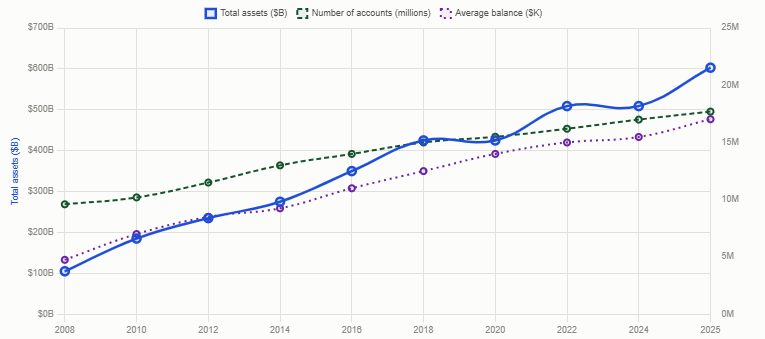
529 plan assets: record $602.9 billion across 17.7 million accounts, avg balance $34,062 (Q4 2025; Investment Company Institute / Wealth in America). 75% of US households now saving for education (ISS Market Intelligence, April 2026, n=1,000+). 30% of households use 529 plans; 45% save outside the system and miss tax advantages. OBBBA signed July 4, 2025: new qualified expenses effective July 5, 2025; K–12 $20,000 limit effective tax year 2026.
There are two types of 529 plans: savings plans (the overwhelming majority, with 95 percent of all 529 accounts) invest in portfolios of mutual funds, bond funds, and ETFs, with the value fluctuating with market performance. Prepaid tuition plans allow families to lock in current tuition rates at participating institutions, reducing exposure to future tuition inflation. Most families use savings plans for their flexibility.
The 529 market has grown substantially:
OBBBA signed: July 4, 2025. New qualified expenses effective: July 5, 2025. New K–12 withdrawal limit ($20,000): effective tax year 2026. Previous K–12 limit (since 2018): $10,000 per beneficiary. ABLE account enhancements: made permanent by OBBBA. Sources: Chase (Jan 2026); OurTaxPartner.com (Jul 2026); Basswoodcounsel.com; Wendroff CPA.
OurTaxPartner.com’s July 2026 guide emphasises the timing mechanics: ‘The higher dollar limit is tied to the tax year, not the date of withdrawal.’ This means that a family making qualifying withdrawals from January 1, 2026 onward can apply the $20,000 limit regardless of when during the year the withdrawal is made. The limit is per beneficiary — a family with two school-age children enrolled in private school can withdraw up to $20,000 per child, for a combined $40,000 in qualifying K–12 distributions per year.
The practical impact is most significant for families paying private school tuition. A family paying $22,000 per year for private elementary school tuition could previously access only $10,000 of that through their 529 plan; the remaining $12,000 had to come from after-tax money. Under the new rules, the full $20,000 can now come from the 529 plan, and the investment growth on that entire amount has compounded tax-free while in the account.
A family with two children in private school, paying $18,000/year in tuition per child ($36,000 total). Under old rules: max 529 withdrawal = $10,000 × 2 = $20,000. Remaining $16,000 paid from after-tax income. Under 2026 rules: max 529 withdrawal = $20,000 × 2 = $40,000 — covers the full $36,000 tuition bill with $4,000 remaining for other qualifying expenses (textbooks, test fees, tutoring). The entire $40,000 accessed in the 529 wrapper grew tax-free during accumulation. Federal tax on qualified withdrawals: $0.
The new expanded list of K–12 qualified expenses (Chase, January 2026; IAdvisor 529/Voya; Basswoodcounsel.com):
Under the OBBBA, structured homeschool curriculum programmes and instructional materials now qualify as 529 distributions. Empower’s analysis of the bill identifies homeschool curriculum as among the newly qualified expenses. The Wendroff CPA guide (2026) confirms: ‘Structured homeschool curriculum and instructional materials now qualify under the expanded rules.’
The qualifying homeschool expenses include:
The homeschool qualification is for 'structured' homeschool curriculum programmes — not all home-based educational expenses. General educational toys, games, subscriptions, or screen time do not qualify. The IRS has not yet issued full guidance on every edge case; families planning to use 529 funds for homeschooling should consult a tax professional and retain documentation of all qualifying programme fees and materials.
Before the OBBBA, postsecondary qualified expenses under Section 529 were limited to tuition, fees, room and board, books, and supplies at an accredited college, university, vocational school, or eligible postsecondary institution. Professional certifications, career-switching credentials, and short-term occupational training programmes at non-accredited providers did not generally qualify.
The OBBBA now includes the following as qualified postsecondary expenses (IAdvisor 529/Voya; Chase January 2026; Basswoodcounsel.com):
If you regularly spend on professional certifications, continuing education, or licensing exams for your career, consider pre-funding a 529 account for these expenses. Even modest regular contributions — $100 to $200 per month — allow the investment to grow tax-free before the credential expense arises. The tax-free growth on the earnings in the account is the benefit: a $5,000 balance that grew from $3,500 in contributions produces $1,500 in tax-free earnings that would otherwise have been taxable.
This is a meaningful change for the substantial proportion of US families managing children with diagnosed learning differences. The Centers for Disease Control estimates that approximately 7 million US children (11.7 percent of all children aged 3 to 17) have been diagnosed with ADHD. Educational therapy, executive function coaching, occupational therapy with an educational component, reading specialists, and similar interventions can cost $1,000 to $5,000 per year or more per child, depending on the frequency and type of support.
IAdvisor 529/Voya confirms that K–12 qualified expenses now include ‘therapies for students with special needs.’ The Empower analysis adds: ‘Families can now use 529 funds for test fees, tutoring, vocational training, homeschool curriculum, and educational therapies, including support for learning differences such as ADHD.’
The OBBBA also made permanent the ABLE (Achieving a Better Life Experience) account enhancements that had previously been subject to sunset provisions, providing additional stability for families with members with disabilities.
For families whose children receive regular educational therapy — whether for ADHD, dyslexia, autism-spectrum learning differences, or other diagnosed conditions — the ability to fund these expenses from a 529 plan represents a meaningful annual tax benefit. Educational therapy costs of $3,000 per year, funded from a 529 plan where the earnings accumulated tax-free, can save a family in the 22% tax bracket approximately $660 in federal income tax annually on the earnings component alone, plus any applicable state tax savings.
What counts as a qualifying credentialing programme? The law specifies programmes that provide credentials — certificates, licences, or credentials — that are recognised by a state or federal regulatory body for the purpose of employment in a trade or occupation. This covers a broad range of vocational and technical programmes including:
The key terms of the 529-to-Roth IRA rollover (Empower; Chase; Saving for College):
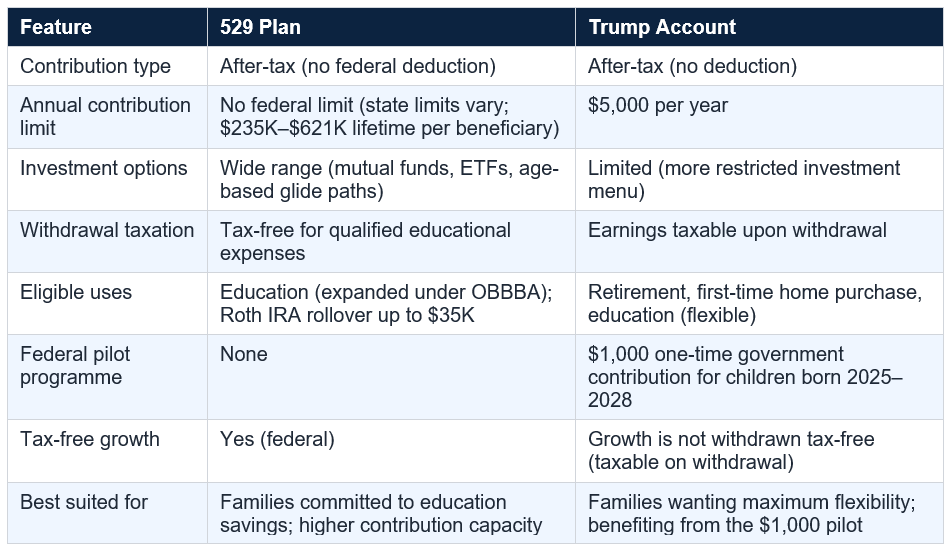
The key distinction: the 529 plan offers tax-free qualified withdrawals, making it more efficient for education-specific spending. The Trump Account offers more flexibility in use but does not provide tax-free withdrawal of earnings. For most families focused on education savings, the 529 plan remains the superior tax-advantaged vehicle — particularly with the OBBBA’s expanded qualified uses. The Trump Account’s primary appeal is the $1,000 federal pilot contribution and its use-flexibility.
Not all states have updated their 529 rules to conform to the OBBBA's expanded expense categories. A withdrawal that qualifies for federal purposes (e.g., for tutoring or credentialing) may be taxable at the state level if the state has not yet passed conforming legislation. Wendroff & Associates CPA (2026) specifically recommends reviewing state-level updates before withdrawing for newly eligible uses. Always verify your state's current conformity status before making withdrawals under the new categories.
Check your state's 529 plan website or consult your tax adviser to confirm whether your state has conformed to the OBBBA's expanded 529 qualified expense definitions. If your state offers a deduction or credit for 529 contributions, ensure you are contributing to the state plan that qualifies (some states require contributions to their specific state-sponsored plan). If you live in a state without a deduction or credit, you may be able to use any state's 529 plan, and it is worth comparing plans for fees and investment options.
A 529 plan opened for a child born today can be used across the following stages:
The doubled K–12 limit, the new expense categories (homeschool, tutoring, test fees, educational therapy, dual enrolment), and the expanded vocational and professional credentialing coverage mean the 529 plan is now a relevant vehicle for virtually every type of educational spending at every stage of life. Vivian Tsai of TIAA Education Savings has it right: the 529 is now a lifelong education savings account.
For families preparing for the 2026 school year, the most productive single action is a review of current 529 balances against the new qualified expense categories. Back-to-school expenses that were previously paid from after-tax income — tutoring programmes, standardised test prep fees, curriculum materials, dual enrolment costs, educational therapy sessions — may now be payable from the 529 plan, with the tax advantage of those funds applied retroactively to the growth period in which they accumulated. The law is written. The accounts are open. The question is whether you are using them.
The One Big Beautiful Bill Act, signed July 4, 2025, made six significant changes to Section 529 plans: (1) the annual K–12 withdrawal limit doubled from $10,000 to $20,000 per beneficiary, effective tax year 2026; (2) K–12 qualified expenses were expanded to include curriculum materials, textbooks, online educational materials, tutoring, standardised test fees, AP exam fees, dual enrolment fees, and academic activity fees (effective July 5, 2025); (3) homeschool curriculum costs became qualifying expenses for the first time; (4) vocational training and professional credentialing programme expenses were added as qualifying postsecondary expenses; (5) educational therapies, including those supporting students with ADHD and other learning differences, now qualify; and (6) ABLE account enhancements were made permanent. Sources: Chase (January 2026); Empower; Basswoodcounsel.com.
Can I use a 529 plan to pay for homeschooling costs?
Yes, under the OBBBA. Structured homeschool curriculum programmes, instructional materials, and related homeschool programme expenses now qualify as 529 distributions, effective July 5, 2025. The key requirement is that the expenses must be for a structured curriculum — general educational toys, games, or subscriptions that are not part of a specific homeschool programme do not qualify. The IRS has not yet issued comprehensive final guidance on all edge cases. Tutoring from a qualified provider (who must be unrelated to the student and meet specific IRS qualifications) also qualifies. As always, state conformity may affect whether these withdrawals are also free from state income tax — verify your state's conformity status before withdrawing. Source: Wendroff CPA (2026); Empower; OurTaxPartner.com.
Does the new $20,000 K–12 limit apply to 2025 or only 2026?
The higher $20,000 annual K–12 limit applies beginning with tax year 2026. For withdrawals made in calendar year 2025 (even after the OBBBA was signed on July 4, 2025), the old $10,000 annual limit still applied. The expanded list of qualifying K–12 expense categories, however, was effective from July 5, 2025 — the day after the law was signed. So in 2025, families could access the new expense categories (tutoring, test fees, homeschool curriculum, etc.) but were still limited to $10,000 in total K–12 qualified distributions for the year. From January 1, 2026 onward, both the new expense categories and the $20,000 annual limit apply together. Source: OurTaxPartner.com (July 2026); Chase (January 2026).
Can adults use a 529 plan for career certifications and training?
Yes, under the OBBBA. Expenses for qualifying credentialing programmes — including tuition, fees, books, supplies, and equipment required for a programme that leads to a state- or federally-recognised credential, certification, or licence in a trade or occupation — are now qualified 529 expenses. This includes trade licences (electrician, plumber, HVAC), healthcare credentials (CNA, medical assistant), technology certifications (CompTIA, AWS, PMP), financial licences, and real estate credentials. CFP Nathan Sebesta of Access Wealth Strategies recommends pre-funding a 529 account monthly for anticipated professional development expenses, so the funds are ready and the investment growth is tax-free before the credential cost arises (CNBC, June 2026). This strategy works whether the account is in the adult's own name (as account owner and beneficiary) or is a family account being repurposed.
What is the Roth IRA rollover from a 529 plan?
The SECURE 2.0 Act (effective 2024, preserved under the OBBBA) allows up to $35,000 in 529 plan funds to be rolled over into a Roth IRA for the same beneficiary over the account's lifetime, subject to the following conditions: (1) the 529 account must have been open for at least 15 years; (2) contributions and earnings from the past five years cannot be rolled over; (3) annual rollovers are limited to the Roth IRA contribution limit for the year ($7,000 in 2026; $8,000 for age 50+), reduced by any other Roth contributions the beneficiary makes; and (4) the beneficiary must have earned income equal to or greater than the rollover amount. The practical benefit is that unused 529 funds — if a child receives a scholarship, doesn't attend college, or doesn't use the full balance — can become a Roth IRA rather than triggering income tax and the 10% penalty on non-qualifying withdrawals. Source: Empower; Chase; Saving for College.
Is there a federal tax deduction for 529 contributions?
No. There is no federal income tax deduction for 529 plan contributions. The federal tax benefit is on the back end: contributions grow tax-free inside the account, and qualified withdrawals are completely free of federal income tax. Many states offer their own income tax deduction or credit for contributions to a 529 plan — 29 states offer deductions and five states (Indiana, Minnesota, Oregon, Utah, Vermont) offer tax credits. The state deduction is typically limited to contributions to that state's own plan; check your state's rules. For 2026, the state-level tax benefit is worth carefully modelling: in a state offering a 5% tax deduction and an income tax rate of 5%, a family contributing $10,000 per year saves approximately $500 annually in state income tax, on top of all the federal benefits.
Table of Contents
- The 529 Plan Just Got a Major Upgrade
- What Is a 529 Plan and Who Is Using One?
- The OBBBA: What Changed on July 4, 2025
- Change #1: K–12 Withdrawal Limit Doubles to $20,000
- Change #2: New Qualified K–12 Expenses Expanded
- Change #3: Homeschooling Costs Now Qualify
- Change #4: Vocational Training and Professional Credentials
- Change #5: Educational Therapies Including ADHD Support
- Change #6: Postsecondary Credentialing Programs
- The Roth IRA Rollover: SECURE 2.0’s Exit Ramp Still Available
- The Trump Account: A New Alternative Savings Vehicle
- State Tax Benefits: What Your State Adds to the Federal Advantage
- What Still Does Not Qualify — And the State Conformity Trap
- The ‘Lifelong Education Account’ Strategy: Beyond College
- Conclusion: The 529 Has Never Been More Versatile
- Frequently Asked Questions
529 Industry Growth: Assets Account (2008 - 2025)
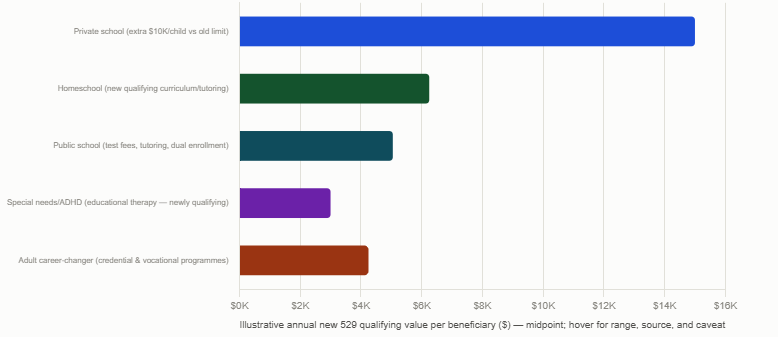
New OBBBA Expenses Categories: Annual value By Family Type
The 529 Plan Just Got a Major Upgrade
The 529 college savings plan has existed in the US tax code since 1996, and for most of that history its name told you everything you needed to know about it: it was a college savings tool. You saved money, it grew tax-free, you withdrew it for higher education expenses, and you paid no federal income tax on qualified withdrawals. The target was a four-year university. The audience was parents with young children who had time to let the investment grow.The One Big Beautiful Bill Act (OBBBA), signed by President Trump on July 4, 2025, has substantially rewritten that definition. The 529 plan is no longer primarily a college savings account. Under the new rules, it is a tax-advantaged vehicle for funding education at virtually every stage of life — from elementary school curriculum costs to professional credentialing programmes in mid-career. Vivian Tsai, managing director of TIAA Education Savings, described the transformation to CNBC (June 1, 2026): ‘You can now use them really as lifelong education savings accounts.’ The changes, she said, are ‘hugely transformational for adult learners.’
As American families prepare for the back-to-school season of 2026, understanding exactly what the new rules permit — and what they do not — is essential for any household with a 529 plan already open, or considering opening one. This guide covers every significant change, with specific examples, effective dates, and the practical considerations that determine whether each new category will work for your family.
529 plan assets: record $602.9 billion across 17.7 million accounts, avg balance $34,062 (Q4 2025; Investment Company Institute / Wealth in America). 75% of US households now saving for education (ISS Market Intelligence, April 2026, n=1,000+). 30% of households use 529 plans; 45% save outside the system and miss tax advantages. OBBBA signed July 4, 2025: new qualified expenses effective July 5, 2025; K–12 $20,000 limit effective tax year 2026.
What Is a 529 Plan and Who Is Using One?
A 529 plan is a tax-advantaged savings account, sponsored by individual states, designed to encourage saving for education expenses. Contributions are made with after-tax dollars — there is no federal income tax deduction for 529 contributions — but the money grows tax-free, and qualified withdrawals are completely free of federal income tax. Earnings that would normally be subject to capital gains or investment income tax accumulate without any annual tax drag, producing significantly better long-term outcomes than equivalent savings in a taxable account.There are two types of 529 plans: savings plans (the overwhelming majority, with 95 percent of all 529 accounts) invest in portfolios of mutual funds, bond funds, and ETFs, with the value fluctuating with market performance. Prepaid tuition plans allow families to lock in current tuition rates at participating institutions, reducing exposure to future tuition inflation. Most families use savings plans for their flexibility.
The 529 market has grown substantially:
- Total 529 plan assets: $602.9 billion across 17.7 million accounts at the end of 2025, up 14.8% year-over-year — the first time the industry crossed the $600 billion threshold (Investment Company Institute / Wealth in America; The College Investor, July 10, 2026).
- Average account balance: $34,062 at the end of 2025, more than double the 2009 average (ISS Market Intelligence; Wealth in America).
- Household adoption: 75% of US households reported saving for education in 2026, up from 72% in 2025 and 53% in 2015. However, only 30% use 529 plans — 45% save outside the system and miss the tax advantages (ISS Market Intelligence, April 2026; The College Investor).
- In 2026, American families have an average of $42,307 saved for postsecondary education, up from $26,266 in 2020 (Education Data Initiative, July 4, 2026).
The OBBBA: What Changed on July 4, 2025
The One Big Beautiful Bill Act (OBBBA), signed into law on July 4, 2025, introduced six significant modifications to Section 529 of the Internal Revenue Code. These changes fall into two categories by effective date:- Effective immediately (July 5, 2025): the expanded list of qualified K–12 expense categories — curriculum materials, tutoring, standardised test fees, dual enrolment fees, educational therapies, and homeschool expenses — became available from the day after the law was signed.
- Effective tax year 2026: the higher K–12 annual withdrawal limit (from $10,000 to $20,000 per beneficiary) applies beginning with the 2026 tax year. For families using 529 funds for K–12 expenses in calendar year 2025, the $10,000 limit still applied.
OBBBA signed: July 4, 2025. New qualified expenses effective: July 5, 2025. New K–12 withdrawal limit ($20,000): effective tax year 2026. Previous K–12 limit (since 2018): $10,000 per beneficiary. ABLE account enhancements: made permanent by OBBBA. Sources: Chase (Jan 2026); OurTaxPartner.com (Jul 2026); Basswoodcounsel.com; Wendroff CPA.
Change #1: K–12 Withdrawal Limit Doubles to $20,000
The most straightforward and immediately valuable change for most families is the doubling of the annual withdrawal limit for K–12 education expenses. Under the law as it stood from 2018 (when the original K–12 inclusion was introduced by the Tax Cuts and Jobs Act), families could withdraw up to $10,000 per beneficiary per year from a 529 plan for elementary and secondary school expenses. Beginning with tax year 2026, that limit rises to $20,000.OurTaxPartner.com’s July 2026 guide emphasises the timing mechanics: ‘The higher dollar limit is tied to the tax year, not the date of withdrawal.’ This means that a family making qualifying withdrawals from January 1, 2026 onward can apply the $20,000 limit regardless of when during the year the withdrawal is made. The limit is per beneficiary — a family with two school-age children enrolled in private school can withdraw up to $20,000 per child, for a combined $40,000 in qualifying K–12 distributions per year.
The practical impact is most significant for families paying private school tuition. A family paying $22,000 per year for private elementary school tuition could previously access only $10,000 of that through their 529 plan; the remaining $12,000 had to come from after-tax money. Under the new rules, the full $20,000 can now come from the 529 plan, and the investment growth on that entire amount has compounded tax-free while in the account.
A family with two children in private school, paying $18,000/year in tuition per child ($36,000 total). Under old rules: max 529 withdrawal = $10,000 × 2 = $20,000. Remaining $16,000 paid from after-tax income. Under 2026 rules: max 529 withdrawal = $20,000 × 2 = $40,000 — covers the full $36,000 tuition bill with $4,000 remaining for other qualifying expenses (textbooks, test fees, tutoring). The entire $40,000 accessed in the 529 wrapper grew tax-free during accumulation. Federal tax on qualified withdrawals: $0.
Change #2: New Qualified K–12 Expenses Expanded
Before the OBBBA, K–12 qualified expenses under Section 529 meant only one thing: tuition at a public, private, or religious elementary or secondary school. Room and board, textbooks, materials, and activities were not covered. The OBBBA substantially expands this definition, effective July 5, 2025.The new expanded list of K–12 qualified expenses (Chase, January 2026; IAdvisor 529/Voya; Basswoodcounsel.com):
- Curriculum materials, textbooks, and instructional materials (including online educational materials).
- Tutoring fees, provided the tutor is unrelated to the student and meets specific qualifications. The 529 plan guide from Wendroff & Associates CPA (2026) notes this includes structured tutoring programmes for general academic improvement as well as subject-specific support.
- Fees for standardised tests, Advanced Placement exams, and college admission exams (including SAT, ACT, AP exams, and similar standardised assessments).
- Dual enrolment fees: costs associated with a high school student taking courses at a community college or university for simultaneous secondary and post-secondary credit.
- Fees for academic activities and extracurricular programmes that are part of a student’s educational experience.
Change #3: Homeschooling Costs Now Qualify
One of the most significant and transformative changes in the OBBBA is the extension of 529 eligibility to cover homeschooling expenses. Previously, homeschooling costs did not qualify as 529 distributions at all — homeschool curriculum was not considered ‘tuition at an educational institution’ in the old statutory definition.Under the OBBBA, structured homeschool curriculum programmes and instructional materials now qualify as 529 distributions. Empower’s analysis of the bill identifies homeschool curriculum as among the newly qualified expenses. The Wendroff CPA guide (2026) confirms: ‘Structured homeschool curriculum and instructional materials now qualify under the expanded rules.’
The qualifying homeschool expenses include:
- Curriculum programme costs and instructional materials from structured homeschool providers.
- Online educational materials and programmes designed for home instruction.
- Books and supplies required for a homeschool curriculum.
- Tutoring from qualified providers, which the IRS specifies must be unrelated to the student and meet qualification criteria.
The homeschool qualification is for 'structured' homeschool curriculum programmes — not all home-based educational expenses. General educational toys, games, subscriptions, or screen time do not qualify. The IRS has not yet issued full guidance on every edge case; families planning to use 529 funds for homeschooling should consult a tax professional and retain documentation of all qualifying programme fees and materials.
Change #4: Vocational Training and Professional Credentials
Perhaps the most consequential change for adult learners and career-changers is the extension of 529 qualified expenses to include certain postsecondary credentialing programmes and vocational training. This is the provision that led Vivian Tsai of TIAA Education Savings to describe the 529 as a ‘lifelong education savings account.’Before the OBBBA, postsecondary qualified expenses under Section 529 were limited to tuition, fees, room and board, books, and supplies at an accredited college, university, vocational school, or eligible postsecondary institution. Professional certifications, career-switching credentials, and short-term occupational training programmes at non-accredited providers did not generally qualify.
The OBBBA now includes the following as qualified postsecondary expenses (IAdvisor 529/Voya; Chase January 2026; Basswoodcounsel.com):
- Tuition, fees, books, supplies, and equipment required for the enrolment and attendance of a credentialing programme.
- Licensing examination fees.
- Expenses for acquiring or maintaining professional certifications or licences recognised by a state or federal regulatory body.
If you regularly spend on professional certifications, continuing education, or licensing exams for your career, consider pre-funding a 529 account for these expenses. Even modest regular contributions — $100 to $200 per month — allow the investment to grow tax-free before the credential expense arises. The tax-free growth on the earnings in the account is the benefit: a $5,000 balance that grew from $3,500 in contributions produces $1,500 in tax-free earnings that would otherwise have been taxable.
Change #5: Educational Therapies Including ADHD Support
The OBBBA also extended 529 qualified expenses to include educational therapies, specifically those supporting students with learning differences and disabilities. Empower’s guide to the OBBBA 529 changes identifies ‘educational therapies, including support for learning differences such as ADHD’ as among the newly qualifying expense categories.This is a meaningful change for the substantial proportion of US families managing children with diagnosed learning differences. The Centers for Disease Control estimates that approximately 7 million US children (11.7 percent of all children aged 3 to 17) have been diagnosed with ADHD. Educational therapy, executive function coaching, occupational therapy with an educational component, reading specialists, and similar interventions can cost $1,000 to $5,000 per year or more per child, depending on the frequency and type of support.
IAdvisor 529/Voya confirms that K–12 qualified expenses now include ‘therapies for students with special needs.’ The Empower analysis adds: ‘Families can now use 529 funds for test fees, tutoring, vocational training, homeschool curriculum, and educational therapies, including support for learning differences such as ADHD.’
The OBBBA also made permanent the ABLE (Achieving a Better Life Experience) account enhancements that had previously been subject to sunset provisions, providing additional stability for families with members with disabilities.
For families whose children receive regular educational therapy — whether for ADHD, dyslexia, autism-spectrum learning differences, or other diagnosed conditions — the ability to fund these expenses from a 529 plan represents a meaningful annual tax benefit. Educational therapy costs of $3,000 per year, funded from a 529 plan where the earnings accumulated tax-free, can save a family in the 22% tax bracket approximately $660 in federal income tax annually on the earnings component alone, plus any applicable state tax savings.
Change #6: Postsecondary Credentialing Programs
The new category of ‘postsecondary credentialing programmes’ deserves specific examination because it represents the broadest expansion of 529 eligibility in the law’s history. The qualifying expenses for credentialing programmes, as defined in Section 70413 of the OBBBA (cited by HavenWealthPlanning, April 2026), include tuition, fees, books, supplies, and equipment required for enrolment and attendance in a qualifying programme.What counts as a qualifying credentialing programme? The law specifies programmes that provide credentials — certificates, licences, or credentials — that are recognised by a state or federal regulatory body for the purpose of employment in a trade or occupation. This covers a broad range of vocational and technical programmes including:
- Licensed trades: electrician, plumber, HVAC technician, and similar programmes.
- Healthcare credentials: Certified Nursing Assistant (CNA), Medical Assistant, phlebotomy, pharmacy technician.
- Technology credentials: CompTIA certifications, AWS cloud certifications, Project Management Professional (PMP) and similar industry credentials.
- Financial industry certifications: FINRA licences, insurance licences, and similar regulatory credentials.
- Real estate licences and broker examinations.
The Roth IRA Rollover: SECURE 2.0’s Exit Ramp Still Available
The OBBBA builds on the SECURE 2.0 Act’s previously introduced rollover provision, which allows unused 529 plan funds to be rolled over into a Roth IRA. This provision, which Empower describes as ‘addressing the financial needs’ of account holders whose educational plans change, remains available under the OBBBA and significantly reduces the risk of over-funding a 529 account.The key terms of the 529-to-Roth IRA rollover (Empower; Chase; Saving for College):
- Lifetime rollover cap: up to $35,000 per beneficiary can be rolled from a 529 plan into a Roth IRA, cumulatively across all years.
- Annual limit: rollovers are subject to the annual Roth IRA contribution limit ($7,000 in 2026; $8,000 for age 50+), reduced by any other Roth IRA contributions made by the beneficiary in that year.
- Account age requirement: the 529 account must have been open for at least 15 years.
- Contribution age restriction: contributions made within the past five years (and their associated earnings) cannot be rolled over.
- Earned income requirement: the beneficiary must have earned income at least equal to the rollover amount in the year of the rollover.
The Trump Account: A New Alternative Savings Vehicle
The OBBBA also introduced a new savings vehicle, informally known as the Trump Account, which families should understand alongside the 529 plan as an alternative or complementary tool. The Trump Account is distinct from the 529 plan in several important ways (Northwestern Mutual; IAdvisor 529/Voya).The key distinction: the 529 plan offers tax-free qualified withdrawals, making it more efficient for education-specific spending. The Trump Account offers more flexibility in use but does not provide tax-free withdrawal of earnings. For most families focused on education savings, the 529 plan remains the superior tax-advantaged vehicle — particularly with the OBBBA’s expanded qualified uses. The Trump Account’s primary appeal is the $1,000 federal pilot contribution and its use-flexibility.
State Tax Benefits: What Your State Adds to the Federal Advantage
The federal tax advantage of the 529 plan — tax-free growth and tax-free qualified withdrawals — is available to all US residents regardless of state. But most states add a further layer of tax incentive that significantly enhances the economics of 529 contributions:- Tax deductions: 29 states and the District of Columbia offer a state income tax deduction for contributions to a 529 plan. The deduction is typically limited to contributions to the state’s own plan (some states offer ‘any state’ deductions). Deduction limits vary from $2,500 to $20,000 or more per year depending on the state and filing status.
- Tax credits: five states offer a tax credit rather than a deduction — Indiana, Minnesota, Oregon, Utah, and Vermont. Tax credits are more valuable than deductions because they directly reduce the tax bill dollar-for-dollar rather than reducing taxable income.
Not all states have updated their 529 rules to conform to the OBBBA's expanded expense categories. A withdrawal that qualifies for federal purposes (e.g., for tutoring or credentialing) may be taxable at the state level if the state has not yet passed conforming legislation. Wendroff & Associates CPA (2026) specifically recommends reviewing state-level updates before withdrawing for newly eligible uses. Always verify your state's current conformity status before making withdrawals under the new categories.
Check your state's 529 plan website or consult your tax adviser to confirm whether your state has conformed to the OBBBA's expanded 529 qualified expense definitions. If your state offers a deduction or credit for 529 contributions, ensure you are contributing to the state plan that qualifies (some states require contributions to their specific state-sponsored plan). If you live in a state without a deduction or credit, you may be able to use any state's 529 plan, and it is worth comparing plans for fees and investment options.
What Still Does Not Qualify — And the State Conformity Trap
Understanding what the OBBBA did not change is as important as understanding what it did. Several commonly assumed uses of 529 funds remain non-qualifying:- Room and board for K–12: the K–12 annual limit (now $20,000) covers qualifying educational expenses, not housing or meal costs. Room and board remains a qualifying expense only for post-secondary students enrolled at least half-time at an eligible institution.
- Transportation and travel: commuting costs to school, whether private school, homeschool co-op, or vocational programme, do not qualify as 529 expenses.
- General extracurricular activities: sports teams, music lessons, art classes, and other activities that are not specifically part of an accredited or credentialing curriculum generally do not qualify.
- Health insurance premiums: student health insurance at a college or university qualifies in very limited circumstances; health insurance for K–12 students or homeschoolers does not.
- Non-educational technology: a computer or tablet qualifies only when required for enrolment or attendance. General-purpose devices that happen to be used for schoolwork but are not specifically required do not automatically qualify.
- Withdrawals for non-qualifying expenses trigger federal income tax on the earnings portion plus a 10% federal penalty. The penalty is on the earnings only, not the full withdrawal amount. Record-keeping for all 529 transactions is essential for tax reporting purposes.
The ‘Lifelong Education Account’ Strategy: Beyond College
The cumulative effect of the OBBBA’s 529 changes — combined with the pre-existing provisions for student loan repayment ($10,000 lifetime limit) and the Roth IRA rollover ($35,000 lifetime limit) — is to transform the 529 from a point-in-time savings tool (save for college, spend on college) into a genuinely multi-stage financial planning instrument.A 529 plan opened for a child born today can be used across the following stages:
- Ages 5–18 (K–12): $20,000/year for private school tuition, tutoring, test fees, AP exams, curriculum materials, homeschool programme costs, dual enrolment, and educational therapy.
- Ages 18–22 (undergraduate): unlimited qualified higher education expenses (tuition, fees, room and board at half-time+ enrolment, books, supplies, required technology).
- Ages 22–50+ (career): expenses for professional credentialing programmes, vocational licences, career-change certifications, and continuing education costs.
- If over-funded: up to $35,000 rolled to a Roth IRA (subject to SECURE 2.0 terms) to seed tax-free retirement savings.
- Up to $10,000 in lifetime withdrawals to repay student loans for the beneficiary and each sibling (pre-existing SECURE Act provision).
Conclusion
The One Big Beautiful Bill Act’s 529 changes arrive at a moment of record 529 adoption — $602.9 billion in assets, 17.7 million accounts, and 75% of American families saving for education. The families already using 529 plans gain significantly expanded flexibility. The 45% of families saving for education outside the 529 system now have more reasons than ever to reconsider whether a 529 plan’s tax advantages are worth capturing.The doubled K–12 limit, the new expense categories (homeschool, tutoring, test fees, educational therapy, dual enrolment), and the expanded vocational and professional credentialing coverage mean the 529 plan is now a relevant vehicle for virtually every type of educational spending at every stage of life. Vivian Tsai of TIAA Education Savings has it right: the 529 is now a lifelong education savings account.
For families preparing for the 2026 school year, the most productive single action is a review of current 529 balances against the new qualified expense categories. Back-to-school expenses that were previously paid from after-tax income — tutoring programmes, standardised test prep fees, curriculum materials, dual enrolment costs, educational therapy sessions — may now be payable from the 529 plan, with the tax advantage of those funds applied retroactively to the growth period in which they accumulated. The law is written. The accounts are open. The question is whether you are using them.
Frequently Asked Questions
What are the main 529 plan changes under the OBBBA?The One Big Beautiful Bill Act, signed July 4, 2025, made six significant changes to Section 529 plans: (1) the annual K–12 withdrawal limit doubled from $10,000 to $20,000 per beneficiary, effective tax year 2026; (2) K–12 qualified expenses were expanded to include curriculum materials, textbooks, online educational materials, tutoring, standardised test fees, AP exam fees, dual enrolment fees, and academic activity fees (effective July 5, 2025); (3) homeschool curriculum costs became qualifying expenses for the first time; (4) vocational training and professional credentialing programme expenses were added as qualifying postsecondary expenses; (5) educational therapies, including those supporting students with ADHD and other learning differences, now qualify; and (6) ABLE account enhancements were made permanent. Sources: Chase (January 2026); Empower; Basswoodcounsel.com.
Can I use a 529 plan to pay for homeschooling costs?
Yes, under the OBBBA. Structured homeschool curriculum programmes, instructional materials, and related homeschool programme expenses now qualify as 529 distributions, effective July 5, 2025. The key requirement is that the expenses must be for a structured curriculum — general educational toys, games, or subscriptions that are not part of a specific homeschool programme do not qualify. The IRS has not yet issued comprehensive final guidance on all edge cases. Tutoring from a qualified provider (who must be unrelated to the student and meet specific IRS qualifications) also qualifies. As always, state conformity may affect whether these withdrawals are also free from state income tax — verify your state's conformity status before withdrawing. Source: Wendroff CPA (2026); Empower; OurTaxPartner.com.
Does the new $20,000 K–12 limit apply to 2025 or only 2026?
The higher $20,000 annual K–12 limit applies beginning with tax year 2026. For withdrawals made in calendar year 2025 (even after the OBBBA was signed on July 4, 2025), the old $10,000 annual limit still applied. The expanded list of qualifying K–12 expense categories, however, was effective from July 5, 2025 — the day after the law was signed. So in 2025, families could access the new expense categories (tutoring, test fees, homeschool curriculum, etc.) but were still limited to $10,000 in total K–12 qualified distributions for the year. From January 1, 2026 onward, both the new expense categories and the $20,000 annual limit apply together. Source: OurTaxPartner.com (July 2026); Chase (January 2026).
Can adults use a 529 plan for career certifications and training?
Yes, under the OBBBA. Expenses for qualifying credentialing programmes — including tuition, fees, books, supplies, and equipment required for a programme that leads to a state- or federally-recognised credential, certification, or licence in a trade or occupation — are now qualified 529 expenses. This includes trade licences (electrician, plumber, HVAC), healthcare credentials (CNA, medical assistant), technology certifications (CompTIA, AWS, PMP), financial licences, and real estate credentials. CFP Nathan Sebesta of Access Wealth Strategies recommends pre-funding a 529 account monthly for anticipated professional development expenses, so the funds are ready and the investment growth is tax-free before the credential cost arises (CNBC, June 2026). This strategy works whether the account is in the adult's own name (as account owner and beneficiary) or is a family account being repurposed.
What is the Roth IRA rollover from a 529 plan?
The SECURE 2.0 Act (effective 2024, preserved under the OBBBA) allows up to $35,000 in 529 plan funds to be rolled over into a Roth IRA for the same beneficiary over the account's lifetime, subject to the following conditions: (1) the 529 account must have been open for at least 15 years; (2) contributions and earnings from the past five years cannot be rolled over; (3) annual rollovers are limited to the Roth IRA contribution limit for the year ($7,000 in 2026; $8,000 for age 50+), reduced by any other Roth contributions the beneficiary makes; and (4) the beneficiary must have earned income equal to or greater than the rollover amount. The practical benefit is that unused 529 funds — if a child receives a scholarship, doesn't attend college, or doesn't use the full balance — can become a Roth IRA rather than triggering income tax and the 10% penalty on non-qualifying withdrawals. Source: Empower; Chase; Saving for College.
Is there a federal tax deduction for 529 contributions?
No. There is no federal income tax deduction for 529 plan contributions. The federal tax benefit is on the back end: contributions grow tax-free inside the account, and qualified withdrawals are completely free of federal income tax. Many states offer their own income tax deduction or credit for contributions to a 529 plan — 29 states offer deductions and five states (Indiana, Minnesota, Oregon, Utah, Vermont) offer tax credits. The state deduction is typically limited to contributions to that state's own plan; check your state's rules. For 2026, the state-level tax benefit is worth carefully modelling: in a state offering a 5% tax deduction and an income tax rate of 5%, a family contributing $10,000 per year saves approximately $500 annually in state income tax, on top of all the federal benefits.
0 Comments
Be the first to share your thoughts on this article.