

Business
What Builds Delivery Loyalty? The Complete Data Guide

Table of Contents
- Why Delivery Is Now the Heart of Customer Loyalty
- What Is Delivery Loyalty?
- The 7 Drivers of Delivery Loyalty: A Data-Backed Reference
- The Delivery Loyalty Flywheel: How It Builds and How It Breaks
- How the Flywheel Builds
- How the Flywheel Breaks
- Delivery Failure vs Delivery Excellence: The Loyalty Outcomes
- Omnichannel Delivery and the Consistency Imperative
- Post-Purchase Communication: The Overlooked Loyalty Lever
- Sustainability as a Delivery Loyalty Driver in 2026
- What Retailers Must Do: A Delivery Loyalty Action Framework
- Conclusion
- Frequently Asked Questions (FAQ)
Why Delivery Is Now the Heart of Customer Loyalty
The transaction has changed. For a growing proportion of retail commerce, the product is no longer the only thing a customer buys. They buy the experience of receiving it. The speed at which it arrives. The accuracy of the time window promised. The notifications they receive while it is in transit. The packaging it arrives in. The ease with which they can return it if it is not right. Delivery has graduated from a logistics function to a loyalty function -- and the data from 2026 makes this unambiguous.Retently's January 2026 ecommerce CX study, based on large-scale post-purchase customer feedback collected across 2025, found that 'shipping and delivery emerge as the most volatile pillar, where execution reliably determines whether customers become Promoters or Detractors.' Capital One Shopping (May 4, 2026) quantified the defection risk: 63% of consumers choose a different retailer for later purchases if shipping takes longer than two days. Bringg's 2026 Delivery Experience Study stated the positive case: reliable, flexible delivery experiences are the primary drivers of ecommerce loyalty, with power shoppers specifically rewarding meeting their expectations with repeat purchases at premium prices.
The economics of loyalty make delivery investment straightforward. Rivo's 2026 ecommerce retention research confirms that 65% of revenue comes from repeat customers, and a 5% increase in retention can boost profits by 25-95%. Delivery loyalty is therefore not a logistics metric -- it is a profit driver. This guide examines every factor that builds delivery loyalty, grounded in the most current available research, and maps the specific actions that turn good delivery experience into lasting commercial relationships.
What Is Delivery Loyalty?
Delivery loyalty is the component of overall customer loyalty that is driven specifically by the delivery experience -- the sum of every interaction between the order confirmation and the product's final acceptance or return. It is distinct from product loyalty (driven by what was bought) and brand loyalty (driven by brand identity and values), though it interacts closely with both. Delivery loyalty is particularly powerful because it is the most recently experienced dimension of a transaction: the delivery experience is the last thing the customer feels before forming their post-purchase opinion of the brand.Retently (January 2026) identifies delivery as the most volatile CX pillar precisely because of this recency effect: 'Shipping and delivery emerge as the most volatile pillar, where execution reliably determines whether customers become Promoters or Detractors.' A great product received late, in damaged packaging, with no tracking communication and a difficult returns process generates a negative overall experience despite the product quality. Conversely, an average product received on time, well-packaged, with clear tracking and easy returns generates a positive overall experience that can override the product's middling quality.
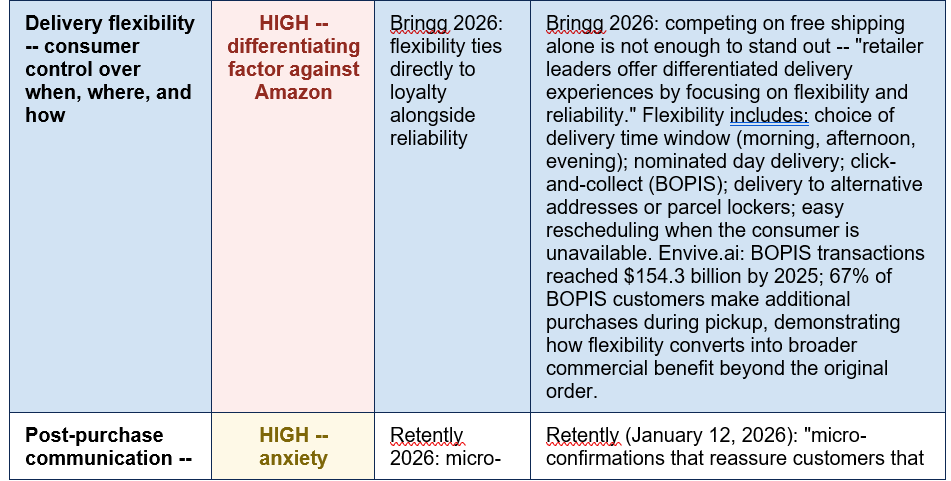
The most important insight from recent research is the shift in what consumers prioritise in delivery. Bringg's 2026 study states clearly that competing on free shipping alone is not enough -- 75% of respondents already do more than half their shopping via Amazon, which has established free shipping as the baseline expectation rather than a differentiator. What differentiates retailers now is reliability and flexibility: the delivery experience that consistently does what it says it will do, and gives the consumer control over how and when they receive it.
Delivery loyalty in 2026 -- the defining data points: 63% switch retailers after slow shipping. 62% value accurate ETA above speed. 52% abandon carts at unexpected costs. 65% of revenue comes from repeat customers. — Capital One Shopping (May 4, 2026): '63% of consumers choose a different retailer for later purchases if shipping takes longer than 2 days. 62% of consumers find an accurate estimated delivery date is more important than fast shipping. 43% of consumers have abandoned a cart or a retailer due to slow shipping speeds.' ZipDo (February 2026): '52% abandon carts due to unexpected shipping costs.' Rivo (2026): '65% of revenue comes from repeat customers; a 5% retention increase can boost profits by 25-95%.' Bringg 2026: 'reliable, flexible delivery experiences are the primary drivers of ecommerce loyalty.'
The 7 Drivers of Delivery Loyalty: A Data-Backed Reference
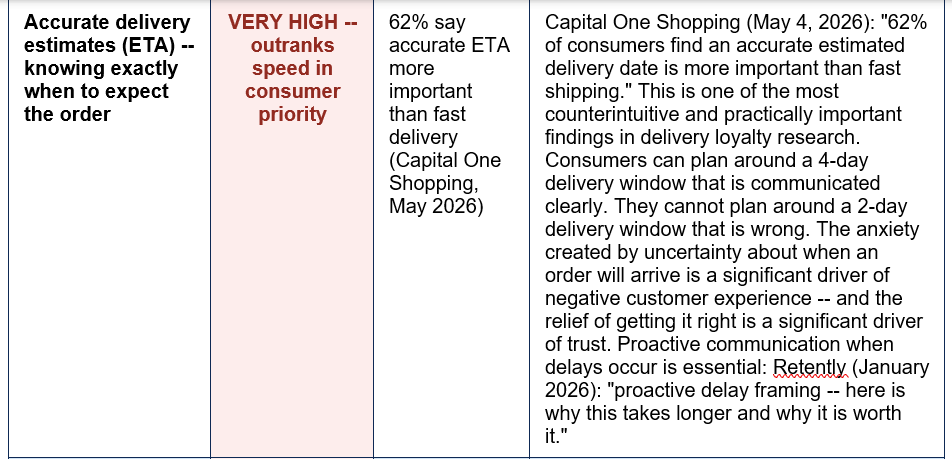
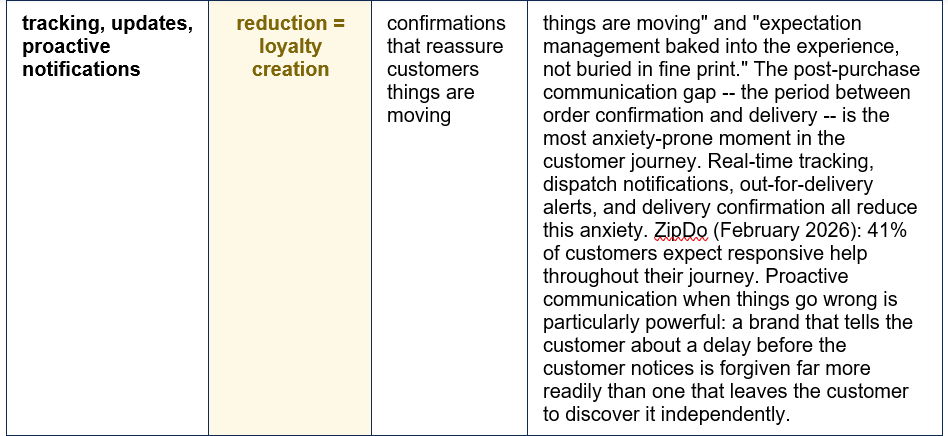
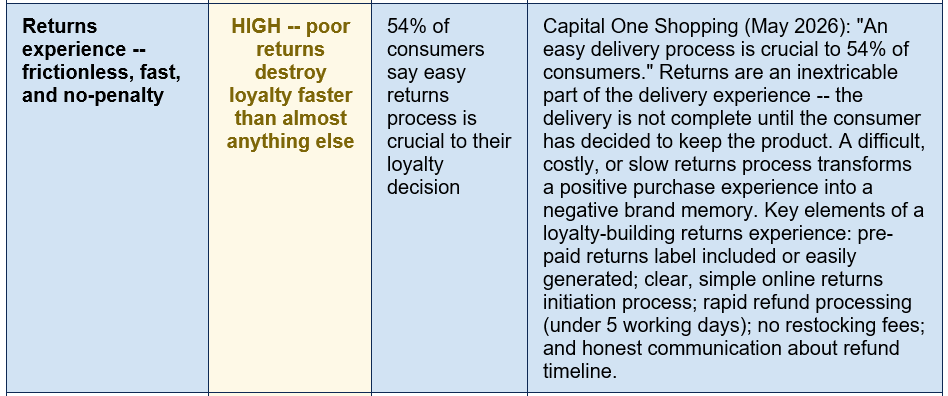
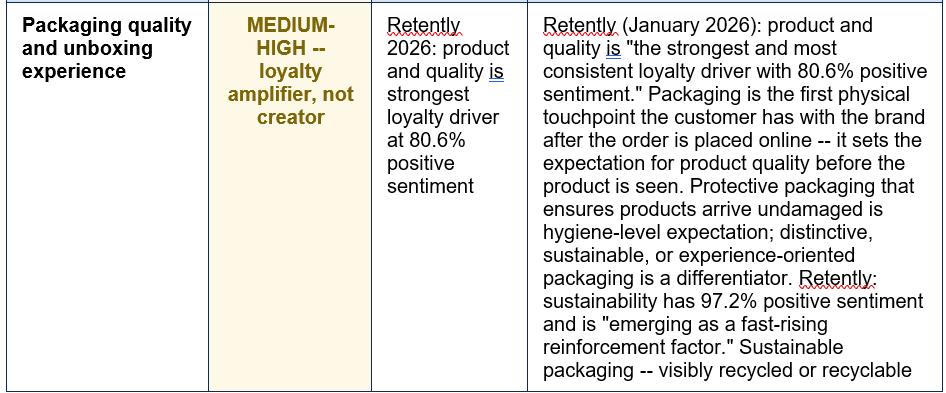
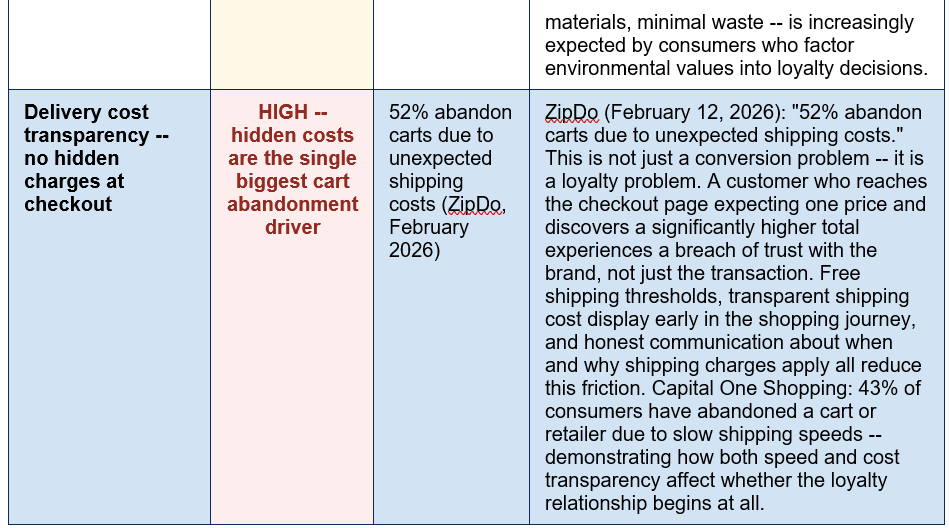
Research from multiple 2025-2026 sources consistently identifies a set of delivery experience factors that drive customer loyalty -- and loyalty-destroying failures. The following table maps all seven key loyalty drivers with their impact level, supporting statistics, and practical application: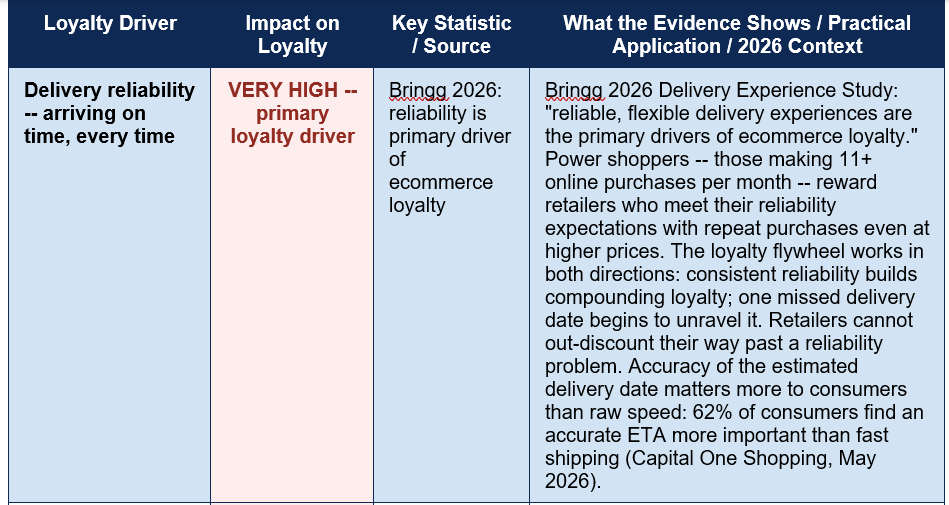
The Delivery Loyalty Flywheel: How It Builds and How It Breaks
Bringg (2026) introduces the concept of the 'loyalty flywheel' in the context of delivery: 'Reliability and flexibility create a loyalty flywheel -- the most profitable customers have the highest expectations and reward retailers that meet them. Conversely, they have the lowest tolerance for delivery failures.' This flywheel model explains both why delivery loyalty compounds and why it collapses -- and why the highest-value customers are simultaneously the highest opportunity and the highest risk.How the Flywheel Builds
The loyalty flywheel begins spinning with a first successful delivery. The consumer places an order, receives accurate pre-delivery information, the delivery arrives on time or early, packaging is intact and pleasing, and post-delivery communication confirms the order is complete. The consumer's trust in the brand's delivery process is established. They order again. Each subsequent delivery that meets expectations adds another rotation to the flywheel -- the consumer's baseline confidence in ordering rises, their purchase anxiety falls, their willingness to order higher-value items increases, and their likelihood of recommending the brand to others grows. Envive.ai (2026): 'Loyalty programs deliver 4.8x average ROI; 90% of programmes report positive returns; members spend 2.5x more than non-members.' Delivery loyalty is the precondition for loyalty programme effectiveness -- consumers do not join or engage with loyalty programmes from brands whose delivery experience they do not trust.How the Flywheel Breaks
The flywheel breaks at the first significant delivery failure -- and breaks faster and more completely in proportion to how strong the flywheel had been spinning. Rivo (2026): 'Customer patience is thin. You do not get multiple chances to recover from service failures, shipping delays, or product quality issues. One strike can mean permanent churn.' The specific failure types that most reliably stop the flywheel are: delivery arriving significantly later than the communicated ETA; delivery failing to arrive at all (lost or stolen parcels); damaged goods on arrival; hidden costs emerging at checkout; and a returns process that feels punitive or complex.Critically, the flywheel breaks differently for different customer segments. Bringg (2026): power shoppers -- those making 11 or more online purchases per month -- 'have the highest expectations and the lowest tolerance for delivery failures.' These are also the most commercially valuable customers, spending more per year and over longer periods. The double irony of the delivery loyalty flywheel is that the customers who give brands the most revenue are the same customers most likely to leave permanently after a single delivery failure.
The ETA paradox: why accuracy beats speed in delivery loyalty. Capital One Shopping (May 2026): '62% of consumers find an accurate estimated delivery date is more important than fast shipping.' This finding overturns the assumption that delivery loyalty is primarily about speed. Consumers have adapted to the reality that same-day or next-day delivery is not universally available from non-Amazon retailers. What they cannot adapt to -- and what most consistently damages loyalty -- is unreliability in the promised timeline. A 5-day delivery that arrives on day 5 as promised builds more loyalty than a 2-day delivery promise that arrives on day 4 with no communication, because it validates the brand's honesty about its own capabilities. Retailers who promise less than they can deliver -- underpromising and overdelivering -- consistently outperform those who promise fast delivery and occasionally fail to meet it. The ETA is not a logistical figure; it is a trust commitment.
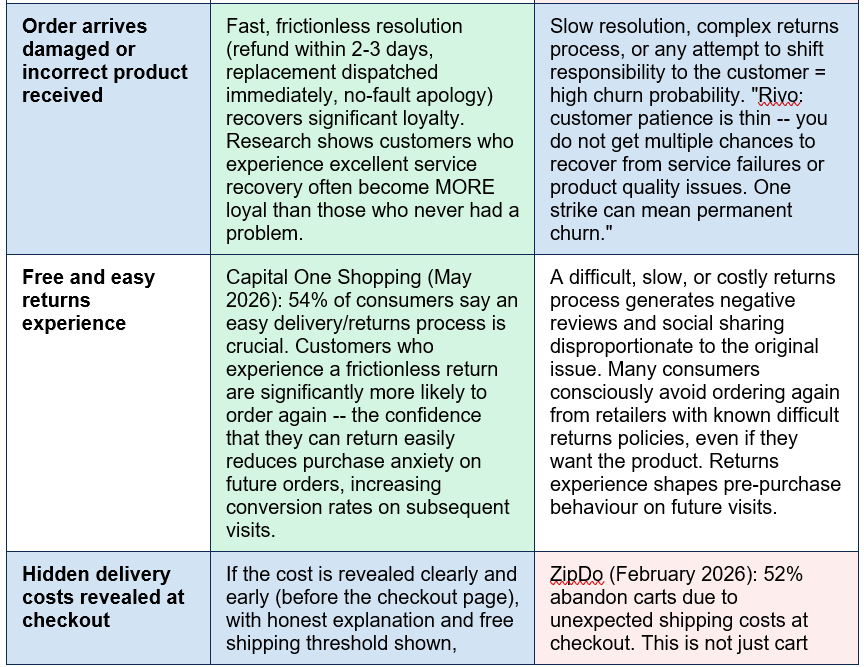
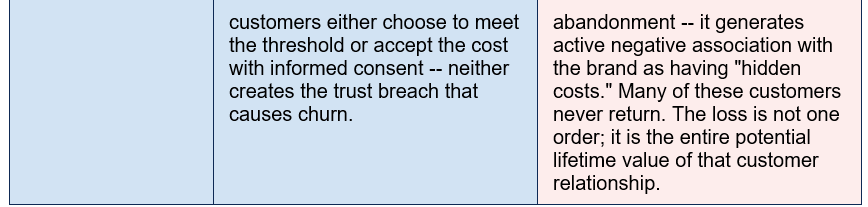
Delivery Failure vs Delivery Excellence: The Loyalty Outcomes
The following table maps five common delivery scenarios against the loyalty outcomes they produce, combining the 2026 research data with the behavioural patterns that follow each type of delivery experience: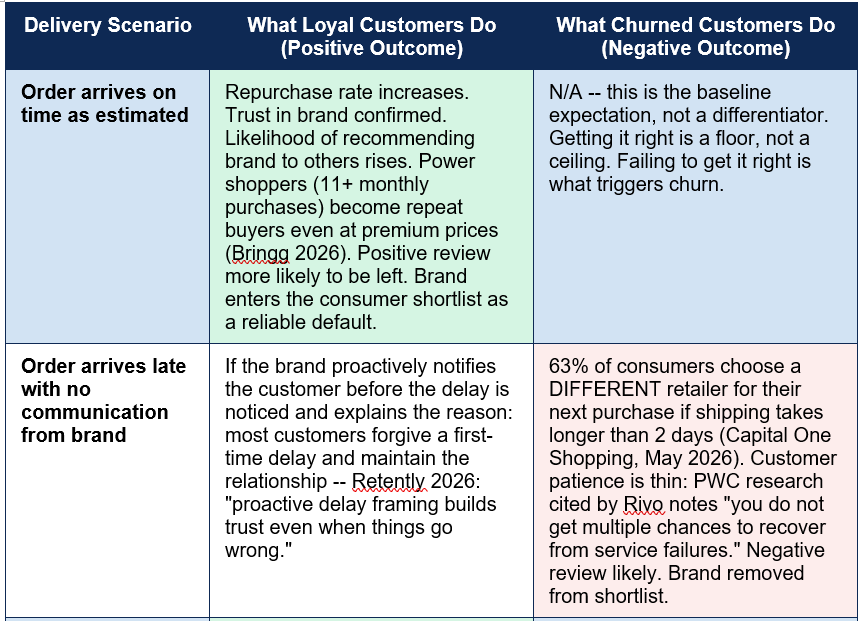
Omnichannel Delivery and the Consistency Imperative
Delivery loyalty is not built in a single channel. The modern consumer interacts with brands across websites, mobile apps, email, SMS, social media, and physical stores -- and expects the delivery experience to be consistent across all of them. Rivo (2026): 'Consistency across touchpoints -- website, email, SMS, mobile app, in-store -- creates a seamless experience that keeps customers engaged. Fragmented experiences create friction that drives churn.'The omnichannel delivery dimension has expanded significantly with the growth of Buy Online Pick Up In Store (BOPIS). Envive.ai (2026): 'BOPIS transactions reached $154.3 billion by 2025; 67% of BOPIS customers make additional in-store purchases during pickup.' BOPIS represents a fusion of the delivery experience and the in-store experience -- the click-and-collect customer who has a smooth collection experience builds loyalty to both the online platform and the physical location simultaneously. A BOPIS experience that is poorly executed -- long waits at collection points, difficulty locating the order, no clear process -- damages loyalty across both channels.
Envive.ai: 'Omnichannel strategies drive 287% higher purchase rates. Companies with strong omnichannel approaches achieve 89% retention rates versus 33% for weak strategies.' The 56-percentage-point difference in retention rates between strong and weak omnichannel strategies is the clearest evidence available that delivery consistency across channels is not a nice-to-have. It is the primary structural determinant of whether a customer base grows or erodes over time. Every consumer touchpoint between order and receipt -- the confirmation email, the dispatch notification, the tracking page, the physical delivery, the packaging, the returns process -- must communicate the same reliability and quality that the brand communicates in its storefront and advertising.
Post-Purchase Communication: The Overlooked Loyalty Lever
The post-purchase period -- from order confirmation to delivery -- is the most anxiety-prone phase of any online shopping experience. The consumer has committed money; the product is not yet in their possession; and they have no direct control over whether the delivery will arrive as expected. Retently (January 2026) identifies this as a critical loyalty opportunity: 'Micro-confirmations that reassure customers that things are moving' and 'expectation management baked into the experience, not buried in fine print.'Effective post-purchase communication covers five key moments: order confirmation (immediate, with clear summary of what was ordered and when it will arrive); dispatch notification (when the order leaves the warehouse, with updated ETA and tracking link); out-for-delivery alert (day-of notification, typically with a narrower time window); delivery confirmation (notification that the parcel has been delivered, with photo evidence where applicable); and delay communication (proactive, explaining the reason and revised ETA before the consumer has noticed the delay).
The most loyalty-critical of these five moments is the delay communication -- because it is the moment when things have gone wrong. Retently (January 2026): 'Proactive delay framing -- here is why this takes longer and why it is worth it -- builds trust even when execution fails.' A consumer who is told about a delay before they notice it feels respected. A consumer who discovers the delay independently -- by checking a tracking page and finding no update, or by waiting for a delivery that never comes -- feels ignored. The psychological difference between these two experiences is profound, and the loyalty implications are equally profound. Brands that invest in proactive delay communication see significantly better loyalty outcomes from delayed deliveries than brands that stay silent and hope the consumer does not notice.
Sustainability as a Delivery Loyalty Driver in 2026
Retently's January 2026 study introduced sustainability as an emerging but significant delivery loyalty factor: 'Sustainability is emerging as a fast-rising reinforcement factor, with 97.2% positive sentiment despite lower mention volume. For a long time, sustainability lived in the good branding bucket. Nice messaging, nice values, but rarely something teams treated as a serious CX lever. The data from 2025 tells a very different story.' The key nuance Retently identifies is that 'sustainability impacts loyalty only when product quality is strong' -- meaning it amplifies loyalty in established customer relationships rather than creating it from scratch.In the delivery context, sustainability manifests through: packaging materials (visibly recycled or recyclable; minimal waste; avoided plastic; compostable alternatives); last-mile delivery choices (electric vehicle deliveries; bicycle couriers in urban areas; consolidated delivery time windows that reduce vehicle journeys); and carbon offset programmes that allow consumers to choose a slower but lower-emission delivery option. These are not merely ethical choices -- they are loyalty signals that communicate brand values in a tangible, physically experienced way at the moment of delivery.
The 97.2% positive sentiment rating for sustainability in Retently's research reflects a consumer market in which environmental values have moved from fringe concern to mainstream expectation. Brands that visibly integrate sustainability into their delivery operation -- not just in marketing copy but in the physical reality of packaging that arrives at the door -- reinforce loyalty in customers who share those values and increasingly generate neutral-to-positive response even in those for whom sustainability is not a primary motivation.
What Retailers Must Do: A Delivery Loyalty Action Framework
Translating the research findings into operational priorities requires a structured framework. The following actions are ordered by their evidence-based impact on delivery loyalty:- Commit to delivery reliability as a non-negotiable standard: Set internal SLAs for on-time delivery performance and track them rigorously. Identify the root causes of delivery failures (carrier performance, warehouse processing times, fulfilment errors) and address them systematically. Bringg (2026): retailers who compete on reliability consistently outperform those who compete on price or speed alone for power shopper retention.
- Set accurate ETAs and communicate proactively when they change: Capital One Shopping (May 2026): 62% of consumers find an accurate ETA more important than fast shipping. Use carrier tracking data and historical performance to set realistic ETAs rather than aspirational ones. Build a proactive delay notification system that triggers automatically when an order falls behind. Retently: proactive delay framing builds trust even when execution fails.
- Eliminate hidden delivery costs: Audit every point in the customer journey where delivery cost information appears. Display shipping costs or free shipping thresholds clearly on product pages and in the basket before the checkout page. ZipDo (February 2026): 52% abandon carts at unexpected shipping costs -- this is revenue that can be recovered by moving cost transparency earlier in the journey.
- Invest in delivery flexibility: Offer delivery time windows, nominated day options, and click-and-collect wherever feasible. Bringg (2026): flexibility is the differentiating factor now that free shipping has become a baseline expectation. Even a choice of two delivery time windows (AM or PM) meaningfully increases consumer sense of control and satisfaction.
- Make returns frictionless and fast: Capital One Shopping (May 2026): 54% say an easy returns process is crucial. Pre-include a returns label or make online returns initiation simple and fast. Process refunds within 3-5 working days. Communicate clearly about what to expect at each stage of the returns process. The investment in a smooth returns operation pays back directly in higher repurchase rates.
- Build post-purchase communication into operational infrastructure: Retently (January 2026): micro-confirmations and expectation management must be baked into the experience, not buried in fine print. Automate post-purchase communication sequences: order confirmation, dispatch, out-for-delivery, delivery confirmation, and delay alerts. Every automated touchpoint that reduces consumer anxiety during the delivery window adds to loyalty.
- Integrate sustainability into the physical delivery experience: Retently (January 2026): sustainability has 97.2% positive sentiment as a delivery loyalty reinforcer. Audit packaging for excess materials and plastic. Switch to recycled or recyclable packaging where cost allows. Make sustainable packaging choices visible to the consumer through messaging on the packaging itself.
DELIVERY LOYALTY SELF-ASSESSMENT CHECKLIST FOR RETAILERS: RELIABILITY: (1) What is your on-time delivery rate? Is it tracked and reported weekly? (2) Are your ETAs set conservatively (what you can reliably achieve) or optimistically (what would be ideal)? (3) Do you have a proactive delay notification system that triggers before customers notice the delay? TRANSPARENCY: (4) At what point in the shopping journey does the customer first see delivery cost information? (5) Is your free shipping threshold clearly communicated before the checkout page? FLEXIBILITY: (6) Do you offer any consumer choice in delivery time windows or nominated day delivery? (7) Do you offer click-and-collect (BOPIS)? (8) Can consumers reschedule delivery easily if they are unavailable? COMMUNICATION: (9) How many automated post-purchase communication touchpoints exist between order confirmation and delivery confirmation? (10) Do you send out-for-delivery alerts with a time window? RETURNS: (11) How many days does it take to process a refund once a return is received? (12) Can a customer initiate a return online in under 3 minutes? SUSTAINABILITY: (13) Is your packaging minimal and visibly recycled or recyclable? (14) Do you offer a lower-emission delivery option?
FIVE DELIVERY EXPERIENCE FAILURES THAT DESTROY LOYALTY: (1) LATE DELIVERY WITH NO COMMUNICATION. Capital One Shopping (May 2026): 63% of consumers choose a different retailer after slow shipping. The damage is not the lateness -- it is the silence. A delay communicated proactively and honestly is forgivable. A delay discovered by the customer with no explanation triggers the deepest loyalty damage. (2) HIDDEN SHIPPING COSTS AT CHECKOUT. ZipDo (February 2026): 52% abandon carts at unexpected shipping costs. This is not just a conversion problem -- it creates active negative brand association that prevents future visits. Move shipping cost transparency to the product page, not the checkout. (3) OPTIMISTIC ETAs THAT ARE REGULARLY MISSED. Setting unrealistic delivery promises to improve conversion creates a trust deficit that compounds with each missed promise. Rivo (2026): 'You do not get multiple chances to recover from service failures.' An ETA is a promise. Break it without communication and the customer registers the brand as untrustworthy. (4) DIFFICULT OR COSTLY RETURNS. Capital One Shopping: 54% consider easy returns crucial. A consumer who successfully returns a product with no friction is more likely to purchase again than one who never had a problem -- because the frictionless return experience proves the brand stands behind what it sells. (5) FRAGMENTED POST-PURCHASE EXPERIENCE. Rivo: 'fragmented experiences create friction that drives churn.' Inconsistency across channels -- good tracking on the website, poor SMS updates, no app notification -- signals operational fragmentation. Consumers interpret inconsistency as unreliability.
Conclusion
Delivery loyalty is built by the combination of seven factors: reliability in meeting promised delivery windows; accuracy in the estimated delivery date communicated to consumers; flexibility in how and when consumers receive their orders; proactive communication throughout the post-purchase journey; a returns experience that is frictionless and fast; packaging that is protective and increasingly sustainable; and complete transparency in delivery costs from early in the shopping journey. Bringg (2026): 'reliable, flexible delivery experiences are the primary drivers of ecommerce loyalty.'The 2026 research base reveals two particularly counterintuitive findings that should reshape how retailers prioritise delivery investment. First, accuracy matters more than speed: 62% of consumers rate an accurate ETA above fast shipping (Capital One Shopping, May 2026). Retailers who can promise less and deliver on that promise consistently will outperform retailers who promise faster and miss their window. Second, free shipping is now a floor, not a ceiling: Bringg's research among 1,000 US shoppers found that 75% already expect free or low-cost shipping from Amazon -- competing on this alone does not differentiate. Reliability and flexibility do.
The economic case for delivery loyalty investment is compelling. Rivo (2026): 65% of revenue comes from repeat customers; a 5% retention increase delivers 25-95% profit growth. Envive.ai: omnichannel excellence drives 89% retention versus 33% for weak strategies -- a 56-percentage-point difference produced primarily by delivery and post-purchase experience consistency. The brands that win customer loyalty in 2026 and beyond are those that treat delivery not as a cost function to be minimised but as a loyalty function to be optimised.
Frequently Asked Questions (FAQ)
What is delivery loyalty and why does it matter?Delivery loyalty is the component of overall customer loyalty generated specifically by the post-purchase delivery experience -- from order confirmation through to receipt of goods and, where relevant, the returns process. It matters because delivery has become one of the most influential variables in whether customers return to buy again. Retently (January 12, 2026), analysing large-scale post-purchase feedback across ecommerce brands in 2025, found that 'shipping and delivery emerge as the most volatile CX pillar, where execution reliably determines whether customers become Promoters or Detractors.' Capital One Shopping (May 2026) quantified the risk: 63% of consumers choose a different retailer for future purchases after experiencing shipping that takes longer than two days. Bringg's 2026 Delivery Experience Study stated the positive case: reliable, flexible delivery experiences are the primary drivers of ecommerce loyalty. The financial stakes are significant: Rivo (2026) confirms that 65% of ecommerce revenue comes from repeat customers and a 5% increase in customer retention can boost profits by 25-95%. Delivery loyalty is not a logistics metric -- it is a profit driver that deserves the same investment and management attention as product quality and marketing.
Is fast delivery or accurate delivery more important for customer loyalty?
Accurate delivery is more important than fast delivery -- and the data is clear on this. Capital One Shopping (May 4, 2026): '62% of consumers find an accurate estimated delivery date is more important than fast shipping.' This counterintuitive finding reflects a fundamental truth about consumer psychology: uncertainty is more uncomfortable than a known wait. A consumer told their order will arrive in 5 days can plan around that. A consumer promised 2-day delivery that arrives in 4 days experiences a breach of trust that damages the brand relationship regardless of how fast the eventual delivery was in absolute terms. Bringg's 2026 research reinforces this: competing on speed alone is not sufficient, because Amazon has set a speed baseline that most independent retailers cannot match. What differentiates is reliability -- consistently delivering what was promised. Retently (January 2026): 'Proactive delay framing -- here is why this takes longer and why it is worth it -- builds trust even when execution fails.' Retailers who underpromise and overdeliver on timing consistently outperform those who overpromise and occasionally miss.
How do hidden shipping costs affect customer loyalty?
Hidden shipping costs -- those that appear for the first time at the checkout page rather than on the product page or basket -- are one of the single largest destroyers of both conversion and loyalty. ZipDo (February 12, 2026): '52% of consumers abandon carts due to unexpected shipping costs.' This is not merely a conversion loss. It is a trust breach that actively damages the brand relationship and discourages future visits. Many consumers who abandon a cart due to a hidden cost do not return to that retailer at all, because the experience has registered the brand as one that hides costs. Capital One Shopping (May 2026): '43% of consumers have abandoned a cart or a retailer due to slow shipping speeds' -- demonstrating that both cost surprise and speed disappointment remove consumers from a retailer's consideration set permanently. The solution is not simply to offer free shipping -- it is to be completely transparent about what delivery will cost and when, as early as possible in the shopping journey. A clear 'free shipping on orders over £50' message on the product page is relationship-preserving even if the threshold is not met. A £4.99 shipping cost appearing for the first time at checkout is relationship-damaging even if the same consumer would have found it acceptable if shown earlier.
How does the returns experience affect delivery loyalty?
The returns experience is an integral part of delivery loyalty -- the delivery is not psychologically complete for the consumer until they have decided to keep the product or successfully returned it. Capital One Shopping (May 2026): '54% of consumers say an easy delivery process is crucial to their loyalty decision.' Research consistently shows that customers who experience a frictionless, fast, no-fault returns process are often more loyal than those who never had a problem -- because the successful resolution of a return proves that the brand stands behind what it sells and values the customer relationship beyond the initial sale. Conversely, a difficult, slow, or costly returns process generates some of the most negative brand experiences in retail. Key elements of a loyalty-building returns experience: an online returns initiation process completable in under 3 minutes; a pre-paid returns label included or digitally generated; refund processing within 3-5 working days; clear communication at each stage of the refund timeline; and no restocking fees or conditions that feel punitive. Rivo (2026): 'Customer patience is thin -- you do not get multiple chances to recover from service failures.' A bad returns experience is a service failure that permanently removes many consumers from a brand's repeat customer pool.
How important is post-purchase communication to building delivery loyalty?
Post-purchase communication is one of the most underinvested delivery loyalty levers available to retailers. Retently (January 12, 2026) identifies it as essential infrastructure: 'Micro-confirmations that reassure customers that things are moving' and 'expectation management baked into the experience, not buried in fine print -- in 2026, this kind of expectation management is not a nice-to-have, it is CX infrastructure.' The post-purchase period -- from order confirmation to receipt -- is the most anxiety-prone phase of the online shopping experience, because the consumer has committed money and has no direct control over what happens next. Every piece of accurate, timely communication during this window reduces anxiety and builds trust in the brand's reliability. The five key post-purchase communication moments are: order confirmation; dispatch notification with tracking link and ETA; out-for-delivery alert with time window; delivery confirmation (with photo evidence where available); and proactive delay notification when timing changes. The most loyalty-critical of these is the delay notification -- because it is when things go wrong that brand character is most clearly demonstrated. ZipDo (February 2026): '41% of customers expect responsive help throughout their journey' -- communication is not optional; it is an explicit expectation.

0 Comments Comments