
Finance
What Is Fiscal Policy? UK & US Explained -- Accountants' Guide

Table of Contents
- The Economic Lever Governments Pull Every Year
- What Is Fiscal Policy? The Core Definition
- The Two Types of Fiscal Policy: Expansionary and Contractionary
- How Fiscal Policy Works: The Transmission Mechanism
- The Government Spending Channel
- The Taxation Channel
- The Automatic Stabilisers
- Fiscal Policy vs Monetary Policy: What Is the Difference?
- The Three Types of Government Spending in Fiscal Policy
- UK vs US Fiscal Policy in 2026: What's Actually Happening
- UK Fiscal Policy in 2026
- US Fiscal Policy in 2026
- How Fiscal Policy Affects Your Personal Finances
- Conclusion
- Frequently Asked Questions (FAQ)
The Economic Lever Governments Pull Every Year
Every year, governments make decisions that directly shape the economic conditions every household, business, and worker experiences. Whether taxes rise or fall. Whether public services are funded or cut. Whether borrowing increases to pay for stimulus or is reduced through austerity. These decisions do not happen in a vacuum -- they are the deliberate use of a policy tool called fiscal policy, and understanding what it is, how it works, and what its effects are is essential financial literacy for anyone seeking to understand economic news.Britannica Money (June 22, 2026): 'Fiscal policy is the use of government taxation and spending to influence economic activity. By adjusting tax rates or public spending, policymakers aim to manage growth, control inflation, and maintain stable employment levels. Examples include stimulus checks and infrastructure spending to boost the economy during a recession, or raising taxes and cutting spending to slow inflation when the economy overheats.' This definition captures the essence of fiscal policy in one paragraph: it is about the government using its two primary financial levers -- taxation and spending -- to steer the economy toward stability, growth, and acceptable levels of employment and inflation.
In 2026, fiscal policy is active and significant in both the UK and the US. The US Congressional Budget Office (CBO) projects a federal budget deficit of $1.9 trillion in fiscal year 2026, with federal debt on course to reach 120% of GDP by 2036. In the UK, the Office for Budget Responsibility (OBR) released its March 2026 fiscal forecast covering five years to 2030-31, following the Autumn 2024 Budget that delivered what the OBR described as 'a significant and sustained loosening of fiscal policy' increasing borrowing by £35 billion in 2025-26. Fiscal policy is not an abstract economics concept -- it is the mechanism through which these numbers are produced and through which they affect mortgage rates, employment, business costs, and household income.
What Is Fiscal Policy? The Core Definition
Fiscal policy is the deliberate use by a government of its decisions about taxation and public spending to influence the level of economic activity in the country. Economics Help (Tejvan Pettinger): 'Fiscal policy involves the government changing the levels of taxation and government spending in order to influence aggregate demand (AD) and the level of economic activity. AD is the total level of planned expenditure in an economy (AD = C + I + G + X - M).' Breaking down this formula: C is consumer spending (what households spend), I is business investment, G is government spending, X is exports, and M is imports. Government spending (G) is directly and immediately one of the five components of aggregate demand. When government spending rises, aggregate demand rises, all else equal. When it falls, aggregate demand falls. Taxation affects (C) -- household consumption -- because taxes reduce the disposable income households have available to spend.The definition has three key elements worth emphasising. First, fiscal policy is deliberate -- it is a conscious choice by government, not a passive consequence of economic conditions (though economic conditions do influence fiscal policy decisions). Second, it involves both taxation and spending -- these two levers can be used together or independently, and they can point in the same or opposite directions. Third, the goal is to influence economic activity -- specifically, to stabilise the economy against the natural swings of the economic cycle, supporting growth when the economy is weak and restraining it when growth is generating inflation.
Fiscal policy is primarily conducted by the elected government -- in the UK, the Chancellor of the Exchequer who presents the Budget; in the US, Congress and the President who pass the federal budget and tax legislation. This makes fiscal policy democratic and politically accountable in a way that monetary policy (controlled by independent central banks) is not. It also makes it subject to political constraints and electoral pressures that can sometimes conflict with economically optimal timing.
Fiscal policy in 2026 -- the scale: US deficit FY2026: $1.9 trillion. UK 2024 fiscal loosening: £35 billion (+1.2% GDP). US federal debt projected at 120% of GDP by 2036. — CBO (2026): 'In CBO's projections, the federal budget deficit in fiscal year 2026 is $1.9 trillion, and federal debt rises to 120 percent of GDP in 2036.' OBR (October 2024): 'This Budget delivers a significant and sustained loosening of fiscal policy which increases borrowing by £35 billion (1.2 per cent of GDP) in 2025-26.' OBR Brief Guide (June 22, 2026) based on March 2026 forecast: covers five fiscal years to 2030-31. Britannica Money (June 22, 2026): fiscal policy is the use of government taxation and spending to influence economic activity.
The Two Types of Fiscal Policy: Expansionary and Contractionary
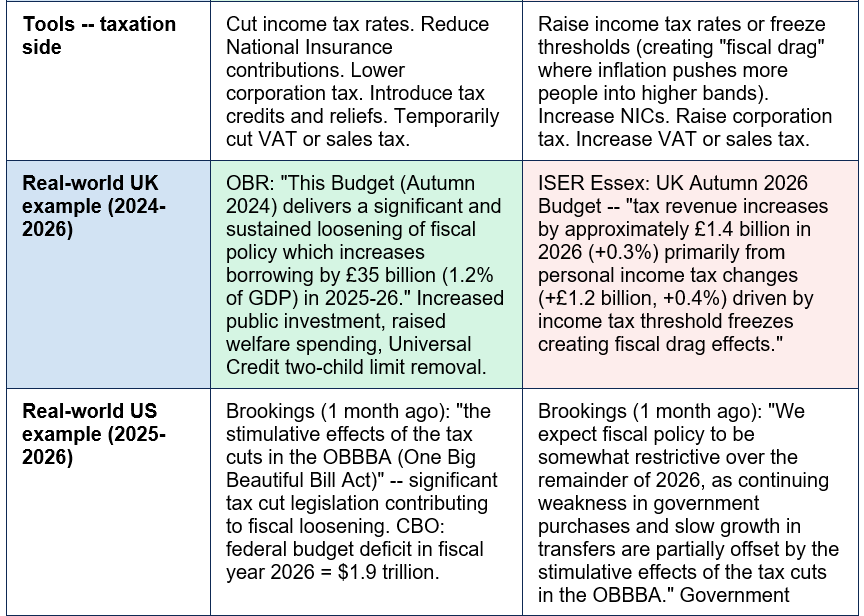
Fiscal policy operates in one of two fundamental directions, depending on the state of the economy and the government's objectives. The following table maps every key dimension of both types, with real-world 2026 examples from the UK and US: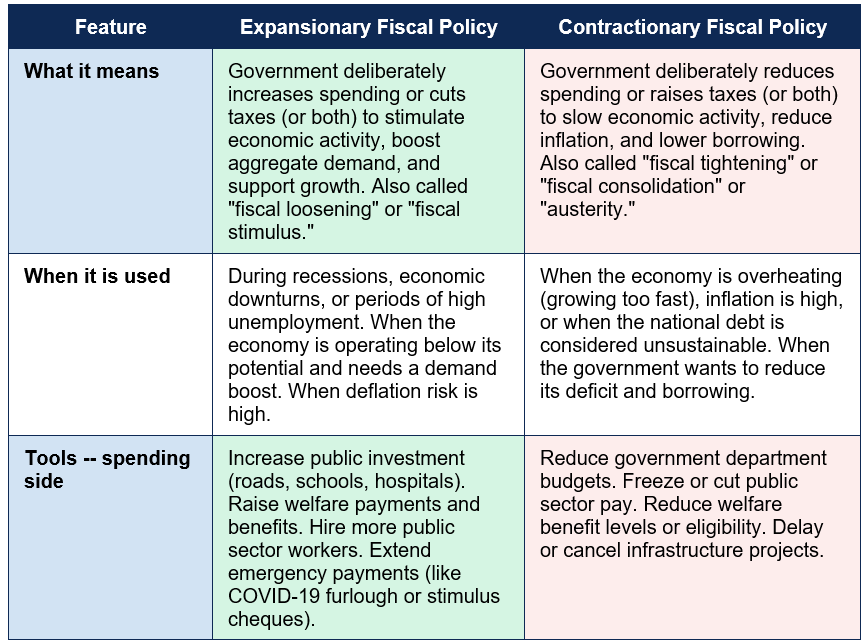

How Fiscal Policy Works: The Transmission Mechanism
Understanding what fiscal policy is requires understanding how it actually transmits through the economy. The mechanisms through which government spending and tax decisions affect economic activity are specific and sequential:The Government Spending Channel
When the government increases spending -- building a new hospital, paying teachers' salaries, funding infrastructure projects, or making welfare payments -- it directly injects money into the economy. This initial injection generates economic activity at the point of spending and then ripples outward through what economists call the 'multiplier effect.' The construction workers building the hospital spend their wages at local shops; those shop owners spend on suppliers; suppliers spend on their employees. Each pound or dollar of government spending generates more than one pound or dollar of economic activity through this chain. Britannica Money: 'Government spending on public works can also help boost economic growth.'The scale of the multiplier varies depending on the state of the economy: during recessions, when private spending is weak and unemployment is high, the government spending multiplier tends to be larger (more of each pound injected generates additional spending, because there are fewer competing demands for resources). During boom periods, when the economy is at or near full capacity, additional government spending competes with private spending and can 'crowd out' private investment -- reducing the multiplier effect and potentially generating inflation rather than growth.
The Taxation Channel
Tax changes affect the economy primarily through their impact on disposable income and incentives. When the government cuts income tax, households have more after-tax income to spend, which increases consumption (C in the AD formula). When the government raises income tax, the reverse happens. Corporation tax changes affect business investment decisions (I in the formula) -- lower corporation tax increases the after-tax return on investment, potentially stimulating business spending on capital equipment, technology, and expansion. Tax reliefs, credits, and allowances can be targeted at specific behaviours: R&D tax credits incentivise innovation; green investment allowances incentivise sustainable capital expenditure.ISER Essex analysis of UK Autumn 2026 Budget: 'Tax revenue increases by approximately £1.4 billion in 2026 (+0.3%) primarily from personal income tax changes (+£1.2 billion, +0.4%) driven by income tax threshold freezes creating fiscal drag effects.' The concept of 'fiscal drag' illustrates a subtler tax mechanism: when income tax thresholds are frozen rather than rising with inflation, more taxpayers are pulled into higher tax bands as their nominal wages rise with inflation, even though their real purchasing power has not increased. This generates additional tax revenue without the government explicitly raising tax rates -- and reduces household disposable income relative to what it would be with fully indexed thresholds.
The Automatic Stabilisers
Not all fiscal policy is discretionary (deliberately chosen by government). An important component of fiscal policy operates automatically through what economists call 'automatic stabilisers.' These are features of the tax and spending system that automatically moderate economic swings without any government decision being required. In a recession: unemployment benefit payments automatically increase as more people lose jobs (increasing government spending and supporting household income); income tax revenues automatically fall as earnings fall; corporation tax revenues fall as profits decline. All three effects automatically increase the deficit during recessions, providing some fiscal stimulus without any policy change. In boom periods: the reverse applies -- lower unemployment means lower benefit payments; higher incomes mean higher tax revenues -- automatically reducing the deficit and slowing demand.Fiscal drag in 2026 -- the stealth tax freeze both the UK and US are using. Both the UK and US governments have used income tax threshold freezes as a mechanism to raise tax revenues without explicitly raising tax rates -- a policy sometimes called 'stealth taxation.' UK: the personal allowance (£12,570) and higher-rate threshold (£50,270) have been frozen since 2021 and are frozen through 2028 under current policy. As wages rise with inflation, more taxpayers are pulled into the 20% band and more 20% taxpayers are pulled into the 40% band without any vote on rate increases. ISER Essex: this mechanism accounts for the £1.2 billion increase in UK personal income tax revenue in 2026. US: income tax brackets are indexed to inflation under current law, but the interaction of fiscal policy decisions with bracket structure continues to evolve. The OBR estimates that freezing UK thresholds generates billions in additional revenue annually -- a significant contractionary fiscal effect achieved without a formal tax rate increase.
Fiscal Policy vs Monetary Policy: What Is the Difference?
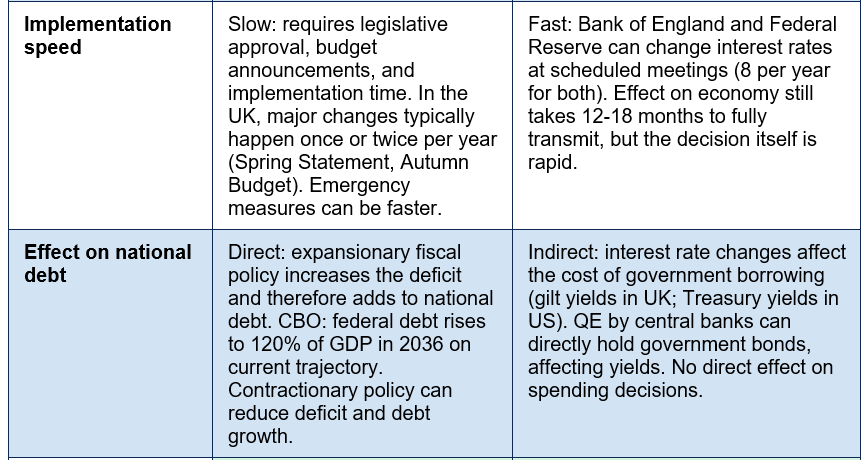
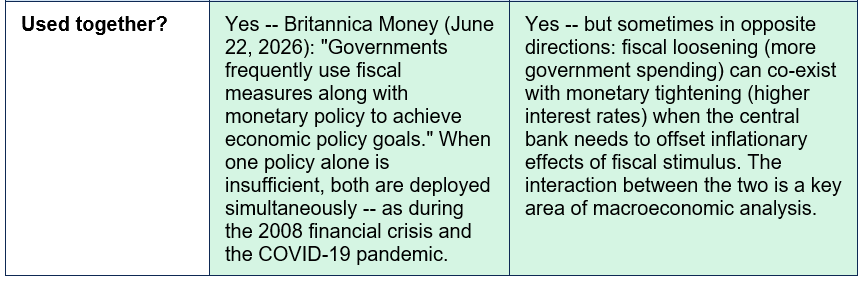
Fiscal policy is frequently confused with monetary policy, and the two are often discussed in the same context. They are related -- they interact significantly -- but they are distinct in who controls them, how they work, and what their limitations are. The following table maps every key difference: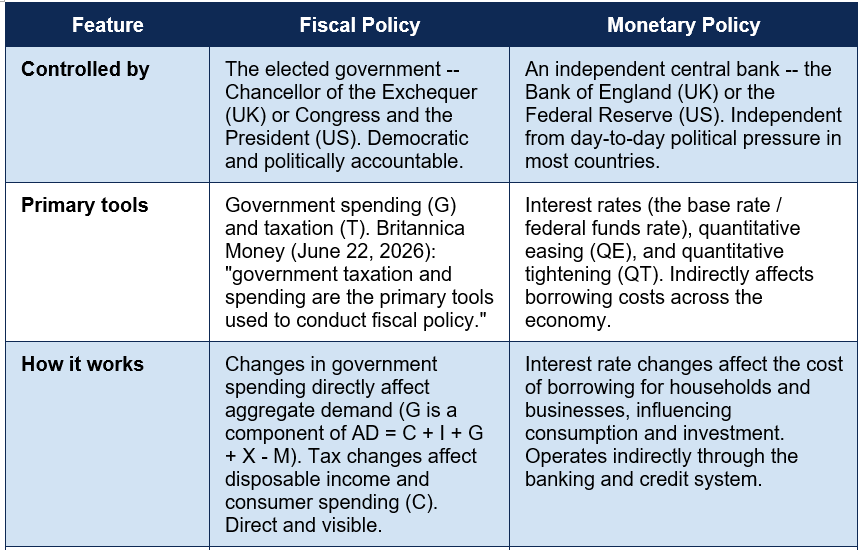
The Three Types of Government Spending in Fiscal Policy
Britannica Money (June 22, 2026): 'There are generally three types of fiscal spending that governments deploy.' Understanding these categories is essential to understanding fiscal policy debates, because the constraints and trade-offs differ significantly across them:- Mandatory spending: Britannica Money: 'Mandatory spending refers to entitlement programmes such as Social Security and Medicare.' In the UK, the equivalent includes state pensions, Universal Credit, and NHS funding commitments. Mandatory spending is defined by law -- the government is legally obliged to pay these amounts to qualifying individuals. It cannot be reduced by a simple budget decision; it requires changes to the underlying legislation. In the US, mandatory spending (Social Security, Medicare, Medicaid, and interest on the debt) accounts for the majority of federal spending and grows automatically with the ageing population. In the UK, the triple lock on state pension increases and the cost of NHS treatment drive mandatory spending growth. Most fiscal policy debates are ultimately about the tension between growing mandatory spending and limited tax revenue.
- Discretionary spending: Britannica Money: 'Discretionary spending refers to annual spending for various administrative functions.' This includes defence, education, infrastructure, research, and the running costs of government departments. Unlike mandatory spending, discretionary spending must be appropriated annually by the legislature. This is where most deliberate fiscal policy decisions are made -- the government can choose to increase or decrease departmental budgets, invest in specific programmes, or cut expenditure in defined areas. The UK Autumn 2024 Budget's £35 billion fiscal loosening was primarily delivered through increased discretionary spending on public investment and departmental budgets.
- Interest on national debt (debt servicing): This is not technically 'policy spending' in the traditional sense, but it is an increasingly significant component of government expenditure in both the UK and the US. As national debt grows, the annual interest cost rises -- and rising interest rates (as occurred globally in 2022-2024) can dramatically increase debt servicing costs even on a stable debt level. CBO: 'Federal debt rises to 120 percent of GDP in 2036.' At high debt levels, interest payments can crowd out spending on services and investment, creating a fiscal constraint that limits the effectiveness of future discretionary fiscal policy. UK debt interest payments have risen significantly since 2021 as both debt levels and interest rates have increased.
UK vs US Fiscal Policy in 2026: What's Actually Happening
UK Fiscal Policy in 2026
The UK's fiscal position in 2026 reflects the legacy of the Autumn 2024 Budget and the subsequent policy adjustments in the 2025 Autumn Budget and Spring 2026 Statement. The OBR's March 2026 forecast covers the five fiscal years to 2030-31. The defining feature of UK fiscal policy since Autumn 2024 has been significant expansion of government spending (particularly on the NHS, public investment, and welfare) financed by increased borrowing and tax rises. OBR (October 2024): 'This Budget delivers a significant and sustained loosening of fiscal policy which increases borrowing by £35 billion (1.2 per cent of GDP) in 2025-26.' The inflationary effect of this expansion: OBR: 'Budget policies increase CPI inflation by 0.4 percentage points in 2025-26 and 0.3 percentage points in 2026-27, reflecting the combined effect of several measures.'The UK's fiscal framework requires the government to meet self-imposed fiscal rules -- the primary rule being that day-to-day spending must be covered by taxation (not borrowing) within five years. Investment spending can be financed by borrowing. The Spring 2026 Statement assessed progress against these rules and provided updated OBR forecasts. The specific measures from the 2026 Autumn Budget analysis (ISER Essex): Universal Credit two-child limit removal adding £714 million to benefit expenditure; income tax threshold freezes generating £1.2 billion in additional revenue; and dividend tax increases from April 2026.
US Fiscal Policy in 2026
US fiscal policy in 2026 is shaped by two major forces operating in partially opposite directions. The expansionary force: the One Big Beautiful Bill Act (OBBBA) -- major tax cut legislation passed in 2025 that provides ongoing fiscal stimulus through reduced tax rates. Brookings Hutchins Center (1 month ago): 'the stimulative effects of the tax cuts in the OBBBA.' The contractionary force: weakness in government purchases and slower growth in transfers. Brookings: 'We expect fiscal policy to be somewhat restrictive over the remainder of 2026, as continuing weakness in government purchases and slow growth in transfers are partially offset by the stimulative effects of the tax cuts in the OBBBA.'The result is a net fiscal position that the Brookings Hutchins Center characterises as 'somewhat restrictive' for the remainder of 2026. Despite this, the deficit remains enormous: CBO: 'In CBO's projections, the federal budget deficit in fiscal year 2026 is $1.9 trillion, and federal debt rises to 120 percent of GDP in 2036. Economic growth strengthens in 2026 and moderates in later years.' The $1.9 trillion deficit -- while smaller than COVID-era peaks -- represents a structural imbalance between government revenue and expenditure that raises long-term sustainability questions.
How Fiscal Policy Affects Your Personal Finances
Fiscal policy is not abstract macroeconomics -- it directly and specifically affects personal financial outcomes for every household. The channels through which fiscal decisions reach individual finances include:- Income tax and National Insurance changes: Direct and immediate. A change in income tax thresholds, rates, or National Insurance bands affects take-home pay from the next payslip. The UK income tax threshold freeze (operating since 2021 and continuing to 2028) is pulling more workers into the 40% band as wages rise, reducing the real value of their pay despite no formal rate increase. US tax cuts in the OBBBA affect take-home pay for many households.
- Mortgage rates and borrowing costs: Indirect but significant. When the government borrows heavily (runs a large deficit), this can increase demand for credit and put upward pressure on interest rates generally -- including mortgage rates. Gilt yields (UK) and Treasury yields (US) are influenced by fiscal policy, and these yields set the floor for mortgage and corporate borrowing rates. The record UK borrowing levels since 2020 have contributed to the environment of higher-than-pre-COVID interest rates that affects mortgages.
- Public services and benefits: Government spending decisions determine the quality and availability of the NHS (UK), state education, welfare benefits, and public infrastructure. Contractionary fiscal policy that cuts these services reduces their quality; expansionary policy that increases them improves availability. For households that rely on these services or benefits, fiscal policy has a direct welfare impact.
- Employment: Government is one of the largest employers in both the UK (public sector = approximately 5.9 million workers) and the US (approximately 22 million federal, state, and local government employees). Fiscal decisions about public sector headcount, wages, and investment programmes directly affect millions of workers. Beyond direct employment, fiscal policy affects the macroeconomic conditions that determine private sector employment too.
- Inflation: Expansionary fiscal policy that increases aggregate demand above the economy's capacity to supply can generate inflation. The OBR attributed 0.4 percentage points of UK CPI inflation in 2025-26 to Budget policy decisions. Inflation erodes the purchasing power of savings, reduces real wages unless nominal wages rise equivalently, and increases the cost of servicing variable-rate debt. Managing the inflationary effects of fiscal expansion is one of the key challenges for fiscal policymakers.
Fiscal policy effect example 1 (UK): UK income tax threshold freeze 2021-2028: Personal allowance frozen at £12,570. Higher-rate threshold frozen at £50,270. Result: each year of 3-4% wage growth pulls hundreds of thousands of additional workers into the 40% tax band, increasing tax revenue by billions without any vote to raise the 40% rate. This is fiscal drag -- a form of gradual fiscal tightening embedded in the structure of the tax system.
Fiscal policy effect example 2 (US): One Big Beautiful Bill Act (OBBBA) 2025: Significant tax cuts for households and businesses. Brookings (1 month ago): the "stimulative effects of the tax cuts in the OBBBA" partially offset contractionary government spending weakness in 2026. Effect: more money in household and business hands, supporting consumption. Offsetting risk: increased deficit and debt, potentially putting upward pressure on Treasury yields and therefore mortgage rates.
Fiscal policy effect example 3 (UK): Autumn 2024 UK Budget fiscal loosening: £35 billion additional borrowing in 2025-26. OBR: increased CPI inflation by 0.4 percentage points in 2025-26. Effect on households: improved public services and welfare payments (Universal Credit two-child limit removal); but also some inflationary pressure that erodes purchasing power and keeps Bank of England interest rates higher for longer than they would otherwise be.
Fiscal policy effect example 4 (US): CBO projects federal debt reaching 120% of GDP by 2036 on current trajectory. Higher debt levels historically correlate with higher long-term interest rates as bond markets price in sustainability risk. Higher long-term rates affect 30-year fixed mortgage rates, the cost of business financing, and the returns on government bonds in retirement portfolios. The fiscal position in 2026 has compounding long-term consequences for interest rate environments.
HOW TO READ FISCAL POLICY NEWS IN 2026 -- A QUICK GUIDE: WHEN YOU HEAR "FISCAL LOOSENING" OR "FISCAL STIMULUS": The government is increasing spending and/or cutting taxes. Aggregate demand is intended to rise. Watch for: potential inflation (Bank of England / Fed may raise interest rates in response); higher borrowing (deficit increases, national debt grows); and potential short-term boost to growth and employment. WHEN YOU HEAR "FISCAL TIGHTENING" OR "AUSTERITY" OR "FISCAL CONSOLIDATION": The government is cutting spending and/or raising taxes. Aggregate demand may fall. Watch for: potential slowdown in economic growth; possible reduction in public services; possible improvement in deficit and debt trajectory; Bank of England / Fed may be able to cut interest rates in response (less inflationary pressure from fiscal side). KEY NUMBERS TO TRACK IN 2026: UK: OBR forecasts (obr.uk) for deficit, debt, and growth; HM Treasury Autumn Statement and Spring Statement. US: CBO projections (cbo.gov) for deficit and debt; Federal budget deficit ($1.9 trillion in FY2026 per CBO); Brookings Hutchins Center Fiscal Impact Measure. WHAT FISCAL POLICY CANNOT DO ALONE: Fiscal policy cannot control inflation independently (it also needs monetary policy support). It cannot instantly eliminate structural economic problems. And expansionary fiscal policy that significantly increases debt may face sustainability constraints over the long term.
FIVE COMMON MISCONCEPTIONS ABOUT FISCAL POLICY: (1) 'THE GOVERNMENT JUST PRINTS MONEY WHEN IT NEEDS MORE.' Governments do not literally print money to fund spending. In the UK and US, the Treasury issues bonds (gilts / Treasury bonds) to borrow money from bond markets, central banks, and international investors. The cost of this borrowing -- the yield on gilts or Treasury bonds -- reflects the market's assessment of fiscal sustainability. Excessive borrowing can raise these yields, increasing the cost of mortgages and corporate debt across the economy. (2) 'A BUDGET DEFICIT IS ALWAYS BAD.' Not necessarily. Running a deficit during a recession -- borrowing to fund economic stimulus -- is widely considered appropriate and can prevent deeper economic damage. The question is whether the deficit is structural (persistent regardless of the economic cycle) or cyclical (a temporary response to economic conditions). CBO's projection of $1.9 trillion in FY2026 deficit with debt at 120% of GDP by 2036 raises legitimate long-term sustainability concerns, but deficit spending during recessions has a strong economic rationale. (3) 'TAX CUTS ALWAYS PAY FOR THEMSELVES THROUGH GROWTH.' The 'Laffer curve' argument that tax cuts generate enough growth to increase total tax revenue is theoretically valid at very high tax rates but is not supported by evidence as a general rule. CBO analysis consistently shows that major US tax cuts increase the deficit, not reduce it. (4) 'FISCAL POLICY WORKS INSTANTLY.' Fiscal policy takes time to work through the economy. Legislation must be passed (slow), funds must be allocated and spent (slow), the multiplier effects ripple through over quarters or years (slow). Economics Help: governments often prefer monetary policy for speed. The typical lag between fiscal policy decision and full economic effect is 12-24 months. (5) 'FISCAL POLICY AND MONETARY POLICY ALWAYS WORK TOGETHER.' Not always: fiscal loosening (government spends more) can be deliberately offset by monetary tightening (central bank raises interest rates) when the central bank is concerned about inflation. In 2022-2024, this tension was visible in both the UK and US as central banks raised rates aggressively while governments maintained significant spending programmes.
Conclusion
Fiscal policy is one of the most consequential tools of economic management available to governments, and understanding it is essential for anyone seeking to interpret economic news, anticipate changes in taxes and public services, or understand the forces shaping mortgage rates, employment, and inflation. Britannica Money (June 22, 2026) provides the clearest definition: 'Fiscal policy is the use of government taxation and spending to influence economic activity. By adjusting tax rates or public spending, policymakers aim to manage growth, control inflation, and maintain stable employment levels.'In 2026, fiscal policy is operating actively in both the UK and US, with significant and real consequences for household finances. The US CBO projects a $1.9 trillion federal budget deficit in FY2026, with federal debt on a trajectory to reach 120% of GDP by 2036. In the UK, the OBR's March 2026 forecast quantifies the ongoing effects of a significant Autumn 2024 fiscal expansion, with income tax threshold freezes generating additional revenue through fiscal drag and continued public investment spending. Both countries are navigating the tension between providing economic support and maintaining fiscal sustainability over the long term.
The distinction between the two types of fiscal policy -- expansionary (more spending, less tax, to boost demand) and contractionary (less spending, more tax, to reduce inflation and debt) -- and the distinction between fiscal policy and monetary policy (government spending and tax versus central bank interest rates) are the foundational concepts for understanding any budget announcement, economic forecast, or policy debate. When the Chancellor presents the Autumn Budget, or when Congress debates a tax bill, fiscal policy is being made in real time -- and its effects will show up in your payslip, your mortgage rate, and the quality of the public services around you.
Frequently Asked Questions (FAQ)
What is fiscal policy in simple terms?Fiscal policy is the government's use of taxation and spending to influence the economy. Britannica Money (June 22, 2026): 'Fiscal policy is the use of government taxation and spending to influence economic activity. By adjusting tax rates or public spending, policymakers aim to manage growth, control inflation, and maintain stable employment levels.' In simple terms: when the economy is sluggish, the government can spend more money on public works and benefits (putting money into people's pockets) or cut taxes (so people keep more of their earnings) to boost economic activity. When the economy is growing too fast and generating inflation, the government can raise taxes (reducing spending power) or cut government spending (reducing demand) to slow things down. Economics Help: fiscal policy changes the levels of taxation and government spending to influence aggregate demand -- the total amount being spent in the economy. The formula for aggregate demand is AD = C + I + G + X - M, where G is government spending. Fiscal policy directly changes G and indirectly affects C (consumption) through tax changes that raise or lower disposable income. It is the economic steering wheel in the hands of the elected government.
What is the difference between fiscal policy and monetary policy?
Fiscal policy and monetary policy are both tools for managing economic conditions, but they are controlled by different institutions and work through different channels. Fiscal policy is controlled by the elected government -- in the UK, the Chancellor of the Exchequer; in the US, Congress and the President. It works through changes in government spending and taxation. Monetary policy is controlled by an independent central bank -- the Bank of England (UK) or the Federal Reserve (US) -- and works primarily through interest rate changes and the money supply. Britannica Money (June 22, 2026): 'Fiscal policy relies on government budget decisions -- taxing and spending -- while monetary policy is controlled by a central bank and involves managing interest rates and the money supply. The two are often used together to meet economic goals.' The key practical difference: fiscal policy changes take longer to implement (require legislation and budget processes) but are highly visible (Budget announcements, new spending programmes). Monetary policy changes can be made faster (Bank of England meets 8 times per year to set the base rate) but work more gradually through the banking and credit system. They can work together (both expansionary to combat a deep recession) or in opposite directions (fiscal expansion plus monetary tightening to prevent fiscal stimulus from generating inflation).
What is expansionary fiscal policy?
Expansionary fiscal policy is when the government deliberately increases spending, cuts taxes, or does both, with the aim of boosting aggregate demand and stimulating economic growth. It is used when the economy is in recession or growing below its potential. Britannica Money (June 22, 2026): 'Examples include stimulus checks and infrastructure spending to boost the economy during a recession.' Real-world examples of expansionary fiscal policy: the COVID-19 pandemic stimulus packages in both the UK (furlough scheme, grants to businesses, increased NHS spending) and the US (stimulus checks, enhanced unemployment benefits, small business loans); the US One Big Beautiful Bill Act (OBBBA) tax cuts in 2025, which Brookings (1 month ago) identifies as having 'stimulative effects' in 2026; the UK Autumn 2024 Budget which the OBR described as 'a significant and sustained loosening of fiscal policy which increases borrowing by £35 billion (1.2 per cent of GDP) in 2025-26.' Expansionary fiscal policy increases the government deficit (more spending / less revenue than before), adds to national debt, and can generate inflation if the economy is near full capacity. The trade-off: short-term economic support at the cost of higher debt and potentially higher future taxes.
What are automatic stabilisers in fiscal policy?
Automatic stabilisers are features of the tax and welfare system that automatically cushion economic downturns or slow booms without any deliberate government decision. They are called 'automatic' because they respond to economic conditions without requiring new legislation or budget decisions. Examples of automatic stabilisers in the UK and US: unemployment benefits (UK Jobseeker's Allowance / US unemployment insurance): when the economy slows and people lose jobs, benefit payments automatically increase without any government decision, putting more money into the economy and supporting household incomes during the downturn. Progressive income taxation: when incomes fall in a recession, income tax revenues fall automatically (because lower income is taxed at lower rates), reducing the tax burden and leaving more money with households. When incomes rise in a boom, tax revenues rise automatically, slowing the demand stimulus. Corporate tax revenues: profits fall in recessions and rise in booms, meaning government tax take from businesses automatically moves counter-cyclically. The significance of automatic stabilisers is that they provide a degree of fiscal policy response to economic cycles without the delays of legislative action. They moderate boom-bust cycles passively. The extent of this automatic stabilisation depends on the size of the welfare state and the progressivity of the tax system -- countries with larger welfare states and more progressive taxation have stronger automatic stabilisers, which is one reason why European economies (including the UK) typically experience smaller GDP swings than some other economies.
What is the UK's current fiscal policy in 2026?
UK fiscal policy in 2026 reflects the ongoing impact of the Autumn 2024 Budget, subsequent policy adjustments, and the constraints of self-imposed fiscal rules. The Autumn 2024 Budget was the most significant fiscal event of recent years: OBR: 'This Budget delivers a significant and sustained loosening of fiscal policy which increases borrowing by £35 billion (1.2 per cent of GDP) in 2025-26 and by £30 billion (0.9 per cent of GDP) in 2029-30.' This loosening was primarily delivered through increased public investment, higher NHS and public service spending, and welfare increases (including the Universal Credit two-child limit removal effective April 2026). The OBR March 2026 forecast (the most recent as of July 2026) covers five fiscal years to 2030-31. The inflationary effects: OBR: 'Budget policies increase CPI inflation by 0.4 percentage points in 2025-26 and 0.3 percentage points in 2026-27.' On the taxation side, UK fiscal policy in 2026 includes ongoing income tax threshold freezes creating fiscal drag (generating an estimated £1.2 billion in additional income tax revenue in 2026 per ISER Essex), employer National Insurance Contributions rise from April 2025, and capital gains tax rate increases. The UK government's fiscal rules require the current budget (day-to-day spending) to be in balance within five years, while capital investment can be debt-financed -- creating a framework within which fiscal policy decisions are evaluated.

0 Comments Comments