
Taxes
What Is IRS Form 4868? Complete US Tax Extension Guide

Table of Contents
- The Six Months That Can Save You Thousands
- What Is IRS Form 4868?
- Who Should File Form 4868? Common Qualifying Situations
- What Form 4868 Does and Does NOT Do: The Complete Reference
- How to File Form 4868: Step-by-Step for 2026
- Method 1: Electronic Filing (E-file) -- Recommended
- Method 2: Paper Mail
- What Information You Need to Complete Form 4868
- How to Estimate Your Tax Payment: The Key to a Penalty-Free Extension
- Penalty and Interest Calculator: Five Scenarios Compared
- Special Situations: Americans Abroad, Disaster Areas, and Military Personnel
- The Most Common Form 4868 Mistakes -- and How to Avoid Them
- Conclusion
- Frequently Asked Questions (FAQ)
The Six Months That Can Save You Thousands
Every April, millions of American taxpayers find themselves in the same position: the April 15 deadline is approaching, the paperwork is not ready, and the prospect of filing an incomplete or inaccurate return under pressure feels unavoidable. It is not. The IRS provides a straightforward, free, automatic mechanism for exactly this situation -- IRS Form 4868, the Application for Automatic Extension of Time to File U.S. Individual Income Tax Return. Filed correctly by April 15, it moves the filing deadline six months forward to October 15, without explanation, without approval, and without penalty for the extension itself.Reed CPA (updated 3 weeks ago): 'An IRS extension gives you six more months to file your return, pushing the deadline from April 15 to October 15. What it does not give you is six more months to pay. That single distinction trips up more taxpayers than any other, and it is the difference between a free six-month grace period and a bill that quietly grows interest and penalties from April 16 forward.' This is the most important sentence in any guide to Form 4868 -- and understanding it fully is the difference between using Form 4868 correctly and being surprised by a penalty bill in October.
This guide explains everything you need to know about IRS Form 4868 for the 2025 tax year (filed in 2026): what it is, who it applies to, what it does and critically what it does not do, the exact 2026 deadlines, how to file it (electronically and by mail), how to estimate your tax payment accurately, the complete penalty framework, the special rules for taxpayers abroad and in disaster areas, state tax considerations, and the most common mistakes to avoid. All information reflects current IRS rules and guidance as of July 2026.
What Is IRS Form 4868?
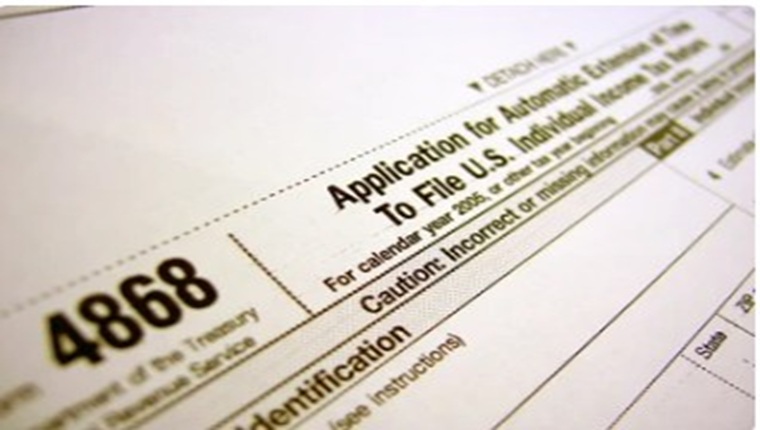
IRS Form 4868 -- officially titled 'Application for Automatic Extension of Time to File U.S. Individual Income Tax Return' -- is the form individual taxpayers file with the IRS to request an automatic six-month extension of time to file their federal income tax return. TaxZerone: 'IRS Form 4868, Application for Automatic Extension of Time to File U.S. Individual Income Tax Return, allows individual taxpayers to request additional time to file their income tax return. This extension applies to U.S. citizens and residents who need more time to complete their Form 1040, 1040-SR, 1040-NR, or 1040-SS. Filing Form 4868 grants a 6-month extension for filing tax returns.'The word 'automatic' in the form's description is precise and significant. Reed CPA: 'The word automatic matters here: the IRS does not review the request, does not ask for a reason, and does not approve or deny it. You submit it on time, and the extension is granted. There is no form of words you have to get right, no hardship to prove.' This is fundamentally different from how many people imagine the extension process works -- there is no application review, no approval waiting period, and no need to justify why you need more time. The extension is simply granted when the form is filed correctly and on time.
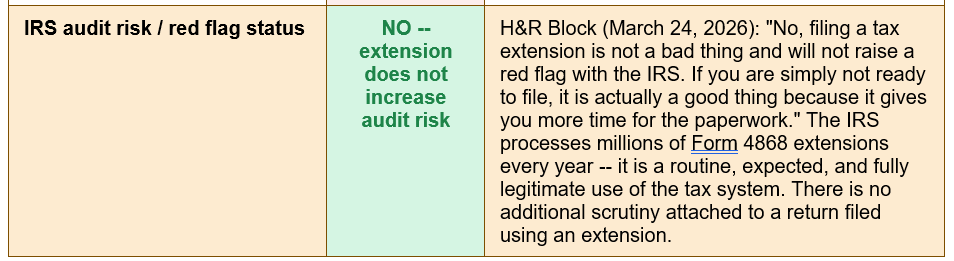
H&R Block (March 24, 2026): 'Filing a tax extension is not a bad thing and will not raise a red flag with the IRS. If you are simply not ready to file, it is actually a good thing because it gives you more time for the paperwork.' The IRS processes millions of Form 4868 extensions annually. Using this mechanism is entirely routine and carries no stigma, no additional audit risk, and no negative consequences for a taxpayer who files on time and pays the estimated amount owed.
IRS Form 4868 -- 2025 tax year key dates and penalties: April 15, 2026: file Form 4868. October 15, 2026: extended filing deadline. Late-filing penalty: 5%/month up to 25%. Extension is automatic -- no reason required. — TaxZerone: 'For the 2025 tax year, filing Form 4868 extends the filing deadline to October 15, 2026. Penalties: late filing penalty of 5% per month (up to 25%); late payment penalty of 0.5% per month (up to 25%) and applicable interest.' Reed CPA (3 weeks ago): 'The IRS does not review the request, does not ask for a reason, and does not approve or deny it.' IRS Form 4868 PDF (IRS.gov): 'If your return is more than 60 days late, the minimum penalty is $525 (adjusted for inflation) or the balance of the tax due, whichever is smaller.' H&R Block (March 24, 2026): extension 'will not raise a red flag with the IRS.'
Who Should File Form 4868? Common Qualifying Situations
Form 4868 is available to any individual taxpayer who needs more time to file their federal income tax return. No specific reason is required. However, the situations where it is most commonly and appropriately used include:- Missing or incomplete tax documents: The most common reason for filing an extension is that not all necessary documents have arrived by April 15. Brokerage and investment account tax documents (1099-B, 1099-DIV) may arrive late, especially for accounts with wash sales, corporate actions, or complex investment transactions. K-1 forms from partnerships, S-corporations, trusts, and estates frequently arrive late due to the complexity of partnership tax accounting. A missing K-1 makes it genuinely impossible to file an accurate return without the extension.
- Complex or major life events in 2025: Instead.com: 'Had a major life event in 2025, such as a property sale, divorce, or new business, that added complexity to your return.' Life events that significantly complicate tax returns include: sale of a primary residence or investment property (capital gains calculation, possible exclusion); divorce and related property transfers or alimony arrangements; starting or acquiring a business; inheritance including complex estates; foreign income or foreign account disclosures; significant cryptocurrency transactions. These situations typically require additional professional preparation time.
- Self-employed individuals and small business owners: Self-employed taxpayers with complex business income, multiple income streams, home office deductions, vehicle use, depreciation calculations, and self-employment tax considerations frequently benefit from the additional preparation time. Note that business entity returns (C-corporations filing Form 1120, partnerships filing Form 1065, and S-corporations filing Form 1120-S) use different extension forms (Form 7004) -- Form 4868 applies to individual returns.
- Taxpayers awaiting a professional adviser: Tax professionals experience significant demand peaks in the weeks before April 15, and not all client returns can be completed in time. Filing Form 4868 for clients whose returns are not yet complete is standard professional practice -- it allows the adviser to complete the return accurately rather than hastily.
- Taxpayers simply needing time to gather information: No justification is required. If you have not gathered your records, reviewed your deductions, or confirmed all income sources and are concerned about filing an inaccurate return, Form 4868 is the appropriate action. Filing an extension and then filing an accurate return in September is far better than filing a hasty, incorrect return in April that requires an amended return (Form 1040-X) later.
What Form 4868 Does and Does NOT Do: The Complete Reference
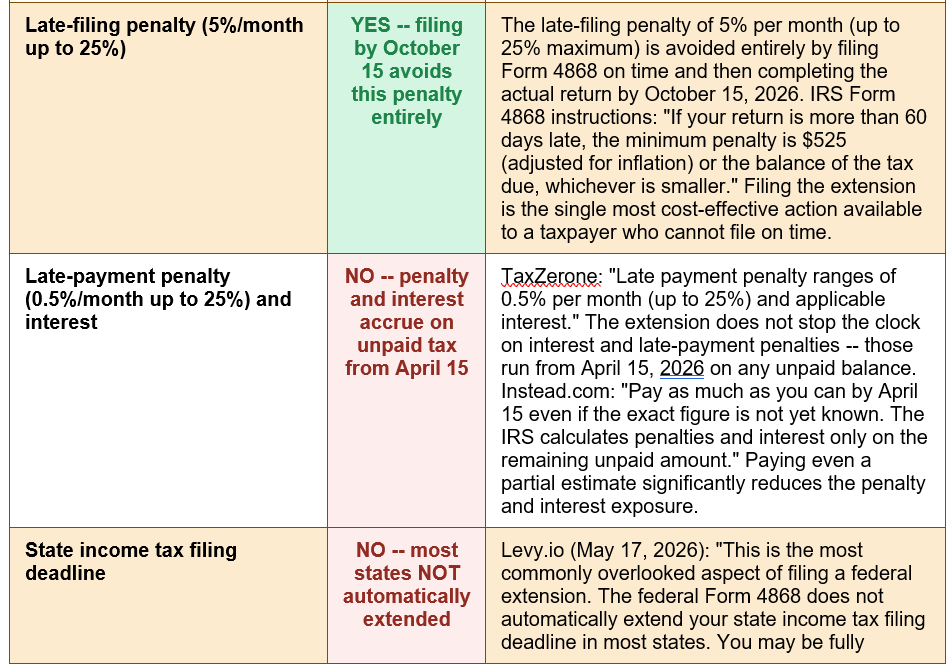
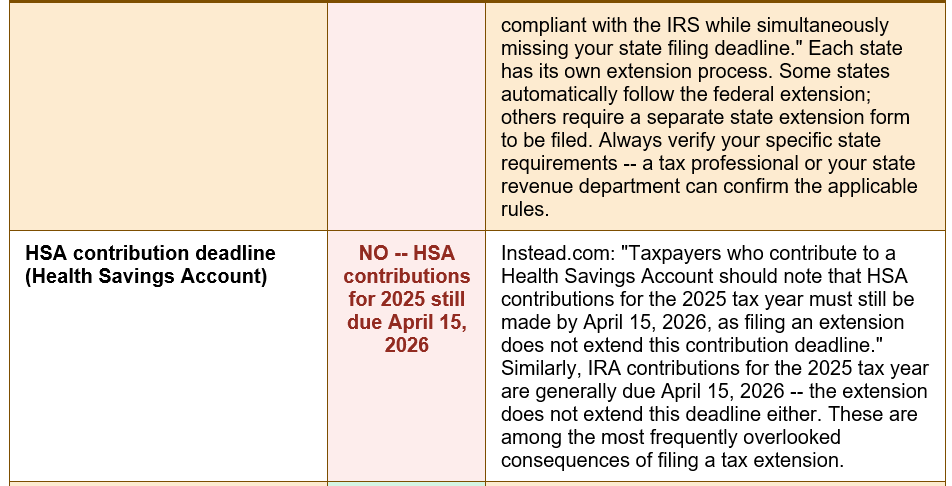
The most important thing to understand about Form 4868 is the precise scope of what it extends -- and the significant things it does not extend. The following table maps every key item: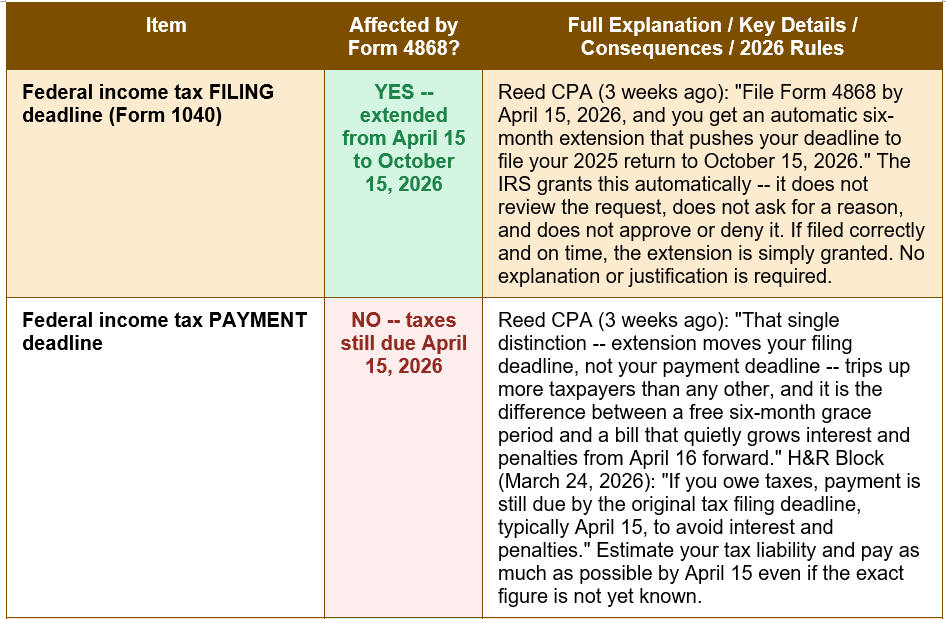
How to File Form 4868: Step-by-Step for 2026
Filing Form 4868 is straightforward. There are two methods: electronic filing (e-file) and paper mail. Both must be completed by April 15, 2026 for the 2025 tax year extension.Method 1: Electronic Filing (E-file) -- Recommended
E-filing Form 4868 is the fastest, most reliable, and most confirmable method. TaxZerone provides a standard e-file process: Step 1 -- Select the tax year and enter personal information (name, address, Social Security Number or ITIN). Step 2 -- Calculate the balance due by providing your estimated total tax liability for 2025 and your total tax payments already made (withholding from W-2, quarterly estimated tax payments). Step 3 -- Transmit to the IRS and receive an acknowledgment confirming the extension is granted.Options for e-filing Form 4868: IRS Free File (free for taxpayers with AGI at or below $84,000 for 2025; available at irs.gov/freefile); commercial tax software (TurboTax, H&R Block, TaxAct, FreeTaxUSA -- all support Form 4868 e-filing); IRS-authorized e-file providers (TaxZerone, ExpressTaxFilings). The key advantage of e-filing: you receive an immediate acknowledgment from the IRS confirming the extension is processed. This acknowledgment is your proof that the extension was granted. Reed CPA: 'The simplest estimate starts with your prior-year return.' If paying with the e-filed extension, use IRS Direct Pay (directpay.irs.gov) or authorize a direct debit payment through the e-file process.
Method 2: Paper Mail
Form 4868 can also be filed by mailing the paper form to the appropriate IRS service center. The address depends on your state of residence -- a full address list is available in the Form 4868 instructions on IRS.gov. Reed CPA: 'If you mail it, send it certified so you have proof of the postmark date.' A certified mail receipt with an April 15 or earlier postmark establishes the extension was timely filed, even if the IRS processes it after that date. If paying by mail with the extension: enclose a check or money order payable to 'United States Treasury,' including your Social Security Number, '2025 Form 4868,' and the tax year on the memo line.What Information You Need to Complete Form 4868
Form 4868 is a single page with five key fields. IRS Form 4868 instructions (IRS.gov): (1) Name(s): enter your full legal name as it appears on your tax return; if filing jointly, include both spouses' names. (2) Address: current mailing address. (3) Social Security Number: primary taxpayer's SSN or ITIN; if filing jointly, include both SSNs. (4) Line 4 -- Estimate of total tax liability for 2025: this is your best estimate of total federal income tax owed for the tax year, before accounting for withholding or estimated tax payments. (5) Line 6 -- Balance due: Line 4 minus total payments already made (withholding on W-2s, quarterly estimated tax payments). This is the amount you should pay with the extension. The form is not designed to be precise -- it asks for an estimate. H&R Block: 'Estimate how much federal tax you owe for the 2025 tax year.' An imperfect estimate is far better than no estimate and no payment.How to Estimate Your Tax Payment: The Key to a Penalty-Free Extension
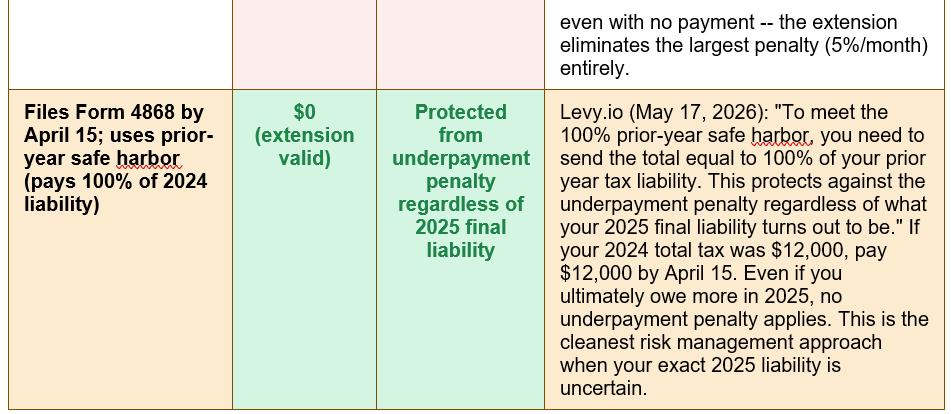
The extension form is only half the job -- the other half is estimating and paying what you owe by April 15. This is where most taxpayers make mistakes, either by skipping the payment entirely (triggering late-payment penalties and interest) or by making an inadequate estimate (same result on the underpaid portion). The following approaches provide reliable estimates:Method 1 -- Prior-year safe harbor approach: Pay an amount equal to 100% of your 2024 total tax liability. This completely protects against the underpayment penalty regardless of your 2025 actual liability. Levy.io (May 2026): "To meet the 100% prior-year safe harbor, pay an amount equal to 100% of your prior year tax liability. This protects against the underpayment penalty regardless of what your 2025 final liability turns out to be." NOTE: taxpayers with prior-year AGI over $150,000 must pay 110% of prior-year liability for the safe harbor to apply.
Method 2 -- Current-year estimate approach: Gather all available income documents (W-2s, 1099s, K-1s received so far). Estimate total income, total deductions, and compute estimated tax liability using the current year tax brackets and rates. Subtract withholding already paid (Box 2 on W-2s). Pay the estimated remaining balance.
Method 3 -- Pay what you can: If neither of the above is feasible, pay as much as possible. Reed CPA: "You do not need a finished return to make a payment, and that is the key to using an extension without penalties." Paying even 50% of the estimated liability reduces the late-payment penalty and interest exposure by 50%. The extension remains valid regardless of how much (or how little) is paid -- only the size of the unpaid balance determines the penalty and interest.
CRITICAL: 90% current-year safety threshold: If you pay at least 90% of your actual 2025 tax liability by April 15, the underpayment penalty does not apply to the remaining 10% balance (though late-payment penalty at 0.5%/month still applies to any amount not paid by April 15). This is a useful threshold if prior-year figures are not readily available.
After filing the return: H&R Block: "When you are ready to file later in the year, be sure to include the amount you already paid with your extension in the payments section of your Form 1040." The payment made with Form 4868 is a pre-payment against your total 2025 tax liability -- it reduces the balance due (or increases the refund) on your completed return.
Penalty and Interest Calculator: Five Scenarios Compared
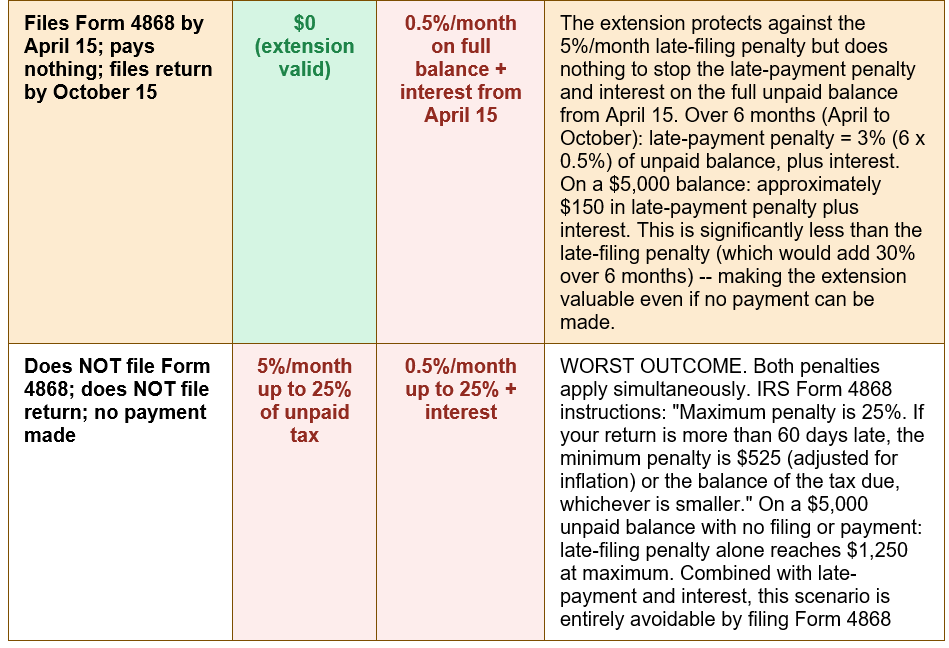
The difference in financial outcome between the five most common filing scenarios illustrates exactly why Form 4868 is so valuable even when you cannot pay in full. The following table maps penalty exposure across scenarios: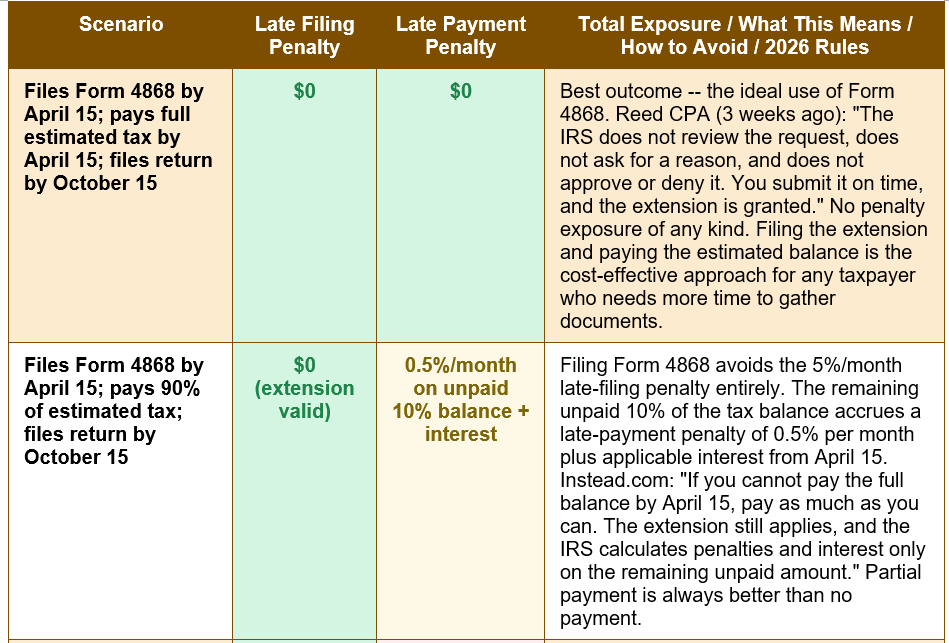
Special Situations: Americans Abroad, Disaster Areas, and Military Personnel
Several categories of taxpayers have extended deadlines beyond April 15 -- sometimes without needing to file Form 4868 at all:- Americans living or working abroad: Levy.io (May 2026): 'Americans living and working outside the United States on April 15 automatically receive a 2-month extension to June 15, 2026, with no form required. This is governed by IRS Publication 54 (Tax Guide for U.S. Citizens and Resident Aliens Abroad). A qualifying statement must be attached to the return explaining the basis for the automatic extension. Critical caveat: interest still accrues on any unpaid taxes from April 15 -- the June 15 extension is for filing only, not for payment.' Expats can then file Form 4868 by June 15 to extend the filing deadline further to October 15, but taxes owed remain due April 15 regardless.
- Taxpayers in federally declared disaster areas: Levy.io: 'The IRS automatically identifies taxpayers in FEMA-declared disaster areas using addresses on file and grants extended deadlines -- no application required. Extended deadlines vary by disaster; affected taxpayers should check IRS.gov/newsroom/tax-relief-in-disaster-situations for the current list. Multiple counties received extended deadlines in 2025-2026 for severe storms, flooding, and tornado damage.' If you are in a disaster area, check IRS.gov directly for your specific extended deadline before taking any action.
- Military personnel in combat zones: Members of the U.S. Armed Forces serving in designated combat zones receive an automatic extension that continues for at least 180 days after the last day in the combat zone. This applies to both filing and payment deadlines -- unlike the Form 4868 extension which only extends filing. The specific rules for combat zone extensions are detailed in IRS Publication 3 (Armed Forces Tax Guide).
-
Taxpayers with a financial hardship who cannot pay: Filing Form 4868 still makes sense even when you cannot make any payment. The extension eliminates the 5%/month late-filing penalty (the larger penalty) while leaving only the 0.5%/month late-payment penalty and interest running on the unpaid balance. After filing the completed return, the IRS offers installment agreement options for taxpayers who cannot pay in full -- apply online at irs.gov/opa or call 1-800-829-1040.
State taxes: the most commonly overlooked Form 4868 consequence. Levy.io (May 2026): 'The federal Form 4868 does not automatically extend your state income tax filing deadline in most states. You may be fully compliant with the IRS while simultaneously missing your state filing deadline and facing state late-filing penalties.' Before relying on the federal extension, always verify your specific state's extension rules. States fall into three categories: those that automatically accept the federal extension (check the IRS acknowledgment as sufficient for the state); those that require a separate state extension form (often with a concurrent deadline); and those with a different state income tax deadline altogether. Your state department of revenue website or a tax professional can confirm which category applies to your state.
The Most Common Form 4868 Mistakes -- and How to Avoid Them
- 10. Filing Form 4868 but paying nothing: The extension extends the filing deadline, not the payment deadline. Paying nothing by April 15 means the late-payment penalty (0.5%/month) and interest accrue on the full balance from April 15 forward. Always pay at least a reasonable estimate of the amount owed, even if it is significantly below the actual liability. Any payment reduces the penalty and interest exposure proportionally.
- 11. Missing the April 15 deadline for Form 4868: Reed CPA (3 weeks ago): 'Miss that date and the extension option is gone, leaving you exposed to the failure-to-file penalty.' Form 4868 must be filed by April 15, 2026 for the 2025 tax year. If April 15 falls on a weekend or federal holiday, the deadline moves to the next business day -- but in 2026, April 15 is a Wednesday, so the standard deadline applies. If you miss the April 15 extension deadline, file the completed return as quickly as possible to minimise the 5%/month late-filing penalty.
- 12. Assuming the extension covers state taxes: The federal Form 4868 has no effect on state income tax deadlines in most states. Levy.io: this is the most commonly overlooked aspect of filing a federal extension. Check your state's requirements separately.
- 13. Forgetting that the October 15 deadline is firm: October 15, 2026 is the absolute deadline for the 2025 tax year if Form 4868 was filed. There is no further extension available for individual income tax returns beyond October 15 (except for certain taxpayers abroad or in disaster areas). Returns filed after October 15 face the full late-filing penalty from October 15, not from April 15.
- 14. Forgetting HSA and IRA contribution deadlines: Instead.com: 'Taxpayers who contribute to a Health Savings Account should note that HSA contributions for the 2025 tax year must still be made by April 15, 2026, as filing an extension does not extend this contribution deadline.' Similarly, IRA contributions for the 2025 tax year are generally due April 15 -- the extension does not change this.
- 15. Attaching Form 4868 to the completed return: IRS Form 4868 instructions: 'Do not attach a copy of Form 4868 to your return.' When you file your completed Form 1040 in October, do not include a copy of Form 4868 with it. The IRS has a record of the extension from its processing. Attaching it is unnecessary and can cause processing confusion.
FORM 4868 -- THE COMPLETE ACTION CHECKLIST FOR 2025 TAXES (FILED IN 2026): BY APRIL 15, 2026 (non-negotiable): (1) File Form 4868 electronically (IRS Free File, tax software, or authorised e-file provider) OR mail paper Form 4868 postmarked by April 15 (send certified mail). (2) Estimate your 2025 total tax liability -- use prior-year return as starting point. (3) Calculate payments already made (withholding from W-2s + quarterly estimated tax payments). (4) Pay the estimated remaining balance by April 15 using IRS Direct Pay (directpay.irs.gov), tax software payment, or check payable to "United States Treasury." To eliminate underpayment penalty risk: pay 100% of your 2024 total tax liability (110% if 2024 AGI exceeded $150,000). (5) Save the IRS acknowledgment (e-file) or certified mail receipt (paper) as proof the extension was timely filed. (6) CHECK YOUR STATE: verify your state extension rules separately -- the federal extension does NOT automatically extend most state deadlines. BY OCTOBER 15, 2026 (firm extended deadline): (7) Complete and file your Form 1040 with all supporting schedules and documentation. (8) Include the amount paid with the extension in the payments section of Form 1040. (9) Pay any remaining balance owed. Do NOT attach Form 4868 to the completed return.
THREE CRITICAL FORM 4868 MISCONCEPTIONS THAT COST TAXPAYERS MONEY: (1) 'FILING AN EXTENSION GIVES ME MORE TIME TO PAY.' This is the most expensive misconception about Form 4868. Reed CPA (3 weeks ago): 'That single distinction -- extension moves your filing deadline, not your payment deadline -- trips up more taxpayers than any other.' Interest and late-payment penalties (0.5%/month) run from April 15 on any unpaid balance, extension or not. Always estimate and pay by April 15. (2) 'I CANNOT FILE AN EXTENSION BECAUSE I CANNOT AFFORD TO PAY MY TAXES.' These are two separate decisions. Form 4868 should be filed to eliminate the late-filing penalty (5%/month up to 25%) regardless of whether you can pay. After filing the extension and then the completed return, you can apply for an IRS payment plan (installment agreement) to pay the balance over time -- but the late-filing penalty must be avoided by filing the extension first. (3) 'FILING AN EXTENSION WILL TRIGGER AN IRS AUDIT.' H&R Block (March 24, 2026): 'No, filing a tax extension is not a bad thing and will not raise a red flag with the IRS. If you are simply not ready to file, it is actually a good thing because it gives you more time for the paperwork.' Millions of extensions are filed each year. Using a legitimate IRS provision carries zero additional audit risk.
Conclusion
IRS Form 4868 is one of the most practically useful provisions in the entire US tax code for individual taxpayers. It provides an automatic, penalty-free, reason-free six-month extension of the filing deadline -- from April 15 to October 15 -- to any taxpayer who needs more time to complete an accurate return. The IRS processes it automatically without review or approval. Filing a tax extension is not an admission of tax problems, does not increase audit risk, and does not reduce your rights in any way.The single critical rule to internalise is this: Form 4868 extends the deadline to FILE, not the deadline to PAY. Reed CPA (3 weeks ago): 'That single distinction trips up more taxpayers than any other, and it is the difference between a free six-month grace period and a bill that quietly grows interest and penalties from April 16 forward.' Estimate what you owe, pay as much of it as possible by April 15, file the extension form by April 15, and then complete the accurate return at any time before October 15, 2026.
For the 2025 tax year, the key dates are clear: April 15, 2026 to file Form 4868 and pay estimated taxes; October 15, 2026 to file the completed Form 1040. Used correctly, Form 4868 is not a sign of tax trouble -- it is a legitimate, widely used tool that allows taxpayers to file accurately rather than hastily, to wait for all income documents, and to give complex returns the preparation time they require. For questions about your specific tax situation, consult a qualified CPA, enrolled agent, or tax attorney, or visit IRS.gov for official guidance.

0 Comments Comments