

Investing
What the Rich Know About Investing That You Don’t

The line between staying financially stuck and building lasting wealth is not income. It’s how that income is deployed. Here are the 10 investing principles that the research shows wealthy investors consistently apply.
There is a persistent belief that wealthy investors have access to opportunities, information, and products that are unavailable to everyone else. Some of that is true. But the more significant and more actionable gap is not about access — it is about behaviour, mindset, and a set of principles that compound quietly over decades. Amundi’s survey of 4,186 investors across 11 countries found that millionaire investors allocate 54% of investable money to investments, versus 43% for less wealthy investors. Fidelity’s 10th annual Millionaire Outlook Study found that 63% of millionaires use a professional adviser. Multiple surveys of multi-millionaires found that the large majority follow buy-and-hold strategies, are optimistic about markets, and treat market volatility as an opportunity rather than a threat. Grant Cardone, speaking to GOBankingRates in 2026, said what most wealthy investors believe but rarely articulate so plainly: ‘The line between being middle class and building real wealth isn’t how much money they make, but how that money is used once it’s earned.’ This article sets out the ten investing principles that research consistently identifies as the habits of wealthy investors.
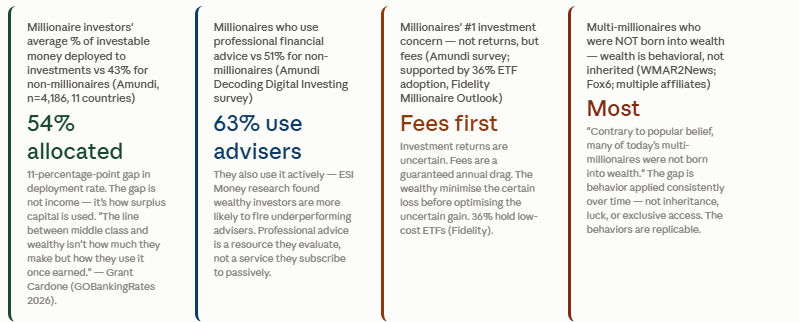
The popular narrative about wealth and investing assumes that the rich have access to opportunities that are unavailable to ordinary investors. Some special deal. Some insider information. Some product you cannot buy without a private banker. Some of that does exist at the very top — private equity, hedge funds with million-dollar minimums, and direct co-investments are genuinely inaccessible to most. But the overwhelming body of research on what actually separates wealthy investors from average investors points to something more accessible and more actionable: behaviour, mindset, and a set of consistent habits applied over long time horizons.
Grant Cardone made the point directly to GOBankingRates in 2026: ‘For many Americans, the line between being middle class and building real wealth isn’t how much money they make, but how that money is used once it’s earned.’ Amundi’s survey of 4,186 investors found an 11-percentage-point gap in investment allocation rates between millionaires (54%) and less wealthy investors (43%). The multi-millionaire survey cited by WMAR2News, Fox6, and multiple affiliates found that the large majority of today’s multi-millionaires were not born into wealth. The Yale and University of Toronto NBER research found that HNW investors’ advantage comes largely from greater financial literacy and more active use of professional advice. The gap is real. It is also largely bridgeable. Not financial or investment advice.
Key research findings: Millionaires allocate 54% of investable money to investments vs 43% for non-millionaires (Amundi, n=4,186). 63% of millionaires use a professional adviser vs 51% of non-millionaires (Amundi). Fidelity Millionaire Outlook: 68% hold domestic stocks; 36% ETFs. Multi-millionaire surveys: most NOT born into wealth. Yale/NBER: HNW investors rely more on professional advice. Sources cited.
Millionaire investors allocate 54% of investable money to investments vs 43% for non-millionaires (Amundi, n=4,186). The 11-percentage-point gap in deployment rate is the primary driver of divergent wealth outcomes.
The large majority of multi-millionaires follow buy-and-hold strategies. Wealthy investors see the fears of others as creating market opportunities. 'Wealthy people don't change their investment thesis every week' — Grant Cardone (GOBankingRates 2026).
63% of millionaire investors use professional advice vs 51% of non-millionaires (Amundi, n=4,186). Wealthy investors also more likely to fire an underperforming adviser (ESI Money). They use advice actively, not passively.
Millionaire investors are most concerned about cost of investing — product and provider fees are key considerations (Amundi survey). 36% of US millionaires hold ETFs (Fidelity). Low fees are a guaranteed improvement to net returns.
Typical investors' lack of knowledge is an important determinant of asset allocation (Yale/Toronto NBER research). Prodigious accumulators of wealth spend more time researching investments (ESI Money). 70%+ of wealthy investors believe they know more about investing than others.
68% of US millionaires hold individual domestic stocks; 36% hold ETFs; just under 50% also hold tangible assets (real estate, etc.) alongside equities (Fidelity Millionaire Outlook; multi-millionaire survey). Not purely equity investors.
The wealthy understand that debt is not inherently bad if it is part of an overall strategic plan' (multi-millionaire survey; WMAR2News/Fox6/multiple affiliates). Strategic leverage generates returns above borrowing cost. Consumer debt at 20-25% APR does the opposite. Borrowing to invest amplifies both gains and losses.
'The rich invest in time, the poor invest in money' — Warren Buffett. A £10,000 investment at 7% for 40 years: ~£150,000. Starting 10 years later: ~£76,000. The decade of compounding from age 20-30 cannot be fully recovered later.
Most multi-millionaires are optimistic investors who do not fall prey to market fears. 'The fears of others create market opportunities for the wealthy' (multi-millionaire survey). ESI Money: anxiety drives short-term detrimental investing behaviors.
Millionaires focus on creating systems and habits that lead to sustainable wealth rather than chasing quick fixes' (finance.katadata.co.id). Most multi-millionaires were NOT born into wealth (multiple surveys). The gap is behavioral, not income-based.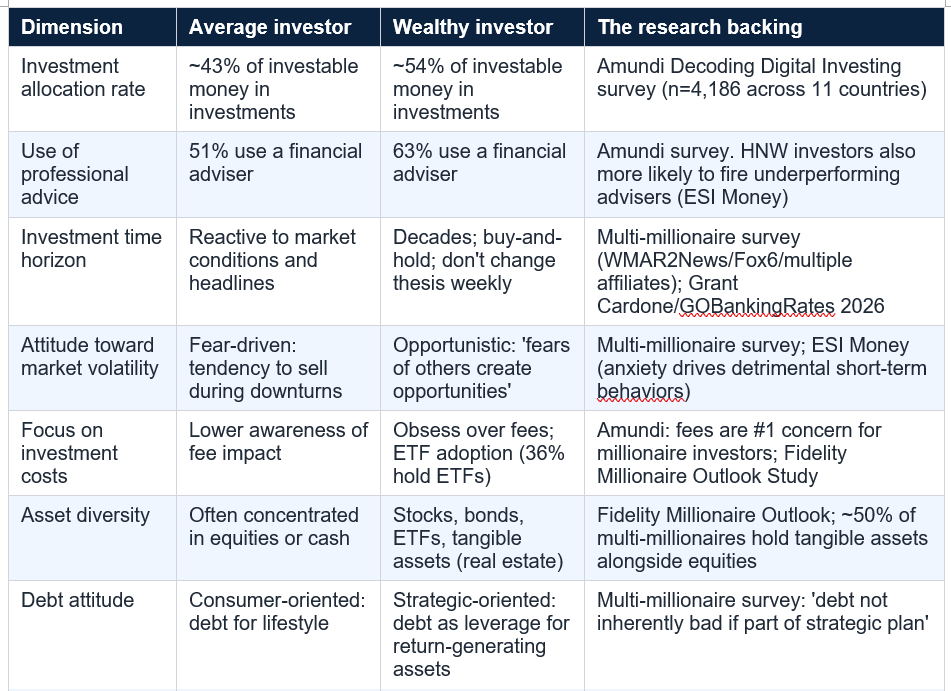
Finance.katadata.co.id’s millionaire mindset analysis captured the unifying insight: millionaires focus on creating systems and habits that lead to sustainable wealth rather than chasing quick fixes or shortcuts. The Amundi survey’s finding that millionaires allocate 11 percentage points more of their investable money to investments is not a consequence of higher income alone — it is a consequence of a different relationship with surplus capital. And the Grant Cardone quote that opened this article remains the clearest summary: the line between staying financially stuck and building real wealth is not how much money you make. It is how you use it. Not financial or investment advice. Consult a qualified financial adviser for guidance specific to your circumstances.
The line between being middle class and building real wealth isn't how much money they make, but how that money is used once it's earned.' — Grant Cardone (GOBankingRates/Yahoo Finance 2026). 'Millionaires focus on creating systems and habits that lead to sustainable wealth rather than chasing quick fixes.' — finance.katadata.co.id (October 2025). 'The rich invest in time, the poor invest in money.' — Warren Buffett. Sources cited.
The research consistently shows that wealthy investors do behave differently, though the differences are primarily in habits and mindset rather than exclusive access to products. Amundi's Decoding Digital Investing survey (4,186 investors across 11 countries) found that millionaire investors allocate 54% of their investable money to investments, compared to 43% for less wealthy investors. Fidelity's 10th Annual Millionaire Outlook Study found that 63% of millionaires use a professional adviser, versus 51% of non-millionaires. The multi-millionaire survey cited across multiple news affiliates found that the large majority follow buy-and-hold strategies, are optimistic about markets, and see market volatility as creating opportunities. Yale and University of Toronto research published via the NBER found that HNW investors rely more on professional advice and are significantly more financially literate than typical investors. The common thread: wealthy investors deploy capital more consistently into growth assets, use professional advice more actively, hold for longer time horizons, and are less emotionally reactive to short-term market movements. Sources: Amundi survey; Fidelity Millionaire Outlook; Yale/Toronto NBER; multi-millionaire survey. Not financial advice.
What do wealthy investors do with their money that others don't?
The research identifies several specific behaviors. First, they deploy a higher proportion of surplus money into investments rather than cash savings: 54% vs 43% (Amundi survey). Second, they obsess over fees: Amundi's survey found that fees are the primary concern of millionaire investors, which is reflected in the 36% who hold low-cost ETFs (Fidelity Millionaire Outlook). Third, they use professional advice more actively and hold advisers to a performance standard — ESI Money's research found they are more likely to fire underperforming advisers. Fourth, they invest for very long time horizons and do not change their investment thesis reactively: Grant Cardone noted 'wealthy people don't change their investment thesis every week' (GOBankingRates/Yahoo Finance 2026). Fifth, they treat market downturns as opportunities: the multi-millionaire survey found that 'the fears of others create market opportunities for the wealthy.' Sources: Amundi; Fidelity; ESI Money; Yahoo Finance/Cardone; multi-millionaire survey.
Do most millionaires inherit their wealth?
No. Multiple surveys of multi-millionaires consistently find the opposite. The multi-millionaire survey cited across regional news affiliates (WMAR2News, Fox6, news5cleveland, kshb) opens with the finding: 'Contrary to popular belief, many of today's multi-millionaires were not born into wealth.' The surveys found that their wealth is the product of specific behaviors applied consistently over long periods: buy-and-hold investment strategies, disciplined saving, early habit formation, and strategic use of debt. Finance.katadata.co.id's millionaire mindset analysis reaches the same conclusion: millionaires focus on creating systems and habits that lead to sustainable wealth. Grant Cardone's framing in GOBankingRates 2026 makes the same point from the behavioral angle: the gap is not income — it is how income is deployed. The implication is that the behaviors are, in principle, replicable by anyone who applies them consistently over a sufficient time horizon. Sources: multi-millionaire survey; finance.katadata.co.id; Yahoo Finance/Cardone.
Why do wealthy investors focus so much on fees?
Because fees are the only guaranteed return in investing. Investment returns are uncertain — the market can go up or down — but fees are a guaranteed annual drag on portfolio performance regardless of market conditions. Amundi's survey of 4,186 investors found that millionaire investors are most concerned about cost of investing, with product and provider fees featuring as key considerations. This is counterintuitive to many people who assume wealthy investors chase high-fee, high-performance products. The research shows the opposite: 36% of US millionaires hold ETFs (Fidelity Millionaire Outlook), which are typically among the cheapest investment structures available. The mathematics support the fee obsession: on a £100,000 portfolio growing at 7% gross for 20 years, the difference between a 0.2% fee (typical passive ETF) and a 1.5% fee (typical active fund) is approximately £45,000 in final portfolio value — a guaranteed difference, not a probabilistic one. Sources: Amundi survey; Fidelity Millionaire Outlook.
What is the single most important thing wealthy investors do that others don't?
The research most consistently points to one behavior: they actually invest their surplus capital rather than keeping it in cash. Amundi's survey found an 11-percentage-point gap in allocation rates (54% vs 43%) that compounds into vastly different wealth outcomes over time. Grant Cardone's framing from GOBankingRates 2026 is direct: the wealthy focus on investing rather than saving excess capital in low-yield accounts. The second most important behavior is starting early: Warren Buffett's observation — 'the rich invest in time, the poor invest in money' — captures the mathematics of compound growth, where a decade of additional compounding produces more wealth than a 30-year catch-up effort. The third is emotional discipline: the multi-millionaire survey found that the wealthy don't fall prey to market fears, and ESI Money's research found that anxiety drives short-term detrimental investing behaviors in typical investors. Taken together: deploy capital into growth assets early, consistently, and without reactive interruption. Sources: Amundi; Yahoo Finance/Cardone; multi-millionaire survey; ESI Money. Not financial advice. Consult a qualified financial adviser.
There is a persistent belief that wealthy investors have access to opportunities, information, and products that are unavailable to everyone else. Some of that is true. But the more significant and more actionable gap is not about access — it is about behaviour, mindset, and a set of principles that compound quietly over decades. Amundi’s survey of 4,186 investors across 11 countries found that millionaire investors allocate 54% of investable money to investments, versus 43% for less wealthy investors. Fidelity’s 10th annual Millionaire Outlook Study found that 63% of millionaires use a professional adviser. Multiple surveys of multi-millionaires found that the large majority follow buy-and-hold strategies, are optimistic about markets, and treat market volatility as an opportunity rather than a threat. Grant Cardone, speaking to GOBankingRates in 2026, said what most wealthy investors believe but rarely articulate so plainly: ‘The line between being middle class and building real wealth isn’t how much money they make, but how that money is used once it’s earned.’ This article sets out the ten investing principles that research consistently identifies as the habits of wealthy investors.
Table of Contents
- Why the Gap Is Behavioral, Not Income-Based
- Lesson 1: They Invest. Full Stop. While Others Are Still Saving.
- Lesson 2: They Think in Decades, Not Headlines.
- Lesson 3: They Use Professional Advice — and Fire Advisers Who Underperform.
- Lesson 4: They Obsess Over Fees. Costs Are the Guaranteed Return.
- Lesson 5: They Think About Risk Differently — and They Can Quantify It.
- Lesson 6: They Diversify Into Tangible Assets, Not Just Stocks.
- Lesson 7: They Use Debt Strategically, Not Accidentally.
- Lesson 8: They Started Early and Let Compounding Work.
- Lesson 9: They Are Optimistic About the Long Term, Even When Headlines Are Bad.
- Lesson 10: They Know That Wealth Is Built From Systems, Not Windfalls.
- The Wealthy Investor vs Average Investor: Comparison Table
- Conclusion: The Knowledge Was Always Available. The Behaviour Was the Barrier.
- Frequently Asked Questions
Why the Gap Is Behavioral, Not Income-Based
The popular narrative about wealth and investing assumes that the rich have access to opportunities that are unavailable to ordinary investors. Some special deal. Some insider information. Some product you cannot buy without a private banker. Some of that does exist at the very top — private equity, hedge funds with million-dollar minimums, and direct co-investments are genuinely inaccessible to most. But the overwhelming body of research on what actually separates wealthy investors from average investors points to something more accessible and more actionable: behaviour, mindset, and a set of consistent habits applied over long time horizons.Grant Cardone made the point directly to GOBankingRates in 2026: ‘For many Americans, the line between being middle class and building real wealth isn’t how much money they make, but how that money is used once it’s earned.’ Amundi’s survey of 4,186 investors found an 11-percentage-point gap in investment allocation rates between millionaires (54%) and less wealthy investors (43%). The multi-millionaire survey cited by WMAR2News, Fox6, and multiple affiliates found that the large majority of today’s multi-millionaires were not born into wealth. The Yale and University of Toronto NBER research found that HNW investors’ advantage comes largely from greater financial literacy and more active use of professional advice. The gap is real. It is also largely bridgeable. Not financial or investment advice.
Key research findings: Millionaires allocate 54% of investable money to investments vs 43% for non-millionaires (Amundi, n=4,186). 63% of millionaires use a professional adviser vs 51% of non-millionaires (Amundi). Fidelity Millionaire Outlook: 68% hold domestic stocks; 36% ETFs. Multi-millionaire surveys: most NOT born into wealth. Yale/NBER: HNW investors rely more on professional advice. Sources cited.
Lesson 1: They Invest. Full Stop. While Others Are Still Saving.
The first and most fundamental distinction between how wealthy investors think and how most people think is about the primary use of surplus money. Grant Cardone, speaking to GOBankingRates in 2026, framed it with deliberate bluntness: ‘Don’t save your money.’ The point is not that emergency funds and cash buffers are unimportant — it is that the wealthy do not park excess capital in low-yield accounts and consider the task done. They invest it. Amundi’s Decoding Digital Investing survey (4,186 retail investors across 11 countries) found that millionaire investors allocate 54% of their investable money to investments, compared to 43% for less wealthy investors. That 11-percentage-point gap in allocation rate, compounded over decades, produces vastly different wealth outcomes regardless of income level. The Yahoo Finance and GOBankingRates 2026 reporting on this framing makes the broader point explicit: for many Americans, the line between staying financially stuck and building real wealth is not how much money they make, but how that money is used once it is earned. Wealth is not a consequence of earning more. It is a consequence of deploying what you earn into assets that grow.Millionaire investors allocate 54% of investable money to investments vs 43% for non-millionaires (Amundi, n=4,186). The 11-percentage-point gap in deployment rate is the primary driver of divergent wealth outcomes.
Lesson 2: They Think in Decades, Not Headlines.
The large majority of multi-millionaires surveyed in research cited across multiple news affiliates (WMAR2News, Fox6, news5cleveland, kshb) follow conservative investment strategies: buy-and-hold, steady gains, and an explicit rejection of market timing. Grant Cardone articulated the mindset to GOBankingRates: ‘Wealthy people don’t change their investment thesis every week.’ The research on multi-millionaire traits adds: it can be emotionally challenging to stay invested through market swings, but wealthy investors keep a long-term view regardless of headlines or short-term volatility. ESI Money’s research on millionaire investing behaviors found the contrast from the other direction: those who are anxious and worried tend to engage in more short-term, potentially detrimental investing behaviors. The wealthy, by contrast, see market volatility as a feature, not a bug. The multi-millionaire survey cited by multiple regional news affiliates noted: ‘Most multi-millionaires are optimistic investors and do not fall prey to market fears. The fears of others create market opportunities for the wealthy.’ Warren Buffett’s observation, cited by finance.katadata.co.id, captures the philosophy: ‘The rich invest in time, the poor invest in money.The large majority of multi-millionaires follow buy-and-hold strategies. Wealthy investors see the fears of others as creating market opportunities. 'Wealthy people don't change their investment thesis every week' — Grant Cardone (GOBankingRates 2026).
Lesson 3: They Use Professional Advice — and Fire Advisers Who Underperform.
One of the clearest research-backed differences between wealthy and less affluent investors is the rate of professional advice use. Amundi’s survey found that 63% of millionaire investors currently use a professional adviser — compared to only 51% of non-millionaire investors. The Yale and University of Toronto research paper, published via the NBER, found that HNW investors rely more on professional advice than typical investors, whose lack of trust in the investment industry and lack of investing knowledge are important determinants of asset allocation. The ESI Money analysis of millionaire investing research adds a specific nuance: wealthy investors with the best investing behaviors are also more likely to fire an adviser they deem less than valuable. This is the distinction that matters. The wealthy use professional advice not as a passive service they subscribe to and forget, but as an active resource they evaluate against outcomes. They seek better information, use it, and hold the professionals providing it to a performance standard. Finance.katadata.co.id’s October 2025 millionaire mindset analysis notes that millionaires focus on creating systems and habits that lead to sustainable wealth. Professional advice, used actively and evaluated regularly, is one of those systems.63% of millionaire investors use professional advice vs 51% of non-millionaires (Amundi, n=4,186). Wealthy investors also more likely to fire an underperforming adviser (ESI Money). They use advice actively, not passively.
Lesson 4: They Obsess Over Fees. Costs Are the Guaranteed Return.
Amundi’s Decoding Digital Investing survey found something that surprised many observers: millionaire investors are most concerned about the cost of investing, with product and provider fees featuring as key considerations. This is not what most people would expect from wealthy investors. The insight is that wealthy investors understand something that less affluent investors often miss: investment returns are uncertain, but fees are guaranteed. A 1% annual management charge on a £500,000 portfolio costs £5,000 per year in certain returns regardless of what the market does. Over 20 years at a 7% gross return, the difference between a 0.2% fee and a 1.5% fee on a £100,000 investment is approximately £45,000 in final portfolio value. The Fidelity Millionaire Outlook Study found that 36% of millionaires hold ETFs — which tend to be materially cheaper than actively managed funds. The wealthy’s obsession with cost is a rational response to understanding that minimising the guaranteed drag is one of the few reliable ways to improve net investment outcomes.Millionaire investors are most concerned about cost of investing — product and provider fees are key considerations (Amundi survey). 36% of US millionaires hold ETFs (Fidelity). Low fees are a guaranteed improvement to net returns.
Lesson 5: They Think About Risk Differently — and They Can Quantify It.
The Yale and University of Toronto research paper on high net worth investor motivations, published via the NBER and reported by InvestmentExecutive.com, contains a crucial finding: typical investors’ lack of investing knowledge is an important determinant of their asset allocation. Put simply: most people’s investment decisions are constrained by what they do not understand, leading them to under-allocate to higher-return asset classes because they cannot assess the associated risk. Wealthy investors, by contrast, are significantly more financially literate and, critically, more confident: ESI Money’s research found that 70%+ of wealthy investors believe they know more about investing than others. This confidence correlates with research behaviors — prodigious accumulators of wealth spend more time researching investments than their underaccumulating counterparts (ESI Money). The multi-millionaire survey cited by multiple regional news affiliates found that the wealthy understand value buys and are not afraid to act on them. The fears of others create opportunities — but only for those who have done enough research to distinguish genuine value from genuine risk.Typical investors' lack of knowledge is an important determinant of asset allocation (Yale/Toronto NBER research). Prodigious accumulators of wealth spend more time researching investments (ESI Money). 70%+ of wealthy investors believe they know more about investing than others.
Lesson 6: They Diversify Into Tangible Assets, Not Just Stocks.
The Fidelity Millionaire Outlook Study found that while 68% of US millionaires invest in domestic stocks, they are not purely equity investors. The multi-millionaire survey cited across multiple news affiliates found that just under half of wealthy investors keep part of their investments in alternate tangible assets — real estate, commodities, and other physical assets — to complement their stocks and bonds. This is not a new insight, but it is a consistently under-implemented one among less affluent investors who often have the entirety of their non-pension savings in a single stocks and shares ISA or 401k, allocated entirely to equities. The wealthy use tangible assets both for diversification (assets that do not always move in correlation with equity markets) and for inflation protection (real assets whose value tends to rise with inflation rather than being eroded by it). Grant Cardone’s view, quoted in GOBankingRates 2026, is more concentrated: ‘The super wealthy don’t diversify.’ This represents a specific philosophy about concentrated conviction rather than mainstream investment theory, which continues to support diversification as a core risk management principle. The general finding — that wealthy investors hold a broader range of asset types than less affluent investors — is consistent across surveys.68% of US millionaires hold individual domestic stocks; 36% hold ETFs; just under 50% also hold tangible assets (real estate, etc.) alongside equities (Fidelity Millionaire Outlook; multi-millionaire survey). Not purely equity investors.
Lesson 7: They Use Debt Strategically, Not Accidentally.
One of the most counterintuitive lessons from multi-millionaire research is the attitude toward debt. The survey cited across multiple affiliates found: ‘The wealthy understand that debt is not inherently bad if it is part of an overall strategic plan.’ This is a fundamentally different relationship with debt than the consumer finance model, where debt is a tool for purchasing goods and services at the cost of future income. The wealthy use debt primarily as leverage — borrowing capital to deploy into assets that produce returns greater than the borrowing cost. A commercial mortgage to purchase a rental property that generates yield above the interest rate is a wealth-building tool. A margin loan to increase equity market exposure is a higher-risk version of the same principle. The crucial distinction: wealth-building debt generates returns that exceed the borrowing cost. Consumer debt at 20-25% APR does the opposite. The wealthy understand both sides of this distinction — they are aggressive users of strategic leverage and disciplined avoiders of high-cost consumer debt. Not financial or investment advice. Borrowing to invest amplifies both gains and losses.The wealthy understand that debt is not inherently bad if it is part of an overall strategic plan' (multi-millionaire survey; WMAR2News/Fox6/multiple affiliates). Strategic leverage generates returns above borrowing cost. Consumer debt at 20-25% APR does the opposite. Borrowing to invest amplifies both gains and losses.
Lesson 8: They Started Early and Let Compounding Work.
The multi-millionaire survey research notes that strong values and useful habits were formed early in life for wealthy investors. Finance.katadata.co.id’s millionaire mindset analysis cited Warren Buffett’s observation: ‘The rich invest in time, the poor invest in money.’ The insight about time is mathematical. A £10,000 investment at 7% annual return grows to approximately £76,000 after 30 years and £150,000 after 40 years. The same investment begun 10 years later reaches only £76,000 at 40 years — the equivalent of what the earlier investor had at 30. The decade of compounding from 20-30 produces more wealth than the subsequent 30 years of compounding from 30-60 can recover from. Wealthy investors typically understand this arithmetic intuitively or have been taught it early. The result is that they begin investing earlier, more consistently, and with more patience. ESI Money’s research on millionaire traits found that financial knowledge and risk tolerance are related: those who understand the mathematics of compounding are both more willing to accept short-term volatility (because the long-term outcome is clear) and less likely to make reactive decisions that interrupt the compounding process.'The rich invest in time, the poor invest in money' — Warren Buffett. A £10,000 investment at 7% for 40 years: ~£150,000. Starting 10 years later: ~£76,000. The decade of compounding from age 20-30 cannot be fully recovered later.
Lesson 9: They Are Optimistic About the Long Term, Even When Headlines Are Bad.
The multi-millionaire survey research, cited across regional news affiliates, returned a finding that sounds simple but is psychologically demanding in practice: most multi-millionaires are optimistic investors and do not fall prey to market fears. The fears of others create market opportunities for the wealthy. This is the inverse of the typical retail investor experience: during market downturns, retail investors tend to sell, and during market upswings, they buy. This sequence — selling low and buying high — is the primary reason most individual investors underperform the market averages they are trying to match. ESI Money’s research found that those who are anxious and worried engage in more short-term, potentially detrimental investing behaviors. The Fidelity Millionaire Outlook data noted that millionaires retain faith in the performance of US assets even as they express apprehension about future bumps. The distinction is between acknowledging that market corrections are likely and using that acknowledgement to sell, versus acknowledging that corrections are likely and using that acknowledgement to buy or hold. Wealthy investors do the latter, because they have a long time horizon and a written investment thesis that does not change with the headlines.Most multi-millionaires are optimistic investors who do not fall prey to market fears. 'The fears of others create market opportunities for the wealthy' (multi-millionaire survey). ESI Money: anxiety drives short-term detrimental investing behaviors.
Lesson 10: They Know That Wealth Is Built From Systems, Not Windfalls.
Finance.katadata.co.id’s October 2025 analysis of how millionaires really think about money captured a unifying theme: millionaires focus on creating systems and habits that lead to sustainable wealth rather than chasing quick fixes or shortcuts. The multi-millionaire survey cited across news affiliates makes the same point in different words: ‘Contrary to popular belief, many of today’s multi-millionaires were not born into wealth.’ Their wealth is the product of a long sequence of decisions: starting early, investing consistently, using professional advice, minimising costs, holding through volatility, thinking in decades, and treating debt as a strategic tool rather than a consumer convenience. None of these is a windfall. None requires exceptional income. Grant Cardone’s framing in GOBankingRates 2026 makes the same point from the opposite direction: the line between being middle class and building real wealth is not how much money you make but how that money is used once it is earned. The wealth gap is overwhelmingly behavioral.Millionaires focus on creating systems and habits that lead to sustainable wealth rather than chasing quick fixes' (finance.katadata.co.id). Most multi-millionaires were NOT born into wealth (multiple surveys). The gap is behavioral, not income-based.
The Wealthy Investor vs Average Investor: Comparison Table
Conclusion
The ten principles in this article are not secrets. Long-term investing, fee minimisation, professional advice, strategic use of debt, tangible asset diversification, and emotional discipline during market volatility are all documented, widely available, and frequently discussed in financial media. What is not widely discussed is the consistent body of research showing that wealthy investors actually apply these principles, while average investors understand them intellectually but fail to act on them consistently.Finance.katadata.co.id’s millionaire mindset analysis captured the unifying insight: millionaires focus on creating systems and habits that lead to sustainable wealth rather than chasing quick fixes or shortcuts. The Amundi survey’s finding that millionaires allocate 11 percentage points more of their investable money to investments is not a consequence of higher income alone — it is a consequence of a different relationship with surplus capital. And the Grant Cardone quote that opened this article remains the clearest summary: the line between staying financially stuck and building real wealth is not how much money you make. It is how you use it. Not financial or investment advice. Consult a qualified financial adviser for guidance specific to your circumstances.
The line between being middle class and building real wealth isn't how much money they make, but how that money is used once it's earned.' — Grant Cardone (GOBankingRates/Yahoo Finance 2026). 'Millionaires focus on creating systems and habits that lead to sustainable wealth rather than chasing quick fixes.' — finance.katadata.co.id (October 2025). 'The rich invest in time, the poor invest in money.' — Warren Buffett. Sources cited.
Frequently Asked Questions
Do rich people invest differently from everyone else?The research consistently shows that wealthy investors do behave differently, though the differences are primarily in habits and mindset rather than exclusive access to products. Amundi's Decoding Digital Investing survey (4,186 investors across 11 countries) found that millionaire investors allocate 54% of their investable money to investments, compared to 43% for less wealthy investors. Fidelity's 10th Annual Millionaire Outlook Study found that 63% of millionaires use a professional adviser, versus 51% of non-millionaires. The multi-millionaire survey cited across multiple news affiliates found that the large majority follow buy-and-hold strategies, are optimistic about markets, and see market volatility as creating opportunities. Yale and University of Toronto research published via the NBER found that HNW investors rely more on professional advice and are significantly more financially literate than typical investors. The common thread: wealthy investors deploy capital more consistently into growth assets, use professional advice more actively, hold for longer time horizons, and are less emotionally reactive to short-term market movements. Sources: Amundi survey; Fidelity Millionaire Outlook; Yale/Toronto NBER; multi-millionaire survey. Not financial advice.
What do wealthy investors do with their money that others don't?
The research identifies several specific behaviors. First, they deploy a higher proportion of surplus money into investments rather than cash savings: 54% vs 43% (Amundi survey). Second, they obsess over fees: Amundi's survey found that fees are the primary concern of millionaire investors, which is reflected in the 36% who hold low-cost ETFs (Fidelity Millionaire Outlook). Third, they use professional advice more actively and hold advisers to a performance standard — ESI Money's research found they are more likely to fire underperforming advisers. Fourth, they invest for very long time horizons and do not change their investment thesis reactively: Grant Cardone noted 'wealthy people don't change their investment thesis every week' (GOBankingRates/Yahoo Finance 2026). Fifth, they treat market downturns as opportunities: the multi-millionaire survey found that 'the fears of others create market opportunities for the wealthy.' Sources: Amundi; Fidelity; ESI Money; Yahoo Finance/Cardone; multi-millionaire survey.
Do most millionaires inherit their wealth?
No. Multiple surveys of multi-millionaires consistently find the opposite. The multi-millionaire survey cited across regional news affiliates (WMAR2News, Fox6, news5cleveland, kshb) opens with the finding: 'Contrary to popular belief, many of today's multi-millionaires were not born into wealth.' The surveys found that their wealth is the product of specific behaviors applied consistently over long periods: buy-and-hold investment strategies, disciplined saving, early habit formation, and strategic use of debt. Finance.katadata.co.id's millionaire mindset analysis reaches the same conclusion: millionaires focus on creating systems and habits that lead to sustainable wealth. Grant Cardone's framing in GOBankingRates 2026 makes the same point from the behavioral angle: the gap is not income — it is how income is deployed. The implication is that the behaviors are, in principle, replicable by anyone who applies them consistently over a sufficient time horizon. Sources: multi-millionaire survey; finance.katadata.co.id; Yahoo Finance/Cardone.
Why do wealthy investors focus so much on fees?
Because fees are the only guaranteed return in investing. Investment returns are uncertain — the market can go up or down — but fees are a guaranteed annual drag on portfolio performance regardless of market conditions. Amundi's survey of 4,186 investors found that millionaire investors are most concerned about cost of investing, with product and provider fees featuring as key considerations. This is counterintuitive to many people who assume wealthy investors chase high-fee, high-performance products. The research shows the opposite: 36% of US millionaires hold ETFs (Fidelity Millionaire Outlook), which are typically among the cheapest investment structures available. The mathematics support the fee obsession: on a £100,000 portfolio growing at 7% gross for 20 years, the difference between a 0.2% fee (typical passive ETF) and a 1.5% fee (typical active fund) is approximately £45,000 in final portfolio value — a guaranteed difference, not a probabilistic one. Sources: Amundi survey; Fidelity Millionaire Outlook.
What is the single most important thing wealthy investors do that others don't?
The research most consistently points to one behavior: they actually invest their surplus capital rather than keeping it in cash. Amundi's survey found an 11-percentage-point gap in allocation rates (54% vs 43%) that compounds into vastly different wealth outcomes over time. Grant Cardone's framing from GOBankingRates 2026 is direct: the wealthy focus on investing rather than saving excess capital in low-yield accounts. The second most important behavior is starting early: Warren Buffett's observation — 'the rich invest in time, the poor invest in money' — captures the mathematics of compound growth, where a decade of additional compounding produces more wealth than a 30-year catch-up effort. The third is emotional discipline: the multi-millionaire survey found that the wealthy don't fall prey to market fears, and ESI Money's research found that anxiety drives short-term detrimental investing behaviors in typical investors. Taken together: deploy capital into growth assets early, consistently, and without reactive interruption. Sources: Amundi; Yahoo Finance/Cardone; multi-millionaire survey; ESI Money. Not financial advice. Consult a qualified financial adviser.
0 Comments
Be the first to share your thoughts on this article.