
Budgeting
Who Does the 50/30/20 Rule Leave Out? Experts Explain
50/30/20 RULE: WHO IT LEAVES OUT | Real Americans earning $75k/year or less spend 64% on needs -- not 50% (Talker/EarnIn survey, GOBankingRates). 36% of US workers are in the gig economy. Childcare can cost more than rent. Rent can exceed 50% of take-home alone. This is who the rule was not designed for -- and what actually works instead.
There is one significant problem. A recent Talker Research and EarnIn survey of Americans earning $75,000 per year or less found that the average respondent spends 64% of income on needs -- not 50%. Not because they are financially undisciplined. Because the cost of living in 2026 does not resemble the cost of living the rule was calibrated for. Due (June 29, 2026 -- most recent): 'A framework built for one economic era can buckle under another, and that is exactly what has happened.' Siebert Financial (3 weeks ago): 'The core tension with the 50/30/20 rule in 2026 is the 50% needs ceiling. That threshold was calibrated against a cost structure that has shifted materially since 2005.'
This article does not argue that the 50/30/20 rule should be discarded. Financial Decision Lab (June 22, 2026): 'The honest framing: the 50/30/20 rule is most useful as a diagnostic tool, not a rigid mandate.' The problem is not the framework's existence -- it is its uncritical application to households for whom it was never designed. This guide identifies those households precisely, explains why the rule fails each of them specifically, and provides the alternative frameworks that financial experts and researchers recommend for each profile.
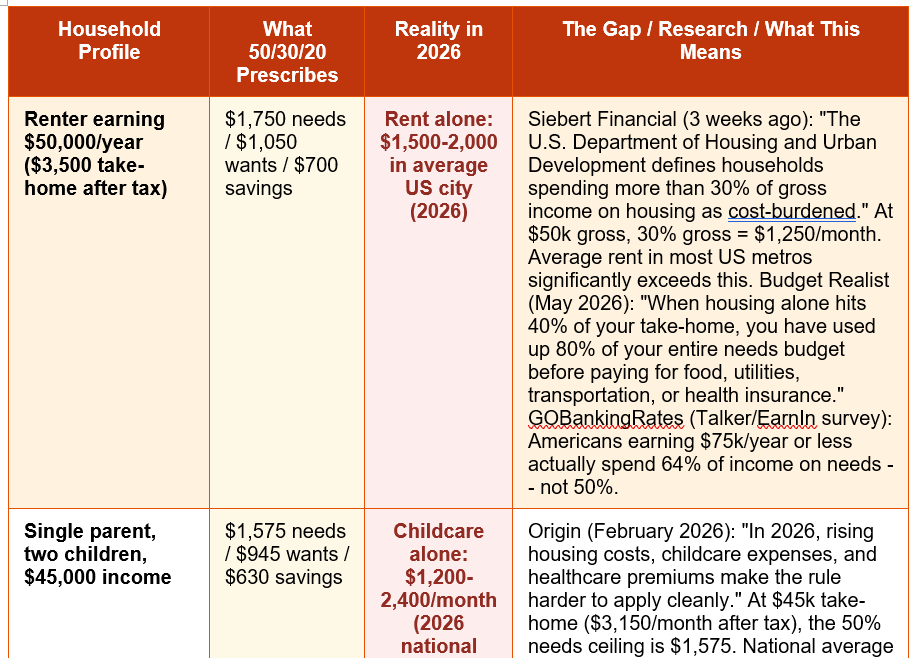
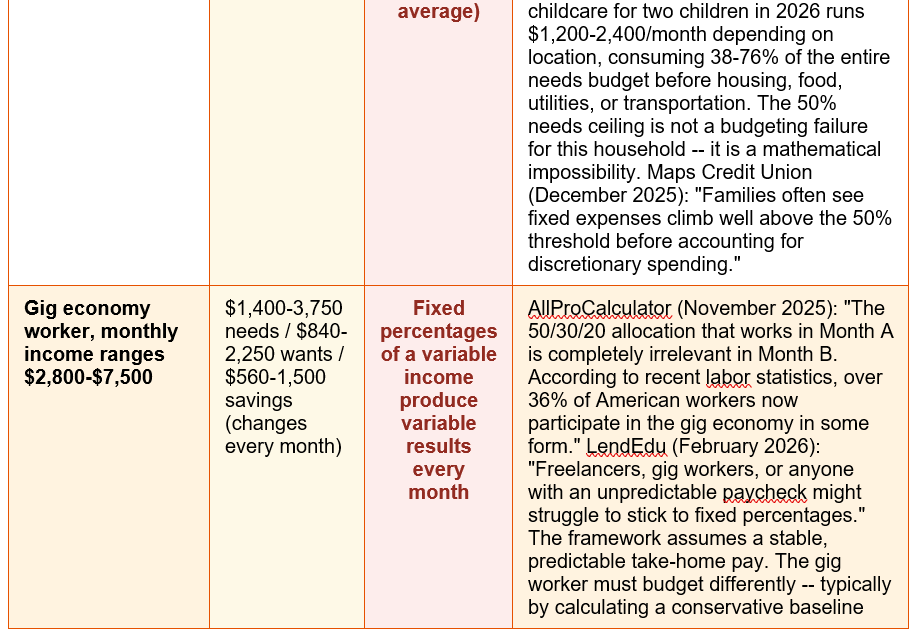
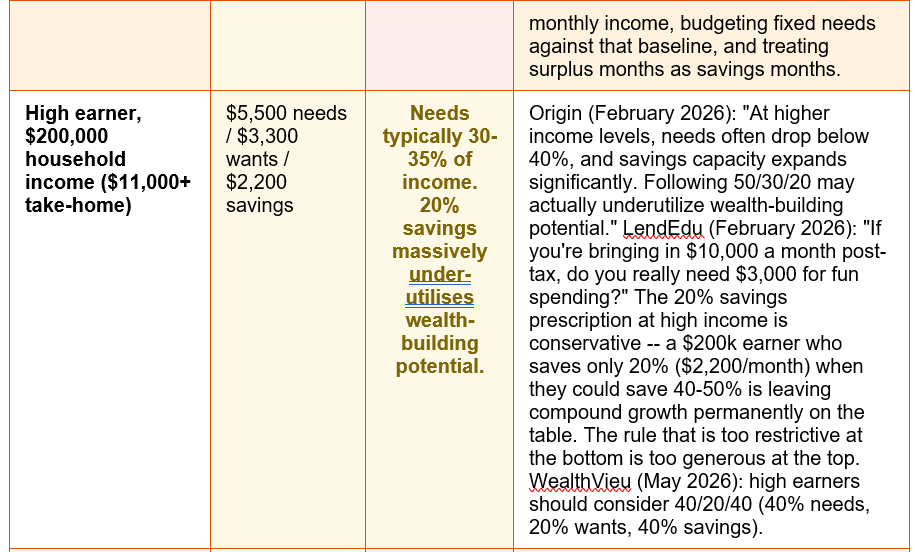
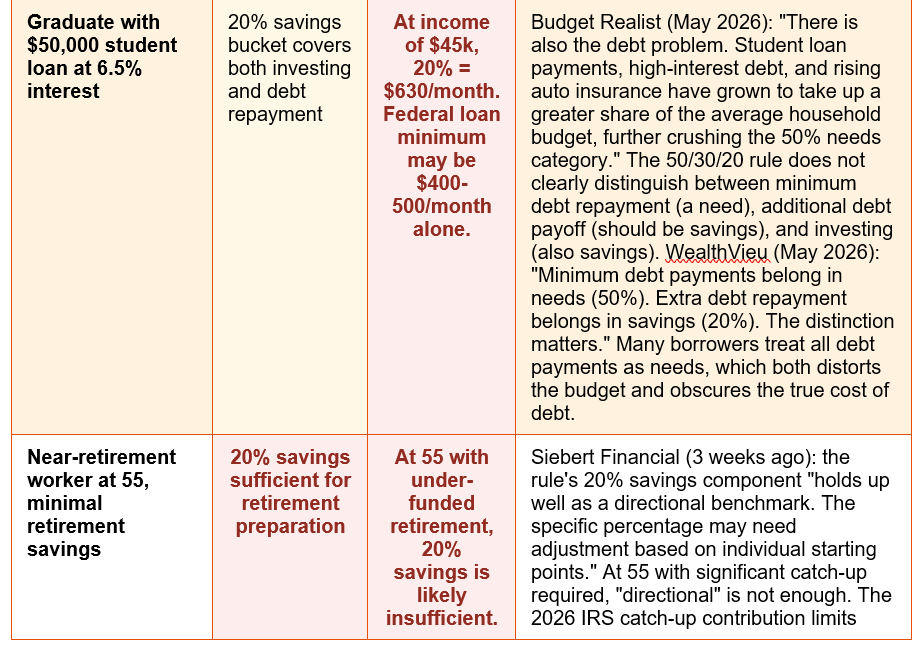
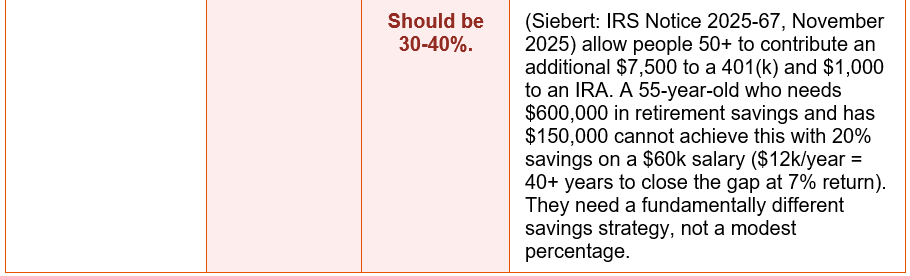
The defining data point: 64% on needs (reality) vs 50% (rule) for Americans earning $75k/year or less — GOBankingRates (Talker Research / EarnIn survey): 'A recent survey of Americans who earn $75,000 a year or less found that the average respondent put 64% of their income toward needs, 16% toward wants and 16% toward savings.' The 14-percentage-point gap between prescription (50%) and reality (64%) is not a behaviour problem. It is a cost-structure problem. Federal Reserve Bank of Cleveland (cited Budget Realist, May 2026): rent inflation has consistently outpaced wage growth across most US metros over the past decade. HUD definition: spending more than 30% of gross income on housing = cost-burdened (Siebert Financial, 3 weeks ago).
The consequence of mechanically applying the rule to this household: the budgeter is told they are spending 64-70% on needs when the rule says 50%, which generates a sense of failure and inadequacy rather than an accurate diagnosis. Budget Realist: 'You are not overspending on wants. You are just trying to cover the basics. The 50/30/20 rule did not break. The assumptions it was built on changed. That is a different problem with a different solution.' Origin (February 2026): 'In many major cities, housing alone can consume 35-45% of take-home pay. If rent already exceeds 40%, keeping total needs at 50% becomes unrealistic.'
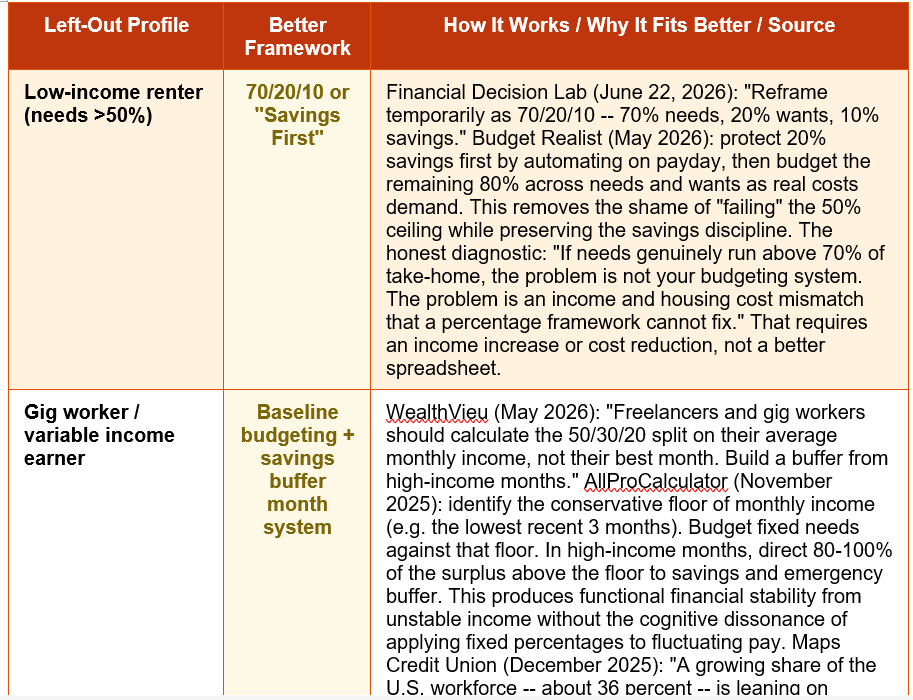
ALTERNATIVE: 70/20/10 or 'Savings First' Budget Realist (May 2026): 'If take-home is $4,000, put $800 away first, automatically, on payday. Budget the remaining $3,200 across needs and wants however the real costs demand.' Financial Decision Lab (June 2026): 'Reframe temporarily as 70/20/10.' The savings discipline is preserved. The shame of exceeding the 50% ceiling is removed. The honest outcome: if needs run above 70%, it is a structural income/housing problem, not a budgeting failure.
The framework also provides no guidance on the specific challenge of irregular costs that caregivers face: school supplies, medical co-pays, seasonal clothing for growing children, extracurricular activities with social development value. These do not fit cleanly into 'needs' or 'wants' -- they are essential expenditures that the 50/30/20 framework is structurally unable to account for. The rule was designed by and for households with stable, predictable costs. Single parents and caregivers have inherently variable essential costs that defeat fixed-percentage budgeting.
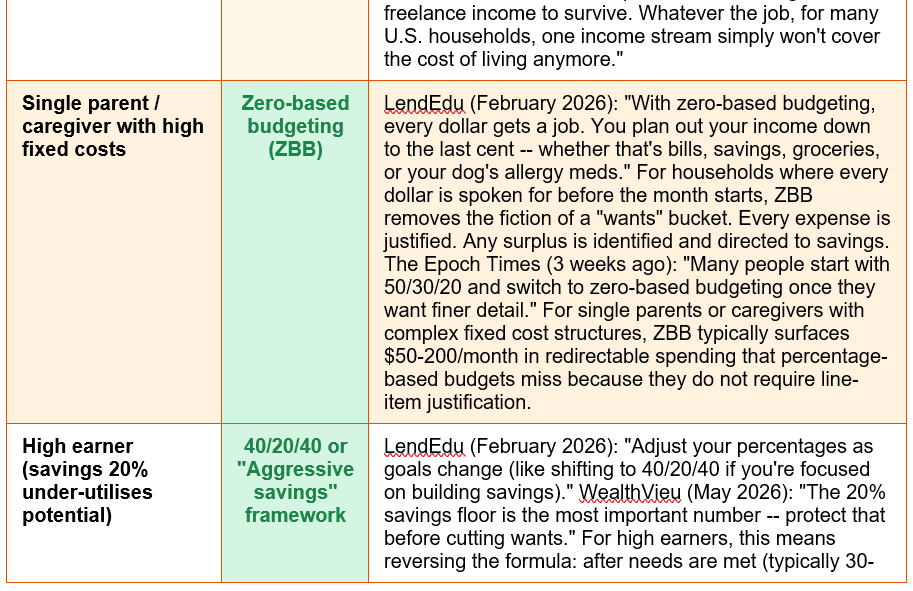
ALTERNATIVE: Zero-Based Budgeting (ZBB) LendEdu (February 2026): 'With zero-based budgeting, every dollar gets a job. You plan out your income down to the last cent.' For households where every dollar is allocated before the month begins, ZBB removes the fiction of a wants bucket. It identifies the $50-200/month in redirectable spending that percentage budgets miss -- and redirects it to a small savings buffer that provides the flexibility to handle irregular costs without going into debt.
The 50/30/20 rule's silent assumption is one of its most significant blind spots: it is designed for an employee with a predictable monthly paycheck. It has nothing meaningful to say to 36% of the American workforce. LendEdu (February 2026): 'Freelancers, gig workers, or anyone with an unpredictable paycheck might struggle to stick to fixed percentages.' The gig worker who applies the rule in their best month and finds it works fine is using a broken compass -- the reading is accurate only when conditions are exactly right and misleading when they are not.
ALTERNATIVE: Baseline budgeting + surplus capture WealthVieu (May 2026): 'Freelancers and gig workers should calculate the 50/30/20 split on their average monthly income, not their best month. Build a buffer from high-income months.' Calculate the conservative income floor (lowest 3 recent months). Budget all fixed needs against that floor. In high months, direct 80-100% of surplus above the floor to a savings buffer. This produces stability from instability -- exactly what the gig worker needs.
The practical problem: a recent graduate earning $45,000 with $50,000 in federal student loans at 6.5% has a minimum monthly payment under the standard 10-year plan of approximately $568/month. On $3,150/month take-home, this is 18% of income -- taken from the needs bucket, where it joins housing, food, utilities, and transportation. The needs budget is already crushed before the 20% savings bucket must cover any additional debt repayment plus emergency savings plus retirement contributions. The 50/30/20 framework provides no sequencing guidance: should this borrower invest first or pay off debt aggressively first? The rule is silent on this.
ALTERNATIVE: Debt avalanche with clear bucket rules WealthVieu (May 2026): Minimum payments = needs. Additional debt payoff = savings. Prioritise by interest rate: clear debts above 7-8% interest before investing beyond the employer 401(k) match. The guaranteed after-tax return of eliminating 20% credit card debt exceeds any realistic investment return. NFCC (nfcc.org): nonprofit debt counselling, free or low-cost, from regulated advisers.
The arithmetic: a high earner who saves 20% ($2,200/month on $11,000 take-home) versus 40% ($4,400/month) over 20 years at 7% real return accumulates approximately $1.38M versus $2.76M -- a $1.38M difference from the same income, same investment return, solely from the savings rate choice. The 50/30/20 rule, applied rigidly, legitimises leaving $1.38M in compound growth on the table by allocating $3,300/month to 'wants' when the household has already met every genuine need.
ALTERNATIVE: 40/20/40 (Aggressive savings framework) LendEdu (February 2026): 'Shifting to 40/20/40 if you're focused on building savings.' WealthVieu (May 2026): high earners should reverse the default savings priority -- needs first at their actual cost (often 30-35%), then maximum savings, then whatever remains goes to wants. Max 401(k) at $23,500 (2026 IRS limit), max Roth IRA or backdoor Roth at $7,000, then taxable accounts. The IRS catch-up limits (Siebert, 3 weeks ago, citing IRS Notice 2025-67) also allow additional contributions for those 50+.
The 2026 IRS catch-up contribution rules (Siebert, 3 weeks ago: IRS Notice 2025-67, November 2025) provide an important tool: those 50 and older can contribute an additional $7,500 to a 401(k) above the standard $23,500 limit, for a total of $31,000, and an additional $1,000 to an IRA. This is $32,000/year in tax-advantaged space -- significantly more than the 20% prescription for most workers in this age bracket. Applying 50/30/20 to this household and calling it adequate financial planning is not a guideline. It is a disservice.
ALTERNATIVE: Catch-up mode: 30-40% savings, slashed wants Redirect every available dollar above genuine needs to retirement accounts in catch-up mode. Max the 401(k) including catch-up ($31,000 in 2026). Max the IRA ($8,000 in 2026 for 50+). Eliminate the 30% wants allocation temporarily -- it is not a permanent sacrifice but a time-limited catch-up period. Use CFPB's free retirement calculator (consumerfinance.gov) and meet with a fee-only financial adviser (NAPFA.org) to model the realistic retirement picture.

The Epoch Times (3 weeks ago): 'I like this rule because it's the rare piece of money advice you can remember without an app or a spreadsheet.' This is a genuine virtue. A budgeting rule that requires a certified financial planner to implement is not a budgeting rule -- it is a consulting engagement. The 50/30/20 rule democratises budgeting by making it memorable and applicable. The problem is not its existence; it is its uncritical promotion to households for whom it is structurally inappropriate. LendEdu (February 2026): 'I believe the 50/30/20 budgeting method works well. It's straightforward and easy for clients to understand. The key is to start with this basic framework and adjust it based on each client's unique financial situation.'
The 50/30/20 rule is most useful not as a budget but as a diagnostic. If your needs consistently exceed 50%, the rule has told you something real: either income needs to rise, essential costs need to fall, or both. Financial Decision Lab (June 22, 2026): 'That's not failure -- that's information.' The rule functions as a mirror: the gap between what it prescribes and what your reality delivers is data about your financial situation that can be acted on. For the low-income renter: the mirror shows a housing cost problem that a budgeting system cannot solve -- it requires an income increase or a cost reduction. For the high earner: the mirror shows that 20% savings is leaving enormous compound growth potential unused. For the gig worker: the mirror shows that fixed-percentage budgeting requires a stable income denominator that they do not have. In each case, the rule's failure to fit is itself the most useful information it provides.
FIVE THINGS THE 50/30/20 RULE GETS WRONG IN 2026 -- AND WHAT TO DO INSTEAD: (1) IT ASSUMES A STABLE, PREDICTABLE PAYCHECK. 36% of the US workforce is in the gig economy (AllProCalculator, November 2025). Variable income workers need baseline budgeting, not fixed-percentage allocations. Calculate your conservative income floor and budget against that. (2) IT TREATS 50% AS A MORAL STANDARD RATHER THAN A BENCHMARK. The average American at $75k or below spends 64% on needs (Talker/EarnIn, GOBankingRates). This is not a character failure. It is a cost-structure reality. A rule that makes 64% of the working population feel they are failing is a rule that has been applied incorrectly. (3) IT CONFLATES MINIMUM DEBT PAYMENTS WITH DISCRETIONARY SAVINGS. WealthVieu (May 2026): minimum debt payments belong in needs (50%). Extra debt repayment belongs in savings (20%). The distinction matters enormously for sequencing decisions. (4) IT PRESCRIBES THE SAME SAVINGS RATE AT $25,000 AND $200,000. The 20% savings prescription that may be aspirationally too high for the minimum-wage earner is irresponsibly low for the high earner who has no genuine constraint on savings capacity. (5) IT PROVIDES NO SEQUENCING GUIDANCE. Should you invest before paying off debt? Max your Roth IRA or build an emergency fund first? The rule is entirely silent on sequencing. For most households under 40, the correct sequence is: employer 401(k) match (free money first) -> emergency fund to $1,000 -> high-interest debt cleared -> 3-6 month emergency fund -> Roth IRA -> additional retirement contributions. CFPB (consumerfinance.gov): free and unbiased financial guidance.
THE UNIVERSAL PRINCIPLES THAT HOLD ACROSS ALL PROFILES -- WHATEVER YOUR BUDGET FRAMEWORK: (1) AUTOMATE SAVINGS ON PAYDAY. Every behavioural economics study agrees: households that automate savings before spending decisions consistently save more than those who save what remains. WealthVieu (May 2026): 'The 20% should be invisible. Set up an automatic transfer to savings on payday before you can spend it.' Even if you cannot save 20%, automate whatever you can -- $50, $100, $200. The act of automation is more important than the percentage. (2) KNOW WHAT YOU ACTUALLY SPEND ON NEEDS. Before applying any budgeting rule, spend one month categorising every expenditure as need, want, or savings. Use a free tool (YNAB, Copilot, Mint successor, or a simple spreadsheet) or a CFPB budget worksheet (consumerfinance.gov). Your actual needs percentage is the real baseline, not the 50% prescription. (3) CAPTURE THE EMPLOYER 401(K) MATCH FIRST. Whatever your broader budget framework, capture the full employer 401(k) match before any other savings or debt decision beyond minimum payments. This is a guaranteed 50-100% return on investment that no budget rule should cause you to miss. (4) USE FREE EXPERT GUIDANCE. CFPB (consumerfinance.gov): free budget worksheets, debt calculators, and retirement planning tools. NFCC (nfcc.org): nonprofit debt counselling. NAPFA (napfa.org): fee-only financial advisers who do not earn commissions. HUD-approved housing counsellors (hud.gov): free or low-cost guidance for cost-burdened renters and homeowners. (5) TREAT ANY BUDGET RULE AS A STARTING POINT, NOT A VERDICT. Financial Decision Lab (June 22, 2026): 'Adjusting the percentages isn't abandoning the framework -- it's applying it honestly to your actual situation.'
FINDING YOUR ACTUAL BUDGET FRAMEWORK -- A STEP-BY-STEP GUIDE: STEP 1 -- CALCULATE YOUR REAL NEEDS PERCENTAGE: Track every essential expenditure for one month (housing, utilities, groceries, transportation, minimum debt payments, insurance, childcare, medical). Add the total and divide by take-home pay. If above 60%: you are a candidate for 70/20/10 or zero-based budgeting, not 50/30/20. STEP 2 -- IDENTIFY YOUR PROFILE: Low-income renter (needs above 60%) -- use savings-first budgeting. Variable income -- use baseline budgeting. Single parent -- use zero-based budgeting. High earner -- use 40/20/40. Debt-burdened -- apply debt sequencing rules. Near-retirement -- enter catch-up mode. STEP 3 -- SET ONE AUTOMATION: Whatever your profile: automate the maximum amount you can save on payday. Even $100/month automated beats $300/month planned but not saved. STEP 4 -- GET FREE HELP IF NEEDED: CFPB budget worksheet at consumerfinance.gov. NFCC nonprofit debt counselling at nfcc.org. HUD-approved housing counsellor at hud.gov. IRS Tax Volunteer Income Tax Assistance (VITA) at irs.gov for free tax help. STEP 5 -- REVIEW QUARTERLY: Your budget framework should change as your circumstances change. A 30-year-old renter and a 55-year-old homeowner with the same income need fundamentally different frameworks. Re-evaluate every 3 months or after every major life event.
Due (June 29, 2026): 'The rule is not wrong in spirit, but its rigid percentages need an update for 2026.' Siebert Financial (3 weeks ago): 'The practical result is that for many households in high-cost metro areas, or those carrying significant debt, genuine needs may already exceed 50% of after-tax income. That does not make the framework wrong. It means the framework requires calibration to individual circumstances rather than mechanical application.' Financial Decision Lab (June 22, 2026): 'If your needs consistently exceed 50%, the rule has told you something real: either income needs to rise, essential costs need to fall, or both. That's not failure -- that's information.'
The rule leaves out low-income renters, single parents, gig workers, student loan borrowers, near-retirement workers, and high earners -- for entirely different reasons. Each of these profiles has a better-fit alternative: savings-first budgeting, zero-based budgeting, baseline budgeting, debt-sequencing frameworks, catch-up mode, and aggressive savings frameworks respectively. The one principle that holds across all of them: automate savings on payday, whatever the amount, before any spending decision is possible. The 50/30/20 rule gets this right. The rest requires calibration.
For most low-income earners, the 50/30/20 rule does not reflect financial reality in 2026. A Talker Research and EarnIn survey of Americans earning $75,000 per year or less (cited by GOBankingRates) found the average respondent spends 64% of income on needs -- 14 percentage points above the rule's 50% ceiling. Budget Realist (May 2026) identifies housing as the primary driver: 'When housing alone hits 40% of your take-home, you have used up 80% of your entire needs budget before paying for food, utilities, transportation, or health insurance.' This is not a behaviour problem; it is a cost-structure problem. The Federal Reserve Bank of Cleveland research confirms that rent inflation has consistently outpaced wage growth across most US metros for a decade. For low-income earners, two better approaches are recommended by financial experts. First, savings-first budgeting: automate savings on payday (even $50-100/month), then budget the remaining income across real needs and wants as costs demand, without artificially targeting 50% needs. Second, the 70/20/10 reframe: treat 70% needs as the realistic baseline, 20% wants, and protect at least 10% savings. Financial Decision Lab (June 22, 2026): 'If needs genuinely run above 70% of take-home, the problem is not your budgeting system. The problem is an income and housing cost mismatch that a percentage framework cannot fix.'
Why does the 50/30/20 rule fail gig workers and freelancers?
The 50/30/20 rule assumes a stable, predictable monthly take-home income -- a denominator that gig workers and freelancers do not have. AllProCalculator (November 2025): 'Freelancers, gig workers, commission-based salespeople, and seasonal workers face a unique challenge: you can't apply fixed percentages to fluctuating income. In a good month, you might earn $8,000. In a slow month, maybe $3,000. The 50/30/20 allocation that works in Month A is completely irrelevant in Month B. According to recent labor statistics, over 36% of American workers now participate in the gig economy in some form.' Maps Credit Union (December 2025) adds: 'A growing share of the US workforce -- about 36% -- is leaning on freelance income to survive. Whatever the job, for many US households, one income stream simply won't cover the cost of living anymore.' The practical alternative for variable income earners: baseline budgeting. WealthVieu (May 2026): 'Freelancers and gig workers should calculate the 50/30/20 split on their average monthly income, not their best month. Build a buffer from high-income months.' Identify the conservative income floor (the lower end of the monthly range). Budget all fixed needs against that floor. In high-income months, direct 80-100% of surplus above the floor to a savings buffer. This approach converts income instability into manageable cash flow without the cognitive dissonance of applying a stable-income framework to unstable conditions.
Is the 50/30/20 rule good for high earners?
For high earners, the 50/30/20 rule's problem is the opposite of its problem for low earners: it is too generous on wants and too conservative on savings. Origin (February 2026): 'At higher income levels, needs often drop below 40%, and savings capacity expands significantly. Following 50/30/20 may actually underutilize wealth-building potential.' LendEdu (February 2026): 'If you're bringing in $10,000 a month post-tax, do you really need $3,000 for fun spending? That's up to you to decide.' Behavioural economics says no -- there is strong evidence from multiple studies that happiness and wellbeing gains from consumption plateau at a level well below $3,000/month in discretionary spending. The opportunity cost of not saving that money is significant: a high earner who saves 40% instead of 20% ($4,400 vs $2,200/month on $11,000 take-home) accumulates approximately $2.76M instead of $1.38M over 20 years at 7% average annual return -- a $1.38M difference from the same income and investment return, solely from the savings rate decision. For high earners, financial experts recommend the 40/20/40 framework (40% needs, 20% wants, 40% savings) or aggressive savings targeting: max the 401(k) ($23,500 in 2026, $31,000 if 50+), max the Roth IRA or backdoor Roth ($7,000 in 2026), then invest in taxable accounts. The 50/30/20 rule, rigidly applied at high income, is the most expensive financial mistake the high earner can make.
What is a better budgeting method than the 50/30/20 rule for single parents?
For single parents and caregivers, zero-based budgeting (ZBB) is typically more appropriate than the 50/30/20 rule. Origin (February 2026): 'In 2026, rising housing costs, childcare expenses, and healthcare premiums make the rule harder to apply cleanly.' For single parents, childcare alone can consume 38-76% of the entire needs budget before housing is paid. LendEdu (February 2026): 'With zero-based budgeting, every dollar gets a job. You plan out your income down to the last cent -- whether that's bills, savings, groceries, or your dog's allergy meds.' ZBB is superior for single parents for three reasons. First, it accounts for irregular essential costs (school supplies, children's medical, extracurricular activities) that do not fit the needs/wants binary cleanly. Second, it typically surfaces $50-200/month in genuinely redirectable spending that percentage-based budgets miss because they do not require line-item justification. Third, it removes the shame of exceeding the 50% needs ceiling, replacing it with an accurate month-by-month view of where money actually goes. The Epoch Times (3 weeks ago): 'Many people start with 50/30/20 and switch to zero-based budgeting once they want finer detail.' For single parents who have always felt they are failing the 50/30/20 rule: they were never the audience the rule was designed for.
What is wrong with the 50/30/20 rule in 2026 specifically?
Several structural changes in 2026 make the 50/30/20 rule more difficult to apply than when it was introduced in 2005. Due (June 29, 2026): 'A framework built for one economic era can buckle under another, and that is exactly what has happened.' The specific 2026 pressures are fivefold. First, housing costs: the Federal Reserve Bank of Cleveland documents that rent inflation has consistently outpaced wage growth across most US metros for a decade. Siebert Financial (3 weeks ago): the HUD definition of cost-burdened (spending more than 30% of gross income on housing) now applies to a significant share of American households -- meaning a single line item already approaches or exceeds the 50% needs ceiling for millions of households. Second, childcare: Origin (February 2026): 'Childcare expenses and healthcare premiums make the rule harder to apply cleanly.' Third, the gig economy: Maps Credit Union (December 2025): approximately 36% of the US workforce relies on freelance or gig income, making fixed-percentage budgeting structurally inapplicable. Fourth, student debt: Budget Realist (May 2026): 'Student loan payments, high-interest debt, and rising auto insurance have grown to take up a greater share of the average household budget.' Fifth, a 2026-specific policy change: Siebert Financial (3 weeks ago) notes the Roth catch-up requirement under SECURE 2.0 Act Section 603 took effect January 1, 2026, affecting high earners' after-tax savings calculations. The rule's survival in 2026 depends entirely on whether it is applied as a diagnostic framework or as a prescriptive mandate. The former is useful; the latter produces budgeting failure for the majority of the working population.
Table of Contents
- The Most Popular Budgeting Rule and Its Blind Spots
- The Reality Gap: Where the Math Collapses by Household Type
- The Six Profiles the Rule Leaves Behind
- Alternative Frameworks by Profile: What Financial Experts Actually Recommend
- What the 50/30/20 Rule Gets Right -- And Why It Is Still Useful
- Conclusion: The Rule Is Not Wrong. Its Universal Application Is.
- Frequently Asked Questions (FAQ)
- Does the 50/30/20 rule work for low income earners?
- Why does the 50/30/20 rule fail gig workers and freelancers?
- Is the 50/30/20 rule good for high earners?
- What is a better budgeting method than the 50/30/20 rule for single parents?
- What is wrong with the 50/30/20 rule in 2026 specifically?
- External References & Further Reading
The Most Popular Budgeting Rule and Its Blind Spots
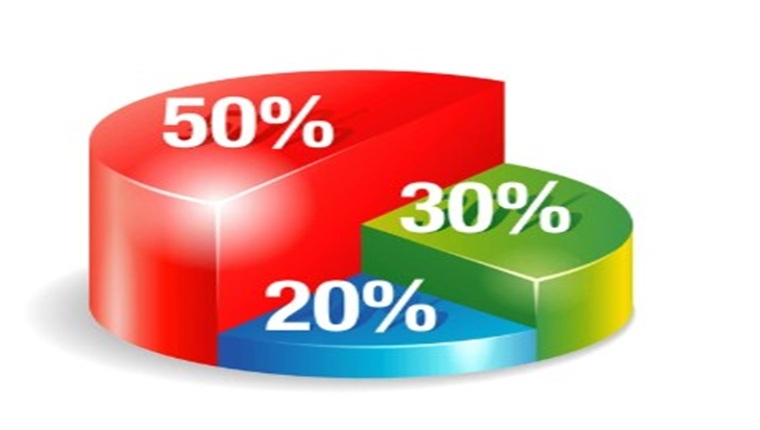
The 50/30/20 rule is the closest thing personal finance has to a universal law. Spend 50% of after-tax income on needs, 30% on wants, and 20% on savings and debt repayment. It is simple enough to remember without a spreadsheet, flexible enough to apply to almost any income, and credible enough to have been popularised by a US Senator. In the two decades since Elizabeth Warren and Amelia Warren Tyagi introduced it in their 2005 book All Your Worth, it has become the default budgeting advice of banks, financial advisers, comparison sites, and personal finance media around the world.There is one significant problem. A recent Talker Research and EarnIn survey of Americans earning $75,000 per year or less found that the average respondent spends 64% of income on needs -- not 50%. Not because they are financially undisciplined. Because the cost of living in 2026 does not resemble the cost of living the rule was calibrated for. Due (June 29, 2026 -- most recent): 'A framework built for one economic era can buckle under another, and that is exactly what has happened.' Siebert Financial (3 weeks ago): 'The core tension with the 50/30/20 rule in 2026 is the 50% needs ceiling. That threshold was calibrated against a cost structure that has shifted materially since 2005.'
This article does not argue that the 50/30/20 rule should be discarded. Financial Decision Lab (June 22, 2026): 'The honest framing: the 50/30/20 rule is most useful as a diagnostic tool, not a rigid mandate.' The problem is not the framework's existence -- it is its uncritical application to households for whom it was never designed. This guide identifies those households precisely, explains why the rule fails each of them specifically, and provides the alternative frameworks that financial experts and researchers recommend for each profile.
The Reality Gap: Where the Math Collapses by Household Type
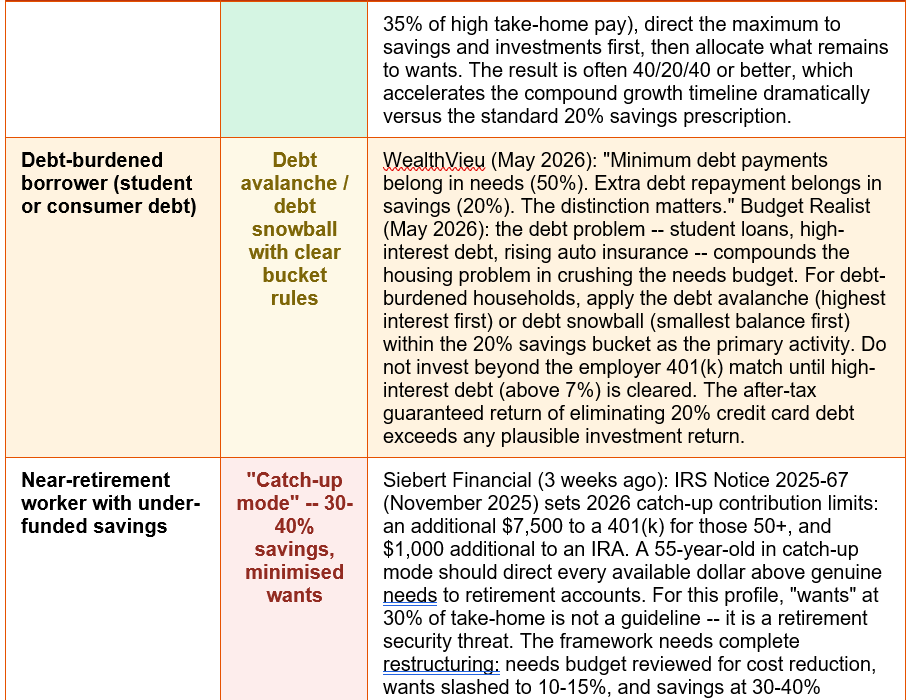
The following table maps six household profiles against what the 50/30/20 rule prescribes versus what 2026 cost structures actually produce:The defining data point: 64% on needs (reality) vs 50% (rule) for Americans earning $75k/year or less — GOBankingRates (Talker Research / EarnIn survey): 'A recent survey of Americans who earn $75,000 a year or less found that the average respondent put 64% of their income toward needs, 16% toward wants and 16% toward savings.' The 14-percentage-point gap between prescription (50%) and reality (64%) is not a behaviour problem. It is a cost-structure problem. Federal Reserve Bank of Cleveland (cited Budget Realist, May 2026): rent inflation has consistently outpaced wage growth across most US metros over the past decade. HUD definition: spending more than 30% of gross income on housing = cost-burdened (Siebert Financial, 3 weeks ago).
The Six Profiles the Rule Leaves Behind
Each of the following profiles represents a structural mismatch between what the 50/30/20 rule assumes and what their actual financial reality contains:LOW-INCOME RENTERS IN HIGH-COST MARKETS | Housing alone exceeds the entire 50% needs ceiling in most major US cities
This is the most documented failure of the 50/30/20 framework in 2026. Siebert Financial (3 weeks ago): 'The U.S. Department of Housing and Urban Development defines households spending more than 30% of gross income on housing as cost-burdened. When a single line item approaches or exceeds the framework's entire needs allocation, the remaining categories -- groceries, utilities, transportation, insurance -- have very little room to fit within the 50% ceiling.' Budget Realist (May 25, 2026): 'Housing is the main culprit. In high-cost cities, rent alone consumes 50% or more of take-home income. But even outside major metros, rents have outpaced wage growth in most US counties over the past decade. When housing alone hits 40% of your take-home, you have used up 80% of your entire needs budget before paying for food, utilities, transportation, or health insurance. Add the rest of the essentials and the math collapses completely. You are not overspending on wants. You are just trying to cover the basics.' The Federal Reserve Bank of Cleveland research confirms rent inflation has consistently outpaced wage growth across most US metros for a decade -- meaning this is not a temporary 2026 condition but a structural shift that makes the 50% needs ceiling increasingly fictional for a growing share of American renters.The consequence of mechanically applying the rule to this household: the budgeter is told they are spending 64-70% on needs when the rule says 50%, which generates a sense of failure and inadequacy rather than an accurate diagnosis. Budget Realist: 'You are not overspending on wants. You are just trying to cover the basics. The 50/30/20 rule did not break. The assumptions it was built on changed. That is a different problem with a different solution.' Origin (February 2026): 'In many major cities, housing alone can consume 35-45% of take-home pay. If rent already exceeds 40%, keeping total needs at 50% becomes unrealistic.'
ALTERNATIVE: 70/20/10 or 'Savings First' Budget Realist (May 2026): 'If take-home is $4,000, put $800 away first, automatically, on payday. Budget the remaining $3,200 across needs and wants however the real costs demand.' Financial Decision Lab (June 2026): 'Reframe temporarily as 70/20/10.' The savings discipline is preserved. The shame of exceeding the 50% ceiling is removed. The honest outcome: if needs run above 70%, it is a structural income/housing problem, not a budgeting failure.
SINGLE PARENTS AND CAREGIVERS | Childcare costs can exceed rent and are invisible in the 50/30/20 framework
Origin (February 2026): 'In 2026, rising housing costs, childcare expenses, and healthcare premiums make the rule harder to apply cleanly.' For single parents, this is an understatement. The national average cost of childcare for two children in the United States in 2026 runs from approximately $1,200 per month in lower-cost states to over $2,400 per month in high-cost urban areas. For a single parent earning $45,000 ($3,150/month after tax), the 50% needs ceiling is $1,575. Childcare alone can consume between 38% and 76% of the entire needs budget before a single dollar is spent on housing, food, utilities, or transportation. Maps Credit Union (December 2025): 'Families often see fixed expenses climb well above the 50% threshold before accounting for discretionary spending.'The framework also provides no guidance on the specific challenge of irregular costs that caregivers face: school supplies, medical co-pays, seasonal clothing for growing children, extracurricular activities with social development value. These do not fit cleanly into 'needs' or 'wants' -- they are essential expenditures that the 50/30/20 framework is structurally unable to account for. The rule was designed by and for households with stable, predictable costs. Single parents and caregivers have inherently variable essential costs that defeat fixed-percentage budgeting.
ALTERNATIVE: Zero-Based Budgeting (ZBB) LendEdu (February 2026): 'With zero-based budgeting, every dollar gets a job. You plan out your income down to the last cent.' For households where every dollar is allocated before the month begins, ZBB removes the fiction of a wants bucket. It identifies the $50-200/month in redirectable spending that percentage budgets miss -- and redirects it to a small savings buffer that provides the flexibility to handle irregular costs without going into debt.
GIG WORKERS AND VARIABLE INCOME EARNERS | 36% of US workers in the gig economy cannot apply fixed percentages to fluctuating monthly income
AllProCalculator (November 2025): 'Freelancers, gig workers, commission-based salespeople, and seasonal workers face a unique challenge: you can't apply fixed percentages to fluctuating income. In a good month, you might earn $8,000. In a slow month, maybe $3,000. The 50/30/20 allocation that works in Month A is completely irrelevant in Month B. According to recent labor statistics, over 36% of American workers now participate in the gig economy in some form.' Maps Credit Union (December 2025): 'A growing share of the U.S. workforce -- about 36 percent, primarily Millennials and Gen Z -- is leaning on freelance income to survive. So, what used to be a side hustle has become part of the main paycheck, whether that's rideshare driving, delivery work, contract design, tutoring, pet care, or other gig-based jobs.'The 50/30/20 rule's silent assumption is one of its most significant blind spots: it is designed for an employee with a predictable monthly paycheck. It has nothing meaningful to say to 36% of the American workforce. LendEdu (February 2026): 'Freelancers, gig workers, or anyone with an unpredictable paycheck might struggle to stick to fixed percentages.' The gig worker who applies the rule in their best month and finds it works fine is using a broken compass -- the reading is accurate only when conditions are exactly right and misleading when they are not.
ALTERNATIVE: Baseline budgeting + surplus capture WealthVieu (May 2026): 'Freelancers and gig workers should calculate the 50/30/20 split on their average monthly income, not their best month. Build a buffer from high-income months.' Calculate the conservative income floor (lowest 3 recent months). Budget all fixed needs against that floor. In high months, direct 80-100% of surplus above the floor to a savings buffer. This produces stability from instability -- exactly what the gig worker needs.
STUDENT LOAN BORROWERS AND THE DEBT-BURDENED | The 20% savings bucket cannot simultaneously service debt and build savings at low-to-moderate incomes
Budget Realist (May 2026): 'There is also the debt problem. Student loan payments, high-interest debt, and rising auto insurance have grown to take up a greater share of the average household budget, further crushing the 50% needs category.' WealthVieu (May 2026) provides a critical clarification that the 50/30/20 rule never makes: 'Minimum debt payments belong in needs (50%). Extra debt repayment belongs in savings (20%). The distinction matters.' This distinction -- between the minimum payment (which is a non-negotiable fixed cost, therefore a need) and additional debt repayment (which is wealth-building, therefore savings) -- is not made in the original framework. Most borrowers treat all debt payments as needs, which distorts both sides of the budget and obscures the financial cost of debt.The practical problem: a recent graduate earning $45,000 with $50,000 in federal student loans at 6.5% has a minimum monthly payment under the standard 10-year plan of approximately $568/month. On $3,150/month take-home, this is 18% of income -- taken from the needs bucket, where it joins housing, food, utilities, and transportation. The needs budget is already crushed before the 20% savings bucket must cover any additional debt repayment plus emergency savings plus retirement contributions. The 50/30/20 framework provides no sequencing guidance: should this borrower invest first or pay off debt aggressively first? The rule is silent on this.
ALTERNATIVE: Debt avalanche with clear bucket rules WealthVieu (May 2026): Minimum payments = needs. Additional debt payoff = savings. Prioritise by interest rate: clear debts above 7-8% interest before investing beyond the employer 401(k) match. The guaranteed after-tax return of eliminating 20% credit card debt exceeds any realistic investment return. NFCC (nfcc.org): nonprofit debt counselling, free or low-cost, from regulated advisers.
HIGH EARNERS -- OVER-ALLOCATED TO WANTS, UNDER-SAVING | The same 20% savings prescription that is too high for the poor is too low for the wealthy
The 50/30/20 rule has a symmetrical problem at the top of the income scale. Origin (February 2026): 'At higher income levels, needs often drop below 40%, and savings capacity expands significantly. Following 50/30/20 may actually underutilize wealth-building potential.' LendEdu (February 2026): 'If you're bringing in $10,000 a month post-tax, do you really need $3,000 for fun spending? That's up to you to decide.' The standard answer from behavioural economists: no, probably not, and the $3,000 that goes to discretionary spending every month instead of investments represents a significant compounding opportunity cost.The arithmetic: a high earner who saves 20% ($2,200/month on $11,000 take-home) versus 40% ($4,400/month) over 20 years at 7% real return accumulates approximately $1.38M versus $2.76M -- a $1.38M difference from the same income, same investment return, solely from the savings rate choice. The 50/30/20 rule, applied rigidly, legitimises leaving $1.38M in compound growth on the table by allocating $3,300/month to 'wants' when the household has already met every genuine need.
ALTERNATIVE: 40/20/40 (Aggressive savings framework) LendEdu (February 2026): 'Shifting to 40/20/40 if you're focused on building savings.' WealthVieu (May 2026): high earners should reverse the default savings priority -- needs first at their actual cost (often 30-35%), then maximum savings, then whatever remains goes to wants. Max 401(k) at $23,500 (2026 IRS limit), max Roth IRA or backdoor Roth at $7,000, then taxable accounts. The IRS catch-up limits (Siebert, 3 weeks ago, citing IRS Notice 2025-67) also allow additional contributions for those 50+.
NEAR-RETIREMENT WORKERS WITH UNDER-FUNDED SAVINGS | 20% savings is not a retirement rescue plan for a 55-year-old starting from behind
Siebert Financial (3 weeks ago): '20% savings target holds up well as a directional benchmark. The specific percentage may need adjustment based on individual starting points.' This is the gentlest possible framing of a harsh mathematical reality. A 55-year-old worker with $100,000 in retirement savings, a $60,000 salary, and a goal of retiring at 67 with $800,000 (a modest retirement by most calculations) needs approximately $700,000 additional in 12 years. At 7% average annual return, even 20% savings ($12,000/year from $60k) gets them to approximately $250,000 in 12 years -- less than half the target. They are not a candidate for the 50/30/20 rule. They are a candidate for financial triage.The 2026 IRS catch-up contribution rules (Siebert, 3 weeks ago: IRS Notice 2025-67, November 2025) provide an important tool: those 50 and older can contribute an additional $7,500 to a 401(k) above the standard $23,500 limit, for a total of $31,000, and an additional $1,000 to an IRA. This is $32,000/year in tax-advantaged space -- significantly more than the 20% prescription for most workers in this age bracket. Applying 50/30/20 to this household and calling it adequate financial planning is not a guideline. It is a disservice.
ALTERNATIVE: Catch-up mode: 30-40% savings, slashed wants Redirect every available dollar above genuine needs to retirement accounts in catch-up mode. Max the 401(k) including catch-up ($31,000 in 2026). Max the IRA ($8,000 in 2026 for 50+). Eliminate the 30% wants allocation temporarily -- it is not a permanent sacrifice but a time-limited catch-up period. Use CFPB's free retirement calculator (consumerfinance.gov) and meet with a fee-only financial adviser (NAPFA.org) to model the realistic retirement picture.
Alternative Frameworks by Profile: What Financial Experts Actually Recommend
The following table maps each left-out profile to the framework that better fits their financial reality, with sources:
What the 50/30/20 Rule Gets Right -- And Why It Is Still Useful
The purpose of this guide is not to dismiss the 50/30/20 rule entirely -- it is to contextualise it honestly. Siebert Financial (3 weeks ago): 'Two aspects of the framework remain as relevant in 2026 as they were in 2005. The conceptual distinction between needs and wants is analytically useful. Many households carry discretionary spending in categories they experience as non-negotiable -- premium streaming bundles, frequent dining out, new vehicle payments above what transportation strictly requires. The framework provides a structured way to surface those distinctions without requiring a line-item audit of every transaction. The savings-first orientation of the 20% bucket reflects a principle documented across behavioral economics literature and Federal Reserve consumer finance research: households that automate savings before allocating discretionary spending tend to save more consistently than those who save whatever remains at the end of the month.'The Epoch Times (3 weeks ago): 'I like this rule because it's the rare piece of money advice you can remember without an app or a spreadsheet.' This is a genuine virtue. A budgeting rule that requires a certified financial planner to implement is not a budgeting rule -- it is a consulting engagement. The 50/30/20 rule democratises budgeting by making it memorable and applicable. The problem is not its existence; it is its uncritical promotion to households for whom it is structurally inappropriate. LendEdu (February 2026): 'I believe the 50/30/20 budgeting method works well. It's straightforward and easy for clients to understand. The key is to start with this basic framework and adjust it based on each client's unique financial situation.'
The 50/30/20 rule is most useful not as a budget but as a diagnostic. If your needs consistently exceed 50%, the rule has told you something real: either income needs to rise, essential costs need to fall, or both. Financial Decision Lab (June 22, 2026): 'That's not failure -- that's information.' The rule functions as a mirror: the gap between what it prescribes and what your reality delivers is data about your financial situation that can be acted on. For the low-income renter: the mirror shows a housing cost problem that a budgeting system cannot solve -- it requires an income increase or a cost reduction. For the high earner: the mirror shows that 20% savings is leaving enormous compound growth potential unused. For the gig worker: the mirror shows that fixed-percentage budgeting requires a stable income denominator that they do not have. In each case, the rule's failure to fit is itself the most useful information it provides.
FIVE THINGS THE 50/30/20 RULE GETS WRONG IN 2026 -- AND WHAT TO DO INSTEAD: (1) IT ASSUMES A STABLE, PREDICTABLE PAYCHECK. 36% of the US workforce is in the gig economy (AllProCalculator, November 2025). Variable income workers need baseline budgeting, not fixed-percentage allocations. Calculate your conservative income floor and budget against that. (2) IT TREATS 50% AS A MORAL STANDARD RATHER THAN A BENCHMARK. The average American at $75k or below spends 64% on needs (Talker/EarnIn, GOBankingRates). This is not a character failure. It is a cost-structure reality. A rule that makes 64% of the working population feel they are failing is a rule that has been applied incorrectly. (3) IT CONFLATES MINIMUM DEBT PAYMENTS WITH DISCRETIONARY SAVINGS. WealthVieu (May 2026): minimum debt payments belong in needs (50%). Extra debt repayment belongs in savings (20%). The distinction matters enormously for sequencing decisions. (4) IT PRESCRIBES THE SAME SAVINGS RATE AT $25,000 AND $200,000. The 20% savings prescription that may be aspirationally too high for the minimum-wage earner is irresponsibly low for the high earner who has no genuine constraint on savings capacity. (5) IT PROVIDES NO SEQUENCING GUIDANCE. Should you invest before paying off debt? Max your Roth IRA or build an emergency fund first? The rule is entirely silent on sequencing. For most households under 40, the correct sequence is: employer 401(k) match (free money first) -> emergency fund to $1,000 -> high-interest debt cleared -> 3-6 month emergency fund -> Roth IRA -> additional retirement contributions. CFPB (consumerfinance.gov): free and unbiased financial guidance.
THE UNIVERSAL PRINCIPLES THAT HOLD ACROSS ALL PROFILES -- WHATEVER YOUR BUDGET FRAMEWORK: (1) AUTOMATE SAVINGS ON PAYDAY. Every behavioural economics study agrees: households that automate savings before spending decisions consistently save more than those who save what remains. WealthVieu (May 2026): 'The 20% should be invisible. Set up an automatic transfer to savings on payday before you can spend it.' Even if you cannot save 20%, automate whatever you can -- $50, $100, $200. The act of automation is more important than the percentage. (2) KNOW WHAT YOU ACTUALLY SPEND ON NEEDS. Before applying any budgeting rule, spend one month categorising every expenditure as need, want, or savings. Use a free tool (YNAB, Copilot, Mint successor, or a simple spreadsheet) or a CFPB budget worksheet (consumerfinance.gov). Your actual needs percentage is the real baseline, not the 50% prescription. (3) CAPTURE THE EMPLOYER 401(K) MATCH FIRST. Whatever your broader budget framework, capture the full employer 401(k) match before any other savings or debt decision beyond minimum payments. This is a guaranteed 50-100% return on investment that no budget rule should cause you to miss. (4) USE FREE EXPERT GUIDANCE. CFPB (consumerfinance.gov): free budget worksheets, debt calculators, and retirement planning tools. NFCC (nfcc.org): nonprofit debt counselling. NAPFA (napfa.org): fee-only financial advisers who do not earn commissions. HUD-approved housing counsellors (hud.gov): free or low-cost guidance for cost-burdened renters and homeowners. (5) TREAT ANY BUDGET RULE AS A STARTING POINT, NOT A VERDICT. Financial Decision Lab (June 22, 2026): 'Adjusting the percentages isn't abandoning the framework -- it's applying it honestly to your actual situation.'
FINDING YOUR ACTUAL BUDGET FRAMEWORK -- A STEP-BY-STEP GUIDE: STEP 1 -- CALCULATE YOUR REAL NEEDS PERCENTAGE: Track every essential expenditure for one month (housing, utilities, groceries, transportation, minimum debt payments, insurance, childcare, medical). Add the total and divide by take-home pay. If above 60%: you are a candidate for 70/20/10 or zero-based budgeting, not 50/30/20. STEP 2 -- IDENTIFY YOUR PROFILE: Low-income renter (needs above 60%) -- use savings-first budgeting. Variable income -- use baseline budgeting. Single parent -- use zero-based budgeting. High earner -- use 40/20/40. Debt-burdened -- apply debt sequencing rules. Near-retirement -- enter catch-up mode. STEP 3 -- SET ONE AUTOMATION: Whatever your profile: automate the maximum amount you can save on payday. Even $100/month automated beats $300/month planned but not saved. STEP 4 -- GET FREE HELP IF NEEDED: CFPB budget worksheet at consumerfinance.gov. NFCC nonprofit debt counselling at nfcc.org. HUD-approved housing counsellor at hud.gov. IRS Tax Volunteer Income Tax Assistance (VITA) at irs.gov for free tax help. STEP 5 -- REVIEW QUARTERLY: Your budget framework should change as your circumstances change. A 30-year-old renter and a 55-year-old homeowner with the same income need fundamentally different frameworks. Re-evaluate every 3 months or after every major life event.
Conclusion
The 50/30/20 rule is not bad financial advice. It is incomplete financial advice applied universally to a population with wildly different financial realities. The data is clear: Americans earning $75,000 per year or less spend an average of 64% of income on needs, not 50%. The Federal Reserve Bank of Cleveland has documented that rent inflation has consistently outpaced wage growth across most US metros for a decade. Thirty-six percent of the US workforce is in the gig economy, where fixed-percentage budgeting does not function. Childcare costs for single parents can exceed rent. Student loan debt compresses both the needs and savings buckets simultaneously. And for high earners, the rule's 20% savings prescription leaves enormous compound growth potential permanently unrealised.Due (June 29, 2026): 'The rule is not wrong in spirit, but its rigid percentages need an update for 2026.' Siebert Financial (3 weeks ago): 'The practical result is that for many households in high-cost metro areas, or those carrying significant debt, genuine needs may already exceed 50% of after-tax income. That does not make the framework wrong. It means the framework requires calibration to individual circumstances rather than mechanical application.' Financial Decision Lab (June 22, 2026): 'If your needs consistently exceed 50%, the rule has told you something real: either income needs to rise, essential costs need to fall, or both. That's not failure -- that's information.'
The rule leaves out low-income renters, single parents, gig workers, student loan borrowers, near-retirement workers, and high earners -- for entirely different reasons. Each of these profiles has a better-fit alternative: savings-first budgeting, zero-based budgeting, baseline budgeting, debt-sequencing frameworks, catch-up mode, and aggressive savings frameworks respectively. The one principle that holds across all of them: automate savings on payday, whatever the amount, before any spending decision is possible. The 50/30/20 rule gets this right. The rest requires calibration.
Frequently Asked Questions (FAQ)
Does the 50/30/20 rule work for low income earners?For most low-income earners, the 50/30/20 rule does not reflect financial reality in 2026. A Talker Research and EarnIn survey of Americans earning $75,000 per year or less (cited by GOBankingRates) found the average respondent spends 64% of income on needs -- 14 percentage points above the rule's 50% ceiling. Budget Realist (May 2026) identifies housing as the primary driver: 'When housing alone hits 40% of your take-home, you have used up 80% of your entire needs budget before paying for food, utilities, transportation, or health insurance.' This is not a behaviour problem; it is a cost-structure problem. The Federal Reserve Bank of Cleveland research confirms that rent inflation has consistently outpaced wage growth across most US metros for a decade. For low-income earners, two better approaches are recommended by financial experts. First, savings-first budgeting: automate savings on payday (even $50-100/month), then budget the remaining income across real needs and wants as costs demand, without artificially targeting 50% needs. Second, the 70/20/10 reframe: treat 70% needs as the realistic baseline, 20% wants, and protect at least 10% savings. Financial Decision Lab (June 22, 2026): 'If needs genuinely run above 70% of take-home, the problem is not your budgeting system. The problem is an income and housing cost mismatch that a percentage framework cannot fix.'
Why does the 50/30/20 rule fail gig workers and freelancers?
The 50/30/20 rule assumes a stable, predictable monthly take-home income -- a denominator that gig workers and freelancers do not have. AllProCalculator (November 2025): 'Freelancers, gig workers, commission-based salespeople, and seasonal workers face a unique challenge: you can't apply fixed percentages to fluctuating income. In a good month, you might earn $8,000. In a slow month, maybe $3,000. The 50/30/20 allocation that works in Month A is completely irrelevant in Month B. According to recent labor statistics, over 36% of American workers now participate in the gig economy in some form.' Maps Credit Union (December 2025) adds: 'A growing share of the US workforce -- about 36% -- is leaning on freelance income to survive. Whatever the job, for many US households, one income stream simply won't cover the cost of living anymore.' The practical alternative for variable income earners: baseline budgeting. WealthVieu (May 2026): 'Freelancers and gig workers should calculate the 50/30/20 split on their average monthly income, not their best month. Build a buffer from high-income months.' Identify the conservative income floor (the lower end of the monthly range). Budget all fixed needs against that floor. In high-income months, direct 80-100% of surplus above the floor to a savings buffer. This approach converts income instability into manageable cash flow without the cognitive dissonance of applying a stable-income framework to unstable conditions.
Is the 50/30/20 rule good for high earners?
For high earners, the 50/30/20 rule's problem is the opposite of its problem for low earners: it is too generous on wants and too conservative on savings. Origin (February 2026): 'At higher income levels, needs often drop below 40%, and savings capacity expands significantly. Following 50/30/20 may actually underutilize wealth-building potential.' LendEdu (February 2026): 'If you're bringing in $10,000 a month post-tax, do you really need $3,000 for fun spending? That's up to you to decide.' Behavioural economics says no -- there is strong evidence from multiple studies that happiness and wellbeing gains from consumption plateau at a level well below $3,000/month in discretionary spending. The opportunity cost of not saving that money is significant: a high earner who saves 40% instead of 20% ($4,400 vs $2,200/month on $11,000 take-home) accumulates approximately $2.76M instead of $1.38M over 20 years at 7% average annual return -- a $1.38M difference from the same income and investment return, solely from the savings rate decision. For high earners, financial experts recommend the 40/20/40 framework (40% needs, 20% wants, 40% savings) or aggressive savings targeting: max the 401(k) ($23,500 in 2026, $31,000 if 50+), max the Roth IRA or backdoor Roth ($7,000 in 2026), then invest in taxable accounts. The 50/30/20 rule, rigidly applied at high income, is the most expensive financial mistake the high earner can make.
What is a better budgeting method than the 50/30/20 rule for single parents?
For single parents and caregivers, zero-based budgeting (ZBB) is typically more appropriate than the 50/30/20 rule. Origin (February 2026): 'In 2026, rising housing costs, childcare expenses, and healthcare premiums make the rule harder to apply cleanly.' For single parents, childcare alone can consume 38-76% of the entire needs budget before housing is paid. LendEdu (February 2026): 'With zero-based budgeting, every dollar gets a job. You plan out your income down to the last cent -- whether that's bills, savings, groceries, or your dog's allergy meds.' ZBB is superior for single parents for three reasons. First, it accounts for irregular essential costs (school supplies, children's medical, extracurricular activities) that do not fit the needs/wants binary cleanly. Second, it typically surfaces $50-200/month in genuinely redirectable spending that percentage-based budgets miss because they do not require line-item justification. Third, it removes the shame of exceeding the 50% needs ceiling, replacing it with an accurate month-by-month view of where money actually goes. The Epoch Times (3 weeks ago): 'Many people start with 50/30/20 and switch to zero-based budgeting once they want finer detail.' For single parents who have always felt they are failing the 50/30/20 rule: they were never the audience the rule was designed for.
What is wrong with the 50/30/20 rule in 2026 specifically?
Several structural changes in 2026 make the 50/30/20 rule more difficult to apply than when it was introduced in 2005. Due (June 29, 2026): 'A framework built for one economic era can buckle under another, and that is exactly what has happened.' The specific 2026 pressures are fivefold. First, housing costs: the Federal Reserve Bank of Cleveland documents that rent inflation has consistently outpaced wage growth across most US metros for a decade. Siebert Financial (3 weeks ago): the HUD definition of cost-burdened (spending more than 30% of gross income on housing) now applies to a significant share of American households -- meaning a single line item already approaches or exceeds the 50% needs ceiling for millions of households. Second, childcare: Origin (February 2026): 'Childcare expenses and healthcare premiums make the rule harder to apply cleanly.' Third, the gig economy: Maps Credit Union (December 2025): approximately 36% of the US workforce relies on freelance or gig income, making fixed-percentage budgeting structurally inapplicable. Fourth, student debt: Budget Realist (May 2026): 'Student loan payments, high-interest debt, and rising auto insurance have grown to take up a greater share of the average household budget.' Fifth, a 2026-specific policy change: Siebert Financial (3 weeks ago) notes the Roth catch-up requirement under SECURE 2.0 Act Section 603 took effect January 1, 2026, affecting high earners' after-tax savings calculations. The rule's survival in 2026 depends entirely on whether it is applied as a diagnostic framework or as a prescriptive mandate. The former is useful; the latter produces budgeting failure for the majority of the working population.

0 Comments Comments