
Investing
2 Vanguard Funds Wall Street Says Could Beat the S&P 500 Now

Next-year upside of 27% for the S&P 500, 44% for information technology and 35% for communication services; VGT $111.98, $154.50 billion in assets, 1.59% yield, 0.09% expense ratio; VOX $181.85, 0.09% expense ratio; VGT holds about 320 stocks and VOX 114. The context: VGT returned 787% (24.4% a year) over 10 years and trades at about 22 times forward earnings; VOX trailed the S&P 500 over 20 years; Nvidia, Apple and Microsoft are about 44% of VGT; the same series cited S&P 500 upside of 18%, 20% and 22% earlier in 2026; VGT is about 13% below its September 16 price ($129.20). My arithmetic: $10,000 grows to $12,700, $14,400 and $13,500 at the S&P 500, VGT and VOX consensus numbers, or $11,350, $12,200 and $11,750 if only half comes true; an 80/10/10 mix of an S&P 500 fund, VGT and VOX gains only 2.5 points over the S&P 500 if consensus is right and loses 2.5 points more in a drawdown (S&P −15%, VGT −30%, VOX −25%).
This guide looks at the claim rather than repeating it: where the numbers come from, what the two funds hold, why analyst-based upside can mislead and what the arithmetic looks like if the forecasts come true, half-come true or fail. I cannot tell you whether these funds will beat the market; the aim is to help you decide how much weight a headline like this deserves.
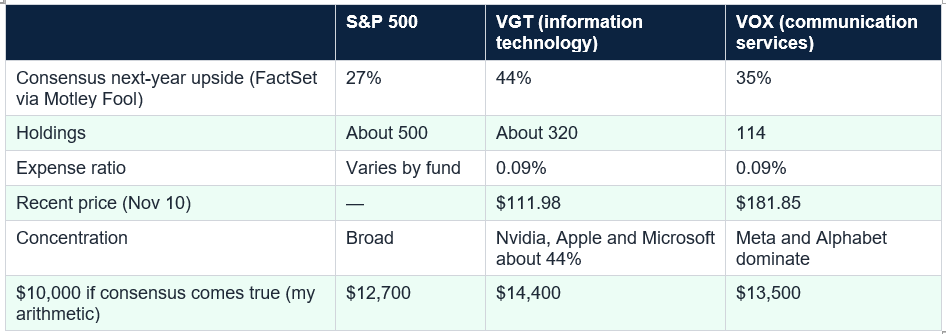
That distinction matters: a price target is an analyst’s estimate of where a stock could trade in about 12 months, not a promise. For the S&P 500, the median target implies about 27% in the next year, unusually high against the market’s long-run average of roughly 10% a year, consistent with Wells Fargo Investment Institute data cited by Kiplinger showing about 10.5% from 1926 to 2025. I did not retrieve FactSet’s own data, so I rely on the publisher’s reading.
The catch is concentration. The series says Nvidia, Apple and Microsoft account for about 44% of the fund, so VGT is less a basket of 320 stocks than a bet on three giants plus a long tail. Technology stocks also tend to fall more than the S&P 500 in drawdowns, and the fund’s quote is about 13% below the $129.20 shown on September 16, in my arithmetic. Past returns of 24% a year are not a promise, and a fund that has multiplied can also fall sharply.
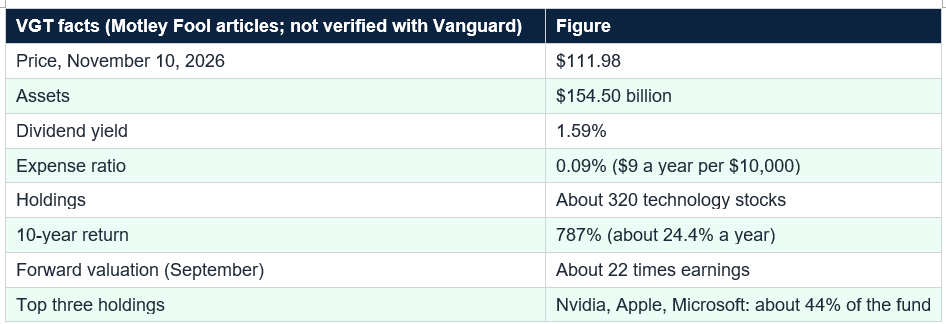
FactSet consensus upside (Nov 10, 2026): S&P 500 27%, information technology 44%, communication services 35%. VGT $111.98, $154.50B in assets, 0.09% expense ratio, about 320 holdings, Nvidia/Apple/Microsoft about 44%. VOX $181.85, 114 holdings, 0.09%.
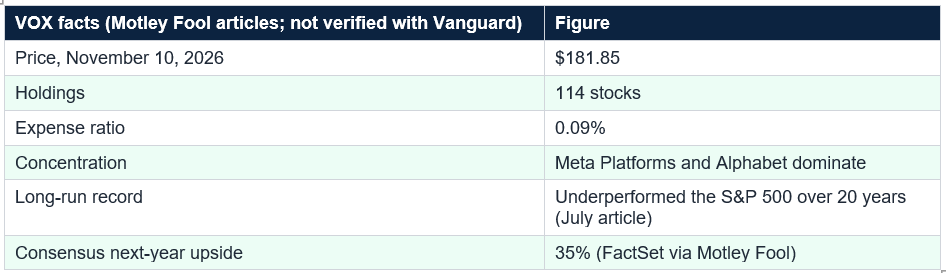
VOX’s record is less impressive than VGT’s: a July article notes it underperformed the S&P 500 over 20 years, though its valuation looks more attractive now. The sector’s bottom-up target was 32.4% above its end-of-June level in a July FactSet Insight reading, against 35% now, and an older article (about June) expected communication services earnings to grow 28% in 2026. VOX was around $181.85 on November 10, up 2.77% that day, while the S&P 500 rose 2.35%.
Third, the S&P 500 consensus has crept up too: 18% in an earlier version, 20% in July, 22% in September and 27% now, with the median target rising from 8,988 in July to 9,252 in September. A forecast that keeps climbing while markets wobble is a reason for caution, not comfort, and a 12-month target can look wrong in three months. None of this means the funds will disappoint, only that the 44% measures analyst sentiment and starting price, not the probability of a return.
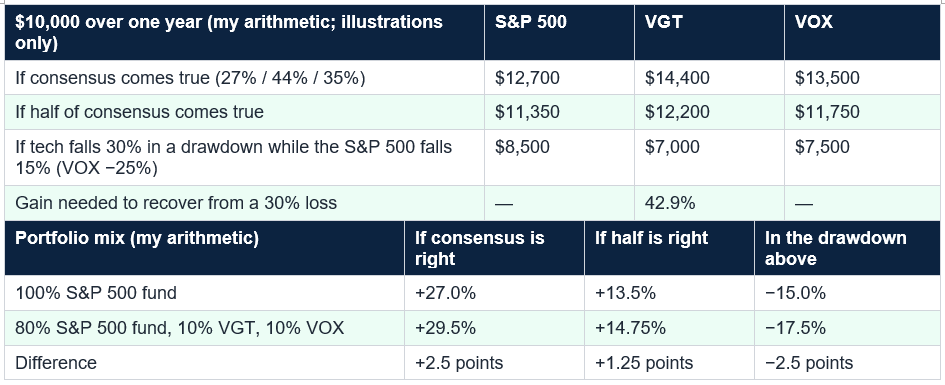
Now the downside. Technology stocks often fall more than the S&P 500 in drawdowns, and a 30% loss needs a 42.9% gain to recover. If the S&P 500 fell 15%, VGT 30% and VOX 25%, an investor with 80% in an S&P 500 fund and 10% each in VGT and VOX would lose 17.5%, 2.5 points worse than the S&P 500 alone; if consensus is right instead, the same mix gains 29.5% against 27%. The upside is modest for the extra concentration.
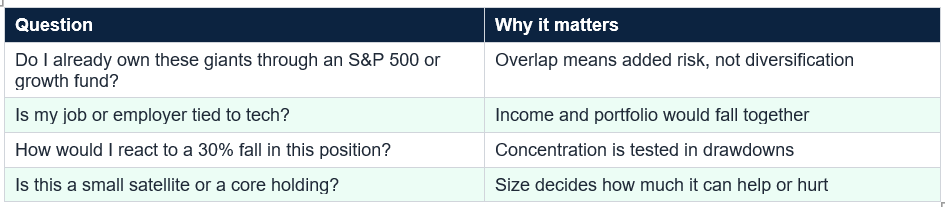
If you think technology and communication services will outperform, a sector fund expresses the view but raises your risk; if you simply want the market, an S&P 500 fund already includes much of the same upside. And if you hold growth funds, a target-date fund or employer stock in a tech company, you may own more of these stocks than you realize, so check your overlap first.
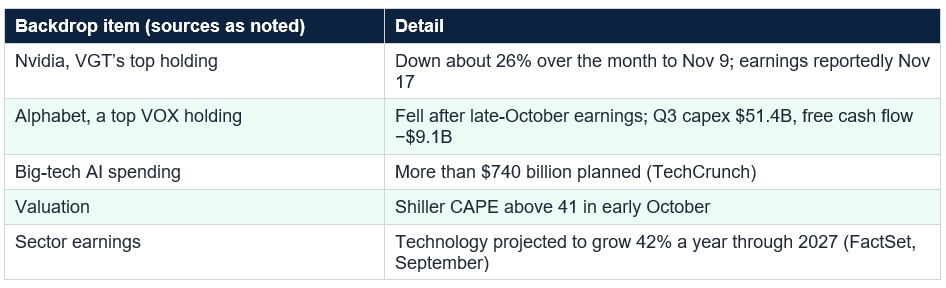
Valuations add to the picture: the Shiller CAPE was above 41 in early October, the highest in about 25 years by one measure, which does not predict a crash but suggests less margin for error. On the other hand, strong earnings growth is the case for the sectors, with FactSet projecting 42% a year for technology through 2027. The honest summary is that analysts see upside, the market has been skeptical and nobody knows which will prove right.
Analyst targets are estimates, not forecasts. The upside rose partly because prices fell, both funds are concentrated in a few giant stocks and sector funds can fall much more than the market. Never invest money you may need soon.
Keep your time horizon in mind: sector funds have long stretches of outperformance and of pain, and VOX trailed the S&P 500 over 20 years. Avoid trying to time the next year, since DALBAR found the average investor earned 6.8% a year over 30 years against 10.2% for the S&P 500, largely because of badly timed trades. If you add a sector fund, do it deliberately, in a size you can hold through a drop, and consider the tax treatment of the account (general knowledge).
Open your brokerage or 401(k) statement, look at your top ten holdings across all funds and see how much Nvidia, Apple, Microsoft, Alphabet and Meta you already own before adding anything. Common mistakes include treating analyst upside as a forecast, ignoring that falling prices inflate the percentage, assuming a sector fund diversifies an S&P 500 portfolio, sizing a position too large, extrapolating 24% annual past returns and trading on a headline. The same headline is also written every few months with different numbers, as these articles show: 27% for tech in July, 44% in November.
In my arithmetic, $10,000 would become $14,400 in VGT and $13,500 in VOX if consensus came true, but only $12,200 and $11,750 at half the consensus, and a mix with 10% in each would beat the S&P 500 by only 2.5 points if consensus is right and trail it by 2.5 points in the drawdown I modeled. They can work as a small, deliberate satellite for investors who accept the volatility, but a broad index fund should stay the core.
The Vanguard Information Technology ETF (VGT) and the Vanguard Communication Services ETF (VOX). VGT holds roughly 320 technology stocks and VOX about 114 communication services stocks, and both charge a 0.09% expense ratio, according to the articles I retrieved. A Motley Fool article published November 10 suggests them because FactSet’s consensus analyst targets imply 44% upside for technology and 35% for communication services over the next year.
Does Wall Street really expect these funds to beat the S&P 500?
Analyst price targets imply they would, but a target is not a forecast you can bank on. FactSet’s bottom-up targets aggregate analysts’ estimates for individual stocks, and they are often optimistic and tend to rise or fall with the market. The implied upside also grew partly because prices fell, which I show with VGT’s drop of about 13% since mid-September.
Are these funds a good substitute for an S&P 500 index fund?
No, and the author of the Fool article says the same: keep a larger share of your portfolio in an S&P 500 fund. VGT and VOX are concentrated in a few giant companies that also sit near the top of the S&P 500, so adding them increases concentration rather than spreading risk, according to my reading of the holdings data. They can work as a small satellite position for investors who accept more volatility.
What are the main risks?
Concentration in a handful of stocks, high valuations, sensitivity to AI spending expectations, and bigger drawdowns than the broad market. In my illustration, if VGT fell 30% while the S&P 500 fell 15%, a mix with 10% in VGT would do worse than the S&P alone. And a 30% loss needs a 42.9% gain to recover. This is general education, not personal advice.
Can I trust the 44% and 35% figures?
Treat them as a snapshot of analyst optimism, not a prediction. They come from FactSet as cited by one publisher, I did not retrieve the underlying FactSet data, and earlier articles from the same series cited different numbers (for example 27% for technology in July and 33% earlier). Targets change quickly, and no one can reliably forecast a 12-month return.
Table of Contents
- The Headline and the Claim
- The Short Answer
- Where 44% and 35% Come From
- The Technology Fund: VGT
- The Communication Services Fund: VOX
- Why Analyst Targets Can Mislead
- The Math: Consensus, Half and Drawdowns
- Overlap and Concentration
- The Market Backdrop
- How a Sensible Investor Might Use Them
- Common Mistakes
- Conclusion
- Frequently Asked Questions
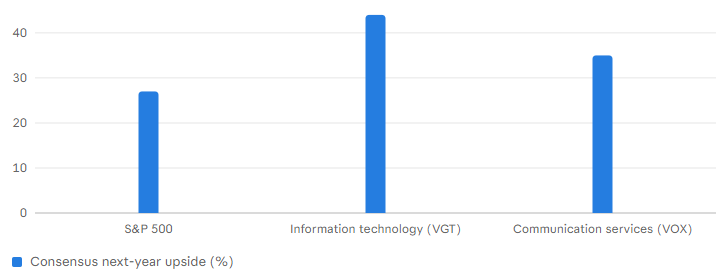
The claim: Wall Street's implied next-year upside, S&P 500 vs. the two sectors (%)
Implied upside (%) by FactSet Research consensus as cited by The Motley Fool on November 10, 2026 (bottom-up analyst price targets, not forecasts of fund returns); I did not retrieve the FactSet data
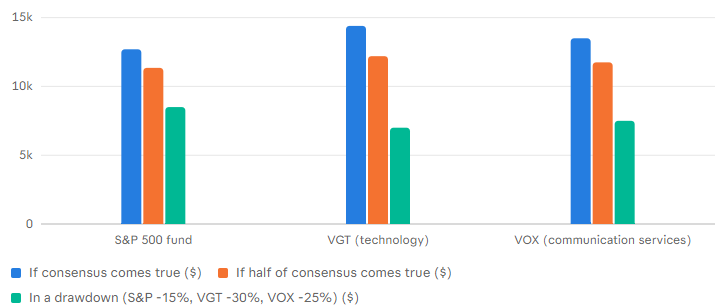
What $10,000 could become in a year: consensus, half of consensus and a drawdown ($)
Value after one year ($) by Author's hypothetical arithmetic from the FactSet consensus figures; the drawdown is an invented scenario, not a forecast; a 30% loss needs a 42.9% gain to recover
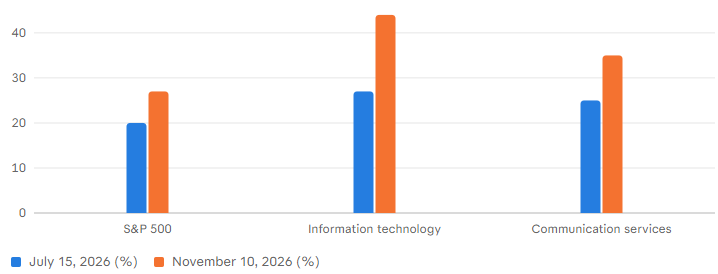
Upside keeps growing: consensus next-year upside, July vs. November 2026 (%)
Implied upside (%) by The Motley Fool articles citing FactSet (July 15 and November 10, 2026); implied upside rises when targets climb or prices fall; VGT's quote is about 13% below its September 16 level (author's arithmetic)
The Headline and the Claim
It is the kind of headline that makes you stop scrolling: two index funds that Wall Street thinks can beat the S&P 500 over the next year. A Motley Fool article published November 10 points to the Vanguard Information Technology ETF (VGT) and the Vanguard Communication Services ETF (VOX) because analysts’ price targets imply bigger gains for those sectors than for the market as a whole. The article, to its credit, adds that investors should still keep a larger share in an S&P 500 index fund.This guide looks at the claim rather than repeating it: where the numbers come from, what the two funds hold, why analyst-based upside can mislead and what the arithmetic looks like if the forecasts come true, half-come true or fail. I cannot tell you whether these funds will beat the market; the aim is to help you decide how much weight a headline like this deserves.
The Short Answer
FactSet’s consensus of analyst targets implies about 27% upside for the S&P 500 over the next year, 44% for information technology and 35% for communication services, so VGT and VOX would beat the index if the targets are right; both charge 0.09%. But targets are not forecasts, the upside grew partly because prices fell and both funds are concentrated in giant stocks that already dominate the S&P 500. In my arithmetic, a 10% allocation to each adds only about 2.5 percentage points if consensus is right and hurts more in a downturn. They can work as a small satellite, not a substitute for a broad fund.
Where 44% and 35% Come From
The numbers come from FactSet Research, a financial-data company, as cited by The Motley Fool. The sector upside is a bottom-up consensus: analysts publish a price target for each stock, and FactSet aggregates those targets across a sector and compares the total with current prices (a July article describes the method for communication services this way). So a 44% figure for technology means that, on average, targets sit 44% above where the stocks trade, not that anyone has forecast a 44% return.That distinction matters: a price target is an analyst’s estimate of where a stock could trade in about 12 months, not a promise. For the S&P 500, the median target implies about 27% in the next year, unusually high against the market’s long-run average of roughly 10% a year, consistent with Wells Fargo Investment Institute data cited by Kiplinger showing about 10.5% from 1926 to 2025. I did not retrieve FactSet’s own data, so I rely on the publisher’s reading.
The Technology Fund: VGT
The Vanguard Information Technology ETF holds roughly 320 stocks in software and cloud services, technology hardware and semiconductors, and the latest article shows it at $111.98, with $154.50 billion in assets, a 1.59% yield and a 0.09% expense ratio. Its past performance is striking: 787% over 10 years, or 24.4% a year, per a September article, when it traded at about 22 times forward earnings and FactSet projected sector earnings growth of 42% a year through 2027, the argument for its upside.The catch is concentration. The series says Nvidia, Apple and Microsoft account for about 44% of the fund, so VGT is less a basket of 320 stocks than a bet on three giants plus a long tail. Technology stocks also tend to fall more than the S&P 500 in drawdowns, and the fund’s quote is about 13% below the $129.20 shown on September 16, in my arithmetic. Past returns of 24% a year are not a promise, and a fund that has multiplied can also fall sharply.
FactSet consensus upside (Nov 10, 2026): S&P 500 27%, information technology 44%, communication services 35%. VGT $111.98, $154.50B in assets, 0.09% expense ratio, about 320 holdings, Nvidia/Apple/Microsoft about 44%. VOX $181.85, 114 holdings, 0.09%.
The Communication Services Fund: VOX
The Vanguard Communication Services ETF tracks 114 stocks and also charges 0.09%. It is dominated by two companies, Meta Platforms and Alphabet, which a July article says may surprise investors, so VOX is a concentrated bet on a few AI-exposed giants rather than a broad media fund, and Alphabet also drives the technology story.VOX’s record is less impressive than VGT’s: a July article notes it underperformed the S&P 500 over 20 years, though its valuation looks more attractive now. The sector’s bottom-up target was 32.4% above its end-of-June level in a July FactSet Insight reading, against 35% now, and an older article (about June) expected communication services earnings to grow 28% in 2026. VOX was around $181.85 on November 10, up 2.77% that day, while the S&P 500 rose 2.35%.
Why Analyst Targets Can Mislead
There are good reasons to be careful. First, analyst targets tend to be optimistic, since analysts and their employers generally prefer bullish views (general knowledge). Second, targets move with prices: when a sector falls and targets do not fall as fast, the implied upside rises. In July the same publisher showed technology at 27% upside, communication services at 25% and the S&P 500 at 20%; by November the figures were 44%, 35% and 27%, while VGT’s quote fell about 13% from September 16, so some of the added upside is simply a lower starting price.Third, the S&P 500 consensus has crept up too: 18% in an earlier version, 20% in July, 22% in September and 27% now, with the median target rising from 8,988 in July to 9,252 in September. A forecast that keeps climbing while markets wobble is a reason for caution, not comfort, and a 12-month target can look wrong in three months. None of this means the funds will disappoint, only that the 44% measures analyst sentiment and starting price, not the probability of a return.
The Math: Consensus, Half and Drawdowns
In my arithmetic, if consensus comes true $10,000 grows to $12,700 in the S&P 500, $13,500 in VOX and $14,400 in VGT (about $13,950 for an even split of VGT and VOX); if only half comes true, to $11,350, $11,750 and $12,200. These show what the targets imply, not forecasts, and real 12-month returns can range from large gains to large losses.Now the downside. Technology stocks often fall more than the S&P 500 in drawdowns, and a 30% loss needs a 42.9% gain to recover. If the S&P 500 fell 15%, VGT 30% and VOX 25%, an investor with 80% in an S&P 500 fund and 10% each in VGT and VOX would lose 17.5%, 2.5 points worse than the S&P 500 alone; if consensus is right instead, the same mix gains 29.5% against 27%. The upside is modest for the extra concentration.
Overlap and Concentration
There is a subtler issue: overlap. Nvidia, Apple, Microsoft, Alphabet and Meta are not only big holdings in VGT and VOX; in my general knowledge they are also among the largest holdings in the S&P 500. An investor who buys an S&P 500 fund and then adds VGT and VOX is not diversifying but doubling down on the same companies, which is why the Fool author keeps a larger share in an S&P 500 fund and treats the sector funds as an add-on.If you think technology and communication services will outperform, a sector fund expresses the view but raises your risk; if you simply want the market, an S&P 500 fund already includes much of the same upside. And if you hold growth funds, a target-date fund or employer stock in a tech company, you may own more of these stocks than you realize, so check your overlap first.
The Market Backdrop
The headline lands in a jittery market for AI-linked stocks. Nvidia, one of VGT’s largest holdings, was down about 26% over the month to November 9 amid a chip-stock sell-off and a board investigation of its CEO, per 24/7 Wall St., with earnings reportedly due November 17. Alphabet, one of VOX’s two giants, fell after late-October earnings showing $51.4 billion of quarterly capital spending and negative free cash flow of $9.1 billion, per Fortune, and big tech’s planned spending of more than $740 billion has raised questions about returns, per TechCrunch.Valuations add to the picture: the Shiller CAPE was above 41 in early October, the highest in about 25 years by one measure, which does not predict a crash but suggests less margin for error. On the other hand, strong earnings growth is the case for the sectors, with FactSet projecting 42% a year for technology through 2027. The honest summary is that analysts see upside, the market has been skeptical and nobody knows which will prove right.
Analyst targets are estimates, not forecasts. The upside rose partly because prices fell, both funds are concentrated in a few giant stocks and sector funds can fall much more than the market. Never invest money you may need soon.
How a Sensible Investor Might Use Them
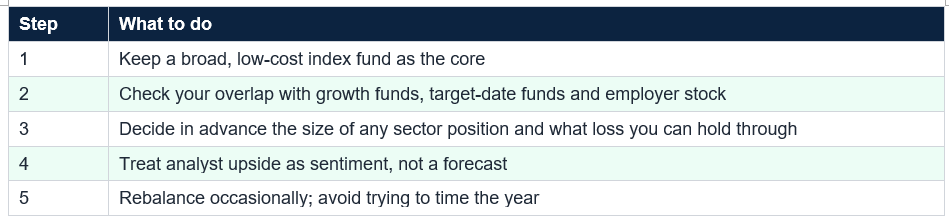
A simple approach is to keep a broad, low-cost index fund as the core, as the Fool author does, with small positions in sector funds only for risk-tolerant investors. Decide the size in advance: what share of your portfolio could you see fall 30% without changing your plan? Costs are low (0.09% is $9 on $10,000), so the issue is risk, not fees; rebalancing once a year keeps a good run in one sector from quietly becoming a large share of your portfolio.Keep your time horizon in mind: sector funds have long stretches of outperformance and of pain, and VOX trailed the S&P 500 over 20 years. Avoid trying to time the next year, since DALBAR found the average investor earned 6.8% a year over 30 years against 10.2% for the S&P 500, largely because of badly timed trades. If you add a sector fund, do it deliberately, in a size you can hold through a drop, and consider the tax treatment of the account (general knowledge).
Open your brokerage or 401(k) statement, look at your top ten holdings across all funds and see how much Nvidia, Apple, Microsoft, Alphabet and Meta you already own before adding anything. Common mistakes include treating analyst upside as a forecast, ignoring that falling prices inflate the percentage, assuming a sector fund diversifies an S&P 500 portfolio, sizing a position too large, extrapolating 24% annual past returns and trading on a headline. The same headline is also written every few months with different numbers, as these articles show: 27% for tech in July, 44% in November.
Conclusion
FactSet’s consensus of analyst targets implies about 44% upside for technology, 35% for communication services and 27% for the S&P 500 over the next year, which is why a Motley Fool article names VGT and VOX as ways to beat the index. Both are low-cost, at 0.09%. But the numbers are targets, not forecasts, they rose partly as prices fell and both funds are concentrated in a handful of giants: Nvidia, Apple and Microsoft are about 44% of VGT, and Meta and Alphabet dominate VOX.In my arithmetic, $10,000 would become $14,400 in VGT and $13,500 in VOX if consensus came true, but only $12,200 and $11,750 at half the consensus, and a mix with 10% in each would beat the S&P 500 by only 2.5 points if consensus is right and trail it by 2.5 points in the drawdown I modeled. They can work as a small, deliberate satellite for investors who accept the volatility, but a broad index fund should stay the core.
Frequently Asked Questions
What are the two Vanguard funds in the headline?The Vanguard Information Technology ETF (VGT) and the Vanguard Communication Services ETF (VOX). VGT holds roughly 320 technology stocks and VOX about 114 communication services stocks, and both charge a 0.09% expense ratio, according to the articles I retrieved. A Motley Fool article published November 10 suggests them because FactSet’s consensus analyst targets imply 44% upside for technology and 35% for communication services over the next year.
Does Wall Street really expect these funds to beat the S&P 500?
Analyst price targets imply they would, but a target is not a forecast you can bank on. FactSet’s bottom-up targets aggregate analysts’ estimates for individual stocks, and they are often optimistic and tend to rise or fall with the market. The implied upside also grew partly because prices fell, which I show with VGT’s drop of about 13% since mid-September.
Are these funds a good substitute for an S&P 500 index fund?
No, and the author of the Fool article says the same: keep a larger share of your portfolio in an S&P 500 fund. VGT and VOX are concentrated in a few giant companies that also sit near the top of the S&P 500, so adding them increases concentration rather than spreading risk, according to my reading of the holdings data. They can work as a small satellite position for investors who accept more volatility.
What are the main risks?
Concentration in a handful of stocks, high valuations, sensitivity to AI spending expectations, and bigger drawdowns than the broad market. In my illustration, if VGT fell 30% while the S&P 500 fell 15%, a mix with 10% in VGT would do worse than the S&P alone. And a 30% loss needs a 42.9% gain to recover. This is general education, not personal advice.
Can I trust the 44% and 35% figures?
Treat them as a snapshot of analyst optimism, not a prediction. They come from FactSet as cited by one publisher, I did not retrieve the underlying FactSet data, and earlier articles from the same series cited different numbers (for example 27% for technology in July and 33% earlier). Targets change quickly, and no one can reliably forecast a 12-month return.
0 Comments
Be the first to share your thoughts on this article.