

Budgeting
7 Ways to Budget Your Money: Which Method Suits You

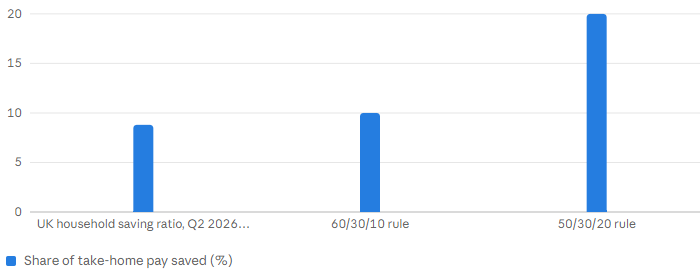
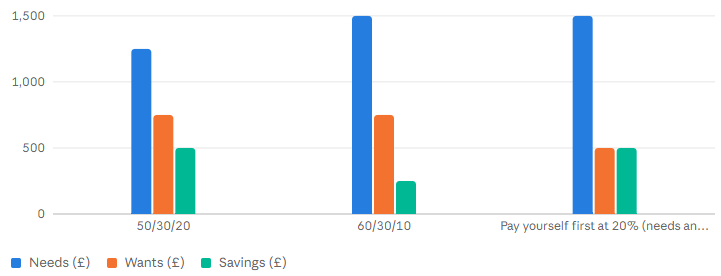
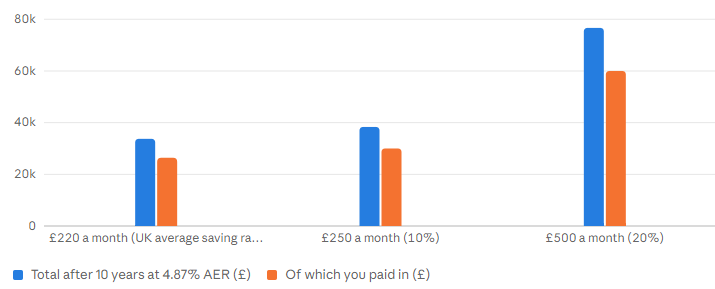
How much UK households save: the ONS household saving ratio was 8.8% in Q2 2026 (8.6% in Q1; 10.2% a year earlier); FCA Financial Lives 2025: one in ten adults has no cash savings and a further 21% have under £1,000; NatWest reports average monthly savings of £288 among those who save. The 50/30/20 problem: originated in a 2005 book by Elizabeth Warren and Amelia Warren Tyagi; one UK analysis finds it fails the bottom six income deciles because essentials exceed 50%; a 60/30/10 split is closer to what most households do. My arithmetic on £2,500 a month: 50/30/20 is £1,250, £750 and £500; 60/30/10 is £1,500, £750 and £250; 80/20 saves £500; the UK average saving ratio is about £220; at 4.87% AER for ten years, £220 a month grows to about £33,700, £250 to about £38,300 and £500 to about £76,700 (rate not guaranteed).
The ONS reports that the UK household saving ratio was 8.8% in the second quarter of 2026, down from 10.2% a year earlier, and the FCA’s Financial Lives research, as summarised by Up The Gains, found that one in ten UK adults has no cash savings and a further 21% have less than £1,000. With Bank Rate at 3.75% and CPI inflation at 3.1% in August, a plan matters. This guide compares seven methods with pounds-and-pence examples so you can choose the one that fits.
The appeal is that it takes five minutes. The drawback is that it assumes essentials take half your income, and for many UK households they do not: one analysis of UK data finds the rule fails the bottom six income deciles on needs, and for higher earners it can under-save. It also tells everyone to save 20% whether or not they can afford it. If rent, energy and council tax already take 60% or more, it will feel like failure on day one. Use it as a benchmark, not a verdict.
The advantage is that you can actually follow it, which beats a perfect rule you abandon. The risk is that it becomes a ceiling: 10% will not build a comfortable cushion quickly. Start at 60/30/10 and nudge savings up a percentage point with each pay rise, until you reach the 15% to 20% many planners suggest.
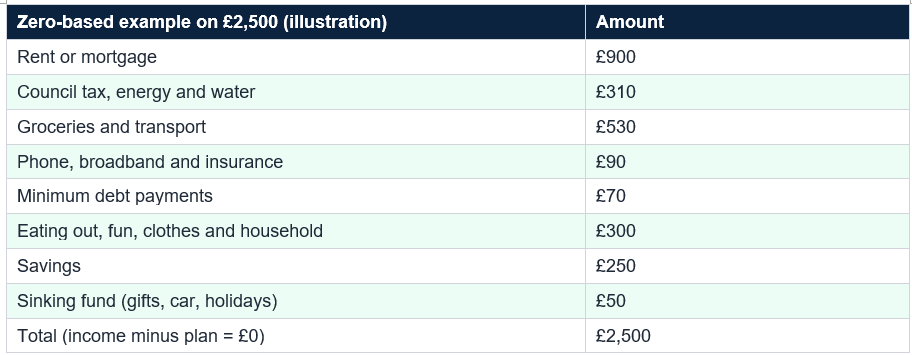
This method gives the most control and works well on tight incomes, forcing you to confront trade-offs before you spend. The downside is time: you must plan each month and track spending, and an irregular income needs a buffer. If building the budget feels like a chore, you will not keep it up.
It is powerful for people who overspend on cards, because the limit is visible: when the groceries pot hits zero, you know. The downside is rigidity, and carrying cash has its own risks. It works best for the two or three categories where you leak money; combine it with a percentage split for the rest.
It suits people who find tracking tiresome but struggle to save. The risk is setting the amount too high and raiding your savings before month-end, so start with what you can sustain. At a 4.87% AER easy access ISA rate, which is not guaranteed, £250 a month grows to about £38,300 in ten years and £500 to about £76,700; even £220, the UK average saving ratio on this income, would reach about £33,700.
If rent, energy and bills already take 70% of your pay, 80/20 leaves little for everything else. Check your essentials first; if they do not fit, scale down to 90/10 and build up. The principle is the same: decide the saving, automate it and live on the rest.
These suit people who want to understand their habits, not just limit them, and combine well with the others. The drawbacks are the time needed and the lack of enforced limits. If you have tried tight budgets and rebelled, a reflective approach may be the one that sticks.
If you are unsure, try this hybrid: an automatic transfer to savings on payday, a percentage split to check the big picture and an envelope or pot for the one category that always goes over. Review it for three months, then adjust. A budget is not a contract; it is an experiment you can rerun.
Give the money a target. At £250 a month, a £4,500 buffer of three months of essentials takes about 18 months to build before interest, and at £500 about nine. If your budget never balances, no method will fix a gap between income and essentials, and free help is available from MoneyHelper and debt charities; asking for it is a sign of sense, not failure.
The numbers: ONS household saving ratio Q2 2026: 8.8% (about £220 a month on £2,500). A 10% saving rate is £250 and 20% is £500. At 4.87% AER for ten years: £220 a month grows to about £33,700, £250 to about £38,300 and £500 to about £76,700 (rate not guaranteed).
Pick the method that matches your problem, try it for three months and adjust. Automate the saving, give your fiddliest category a limit and review monthly. On £2,500 a month, saving £250 at 4.87% AER would build about £38,300 in ten years, and £500 about £76,700, though rates are not guaranteed. The best budget is the one you still use next year.
The best method is the one you will actually keep using. Detail-lovers often prefer zero-based budgeting, people who want simplicity prefer 50/30/20 or 60/30/10, and people who struggle to save usually do best paying themselves first. Many people combine two methods. I explain how to choose in the guide above.
Is the 50/30/20 rule realistic in the UK?
For many households, not quite. Popularised by Elizabeth Warren and Amelia Warren Tyagi in a 2005 book, it splits take-home pay into 50% needs, 30% wants and 20% savings. One analysis of UK data finds it fails the bottom six income deciles because essentials cost more than 50%, and the ONS household saving ratio was 8.8% in the second quarter of 2026. A 60/30/10 split is often a more realistic starting point.
How much should I save each month?
A common target is 10% to 20% of take-home pay, but start with what you can sustain. On a take-home pay of £2,500, 10% is £250 and 20% is £500. At a 4.87% AER easy access ISA rate, which is not guaranteed, £250 a month would grow to about £38,300 in ten years, and £500 to about £76,700.
Do I need an app to budget?
No. A notebook, a spreadsheet or a free planner such as MoneyHelper’s will do. Apps can help by pulling in transactions automatically, but the method matters more than the tool, and the habit matters most: reviewing your numbers at least monthly.
What should I do if my budget never balances?
Look at income first as well as spending. Check essentials such as rent, energy and debt payments, ask whether any can be reduced, and consider free help from MoneyHelper or a debt charity if you are falling behind. If the gap is large, no method can close it alone, and that is not a personal failing. This is general information, not regulated advice.
Table of Contents
- Why Most Budgets Fail
- The Short Answer
- Method 1: 50/30/20
- Method 2: 60/30/10
- Method 3: Zero-Based Budgeting
- Method 4: Envelopes and Pots
- Method 5: Pay Yourself First
- Method 6: 80/20
- Method 7: Kakeibo and Values-Based Budgeting
- The Seven Side by Side
- Which Method Is Right for You?
- Making It Stick
- Conclusion
- Frequently Asked Questions
The gap: what UK households save vs. what budgeting rules suggest (% of pay)
Percent of income saved by ONS via SalaryTax (secondary summary); Up The Gains (60/30/10); Warren and Tyagi 2005 via NatWest and Financial Interest (50/30/20)
The same £2,500 a month under three splits (£)
Pounds per month (£) by Author's illustration on an assumed £2,500 monthly take-home pay; the third column splits the remaining £2,000 as £1,500 needs and £500 wants
What saving at different rates builds over ten years (£)
Pounds (£) by Author's arithmetic at a constant 4.87% AER (best easy access ISA, 30 Oct 2026; not guaranteed), monthly contributions, no tax or fees
Why Most Budgets Fail
Most budgets fail because they are built for an imaginary person who never has a surprise bill, never fancies a takeaway and never forgets the car insurance renewal. The real person in your house does all three. When the spreadsheet meets real life, the spreadsheet loses, and it is easy to conclude you are bad at budgeting. You are not; you probably just picked a method that does not fit how you think.The ONS reports that the UK household saving ratio was 8.8% in the second quarter of 2026, down from 10.2% a year earlier, and the FCA’s Financial Lives research, as summarised by Up The Gains, found that one in ten UK adults has no cash savings and a further 21% have less than £1,000. With Bank Rate at 3.75% and CPI inflation at 3.1% in August, a plan matters. This guide compares seven methods with pounds-and-pence examples so you can choose the one that fits.
2. The Short Answer
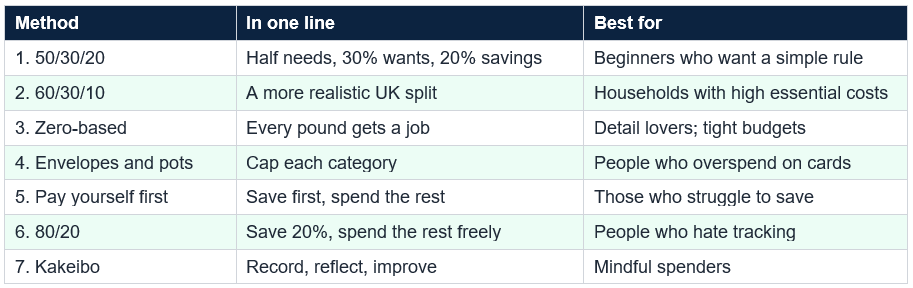
The seven methods are 50/30/20, 60/30/10, zero-based budgeting, envelopes and pots, pay yourself first, 80/20 and Kakeibo. Choose a percentage split for simplicity, zero-based budgeting or envelopes for control, pay yourself first or 80/20 if saving is the hard part and you would rather not track every purchase, and Kakeibo if you want to change your relationship with spending. Many people blend two, and that is fine.
Method 1: 50/30/20
The best-known method splits take-home pay into 50% needs, 30% wants and 20% savings and debt repayment. It was popularised by Elizabeth Warren and her daughter Amelia Warren Tyagi in their 2005 book All Your Worth, and NatWest’s Savings Index describes it the same way. On £2,500 a month, that is £1,250 for needs, £750 for wants and £500 for savings.The appeal is that it takes five minutes. The drawback is that it assumes essentials take half your income, and for many UK households they do not: one analysis of UK data finds the rule fails the bottom six income deciles on needs, and for higher earners it can under-save. It also tells everyone to save 20% whether or not they can afford it. If rent, energy and council tax already take 60% or more, it will feel like failure on day one. Use it as a benchmark, not a verdict.
Method 2: 60/30/10
This is 50/30/20 with the numbers adjusted for reality. Up The Gains suggests a more realistic UK split for most households is closer to 60% needs, 30% wants and 10% savings; on £2,500 that is £1,500, £750 and £250. It is no coincidence that 10% sits close to the ONS household saving ratio of 8.8%, about £220 a month on £2,500.The advantage is that you can actually follow it, which beats a perfect rule you abandon. The risk is that it becomes a ceiling: 10% will not build a comfortable cushion quickly. Start at 60/30/10 and nudge savings up a percentage point with each pay rise, until you reach the 15% to 20% many planners suggest.
Method 3: Zero-Based Budgeting
In zero-based budgeting, every pound of income is assigned a job, so that income minus planned spending equals zero. That does not mean you spend it all: savings and debt payments are lines in the budget too. On £2,500, you might allocate £900 to rent, £150 to council tax, £160 to energy and water, £350 to groceries, £180 to transport, £50 to phone and broadband, £40 to insurance, £70 to minimum debt payments, £200 to eating out and fun, £100 to clothes and household items, £250 to savings and £50 to a sinking fund for gifts and car repairs. The total is exactly £2,500.This method gives the most control and works well on tight incomes, forcing you to confront trade-offs before you spend. The downside is time: you must plan each month and track spending, and an irregular income needs a buffer. If building the budget feels like a chore, you will not keep it up.
Method 4: Envelopes and Pots
The envelope method gives each spending category a fixed amount, traditionally in cash, and when an envelope is empty you stop spending in that category. Many people now use digital versions: separate bank pots for groceries, fun or petrol, topped up on payday. On £2,500, you might hold £350 for groceries and £200 for eating out in their own pots. I describe the method from general budgeting practice, not a retrieved source.It is powerful for people who overspend on cards, because the limit is visible: when the groceries pot hits zero, you know. The downside is rigidity, and carrying cash has its own risks. It works best for the two or three categories where you leak money; combine it with a percentage split for the rest.
Method 5: Pay Yourself First
Pay yourself first reverses the usual order. Instead of saving what is left over, you move a fixed amount to savings the moment you are paid, then spend the rest after bills. On £2,500, saving 10% means £250 leaves your account on payday. It sidesteps the willpower problem: by the time you could spend the money, it is already gone.It suits people who find tracking tiresome but struggle to save. The risk is setting the amount too high and raiding your savings before month-end, so start with what you can sustain. At a 4.87% AER easy access ISA rate, which is not guaranteed, £250 a month grows to about £38,300 in ten years and £500 to about £76,700; even £220, the UK average saving ratio on this income, would reach about £33,700.
Method 6: 80/20
The 80/20 method is a lighter pay yourself first. You save 20% of take-home pay and spend the remaining 80% without categories or tracking: on £2,500, £500 saved and £2,000 for everything else. It can be freeing for people who dislike detail. The catch is that the 80% must cover all your essentials, so your fixed costs need to be comfortably below that.If rent, energy and bills already take 70% of your pay, 80/20 leaves little for everything else. Check your essentials first; if they do not fit, scale down to 90/10 and build up. The principle is the same: decide the saving, automate it and live on the rest.
Method 7: Kakeibo and Values-Based Budgeting
Kakeibo, a Japanese method whose name means household ledger, is about awareness. Each month you set an income and a saving goal, record every expense by hand in four categories (needs, wants, culture and extras) and then reflect on what you spent and what you will change. A values-based budget works similarly: decide what matters most to you and spend on that first. I describe both from general knowledge, not a retrieved source.These suit people who want to understand their habits, not just limit them, and combine well with the others. The drawbacks are the time needed and the lack of enforced limits. If you have tried tight budgets and rebelled, a reflective approach may be the one that sticks.
The Seven Side by Side
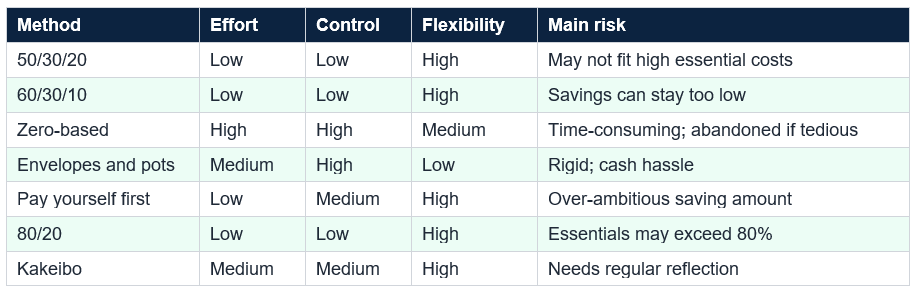
The effort and control columns below are my own judgement, not research findings. The methods fall into two families: those that tell you how much to spend in each category, such as zero-based and envelopes, and those that tell you how much to save, such as pay yourself first and 80/20. Neither is better; it depends whether your problem is overspending or under-saving.
Which Method Is Right for You?
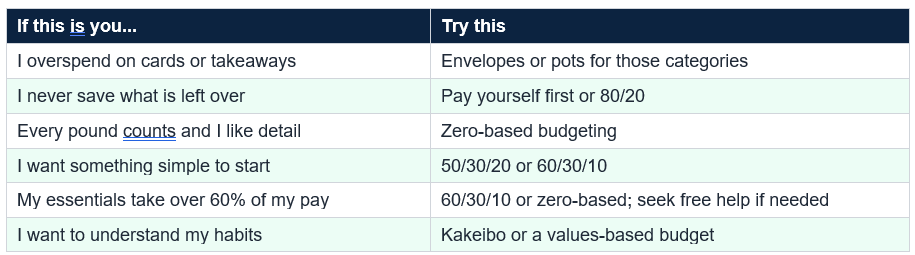
Ask four questions. Is your problem overspending or under-saving? If overspending, lean towards zero-based or envelopes; if under-saving, pay yourself first or 80/20. How much detail can you stand? If not much, choose a percentage split. Do essentials take more than half your income? If so, start with 60/30/10, or zero-based if every pound matters. Is your income irregular? If so, build a buffer and budget from your lowest typical month.If you are unsure, try this hybrid: an automatic transfer to savings on payday, a percentage split to check the big picture and an envelope or pot for the one category that always goes over. Review it for three months, then adjust. A budget is not a contract; it is an experiment you can rerun.
Making It Stick
A few habits matter more than the method. Review your numbers monthly, even for ten minutes. Build a small buffer, since a few hundred pounds can turn a crisis into an inconvenience. Keep a sinking fund for predictable but irregular costs such as car repairs, gifts and annual insurance. And put your savings somewhere that pays: at the end of October the best easy access ISA paid 4.87% AER, the best one-year fixed 5.02% and the best two-year fixed 5.12%, according to Moneyfacts, against inflation of 3.1% in August.Give the money a target. At £250 a month, a £4,500 buffer of three months of essentials takes about 18 months to build before interest, and at £500 about nine. If your budget never balances, no method will fix a gap between income and essentials, and free help is available from MoneyHelper and debt charities; asking for it is a sign of sense, not failure.
The numbers: ONS household saving ratio Q2 2026: 8.8% (about £220 a month on £2,500). A 10% saving rate is £250 and 20% is £500. At 4.87% AER for ten years: £220 a month grows to about £33,700, £250 to about £38,300 and £500 to about £76,700 (rate not guaranteed).
Conclusion
Budgeting is not about restriction; it is about deciding in advance what your money is for. Of the seven methods, 50/30/20 and 60/30/10 offer simplicity, zero-based and envelopes offer control, pay yourself first and 80/20 solve saving and Kakeibo builds awareness. The UK data make the case for a realistic plan: households save about 8.8% of income, one in ten adults has no cash savings and 50/30/20 does not fit many households’ essential costs.Pick the method that matches your problem, try it for three months and adjust. Automate the saving, give your fiddliest category a limit and review monthly. On £2,500 a month, saving £250 at 4.87% AER would build about £38,300 in ten years, and £500 about £76,700, though rates are not guaranteed. The best budget is the one you still use next year.
Frequently Asked Questions
What is the best budgeting method?The best method is the one you will actually keep using. Detail-lovers often prefer zero-based budgeting, people who want simplicity prefer 50/30/20 or 60/30/10, and people who struggle to save usually do best paying themselves first. Many people combine two methods. I explain how to choose in the guide above.
Is the 50/30/20 rule realistic in the UK?
For many households, not quite. Popularised by Elizabeth Warren and Amelia Warren Tyagi in a 2005 book, it splits take-home pay into 50% needs, 30% wants and 20% savings. One analysis of UK data finds it fails the bottom six income deciles because essentials cost more than 50%, and the ONS household saving ratio was 8.8% in the second quarter of 2026. A 60/30/10 split is often a more realistic starting point.
How much should I save each month?
A common target is 10% to 20% of take-home pay, but start with what you can sustain. On a take-home pay of £2,500, 10% is £250 and 20% is £500. At a 4.87% AER easy access ISA rate, which is not guaranteed, £250 a month would grow to about £38,300 in ten years, and £500 to about £76,700.
Do I need an app to budget?
No. A notebook, a spreadsheet or a free planner such as MoneyHelper’s will do. Apps can help by pulling in transactions automatically, but the method matters more than the tool, and the habit matters most: reviewing your numbers at least monthly.
What should I do if my budget never balances?
Look at income first as well as spending. Check essentials such as rent, energy and debt payments, ask whether any can be reduced, and consider free help from MoneyHelper or a debt charity if you are falling behind. If the gap is large, no method can close it alone, and that is not a personal failing. This is general information, not regulated advice.
0 Comments
Be the first to share your thoughts on this article.