
Investing
America's Bond Market Is Quietly Collapsing: The Full Story

The US has $37 trillion in national debt. Interest payments now exceed what America spends on defence, Medicaid, and veterans’ benefits combined. The 30-year Treasury yield crossed 5% in May 2025 for the first time since 2007. Moody’s stripped the US of its last AAA credit rating. Foreign governments are selling US bonds — for the first time during a major conflict in modern history. Central banks dumped $48 billion in Treasuries since late March 2025. $9 trillion of debt needs rolling over by the end of 2027. This is not a financial headline. It is the slow-motion unravelling of the financial architecture that has underwritten Western prosperity for eighty years. Not financial advice.
The US Treasury bond market is the largest, most liquid financial market in the world. It underpins the US dollar’s status as the world’s reserve currency. It sets the risk-free rate against which every other financial asset on earth is priced — every mortgage, every corporate bond, every emerging market loan, every government borrowing cost globally. When the US bond market works smoothly, global financial markets work. When it does not, the effects propagate outward into every corner of the financial system.
What happened to the US bond market in 2025 was not a full collapse. It was something more dangerous: a set of structural cracks that revealed that the dynamics financial markets had relied on for eighty years were no longer behaving as expected. Not financial advice.
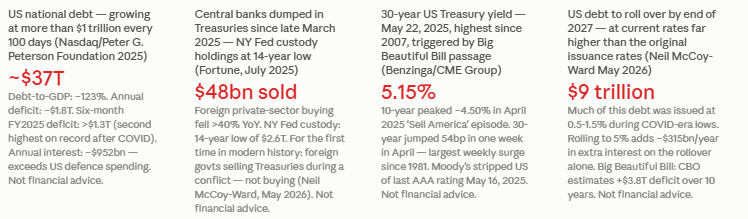
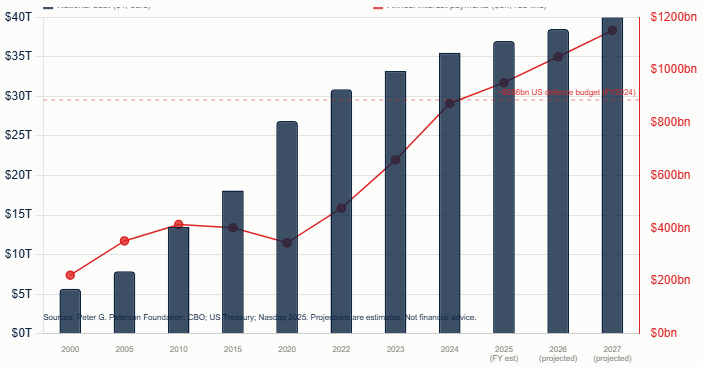
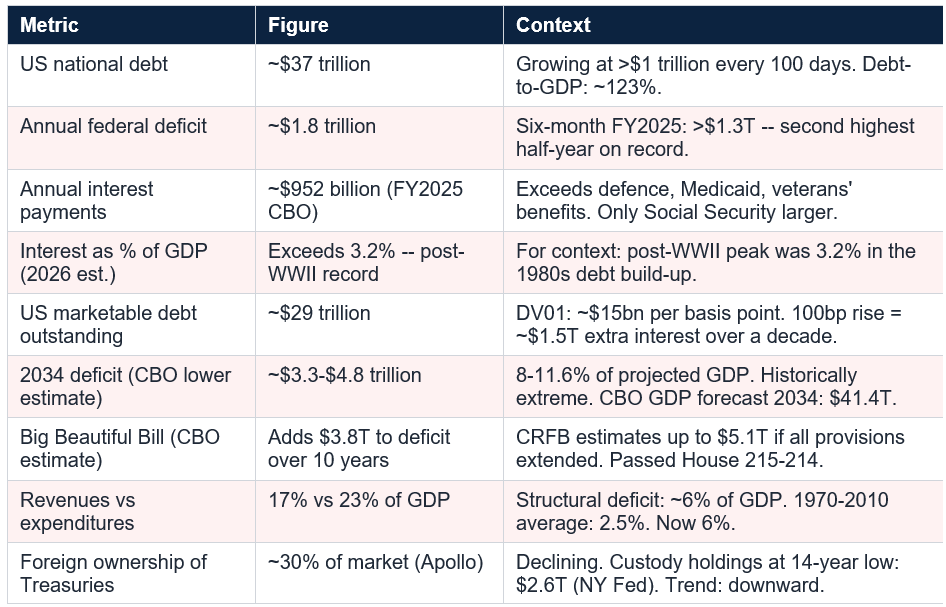
US national debt: ~$37 trillion. Growing at more than $1 trillion every 100 days. Debt-to-GDP: ~123% (Nasdaq/Peter G. Peterson Foundation 2025). Annual deficit: ~$1.8 trillion. Six-month FY2025 deficit: >$1.3 trillion -- second highest on record (second only to COVID) (Nasdaq 2025). Annual interest payments: CBO projects ~$952 billion in FY2025. By 2026: interest costs exceed the post-WWII high of 3.2% of GDP (Peter G. Peterson Foundation). US now spends more on debt interest than on defence, Medicaid, veterans' benefits, income security programmes, and federal spending on children. Only Social Security is now a larger line item. Sources: Peter G. Peterson Foundation; CBO; Nasdaq 2025. Not financial advice.
The yield on a Treasury bond — the effective annual return an investor receives — moves inversely to its price. When demand for Treasuries is high, prices rise and yields fall. When demand falls, prices drop and yields rise. This is not merely a financial technicality; it is the mechanism through which bond markets send their most important signal: rising yields mean investors are becoming more concerned about lending to the US government and demanding higher compensation for the risk.
The 10-year Treasury yield is the single most important number in global finance. It is the benchmark risk-free rate. When it rises, borrowing costs rise for everyone — US homeowners, US corporations, foreign governments borrowing in dollars, and any entity anywhere in the world whose financing cost is benchmarked against US Treasuries. A 1% rise in the 10-year yield adds approximately $1.5 trillion to cumulative US interest costs over a decade on the $29 trillion in existing marketable Treasury debt. It is, in a very precise sense, a tax on the entire US economy. Not financial advice.
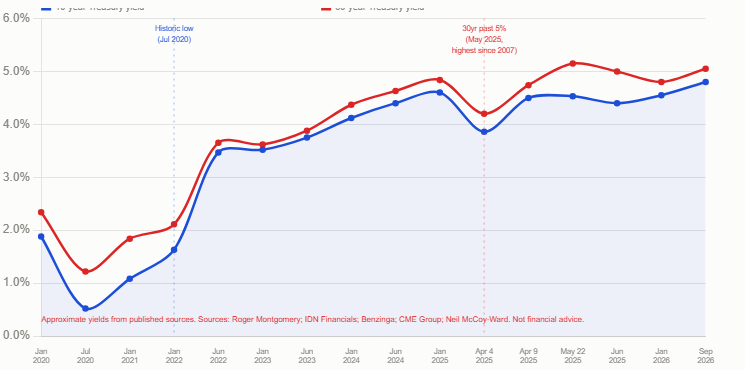
Historical Context: Historical US 10-year Treasury yield context: 1981 peak: approximately 15.8% (during Volcker Fed inflation fight). 1990s: 5-8%. 2000s pre-GFC: 4-5%. Post-2008 financial crisis: declining to historic lows. 2020 COVID: reached 0.52% (July 2020 -- lowest in US history). 2022-2024: rapid rise from near zero to 5%+. April 2025: surged to ~4.50% (10-year) and ~5.15% (30-year) as the 'sell America' trade intensified. As of late 2025-2026: 10-year approximately 4.75-5%, 30-year approximately 5-5.2%. Sources: multiple cited in body. Not financial advice.
The interest cost of this debt is the crucial number that most people miss. Annual interest payments on US debt are projected by the Congressional Budget Office to reach approximately $952 billion in fiscal year 2025. To put this in concrete terms: the US government will spend more on interest payments than on its entire defence budget, its entire Medicaid programme, its entire spending on children, its income security programmes, and its veterans’ benefits. Interest on the debt is now the second largest single line item in the US federal budget, behind only Social Security. Every year, it takes a larger share of every tax dollar collected.
The structural problem has been building for decades but accelerated sharply. Between 1970 and 2010, the US averaged a relatively modest deficit-to-GDP ratio of approximately 2.5%. Since 2011, this has surged to an average of approximately 6%. US government revenues are approximately 17% of GDP; expenditures exceed 23%. The gap — the structural deficit — is funded entirely by issuing new Treasury bonds. And it is growing. Not financial advice.
A sovereign credit downgrade is the bond market’s equivalent of a credit score drop for a government. It signals to investors that the issuer’s capacity to service its debt, while not immediately in doubt, is less certain than previously assessed. For the world’s largest sovereign issuer, whose debt underpins the global financial system, a downgrade is particularly significant: it raises questions about whether the implicit guarantee of the US dollar as the world’s ultimate safe-haven asset remains unconditional.
The timing was devastating. Just days after the Moody’s downgrade, on May 21, a $16 billion Treasury auction saw weak demand, dragging the stock market lower. The following day, May 22, the 30-year US Treasury yield climbed above 5% — nearing its highest level since 2007 — as the House of Representatives passed the ‘Big Beautiful Bill.’ The sequential events — downgrade, weak auction, yield spike, fiscal expansion — told a coherent and alarming story about the direction of US fiscal credibility. Not financial advice.
May 2025 sequence: May 16: Moody's strips US of last AAA rating. May 21: $16bn Treasury auction sees weak demand; stock market falls. May 22: 30-year yield surges above 5.15% (highest since 2007) as Big Beautiful Bill passes House. Sources: CME Group; Seeking Alpha; Benzinga; Semafor (all May-June 2025). Ed Yardeni (veteran investor, May 22, 2025): 'Stock investors may now be getting spooked that the bond market might be on the verge of a debt crisis. Trump's Big Beautiful Bill could push deficits and debt into uncharted territory.' Not financial advice.
In April 2025, this dynamic broke down. As US equity markets fell — dragged down by Trump’s tariff announcements and inflation fears — the 10-year Treasury yield initially dipped to 3.86% on April 4. Then, contrary to every historical precedent of the past decades, yields surged. By April 9, the 10-year yield was around 4.50% and the 30-year had jumped 54 basis points. The 10-year rose by more than 40 basis points during the week of April 11; the 30-year rose 60 basis points — on track for the largest weekly surge since 1981. The 10-year’s weekly rise of 0.506 percentage points was the largest since 2001.
Stocks were falling. Bonds were falling. The dollar was weakening. Gold was rising. This was not the behaviour of the world’s premier reserve currency and safe-haven asset during a period of uncertainty. It was the behaviour of an asset under fundamental doubt. Roger Montgomery (2026) characterised it precisely: ‘The US bond market didn’t behave as it should have when equity investors became nervous — rather than US Treasuries offering a haven, investors saw them as sources of risk.’ Not financial advice.
Roger Montgomery (2026): 'The US bond market didn't behave as it should have when equity investors became nervous -- rather than US Treasuries offering a haven, investors saw them as sources of risk. This dysfunctional reaction has since led some commentators and analysts to argue that the usual flight-to-safety dynamics are breaking down.' Brien Lundin (Gold Newsletter publisher, April 2025): 'The rest of the world is selling America.' Artis Shepherd (Mises Wire, April 2025): 'The bond market is sending a message to the US government that its spending is out of control and the reserve currency privilege it has abused for the last 80 years is running out.' Sources: Roger Montgomery 2026; FXStreet/Mises Wire April 2025.
The bond market’s reaction was immediate. The 30-year Treasury yield surged to 5.15% on the day of the vote. The comparison commentators immediately reached for was the UK’s Liz Truss moment. Semafor (May 2025) made the parallel explicit: ‘US government bonds sold off sharply in response to Trump’s tax and spending bill, raising fears that the US is in for its own Liz Truss moment. The UK prime minister was bounced from office in 2022 after proposing a budget that cut taxes far more than it cut spending — sowing fears that the government would have to borrow heavily to close the gap. Investors dumped their bonds.’ One market veteran told Bloomberg that it may be necessary to have a repeat of the UK crisis ‘to force everyone to do the right thing’ and get serious about fiscal discipline.
The difference between the US and the UK is scale: the UK’s fiscal crisis was manageable within months. The US fiscal trajectory, if the $3.8–$5.1 trillion additional deficit materialises on top of an already structurally unbalanced budget, puts the US on a trajectory where the debt burden becomes self-reinforcing — higher debt requiring higher interest payments requiring more borrowing requiring higher yields. Not financial advice.
The most famous example was the Clinton administration in the early 1990s. Investors concerned about US fiscal policy pushed 10-year Treasury yields from approximately 5% to over 8%, threatening the health of the entire economy and forcing a Democratic president to change course — achieving budget surpluses with Newt Gingrich by the late 1990s. The national debt at the time was $4.2 trillion when Clinton took office. It was $5.7 trillion when he left. Today, with a $37 trillion debt and the same vigilante dynamic beginning to reassert, the scale of the challenge is categorically different.
Ed Yardeni, the veteran investor who coined the original concept in the 1980s, noted in May 2025 that bond vigilantes might push the 10-year yield above 5% in coming weeks — and suggested that even a debt crisis might ultimately be a ‘buying opportunity for stocks’ if it forced Washington toward fiscal discipline. This view — that the bond market’s punishment may ultimately be necessary to produce the political will for reform — is the most optimistic case for the bond market’s behaviour in 2025. Not financial advice.
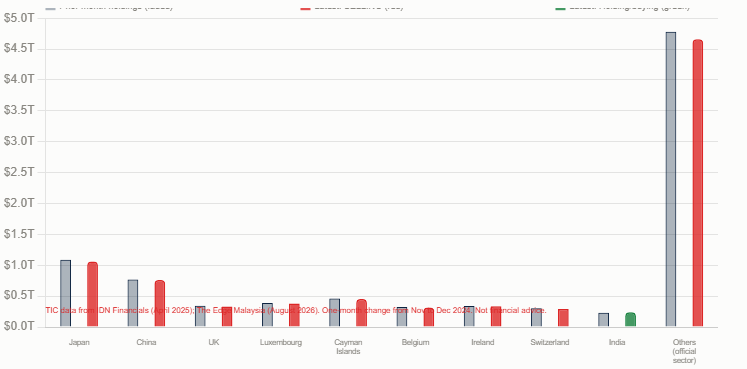
In 2025, that support began to fracture. In the twelve months through June 2026, net purchases of US Treasury notes and bonds by foreign private-sector investors declined by more than 40% from the same period the prior year — to $329 billion from an estimated $550+ billion the year before (The Edge Malaysia, August 2026, citing TIC data). Foreign private-sector buying fell to just $16.6 billion in June alone — the lowest since January. Central banks and reserve managers sold a net $35 billion of notes and bonds in the year through June. NY Fed custody holdings of foreign entities hit a 14-year low of $2.6 trillion.
The specific trigger that crystallised the shift was Trump’s April 2025 tariff rollout. Fortune (July 2025) reported that central banks dumped $48 billion in Treasuries in the two months after late March 2025. Neil McCoy-Ward’s May 2026 briefing identified what made this historically unprecedented: for the first time in modern history, foreign governments were selling US Treasuries during a period of major geopolitical conflict — rather than buying, which had been the pattern in every major conflict of the previous eighty years. Gold rose to record highs as the alternative to Treasuries for reserve managers. Not financial advice.
Foreign Treasury demand deteriorating: Net foreign private purchases fell >40% YoY to $329bn in 12 months through June (TIC data, The Edge Malaysia August 2026). June alone: $16.6bn -- lowest since January. Central banks sold net ~$35bn in the year (down from $91bn prior year). Central banks dumped $48bn since late March 2025 (Fortune July 2025). NY Fed custody holdings: 14-year low of $2.6T. Japan: reduced holdings $1.087T to $1.060T (Dec 2024). China: reduced $768.6bn to $759bn (Dec 2024). Apollo: foreign buyers ~30% of Treasury market. BofA Meghan Swiber: 'foreign private investors may not be adding to Treasury securities... creating a lot of concern.' Gold rising as alternative reserve asset. For the first time in modern history: foreign govts selling Treasuries during conflict, not buying (Neil McCoy-Ward May 2026). Not financial advice.
The mathematics of this rollover are punishing. A $1 trillion tranche of debt rolling over from 1% to 5% costs an additional $40 billion per year in interest payments. Applied to $9 trillion rolling over at an average additional cost of 3.5–4 percentage points, the cumulative additional annual interest burden from the rollover alone — before any new net issuance — could add $300–$360 billion per year to the US interest bill. This is a structural increase in the cost of existing debt that compounds with every dollar of new deficit spending.
The rollover problem creates a fundamental tension for the Federal Reserve. Higher interest rates are the standard tool for fighting inflation. But higher rates applied to $9 trillion of rolling debt are an acute fiscal problem for the Treasury. The Fed’s rate decisions are therefore no longer purely monetary policy decisions; they are fiscal policy decisions that directly affect the US government’s ability to service its obligations. This is a constraint on monetary policy independence that was not present when the debt was a fraction of its current level. Not financial advice.
In April 2025, during the tariff-driven equity sell-off, Treasuries did not rally. They sold off alongside stocks. This was not a one-day aberration; it was a pattern that has been building since late 2021 and has become more pronounced in episodes of market stress. If Treasuries are no longer reliable safe havens during equity market stress, the foundational assumption of most institutional and retail portfolio construction for the past thirty years — that bonds provide protection when stocks fall — is materially weakened.
The practical consequence for investors is significant. A 60/40 portfolio in a world where bonds no longer provide safe-haven ballast performs differently from a 60/40 portfolio in a world where they do. The diversification benefit that has been the primary justification for holding government bonds in a portfolio — not the yield, but the inverse equity correlation — may no longer be reliable. Not financial or investment advice. Consult a qualified financial adviser before making any portfolio changes.
By 2025–26, UK gilt yields had returned to similar crisis-adjacent levels. The 10-year gilt passed 5.1% and the 30-year briefly touched 5.8% — the highest since 1998 (Neil McCoy-Ward, May 2026 briefing). The UK bond market was again under pressure from a combination of fiscal concerns, elevated inflation, and geopolitical uncertainty. The lesson that the UK experience provides for the US is stark: the bond market can move faster than governments can respond, and the consequences can be systemic.
The key difference between the UK crisis of 2022 and a potential US equivalent is scale. The UK gilt market, while significant, is not the global reserve asset. A comparable loss of confidence in the US Treasury market would propagate through every dollar-denominated financial market globally, affecting interest rates, exchange rates, and asset valuations worldwide. That is precisely what makes the structural fractures in the US bond market in 2025 so significant. Not financial advice.
🇬🇧 UK Connection: UK gilt context 2025-2026: 10-year gilt yields past 5.1%; 30-year gilts briefly 5.8% -- highest since 1998 (Neil McCoy-Ward May 2026 briefing). UK bond market losing patience with fiscal policy and energy prices; traders pricing in rate hikes. UK borrowing costs at highest levels since 1998. Liz Truss comparison (Semafor, May 2025): 'US is in for its own Liz Truss moment -- fears that the government would have to borrow heavily to close the gap. Investors dumped their bonds.' Sources: Neil McCoy-Ward May 2026; Semafor May 2025. Not financial advice.
The scenarios that could accelerate toward acute crisis include: a failed or deeply weak Treasury auction that sends yields sharply higher; a significant foreign holder (Japan, China) deciding to accelerate Treasury sales; a domestic political impasse over the debt ceiling that creates even momentary default risk; a sharper-than-expected economic slowdown that worsens the deficit while simultaneously reducing Treasury demand from domestic investors who need liquidity. Any of these would not, in isolation, break the bond market. In combination, or in a context of already-elevated yields and declining foreign confidence, the feedback loops could become self-reinforcing.
The global consequences of a genuine US Treasury crisis would include: sharp rises in global interest rates across all dollar-benchmarked markets; dollar depreciation and potential loss of reserve currency status; significant stress in any financial institution holding Treasuries as safe assets (banks, pension funds, insurance companies globally); and a severe recession as the cost of borrowing rises sharply for consumers and corporations. These are not inevitable outcomes; they are the consequences of the tail risk. Not financial advice.
Third, pension funds and savings: pension funds, insurance companies, and savings vehicles hold Treasuries as safe assets. A bond market that is selling off destroys the value of these holdings. The UK LDI crisis of 2022 illustrated how pension fund exposure to government bonds can create systemic risk during a rapid yield rise. Fourth, tax: the growing share of government revenue consumed by interest payments reduces the resources available for public services, potentially requiring either higher taxes or reduced expenditure on everything from infrastructure to social services. Fifth, dollar purchasing power: a government that eventually resorts to printing money to service debts — the monetisation of the deficit — erodes the purchasing power of every dollar held in savings accounts. Not financial advice.
What this means for personal finance (general information only -- not financial advice): (1) Variable rate debt (credit cards, adjustable mortgages): particularly vulnerable to rising rate environments. Reducing high-interest debt is a priority in a rising-rate world. (2) Fixed income portfolio: review whether government bond holdings still serve their intended purpose of diversification if the equity-bond inverse correlation is weakening. (3) Inflation protection: assets with historically positive real returns in high-inflation, rising-rate environments (equities in real asset-heavy sectors, inflation-linked bonds, property, commodities) have different characteristics from nominal bonds. (4) Currency diversification: a weakening dollar has implications for the real value of dollar-denominated assets. (5) Consult a qualified financial adviser to assess your specific exposure. Not investment advice.
What the bond market is doing is what it always does when fiscal sustainability is in question: it is pricing in the risk. The 30-year yield at 5%+ after a Moody’s downgrade and a fiscal expansion is the bond market’s version of a credit score reaction. The ‘sell America’ trade — bonds, stocks, and dollar falling simultaneously in April 2025 — was the bond market’s way of saying that Treasuries are no longer a safe haven from themselves.
This does not inevitably end in catastrophe. Fiscal adjustments are possible. The Fed retains tools. The US economy is still the largest in the world. The dollar, despite its weakening, remains dominant. But the structural trajectory — rising debt, rising interest costs, declining foreign demand, and an expanding fiscal programme — is not self-correcting. It will require deliberate political action to reverse. The bond vigilantes are watching. So far, Washington is not listening. Not financial advice. Consult a qualified financial adviser.
Not in the sense of a sudden, complete breakdown. What is happening is better described as a structural deterioration: rising yields reflecting declining confidence in US fiscal sustainability, declining foreign demand, the loss of all three major AAA credit ratings (S&P 2011, Fitch 2023, Moody's May 2025), and episodes where the traditional safe-haven behaviour of Treasuries broke down (April 2025, when bonds and stocks fell simultaneously). The word 'collapse' is provocative but captures the direction of travel rather than an event that has already occurred. The risk of acute crisis exists but is not the base case of mainstream economists. What is already certain is the structural deterioration of US fiscal sustainability, the rising cost of debt service, and the weakening of foreign demand for Treasuries. Not financial advice.
Why did Moody's downgrade the US credit rating?
Moody's downgraded the US sovereign credit rating on May 16, 2025, citing the staggering national debt of $36 trillion (now approaching $37 trillion). This followed S&P's 2011 downgrade (after the debt ceiling crisis) and Fitch's 2023 downgrade. The Moody's action stripped the US of its last remaining AAA rating from a major credit agency. The downgrade reflects concerns about fiscal trajectory rather than an immediate default risk -- the US can always create dollars to service dollar-denominated debt, a significant distinction from other sovereign debtors. But the downgrade signals that the implicit unconditional nature of US fiscal credibility is increasingly questioned. Sources: CME Group; Seeking Alpha; Semafor (all May-June 2025). Not financial advice.
What is the Big Beautiful Bill and why does it matter for bonds?
The 'One Big Beautiful Bill' is a sweeping US tax-cut and spending legislation passed by the US House of Representatives on May 22, 2025, by a 215-214 margin. The Congressional Budget Office projects it will add approximately $3.8 trillion to the national deficit over the next decade; the Committee for a Responsible Federal Budget estimates $5.1 trillion if all provisions are extended. It matters for the bond market because it dramatically expands the fiscal deficit at a time when the bond market is already demanding higher yields to absorb existing debt. The day it passed the House, 30-year Treasury yields surged to 5.15% -- the highest level since 2007. Bond vigilantes responded immediately to the signal that the fiscal expansion was not being matched by spending cuts. Sources: Semafor May 2025; CME Group/Seeking Alpha June 2025; Benzinga/Webull May 2025. Not financial advice.
Who are bond vigilantes and are they back?
Bond vigilantes are institutional investors who respond to government fiscal irresponsibility by selling government bonds, driving up yields, and effectively imposing a market-based punishment that forces policy change. The term was coined in the 1980s and became famous during the Clinton administration, when investors pushed 10-year Treasury yields from approximately 5% to over 8%, forcing a Democratic administration to achieve budget surpluses. The evidence in 2025 suggests bond vigilantes are reasserting: the yield spike after the Big Beautiful Bill's passage, the weak Treasury auction on May 21, the Moody's-adjacent market reaction, and the general rise in long yields despite Fed rate cuts all suggest the market is pricing in fiscal risk. Ed Yardeni (who coined the bond vigilante term) confirmed in May 2025 that 'bond vigilantes may push the 10-year yield above 5%.' Sources: Semafor May 2025; CME Group/Interactive Brokers June 2025; Webull/Benzinga May 2025. Not financial advice.
What can ordinary investors do about this?
General information only -- not financial or investment advice. Consult a qualified financial adviser. Several considerations are relevant to anyone reviewing their portfolio in the context of US fiscal concerns: (1) The traditional diversification benefit of government bonds (inverse equity correlation) may be less reliable than historically. Review whether your bond allocation is serving its intended purpose. (2) Variable-rate debt is particularly vulnerable to a rising-rate environment. Paying down high-interest variable debt is a priority. (3) Inflation-linked bonds (TIPS in the US; Index-Linked Gilts in the UK) provide explicit inflation protection that nominal bonds do not. (4) Gold has historically performed well during periods of dollar weakness and fiscal concern -- it rose to record highs during the April 2025 'sell America' episode. (5) Geographic and currency diversification reduces concentration in a single currency that is under structural pressure. None of this is advice; it is context. Always consult a qualified independent financial adviser before making portfolio changes. Not affiliated with any investment provider.
Table of Contents
- The Quiet Crisis: Why Nobody Notices Until It’s Too Late
- Bond Markets 101: Why Treasuries Are the Foundation of Everything
- The Numbers That Should Keep You Awake
- The Moody’s Downgrade: America’s Last AAA Rating Gone
- April 2025: The Day Bonds and Stocks Both Fell Together
- The Big Beautiful Bill: Pouring Fuel on the Fire
- Bond Vigilantes: The Market’s Last Warning System
- Foreign Governments Are Selling America
- The $9 Trillion Rollover Problem
- The Broken Safe-Haven Dynamic: What This Means
- The UK Parallel: The Liz Truss Warning
- What Happens If the Bond Market Breaks?
- What This Means for Ordinary People
- Conclusion: The Slow-Motion Reckoning
- Frequently Asked Questions
US debt and interest burden — the compounding crisis
Treasury yield timeline --- key events 2020 - 2025
Foreign demand collapse — who is selling America
The Quiet Crisis: Why Nobody Notices Until It’s Too Late
Bond market crises are not the kind of financial disasters that announce themselves with dramatic market crashes visible to ordinary people on the evening news. They build slowly, in a corner of the financial system that most people never look at, through the dry mechanics of auction demand, yield curve movements, and basis point spreads. And then, at some point that is only obvious in retrospect, the slow build becomes something that cannot be contained.The US Treasury bond market is the largest, most liquid financial market in the world. It underpins the US dollar’s status as the world’s reserve currency. It sets the risk-free rate against which every other financial asset on earth is priced — every mortgage, every corporate bond, every emerging market loan, every government borrowing cost globally. When the US bond market works smoothly, global financial markets work. When it does not, the effects propagate outward into every corner of the financial system.
What happened to the US bond market in 2025 was not a full collapse. It was something more dangerous: a set of structural cracks that revealed that the dynamics financial markets had relied on for eighty years were no longer behaving as expected. Not financial advice.
US national debt: ~$37 trillion. Growing at more than $1 trillion every 100 days. Debt-to-GDP: ~123% (Nasdaq/Peter G. Peterson Foundation 2025). Annual deficit: ~$1.8 trillion. Six-month FY2025 deficit: >$1.3 trillion -- second highest on record (second only to COVID) (Nasdaq 2025). Annual interest payments: CBO projects ~$952 billion in FY2025. By 2026: interest costs exceed the post-WWII high of 3.2% of GDP (Peter G. Peterson Foundation). US now spends more on debt interest than on defence, Medicaid, veterans' benefits, income security programmes, and federal spending on children. Only Social Security is now a larger line item. Sources: Peter G. Peterson Foundation; CBO; Nasdaq 2025. Not financial advice.
Bond Markets 101: Why Treasuries Are the Foundation of Everything
A US Treasury bond is a loan to the US government. When an investor buys a Treasury, they are lending money to Washington for a fixed period — from a few months (Treasury bills) to thirty years (long bonds) — in exchange for regular interest payments and the return of their principal at maturity. Treasuries are backed by the ‘full faith and credit’ of the United States government, which has, throughout its history, never defaulted on this commitment.The yield on a Treasury bond — the effective annual return an investor receives — moves inversely to its price. When demand for Treasuries is high, prices rise and yields fall. When demand falls, prices drop and yields rise. This is not merely a financial technicality; it is the mechanism through which bond markets send their most important signal: rising yields mean investors are becoming more concerned about lending to the US government and demanding higher compensation for the risk.
The 10-year Treasury yield is the single most important number in global finance. It is the benchmark risk-free rate. When it rises, borrowing costs rise for everyone — US homeowners, US corporations, foreign governments borrowing in dollars, and any entity anywhere in the world whose financing cost is benchmarked against US Treasuries. A 1% rise in the 10-year yield adds approximately $1.5 trillion to cumulative US interest costs over a decade on the $29 trillion in existing marketable Treasury debt. It is, in a very precise sense, a tax on the entire US economy. Not financial advice.
Historical Context: Historical US 10-year Treasury yield context: 1981 peak: approximately 15.8% (during Volcker Fed inflation fight). 1990s: 5-8%. 2000s pre-GFC: 4-5%. Post-2008 financial crisis: declining to historic lows. 2020 COVID: reached 0.52% (July 2020 -- lowest in US history). 2022-2024: rapid rise from near zero to 5%+. April 2025: surged to ~4.50% (10-year) and ~5.15% (30-year) as the 'sell America' trade intensified. As of late 2025-2026: 10-year approximately 4.75-5%, 30-year approximately 5-5.2%. Sources: multiple cited in body. Not financial advice.
The Numbers That Should Keep You Awake
The fiscal position of the United States in 2025 is quantifiably different from anything in the country’s post-War history. The national debt stands at approximately $37 trillion and is growing at more than $1 trillion every 100 days. The debt-to-GDP ratio is approximately 123% — a level that would have been considered catastrophic fiscal management a generation ago and is now simply the operating reality of the US government.The interest cost of this debt is the crucial number that most people miss. Annual interest payments on US debt are projected by the Congressional Budget Office to reach approximately $952 billion in fiscal year 2025. To put this in concrete terms: the US government will spend more on interest payments than on its entire defence budget, its entire Medicaid programme, its entire spending on children, its income security programmes, and its veterans’ benefits. Interest on the debt is now the second largest single line item in the US federal budget, behind only Social Security. Every year, it takes a larger share of every tax dollar collected.
The structural problem has been building for decades but accelerated sharply. Between 1970 and 2010, the US averaged a relatively modest deficit-to-GDP ratio of approximately 2.5%. Since 2011, this has surged to an average of approximately 6%. US government revenues are approximately 17% of GDP; expenditures exceed 23%. The gap — the structural deficit — is funded entirely by issuing new Treasury bonds. And it is growing. Not financial advice.
The Moody’s Downgrade: America’s Last AAA Rating Gone
On May 16, 2025, Moody’s downgraded the United States’ sovereign credit rating, citing the staggering national debt of $36 trillion. This was not a financial footnote; it was a historic milestone. The United States had lost its S&P AAA rating in 2011, after the debt ceiling crisis. It lost its Fitch AAA rating in 2023. The Moody’s downgrade in May 2025 meant that the US had now lost all three major AAA sovereign credit ratings — for the first time in modern history.A sovereign credit downgrade is the bond market’s equivalent of a credit score drop for a government. It signals to investors that the issuer’s capacity to service its debt, while not immediately in doubt, is less certain than previously assessed. For the world’s largest sovereign issuer, whose debt underpins the global financial system, a downgrade is particularly significant: it raises questions about whether the implicit guarantee of the US dollar as the world’s ultimate safe-haven asset remains unconditional.
The timing was devastating. Just days after the Moody’s downgrade, on May 21, a $16 billion Treasury auction saw weak demand, dragging the stock market lower. The following day, May 22, the 30-year US Treasury yield climbed above 5% — nearing its highest level since 2007 — as the House of Representatives passed the ‘Big Beautiful Bill.’ The sequential events — downgrade, weak auction, yield spike, fiscal expansion — told a coherent and alarming story about the direction of US fiscal credibility. Not financial advice.
May 2025 sequence: May 16: Moody's strips US of last AAA rating. May 21: $16bn Treasury auction sees weak demand; stock market falls. May 22: 30-year yield surges above 5.15% (highest since 2007) as Big Beautiful Bill passes House. Sources: CME Group; Seeking Alpha; Benzinga; Semafor (all May-June 2025). Ed Yardeni (veteran investor, May 22, 2025): 'Stock investors may now be getting spooked that the bond market might be on the verge of a debt crisis. Trump's Big Beautiful Bill could push deficits and debt into uncharted territory.' Not financial advice.
April 2025: The Day Bonds and Stocks Both Fell Together
In normal financial markets, US Treasury bonds and US equities move in opposite directions during periods of stress. When stocks fall, investors flee to the safety of Treasury bonds, driving bond prices up and yields down. This ‘flight to safety’ dynamic is one of the most fundamental and reliable patterns in global finance, and it is the mechanism that makes Treasuries the world’s premier safe-haven asset.In April 2025, this dynamic broke down. As US equity markets fell — dragged down by Trump’s tariff announcements and inflation fears — the 10-year Treasury yield initially dipped to 3.86% on April 4. Then, contrary to every historical precedent of the past decades, yields surged. By April 9, the 10-year yield was around 4.50% and the 30-year had jumped 54 basis points. The 10-year rose by more than 40 basis points during the week of April 11; the 30-year rose 60 basis points — on track for the largest weekly surge since 1981. The 10-year’s weekly rise of 0.506 percentage points was the largest since 2001.
Stocks were falling. Bonds were falling. The dollar was weakening. Gold was rising. This was not the behaviour of the world’s premier reserve currency and safe-haven asset during a period of uncertainty. It was the behaviour of an asset under fundamental doubt. Roger Montgomery (2026) characterised it precisely: ‘The US bond market didn’t behave as it should have when equity investors became nervous — rather than US Treasuries offering a haven, investors saw them as sources of risk.’ Not financial advice.
Roger Montgomery (2026): 'The US bond market didn't behave as it should have when equity investors became nervous -- rather than US Treasuries offering a haven, investors saw them as sources of risk. This dysfunctional reaction has since led some commentators and analysts to argue that the usual flight-to-safety dynamics are breaking down.' Brien Lundin (Gold Newsletter publisher, April 2025): 'The rest of the world is selling America.' Artis Shepherd (Mises Wire, April 2025): 'The bond market is sending a message to the US government that its spending is out of control and the reserve currency privilege it has abused for the last 80 years is running out.' Sources: Roger Montgomery 2026; FXStreet/Mises Wire April 2025.
The Big Beautiful Bill: Pouring Fuel on the Fire
The US House of Representatives passed the ‘One Big Beautiful Bill’ on May 22, 2025, by the narrowest of margins: 215 votes to 214, with all Democrats, two Republicans voting against, and one Republican voting present. The bill combines deep tax cuts with spending changes that the Congressional Budget Office projects will add approximately $3.8 trillion to the national deficit over the next decade. The Committee for a Responsible Federal Budget estimates the total impact could reach $5.1 trillion if all provisions are extended.The bond market’s reaction was immediate. The 30-year Treasury yield surged to 5.15% on the day of the vote. The comparison commentators immediately reached for was the UK’s Liz Truss moment. Semafor (May 2025) made the parallel explicit: ‘US government bonds sold off sharply in response to Trump’s tax and spending bill, raising fears that the US is in for its own Liz Truss moment. The UK prime minister was bounced from office in 2022 after proposing a budget that cut taxes far more than it cut spending — sowing fears that the government would have to borrow heavily to close the gap. Investors dumped their bonds.’ One market veteran told Bloomberg that it may be necessary to have a repeat of the UK crisis ‘to force everyone to do the right thing’ and get serious about fiscal discipline.
The difference between the US and the UK is scale: the UK’s fiscal crisis was manageable within months. The US fiscal trajectory, if the $3.8–$5.1 trillion additional deficit materialises on top of an already structurally unbalanced budget, puts the US on a trajectory where the debt burden becomes self-reinforcing — higher debt requiring higher interest payments requiring more borrowing requiring higher yields. Not financial advice.
Bond Vigilantes: The Market’s Last Warning System
The term ‘bond vigilantes’ was popularised in the 1990s to describe institutional bond investors who respond to fiscal irresponsibility by selling government bonds, driving up yields, and effectively imposing a market-based punishment on governments that spend beyond their means. The mechanism is simple and powerful: when bond investors lose confidence in a government’s fiscal trajectory, they demand higher yields to compensate for the risk of holding that government’s debt. Higher yields mean higher borrowing costs for the government, which worsens the deficit, which eventually forces a policy change.The most famous example was the Clinton administration in the early 1990s. Investors concerned about US fiscal policy pushed 10-year Treasury yields from approximately 5% to over 8%, threatening the health of the entire economy and forcing a Democratic president to change course — achieving budget surpluses with Newt Gingrich by the late 1990s. The national debt at the time was $4.2 trillion when Clinton took office. It was $5.7 trillion when he left. Today, with a $37 trillion debt and the same vigilante dynamic beginning to reassert, the scale of the challenge is categorically different.
Ed Yardeni, the veteran investor who coined the original concept in the 1980s, noted in May 2025 that bond vigilantes might push the 10-year yield above 5% in coming weeks — and suggested that even a debt crisis might ultimately be a ‘buying opportunity for stocks’ if it forced Washington toward fiscal discipline. This view — that the bond market’s punishment may ultimately be necessary to produce the political will for reform — is the most optimistic case for the bond market’s behaviour in 2025. Not financial advice.
Foreign Governments Are Selling America
The most alarming structural development in the US Treasury market is not the yield level, the deficit size, or the downgrade. It is the behaviour of foreign buyers. US Treasuries have been the global reserve asset of choice for central banks, sovereign wealth funds, and foreign institutional investors for eight decades. Foreign buyers account for approximately 30% of the US Treasury market, according to Apollo chief economist Torsten Slok. Their willingness to absorb continuous Treasury issuance has been one of the structural supports that allowed the US to run persistent deficits without immediate fiscal consequence.In 2025, that support began to fracture. In the twelve months through June 2026, net purchases of US Treasury notes and bonds by foreign private-sector investors declined by more than 40% from the same period the prior year — to $329 billion from an estimated $550+ billion the year before (The Edge Malaysia, August 2026, citing TIC data). Foreign private-sector buying fell to just $16.6 billion in June alone — the lowest since January. Central banks and reserve managers sold a net $35 billion of notes and bonds in the year through June. NY Fed custody holdings of foreign entities hit a 14-year low of $2.6 trillion.
The specific trigger that crystallised the shift was Trump’s April 2025 tariff rollout. Fortune (July 2025) reported that central banks dumped $48 billion in Treasuries in the two months after late March 2025. Neil McCoy-Ward’s May 2026 briefing identified what made this historically unprecedented: for the first time in modern history, foreign governments were selling US Treasuries during a period of major geopolitical conflict — rather than buying, which had been the pattern in every major conflict of the previous eighty years. Gold rose to record highs as the alternative to Treasuries for reserve managers. Not financial advice.
Foreign Treasury demand deteriorating: Net foreign private purchases fell >40% YoY to $329bn in 12 months through June (TIC data, The Edge Malaysia August 2026). June alone: $16.6bn -- lowest since January. Central banks sold net ~$35bn in the year (down from $91bn prior year). Central banks dumped $48bn since late March 2025 (Fortune July 2025). NY Fed custody holdings: 14-year low of $2.6T. Japan: reduced holdings $1.087T to $1.060T (Dec 2024). China: reduced $768.6bn to $759bn (Dec 2024). Apollo: foreign buyers ~30% of Treasury market. BofA Meghan Swiber: 'foreign private investors may not be adding to Treasury securities... creating a lot of concern.' Gold rising as alternative reserve asset. For the first time in modern history: foreign govts selling Treasuries during conflict, not buying (Neil McCoy-Ward May 2026). Not financial advice.
The $9 Trillion Rollover Problem
The debt maturity schedule is a dimension of the US fiscal crisis that is even more immediately pressing than the long-run deficit projections. Neil McCoy-Ward’s May 2026 briefing identified the central near-term problem: the US Treasury needs to roll over approximately $9 trillion of debt by the end of 2027. This means that $9 trillion of existing Treasury bonds that were issued when interest rates were lower — many at rates of 0.5–1.5% during the COVID-era low-rate environment — will mature and need to be replaced with new bonds issued at current market rates of approximately 4.75–5% on the 10-year and 5–5.2% on the 30-year.The mathematics of this rollover are punishing. A $1 trillion tranche of debt rolling over from 1% to 5% costs an additional $40 billion per year in interest payments. Applied to $9 trillion rolling over at an average additional cost of 3.5–4 percentage points, the cumulative additional annual interest burden from the rollover alone — before any new net issuance — could add $300–$360 billion per year to the US interest bill. This is a structural increase in the cost of existing debt that compounds with every dollar of new deficit spending.
The rollover problem creates a fundamental tension for the Federal Reserve. Higher interest rates are the standard tool for fighting inflation. But higher rates applied to $9 trillion of rolling debt are an acute fiscal problem for the Treasury. The Fed’s rate decisions are therefore no longer purely monetary policy decisions; they are fiscal policy decisions that directly affect the US government’s ability to service its obligations. This is a constraint on monetary policy independence that was not present when the debt was a fraction of its current level. Not financial advice.
The Broken Safe-Haven Dynamic: What This Means
The single most consequential change in the US bond market in 2025 is one that most investors have not yet fully processed: the traditional inverse correlation between US equities and US Treasuries appears to be breaking down. For decades, a falling stock market was a rising Treasury market — investors selling equities bought Treasuries as a safe haven, and this provided automatic portfolio stabilisation for investors who held both. A 60/40 portfolio (60% equities, 40% bonds) was the standard diversification model specifically because the two asset classes moved inversely.In April 2025, during the tariff-driven equity sell-off, Treasuries did not rally. They sold off alongside stocks. This was not a one-day aberration; it was a pattern that has been building since late 2021 and has become more pronounced in episodes of market stress. If Treasuries are no longer reliable safe havens during equity market stress, the foundational assumption of most institutional and retail portfolio construction for the past thirty years — that bonds provide protection when stocks fall — is materially weakened.
The practical consequence for investors is significant. A 60/40 portfolio in a world where bonds no longer provide safe-haven ballast performs differently from a 60/40 portfolio in a world where they do. The diversification benefit that has been the primary justification for holding government bonds in a portfolio — not the yield, but the inverse equity correlation — may no longer be reliable. Not financial or investment advice. Consult a qualified financial adviser before making any portfolio changes.
The UK Parallel: The Liz Truss Warning
The UK’s Liz Truss moment in September 2022 is the most instructive recent case study in what happens when a sovereign government’s bond market loses confidence in fiscal policy. Truss’s government proposed a mini-budget that included £45 billion in unfunded tax cuts. The bond market’s reaction was swift and brutal: UK gilt yields spiked dramatically in days, with the 30-year gilt reaching 5.1% within a week. The resulting crisis forced the Bank of England to intervene as an emergency buyer, destabilised UK pension funds (through LDI—liability-driven investment—strategies that were exposed to rapid gilt yield movements), and drove Truss from office within 45 days.By 2025–26, UK gilt yields had returned to similar crisis-adjacent levels. The 10-year gilt passed 5.1% and the 30-year briefly touched 5.8% — the highest since 1998 (Neil McCoy-Ward, May 2026 briefing). The UK bond market was again under pressure from a combination of fiscal concerns, elevated inflation, and geopolitical uncertainty. The lesson that the UK experience provides for the US is stark: the bond market can move faster than governments can respond, and the consequences can be systemic.
The key difference between the UK crisis of 2022 and a potential US equivalent is scale. The UK gilt market, while significant, is not the global reserve asset. A comparable loss of confidence in the US Treasury market would propagate through every dollar-denominated financial market globally, affecting interest rates, exchange rates, and asset valuations worldwide. That is precisely what makes the structural fractures in the US bond market in 2025 so significant. Not financial advice.
🇬🇧 UK Connection: UK gilt context 2025-2026: 10-year gilt yields past 5.1%; 30-year gilts briefly 5.8% -- highest since 1998 (Neil McCoy-Ward May 2026 briefing). UK bond market losing patience with fiscal policy and energy prices; traders pricing in rate hikes. UK borrowing costs at highest levels since 1998. Liz Truss comparison (Semafor, May 2025): 'US is in for its own Liz Truss moment -- fears that the government would have to borrow heavily to close the gap. Investors dumped their bonds.' Sources: Neil McCoy-Ward May 2026; Semafor May 2025. Not financial advice.
What Happens If the Bond Market Breaks?
The term ‘bond market collapse’ is used loosely but deserves precision. A genuine collapse of the US Treasury market — a scenario in which buyers completely withdraw and yields spike to levels that make debt servicing fiscally impossible — is not the base case of mainstream economists. It is the tail risk. What is already happening is better described as a slow erosion: rising yields that make the deficit self-reinforcing, declining foreign demand that requires domestic buyers to step in at higher rates, and a credibility deficit that compounds with each new fiscal expansion.The scenarios that could accelerate toward acute crisis include: a failed or deeply weak Treasury auction that sends yields sharply higher; a significant foreign holder (Japan, China) deciding to accelerate Treasury sales; a domestic political impasse over the debt ceiling that creates even momentary default risk; a sharper-than-expected economic slowdown that worsens the deficit while simultaneously reducing Treasury demand from domestic investors who need liquidity. Any of these would not, in isolation, break the bond market. In combination, or in a context of already-elevated yields and declining foreign confidence, the feedback loops could become self-reinforcing.
The global consequences of a genuine US Treasury crisis would include: sharp rises in global interest rates across all dollar-benchmarked markets; dollar depreciation and potential loss of reserve currency status; significant stress in any financial institution holding Treasuries as safe assets (banks, pension funds, insurance companies globally); and a severe recession as the cost of borrowing rises sharply for consumers and corporations. These are not inevitable outcomes; they are the consequences of the tail risk. Not financial advice.
What This Means for Ordinary People
Most people do not trade Treasury bonds and never will. But the US bond market affects their financial lives directly through five channels. First, mortgage rates: in the US, 30-year fixed mortgage rates are benchmarked against 30-year Treasury yields. When Treasury yields rise, mortgage rates rise. The rise in Treasury yields since 2022 is the primary reason US mortgage rates went from approximately 3% to approximately 7%. Second, the cost of all borrowing: corporate bonds, car loans, student loans, credit cards, and business loans are all priced relative to the risk-free Treasury rate. Higher Treasuries mean higher borrowing costs for everyone.Third, pension funds and savings: pension funds, insurance companies, and savings vehicles hold Treasuries as safe assets. A bond market that is selling off destroys the value of these holdings. The UK LDI crisis of 2022 illustrated how pension fund exposure to government bonds can create systemic risk during a rapid yield rise. Fourth, tax: the growing share of government revenue consumed by interest payments reduces the resources available for public services, potentially requiring either higher taxes or reduced expenditure on everything from infrastructure to social services. Fifth, dollar purchasing power: a government that eventually resorts to printing money to service debts — the monetisation of the deficit — erodes the purchasing power of every dollar held in savings accounts. Not financial advice.
What this means for personal finance (general information only -- not financial advice): (1) Variable rate debt (credit cards, adjustable mortgages): particularly vulnerable to rising rate environments. Reducing high-interest debt is a priority in a rising-rate world. (2) Fixed income portfolio: review whether government bond holdings still serve their intended purpose of diversification if the equity-bond inverse correlation is weakening. (3) Inflation protection: assets with historically positive real returns in high-inflation, rising-rate environments (equities in real asset-heavy sectors, inflation-linked bonds, property, commodities) have different characteristics from nominal bonds. (4) Currency diversification: a weakening dollar has implications for the real value of dollar-denominated assets. (5) Consult a qualified financial adviser to assess your specific exposure. Not investment advice.
Conclusion
The US bond market has not collapsed. It is under structural stress that is both quantifiably measurable and historically unprecedented in several key dimensions. The debt is $37 trillion. Interest payments consume more than the defence budget. The last AAA rating is gone. Foreign buyers are reducing their exposure. The $9 trillion rollover will impose a rising interest burden for years regardless of new fiscal decisions. And the Big Beautiful Bill, if enacted in full, will add $3.8–5.1 trillion to the deficit over the next decade.What the bond market is doing is what it always does when fiscal sustainability is in question: it is pricing in the risk. The 30-year yield at 5%+ after a Moody’s downgrade and a fiscal expansion is the bond market’s version of a credit score reaction. The ‘sell America’ trade — bonds, stocks, and dollar falling simultaneously in April 2025 — was the bond market’s way of saying that Treasuries are no longer a safe haven from themselves.
This does not inevitably end in catastrophe. Fiscal adjustments are possible. The Fed retains tools. The US economy is still the largest in the world. The dollar, despite its weakening, remains dominant. But the structural trajectory — rising debt, rising interest costs, declining foreign demand, and an expanding fiscal programme — is not self-correcting. It will require deliberate political action to reverse. The bond vigilantes are watching. So far, Washington is not listening. Not financial advice. Consult a qualified financial adviser.
Frequently Asked Questions
Is the US bond market actually collapsing?Not in the sense of a sudden, complete breakdown. What is happening is better described as a structural deterioration: rising yields reflecting declining confidence in US fiscal sustainability, declining foreign demand, the loss of all three major AAA credit ratings (S&P 2011, Fitch 2023, Moody's May 2025), and episodes where the traditional safe-haven behaviour of Treasuries broke down (April 2025, when bonds and stocks fell simultaneously). The word 'collapse' is provocative but captures the direction of travel rather than an event that has already occurred. The risk of acute crisis exists but is not the base case of mainstream economists. What is already certain is the structural deterioration of US fiscal sustainability, the rising cost of debt service, and the weakening of foreign demand for Treasuries. Not financial advice.
Why did Moody's downgrade the US credit rating?
Moody's downgraded the US sovereign credit rating on May 16, 2025, citing the staggering national debt of $36 trillion (now approaching $37 trillion). This followed S&P's 2011 downgrade (after the debt ceiling crisis) and Fitch's 2023 downgrade. The Moody's action stripped the US of its last remaining AAA rating from a major credit agency. The downgrade reflects concerns about fiscal trajectory rather than an immediate default risk -- the US can always create dollars to service dollar-denominated debt, a significant distinction from other sovereign debtors. But the downgrade signals that the implicit unconditional nature of US fiscal credibility is increasingly questioned. Sources: CME Group; Seeking Alpha; Semafor (all May-June 2025). Not financial advice.
What is the Big Beautiful Bill and why does it matter for bonds?
The 'One Big Beautiful Bill' is a sweeping US tax-cut and spending legislation passed by the US House of Representatives on May 22, 2025, by a 215-214 margin. The Congressional Budget Office projects it will add approximately $3.8 trillion to the national deficit over the next decade; the Committee for a Responsible Federal Budget estimates $5.1 trillion if all provisions are extended. It matters for the bond market because it dramatically expands the fiscal deficit at a time when the bond market is already demanding higher yields to absorb existing debt. The day it passed the House, 30-year Treasury yields surged to 5.15% -- the highest level since 2007. Bond vigilantes responded immediately to the signal that the fiscal expansion was not being matched by spending cuts. Sources: Semafor May 2025; CME Group/Seeking Alpha June 2025; Benzinga/Webull May 2025. Not financial advice.
Who are bond vigilantes and are they back?
Bond vigilantes are institutional investors who respond to government fiscal irresponsibility by selling government bonds, driving up yields, and effectively imposing a market-based punishment that forces policy change. The term was coined in the 1980s and became famous during the Clinton administration, when investors pushed 10-year Treasury yields from approximately 5% to over 8%, forcing a Democratic administration to achieve budget surpluses. The evidence in 2025 suggests bond vigilantes are reasserting: the yield spike after the Big Beautiful Bill's passage, the weak Treasury auction on May 21, the Moody's-adjacent market reaction, and the general rise in long yields despite Fed rate cuts all suggest the market is pricing in fiscal risk. Ed Yardeni (who coined the bond vigilante term) confirmed in May 2025 that 'bond vigilantes may push the 10-year yield above 5%.' Sources: Semafor May 2025; CME Group/Interactive Brokers June 2025; Webull/Benzinga May 2025. Not financial advice.
What can ordinary investors do about this?
General information only -- not financial or investment advice. Consult a qualified financial adviser. Several considerations are relevant to anyone reviewing their portfolio in the context of US fiscal concerns: (1) The traditional diversification benefit of government bonds (inverse equity correlation) may be less reliable than historically. Review whether your bond allocation is serving its intended purpose. (2) Variable-rate debt is particularly vulnerable to a rising-rate environment. Paying down high-interest variable debt is a priority. (3) Inflation-linked bonds (TIPS in the US; Index-Linked Gilts in the UK) provide explicit inflation protection that nominal bonds do not. (4) Gold has historically performed well during periods of dollar weakness and fiscal concern -- it rose to record highs during the April 2025 'sell America' episode. (5) Geographic and currency diversification reduces concentration in a single currency that is under structural pressure. None of this is advice; it is context. Always consult a qualified independent financial adviser before making portfolio changes. Not affiliated with any investment provider.
0 Comments
Be the first to share your thoughts on this article.