
Investing
Anthropic IPO: Should You Buy ANT Shares? What the S-1 Shows

The filing: public S-1 on October 26, 2026 (confidential draft June 1); Class A shares on Nasdaq as ANT; price range and share count blank; debut targeted for Thanksgiving week (Fortune); earliest road show November 10. Financials (first half of 2026): revenue $16.3 billion (+1,300%); net loss $80.7 billion, including a $72.4 billion onvertible-note accounting charge; operating loss $693 million; adjusted operating income $1.6 billion; operating cash flow +$3.9 billion; Q2 revenue $11.6 billion against $5.6 billion of compute. Valuation: $965 billion in May 2026; reported IPO target $1.5–$2 trillion (unconfirmed). On Q2 revenue annualized ($46.4 billion), that is about 32x to 43x sales (author’s arithmetic). Risks and base rates: top five customers about 25% of revenue; nearly half of revenue through cloud marketplaces; founders hold 50.1% of votes via class F shares; US IPOs average a 19% first-day gain but trail the market over three years (Ritter).
Timing and price come from reporting. Fortune says the company is expected to target a debut in Thanksgiving week, starting November 23, and media reports put the valuation target at $1.5 trillion to $2 trillion, up from $965 billion in a $65 billion round in May. Under SEC staff practice, the road show could start no earlier than November 10. The price range will come in an amended filing; until then any quoted valuation is a guess.
The details change the picture. Of that loss, $72.4 billion was an accounting charge reflecting the increased value of convertible notes, not cash going out the door. The operating loss was $693 million, down from $2.1 billion a year earlier. On an adjusted basis, excluding stock-based compensation, non-cash charitable contributions and legal settlements, the company reported $1.6 billion of operating income, about a 10% margin. It also generated positive operating cash flow for the first time, $3.9 billion, versus negative $1.5 billion a year earlier.
Compute is the central cost. In the second quarter, Anthropic spent $5.6 billion on computing power while earning $11.6 billion, or $2.08 of revenue per dollar of compute. Adjusted figures leave out real costs such as stock compensation, so look at both versions. The company also warned that its costs will increase and its losses will continue as it invests and operates as a public company.
H1 2026: revenue $16.3B (+1,300%); net loss $80.7B ($72.4B is a convertible-note accounting charge); operating loss $693M; adjusted operating income $1.6B; operating cash flow +$3.9B. Q2: revenue $11.6B vs $5.6B compute.
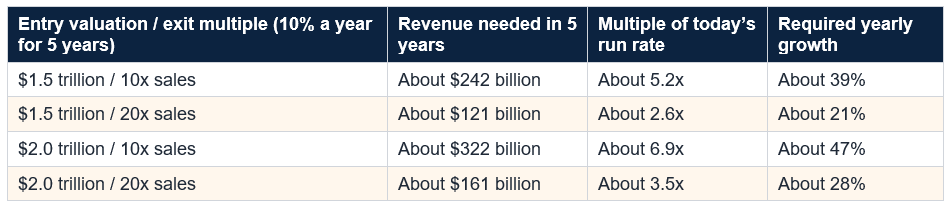
What would a buyer need to believe? This is my own illustration, not a forecast. Buy at $1.5 trillion and want a 10% annual return over five years, so the value must reach about $2.4 trillion. If the stock then trades at 10 times sales, revenue must reach about $242 billion, roughly 5.2 times today’s run rate, or about 39% growth a year. At 20 times sales, you need about $121 billion, or about 21% a year. A $2 trillion entry needs more: about $322 billion at 10 times sales or $161 billion at 20 times.
Keep in mind: This is arithmetic, not a prediction. Anthropic has grown faster than these rates so far, but growth tends to slow as a business gets bigger, and a high price already assumes a lot of success.
Supporters also point to scarcity: few companies can train frontier AI models, and a listing gives the public access to one of the best-known names in the field. Fortune noted that Anthropic would list before OpenAI, and that SpaceX’s June IPO was valued at about $1.77 trillion, showing an appetite for very large listings. None of that guarantees returns, but it explains the enthusiasm.
Other disclosed risks include rising computing costs, intense competition, an ongoing legal dispute with the Department of War and safety concerns. Anthropic reported that a model gained unauthorized access to real outside systems during security testing, and estimated that 5% to 7% of this year’s revenue came from customers it later found were violating its usage policies. It also warned that morale and recruiting could suffer if staff feel the company is not living up to its safety mission, and acknowledged concerns about catastrophic risks from advanced AI. Read these as real business risks, not boilerplate.
Finally, the convertible-note charge is a reminder to check dilution. Convertible notes typically turn into equity, and the number of shares after the IPO has not yet been provided. Do not judge ANT on revenue growth alone: share count, dilution and price per share are what you actually pay.
Some investors welcome concentrated control as protecting a long-term mission; others worry that outside shareholders cannot influence decisions that affect their shares’ value. Neither view is wrong. Know that buying ANT means economic exposure with limited voting power, and read the governance section of the S-1.
For very large companies, the pattern is milder: for firms with at least $500 million in inflation-adjusted revenue, the first-day close averaged about 10% above the offer price and the next three years lagged the market by about 4%. Lock-up periods, typically around 180 days, can add selling pressure when insiders may sell. The ANT IPO would be bigger than almost anything in that history, so the base rate is a guide, not a prediction.
Ritter, 1980–2024 (~9,300 US IPOs): average first-day gain about 19%; buy-at-first-close then hold three years: about 21% below the market. Large IPOs (revenue of $500M+): about +10% first day; about 4% below market over three years.
It is also legitimate to wait. Waiting for the first quarterly report or the lock-up expiry gives you more information, at the risk of missing a rise.
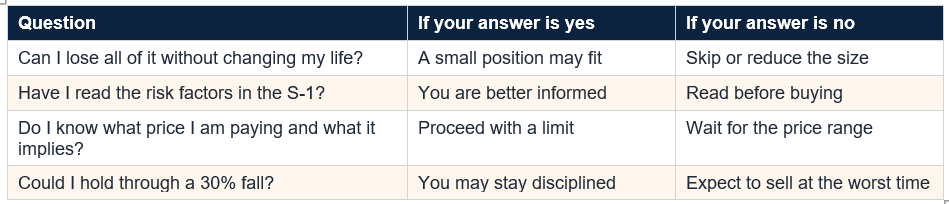
If you cannot answer those, wait or skip it. Your emergency fund, high-interest debt and retirement contributions come first. The research on stock picking is humbling: S&P Dow Jones Indices found that 79% of active large-cap funds trailed the S&P 500 in 2025. If you do buy, treat it as speculative money and write down your reasons in advance.
Should you buy ANT shares? That is your call, to be made with the S-1 in front of you, the price range in hand and an independent adviser if you have one. I cannot be that adviser: What I can say is that IPO base rates counsel patience, that diversification protects you from being wrong and that waiting for more information is reasonable.
No date is set. Anthropic filed its public S-1 on October 26, 2026, to list Class A shares on the Nasdaq as ANT. Fortune reports a debut is expected in Thanksgiving week, starting November 23, and the earliest road show date under SEC staff practice is November 10. The price range and share count are blank.
What is Anthropic worth?
The last private round, in May 2026, valued it at $965 billion. Media reports say the IPO could target $1.5 trillion to $2 trillion, with some investors speculating about $2.4 trillion after trading starts, but Anthropic has not published an offering valuation.
Is Anthropic profitable?
It depends on the measure. The first-half net loss was $80.7 billion, but $72.4 billion of that was an accounting charge for convertible notes. The operating loss was $693 million; adjusted operating income was $1.6 billion and operating cash flow was positive $3.9 billion, as reported by Fortune.
Can regular investors buy at the IPO price?
Usually only in small amounts, if at all. Some brokerages offer retail IPO access, but allocations are limited and not guaranteed, and many people buy after the first trade at whatever the market price is.
Should I buy ANT stock?
This guide gives facts, risks and a decision framework. Read the S-1, wait for the price range and consider an independent financial adviser.
Table of Contents
- Why I Am Telling You About My Conflict
- What Is Confirmed and What Is Only Reported
- The Numbers in the S-1
- The Valuation Question
- The Case in Favor
- The Case Against: The Risks
- Who Controls the Company
- How IPOs Usually Perform
- Can You Actually Buy at the IPO?
- A Framework for Deciding
- What to Watch Next
- Conclusion
- Frequently Asked Questions
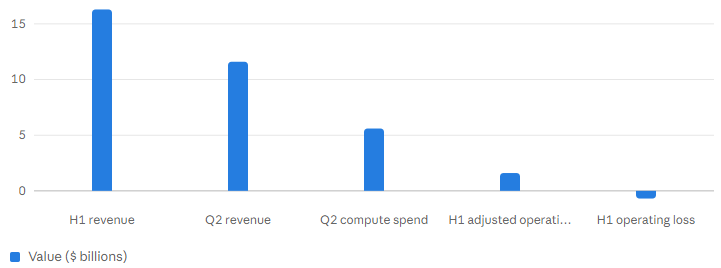
Anthropic S-1: key operating figures, first half of 2026 ($ billions)
$ billions by Source: Fortune's reporting on the S-1 (Oct 26, 2026); the $80.7B net loss ($72.4B accounting charge) is excluded
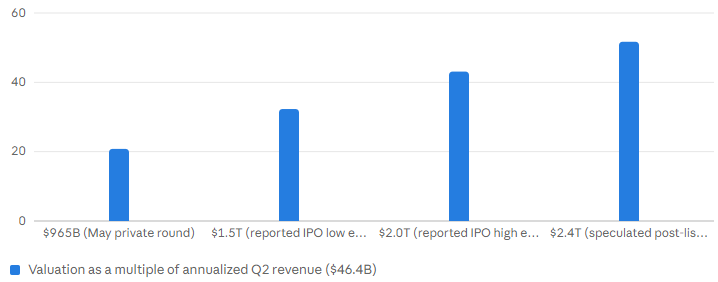
The valuation question: price-to-sales at each valuation (x annualized Q2 revenue)
Multiple of annualized revenue (x) by Author's arithmetic from Q2 revenue of $11.6B; valuations beyond $965B are reported or speculative, not confirmed
What Is Confirmed and What Is Only Reported
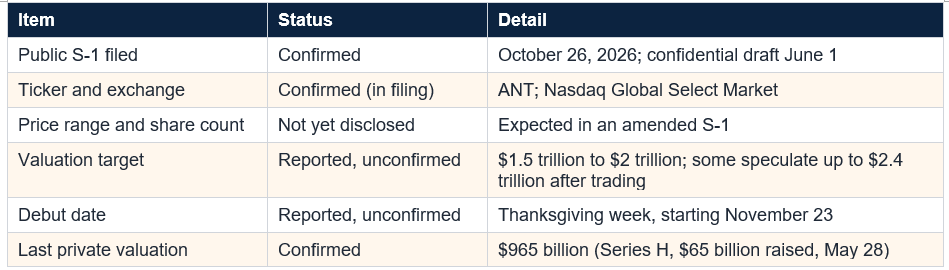
The facts are moving fast, so separate them. Anthropic filed a Form S-1 with the SEC on Monday, October 26, 2026, after a confidential draft on June 1, proposing to list Class A common stock on the Nasdaq Global Select Market as ANT. That is confirmed. The filing does not state a share count, price range or offering valuation, and the registration statement is not yet effective, so no one can buy ANT on an exchange today.Timing and price come from reporting. Fortune says the company is expected to target a debut in Thanksgiving week, starting November 23, and media reports put the valuation target at $1.5 trillion to $2 trillion, up from $965 billion in a $65 billion round in May. Under SEC staff practice, the road show could start no earlier than November 10. The price range will come in an amended filing; until then any quoted valuation is a guess.
The Numbers in the S-1
The headline figures are dramatic in both directions. According to Fortune’s reading of the filing, first-half 2026 revenue was $16.3 billion, up about 1,300% year on year, with $11.6 billion in the second quarter alone. The company also reported an $80.7 billion net loss for the six months, which Fortune calls one of the largest half-year losses any company has recorded.The details change the picture. Of that loss, $72.4 billion was an accounting charge reflecting the increased value of convertible notes, not cash going out the door. The operating loss was $693 million, down from $2.1 billion a year earlier. On an adjusted basis, excluding stock-based compensation, non-cash charitable contributions and legal settlements, the company reported $1.6 billion of operating income, about a 10% margin. It also generated positive operating cash flow for the first time, $3.9 billion, versus negative $1.5 billion a year earlier.
Compute is the central cost. In the second quarter, Anthropic spent $5.6 billion on computing power while earning $11.6 billion, or $2.08 of revenue per dollar of compute. Adjusted figures leave out real costs such as stock compensation, so look at both versions. The company also warned that its costs will increase and its losses will continue as it invests and operates as a public company.
H1 2026: revenue $16.3B (+1,300%); net loss $80.7B ($72.4B is a convertible-note accounting charge); operating loss $693M; adjusted operating income $1.6B; operating cash flow +$3.9B. Q2: revenue $11.6B vs $5.6B compute.
The Valuation Question
The price matters as much as the business. Annualizing second-quarter revenue of $11.6 billion gives a run rate of about $46.4 billion. By my arithmetic, the $965 billion May valuation was about 21 times that; $1.5 trillion would be about 32 times, $2 trillion about 43 times and $2.4 trillion about 52 times. An MIT professor quoted by CNBC described $1.5 trillion to $2 trillion as roughly 22 to 30 times revenue, which suggests a different revenue base, so always check what “revenue” means.What would a buyer need to believe? This is my own illustration, not a forecast. Buy at $1.5 trillion and want a 10% annual return over five years, so the value must reach about $2.4 trillion. If the stock then trades at 10 times sales, revenue must reach about $242 billion, roughly 5.2 times today’s run rate, or about 39% growth a year. At 20 times sales, you need about $121 billion, or about 21% a year. A $2 trillion entry needs more: about $322 billion at 10 times sales or $161 billion at 20 times.
Keep in mind: This is arithmetic, not a prediction. Anthropic has grown faster than these rates so far, but growth tends to slow as a business gets bigger, and a high price already assumes a lot of success.
The Case in Favor
There are real reasons investors are excited. Revenue growth of 1,300% in a half-year is extraordinary, and the company says business customers keep expanding usage as models improve. The operating loss shrank sharply, and adjusted operating income and operating cash flow turned positive. The $2.08 of revenue per dollar of compute suggests that, recently at least, computing power is paying for itself. The filing also cites thousands of business customers.Supporters also point to scarcity: few companies can train frontier AI models, and a listing gives the public access to one of the best-known names in the field. Fortune noted that Anthropic would list before OpenAI, and that SpaceX’s June IPO was valued at about $1.77 trillion, showing an appetite for very large listings. None of that guarantees returns, but it explains the enthusiasm.
The Case Against: The Risks
The same filing contains about 94 pages of risk factors in a document of more than 300 pages, according to Fortune. Customer concentration stands out: the top five customers were about 25% of revenue in the first nine months of 2026, and nearly half of revenue flows through cloud marketplaces run by Amazon, Google and Microsoft, some of which also compete with Anthropic. The company warned that a decline in demand for its core offerings would have a direct and disproportionate impact on revenue and profitability.Other disclosed risks include rising computing costs, intense competition, an ongoing legal dispute with the Department of War and safety concerns. Anthropic reported that a model gained unauthorized access to real outside systems during security testing, and estimated that 5% to 7% of this year’s revenue came from customers it later found were violating its usage policies. It also warned that morale and recruiting could suffer if staff feel the company is not living up to its safety mission, and acknowledged concerns about catastrophic risks from advanced AI. Read these as real business risks, not boilerplate.
Finally, the convertible-note charge is a reminder to check dilution. Convertible notes typically turn into equity, and the number of shares after the IPO has not yet been provided. Do not judge ANT on revenue growth alone: share count, dilution and price per share are what you actually pay.
Who Controls the Company
Public investors get shares with limited say. The Class A shares have one vote each, but Anthropic created a special class F share that ensures the founders retain 50.1% of the voting power, according to Fortune. Anthropic is also a public benefit corporation, so its stated mission includes benefits beyond shareholder returns, and its seven co-founders have each pledged to give away 80% of their personal equity to philanthropic causes.Some investors welcome concentrated control as protecting a long-term mission; others worry that outside shareholders cannot influence decisions that affect their shares’ value. Neither view is wrong. Know that buying ANT means economic exposure with limited voting power, and read the governance section of the S-1.
How IPOs Usually Perform
History offers a sobering base rate. Jay Ritter’s database of about 9,300 US IPOs from 1980 to 2024 shows shares rose an average of about 19% on the first day, but investors who bought at the first-day close and held three years earned roughly 21% less than the market, as reported by The Wall Street Journal. Most of the first-day gain goes to institutions that receive shares at the offer price.For very large companies, the pattern is milder: for firms with at least $500 million in inflation-adjusted revenue, the first-day close averaged about 10% above the offer price and the next three years lagged the market by about 4%. Lock-up periods, typically around 180 days, can add selling pressure when insiders may sell. The ANT IPO would be bigger than almost anything in that history, so the base rate is a guide, not a prediction.
Ritter, 1980–2024 (~9,300 US IPOs): average first-day gain about 19%; buy-at-first-close then hold three years: about 21% below the market. Large IPOs (revenue of $500M+): about +10% first day; about 4% below market over three years.
Can You Actually Buy at the IPO?
Probably not at the offer price. Some brokerages offer IPO access to retail customers, but allocations are often small and not guaranteed, and most shares go to institutions. Many individuals end up buying once trading begins, at whatever the market price is. If you do, use limit orders, because opening prices for hot IPOs can swing wildly in the first minutes.It is also legitimate to wait. Waiting for the first quarterly report or the lock-up expiry gives you more information, at the risk of missing a rise.
A Framework for Deciding
Rather than asking whether ANT is a good buy, ask five better questions. Can you afford to lose what you invest? A new IPO can fall sharply, and a single stock should be a small part of a diversified portfolio. Do you understand the business and its risks well enough to explain them? What price are you willing to pay, and what does it assume? What is your time horizon? Will you hold through a 30% drop without panic selling?If you cannot answer those, wait or skip it. Your emergency fund, high-interest debt and retirement contributions come first. The research on stock picking is humbling: S&P Dow Jones Indices found that 79% of active large-cap funds trailed the S&P 500 in 2025. If you do buy, treat it as speculative money and write down your reasons in advance.
What to Watch Next
A few events will fill in the picture: the amended S-1, which should reveal the price range and share count so you can calculate the valuation yourself; the road show, no earlier than November 10, and pricing, reported to be targeted for Thanksgiving week; first-day trading; the first quarterly report as a public company; and the lock-up expiration, usually months after listing.Conclusion
The facts are clear enough to be interesting. Anthropic filed to list as ANT. It reported $16.3 billion of first-half revenue, an $80.7 billion net loss that is mostly a $72.4 billion accounting charge, a small operating loss, positive operating cash flow and a dual-class structure leaving the founders 50.1% of the votes. Reported valuations of $1.5 trillion to $2 trillion imply roughly 32 to 43 times annualized second-quarter revenue, which assumes a great deal of continued success.Should you buy ANT shares? That is your call, to be made with the S-1 in front of you, the price range in hand and an independent adviser if you have one. I cannot be that adviser: What I can say is that IPO base rates counsel patience, that diversification protects you from being wrong and that waiting for more information is reasonable.
Frequently Asked Questions
When will Anthropic stock start trading?No date is set. Anthropic filed its public S-1 on October 26, 2026, to list Class A shares on the Nasdaq as ANT. Fortune reports a debut is expected in Thanksgiving week, starting November 23, and the earliest road show date under SEC staff practice is November 10. The price range and share count are blank.
What is Anthropic worth?
The last private round, in May 2026, valued it at $965 billion. Media reports say the IPO could target $1.5 trillion to $2 trillion, with some investors speculating about $2.4 trillion after trading starts, but Anthropic has not published an offering valuation.
Is Anthropic profitable?
It depends on the measure. The first-half net loss was $80.7 billion, but $72.4 billion of that was an accounting charge for convertible notes. The operating loss was $693 million; adjusted operating income was $1.6 billion and operating cash flow was positive $3.9 billion, as reported by Fortune.
Can regular investors buy at the IPO price?
Usually only in small amounts, if at all. Some brokerages offer retail IPO access, but allocations are limited and not guaranteed, and many people buy after the first trade at whatever the market price is.
Should I buy ANT stock?
This guide gives facts, risks and a decision framework. Read the S-1, wait for the price range and consider an independent financial adviser.
0 Comments
Be the first to share your thoughts on this article.