

Investing
Best AI Stocks to Buy in 2026: Smart Artificial Intelligence

Artificial intelligence is the catalyst for what many observers call a fourth industrial revolution. Here is a data-led look at the AI stocks worth researching right now. Nvidia quarterly revenue $115.8B (+103%); Q4 guide $130B; four big cloud firms spent $208.7B on capex in Q3 (+84%); 2026 capex estimates $720B to $828B; TSMC 2026 growth about 44%; semiconductor shares about 38% below June highs (Wells Fargo, as reported).
If you are hoping for a single "buy this" answer, I will disappoint you. Nobody can know which stock will win, and anyone who sounds certain is selling something. What I can do is lay out the companies at the centre of the AI build-out, show what their latest numbers say, and be straight about what could go wrong. Treat this post as a research starting list, not a shopping list.
Here is the picture on 18 November 2026. Nvidia reported revenue of $115.8 billion for its latest quarter, up 103% from a year earlier. TSMC lifted its 2026 revenue growth outlook to about 44%. The four biggest US cloud companies spent $208.7 billion on capital projects in the third quarter alone, up 84%. Demand for AI computing is clearly real.
But a booming business is not the same as a rising share price. Nvidia was down more than 14% for the year going into its report [8], and Wells Fargo analysts say semiconductor shares trade about 38% below their June highs [3]. Great companies can be rough stocks to hold.
Key takeaway: The AI story has strong evidence behind it, but the stocks are volatile and expectations are high. Spread your risk, know your time horizon, and never put in money you may need soon.
History offers a useful, if sobering, lesson from earlier waves (also general knowledge). The technology often changes the world, yet many investors who bought the early hype lost money, because prices ran ahead of profits. The railways and the internet both changed life and still produced painful crashes for shareholders.
The market has already lived a small version of this. After strong gains in 2025, "anything-but-AI" sentiment led to a selloff in many AI-related stocks in the first quarter of 2026. So the question is not whether AI matters. It is which businesses turn AI demand into profit, and at what price you are willing to join them.

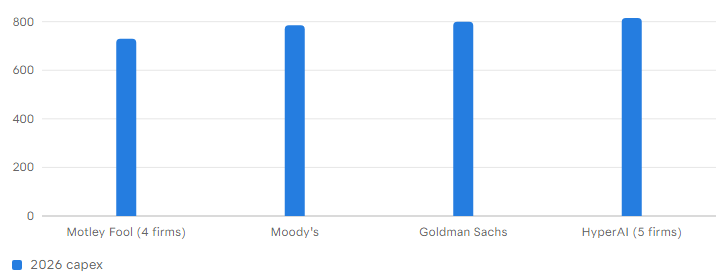
Looking ahead, Goldman projects about $1.2 trillion for 2027, a 50% to 54% jump, above a consensus of about $1.1 trillion. Moody's says spending is closing in on $1 trillion in 2027. A separate analysis argues that analysts have repeatedly underestimated this spending. I would treat all forward numbers as estimates that have so far been revised upwards, not as certainties.
Why this matters for stock picking: one company's capital spending is another company's revenue. Chipmakers, foundries and networking firms collect that money first. The cloud companies spend it and hope customers pay them back later. These two groups carry different risks, which is how I sort them below.
A word on sources. Many "best AI stocks" articles are written by authors who own the shares. For instance, the Motley Fool piece I cite on Nvidia, Amazon and Alphabet discloses that its author holds positions in all three. That does not make it wrong, but it is a reason to weigh it as opinion. The Insider Monkey list is a screen of stocks with large average analyst upside, not a set of recommendations.
The outlook is strong too. Nvidia guided fourth-quarter revenue to $130 billion and raised its fiscal 2028 growth outlook to 75% from 70%. My calculation puts the Q4 guide about 12% above Q3 (130 divided by 115.8). The guidance assumes no data centre compute revenue from China.
Nvidia usually beats its own guidance. It came in about 5% above the midpoint in each of the last four quarters, yet the share price fell the next day in three of those four. This time revenue was about 7% above its $108 billion forecast (my calculation: 115.8 divided by 108), and the stock rose about 3% in extended trading. One good reaction does not change the pattern: beating expectations is not the same as surprising the market.
Watch the margin. Gross margin was about 75% this quarter, but management guided to between 71% and 72% next quarter. Also note that this was the first report since Jensen Huang resigned as chief executive, with an interim CEO in place. Leadership changes add uncertainty. On valuation, the 2 November Fool article said Nvidia traded around 26 times trailing earnings and about 13 times next year's earnings. That was before the latest results and share price moves, so recheck current figures. Morningstar, in an early October update, rated Nvidia four stars with a wide moat and a very high uncertainty rating. Cheap on forecasts, but very sensitive if forecasts slip.
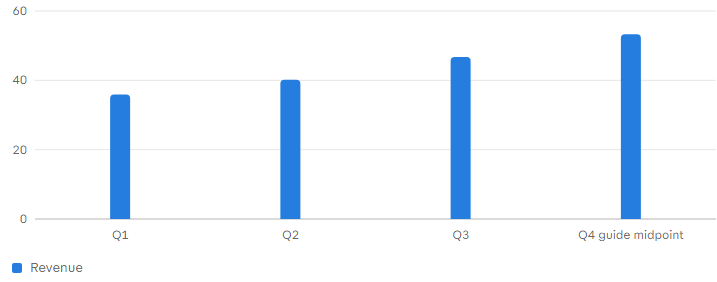
Quarterly revenue has stepped up all year: $35.9 billion in the first quarter, $40.2 billion in the second, $46.7 billion in the third, with $52.3 billion to $54.3 billion guided for the fourth. TSMC also said its AI accelerator revenue should grow at a mid-to-high-50s percent compound annual rate. The trade-offs: gross margin was 66.4%, and management accepts some margin dilution from the 2-nanometre ramp and overseas factories. TSMC is also a single point of concentration for the whole industry, which investors should weigh when thinking about geopolitical risk (general reasoning, not a sourced claim here).
That source is a lower-quality blog and its comparisons are its own arithmetic, so please verify against Broadcom's releases. What it does show is the direction: custom chips are growing quickly from a smaller base, and they give cloud companies an alternative to buying only from Nvidia. Broadcom typically reports its fiscal fourth quarter in December (general knowledge, check the date), which makes it the next big AI read-through after Nvidia.
The spending is large. Alphabet guided $195 billion to $205 billion for 2026, Amazon about $220 billion, Meta $135 billion to $145 billion, and Microsoft about $170 billion for the calendar year, down from about $190 billion in its April outlook because some third-party capacity arrived late. Amazon's chief executive said he expects to spend meaningfully more in 2027.
Morningstar has rated Microsoft and Taiwan Semiconductor among the top constituents of its AI index at four or five stars as of April, and Amazon four stars with a wide moat as of early October. Those are snapshots, not live ratings, so check the current figures. The key point for investors is that heavy spending can squeeze cash flow in the short term (general reasoning). These stocks are often easier to hold than pure chip names, because they have other large businesses, but the AI payoff is not guaranteed.
Another caution is the "circular" nature of some AI spending, where suppliers invest in customers who then buy from them. One analyst quoted in a market piece said the focus on circular spending highlights concerns that end-user demand has yet to fully emerge. That is a viewpoint, but it is a fair question to ask of any AI stock.
Sentiment swings are large. The same analysts say the recent selloff erased about $3 trillion from the S&P 500 and left semiconductor shares about 38% below June highs. By my calculation, a 38% fall turns $10,000 into $6,200. Can you sit through that? Regulation and local opposition are a factor too. Wells Fargo noted that Democratic midterm wins, including in states opposing new data centres, raised concerns that construction could slow and cost more. Customer concentration and China are further issues. The forecasts above cover only five or six buyers, so demand is concentrated, and Nvidia's guidance assumes no China data centre compute revenue. And margins can fall even when sales grow.
I would hold two thoughts at once: valuations are not extreme on current forecasts, and the forecasts depend on one fragile assumption, that the biggest buyers keep raising spending.
This section is general education. It is not personal advice. Know your time horizon. Money you need within a few years does not belong in a volatile sector. Money for ten years or more can ride out cycles more easily. Size your positions. As an example, if you hold $10,000 and put 5% ($500) in a single stock that falls 50%, you lose $250, or 2.5% of the portfolio (my calculation). A single stock at 40% of the portfolio would cost you $2,000 in the same fall. Consider a fund. A broad index fund already holds many of the names above, and a thematic AI fund spreads risk across more companies. Check the fund's top holdings and fees, because many AI funds are heavily concentrated in the same few stocks. Invest in steps. Buying in equal instalments over several months means you do not have to guess the top or the bottom. Use the right account. Depending on your country, tax-advantaged accounts such as an ISA or 401(k) can help, but rules vary, so check yours.
Mistakes I see often: buying because a stock is up, not because you understand it; assuming a great company is automatically a great stock at any price; putting too much in one name; ignoring the author's holdings when reading "best stock" lists; treating analyst price targets as promises; and checking prices daily, which makes calm decisions harder.
Another is mixing up headline numbers. Different outlets reported Nvidia's latest revenue differently, as I note below, and capex totals differ by source. Go to the company's own release when a figure matters.
There is no single answer. The names most often discussed are Nvidia, TSMC, Broadcom, Alphabet, Amazon and Microsoft, but whether any suits you depends on your goals and risk tolerance. Treat them as research candidates.
Is Nvidia still a buy after its latest earnings?
Nvidia reported $115.8 billion in revenue, up 103%, and guided to $130 billion. Whether that justifies buying depends on the price you pay and your risk appetite. Margins are guided lower, and the stock has often fallen after strong reports.
Is AI a bubble?
Nobody knows. Spending is huge and rising, and some analysts worry about circular financing and a possible peak in 2028. Others point to rising backlogs. Both views have evidence.
Should beginners buy individual AI stocks or a fund?
A broad fund spreads risk more widely and is simpler for most beginners. If you pick individual stocks, keep each position small and research each company yourself.
How much of my portfolio should go into AI?
There is no standard answer. It depends on your age, goals and other holdings. Many investors already own a lot of AI exposure through broad index funds, so check your total before adding more.
Table of Contents
- Why AI is called a fourth industrial revolution
- The money behind the boom
- How I sorted the AI stocks
- Nvidia: the engine room
- TSMC: the factory behind the chips
- Broadcom: custom chips and networking
- Alphabet, Amazon and Microsoft: the cloud platforms
- AI stocks to treat with extra care
- Side-by-side watchlist
- The risks nobody should skip
- What is already priced in?
- Conclusion
- FAQ
2026 hyperscaler capex estimates by source ($B, midpoints)
$ billions by Sources differ on which companies are counted; ranges midpointed (my calculation)
TSMC 2026 quarterly revenue ($B)
$ billions by Source: Xenospectrum; Q4 is the midpoint of $52.3B to $54.3B guidance
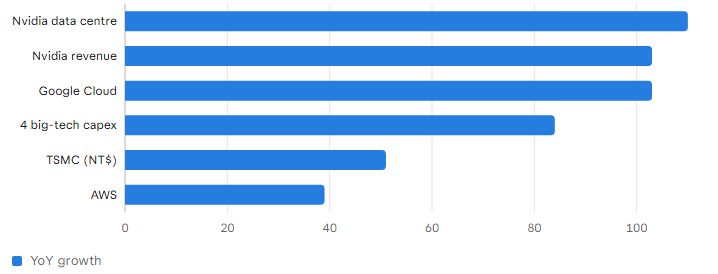
Latest year-on-year growth, AI-linked metrics (%)
% year on year by Sources: Nvidia, Motley Fool, Futurum/Tech-Insider; different measures, not like for likeIf you are hoping for a single "buy this" answer, I will disappoint you. Nobody can know which stock will win, and anyone who sounds certain is selling something. What I can do is lay out the companies at the centre of the AI build-out, show what their latest numbers say, and be straight about what could go wrong. Treat this post as a research starting list, not a shopping list.
Here is the picture on 18 November 2026. Nvidia reported revenue of $115.8 billion for its latest quarter, up 103% from a year earlier. TSMC lifted its 2026 revenue growth outlook to about 44%. The four biggest US cloud companies spent $208.7 billion on capital projects in the third quarter alone, up 84%. Demand for AI computing is clearly real.
But a booming business is not the same as a rising share price. Nvidia was down more than 14% for the year going into its report [8], and Wells Fargo analysts say semiconductor shares trade about 38% below their June highs [3]. Great companies can be rough stocks to hold.
Key takeaway: The AI story has strong evidence behind it, but the stocks are volatile and expectations are high. Spread your risk, know your time horizon, and never put in money you may need soon.
Why AI is called a fourth industrial revolution
The phrase "fourth industrial revolution" was popularised by the World Economic Forum around 2016 (general knowledge, not from this session's sources). The idea is that steam power, electricity and computing each reshaped the economy, and that AI, automation and connected systems are the next wave.History offers a useful, if sobering, lesson from earlier waves (also general knowledge). The technology often changes the world, yet many investors who bought the early hype lost money, because prices ran ahead of profits. The railways and the internet both changed life and still produced painful crashes for shareholders.
The market has already lived a small version of this. After strong gains in 2025, "anything-but-AI" sentiment led to a selloff in many AI-related stocks in the first quarter of 2026. So the question is not whether AI matters. It is which businesses turn AI demand into profit, and at what price you are willing to join them.
The money behind the boom
The simplest way to follow AI money is to follow the spending. The giant cloud companies, often called hyperscalers, are buying chips, building data centres and signing power contracts at a scale that has no recent precedent. The Motley Fool reports that Microsoft, Alphabet, Amazon and Meta spent $208.7 billion in the third quarter, up 84% from $113.4 billion a year earlier. Their combined 2026 guidance adds up to roughly $720 billion to $740 billion. Alphabet and Amazon both said they expect to spend meaningfully more in 2027. Other forecasters give different totals because they include different companies. That is the first source conflict to flag, and the table shows it.Looking ahead, Goldman projects about $1.2 trillion for 2027, a 50% to 54% jump, above a consensus of about $1.1 trillion. Moody's says spending is closing in on $1 trillion in 2027. A separate analysis argues that analysts have repeatedly underestimated this spending. I would treat all forward numbers as estimates that have so far been revised upwards, not as certainties.
Why this matters for stock picking: one company's capital spending is another company's revenue. Chipmakers, foundries and networking firms collect that money first. The cloud companies spend it and hope customers pay them back later. These two groups carry different risks, which is how I sort them below.
How I sorted the AI stocks
I sorted the stocks into two layers. The first is the "picks and shovels" group: the companies that sell the chips and manufacturing behind AI, such as Nvidia, TSMC and Broadcom. The second is the platform group: Alphabet, Amazon and Microsoft, which buy the hardware and rent AI computing to customers. For each, I looked at five things: recent revenue growth, profit margins, how dependent the company is on a few customers, how it is valued, and what could break the story. I did not use social media tips, and I did not include small speculative names as core ideas.A word on sources. Many "best AI stocks" articles are written by authors who own the shares. For instance, the Motley Fool piece I cite on Nvidia, Amazon and Alphabet discloses that its author holds positions in all three. That does not make it wrong, but it is a reason to weigh it as opinion. The Insider Monkey list is a screen of stocks with large average analyst upside, not a set of recommendations.
Nvidia: the engine room
Nvidia remains the reference point for AI hardware. On 17 November it reported third-quarter revenue of $115.8 billion, up 103% year on year and up 20% on the previous quarter. Data centre revenue was $107.6 billion, up 110%. By my calculation, data centre was about 93% of total revenue (107.6 divided by 115.8). GAAP net income was $65.3 billion, up 105%.The outlook is strong too. Nvidia guided fourth-quarter revenue to $130 billion and raised its fiscal 2028 growth outlook to 75% from 70%. My calculation puts the Q4 guide about 12% above Q3 (130 divided by 115.8). The guidance assumes no data centre compute revenue from China.
Nvidia usually beats its own guidance. It came in about 5% above the midpoint in each of the last four quarters, yet the share price fell the next day in three of those four. This time revenue was about 7% above its $108 billion forecast (my calculation: 115.8 divided by 108), and the stock rose about 3% in extended trading. One good reaction does not change the pattern: beating expectations is not the same as surprising the market.
Watch the margin. Gross margin was about 75% this quarter, but management guided to between 71% and 72% next quarter. Also note that this was the first report since Jensen Huang resigned as chief executive, with an interim CEO in place. Leadership changes add uncertainty. On valuation, the 2 November Fool article said Nvidia traded around 26 times trailing earnings and about 13 times next year's earnings. That was before the latest results and share price moves, so recheck current figures. Morningstar, in an early October update, rated Nvidia four stars with a wide moat and a very high uncertainty rating. Cheap on forecasts, but very sensitive if forecasts slip.
TSMC: the factory behind the chips
TSMC manufactures chips designed by Nvidia, Apple and many others, so it benefits from AI demand without needing to pick the winning chip design. That is the appeal of the "neutral supplier" idea. In its third quarter of 2026, TSMC reported revenue of about $46.7 billion, above the top of its guidance, with net income up nearly 69%. High-performance computing, which includes AI accelerators, made up 68% of revenue. Management raised the full-year 2026 revenue growth outlook to about 44% in US dollars.Quarterly revenue has stepped up all year: $35.9 billion in the first quarter, $40.2 billion in the second, $46.7 billion in the third, with $52.3 billion to $54.3 billion guided for the fourth. TSMC also said its AI accelerator revenue should grow at a mid-to-high-50s percent compound annual rate. The trade-offs: gross margin was 66.4%, and management accepts some margin dilution from the 2-nanometre ramp and overseas factories. TSMC is also a single point of concentration for the whole industry, which investors should weigh when thinking about geopolitical risk (general reasoning, not a sourced claim here).
Broadcom: custom chips and networking
Broadcom designs custom AI chips and the networking gear that links them. One analysis based on company filings says its AI semiconductor revenue rose 54% in a quarter, from $10.8 billion to $16.7 billion, in the quarter ended 2 August 2026. The same piece says that was about 19% of Nvidia's data centre revenue in the comparable quarter, though it notes the lines are not like for like.That source is a lower-quality blog and its comparisons are its own arithmetic, so please verify against Broadcom's releases. What it does show is the direction: custom chips are growing quickly from a smaller base, and they give cloud companies an alternative to buying only from Nvidia. Broadcom typically reports its fiscal fourth quarter in December (general knowledge, check the date), which makes it the next big AI read-through after Nvidia.
Alphabet, Amazon and Microsoft: the cloud platforms
Alphabet, Amazon and Microsoft are different. They are both big AI spenders and big AI sellers. Their question is whether customers will pay enough for AI services to justify the spending. There is evidence that they might. In the third quarter, Google Cloud revenue grew 103% and AWS grew 39%, with AWS accounting for 63% of Amazon's operating profit. Yet the same article notes Alphabet's stock fell more than 10% the day after earnings, because investors focused on the cost of the buildout.The spending is large. Alphabet guided $195 billion to $205 billion for 2026, Amazon about $220 billion, Meta $135 billion to $145 billion, and Microsoft about $170 billion for the calendar year, down from about $190 billion in its April outlook because some third-party capacity arrived late. Amazon's chief executive said he expects to spend meaningfully more in 2027.
Morningstar has rated Microsoft and Taiwan Semiconductor among the top constituents of its AI index at four or five stars as of April, and Amazon four stars with a wide moat as of early October. Those are snapshots, not live ratings, so check the current figures. The key point for investors is that heavy spending can squeeze cash flow in the short term (general reasoning). These stocks are often easier to hold than pure chip names, because they have other large businesses, but the AI payoff is not guaranteed.
AI stocks to treat with extra care
Some AI names carry much bigger forecasted upside, and bigger risk. In the Insider Monkey screen, SoundHound AI showed 186% average analyst upside but only 20 hedge fund holders, while Nvidia showed 83% upside with 285 holders. The list also includes Oracle at 90% average upside. A very large upside target can mean a beaten-down price, high uncertainty, or both. I read it as a prompt to ask "why is the gap so big?", not as a reason to buy. I covered Oracle's concentration in OpenAI in a separate post, and the lesson there applies broadly: when one customer is a large share of future revenue, the stock inherits that customer's risks.Another caution is the "circular" nature of some AI spending, where suppliers invest in customers who then buy from them. One analyst quoted in a market piece said the focus on circular spending highlights concerns that end-user demand has yet to fully emerge. That is a viewpoint, but it is a fair question to ask of any AI stock.
Side-by-side watchlist
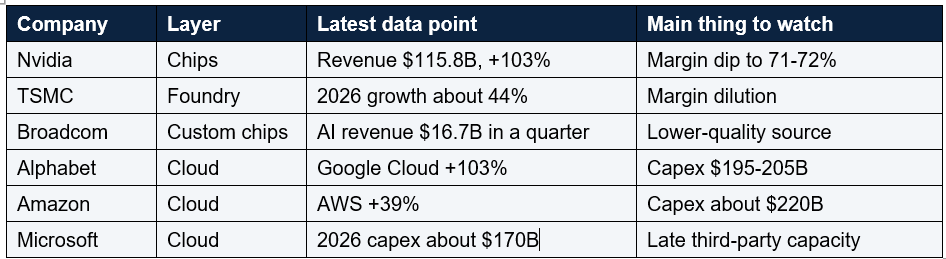
This table summarises the latest data points from the sources above. It is a research aid, not a ranking.
The risks nobody should skip
Every AI stock has a risk list. These are the ones I would not skip. The spending cycle could peak. Wells Fargo analysts say AI spending added about 8 percentage points to S&P 500 earnings growth over the past year and that the tailwind should continue in 2027, but they expect it to largely disappear in 2028 as spending growth slows and depreciation costs rise. They also flag an earnings downturn once capital spending peaks.Sentiment swings are large. The same analysts say the recent selloff erased about $3 trillion from the S&P 500 and left semiconductor shares about 38% below June highs. By my calculation, a 38% fall turns $10,000 into $6,200. Can you sit through that? Regulation and local opposition are a factor too. Wells Fargo noted that Democratic midterm wins, including in states opposing new data centres, raised concerns that construction could slow and cost more. Customer concentration and China are further issues. The forecasts above cover only five or six buyers, so demand is concentrated, and Nvidia's guidance assumes no China data centre compute revenue. And margins can fall even when sales grow.
What is already priced in?
Is the good news already in the price? Partly, and it depends on the stock. Wells Fargo says that at current prices semiconductor valuations imply only about 8% annual earnings growth [3], which is modest next to the growth rates above. That is why the firm moved its view on US AI infrastructure from negative to neutral. Nvidia's roughly 13 times next-year earnings, as of 2 November, tells a similar story. The market is not paying a bubble multiple for forecast earnings. But it is paying for the forecasts to come true, and revenue that has roughly doubled is hard to double again (general reasoning). If spending beats the $1.1 trillion consensus for 2027, suppliers benefit. If it merely peaks, they could be hit hard.I would hold two thoughts at once: valuations are not extreme on current forecasts, and the forecasts depend on one fragile assumption, that the biggest buyers keep raising spending.
This section is general education. It is not personal advice. Know your time horizon. Money you need within a few years does not belong in a volatile sector. Money for ten years or more can ride out cycles more easily. Size your positions. As an example, if you hold $10,000 and put 5% ($500) in a single stock that falls 50%, you lose $250, or 2.5% of the portfolio (my calculation). A single stock at 40% of the portfolio would cost you $2,000 in the same fall. Consider a fund. A broad index fund already holds many of the names above, and a thematic AI fund spreads risk across more companies. Check the fund's top holdings and fees, because many AI funds are heavily concentrated in the same few stocks. Invest in steps. Buying in equal instalments over several months means you do not have to guess the top or the bottom. Use the right account. Depending on your country, tax-advantaged accounts such as an ISA or 401(k) can help, but rules vary, so check yours.
Mistakes I see often: buying because a stock is up, not because you understand it; assuming a great company is automatically a great stock at any price; putting too much in one name; ignoring the author's holdings when reading "best stock" lists; treating analyst price targets as promises; and checking prices daily, which makes calm decisions harder.
Another is mixing up headline numbers. Different outlets reported Nvidia's latest revenue differently, as I note below, and capex totals differ by source. Go to the company's own release when a figure matters.
Conclusion
AI is a real and fast-growing force. Nvidia revenue doubled, TSMC is guiding to 44% growth [9], and the biggest cloud companies are spending at record rates. The chip suppliers collect that money first, and the cloud platforms hope to earn it back. But "best" depends on you. Strong businesses can fall hard when expectations are high, and analysts already worry about 2028. A sensible approach is to research a handful of quality names, keep position sizes modest, invest gradually, and keep a long time horizon. This post is education only, not advice.FAQ
What are the best AI stocks to buy right now?There is no single answer. The names most often discussed are Nvidia, TSMC, Broadcom, Alphabet, Amazon and Microsoft, but whether any suits you depends on your goals and risk tolerance. Treat them as research candidates.
Is Nvidia still a buy after its latest earnings?
Nvidia reported $115.8 billion in revenue, up 103%, and guided to $130 billion. Whether that justifies buying depends on the price you pay and your risk appetite. Margins are guided lower, and the stock has often fallen after strong reports.
Is AI a bubble?
Nobody knows. Spending is huge and rising, and some analysts worry about circular financing and a possible peak in 2028. Others point to rising backlogs. Both views have evidence.
Should beginners buy individual AI stocks or a fund?
A broad fund spreads risk more widely and is simpler for most beginners. If you pick individual stocks, keep each position small and research each company yourself.
How much of my portfolio should go into AI?
There is no standard answer. It depends on your age, goals and other holdings. Many investors already own a lot of AI exposure through broad index funds, so check your total before adding more.
0 Comments
Be the first to share your thoughts on this article.