

Credits
Financial Impact of Using Buy Now, Pay Later Credit Services

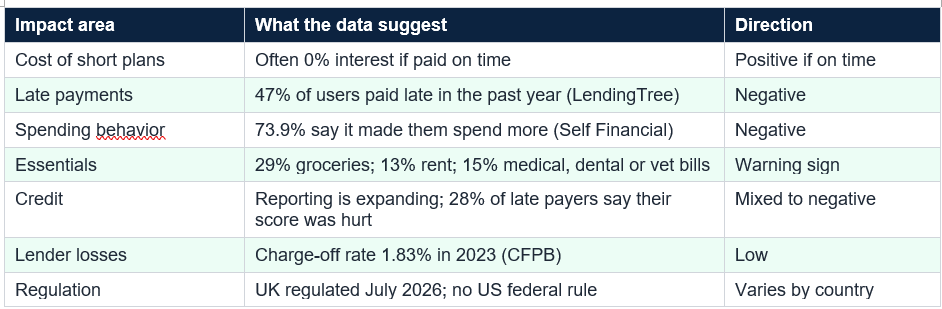
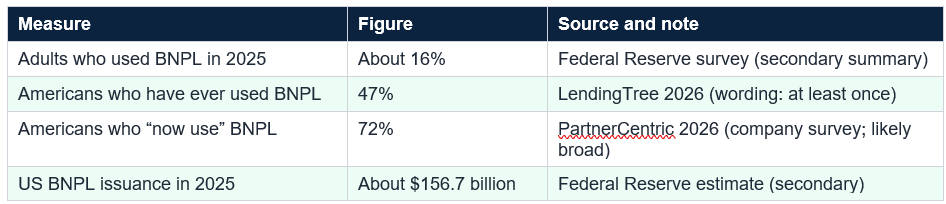
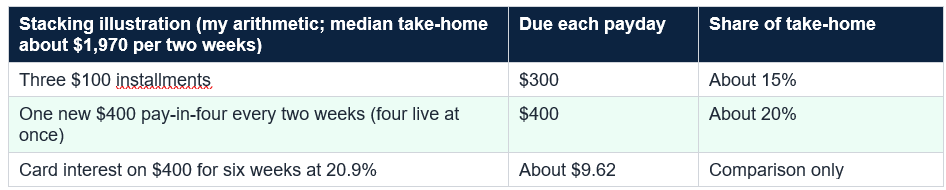
About 16% of US adults used BNPL in 2025 (Federal Reserve survey) with an estimated $156.7 billion of US issuance; 47% of users paid late in the past year in 2026, up from 41% in 2025 and 34% in 2024 (LendingTree); other surveys put missed payments at 24% (PartnerCentric) and 58.8% (Self Financial); CFPB charge-offs 1.83% in 2023, down from 2.63% in 2022. Everyday use: 29% of BNPL users have used it for groceries, up from 14% two years ago (38% of Gen Z); 13% for rent and 15% for medical, dental or veterinary bills; 73.9% in one survey say it made them spend more; the UK began regulating BNPL on July 15, 2026, while the US has no federal rule. My arithmetic: a $400 purchase in four $100 payments costs $0 if paid on time vs about $9.62 of card interest over six weeks at 20.9%, but one assumed $7 late fee on a $100 instalment is 7%; one new $400 pay-in-four purchase every two weeks means $400 due every payday, about 20% of median take-home pay; $1,200 over 12 months at 30% APR costs about $204 of interest.
This guide looks at the financial impact of BNPL on households: how common it is, what it does well, how often people pay late, what it does to spending, what stacking plans means for a budget, how it affects credit, when it carries interest and how regulation is changing. I rely on 2026 survey data and flag where numbers conflict, which on this topic they do, sometimes by a lot.
The safest reading is that a meaningful minority of adults use BNPL in any year, a much larger share has tried it and the share is rising. The sources agree on direction: more users, more categories and more dollars, with clothing, technology, travel and groceries the most common purchases in one survey. Whatever the exact count, it is no longer a niche product.
The lender side looks healthy too. The CFPB’s December 2025 report, as summarized, found charge-offs across the six providers it studied of 1.83% in 2023, down from 2.63% in 2022, and delinquency under 2%, which suggests most loans are repaid. But low charge-offs do not mean low stress for borrowers, who may still pay late fees or lean on BNPL to cover basics, which is why self-reported late payments are worth watching.
Short lapses can still cost money. Fees vary by provider and I did not retrieve their schedules, so my example uses an assumed $7 late fee: 7% of a $100 installment, which if one week late is the equivalent of about 364% APR, far above any card. A lapse is not a catastrophe, but a habit of lateness is a form of expensive borrowing.
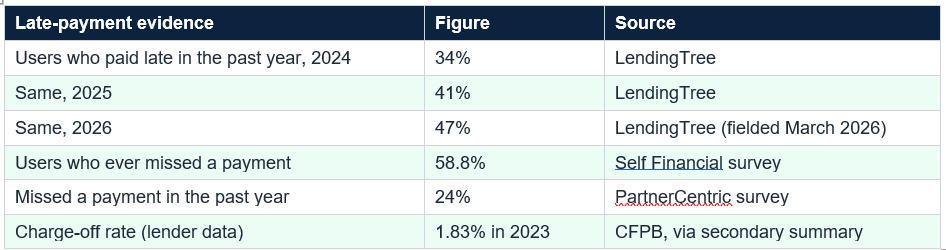
LendingTree: 47% of BNPL users paid late in the past year (41% in 2025, 34% in 2024). Other surveys: 24% to 58.8% missed a payment. CFPB lender data: charge-offs 1.83% in 2023, down from 2.63% in 2022. An assumed $7 fee on a $100 payment one week late is about 364% APR.
The extra spending is on credit: if BNPL turns a $100 purchase you would have skipped into four $25 payments, you have taken on a future obligation for something you did not plan to buy, and because each plan feels small, it is easy to lose track. The fix is to treat every installment plan as the full price today and ask whether you would buy it if you had to pay all at once.
With essentials, the payments come due whether or not your income stretches: the food is eaten but you still owe the money, and next month’s groceries need paying too, creating a treadmill. Bankrate’s finding that only 46% of Americans could cover three months of expenses explains why: with a thin cushion, a small shortfall turns into a new plan. If you are using BNPL for basics, treat it as an early warning and look for ways to adjust your budget or income.

That is the treadmill: to stop paying you must stop buying, and if your budget has no room, the only way to keep up is more plans. LendingTree’s report notes more users are carrying three or more at once. The cost is not only fee risk but lost flexibility, since money committed to old purchases cannot cover a car repair. Keep a list of every plan with its due dates and total, and do not add a new one until an old one is paid off.
In my general knowledge, scoring companies have been developing models that include BNPL data (not retrieved), so the rules are in flux. The safest assumption is that missed payments could hurt and on-time payments may not help. One source also says BNPL users carry an average of $871 more in credit card debt than non-users, which I could not verify; at 20.9% APR that would cost about $182 a year in interest.
In the UK, you should see more checks before approval and clearer routes to complain, which may reduce overuse. In the US, protections depend on the provider and state, so read the terms: due dates, late fees, what happens after a missed payment and how disputes and returns work. Whatever the rules, the responsibility to budget stays with you.
If you are struggling, act early: contact the provider before a missed payment and ask about hardship options, stop taking new plans, list every plan and prioritize essentials. Non-profit credit counselors can help, and a modest emergency fund prevents the next shortfall from becoming the next plan. Avoid paying BNPL with a high-rate card or loan unless it truly lowers your cost.
List every BNPL plan you have: the merchant, the amount left, the next due date and the payment. If the total surprises you, stop adding new ones until it falls.
Common mistakes include treating installments as free money, taking several plans at once, using BNPL for groceries or rent, forgetting due dates, not checking the APR on longer plans, assuming it cannot affect credit and covering a missed payment with a credit card. The best defense is a simple rule: if you would not buy it with cash today, do not buy it with installments.
The UK began regulating BNPL on July 15, 2026, while the US has no federal rule, so protection depends on where you live. Use BNPL deliberately: one plan at a time, autopay, no essentials, and check the APR on longer plans. If you are leaning on it to get through the month, treat that as a signal to adjust your budget and build a cushion; a non-profit credit counselor can help if payments feel unmanageable.
It depends on how it is used. Short, interest-free plans paid on time can be a convenient budgeting tool, and the CFPB reported charge-off rates of 1.83% in 2023. But LendingTree’s 2026 survey found 47% of users paid late in the past year, and many surveys link BNPL to overspending and use for groceries and rent, which are signs of strain. The danger is stacking several plans you cannot comfortably repay.
Does BNPL hurt your credit score?
It can, increasingly. Many short plans did not report to credit bureaus, but reporting is expanding, and one 2026 survey found 28% of users who missed a payment said it hurt their credit score. Most pay-in-four plans typically do not require a hard credit check, according to one source. Rules vary by provider, so read the terms and check whether yours reports.
How many people use buy now, pay later?
It depends on the survey. The Federal Reserve survey found about 16% of US adults used BNPL in 2025, while LendingTree found 47% of Americans have used it at least once and PartnerCentric reported 72% use it now. The differences come from wording and samples, such as use in the past year versus ever. Treat the Fed’s figure as the most conservative.
Is BNPL regulated?
In the UK, yes: the FCA began regulating BNPL on July 15, 2026, with affordability checks, disclosures and access to the Financial Ombudsman Service. The EU’s Consumer Credit Directive II applies from November 2026 and Australia regulated BNPL in 2025. In the US there is no federal BNPL rule after the CFPB withdrew its 2024 interpretation, though some states such as New York have their own rules.
What should I do if I am struggling with BNPL payments?
Contact the provider before a payment is missed and ask about hardship options, stop taking new plans, list every plan with its due dates and amounts and prioritize essentials such as housing and food. Non-profit credit counselors can help. Avoid covering BNPL payments with high-interest debt. This is general education, not personal advice.
Table of Contents
- From Checkout Convenience to Household Debt
- The Short Answer
- How Big Is Buy Now, Pay Later?
- The Upside: What BNPL Does Well
- Late Payments and Fees
- Spending More Than Planned
- When Essentials Go on Installments
- The Stacking Math
- Effects on Your Credit
- When BNPL Charges Interest
- Rules and Protections
- How to Use BNPL Safely
- Common Mistakes
- Conclusion
- Frequently Asked Questions
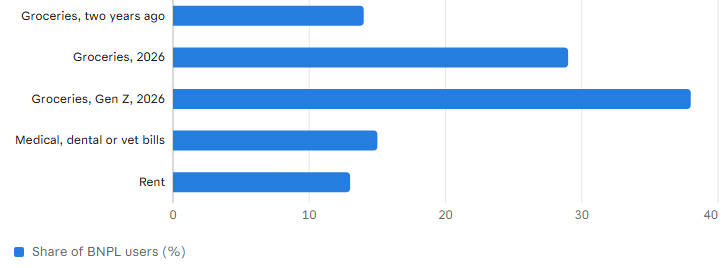
When essentials go on installments: what BNPL users have paid for (%)
% of BNPL users by LendingTree 2026 report via NewsNation; self-reported; shares of BNPL users who have ever used it for each purpose
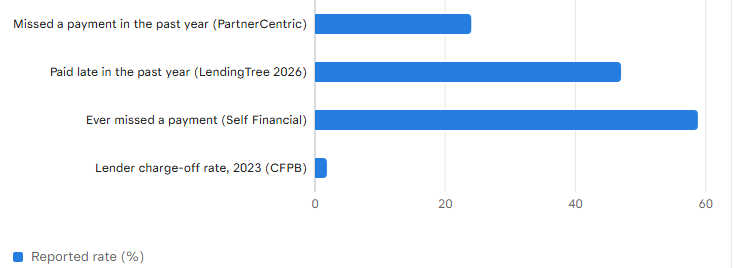
Why the numbers conflict: late payments by survey vs. lender charge-offs (%)
% by Company surveys use different wording and samples; the CFPB figure is lender loan-level data (via a secondary summary) and measures dollars written off, not late payments
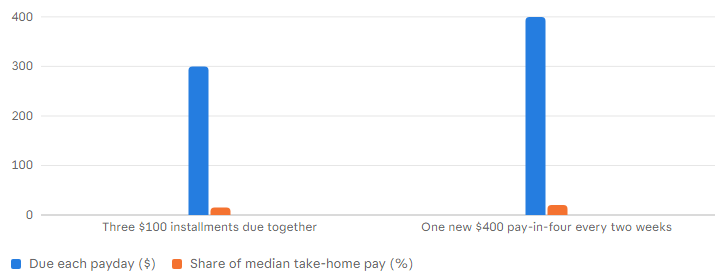
The stacking math: BNPL payments due each payday vs. share of median take-home pay
Dollars due ($) and percent of pay (%) by Author's arithmetic: $64,064 median salary; take-home about 80% of gross, about $1,970 per two weeks; hypothetical; dollars and percent shown on one axis
From Checkout Convenience to Household Debt
A few years ago, buy now, pay later was a button at the checkout for a pair of sneakers. Today it is on takeout orders, concert tickets, groceries and even rent. The pitch is simple: split the cost into a few small payments, usually without interest, and walk away with what you want today. For many people, used carefully, it works as advertised; for a growing number, it has become a way of getting through the month.This guide looks at the financial impact of BNPL on households: how common it is, what it does well, how often people pay late, what it does to spending, what stacking plans means for a budget, how it affects credit, when it carries interest and how regulation is changing. I rely on 2026 survey data and flag where numbers conflict, which on this topic they do, sometimes by a lot.
The Short Answer
BNPL can be cheap and convenient when you use one short plan, pay on time and would have bought the item anyway. But many users struggle: LendingTree found 47% paid late in the past year, up from 34% in 2024; 29% have used it for groceries, double the share two years ago; and one survey found 73.9% say it made them spend more. Lender losses are low, with CFPB charge-offs of 1.83% in 2023, so the strain shows up in late fees, stacked payments and credit effects more than in outright defaults. The impact depends almost entirely on how you use it.
How Big Is Buy Now, Pay Later?
It depends on how you ask. The Federal Reserve’s survey found about 16% of US adults used BNPL in 2025, with an estimated $156.7 billion of US issuance, per a secondary summary of Fed data. LendingTree found 47% of Americans have used a BNPL service at least once, and PartnerCentric’s 2026 survey reported that 72% now use it. The numbers conflict because of wording and samples: “used in the past year” is far narrower than “ever used,” and company surveys skew toward active users.The safest reading is that a meaningful minority of adults use BNPL in any year, a much larger share has tried it and the share is rising. The sources agree on direction: more users, more categories and more dollars, with clothing, technology, travel and groceries the most common purchases in one survey. Whatever the exact count, it is no longer a niche product.
The Upside: What BNPL Does Well
Start with the benefits. A typical pay-in-four plan splits a purchase into four equal payments, often every two weeks, with no interest, and most do not require a hard credit inquiry, according to one source. Compared with a credit card at about 20.9% APR, that can be cheaper: in my arithmetic, a $400 purchase carried on a card for six weeks would cost about $9.62 in interest if paid at the end, while four $100 payments on time cost nothing extra.The lender side looks healthy too. The CFPB’s December 2025 report, as summarized, found charge-offs across the six providers it studied of 1.83% in 2023, down from 2.63% in 2022, and delinquency under 2%, which suggests most loans are repaid. But low charge-offs do not mean low stress for borrowers, who may still pay late fees or lean on BNPL to cover basics, which is why self-reported late payments are worth watching.
Late Payments and Fees
The warning sign is lateness. LendingTree’s annual survey found 34% of BNPL users paid late in 2024, 41% in 2025 and 47% in 2026, the highest on record. A second survey found 58.8% had missed a payment at least once, while PartnerCentric found 24% had missed one in the past year; the numbers differ by sample and wording, but the direction of the best-tracked survey is clear. Another source notes 72% of late payers were about a week late at most, so many lapses are short.Short lapses can still cost money. Fees vary by provider and I did not retrieve their schedules, so my example uses an assumed $7 late fee: 7% of a $100 installment, which if one week late is the equivalent of about 364% APR, far above any card. A lapse is not a catastrophe, but a habit of lateness is a form of expensive borrowing.
LendingTree: 47% of BNPL users paid late in the past year (41% in 2025, 34% in 2024). Other surveys: 24% to 58.8% missed a payment. CFPB lender data: charge-offs 1.83% in 2023, down from 2.63% in 2022. An assumed $7 fee on a $100 payment one week late is about 364% APR.
Spending More Than Planned
The second impact is on behavior. In Self Financial’s survey, 73.9% of people who had used BNPL said it made them spend more than they otherwise would, and another compilation puts the share at about two-thirds. That fits what psychologists call the pain of paying: splitting a price into small pieces makes it feel smaller, so people buy more or sooner. These are company surveys and self-reports, but the pattern is familiar.The extra spending is on credit: if BNPL turns a $100 purchase you would have skipped into four $25 payments, you have taken on a future obligation for something you did not plan to buy, and because each plan feels small, it is easy to lose track. The fix is to treat every installment plan as the full price today and ask whether you would buy it if you had to pay all at once.
When Essentials Go on Installments
The most worrying trend is what people are buying. LendingTree found 29% of BNPL users had used it for groceries in 2026, up from 14% two years earlier, and 38% among Gen Z; 13% had used it for rent and 15% for medical, dental or veterinary bills. A separate summary reported that more than half of users say they could not manage without it. Installments for a sofa are a choice; for groceries they are often a sign that cash flow is tight.With essentials, the payments come due whether or not your income stretches: the food is eaten but you still owe the money, and next month’s groceries need paying too, creating a treadmill. Bankrate’s finding that only 46% of Americans could cover three months of expenses explains why: with a thin cushion, a small shortfall turns into a new plan. If you are using BNPL for basics, treat it as an early warning and look for ways to adjust your budget or income.
The Stacking Math
Stacking, carrying several plans at once, makes BNPL expensive in a different way: it consumes your paycheck. Suppose a worker earns the US median full-time salary of $64,064, about $2,464 gross every two weeks and, in my rough estimate, about $1,970 take-home. Three $100 installments due on one payday is $300, about 15% of take-home pay; and one new $400 pay-in-four purchase every two weeks means $100 for the new purchase and $100 for each of three earlier ones, $400 in all, about 20% of take-home pay, before rent or groceries.That is the treadmill: to stop paying you must stop buying, and if your budget has no room, the only way to keep up is more plans. LendingTree’s report notes more users are carrying three or more at once. The cost is not only fee risk but lost flexibility, since money committed to old purchases cannot cover a car repair. Keep a list of every plan with its due dates and total, and do not add a new one until an old one is paid off.
Effects on Your Credit
For years, the standard line was that BNPL does not touch your credit, and that is changing. Most pay-in-four loans do not require a hard inquiry, according to one source, but providers are expanding credit reporting. In PartnerCentric’s survey, 28% of users who missed a payment in the past year said it hurt their credit score, and credit reporting is leading one in six users to use BNPL less; an older article found 62% wrongly believed BNPL builds credit, because most services did not then report on-time payments.In my general knowledge, scoring companies have been developing models that include BNPL data (not retrieved), so the rules are in flux. The safest assumption is that missed payments could hurt and on-time payments may not help. One source also says BNPL users carry an average of $871 more in credit card debt than non-users, which I could not verify; at 20.9% APR that would cost about $182 a year in interest.
When BNPL Charges Interest
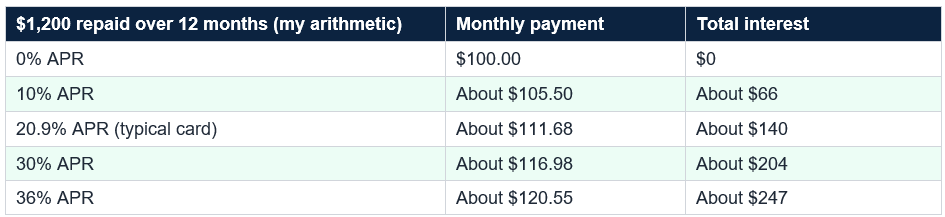
Not all BNPL is interest-free. Longer plans, often for bigger purchases, can carry interest, and in my general knowledge some charge up to 36% APR (not retrieved). In my illustration, $1,200 repaid over 12 months costs $0 at 0%, about $66 at 10%, about $140 at 20.9% (a typical card rate), about $204 at 30% and about $247 at 36%. Check the APR and total cost before accepting a longer plan, since it works like a personal loan.
Rules and Protections
Regulation is diverging by country. In the UK, the Financial Conduct Authority began regulating BNPL on July 15, 2026, with affordability checks, standardized disclosures, Consumer Duty obligations and access to the Financial Ombudsman Service, according to several sources. The EU’s Consumer Credit Directive II applies from November 2026, and Australia regulated BNPL in 2025. In the US there is no federal rule after the CFPB withdrew its 2024 interpretation treating BNPL like credit cards, though some states, such as New York, have their own.In the UK, you should see more checks before approval and clearer routes to complain, which may reduce overuse. In the US, protections depend on the provider and state, so read the terms: due dates, late fees, what happens after a missed payment and how disputes and returns work. Whatever the rules, the responsibility to budget stays with you.
How to Use BNPL Safely
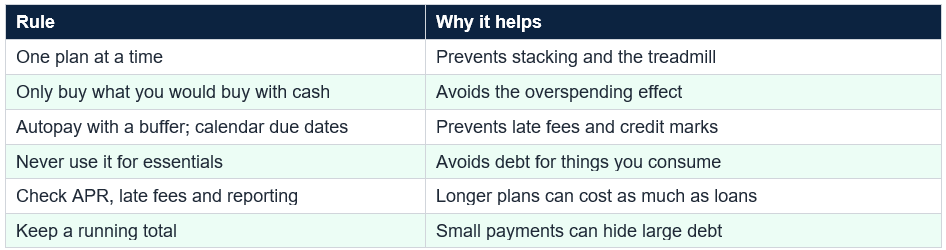
A few rules keep BNPL on the useful side. Use only one plan at a time, buy only what you would purchase with cash today, turn on autopay with a buffer and put every due date in a calendar, avoid BNPL for groceries, rent and other essentials, check the APR and late fees before you accept and keep a total of everything you owe, so small payments do not hide a large number.If you are struggling, act early: contact the provider before a missed payment and ask about hardship options, stop taking new plans, list every plan and prioritize essentials. Non-profit credit counselors can help, and a modest emergency fund prevents the next shortfall from becoming the next plan. Avoid paying BNPL with a high-rate card or loan unless it truly lowers your cost.
List every BNPL plan you have: the merchant, the amount left, the next due date and the payment. If the total surprises you, stop adding new ones until it falls.
Common mistakes include treating installments as free money, taking several plans at once, using BNPL for groceries or rent, forgetting due dates, not checking the APR on longer plans, assuming it cannot affect credit and covering a missed payment with a credit card. The best defense is a simple rule: if you would not buy it with cash today, do not buy it with installments.
Conclusion
Buy now, pay later is neither a trap nor a free lunch. Used for one planned purchase and paid on time, an interest-free plan can beat a card at about 20.9% and cost nothing extra. But the 2026 data show strain: 47% of users paid late in the past year, up from 34% in 2024; 29% have used it for groceries and 13% for rent; one survey found 73.9% spent more because of it; and stacking a few plans can take 15% to 20% of take-home pay. Lender losses are low, so the pain falls on households through fees, lost flexibility and credit effects.The UK began regulating BNPL on July 15, 2026, while the US has no federal rule, so protection depends on where you live. Use BNPL deliberately: one plan at a time, autopay, no essentials, and check the APR on longer plans. If you are leaning on it to get through the month, treat that as a signal to adjust your budget and build a cushion; a non-profit credit counselor can help if payments feel unmanageable.
Frequently Asked Questions
Is buy now, pay later bad for your finances?It depends on how it is used. Short, interest-free plans paid on time can be a convenient budgeting tool, and the CFPB reported charge-off rates of 1.83% in 2023. But LendingTree’s 2026 survey found 47% of users paid late in the past year, and many surveys link BNPL to overspending and use for groceries and rent, which are signs of strain. The danger is stacking several plans you cannot comfortably repay.
Does BNPL hurt your credit score?
It can, increasingly. Many short plans did not report to credit bureaus, but reporting is expanding, and one 2026 survey found 28% of users who missed a payment said it hurt their credit score. Most pay-in-four plans typically do not require a hard credit check, according to one source. Rules vary by provider, so read the terms and check whether yours reports.
How many people use buy now, pay later?
It depends on the survey. The Federal Reserve survey found about 16% of US adults used BNPL in 2025, while LendingTree found 47% of Americans have used it at least once and PartnerCentric reported 72% use it now. The differences come from wording and samples, such as use in the past year versus ever. Treat the Fed’s figure as the most conservative.
Is BNPL regulated?
In the UK, yes: the FCA began regulating BNPL on July 15, 2026, with affordability checks, disclosures and access to the Financial Ombudsman Service. The EU’s Consumer Credit Directive II applies from November 2026 and Australia regulated BNPL in 2025. In the US there is no federal BNPL rule after the CFPB withdrew its 2024 interpretation, though some states such as New York have their own rules.
What should I do if I am struggling with BNPL payments?
Contact the provider before a payment is missed and ask about hardship options, stop taking new plans, list every plan with its due dates and amounts and prioritize essentials such as housing and food. Non-profit credit counselors can help. Avoid covering BNPL payments with high-interest debt. This is general education, not personal advice.
0 Comments
Be the first to share your thoughts on this article.