

Credits
You Probably Won’t Hit 850. Here’s the Credit Score to Chase

Who has what (Experian, June 2026; FICO, April 2026): 1.71% have a perfect 850 (about 1 in 58); 22.9% have 800 or higher per Experian (24.8% per FICO); the average FICO Score is 713–714; 18.2% score below 600. What the tiers pay: Experian’s October 2026 table shows 30-year mortgage rates of 7.78% at 700, 7.54% at 760 and 7.46% at 780, 800 and 820; on a loan of about $280,000 the payments are $2,012, $1,965 and $1,950. Auto lenders’ super prime tier (781–850) averages about 4.7%–5.1% on new cars against about 6.3%–6.9% for prime. My arithmetic: 700 to 760 saves about $47 a month ($16,900 over 30 years) while 760 to 800 saves about $15 a month ($5,400); super prime versus prime on a $35,000, five-year auto loan saves about $26–$30 a month ($1,560–$1,780); only about 7.5% of people with an 800-plus score have an 850; a $5,000 card balance at 21% costs about $1,050 a year.
The good news: the number you need is much lower. The article behind this post’s headline argues that 800, not 850, is the score to aim for, because at 800 lenders give you their best rates and you can likely qualify for nearly any credit card. The data mostly agree, with a twist: the best rates often start closer to 780 than 800, and different loans use different cutoffs. This guide checks the claim against Experian and myFICO data, shows what each tier saves in dollars and explains how to get there.
So 800 is not exotic: nearly one person in four has reached it, and only about 7.5% of people with an 800-plus score have an 850 in my arithmetic. The gap between 800 and 850 is small in practice and mostly reflects tiny differences, such as slightly higher utilization or a younger account, not a difference in creditworthiness that lenders price.
Experian (June 2026): 1.71% have an 850; 22.9% have 800+; average 713. FICO (April 2026): 24.8% at 800–850; average 714. Mortgage (Experian, Oct 2026): 30-year 7.78% at 700, 7.54% at 760, 7.46% at 780, 800 and 820. Auto: super prime (781+) about 4.7%–5.1% on new cars vs about 6.3%–6.9% for prime.
Other sources show different rate levels but a similar pattern: myFICO sample data show 6.70% for 760 to 850 against 6.95% for 700 to 759, and a myFICO-based ConsumerAffairs table shows 7.39% against 7.61%, gaps of about 0.22 to 0.25 percentage points. The absolute rates differ because of dates, loan sizes and assumptions, so use the gaps, not the levels. Some sources put the best tier at 740 or 760, and pricing also depends on down payment and loan type (general knowledge). The lesson is consistent: the step from the 700s to 760-plus matters, and the step above is small.
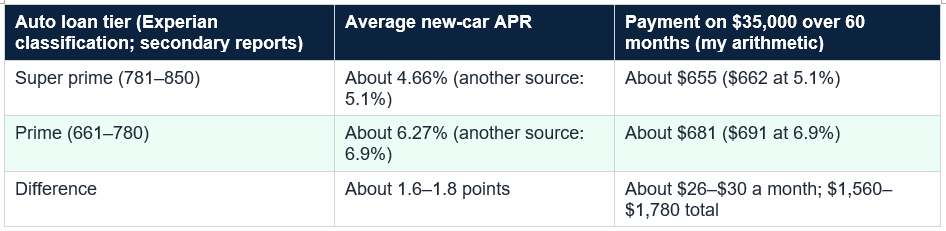
On a $35,000 five-year loan, 4.66% instead of 6.27% saves about $26 a month, or about $1,560 in interest, and 5.1% versus 6.9% saves about $30 a month, or about $1,780 (my arithmetic). That is real money and the best argument for reaching the 780s before you shop for a car. It is also why 800 is a useful target: it sits just above the 781 line, leaving a buffer for score differences between the version your lender uses and the one you check.
That is why card habits dwarf score gains. A $5,000 balance costs about $1,050 a year at 21%, or $850 at 17%, so a rate cut of a few points saves less than simply paying the balance. A high score helps you get approved for better rewards, but the surest benefit is paying in full each month, which also keeps utilization low, the factor that helps your score most after payment history.
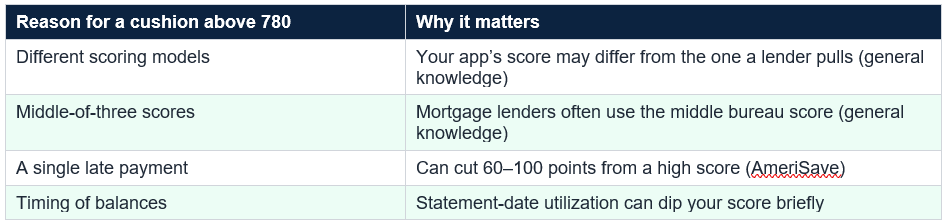
It also protects you from slips. A single 30-day late payment can drop a high score by 60 to 100 points, according to AmeriSave, taking an 800 to between 700 and 740 and costing you the best tier. At 800 you have room for a small mistake, a new inquiry or a balance that spikes before the statement date. That is the sense in which a higher score is “extra breathing room,” as the article puts it: the room has real value, but the value flattens above the best tier.
The rest is patience. Keep your oldest accounts open, open new ones only when you need them, do not take on debt for credit mix (only 10%), check your reports for errors and dispute them using the free reports available from the bureaus (general knowledge), and pay balances before statement dates to lower reported utilization. High scores are built over years, so steady habits beat quick fixes, and if you are far below 700 the first goals are on-time payments and lower balances, not 800.
Pull your free credit reports, check them for errors, set autopay for at least the minimum on every account and list each card’s balance against its limit. Aim to get every card under 10% before the statement closes.
The better use of your attention is what saves real money: paying cards in full, shopping several lenders for a mortgage or car loan, since offers vary, and avoiding new debt before a major loan application. A lender with a lower rate at 760 can beat one with a higher rate at 850, so shopping around saves more than a higher score once you are in the top tier.
Common mistakes include assuming you need 850, assuming one cutoff applies to all loans, trusting an app score as the score a lender will use, closing old cards, missing a payment before a big loan, applying for several credit lines before a mortgage and carrying card balances while trying to raise a score. Most of what helps is free and boring: pay on time, use little of your limits and wait.
So aim for the high 700s, treat 800 as a cushion against score differences and mistakes and put your effort into habits that matter: on-time payments, low utilization, paying cards in full and shopping lenders. The article is right that 800 is the number to remember, with the nuance that the best rates may start a little earlier. Check your own reports, compare offers and let the score serve your goals, not become one.
About 1.71% of Americans with a credit file had a FICO Score of 850 as of June 2026, according to Experian, roughly one in 58. Experian also reports that 22.9% have a score of 800 or higher, while FICO’s own April 2026 data puts the 800-plus share at 24.8%. The average FICO score is about 714, per FICO, or 713 per Experian.
Is an 800 credit score really where the best rates start?
Close, but the cutoff is a little lower for most loans. Experian’s October 2026 mortgage table shows the same 30-year rate (7.46%) at 780, 800 and 820, versus 7.54% at 760 and 7.78% at 700. Auto lenders’ top “super prime” tier starts at 781. So 780 to 800 is the practical target, and 800 gives you a cushion for score differences between models and for a small slip.
How much does a higher score save on a mortgage?
Most of the savings come from moving from the 700s to the high 700s, not from 800 to 850. In Experian’s example for a loan of about $280,000, the monthly payment is about $2,012 at 700, $1,965 at 760 and $1,950 at 800, so 700 to 760 saves about $47 a month and 760 to 800 only about $15. Other sources show different rate levels but a similar gap of roughly 0.2 to 0.25 percentage points between the 700s and 760-plus.
Do I need an 800 score to get a good credit card?
Usually not. In my general knowledge, many premium rewards cards approve applicants in the high 600s to mid 700s, depending on income and history, and the card’s interest rate depends on more than score (the average APR is about 21%). What matters more is paying in full: carrying a $5,000 balance at 21% costs about $1,050 a year, which dwarfs any gain from a few more points. This is general education, not personal advice.
What is the fastest way to raise my score?
Pay every bill on time, since payment history is about 35% of a FICO score, and reduce revolving balances, since amounts owed is about 30%. Many sources suggest keeping utilization below 30% overall and under about 10% for the cleanest score. Avoid unnecessary new accounts, keep old ones open, check your reports for errors and give changes time to show up, since high scores are built over years.
Table of Contents
- The Perfect Score Myth
- The Short Answer
- Who Has What Score
- Mortgages: Where the Score Pays Most
- Auto Loans: A Different Cutoff
- Credit Cards: Approval Is Not Price
- Why 800 Is Still a Smart Target
- How to Get to 800
- Is Chasing 850 Worth It?
- Conclusion
- Frequently Asked Questions
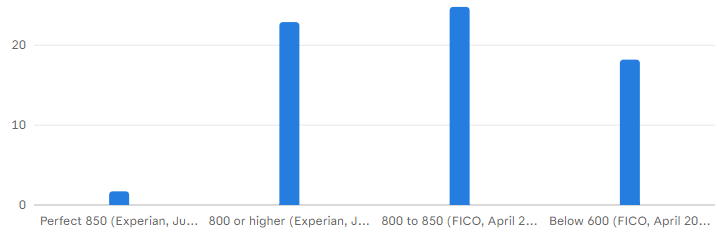
How rare is perfect? Share of Americans at each credit score level (%)
Share of consumers (%) by Experian FICO Score 8 data (June 2026): 1.71% have an 850 (about 1 in 58), 22.9% have 800+; FICO (April 2026): 24.8% at 800-850 and 18.2% below 600; the average FICO score is 713-714
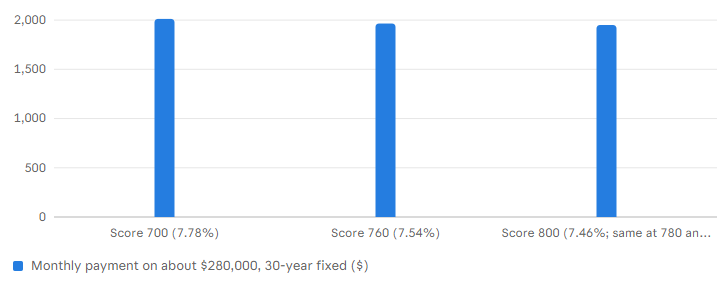
Where the savings are: monthly mortgage payment by credit score ($)
Monthly payment ($) by Experian mortgage table using Curinos data, October 2026 (30-year conventional); loan size (about $280,000) inferred by the author from the payments; 700 to 760 saves about $47 a month, 760 to 800
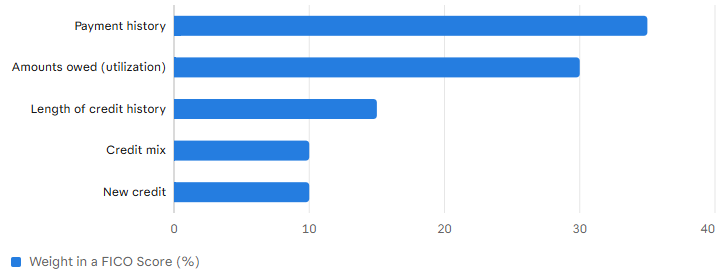
What builds the score: FICO's five factors and their weights (%)
Weight (%) by FICO factor weights as reported by ConsumerAffairs citing myFICO (October 2026); the two biggest, paying on time and keeping balances low, are 65% of the score
The Perfect Score Myth
Here is something oddly comforting: you will probably never have a perfect credit score. As of June 2026 only 1.71% of Americans with a credit file had a FICO Score of 850, according to Experian, about one in 58. People with perfect scores tend to hold more credit cards than average, use a smaller share of their available credit and carry less debt, and Experian notes that anyone short of 850 has at least one small blemish on their record. For most of us that blemish exists, and it does not matter.The good news: the number you need is much lower. The article behind this post’s headline argues that 800, not 850, is the score to aim for, because at 800 lenders give you their best rates and you can likely qualify for nearly any credit card. The data mostly agree, with a twist: the best rates often start closer to 780 than 800, and different loans use different cutoffs. This guide checks the claim against Experian and myFICO data, shows what each tier saves in dollars and explains how to get there.
The Short Answer
The practical target is about 780 to 800. Experian’s October 2026 mortgage data show the same 30-year rate, 7.46%, at scores of 780, 800 and 820, and auto lenders’ best “super prime” tier begins at 781. Above that, a higher score mostly buys breathing room, not a better price. The big savings come from moving up from the 600s and 700s: in Experian’s example, going from 700 to 760 saves about $47 a month on a mortgage, but going from 760 to 800 saves only about $15. So aim for the high 700s, treat 800 as a comfortable cushion and do not spend energy chasing 850.
Who Has What Score
FICO’s five ranges are poor (300 to 579), fair (580 to 669), good (670 to 739), very good (740 to 799) and exceptional (800 to 850). The average FICO Score was 714 in April 2026, unchanged since October 2025 and down one point from a year earlier, per FICO; Experian’s measure was 713. Nearly half of consumers have 750 or higher and about 18.2% are below 600. The share with 800 or more is 22.9% by Experian’s June 2026 data and 24.8% by FICO’s, up from 19.5% in 2016.So 800 is not exotic: nearly one person in four has reached it, and only about 7.5% of people with an 800-plus score have an 850 in my arithmetic. The gap between 800 and 850 is small in practice and mostly reflects tiny differences, such as slightly higher utilization or a younger account, not a difference in creditworthiness that lenders price.
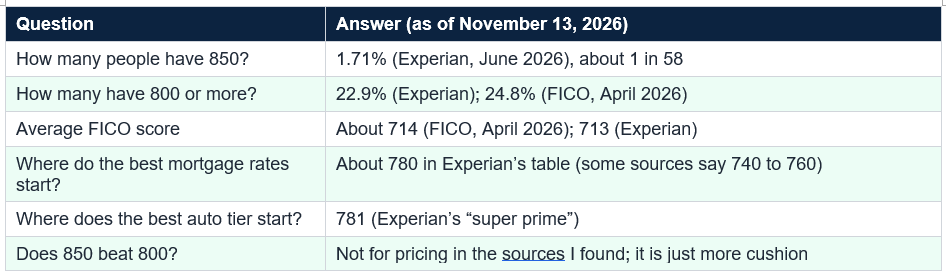
Experian (June 2026): 1.71% have an 850; 22.9% have 800+; average 713. FICO (April 2026): 24.8% at 800–850; average 714. Mortgage (Experian, Oct 2026): 30-year 7.78% at 700, 7.54% at 760, 7.46% at 780, 800 and 820. Auto: super prime (781+) about 4.7%–5.1% on new cars vs about 6.3%–6.9% for prime.
Mortgages: Where the Score Pays Most
Mortgages are the most score-sensitive loan, and the data are revealing. Experian’s table, based on Curinos data from October 2026, shows 30-year conventional rates of 7.78% at 700, 7.54% at 760 and 7.46% at 800, and the same 7.46% at 780 and 820. On a loan of about $280,000 (my inference from the payments) that is $2,012 a month at 700, $1,965 at 760 and $1,950 at 800: 700 to 760 saves about $47 a month, or $16,900 over 30 years, while 760 to 800 saves about $15 a month, or $5,400. Experian itself says you do not need an 850 for the best rates and might get them at 780.Other sources show different rate levels but a similar pattern: myFICO sample data show 6.70% for 760 to 850 against 6.95% for 700 to 759, and a myFICO-based ConsumerAffairs table shows 7.39% against 7.61%, gaps of about 0.22 to 0.25 percentage points. The absolute rates differ because of dates, loan sizes and assumptions, so use the gaps, not the levels. Some sources put the best tier at 740 or 760, and pricing also depends on down payment and loan type (general knowledge). The lesson is consistent: the step from the 700s to 760-plus matters, and the step above is small.
Auto Loans: A Different Cutoff
Auto lenders draw lines in different places. Experian classifies borrowers as prime from 661 to 780 and super prime from 781 to 850, so crossing 780 matters here. Experian’s auto finance data, as reported by AmeriSave, show super-prime borrowers paying about 4.66% on new cars and 7.70% on used, against about 6.27% for prime borrowers on new cars; another summary puts super prime at about 5.1% in early 2026 against about 6.9% for prime. These are national averages, and your offer depends on the lender, term and vehicle.On a $35,000 five-year loan, 4.66% instead of 6.27% saves about $26 a month, or about $1,560 in interest, and 5.1% versus 6.9% saves about $30 a month, or about $1,780 (my arithmetic). That is real money and the best argument for reaching the 780s before you shop for a car. It is also why 800 is a useful target: it sits just above the 781 line, leaving a buffer for score differences between the version your lender uses and the one you check.
Credit Cards: Approval Is Not Price
The article says that at 800 you can likely qualify for pretty much any card you want, and that is about right: an 800 clears nearly every bar. But you do not need 800 for most. In my general knowledge many top cards approve applicants from the high 600s to the mid 700s, depending on other factors (I did not retrieve approval ranges for specific cards). What matters more is how you use the card: the average APR on cards that charge interest is about 21%, per a Federal Reserve data summary.That is why card habits dwarf score gains. A $5,000 balance costs about $1,050 a year at 21%, or $850 at 17%, so a rate cut of a few points saves less than simply paying the balance. A high score helps you get approved for better rewards, but the surest benefit is paying in full each month, which also keeps utilization low, the factor that helps your score most after payment history.
Why 800 Is Still a Smart Target
If the best rates start around 780, why aim for 800? Because scores are slippery. There are many scoring models, and the one on your app, often FICO 8 or VantageScore, may differ from the one a lender uses; Experian’s own charts note that models produce different scores, and one summary puts VantageScore’s average below FICO’s. In my general knowledge, mortgage lenders often use older FICO versions and take the middle of three bureau scores, which can differ by 20 to 40 points from what you saw, and a 20-point cushion protects against that.It also protects you from slips. A single 30-day late payment can drop a high score by 60 to 100 points, according to AmeriSave, taking an 800 to between 700 and 740 and costing you the best tier. At 800 you have room for a small mistake, a new inquiry or a balance that spikes before the statement date. That is the sense in which a higher score is “extra breathing room,” as the article puts it: the room has real value, but the value flattens above the best tier.
How to Get to 800
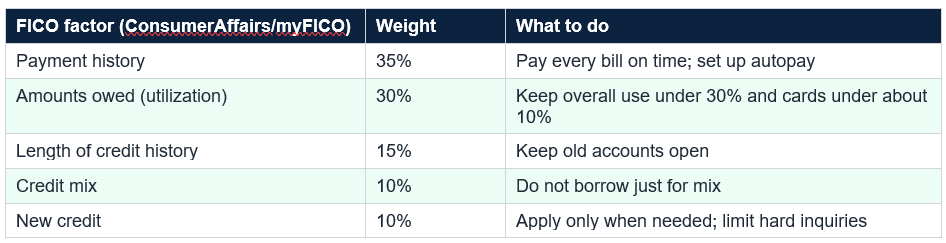
The route is built on FICO’s five factors: payment history (about 35%), amounts owed (30%), length of credit history (15%), credit mix (10%) and new credit (10%). The most important step is to pay every bill on time and automate at least minimum payments so a busy week cannot cost you dozens of points. The second is to keep revolving balances low: sources suggest under 30% utilization overall and under about 10% on each card for the cleanest score, which on a $20,000 total limit is $6,000 and $2,000.The rest is patience. Keep your oldest accounts open, open new ones only when you need them, do not take on debt for credit mix (only 10%), check your reports for errors and dispute them using the free reports available from the bureaus (general knowledge), and pay balances before statement dates to lower reported utilization. High scores are built over years, so steady habits beat quick fixes, and if you are far below 700 the first goals are on-time payments and lower balances, not 800.
Pull your free credit reports, check them for errors, set autopay for at least the minimum on every account and list each card’s balance against its limit. Aim to get every card under 10% before the statement closes.
Is Chasing 850 Worth It?
Mostly not. People with 850s have habits that are good in themselves (more cards, lower utilization, less debt, per Experian) and no negative marks, but the sources I found show no further mortgage rate improvement above about 780 to 800, and auto pricing does not improve beyond its best tier either. Chasing the last 30 or 50 points can push people toward behaviors that are not worth it, such as opening or closing accounts to game the score or delaying a purchase to gain a few points.The better use of your attention is what saves real money: paying cards in full, shopping several lenders for a mortgage or car loan, since offers vary, and avoiding new debt before a major loan application. A lender with a lower rate at 760 can beat one with a higher rate at 850, so shopping around saves more than a higher score once you are in the top tier.
Common mistakes include assuming you need 850, assuming one cutoff applies to all loans, trusting an app score as the score a lender will use, closing old cards, missing a payment before a big loan, applying for several credit lines before a mortgage and carrying card balances while trying to raise a score. Most of what helps is free and boring: pay on time, use little of your limits and wait.
Conclusion
A perfect 850 is rare, with only 1.71% of Americans holding one, and you do not need it. The data suggest a practical target of about 780 to 800: Experian’s October 2026 table shows the same mortgage rate of 7.46% at 780, 800 and 820, and auto lenders’ best tier starts at 781. The big savings come from climbing out of the 600s and 700s: in Experian’s example, 700 to 760 saves about $47 a month on a mortgage, while 760 to 800 saves about $15, and super prime versus prime saves about $26 to $30 a month on a $35,000 car loan.So aim for the high 700s, treat 800 as a cushion against score differences and mistakes and put your effort into habits that matter: on-time payments, low utilization, paying cards in full and shopping lenders. The article is right that 800 is the number to remember, with the nuance that the best rates may start a little earlier. Check your own reports, compare offers and let the score serve your goals, not become one.
Frequently Asked Questions
What percentage of people have a perfect 850 credit score?About 1.71% of Americans with a credit file had a FICO Score of 850 as of June 2026, according to Experian, roughly one in 58. Experian also reports that 22.9% have a score of 800 or higher, while FICO’s own April 2026 data puts the 800-plus share at 24.8%. The average FICO score is about 714, per FICO, or 713 per Experian.
Is an 800 credit score really where the best rates start?
Close, but the cutoff is a little lower for most loans. Experian’s October 2026 mortgage table shows the same 30-year rate (7.46%) at 780, 800 and 820, versus 7.54% at 760 and 7.78% at 700. Auto lenders’ top “super prime” tier starts at 781. So 780 to 800 is the practical target, and 800 gives you a cushion for score differences between models and for a small slip.
How much does a higher score save on a mortgage?
Most of the savings come from moving from the 700s to the high 700s, not from 800 to 850. In Experian’s example for a loan of about $280,000, the monthly payment is about $2,012 at 700, $1,965 at 760 and $1,950 at 800, so 700 to 760 saves about $47 a month and 760 to 800 only about $15. Other sources show different rate levels but a similar gap of roughly 0.2 to 0.25 percentage points between the 700s and 760-plus.
Do I need an 800 score to get a good credit card?
Usually not. In my general knowledge, many premium rewards cards approve applicants in the high 600s to mid 700s, depending on income and history, and the card’s interest rate depends on more than score (the average APR is about 21%). What matters more is paying in full: carrying a $5,000 balance at 21% costs about $1,050 a year, which dwarfs any gain from a few more points. This is general education, not personal advice.
What is the fastest way to raise my score?
Pay every bill on time, since payment history is about 35% of a FICO score, and reduce revolving balances, since amounts owed is about 30%. Many sources suggest keeping utilization below 30% overall and under about 10% for the cleanest score. Avoid unnecessary new accounts, keep old ones open, check your reports for errors and give changes time to show up, since high scores are built over years.
0 Comments
Be the first to share your thoughts on this article.