

Credits
What Is the Best American Express Credit Card? Pick by Spend

Platinum $895; Gold $325; Blue Cash Preferred $0 the first year then $95; Blue Cash Everyday $0; Green $150 (one source says closed to new applicants since July 2026). Welcome offers (“as high as,” personalized): Platinum up to 175,000 points after $12,000 in six months; Gold up to 100,000 after $8,000; Blue Cash Preferred $300 after $3,000; Blue Cash Everyday $200 after $2,000. Rewards: Platinum 5x on flights booked directly or via Amex Travel (up to $500,000 a year) and prepaid hotels via Amex Travel, 1x otherwise; Gold 4x at restaurants (to $50,000) and U.S. supermarkets (to $25,000); Blue Cash Preferred 6% at U.S. supermarkets and streaming; Blue Cash Everyday 3% at supermarkets, gas and online retail. My arithmetic (household spending $33,900 a year): Blue Cash Preferred about $689 in rewards, $594 after the $95 fee; Blue Cash Everyday about $489; Gold about $699 at 1 cent a point, about $374 after the fee or $698 if all $324 of credits are used; the Platinum’s net fee is about $295 if you would use $600 of its credits; a $5,000 balance at 20.9% costs about $1,045 a year.
This guide compares the main personal Amex cards, the Platinum, Gold, Blue Cash Preferred and Blue Cash Everyday, on fees, rewards and welcome offers, using November 2026 reviews. Then it does what most roundups skip: it runs one household budget through the cards to show how the ranking changes. I flag where sources conflict and where I am assuming. Rewards only make sense if you pay your bill in full.
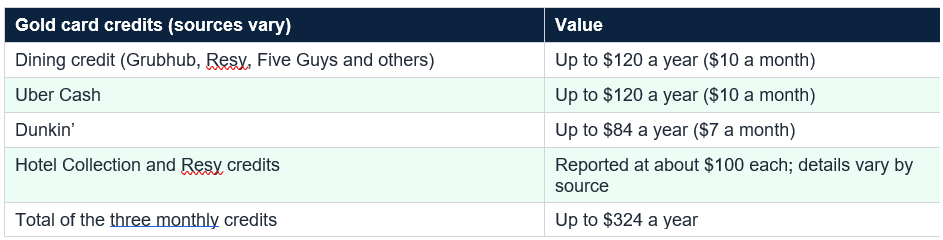
Then the points cards. The Gold, at $325, earns 4x Membership Rewards points at restaurants worldwide (up to $50,000 a year) and U.S. supermarkets (up to $25,000), according to Firstcard, with credits including up to $120 in dining, $120 in Uber Cash and $84 in Dunkin’. The Platinum, at $895, earns 5x on flights booked directly or through Amex Travel (up to $500,000 a year) and on prepaid hotels through Amex Travel, and 1x on most other spending; its value comes through credits and lounge access. The $150 Green card shows up in some lists, though one source says it has been closed to new applicants since July 2026, which I could not confirm. Business cards serve a different audience.
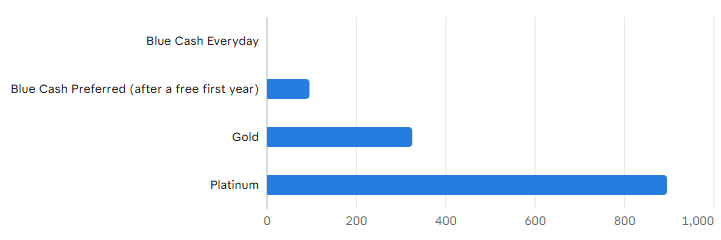
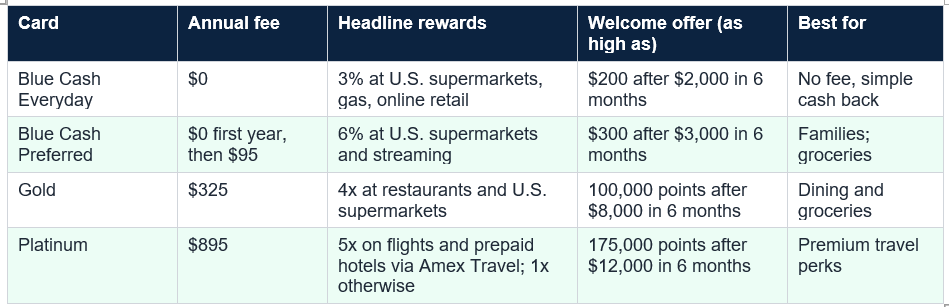
Platinum $895; Gold $325; Blue Cash Preferred $0 the first year, then $95; Blue Cash Everyday $0. Welcome offers (as high as): Platinum 175,000 points, Gold 100,000, Blue Cash Preferred $300, Blue Cash Everyday $200, usually after spending requirements within six months; offers are personalized and you may not be eligible.
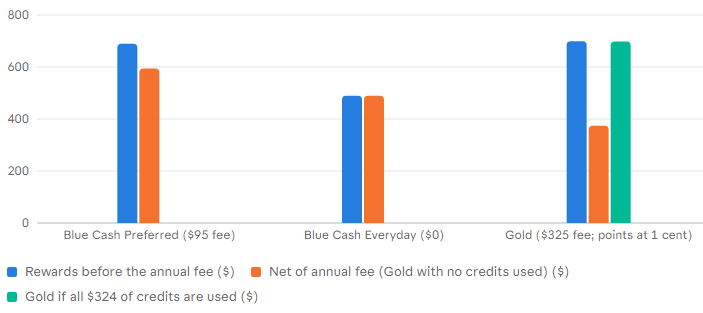
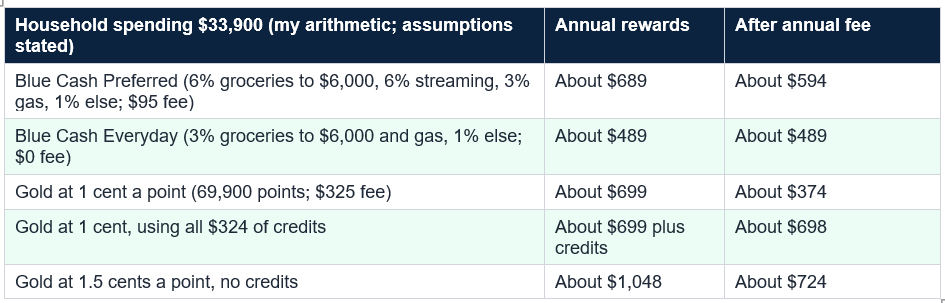
The Blue Cash Everyday earns about $489 with no fee. The Gold earns 69,900 points (16,000 on dining, 32,000 on groceries, 21,900 on the rest), about $699 at an assumed 1 cent each, or about $374 after the $325 fee. If the household uses all $324 of the monthly credits it would otherwise pay for, the Gold nets about $698, and at 1.5 cents a point about $1,048. So here the Blue Cash Preferred beats the Gold unless you value points above about 1.3 cents or use most of the credits, and a household that dined out far more could reverse that.
This example is one invented household with assumed caps and point values. Your result depends on where you spend, the caps and credits you actually use, and how you redeem points. Change the numbers to match your budget before choosing.
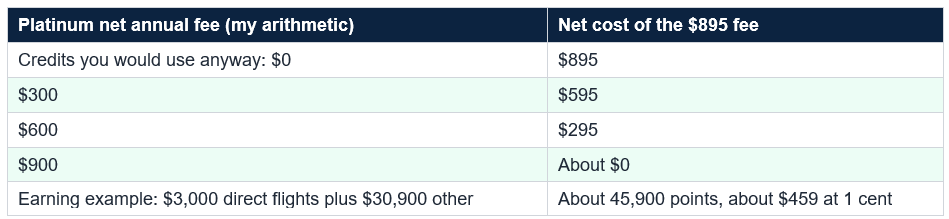
So the Platinum only works if you would use its credits and perks anyway: net of credits you would genuinely use, the fee falls to about $595 with $300 of credits, $295 with $600 and about zero with $900, before counting lounge access. The welcome offer is large, as high as 175,000 points after $12,000 in six months, about $1,750 at 1 cent (roughly 15% of that spending), but it is a one-time prize and the fee comes back every year. If you will not use the benefits, choose a cheaper card.
Treat them with care. Offers are personalized “as high as” figures, and Forbes notes you may not be eligible. The required spending should be spending you would do anyway; never spend extra or carry a balance to earn a bonus, since interest can cost more than the bonus is worth. And think about year two: the annual fee and everyday rewards, not the first-year bonus, decide whether a card is best over time.
Be honest about how you will redeem. If you will take statement credits or cash-like redemptions, use 1 cent; if you will research transfer partners and book travel, a higher value may be realistic; if not, cash back is better. A card that gives $594 in simple cash back can beat a points card with a theoretical higher value you never fully use. Choose the system you will follow.
If you tend to carry a balance, the best card is one with a low rate or a 0% introductory period, not the highest rewards: a 20% interest rate quickly undoes 6% back. If you cannot pay in full this month, focus on the debt first. For disciplined payers, though, a good card is a modest but real discount on spending you would do anyway.

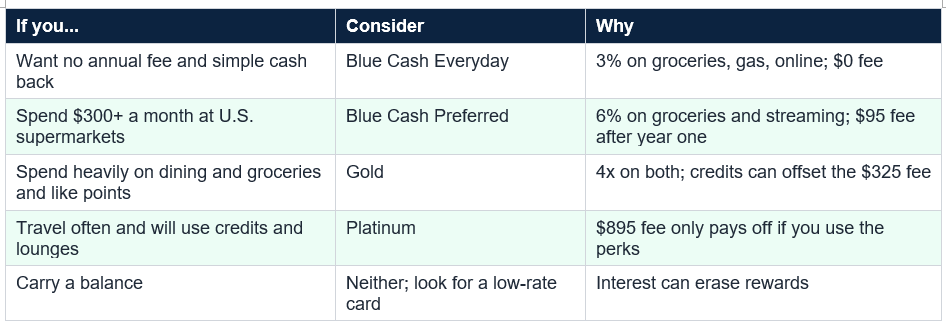
If you travel often, want lounge access and will use credits, consider the Platinum, but do the credit math honestly. If you run a business, look at the Business Gold (4x on your top two categories) or the no-fee Blue Business Plus. Reviewers recommend Good to Excellent credit for these cards, and some sites offer prequalification that does not affect your score.
Then apply for one card, not several, and set up autopay for the full statement balance. Put the credits in your calendar so you actually use them, review the card each year and switch if your spending or the fee changes. Keep expectations realistic: the best card saves a few hundred dollars a year, while the larger gains come from not paying interest and spending within your budget.
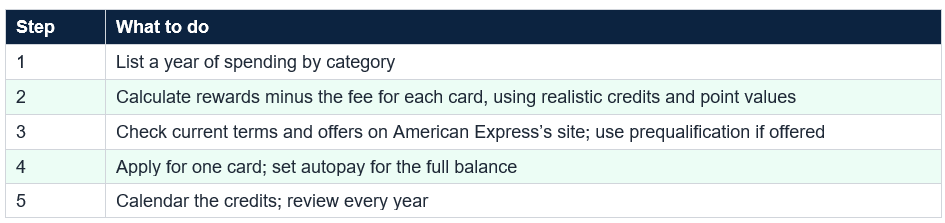
Pull last year’s card and bank statements, total your groceries, dining, gas and streaming, and run those numbers through the three cards. It takes ten minutes and can show a $200 to $400 difference. Common mistakes include choosing a card for its welcome offer alone, paying a high annual fee without using the credits, ignoring category caps, assuming points are worth more than you will get, carrying a balance, spending extra to earn a bonus and never reviewing the card after the first year. Also remember affiliate-supported sites earn commissions and fees and offers change: check the issuer’s page and do your own math.
So pick by spending: list your categories, run the numbers, be honest about credits and point values and read American Express’s current terms. Pay in full every month, since a $5,000 balance at 20.9% costs about $1,045 a year and erases the rewards, and treat welcome offers as a bonus, not the reason to choose.
There is no single best card, because the answer depends on how you spend. For everyday cash back, many reviewers pick the Blue Cash Preferred (6% at U.S. supermarkets, $0 the first year, then $95). For dining and groceries with flexible points, the Gold ($325). For premium travel perks, the Platinum ($895). For no annual fee, the Blue Cash Everyday ($0). The worked example in this guide shows how the ranking changes with your budget.
Is the Amex Platinum worth $895 a year?
Only if you will actually use its credits and perks. Reviewers describe it as earning its keep mainly through statement credits, lounge access and travel perks, since everyday earning is 1x on most purchases. In my arithmetic, the net cost falls to about $295 if you would use $600 of credits anyway and to about $0 if you would use $900. If you would not use them, it is expensive.
Is the Amex Gold card worth the $325 annual fee?
It can be for people who spend heavily on dining and groceries. It earns 4x points on restaurants and U.S. supermarkets (up to annual caps) and offers credits such as up to $120 in dining and $120 in Uber Cash. In my example household, rewards of about $699 at 1 cent a point beat the fee, and using the credits adds up to about $324. Lighter spenders may do better with a cheaper card.
Should I choose points or cash back?
Cash back is simple: you know what you earn. Membership Rewards points can be worth more if you use transfer partners or travel, but the value varies, which I note from general knowledge. In my arithmetic, 69,900 Gold points are worth about $699 at 1 cent and about $1,048 at 1.5 cents. Choose points only if you will put in the effort to use them well.
Do Amex rewards make sense if I carry a balance?
No. Interest can erase rewards: a $5,000 balance at a 20.9% average card rate costs about $1,045 a year, more than the rewards on a typical household budget. American Express rates are variable, and I did not retrieve each card’s APR, so check yours. If you cannot pay in full every month, a low-rate card is usually better. This is general education, not personal advice.
Table of Contents
- “Best” Depends on You
- The Short Answer
- The Lineup
- A Worked Example: One Household, Three Cards
- The Platinum’s $895 Question
- Welcome Offers: Useful, Not the Point
- Points or Cash Back?
- Carrying a Balance Changes Everything
- Which Card Suits Which Person
- How to Choose and Apply
- Common Mistakes
- Conclusion
- Frequently Asked Questions
What each card costs: American Express annual fees, November 2026 ($)
Annual fee ($) by CNBC Select, WalletHub, Forbes Advisor and others (affiliate-supported sites); the Platinum fee appears as $695 on older articles; check American Express's own pages for current terms
One household, three cards: annual value on $33,900 of spending ($)
Dollars a year by my hypothetical arithmetic: groceries $8,000, dining $4,000, gas $1,500, streaming $400, other $20,000; assumed $6,000 per-category caps on Blue Cash cards; the third series applies only to the Gold; not an estimate of your results
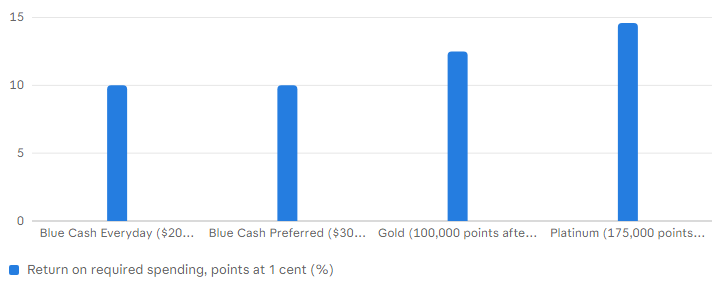
Welcome offers as a return on the spending required (%)
Return (%) by Offers are personalized 'as high as' figures per CNBC, Forbes and CardCompass; points valued at an assumed 1 cent (the Platinum would be about 29% at 2 cents); author's arithmetic; you may not be eligible
“Best” Depends on You
Ask five people which American Express card is best and you may get five different answers, all of them right. Amex sells cards aimed at very different people: a family buying groceries, a frequent flyer who wants lounge access, a foodie, someone who hates annual fees. A card that earns one household hundreds of dollars can cost another money, so the useful question is which card is best for your spending.This guide compares the main personal Amex cards, the Platinum, Gold, Blue Cash Preferred and Blue Cash Everyday, on fees, rewards and welcome offers, using November 2026 reviews. Then it does what most roundups skip: it runs one household budget through the cards to show how the ranking changes. I flag where sources conflict and where I am assuming. Rewards only make sense if you pay your bill in full.
The Short Answer
For households that spend a lot on groceries and gas and want simple cash back, the Blue Cash Preferred ($0 the first year, then $95) looks strongest in my example. For heavy dining and grocery spenders who like flexible points, the Gold at $325 can win, especially if you use its credits. For frequent travelers who will use lounge access and credits, the Platinum at $895 can pay off, but it is poor value if you will not. For no annual fee, the Blue Cash Everyday is solid. The ranking depends on your spending, so run your own numbers.
The Lineup
Start with the cash-back pair. The Blue Cash Everyday has no annual fee and earns 3% at U.S. supermarkets, gas stations and online retail, with a welcome offer as high as $200 after $2,000 in six months, according to Forbes and CardCompass. The Blue Cash Preferred charges $0 the first year and then $95, and earns 6% at U.S. supermarkets and on streaming, with an offer as high as $300 after $3,000. In my general knowledge (not retrieved from American Express), both cap the top rates at $6,000 a year per category, and other purchases earn 1%.Then the points cards. The Gold, at $325, earns 4x Membership Rewards points at restaurants worldwide (up to $50,000 a year) and U.S. supermarkets (up to $25,000), according to Firstcard, with credits including up to $120 in dining, $120 in Uber Cash and $84 in Dunkin’. The Platinum, at $895, earns 5x on flights booked directly or through Amex Travel (up to $500,000 a year) and on prepaid hotels through Amex Travel, and 1x on most other spending; its value comes through credits and lounge access. The $150 Green card shows up in some lists, though one source says it has been closed to new applicants since July 2026, which I could not confirm. Business cards serve a different audience.
Platinum $895; Gold $325; Blue Cash Preferred $0 the first year, then $95; Blue Cash Everyday $0. Welcome offers (as high as): Platinum 175,000 points, Gold 100,000, Blue Cash Preferred $300, Blue Cash Everyday $200, usually after spending requirements within six months; offers are personalized and you may not be eligible.
A Worked Example: One Household, Three Cards
Consider a household that spends $33,900 a year: $8,000 on groceries, $4,000 on dining, $1,500 on gas, $400 on streaming and $20,000 on everything else. I applied each card’s rates, with my assumed $6,000 per-category cap on the Blue Cash cards. The Blue Cash Preferred earns about $689: $360 on the first $6,000 of groceries at 6%, $20 on the other $2,000 at 1%, $24 on streaming, $45 on gas at 3% and 1% on the rest, or about $594 after the $95 fee (from year two).The Blue Cash Everyday earns about $489 with no fee. The Gold earns 69,900 points (16,000 on dining, 32,000 on groceries, 21,900 on the rest), about $699 at an assumed 1 cent each, or about $374 after the $325 fee. If the household uses all $324 of the monthly credits it would otherwise pay for, the Gold nets about $698, and at 1.5 cents a point about $1,048. So here the Blue Cash Preferred beats the Gold unless you value points above about 1.3 cents or use most of the credits, and a household that dined out far more could reverse that.
This example is one invented household with assumed caps and point values. Your result depends on where you spend, the caps and credits you actually use, and how you redeem points. Change the numbers to match your budget before choosing.
The Platinum’s $895 Question
The Platinum is the Amex everyone has heard of, and its $895 annual fee is hard to ignore. Reviewers say it earns its keep mainly through statement credits, lounge access and travel perks, because everyday earning is ordinary: 5x on flights and prepaid hotels booked through Amex Travel and 1x on most other spending. In my arithmetic, $3,000 of direct flights plus $30,900 of other spending earns about 45,900 points, worth about $459 at 1 cent, far less than the fee.So the Platinum only works if you would use its credits and perks anyway: net of credits you would genuinely use, the fee falls to about $595 with $300 of credits, $295 with $600 and about zero with $900, before counting lounge access. The welcome offer is large, as high as 175,000 points after $12,000 in six months, about $1,750 at 1 cent (roughly 15% of that spending), but it is a one-time prize and the fee comes back every year. If you will not use the benefits, choose a cheaper card.
Welcome Offers: Useful, Not the Point
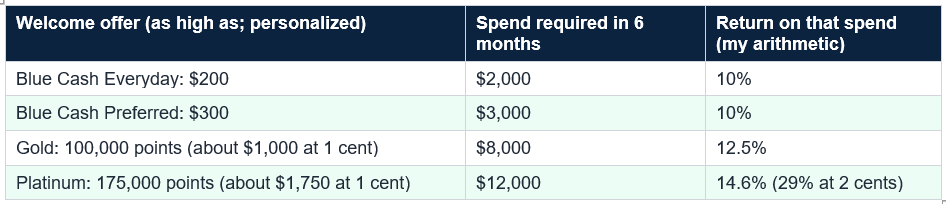
Welcome offers are the headline for many reviews, and they can be worth real money. The Blue Cash Preferred’s $300 after $3,000 and the Blue Cash Everyday’s $200 after $2,000 are each a 10% return on the required spending; the Gold’s as-high-as 100,000 points after $8,000 is about $1,000 at 1 cent (12.5%) and the Platinum’s 175,000 after $12,000 about $1,750 (14.6%, or 29% at 2 cents a point).Treat them with care. Offers are personalized “as high as” figures, and Forbes notes you may not be eligible. The required spending should be spending you would do anyway; never spend extra or carry a balance to earn a bonus, since interest can cost more than the bonus is worth. And think about year two: the annual fee and everyday rewards, not the first-year bonus, decide whether a card is best over time.
Points or Cash Back?
The Blue Cash cards pay cash back, which is simple: 6% means $6 per $100 at those merchants. The Gold and Platinum earn Membership Rewards points, whose value depends on how you redeem them. In my general knowledge a baseline cash-like value is about 1 cent a point, and travel transfers can be worth more, which is why reviewers often use higher figures. The Gold’s 69,900 points are worth about $699 at 1 cent, $1,048 at 1.5 cents and $1,398 at 2 cents, so the valuation can change the ranking.Be honest about how you will redeem. If you will take statement credits or cash-like redemptions, use 1 cent; if you will research transfer partners and book travel, a higher value may be realistic; if not, cash back is better. A card that gives $594 in simple cash back can beat a points card with a theoretical higher value you never fully use. Choose the system you will follow.
Carrying a Balance Changes Everything
All of this assumes you pay in full every month; if not, rewards become a rounding error. The average card APR was about 20.9% in the second quarter, according to a secondary summary of Federal Reserve data, so a $5,000 balance costs about $1,045 a year in interest, more than the rewards in my example. The Business Platinum lists a regular APR of 17.99% to 28.74%, up to about $1,437 on $5,000. I did not retrieve APRs for the personal cards, so check yours.If you tend to carry a balance, the best card is one with a low rate or a 0% introductory period, not the highest rewards: a 20% interest rate quickly undoes 6% back. If you cannot pay in full this month, focus on the debt first. For disciplined payers, though, a good card is a modest but real discount on spending you would do anyway.
Which Card Suits Which Person
A simple guide: if you want the least hassle and no fee, the Blue Cash Everyday fits, especially if groceries, gas and online shopping are your biggest costs. If you spend $300 or more a month at U.S. supermarkets, one review (Wealth Partners) names the Blue Cash Preferred the best fit for families. If you dine out, shop for groceries and enjoy points, the Gold is the candidate: Firstcard says households spending more than $8,000 a year in its categories typically earn more than the fee, which matches my arithmetic that $8,125 of 4x spending covers $325 at 1 cent.If you travel often, want lounge access and will use credits, consider the Platinum, but do the credit math honestly. If you run a business, look at the Business Gold (4x on your top two categories) or the no-fee Blue Business Plus. Reviewers recommend Good to Excellent credit for these cards, and some sites offer prequalification that does not affect your score.
How to Choose and Apply
Start by writing down a year of spending by category: groceries, dining, gas, streaming, travel and everything else. Multiply by each card’s rates, subtract the fee, add credits you would truly use and compare, as in my example, deciding how you will redeem points. Check American Express’s official pages for the current fee, rates and offer, which can differ from a review.Then apply for one card, not several, and set up autopay for the full statement balance. Put the credits in your calendar so you actually use them, review the card each year and switch if your spending or the fee changes. Keep expectations realistic: the best card saves a few hundred dollars a year, while the larger gains come from not paying interest and spending within your budget.
Pull last year’s card and bank statements, total your groceries, dining, gas and streaming, and run those numbers through the three cards. It takes ten minutes and can show a $200 to $400 difference. Common mistakes include choosing a card for its welcome offer alone, paying a high annual fee without using the credits, ignoring category caps, assuming points are worth more than you will get, carrying a balance, spending extra to earn a bonus and never reviewing the card after the first year. Also remember affiliate-supported sites earn commissions and fees and offers change: check the issuer’s page and do your own math.
Conclusion
There is no single best American Express card. The Blue Cash Everyday offers 3% cash back with no annual fee, the Blue Cash Preferred offers 6% at U.S. supermarkets and streaming for $0 the first year and then $95, the Gold offers 4x on dining and groceries for $325 and the Platinum offers travel perks for $895. In my example household with $33,900 of spending, the Blue Cash Preferred earned about $594 after its fee, the Blue Cash Everyday about $489 and the Gold about $374 to $698 depending on credits, with the Platinum a poor fit unless you would use $600 or more of its credits.So pick by spending: list your categories, run the numbers, be honest about credits and point values and read American Express’s current terms. Pay in full every month, since a $5,000 balance at 20.9% costs about $1,045 a year and erases the rewards, and treat welcome offers as a bonus, not the reason to choose.
Frequently Asked Questions
What is the best American Express credit card overall?There is no single best card, because the answer depends on how you spend. For everyday cash back, many reviewers pick the Blue Cash Preferred (6% at U.S. supermarkets, $0 the first year, then $95). For dining and groceries with flexible points, the Gold ($325). For premium travel perks, the Platinum ($895). For no annual fee, the Blue Cash Everyday ($0). The worked example in this guide shows how the ranking changes with your budget.
Is the Amex Platinum worth $895 a year?
Only if you will actually use its credits and perks. Reviewers describe it as earning its keep mainly through statement credits, lounge access and travel perks, since everyday earning is 1x on most purchases. In my arithmetic, the net cost falls to about $295 if you would use $600 of credits anyway and to about $0 if you would use $900. If you would not use them, it is expensive.
Is the Amex Gold card worth the $325 annual fee?
It can be for people who spend heavily on dining and groceries. It earns 4x points on restaurants and U.S. supermarkets (up to annual caps) and offers credits such as up to $120 in dining and $120 in Uber Cash. In my example household, rewards of about $699 at 1 cent a point beat the fee, and using the credits adds up to about $324. Lighter spenders may do better with a cheaper card.
Should I choose points or cash back?
Cash back is simple: you know what you earn. Membership Rewards points can be worth more if you use transfer partners or travel, but the value varies, which I note from general knowledge. In my arithmetic, 69,900 Gold points are worth about $699 at 1 cent and about $1,048 at 1.5 cents. Choose points only if you will put in the effort to use them well.
Do Amex rewards make sense if I carry a balance?
No. Interest can erase rewards: a $5,000 balance at a 20.9% average card rate costs about $1,045 a year, more than the rewards on a typical household budget. American Express rates are variable, and I did not retrieve each card’s APR, so check yours. If you cannot pay in full every month, a low-rate card is usually better. This is general education, not personal advice.
0 Comments
Be the first to share your thoughts on this article.