

Retirement
Employer Pension Match: How Much Free Money Left Behind?

If your employer offers a 401(k) match and you are not contributing enough to capture the full amount, you are leaving money on the table that your employer has already set aside for you. Not investing it. Not gambling it. Simply not taking it. Americans forfeit an estimated $24 billion in unclaimed 401(k) employer match contributions every year, according to Financial Engines’ analysis of 4.4 million retirement plan participants across 553 companies. One in four employees — 25% — misses out on the full match by not saving enough. The typical employee losing out on the full match leaves $1,336 in free money unclaimed each year. With compounding over 20 years, that is approximately $42,855. From age 30 to 65, capturing the full employer match on a median income can mean an additional $355,000 in your retirement account — money that came from your employer, not from your own contributions. This article explains how the match works, how to calculate exactly what you are or are not capturing, the vesting rules that govern when it is actually yours, and the single habit change that resolves this for almost every person who is currently leaving match money unclaimed.
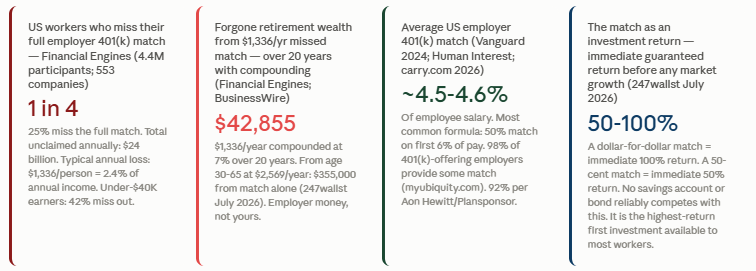
The typical employee who fails to capture the full match loses $1,336 in potential free money each year — which equates to an extra 2.4% of annual income that goes uncollected. Over 20 years of compounding, that $1,336 per year becomes approximately $42,855 in foregone retirement wealth. And 247wallst’s July 2026 analysis extended the calculation further: a worker who captures $2,569 in annual employer match money (a 4% match on median income) starting at age 30 accumulates roughly $355,000 from the match alone by age 65, assuming a 7% annual return. That $355,000 came from the employer. The employee simply needed to contribute enough to trigger it.
$24B unclaimed 401(k) match every year (Financial Engines; 4.4M participants; 553 companies). 25% of employees miss the full match. Typical employee loss: $1,336/year = 2.4% of annual income. $42,855 lost over 20 years with compounding (BusinessWire/Financial Engines). $355,000 forgone from age 30 to 65 at 7% return if $2,569/year match is missed (247wallst July 2026). 15% of eligible Vanguard plan participants contribute nothing (Vanguard 2024; cited 247wallst). Sources cited. Not financial advice.
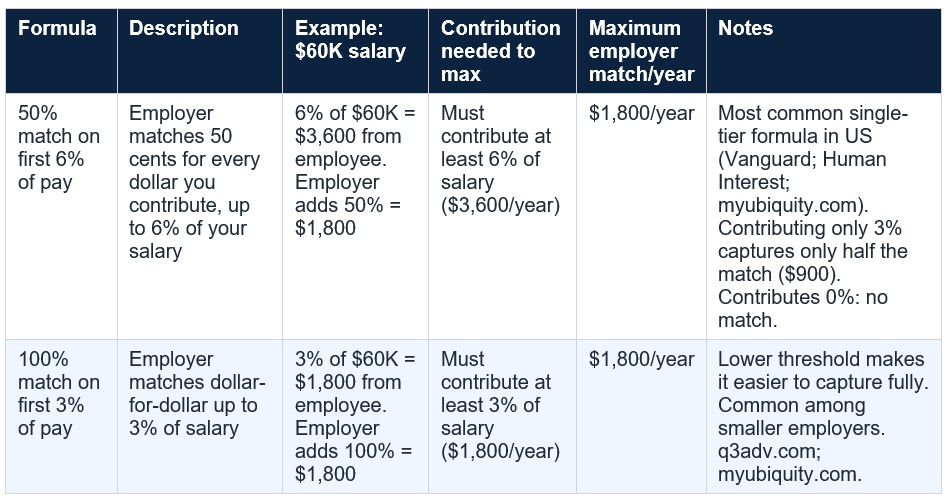
The mechanics work through a formula set by the employer and specified in the plan documents. The formula has two components: the match rate (what percentage of your contribution the employer matches) and the match ceiling (the maximum percentage of your salary that triggers the match). Most employers who offer a 401(k) plan provide some form of match — myubiquity.com cites 98% of 401(k)-offering employers providing some match; Aon Hewitt data cited by PLANSPONSOR puts it at 92%. The average promised match value in Vanguard plan data is 4.6% of employee compensation (Human Interest; Vanguard). The average employer match is approximately 4.5% of salary (Human Interest).
The single most important thing to understand about the employer match is that it is an immediate guaranteed return. 247wallst’s July 2026 analysis describes it precisely: ‘The match itself functions as an immediate 100% return on the first tranche of contributions before any market growth is layered on.’ A dollar-for-dollar match is a 100% instantaneous return on the matched contribution. A 50-cent match is a 50% instantaneous return. No savings account, bond, stock, or investment product can reliably compete with this as a first destination for retirement savings. Not financial advice.
Financial Engines quantified this directly in the ‘Missing Out’ report: $1,336 in uncaptured match each year, compounded over 20 years, amounts to approximately $42,855 in forgone retirement wealth. 247wallst’s July 2026 analysis extended the horizon to a full career, calculating that $2,569 in annual employer match money (from a 4% match on median US income) starting at age 30 grows to approximately $355,000 by age 65 at a 7% annual return. That number is the cost of contributing enough to get the match versus not contributing enough, sustained over a working lifetime.
The specific numbers depend on salary, match formula, age, and investment return. But the structure of the maths is always the same: missing the match costs you not the match itself, but all the compounding growth the match would have produced for the rest of your working life. The earlier you are in your career when you fix this, the larger the compounding payoff. Not financial advice.
Younger workers are also significantly more likely to miss out. Employees under age 30 are approximately twice as likely to miss the full employer match compared to employees over age 60. SHRM’s coverage of the Financial Engines report identifies the dynamic clearly: younger employees are dealing with student loans, rent, and entry-level salaries that leave limited cash flow for retirement savings. Middle-aged workers face their own distinctive pressure: as SHRM noted, ‘for many employees, middle age poses additional savings challenges’ — children’s education costs, mortgage payments, and the competing demands of the peak earning years can actually compete with retirement contributions.
The 2026 macroeconomic context adds another dimension. The personal savings rate fell from 6.2% in Q1 2024 to 3.9% in Q1 2026, even as per-capita disposable income rose during the same period (247wallst July 2026; BLS data). Real wages have been essentially flat. Consumer prices rose from 322.169 to 335.123 on the CPI between July 2025 and May 2026. In this environment, the psychological cost of diverting income to retirement savings feels higher even when the arithmetic of the employer match makes it a positive-return decision. Not financial advice.
There are three main vesting structures. Immediate vesting: the employer’s match belongs to you from day one. Cliff vesting: you vest 0% until a specific point (e.g., three years of service), then 100% all at once. Graded vesting: your ownership increases gradually over time. The IRS maximum vesting periods are three years for cliff vesting and six years for graded vesting (q3adv.com; SoFi). A common graded schedule is 20% per year over five years; the IRS minimum graded schedule requires 20% at year 2, 40% at year 3, 60% at year 4, 80% at year 5, and 100% at year 6.
The vesting schedule matters enormously if you are considering changing jobs. A worker who has accumulated two years of employer match under a three-year cliff vesting schedule and then leaves would forfeit all of the unvested employer contributions. This is sometimes called the ‘golden handcuff’ effect — the employer match is partly designed to incentivise tenure. When evaluating a job change, look up your plan’s vesting schedule, calculate how much unvested employer match you would leave behind, and factor that into the financial comparison. Not financial advice.
If you leave a job before fully vesting, you may forfeit part or all of the employer match. Cliff vesting means losing 100% if you leave before the cliff date. Graded vesting means losing the unvested portion. Always check your vesting schedule in your Summary Plan Description (SPD) before giving notice. The unvested employer match is a real financial asset that belongs to the employer until you have earned it through tenure. Source: q3adv.com 2026; SoFi; carry.com. Not financial advice.
First: the super catch-up contribution for ages 60-63. Workers aged 60-63 can contribute an additional $11,250 in 2025 and 2026 as a catch-up contribution, rather than the standard $7,500 available to workers aged 50 and over (SoFi; q3adv.com). This higher ceiling allows older workers approaching retirement to contribute substantially more and, if their employer’s match formula extends across higher contribution amounts, capture more match income.
Second: student loan matching. SECURE 2.0 allows employers to make 401(k) match contributions based on an employee’s student loan repayments, as if those repayments were 401(k) contributions. For workers carrying student loan debt who feel they cannot afford to both repay loans and contribute to their 401(k), this provision means they can receive employer match contributions even if they are putting nothing into the plan — as long as their employer has adopted the provision and they are making qualifying student loan repayments (q3adv.com; SoFi; myubiquity.com). Not all employers have adopted this feature; check your plan documentation.
Third: automatic enrolment requirements. SECURE 2.0 requires new 401(k) plans established after December 29, 2022 to automatically enrol eligible employees at a 3% contribution rate with automatic escalation of 1% per year until the employee reaches 10-15%. This reduces the likelihood of completely missing the match for workers at new-plan employers, though the initial 3% auto-enrolment rate may still leave a partial match gap if the match threshold is 6%. Not financial advice.
The average employee contribution rate needed to maximise the employer match in Vanguard’s 2023 data was 6.7% of annual pay (Human Interest; Vanguard data). That is the number to target as a minimum, adjusted for your specific plan’s formula. Every dollar you contribute above this is valuable for your retirement, but the most impactful single action is closing the gap between where your contribution is now and the threshold that captures the full employer match.
One mechanism that helps is automatic escalation: if your plan offers it, enrol in automatic annual escalation that increases your contribution by 1% per year. Combined with starting at the minimum threshold to capture the full match, automatic escalation gradually moves your total contribution toward the 10-15% savings rate that financial advisers commonly recommend for retirement security — without requiring an annual decision. Not financial advice.
How to fix a missed employer match in three steps: (1) Find your plan's formula — log into your plan provider's website (Fidelity, Vanguard, Schwab, etc.), request your Summary Plan Description from HR, or call your plan administrator. (2) Calculate the contribution rate needed to capture the full match — the formula is: Minimum contribution % = Plan match threshold % (e.g., 6%). If you currently contribute less, calculate the gap. (3) Log into your plan account and raise your contribution rate to at least the threshold. Most plan websites allow you to do this in under five minutes. If your plan offers automatic escalation, enable it. Source: Financial Engines; Vanguard; Human Interest. Not financial advice.
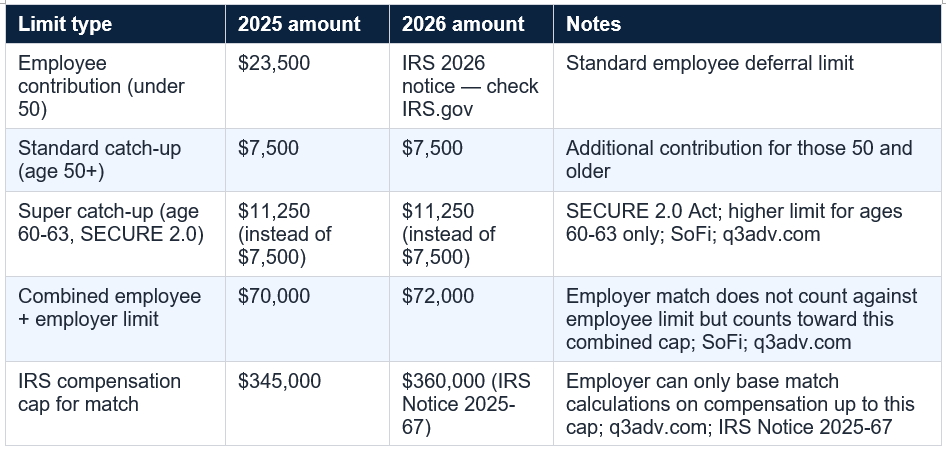
Note: The IRS adjusts contribution limits annually based on inflation. Always verify current limits at IRS.gov or with your plan administrator before making contribution decisions. Not financial advice.
247wallst’s July 2026 analysis makes the comparative return explicit: ‘The match itself functions as an immediate 100% return on the first tranche of contributions before any market growth is layered on.’ A 50-cent match is an immediate 50% return. No credit card has an interest rate of 50% or 100%; even the most expensive debt on a per-dollar basis does not carry a penalty as large as the immediate guaranteed return of a dollar-for-dollar employer match. The exception most financial advisers cite is true financial emergency: if you cannot cover rent or food, 401(k) contributions may need to pause. But in most normal circumstances, the employer match captures the first dollars of savings before any other priority.
The ranking advisers commonly recommend: (1) Contribute enough to capture the full employer match. (2) Build a 3-6 month emergency fund in a high-yield savings account. (3) Pay down high-interest debt (typically above 7-8%). (4) Max out a Roth or traditional IRA if eligible. (5) Return to the 401(k) to increase contributions toward the annual IRS limit. Not financial advice. Consult a fee-only CFP for guidance personalised to your situation.
The fix takes five minutes. The payoff is $355,000 in extra retirement wealth over a working lifetime for a median earner, from employer money alone. The cost of the fix is contributing 2-4% more of your salary to your own retirement, which you would otherwise need to save for retirement anyway. It is the only financial decision in which doing the right thing for your future comes with an immediate reward attached.
Find your plan’s formula. Calculate the threshold. Close the gap. If you have been leaving employer match money unclaimed, every month you continue to do so is another $100–$200 in free money that expires uncollected at the end of the pay period. Not financial, investment, or tax advice. Consult a fee-only financial adviser for guidance specific to your situation.
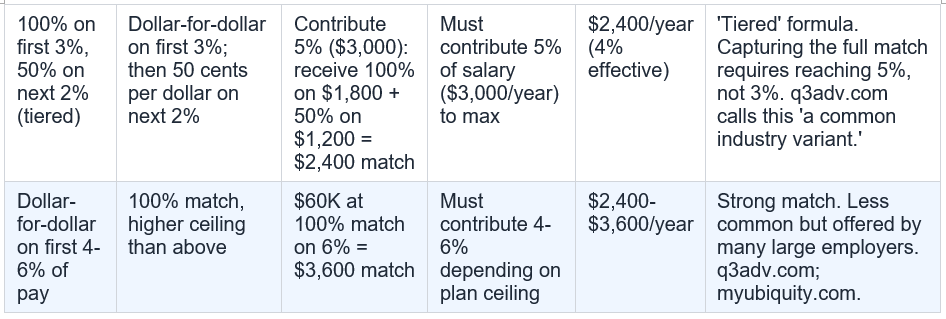
It depends on your specific plan's formula, which is set by your employer and disclosed in the Summary Plan Description (SPD). The most common formula in the US is 50% on the first 6% of pay — to get the full match under this formula, you need to contribute at least 6% of your salary. Other common formulas include 100% match on the first 3% (requires contributing 3%) or 100% on first 3% plus 50% on next 2% (requires contributing 5%). The average employee contribution rate to maximise the employer match in Vanguard's 2023 data was 6.7% of annual pay (Human Interest; Vanguard). To find your specific threshold: log into your plan account, request the Summary Plan Description from HR, or call your plan administrator. Not financial advice.
What happens to uncaptured employer match money?
It simply stays in the employer's plan budget, unallocated to your account. Unlike salary, which is earned and paid regardless of what you do with it, the employer match only lands in your account if you contribute enough to trigger it. Any match money you fail to trigger in a given pay period is not credited to your account — it remains with the employer. There is no mechanism to claim it retroactively. The $24 billion in annual unclaimed match money documented by Financial Engines (4.4 million participants across 553 companies) is not sitting in an account waiting to be claimed — it simply never enters employee accounts. Source: Financial Engines 'Missing Out' report; PLANADVISER; Investment News; BusinessWire.
Does the employer match count toward the IRS 401(k) contribution limit?
Your employer's match does not count toward your personal employee contribution limit (which is $23,500 for those under 50 in 2025). It does count toward the combined employee-plus-employer limit, which is $70,000 in 2025 and $72,000 in 2026 (SoFi; q3adv.com; IRS Notice 2025-67). For most workers whose total contributions (employee + employer match) are well below $70,000, this combined limit is not a practical constraint. Workers with very generous employer match formulas or very high salaries near the compensation cap ($360,000 in 2026) may need to be aware of the combined limit. Always verify current limits at IRS.gov or with your plan administrator. Not financial or tax advice.
What is vesting and why does it matter for the employer match?
Vesting is the schedule by which your employer's contributions to your 401(k) become permanently yours. Your own employee contributions are always immediately 100% vested. The employer's match may be subject to a vesting schedule — meaning if you leave the job before completing the vesting period, you may forfeit some or all of the employer match contributions. Common vesting structures: immediate (match is yours from day one), cliff (0% until a specific date, then 100% — maximum 3 years under IRS rules), and graded (increasing percentage over time — maximum 6 years under IRS rules). A typical graded schedule: 20% at year 2, 40% at year 3, 60% at year 4, 80% at year 5, 100% at year 6. Check your Summary Plan Description for your specific vesting schedule before changing jobs — unvested employer contributions are a real financial asset that belongs to the employer until you earn it through tenure. Sources: q3adv.com 2026; SoFi; carry.com. Not financial advice.
What is the student loan match in SECURE 2.0 and how does it work?
The SECURE 2.0 Act, enacted in 2022, allows employers to treat an employee's qualifying student loan repayments as if they were 401(k) contributions for the purpose of calculating the employer match. This means an employee who is paying off student loans and contributing little or nothing to their 401(k) — because they feel they cannot afford both — could still receive employer match contributions as long as they are making qualifying student loan payments and their employer has adopted this provision. Not all employers have implemented this feature; it is optional for plan sponsors. If you are carrying student loan debt and contributing below the match threshold, ask your HR or plan administrator whether your plan has adopted the student loan match provision. Sources: q3adv.com 2026; SoFi; myubiquity.com. Not financial advice.
Table of Contents
- The $24 Billion Problem: Why One in Four Workers Misses Free Money
- How the Employer Match Actually Works
- The Four Most Common Match Formulas Explained
- How to Calculate Exactly What You Are (or Are Not) Capturing
- The Compounding Maths: What Missing the Match Actually Costs
- Who Misses Out Most — And Why
- Vesting: When Does the Match Actually Become Yours?
- The SECURE 2.0 Changes That Affect Your Match
- The One Habit Change That Fixes the Problem
- Contribution Limits for 2025 and 2026
- The Match vs Other Financial Priorities: Where It Ranks
- Conclusion: The Match Is the Highest-Return Investment Available to Most Workers
- Frequently Asked Questions
The $24 Billion Problem: Why One in Four Workers Misses Free Money
There is a category of financial mistake that is not caused by bad information, reckless spending, or complex investment decisions. It is caused by not doing the one simple thing that captures money your employer has already set aside for you. Financial Engines, the largest independent investment adviser in the United States at the time, published a study called ‘Missing Out: How Much Employer 401(k) Matching Contributions Do Employees Leave on the Table?’ that examined the saving records of 4.4 million retirement plan participants across 553 companies. The finding was stark: Americans leave $24 billion in unclaimed 401(k) company match contributions on the table every year. One in four employees — exactly 25% — misses the full employer match by not saving enough.The typical employee who fails to capture the full match loses $1,336 in potential free money each year — which equates to an extra 2.4% of annual income that goes uncollected. Over 20 years of compounding, that $1,336 per year becomes approximately $42,855 in foregone retirement wealth. And 247wallst’s July 2026 analysis extended the calculation further: a worker who captures $2,569 in annual employer match money (a 4% match on median income) starting at age 30 accumulates roughly $355,000 from the match alone by age 65, assuming a 7% annual return. That $355,000 came from the employer. The employee simply needed to contribute enough to trigger it.
$24B unclaimed 401(k) match every year (Financial Engines; 4.4M participants; 553 companies). 25% of employees miss the full match. Typical employee loss: $1,336/year = 2.4% of annual income. $42,855 lost over 20 years with compounding (BusinessWire/Financial Engines). $355,000 forgone from age 30 to 65 at 7% return if $2,569/year match is missed (247wallst July 2026). 15% of eligible Vanguard plan participants contribute nothing (Vanguard 2024; cited 247wallst). Sources cited. Not financial advice.
How the Employer Match Actually Works
A 401(k) match is your employer’s contribution to your retirement account, contingent on you contributing a minimum amount yourself. It is compensation, in the same category as salary and health insurance. The difference is that unlike your salary, which arrives regardless of what you do with it, the match is conditional: it exists only if you contribute enough to trigger it. If you contribute less than the required threshold, you receive less than the full match. If you contribute nothing, you receive nothing from your employer’s match budget.The mechanics work through a formula set by the employer and specified in the plan documents. The formula has two components: the match rate (what percentage of your contribution the employer matches) and the match ceiling (the maximum percentage of your salary that triggers the match). Most employers who offer a 401(k) plan provide some form of match — myubiquity.com cites 98% of 401(k)-offering employers providing some match; Aon Hewitt data cited by PLANSPONSOR puts it at 92%. The average promised match value in Vanguard plan data is 4.6% of employee compensation (Human Interest; Vanguard). The average employer match is approximately 4.5% of salary (Human Interest).
The single most important thing to understand about the employer match is that it is an immediate guaranteed return. 247wallst’s July 2026 analysis describes it precisely: ‘The match itself functions as an immediate 100% return on the first tranche of contributions before any market growth is layered on.’ A dollar-for-dollar match is a 100% instantaneous return on the matched contribution. A 50-cent match is a 50% instantaneous return. No savings account, bond, stock, or investment product can reliably compete with this as a first destination for retirement savings. Not financial advice.
The Four Most Common Match Formulas Explained
Match formulas vary by employer and are specified in plan documents. There is no universal formula. Here are the four most common structures you will encounter, with real-number examples on a $60,000 salary. Not financial advice — check your specific plan documents for your actual formula.
How to Calculate Exactly What You Are (or Are Not) Capturing
The calculation is straightforward. You need three numbers: your annual salary, your current contribution rate, and your employer’s match formula. If you do not know your match formula, find your plan’s Summary Plan Description (SPD), log into your plan provider’s website, or ask your HR department. The formula is disclosed by law.- Step 1: Find the match threshold. If your employer matches 50% on the first 6% of salary, the threshold is 6%. If they match dollar-for-dollar on the first 4%, the threshold is 4%.
- Step 2: Calculate the maximum match. On $65,000 at 50% on first 6%: 6% of $65,000 = $3,900 employee contribution; employer adds 50% = $1,950 maximum annual match.
- Step 3: Check your current contribution rate. If you are contributing 4% of $65,000 ($2,600/year), you are receiving only 50% of $2,600 = $1,300 in match, not the full $1,950. You are leaving $650/year uncaptured.
- Step 4: The fix. Increase your contribution from 4% to 6%. Your annual contribution rises by $1,300 (2% of $65,000). Your employer’s match contribution rises by $650. You have spent $1,300 of your own money to acquire an additional $650 in free employer money, an immediate 50% return before any investment growth.
The Compounding Maths: What Missing the Match Actually Costs
The annual dollar amount you miss each year understates the real cost because of compounding. Money deposited into a 401(k) today is invested and grows. Every year’s uncaptured match is not just lost income — it is lost principal that was never invested, which means the compounding growth on that principal is also lost, permanently. This is the distinction between losing $1,336 once and losing the full future value of $1,336 invested at retirement-account rates of return for 20 or 30 years.Financial Engines quantified this directly in the ‘Missing Out’ report: $1,336 in uncaptured match each year, compounded over 20 years, amounts to approximately $42,855 in forgone retirement wealth. 247wallst’s July 2026 analysis extended the horizon to a full career, calculating that $2,569 in annual employer match money (from a 4% match on median US income) starting at age 30 grows to approximately $355,000 by age 65 at a 7% annual return. That number is the cost of contributing enough to get the match versus not contributing enough, sustained over a working lifetime.
The specific numbers depend on salary, match formula, age, and investment return. But the structure of the maths is always the same: missing the match costs you not the match itself, but all the compounding growth the match would have produced for the rest of your working life. The earlier you are in your career when you fix this, the larger the compounding payoff. Not financial advice.
Who Misses Out Most — And Why
The Financial Engines study of 4.4 million plan participants across 553 companies found a consistent pattern in who misses the employer match and why. Lower-income workers are the most likely to miss out: 42% of plan participants earning less than $40,000 per year do not take full advantage of the employer match, compared to just 10% of those earning more than $100,000. The reason is not ignorance; it is competing financial pressure. When every dollar of take-home pay is accounted for, directing an additional 2-4% of gross salary to a retirement account — even knowing it triggers a match — can feel impossible.Younger workers are also significantly more likely to miss out. Employees under age 30 are approximately twice as likely to miss the full employer match compared to employees over age 60. SHRM’s coverage of the Financial Engines report identifies the dynamic clearly: younger employees are dealing with student loans, rent, and entry-level salaries that leave limited cash flow for retirement savings. Middle-aged workers face their own distinctive pressure: as SHRM noted, ‘for many employees, middle age poses additional savings challenges’ — children’s education costs, mortgage payments, and the competing demands of the peak earning years can actually compete with retirement contributions.
The 2026 macroeconomic context adds another dimension. The personal savings rate fell from 6.2% in Q1 2024 to 3.9% in Q1 2026, even as per-capita disposable income rose during the same period (247wallst July 2026; BLS data). Real wages have been essentially flat. Consumer prices rose from 322.169 to 335.123 on the CPI between July 2025 and May 2026. In this environment, the psychological cost of diverting income to retirement savings feels higher even when the arithmetic of the employer match makes it a positive-return decision. Not financial advice.
Vesting: When Does the Match Actually Become Yours?
An employer match that has not vested is not fully yours yet. Vesting is the schedule by which employer contributions to your 401(k) become permanently yours, rather than belonging to the plan until you have stayed long enough to earn them. Your own contributions are always 100% immediately vested — the money you put in is yours the moment it goes in. The employer’s contributions follow the vesting schedule set by the plan.There are three main vesting structures. Immediate vesting: the employer’s match belongs to you from day one. Cliff vesting: you vest 0% until a specific point (e.g., three years of service), then 100% all at once. Graded vesting: your ownership increases gradually over time. The IRS maximum vesting periods are three years for cliff vesting and six years for graded vesting (q3adv.com; SoFi). A common graded schedule is 20% per year over five years; the IRS minimum graded schedule requires 20% at year 2, 40% at year 3, 60% at year 4, 80% at year 5, and 100% at year 6.
The vesting schedule matters enormously if you are considering changing jobs. A worker who has accumulated two years of employer match under a three-year cliff vesting schedule and then leaves would forfeit all of the unvested employer contributions. This is sometimes called the ‘golden handcuff’ effect — the employer match is partly designed to incentivise tenure. When evaluating a job change, look up your plan’s vesting schedule, calculate how much unvested employer match you would leave behind, and factor that into the financial comparison. Not financial advice.
If you leave a job before fully vesting, you may forfeit part or all of the employer match. Cliff vesting means losing 100% if you leave before the cliff date. Graded vesting means losing the unvested portion. Always check your vesting schedule in your Summary Plan Description (SPD) before giving notice. The unvested employer match is a real financial asset that belongs to the employer until you have earned it through tenure. Source: q3adv.com 2026; SoFi; carry.com. Not financial advice.
The SECURE 2.0 Changes That Affect Your Match
The SECURE 2.0 Act (Securing a Strong Retirement Act 2022) introduced several changes to employer matching that have been phasing in through 2025 and 2026. Three are particularly relevant to understanding your match.First: the super catch-up contribution for ages 60-63. Workers aged 60-63 can contribute an additional $11,250 in 2025 and 2026 as a catch-up contribution, rather than the standard $7,500 available to workers aged 50 and over (SoFi; q3adv.com). This higher ceiling allows older workers approaching retirement to contribute substantially more and, if their employer’s match formula extends across higher contribution amounts, capture more match income.
Second: student loan matching. SECURE 2.0 allows employers to make 401(k) match contributions based on an employee’s student loan repayments, as if those repayments were 401(k) contributions. For workers carrying student loan debt who feel they cannot afford to both repay loans and contribute to their 401(k), this provision means they can receive employer match contributions even if they are putting nothing into the plan — as long as their employer has adopted the provision and they are making qualifying student loan repayments (q3adv.com; SoFi; myubiquity.com). Not all employers have adopted this feature; check your plan documentation.
Third: automatic enrolment requirements. SECURE 2.0 requires new 401(k) plans established after December 29, 2022 to automatically enrol eligible employees at a 3% contribution rate with automatic escalation of 1% per year until the employee reaches 10-15%. This reduces the likelihood of completely missing the match for workers at new-plan employers, though the initial 3% auto-enrolment rate may still leave a partial match gap if the match threshold is 6%. Not financial advice.
The One Habit Change That Fixes the Problem
The mathematics of the employer match are not complicated, and the fix is not complicated either. Find your plan’s match formula, calculate the minimum contribution rate needed to capture the full match, and set your contribution to that rate today. That is the entire action. For the majority of US workers whose plan uses a 50%-on-6% formula, this means setting their contribution rate to at least 6% of salary. For a plan with a 100%-on-4% formula, it means contributing at least 4%.The average employee contribution rate needed to maximise the employer match in Vanguard’s 2023 data was 6.7% of annual pay (Human Interest; Vanguard data). That is the number to target as a minimum, adjusted for your specific plan’s formula. Every dollar you contribute above this is valuable for your retirement, but the most impactful single action is closing the gap between where your contribution is now and the threshold that captures the full employer match.
One mechanism that helps is automatic escalation: if your plan offers it, enrol in automatic annual escalation that increases your contribution by 1% per year. Combined with starting at the minimum threshold to capture the full match, automatic escalation gradually moves your total contribution toward the 10-15% savings rate that financial advisers commonly recommend for retirement security — without requiring an annual decision. Not financial advice.
How to fix a missed employer match in three steps: (1) Find your plan's formula — log into your plan provider's website (Fidelity, Vanguard, Schwab, etc.), request your Summary Plan Description from HR, or call your plan administrator. (2) Calculate the contribution rate needed to capture the full match — the formula is: Minimum contribution % = Plan match threshold % (e.g., 6%). If you currently contribute less, calculate the gap. (3) Log into your plan account and raise your contribution rate to at least the threshold. Most plan websites allow you to do this in under five minutes. If your plan offers automatic escalation, enable it. Source: Financial Engines; Vanguard; Human Interest. Not financial advice.
Contribution Limits for 2025 and 2026
The IRS sets annual limits on employee contributions to 401(k) plans. Your employer’s match contribution does not count against your employee contribution limit but does count against the combined limit. Here is the 2025 limit structure (for 2026 limits, check IRS.gov or IRS Notice for the current year, as the IRS adjusts annually):Note: The IRS adjusts contribution limits annually based on inflation. Always verify current limits at IRS.gov or with your plan administrator before making contribution decisions. Not financial advice.
The Match vs Other Financial Priorities: Where It Ranks
A common personal finance question is how to rank the employer match against other competing financial priorities: paying off high-interest debt, building an emergency fund, contributing to a Roth IRA, or paying down a mortgage. The employer match’s rank in this hierarchy is almost always first, ahead of all other savings priorities except maintaining essential living expenses, because of the immediate guaranteed return it represents.247wallst’s July 2026 analysis makes the comparative return explicit: ‘The match itself functions as an immediate 100% return on the first tranche of contributions before any market growth is layered on.’ A 50-cent match is an immediate 50% return. No credit card has an interest rate of 50% or 100%; even the most expensive debt on a per-dollar basis does not carry a penalty as large as the immediate guaranteed return of a dollar-for-dollar employer match. The exception most financial advisers cite is true financial emergency: if you cannot cover rent or food, 401(k) contributions may need to pause. But in most normal circumstances, the employer match captures the first dollars of savings before any other priority.
The ranking advisers commonly recommend: (1) Contribute enough to capture the full employer match. (2) Build a 3-6 month emergency fund in a high-yield savings account. (3) Pay down high-interest debt (typically above 7-8%). (4) Max out a Roth or traditional IRA if eligible. (5) Return to the 401(k) to increase contributions toward the annual IRS limit. Not financial advice. Consult a fee-only CFP for guidance personalised to your situation.
Conclusion
There is no investment product, savings account, or financial instrument available to most workers that reliably delivers an immediate 50% or 100% guaranteed return on invested capital. The employer 401(k) match is exactly that instrument — and $24 billion of it goes unclaimed every year because one in four employees never adjusts their contribution rate high enough to trigger the full amount.The fix takes five minutes. The payoff is $355,000 in extra retirement wealth over a working lifetime for a median earner, from employer money alone. The cost of the fix is contributing 2-4% more of your salary to your own retirement, which you would otherwise need to save for retirement anyway. It is the only financial decision in which doing the right thing for your future comes with an immediate reward attached.
Find your plan’s formula. Calculate the threshold. Close the gap. If you have been leaving employer match money unclaimed, every month you continue to do so is another $100–$200 in free money that expires uncollected at the end of the pay period. Not financial, investment, or tax advice. Consult a fee-only financial adviser for guidance specific to your situation.
Frequently Asked Questions
How much do I need to contribute to my 401(k) to get the full employer match?It depends on your specific plan's formula, which is set by your employer and disclosed in the Summary Plan Description (SPD). The most common formula in the US is 50% on the first 6% of pay — to get the full match under this formula, you need to contribute at least 6% of your salary. Other common formulas include 100% match on the first 3% (requires contributing 3%) or 100% on first 3% plus 50% on next 2% (requires contributing 5%). The average employee contribution rate to maximise the employer match in Vanguard's 2023 data was 6.7% of annual pay (Human Interest; Vanguard). To find your specific threshold: log into your plan account, request the Summary Plan Description from HR, or call your plan administrator. Not financial advice.
What happens to uncaptured employer match money?
It simply stays in the employer's plan budget, unallocated to your account. Unlike salary, which is earned and paid regardless of what you do with it, the employer match only lands in your account if you contribute enough to trigger it. Any match money you fail to trigger in a given pay period is not credited to your account — it remains with the employer. There is no mechanism to claim it retroactively. The $24 billion in annual unclaimed match money documented by Financial Engines (4.4 million participants across 553 companies) is not sitting in an account waiting to be claimed — it simply never enters employee accounts. Source: Financial Engines 'Missing Out' report; PLANADVISER; Investment News; BusinessWire.
Does the employer match count toward the IRS 401(k) contribution limit?
Your employer's match does not count toward your personal employee contribution limit (which is $23,500 for those under 50 in 2025). It does count toward the combined employee-plus-employer limit, which is $70,000 in 2025 and $72,000 in 2026 (SoFi; q3adv.com; IRS Notice 2025-67). For most workers whose total contributions (employee + employer match) are well below $70,000, this combined limit is not a practical constraint. Workers with very generous employer match formulas or very high salaries near the compensation cap ($360,000 in 2026) may need to be aware of the combined limit. Always verify current limits at IRS.gov or with your plan administrator. Not financial or tax advice.
What is vesting and why does it matter for the employer match?
Vesting is the schedule by which your employer's contributions to your 401(k) become permanently yours. Your own employee contributions are always immediately 100% vested. The employer's match may be subject to a vesting schedule — meaning if you leave the job before completing the vesting period, you may forfeit some or all of the employer match contributions. Common vesting structures: immediate (match is yours from day one), cliff (0% until a specific date, then 100% — maximum 3 years under IRS rules), and graded (increasing percentage over time — maximum 6 years under IRS rules). A typical graded schedule: 20% at year 2, 40% at year 3, 60% at year 4, 80% at year 5, 100% at year 6. Check your Summary Plan Description for your specific vesting schedule before changing jobs — unvested employer contributions are a real financial asset that belongs to the employer until you earn it through tenure. Sources: q3adv.com 2026; SoFi; carry.com. Not financial advice.
What is the student loan match in SECURE 2.0 and how does it work?
The SECURE 2.0 Act, enacted in 2022, allows employers to treat an employee's qualifying student loan repayments as if they were 401(k) contributions for the purpose of calculating the employer match. This means an employee who is paying off student loans and contributing little or nothing to their 401(k) — because they feel they cannot afford both — could still receive employer match contributions as long as they are making qualifying student loan payments and their employer has adopted this provision. Not all employers have implemented this feature; it is optional for plan sponsors. If you are carrying student loan debt and contributing below the match threshold, ask your HR or plan administrator whether your plan has adopted the student loan match provision. Sources: q3adv.com 2026; SoFi; myubiquity.com. Not financial advice.
0 Comments
Be the first to share your thoughts on this article.