
Spending
Grocery Prices: Americans’ Top Affordability Challenge 2026

90% of Americans name food costs their biggest financial worry. A McKinsey–Kellogg Foundation report calls affordability the ‘defining challenge’ for economic mobility. Here is what the data shows — and what households can actually do about it.

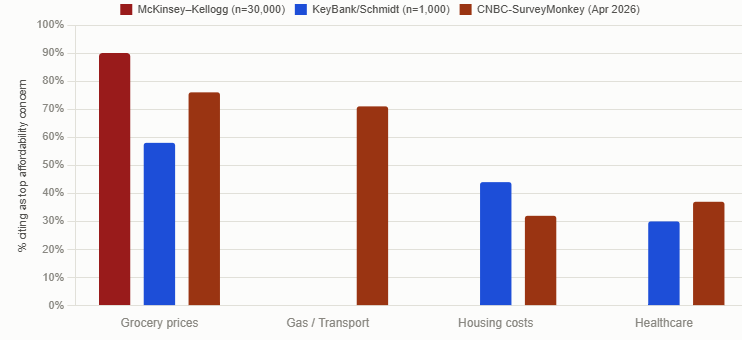
It is not alone. A Harris Poll conducted on behalf of The Guardian in July 2026 found that 95 percent of US adults believe the country is facing an affordability crisis. KeyBank’s Financial Mobility Survey Pulse Poll, fielded by Schmidt Market Research in January 2026, found that 88 percent of Americans had adjusted their financial behaviour in response to economic pressures, with 58 percent citing grocery prices as their top concern — well ahead of housing at 44 percent and healthcare at 30 percent.
A CNBC-SurveyMonkey survey in April 2026 found that 76 percent of Americans who said life had become less affordable pointed to rising grocery prices as a leading cause — more than gasoline and transportation (71%), healthcare (37%), or housing (32%). For most Americans, as Brookings noted in a March 2026 analysis, the grocery store is where they most vividly and regularly see what is happening to prices. It is also where they can do the least to avoid the cost.
The Data: 90% of Americans identify grocery prices as a top financial worry (McKinsey–Kellogg Foundation, August 2026, n=30,000). 95% believe the US faces an affordability crisis (Harris Poll for The Guardian, July 2026). 58% name groceries their #1 financial concern — ahead of housing (44%) and healthcare (30%) (KeyBank, January 2026, n=1,000).
The report’s framing matters as much as the data. It calls affordability the ‘defining challenge’ for economic mobility in the US — not a temporary disruption waiting to resolve itself, but a structural feature of the current economic environment that is reshaping how families prioritise, spend, borrow, and plan. Food costs occupy the top of this affordability hierarchy specifically because they are recurring, unavoidable, and experiential in a way that other cost pressures are not. A family might avoid a healthcare expense by deferring a doctor’s visit or ignore a utility bill for a month. They cannot defer eating.
McKinsey Institute for Economic Mobility / W.K. Kellogg Foundation (August 2026): Affordability has become the ‘defining challenge’ for economic mobility in the United States. 90% of survey respondents — across income groups — identified groceries and food prices as one of their biggest financial worries, outpacing housing and healthcare.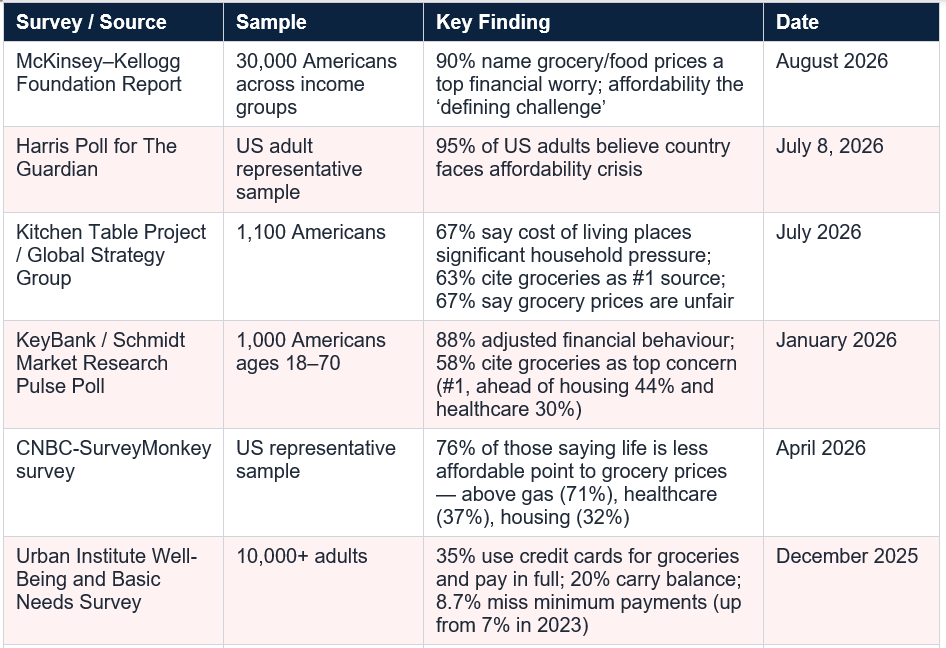

The Kitchen Table Project survey, conducted by Global Strategy Group in May 2026 and surveying 1,100 people, captured a dimension that the larger surveys hinted at but did not fully articulate: the political valence of the anger. Two-thirds of Americans say grocery prices are unfair, with meat and poultry described as especially unaffordable. Eighty-two percent believe that politicians have the power to lower costs if they choose to do so. This belief in the political controllability of food prices — whether or not it is accurate — converts economic stress into political expectation in ways that will be central to the 2026 midterm elections.
Brookings’ March 2026 analysis of affordability as a midterm issue captured the underlying dynamic: although average hourly wages have risen 30.8 percent since the start of the pandemic, costs for many core household budget items have risen even more. Most Americans feel that they are at best running in place. The most vivid and regular reminder of this feeling is the grocery checkout.
The Data: 76% of Americans who say life has become less affordable point to grocery prices as the leading cause — more than gas (71%), healthcare (37%), or housing (32%) (CNBC-SurveyMonkey, April 2026). 67% say grocery prices are unfair, with meat and poultry especially unaffordable. 82% believe politicians can lower costs if they choose to (Kitchen Table Project, July 2026).
Among adults who paid for groceries with a credit card: 35 percent paid their bill in full at the end of the month — a financially sound practice that maximises rewards while avoiding interest. A further 20 percent carried a balance but made at least the minimum monthly payment. And 8.7 percent did not consistently make even the minimum payment. That final figure has risen from approximately 7 percent in 2023 — a near-25 percent increase in the rate of credit stress specifically around grocery purchases in two years.
The buy-now-pay-later dimension is equally concerning. According to CNBC’s August 2026 coverage of the McKinsey–Kellogg report, a separate March 2026 survey found that 29 percent of BNPL users said they had used these short-term instalment loans to buy groceries — up from 14 percent two years ago. A doubling of BNPL usage for grocery purchases in two years is a direct indicator that a meaningful segment of households cannot cash-flow even routine food expenses within a monthly budget.
The implications are significant. Credit card revolving debt carries average annual interest rates above 20 percent in 2026. Households that are using credit cards for grocery purchases and not paying them off are effectively paying a 20-plus percent premium on food costs that are already elevated by inflation. As CNBC quoted Georgetown University’s Marshall Lux: ‘There’s no doubt that there’s pressure in terms of affordability in this country.’
The Data: 29% of BNPL users used buy-now-pay-later to purchase groceries in 2026, up from 14% two years ago (CNBC, August 2026). 8.7% of credit card-using adults did not consistently make minimum payments on balances that included grocery purchases — up from 7% in 2023 (Urban Institute, December 2025).
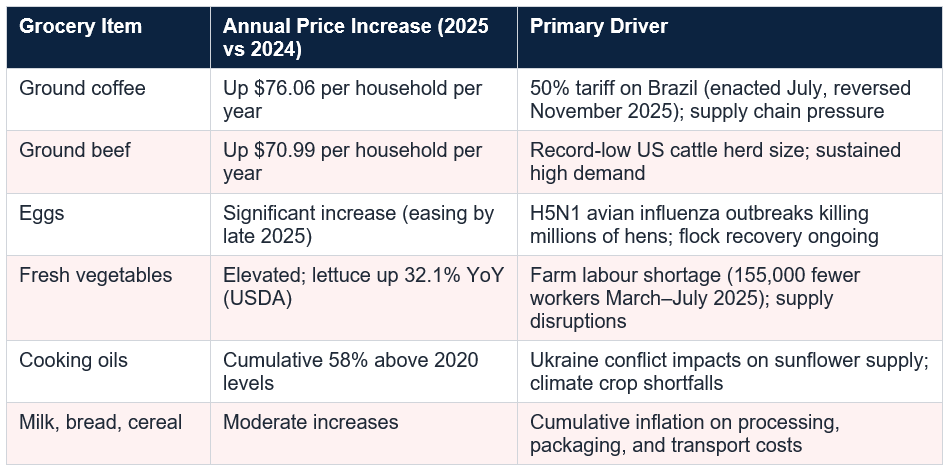
A separate year-long price tracker conducted by heritage-foundation.org in Chicago, which checked 35 common items at major local supermarkets monthly from January 2025 to February 2026, found that the total cost of the basket rose from $263 to $285 at one leading chain — an approximately 8 percent increase in 13 months, outpacing general inflation. At that same chain, 18 of 35 products saw price increases, 15 stayed flat, and only 2 dropped in price over the year.
Brookings’ March 2026 midterm analysis articulates the answer precisely: for most Americans, trips to the grocery store provide the most regular and vivid indication of what is happening to prices. While a rent increase happens once a year and a healthcare cost increase may be noticed only when a bill arrives, the grocery store is visited weekly or more. Every visit produces a real-time update on the cost of living — a cumulative experience that no abstract economic statistic can replicate.
The Christian Science Monitor’s May 2026 analysis of grocery affordability describes the consumer experience clearly. People do not assess food costs the way economists do. They focus on their day-to-day spending — which keeps climbing — and compare their out-of-pocket spending today with what they paid several years ago. A 2.7 percent year-over-year increase sounds manageable in isolation. It sounds very different when a shopper remembers that the previous year’s 9.9 percent increase in 2022 was itself following a period of elevated prices — and that cumulative food prices as of mid-2025 were more than 18 percent above January 2022 levels according to the CBS News price tracker, and approximately 30 to 32 percent above 2020 levels by other estimates.
The affordability of food is also uniquely democratic as a concern. It does not require owning a home to experience housing pressure, but most Americans do not. Almost all Americans buy groceries. As the McKinsey–Kellogg report found, grocery cost stress is nearly universal — across income groups, geographies, ages, and political affiliations.
The Kitchen Table Project survey captures the bipartisan character of this anger. The rising cost of living is placing significant pressure across partisan, gender, generational, and geographic lines. Sixty-three percent cite grocery prices as the top source of that pressure. Eighty-two percent believe that politicians have the power to lower costs. This is not a finding that divides neatly along partisan lines; it represents a broadly shared expectation of government action on food prices that will create accountability across political affiliations.
Consumer optimism data from KeyBank’s January 2026 survey reinforces the political significance. Only 20 percent of Americans described their personal financial outlook as positive in 2026 — down from 26 percent in 2025. Among households earning $100,000 or more, optimism dropped from 34 to 29 percent. Millennials fell from 28 to 23 percent positive. Across income and generational lines, the direction is the same: downward.
The McKinsey–Kellogg Foundation’s framing — affordability as the ‘defining challenge’ for economic mobility — is not hyperbole. Food is the most basic of necessities. When the cost of meeting that necessity rises 30 percent in five years while wages rise 30 percent in the same period, the result is not mathematical neutrality but felt deprivation: the week’s groceries cost more than they used to, the cart is smaller than it used to be, and the credit card balance is higher than it used to be.
The structural causes — agricultural disruptions, labour shortages, tariff effects, and supply chain fragility — are not reversing quickly. The political consequences, documented in survey after survey of bipartisan frustration, are feeding directly into the 2026 midterms. In the meantime, the households experiencing this pressure have access to a set of specific, documented strategies that can meaningfully reduce their exposure to the elevated price environment. None of them involves waiting for the price of ground beef to return to 2020 levels. None of them requires doing without.
The report was produced by the McKinsey Institute for Economic Mobility in partnership with the W.K. Kellogg Foundation and was released in August 2026. It was based on a survey of 30,000 Americans across income groups. The report found that 90% of respondents identified groceries and food prices as one of their biggest financial worries, outpacing housing and healthcare costs. The report described affordability as the ‘defining challenge’ for economic mobility in the United States. Coverage was led by CNBC and IBTimes in August 2026.
How much more are Americans spending on groceries now versus five years ago?
Estimates vary by source and methodology, but converge on a cumulative increase of approximately 28–32% since 2020. The CBS News price tracker found food prices were more than 18% above January 2022 levels by mid-2025. The Urban Institute’s survey noted food costs had risen approximately 32% over five years. The BLS CPI data shows food-at-home prices approximately 26–28% above January 2020 levels. The Congress Joint Economic Committee found the typical family paid $310 more for groceries in 2025 than in 2024, with 20 of 31 tracked items rising in price.
Are Americans using credit cards and BNPL to pay for groceries?
Yes, increasingly. The Urban Institute’s December 2025 Well-Being and Basic Needs Survey (n=10,000+) found that among adults who used credit cards for grocery purchases, 20% carried a balance making minimum monthly payments, and 8.7% did not consistently make even the minimum payment — up from 7% in 2023. A separate March 2026 survey found that 29% of buy-now-pay-later users had used BNPL specifically to purchase groceries, up from 14% two years earlier. These patterns are financially costly: revolving credit card debt carries average interest rates above 20% in 2026.
Did Americans change how they shop for groceries in 2025?
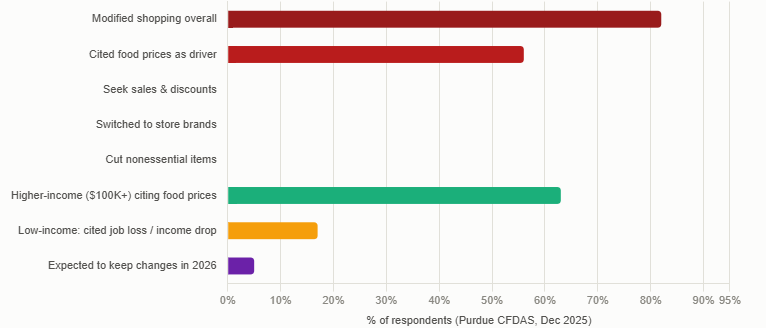
Yes, significantly. Purdue University’s Consumer Food Insights Report (December 2025, n=1,200) found that 82% of consumers modified their grocery shopping behaviour in 2025, primarily in response to higher food prices. The most common adjustments were seeking sales and discounts, switching to store brands, and cutting nonessential items. 56% cited higher food prices as the primary motivation. However, only 5% expected to maintain these changes in 2026, suggesting most viewed the adjustments as temporary. The survey found households with incomes above $100,000 were more likely than lower-income households to cite food prices as their motivation for change (63% vs 52%).
Why have grocery prices risen so much since 2020?
Multiple overlapping causes: the pandemic-era supply chain shock (food-at-home prices rose 9.9% in 2022 alone, the highest since 1979); repeated H5N1 avian influenza outbreaks since 2022 (killing more than 169 million birds and affecting egg and poultry supplies); the US cattle herd at its smallest size in decades (keeping beef prices elevated); farm labour shortages (the farm labour force shrank by 155,000 workers between March and July 2025 due to immigration enforcement, per the Center for American Progress); tariff effects on specific food categories including coffee and tropical fruits; and energy cost increases flowing through food production, processing, and distribution. These causes are largely structural and are not expected to fully reverse.
What can individuals do to manage high grocery costs?
The most evidence-backed strategies, in order of impact: (1) switch primary grocery store to a discount grocer like Aldi or Lidl, which saves more than all other strategies combined according to Wealthvieu’s July 2026 analysis; (2) shift protein consumption from expensive beef toward eggs (prices falling in 2026), chicken thighs, lentils, and canned fish; (3) switch to store brands where quality difference is minimal (up to 75% saving on specific items, per NetCredit April 2026); (4) use digital coupon and cashback apps (Ibotta, Rakuten, store loyalty apps); (5) check SNAP eligibility if income qualifies (fully funded through September 2026; single adult income threshold approximately $1,632/month gross). If using a credit card for groceries, avoid carrying a balance — the 20%+ interest rate on revolving debt adds a significant hidden premium to already-elevated food costs.
Concern Level By category
Shopping Behavior Change 2025
Table of Contents
- The Report That Put a Number on What Everyone Already Feels
- The McKinsey–Kellogg Foundation Report: Key Findings
- A Nation’s Financial Stress by the Numbers
- What the Surveys Are Telling Us: A Multi-Source Overview
- How Americans Are Paying for Groceries: The Credit Card and BNPL Problem
- What Changed How Americans Shop in 2025
- The Items That Rose Most in Cost
- Why Food Feels Different From Other Inflation
- Who Is Hit Hardest?
- Why Grocery Prices Have Risen So Much
- The Political Dimension: Bipartisan Anger at the Checkout
- What Individuals Can Do Right Now
- Conclusion: The Defining Challenge of 2026
- Frequently Asked Questions
The Report That Put a Number on What Everyone Already Feels
The headline finding from a new report released in August 2026 is striking, but it should not be surprising to anyone who has been to a grocery store recently: 90 percent of Americans identify groceries and food prices as one of their biggest financial worries. The report, produced by the McKinsey Institute for Economic Mobility in partnership with the W.K. Kellogg Foundation, surveyed 30,000 Americans across income groups. Its conclusion frames food affordability not as a temporary disruption but as the ‘defining challenge’ for economic mobility in the United States.It is not alone. A Harris Poll conducted on behalf of The Guardian in July 2026 found that 95 percent of US adults believe the country is facing an affordability crisis. KeyBank’s Financial Mobility Survey Pulse Poll, fielded by Schmidt Market Research in January 2026, found that 88 percent of Americans had adjusted their financial behaviour in response to economic pressures, with 58 percent citing grocery prices as their top concern — well ahead of housing at 44 percent and healthcare at 30 percent.
A CNBC-SurveyMonkey survey in April 2026 found that 76 percent of Americans who said life had become less affordable pointed to rising grocery prices as a leading cause — more than gasoline and transportation (71%), healthcare (37%), or housing (32%). For most Americans, as Brookings noted in a March 2026 analysis, the grocery store is where they most vividly and regularly see what is happening to prices. It is also where they can do the least to avoid the cost.
The Data: 90% of Americans identify grocery prices as a top financial worry (McKinsey–Kellogg Foundation, August 2026, n=30,000). 95% believe the US faces an affordability crisis (Harris Poll for The Guardian, July 2026). 58% name groceries their #1 financial concern — ahead of housing (44%) and healthcare (30%) (KeyBank, January 2026, n=1,000).
The McKinsey–Kellogg Foundation Report: Key Findings
The McKinsey Institute for Economic Mobility and the W.K. Kellogg Foundation report, released in August 2026, represents one of the most comprehensive recent assessments of affordability in America. Its central finding — that 90 percent of a 30,000-person sample across income groups named groceries and food prices as a top cost concern — is particularly striking because it cuts across demographic lines. This is not a phenomenon isolated to lower-income households. High-income respondents cited food costs at rates comparable to middle- and lower-income ones.The report’s framing matters as much as the data. It calls affordability the ‘defining challenge’ for economic mobility in the US — not a temporary disruption waiting to resolve itself, but a structural feature of the current economic environment that is reshaping how families prioritise, spend, borrow, and plan. Food costs occupy the top of this affordability hierarchy specifically because they are recurring, unavoidable, and experiential in a way that other cost pressures are not. A family might avoid a healthcare expense by deferring a doctor’s visit or ignore a utility bill for a month. They cannot defer eating.
McKinsey Institute for Economic Mobility / W.K. Kellogg Foundation (August 2026): Affordability has become the ‘defining challenge’ for economic mobility in the United States. 90% of survey respondents — across income groups — identified groceries and food prices as one of their biggest financial worries, outpacing housing and healthcare.
A Nation’s Financial Stress by the Numbers
What the Surveys Are Telling Us: A Multi-Source Overview
The statistical picture that emerges from the multiple surveys conducted between December 2025 and August 2026 is consistent across methodology, sample size, and political orientation of the research organisation. Grocery prices are not one of several affordability concerns — they are the top concern, by a significant margin, among every group measured.The Kitchen Table Project survey, conducted by Global Strategy Group in May 2026 and surveying 1,100 people, captured a dimension that the larger surveys hinted at but did not fully articulate: the political valence of the anger. Two-thirds of Americans say grocery prices are unfair, with meat and poultry described as especially unaffordable. Eighty-two percent believe that politicians have the power to lower costs if they choose to do so. This belief in the political controllability of food prices — whether or not it is accurate — converts economic stress into political expectation in ways that will be central to the 2026 midterm elections.
Brookings’ March 2026 analysis of affordability as a midterm issue captured the underlying dynamic: although average hourly wages have risen 30.8 percent since the start of the pandemic, costs for many core household budget items have risen even more. Most Americans feel that they are at best running in place. The most vivid and regular reminder of this feeling is the grocery checkout.
The Data: 76% of Americans who say life has become less affordable point to grocery prices as the leading cause — more than gas (71%), healthcare (37%), or housing (32%) (CNBC-SurveyMonkey, April 2026). 67% say grocery prices are unfair, with meat and poultry especially unaffordable. 82% believe politicians can lower costs if they choose to (Kitchen Table Project, July 2026).
How Americans Are Paying for Groceries: The Credit Card and BNPL Problem
Perhaps the most financially alarming finding in the 2026 affordability data is not the price data itself — it is the payment data. The Urban Institute’s Well-Being and Basic Needs Survey, conducted in December 2025 with a sample of more than 10,000 adults (expanded from prior years to include 2,500 adults aged 65 and over), provides the clearest picture of how households are financing basic food purchases.Among adults who paid for groceries with a credit card: 35 percent paid their bill in full at the end of the month — a financially sound practice that maximises rewards while avoiding interest. A further 20 percent carried a balance but made at least the minimum monthly payment. And 8.7 percent did not consistently make even the minimum payment. That final figure has risen from approximately 7 percent in 2023 — a near-25 percent increase in the rate of credit stress specifically around grocery purchases in two years.
The buy-now-pay-later dimension is equally concerning. According to CNBC’s August 2026 coverage of the McKinsey–Kellogg report, a separate March 2026 survey found that 29 percent of BNPL users said they had used these short-term instalment loans to buy groceries — up from 14 percent two years ago. A doubling of BNPL usage for grocery purchases in two years is a direct indicator that a meaningful segment of households cannot cash-flow even routine food expenses within a monthly budget.
The implications are significant. Credit card revolving debt carries average annual interest rates above 20 percent in 2026. Households that are using credit cards for grocery purchases and not paying them off are effectively paying a 20-plus percent premium on food costs that are already elevated by inflation. As CNBC quoted Georgetown University’s Marshall Lux: ‘There’s no doubt that there’s pressure in terms of affordability in this country.’
The Data: 29% of BNPL users used buy-now-pay-later to purchase groceries in 2026, up from 14% two years ago (CNBC, August 2026). 8.7% of credit card-using adults did not consistently make minimum payments on balances that included grocery purchases — up from 7% in 2023 (Urban Institute, December 2025).
What Changed How Americans Shop in 2025
Purdue University’s Center for Food Demand Analysis and Sustainability (CFDAS) publishes a monthly Consumer Food Insights report based on surveys of approximately 1,200 consumers. The December 2025 edition specifically tracked grocery shopping behaviour changes made throughout 2025. The findings:- 82% of consumers reported modifying their grocery shopping behaviour in 2025, driven by economic pressures.
- The three most common adjustments: seeking sales and discounts; switching to cheaper or store-brand products instead of name brands; cutting nonessential items and splurges from the grocery list.
- 56% cited higher overall food prices as the primary motivation for changing their shopping. Notably, households with incomes of $100,000 or more were more likely than lower-income households to cite food prices as their reason for change (63% vs 52%).
- Only 5% expected to maintain these behaviour changes in 2026 — suggesting most viewed their 2025 adjustments as temporary responses rather than permanent shifts.
The Items That Rose Most in Cost
The Congress Joint Economic Committee’s January 2026 report, which tracked the prices of 31 common grocery products based on Walmart price data and Bureau of Labor Statistics figures, found that the typical American family paid $310 more for groceries in 2025 compared to 2024. Twenty of the 31 tracked items rose in price. The items with the largest annual increases:A separate year-long price tracker conducted by heritage-foundation.org in Chicago, which checked 35 common items at major local supermarkets monthly from January 2025 to February 2026, found that the total cost of the basket rose from $263 to $285 at one leading chain — an approximately 8 percent increase in 13 months, outpacing general inflation. At that same chain, 18 of 35 products saw price increases, 15 stayed flat, and only 2 dropped in price over the year.
Why Food Feels Different From Other Inflation
Housing costs have risen sharply. Healthcare expenses have climbed for decades. Energy bills have spiked. Yet survey after survey in 2025 and 2026 places grocery prices at the top of the affordability concern hierarchy. Why does food feel different?Brookings’ March 2026 midterm analysis articulates the answer precisely: for most Americans, trips to the grocery store provide the most regular and vivid indication of what is happening to prices. While a rent increase happens once a year and a healthcare cost increase may be noticed only when a bill arrives, the grocery store is visited weekly or more. Every visit produces a real-time update on the cost of living — a cumulative experience that no abstract economic statistic can replicate.
The Christian Science Monitor’s May 2026 analysis of grocery affordability describes the consumer experience clearly. People do not assess food costs the way economists do. They focus on their day-to-day spending — which keeps climbing — and compare their out-of-pocket spending today with what they paid several years ago. A 2.7 percent year-over-year increase sounds manageable in isolation. It sounds very different when a shopper remembers that the previous year’s 9.9 percent increase in 2022 was itself following a period of elevated prices — and that cumulative food prices as of mid-2025 were more than 18 percent above January 2022 levels according to the CBS News price tracker, and approximately 30 to 32 percent above 2020 levels by other estimates.
The affordability of food is also uniquely democratic as a concern. It does not require owning a home to experience housing pressure, but most Americans do not. Almost all Americans buy groceries. As the McKinsey–Kellogg report found, grocery cost stress is nearly universal — across income groups, geographies, ages, and political affiliations.
Who Is Hit Hardest?
While grocery affordability is a near-universal concern, the intensity of its impact is not uniform. The data from multiple surveys and studies identifies the groups experiencing the most acute pressure:- Lower-income households: The Urban Institute’s findings on grocery credit card usage and minimum payment misses are most acute in lower-income brackets. The Purdue CFI data found that 17 percent of low-income households (earning below $50,000) cited reduced income or job loss — not just food price increases — as the driver of their grocery behaviour changes.
- Younger adults: A February 2026 LendingTree survey found that approximately 20 percent of younger adults said affording food had become difficult. By contrast, only 5 percent of baby boomers reported such difficulty. The Christian Science Monitor’s May 2026 profile of Joei Chan, a recent college graduate in Boston working in hospitality, captures this experience: ‘Food shopping has become “strategic.” Now it’s all about: how can I best save my money?’
- Fixed-income older adults: The Urban Institute’s 2025 survey expansion to include adults 65 and over was specifically motivated by the affordability pressures facing seniors on fixed incomes, whose Social Security COLA of 2.8 percent in 2026 trails current food inflation rates.
- Residents of previously affordable regions: The Urban Institute’s American Affordability Tracker found that affordability pressures are spreading beyond traditionally high-cost coastal areas. Parts of Atlanta, Chicago, Louisville, Winston-Salem, Columbus, Nashville, western New York, south-central Wisconsin, and central Florida are seeing costs for housing, healthcare, and groceries rise faster than in other areas.
Why Grocery Prices Have Risen So Much
The causes of the sustained grocery price increase since 2020 are multiple, overlapping, and in some cases ongoing. Understanding them helps frame realistic expectations about whether and when conditions might improve:- The pandemic shock (2020–2022): supply chain disruptions, labour shortages, and demand surges combined to produce the highest food inflation in 40 years. Food-at-home prices rose 9.9 percent in 2022 — a figure not seen since 1979.
- Agricultural disruptions: repeated outbreaks of Highly Pathogenic Avian Influenza (H5N1) since 2022 have killed more than 169 million birds, severely affecting egg and poultry supplies and prices. The US cattle herd is at its smallest size in decades, keeping beef prices elevated despite moderated demand.
- Farm labour shortages: the Center for American Progress’ March 2026 analysis found that the farm labour force shrank by 155,000 workers between March and July 2025, with the US Department of Labor stating that immigration enforcement was ‘threatening the stability of domestic food production and prices.’ Without sufficient agricultural labour, unharvested crops and reduced production add cost pressure throughout the food supply chain.
- Tariff impacts: a 50 percent tariff on Brazil enacted in July 2025 (later reversed in November) contributed to coffee price spikes. Broader tariff policies on imported goods — including tropical fruits, cocoa, and some seafood — are adding above-trend price increases to those categories in 2026.
- Dynamic pricing on digital platforms: the Center for American Progress’ March 2026 study found that 74 percent of grocery items on the Instacart platform were offered at multiple price points for different users simultaneously, raising questions about personalised pricing practices that may systematically disadvantage certain customer segments.
The Political Dimension: Bipartisan Anger at the Checkout
The food affordability crisis has become one of the central political issues of 2026. Brookings’ March 2026 analysis specifically frames grocery affordability as a key driver of the 2026 midterm elections: with the war in Iran raising energy prices that flow through much of the economy, the Trump administration’s window to alleviate affordability concerns before the midterms is narrowing.The Kitchen Table Project survey captures the bipartisan character of this anger. The rising cost of living is placing significant pressure across partisan, gender, generational, and geographic lines. Sixty-three percent cite grocery prices as the top source of that pressure. Eighty-two percent believe that politicians have the power to lower costs. This is not a finding that divides neatly along partisan lines; it represents a broadly shared expectation of government action on food prices that will create accountability across political affiliations.
Consumer optimism data from KeyBank’s January 2026 survey reinforces the political significance. Only 20 percent of Americans described their personal financial outlook as positive in 2026 — down from 26 percent in 2025. Among households earning $100,000 or more, optimism dropped from 34 to 29 percent. Millennials fell from 28 to 23 percent positive. Across income and generational lines, the direction is the same: downward.
What Individuals Can Do Right Now
The causes of grocery price inflation are largely structural and beyond individual control. The responses available to households are not. The most evidence-backed immediate actions:- • Switch primary grocery store: according to Wealthvieu’s July 2026 grocery analysis, switching to a discount grocer like Aldi or Lidl is the single highest-impact strategy available — saving more than all other strategies combined for most households. Aldi gained 19 million new shoppers in 2025 as households voted with their feet.
- • Shift from ground beef and expensive proteins: the JEC report specifically identified ground beef (up $70.99 annually per household) as one of the highest-impact individual item increases. Chicken thighs, eggs (prices falling in 2026 as flocks recover), dried lentils, and canned fish provide equivalent or superior protein nutrition at a fraction of current beef prices.
- • Switch to store brands: the NetCredit April 2026 study of 171 grocery items found store-brand versions can save up to 75 percent compared to national brands at Walmart, Kroger, or Target. The Purdue CFI report confirmed this was the second most common adaptation made by the 82 percent of shoppers who changed their behaviour in 2025.
- • Use digital coupons and cashback apps: Ibotta, Rakuten, store loyalty apps with personalised offers, and Flipp (which aggregates weekly circulars from all nearby stores) provide consistent savings with minimal ongoing effort.
- • Check SNAP eligibility: the Supplemental Nutrition Assistance Program remains fully funded through September 2026. Many qualifying households, particularly older adults, have not applied. SNAP eligibility extends to single adults with gross monthly income below approximately $1,632 and families of four below approximately $3,354 per month.
Conclusion
Nine in ten Americans name groceries and food prices as a top financial worry. Ninety-five percent believe the country faces an affordability crisis. Fifty-eight percent in one survey — the largest share identifying any single concern — name grocery costs as their top financial issue. These are not the outputs of a single methodology or a particular political perspective. They are the convergent findings of surveys ranging from 1,000 to 30,000 respondents, conducted by organisations as different as a progressive think tank, a major commercial bank, and an Ivy League research centre.The McKinsey–Kellogg Foundation’s framing — affordability as the ‘defining challenge’ for economic mobility — is not hyperbole. Food is the most basic of necessities. When the cost of meeting that necessity rises 30 percent in five years while wages rise 30 percent in the same period, the result is not mathematical neutrality but felt deprivation: the week’s groceries cost more than they used to, the cart is smaller than it used to be, and the credit card balance is higher than it used to be.
The structural causes — agricultural disruptions, labour shortages, tariff effects, and supply chain fragility — are not reversing quickly. The political consequences, documented in survey after survey of bipartisan frustration, are feeding directly into the 2026 midterms. In the meantime, the households experiencing this pressure have access to a set of specific, documented strategies that can meaningfully reduce their exposure to the elevated price environment. None of them involves waiting for the price of ground beef to return to 2020 levels. None of them requires doing without.
Frequently Asked Questions
What report found that grocery prices are Americans’ top affordability challenge?The report was produced by the McKinsey Institute for Economic Mobility in partnership with the W.K. Kellogg Foundation and was released in August 2026. It was based on a survey of 30,000 Americans across income groups. The report found that 90% of respondents identified groceries and food prices as one of their biggest financial worries, outpacing housing and healthcare costs. The report described affordability as the ‘defining challenge’ for economic mobility in the United States. Coverage was led by CNBC and IBTimes in August 2026.
How much more are Americans spending on groceries now versus five years ago?
Estimates vary by source and methodology, but converge on a cumulative increase of approximately 28–32% since 2020. The CBS News price tracker found food prices were more than 18% above January 2022 levels by mid-2025. The Urban Institute’s survey noted food costs had risen approximately 32% over five years. The BLS CPI data shows food-at-home prices approximately 26–28% above January 2020 levels. The Congress Joint Economic Committee found the typical family paid $310 more for groceries in 2025 than in 2024, with 20 of 31 tracked items rising in price.
Are Americans using credit cards and BNPL to pay for groceries?
Yes, increasingly. The Urban Institute’s December 2025 Well-Being and Basic Needs Survey (n=10,000+) found that among adults who used credit cards for grocery purchases, 20% carried a balance making minimum monthly payments, and 8.7% did not consistently make even the minimum payment — up from 7% in 2023. A separate March 2026 survey found that 29% of buy-now-pay-later users had used BNPL specifically to purchase groceries, up from 14% two years earlier. These patterns are financially costly: revolving credit card debt carries average interest rates above 20% in 2026.
Did Americans change how they shop for groceries in 2025?
Yes, significantly. Purdue University’s Consumer Food Insights Report (December 2025, n=1,200) found that 82% of consumers modified their grocery shopping behaviour in 2025, primarily in response to higher food prices. The most common adjustments were seeking sales and discounts, switching to store brands, and cutting nonessential items. 56% cited higher food prices as the primary motivation. However, only 5% expected to maintain these changes in 2026, suggesting most viewed the adjustments as temporary. The survey found households with incomes above $100,000 were more likely than lower-income households to cite food prices as their motivation for change (63% vs 52%).
Why have grocery prices risen so much since 2020?
Multiple overlapping causes: the pandemic-era supply chain shock (food-at-home prices rose 9.9% in 2022 alone, the highest since 1979); repeated H5N1 avian influenza outbreaks since 2022 (killing more than 169 million birds and affecting egg and poultry supplies); the US cattle herd at its smallest size in decades (keeping beef prices elevated); farm labour shortages (the farm labour force shrank by 155,000 workers between March and July 2025 due to immigration enforcement, per the Center for American Progress); tariff effects on specific food categories including coffee and tropical fruits; and energy cost increases flowing through food production, processing, and distribution. These causes are largely structural and are not expected to fully reverse.
What can individuals do to manage high grocery costs?
The most evidence-backed strategies, in order of impact: (1) switch primary grocery store to a discount grocer like Aldi or Lidl, which saves more than all other strategies combined according to Wealthvieu’s July 2026 analysis; (2) shift protein consumption from expensive beef toward eggs (prices falling in 2026), chicken thighs, lentils, and canned fish; (3) switch to store brands where quality difference is minimal (up to 75% saving on specific items, per NetCredit April 2026); (4) use digital coupon and cashback apps (Ibotta, Rakuten, store loyalty apps); (5) check SNAP eligibility if income qualifies (fully funded through September 2026; single adult income threshold approximately $1,632/month gross). If using a credit card for groceries, avoid carrying a balance — the 20%+ interest rate on revolving debt adds a significant hidden premium to already-elevated food costs.
Content for adults can be streamed on trusted platforms for privacy. Explore reliable adult hubs for quality viewing.