

Credits
How Much Credit Card Debt Can You Afford?


Table of Contents
- The Question Nobody Asks Until It Is Too Late
- The State of Credit Card Debt in 2026: Key Statistics
- The True Cost of Carrying Credit Card Debt: 2026 Calculations
- How Much Credit Card Debt Can You Actually Afford?
- Framework 1: The Debt-to-Income Ratio (DTI)
- Accountant's Worked Examples: Calculating Your Personal Affordability
- Example 1 — UK Professional (£40,000 gross income)
- Example 2 — US Household (Dual Income $85,000 gross)
- The Minimum Payment Trap: Why It Is the Most Expensive Decision You Can Make
- How Credit Card Debt Affects Your Credit Score and Mortgage Eligibility
- Warning Signs: When Credit Card Debt Has Become a Problem
- Conclusion
- Frequently Asked Questions (FAQ)
The Question Nobody Asks Until It Is Too Late
Credit card debt is the most expensive form of mainstream borrowing available to consumers — and it is the form of debt that most people carry with the least awareness of its true cost. The question 'how much credit card debt can I afford?' is rarely asked when the card is being swiped. It is most often asked when the balance has reached a level that is creating palpable financial stress: when the minimum payment is consuming a meaningful share of disposable income, when the interest charges are growing faster than repayments reduce the principal, or when an additional unexpected expense makes the whole structure feel precarious.The 2026 data makes the scale of this problem impossible to minimise. Total US credit card debt reached $1.25 trillion in Q1 2026 — down slightly from the record $1.277 trillion in Q4 2025 but still at historically elevated levels (LendingTree, 1 week ago). The average American carries $6,715 in credit card debt per person; the average American household carries $11,507 (Forbes Advisor, 1 week ago; WalletHub, May 2026). The average APR across all US credit card accounts in Q2 2026 was 20.94%, with cards carrying interest averaging 22.15%. In the UK, total credit card debt is forecast to hit £79 billion by the end of 2026, with the average British person carrying £1,400 at an average rate of 24.4% — and paying £342 in credit card interest annually for the privilege (Updraft, May 2026).
This guide takes an accountant's structured, numerical approach to the central question: how much credit card debt can you actually afford? It covers the true cost of carrying balances at current 2026 interest rates through detailed examples, the debt-to-income ratio framework that lenders and financial advisers use to assess affordability, the minimum payment trap and exactly how much it costs in pounds and dollars, how credit card debt affects your credit score and mortgage eligibility, the specific warning signs that your debt has crossed from manageable to problematic, four evidence-based strategies for getting out of credit card debt, and the free resources available in the UK and US for people who need professional help now.
The State of Credit Card Debt in 2026: Key Statistics
Before examining how much debt is affordable, it is essential to establish what is actually happening across the population — because the data reveals patterns that should concern anyone carrying a credit card balance at current interest rates:- US credit card debt has reached historic highs: LendingTree (1 week ago): 'Americans total credit card balance is $1.252 trillion as of Q1 2026, according to the Federal Reserve Bank of New York. That is down from $1.277 trillion in Q4 2025, which marked the highest balance since the New York Fed began tracking the data in 1999.' This is not just a large number in the abstract — it represents an average of $11,507 per US household in active credit card debt, carrying interest at rates averaging 21-22%.
- UK credit card rates are even higher: Updraft (May 2026): 'The average credit card interest rate is 24.4% (Bank of England December 2026 estimate). The average Brit is estimated to have £1,400 of credit card debt in 2026. The average credit card interest paid per person in 2026 is forecast to total £342.' Total UK credit card interest payments: £19.3 billion in 2026. Average interest paid per adult has risen 60% since 2015 (£215 in 2015 to £345 in 2025).
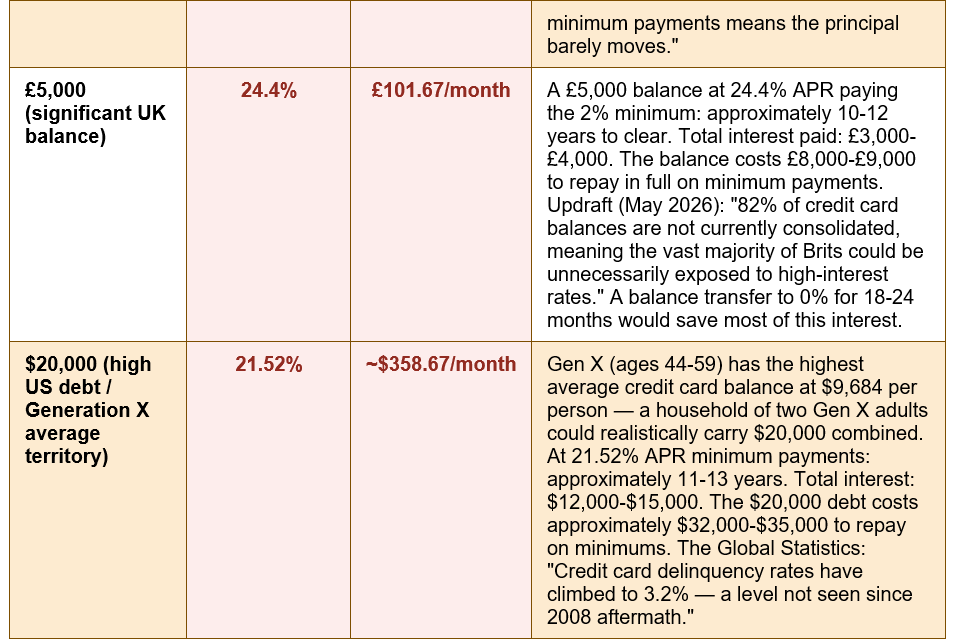
- Delinquency rates are at post-2008 levels: The Global Statistics (May 2026): 'Credit card delinquency rates have climbed meaningfully in 2026, with the 90-day-plus delinquency rate reaching 3.2% — a level not seen since the aftermath of the 2008 financial crisis. The charge-off rate of 4.7% means that for every $100 lenders have extended, nearly $5 is being written off as uncollectable debt.' These are systemic signals that a significant proportion of cardholders have already crossed from 'manageable' to 'crisis' territory.
- Many people are in the minimum payment trap: WalletHub (June 2026): 'It would take over 7 years of minimum payments for the average person to pay off their total credit card bill — assuming no new purchases — and it would cost roughly $3,610 in interest.' Updraft (May 2026): '6% of UK credit cardholders make only the minimum payment each month.' These people are effectively trapped in interest-servicing with minimal principal reduction.
- More than 1 in 5 Americans are highly stressed by credit card debt: WalletHub (June 2026): 'More than 1 in 5 Americans are very stressed about their credit card debt.' LendingTree (1 week ago): '45% of cardholders carried a balance for at least one month in the past year, according to a May 2026 Federal Reserve study using 2025 data.' The majority who carry balances are paying significant interest that represents a perpetual drain on household finances.
The 2026 credit card debt reality: US: $1.25 trillion total debt. Average household: $11,507. APR: 21.52%. 7+ years on minimums. $3,610 interest on average balance. — Forbes Advisor (1 week ago, July 2026): Average American credit card debt $6,715 (December 2025, TransUnion). WalletHub (May 1, 2026): Average US household $11,507 Q1 2026; APR 20.94% all accounts Q2 2026; 21.52% for cards with finance charges. LendingTree (1 week ago): $1.252 trillion total Q1 2026. Updraft (May 6, 2026): UK total forecast £79 billion by December 2026; average £1,400 per person; 24.4% average APR; £342 annual interest per adult; 82% of balances not consolidated; 6% on minimum payments only
The True Cost of Carrying Credit Card Debt: 2026 Calculations
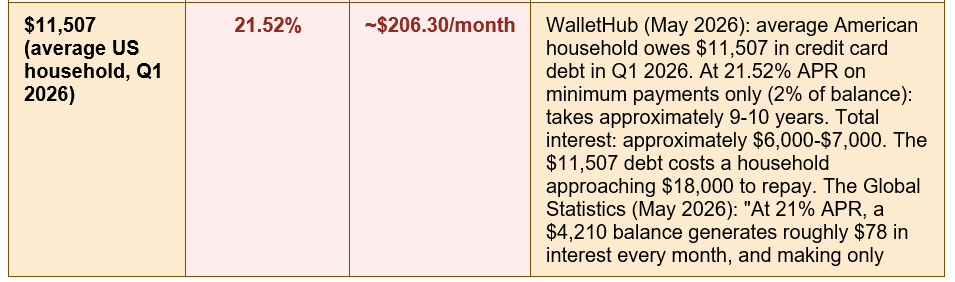
The most powerful thing an accountant can show anyone with credit card debt is the true cost of carrying that balance — not the headline balance, but the total amount paid by the time the debt is cleared on minimum payments. The numbers are consistently and dramatically higher than most cardholders realise: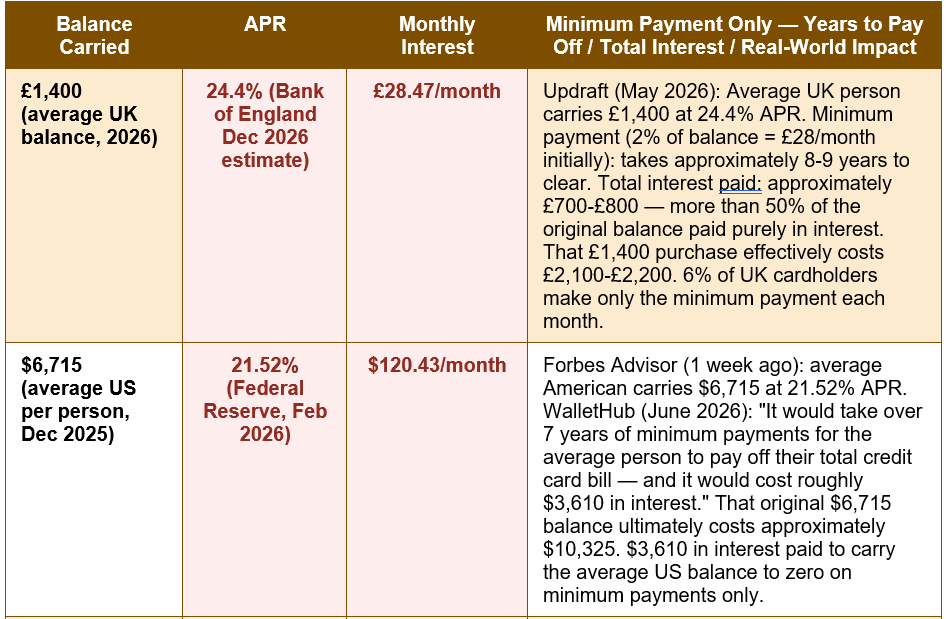
How Much Credit Card Debt Can You Actually Afford?
There is no universal answer to how much credit card debt is too much — it depends on income, total debt obligations, savings, and individual financial circumstances. But there are three structured frameworks that accountants and financial advisers use to assess whether a given level of credit card debt is manageable, concerning, or critical:Framework 1: The Debt-to-Income Ratio (DTI)
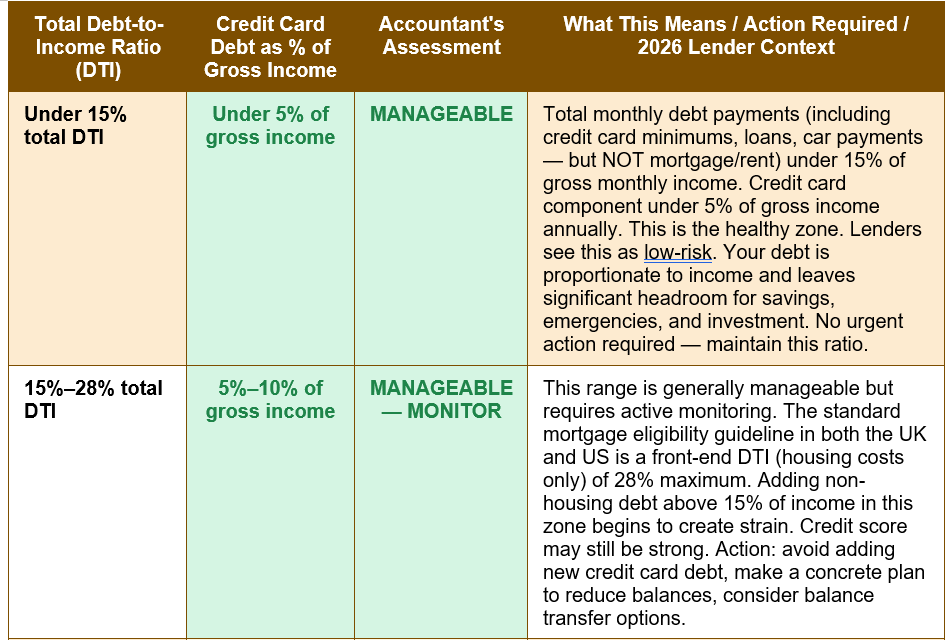
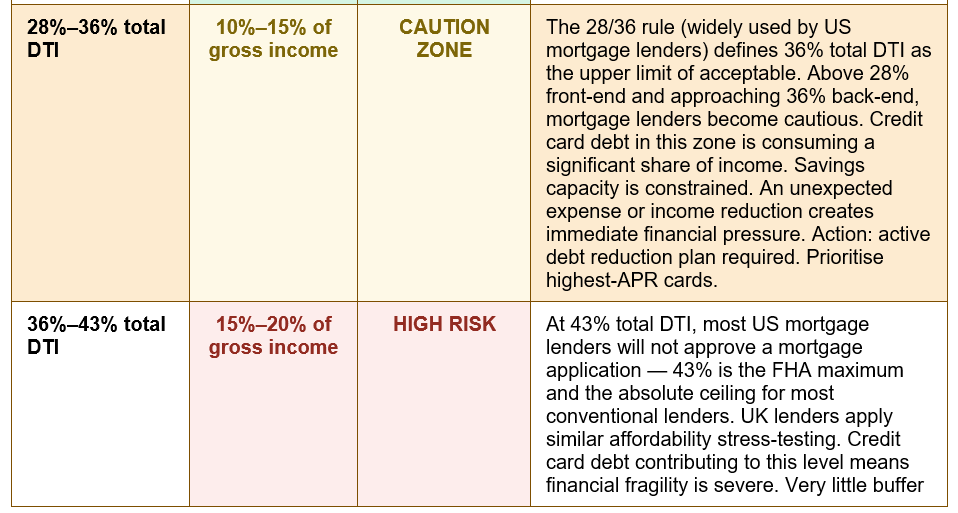
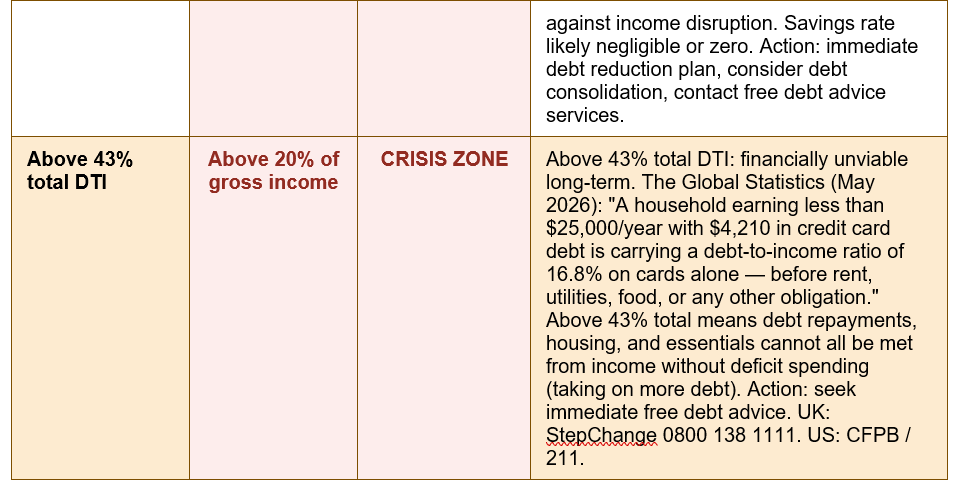
The debt-to-income ratio (DTI) is the most widely used measure of debt affordability. It calculates total monthly debt payments as a percentage of gross (pre-tax) monthly income. The formula is: DTI = (Total Monthly Debt Payments / Gross Monthly Income) x 100. For credit cards specifically, the monthly debt payment is the minimum payment required — though paying the minimum is never recommended as a long-term strategy.The 28/36 rule is the standard US mortgage lending guideline: no more than 28% of gross income should go to housing costs (front-end DTI), and no more than 36% total should go to all debt payments combined (back-end DTI). At 43% total DTI, most conventional mortgage lenders in the US will decline applications — 43% is the FHA maximum. In the UK, lenders conduct individual affordability assessments but apply similar stress tests to evaluate whether the borrower can service debt at higher interest rates. The table below maps the full DTI spectrum:
Accountant's Worked Examples: Calculating Your Personal Affordability
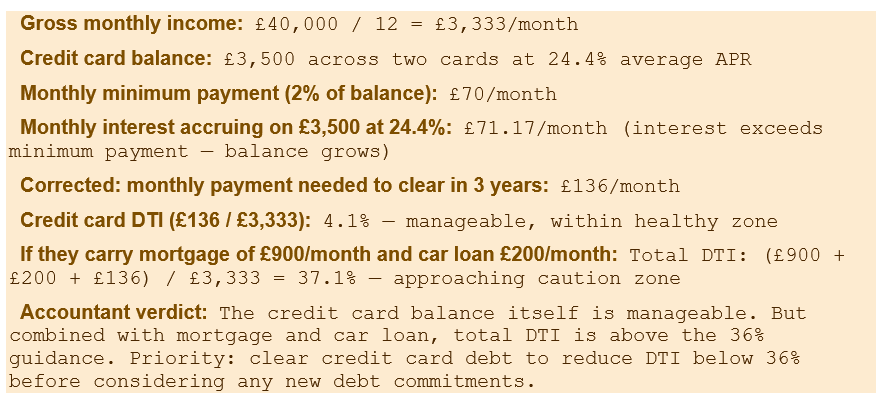
Example 1 — UK Professional (£40,000 gross income)
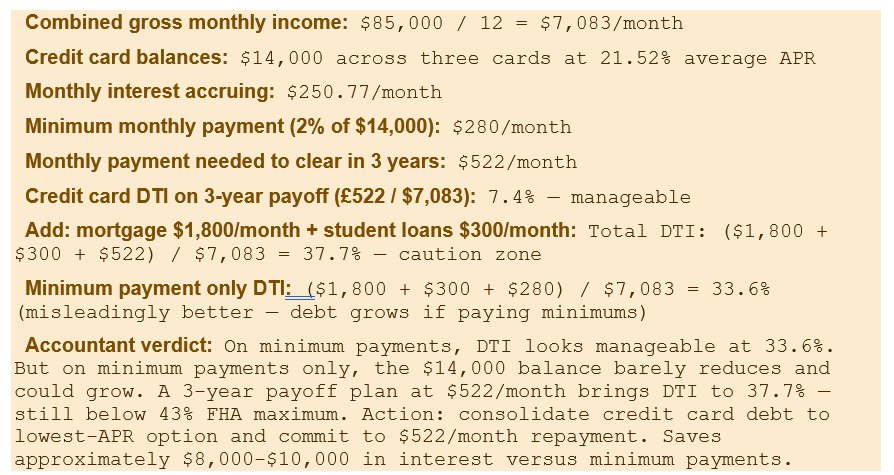
Example 2 — US Household (Dual Income $85,000 gross)
The Minimum Payment Trap: Why It Is the Most Expensive Decision You Can Make
The minimum payment is the most financially destructive legal option available on a credit card — and it is the option that 6% of UK cardholders (Updraft, May 2026) and a significant proportion of US cardholders choose every month. Understanding why requires understanding the mathematics of amortisation at 21-24% interest rates.The minimum payment on most credit cards is calculated as either a fixed amount (typically £25 in the UK, $25 in the US) or a percentage of the outstanding balance (typically 2%), whichever is greater. When the minimum is 2% of the balance, it means that at 24.4% APR (UK average), approximately 2.03% of the balance is generated in interest each month — and 2% is being repaid as the minimum. The balance barely moves, because interest is consuming almost the entire payment. WalletHub (June 2026) quantifies this: 'It would take over 7 years of minimum payments for the average person to pay off their total credit card bill — assuming there are no new purchases — and it would cost roughly $3,610 in interest.'
The only sustainable approach to credit card debt is to pay significantly more than the minimum every month — ideally paying the full statement balance each month to avoid interest entirely. For anyone who cannot pay the full balance, the target should be a fixed monthly payment large enough to clear the balance within 12-24 months, calculated using an online debt payoff calculator or the formula: Monthly Payment = Balance x (Monthly Rate / (1 - (1 + Monthly Rate)^-n)), where n is the number of months to clear.
The true cost of minimum payments — an accountant's illustration: Suppose you carry a £3,000 credit card balance at 24.4% APR and make only the minimum payment (2% of balance or £25, whichever is greater). Month 1: balance £3,000; interest £61; minimum payment £60; new balance £3,001 — the balance has GROWN because the interest exceeds the minimum. This is the minimum payment trap in its starkest form: at 24.4% APR, any balance above £1,250 generates more interest per month than the minimum payment covers. The balance does not shrink; it grows until the minimum payment exceeds the monthly interest charge — which can take years. The same £3,000 paid at a fixed £150/month is cleared in approximately 23 months with total interest of approximately £390. On minimum payments only: cleared in approximately 10-11 years with total interest of approximately £1,600. The difference between minimum payments and a structured repayment plan on this single balance: approximately £1,210 and 9 years of your life.
How Credit Card Debt Affects Your Credit Score and Mortgage Eligibility
Credit card debt affects financial life far beyond the direct cost of interest. Its impact on credit scores and mortgage eligibility creates second-order consequences that extend to every other financial decision:- Credit utilisation rate: The credit utilisation ratio — the percentage of available credit you are using — is one of the most significant factors in credit score calculations in both the UK and US. Yahoo Finance (May 2026): 'The credit utilization rate was 29.1% in September 2025.' Motley Fool (May 2026): 'The conventional wisdom is to keep utilisation below 30%, and the data suggests consumers are doing well to manage their credit cards.' However, for the best credit scores, experts typically recommend staying below 10% utilisation. A £3,000 balance on a card with a £5,000 limit represents 60% utilisation — significantly damaging to credit scores regardless of the payment history.
- Payment history: Late or missed credit card payments are among the most damaging events to a credit score — in the UK (Equifax, Experian, TransUnion scores) and the US (FICO, VantageScore). A single missed payment can reduce a good credit score by 50-100 points. Consistent on-time payments, even of only the minimum, are essential for maintaining credit score health. The Global Statistics (May 2026): delinquency rates at 3.2% — meaning 3.2% of accounts are 90+ days past due, a post-2008 high.
- Mortgage affordability assessment: UK mortgage lenders conduct strict affordability assessments that examine total monthly debt commitments as a proportion of income, and stress-test affordability at interest rates 3%+ above the offered rate. High credit card balances appear in these assessments and directly reduce the mortgage amount lenders will offer. In the US, the back-end DTI (total monthly debt including credit card minimums, student loans, car loans, and proposed mortgage) must stay below 43% for most lenders (28-36% is the recommended range). A household with $11,507 in credit card debt at minimum payments of $230/month has that $230 counted against their mortgage affordability — potentially reducing the mortgage they qualify for by $30,000-$50,000.
Warning Signs: When Credit Card Debt Has Become a Problem
The accountant's six warning signs that credit card debt has moved from manageable to problematic — each representing a quantifiable risk to financial health:- You are making only minimum payments: If you cannot pay more than the minimum each month, your debt is not affordable — it is growing. At 21-24% APR, minimum payments barely cover the interest charge at typical balance levels. This is the clearest single signal that intervention is needed.
- Your credit utilisation is above 30%: Credit card balances exceeding 30% of your total available credit limit are damaging your credit score every month and may be preventing you from accessing lower-rate debt products (personal loans, balance transfers, mortgages) that could help manage the situation.
- Your total DTI is above 36%: When all monthly debt payments — credit cards, loans, car finance, student loans — exceed 36% of gross income, financial vulnerability is significant. Above 43%, it is critical. Use the DTI table in this guide to calculate your exact position.
- You are using credit cards for essential spending: If credit card spending is covering groceries, utilities, or other essential expenses because cash income is insufficient, the balance is not a chosen financial tool — it is a symptom of a cashflow deficit. The deficit needs to be addressed directly, not deferred onto a card at 21-24%.
- You are stressed about your credit card debt: WalletHub (June 2026): 'More than 1 in 5 Americans are very stressed about their credit card debt.' Persistent financial stress is itself a warning sign — your psychology is recognising a risk that the numbers may be obscuring.
- You cannot identify a realistic payoff date: If you cannot answer the question 'when will this balance be zero?' with a specific date and a monthly payment plan, your debt does not have a trajectory toward resolution. Open-ended debt at 21-24% APR is a compounding liability with no natural endpoint.
THE FOUR DEBT STRATEGIES RANKED BY COST-EFFECTIVENESS: (1) BALANCE TRANSFER — Best for those with good credit. Transfer high-rate balances to a 0% promotional card (typically 18-24 months in the UK and US). Eliminate interest entirely during the promotional period. UK: Updraft notes 82% of UK balances are not consolidated — the majority could save hundreds of pounds with a balance transfer. Requirements: good credit score; balance transfer fee (typically 2-3%). Commit to clearing the balance before the promotional period expires — when it expires, the rate typically jumps to 20%+. (2) DEBT CONSOLIDATION LOAN — A personal loan at 7-15% APR used to clear multiple credit card balances at 21-24%. Lower rate, fixed monthly payment, defined payoff date. Discipline required: do not re-accumulate card balances after consolidating. (3) AVALANCHE METHOD — Pay minimum on all cards, then direct all extra money to the highest-APR card first. Mathematically optimal — reduces total interest paid. Best if you can identify surplus income for accelerated repayment. (4) SNOWBALL METHOD — Pay minimum on all cards, then direct all extra money to the smallest balance first. Psychologically motivating — quick wins. Slightly more expensive than the avalanche method but more adherence-friendly. The worst strategy: minimum payments only, no plan, indefinitely. This costs more than any other approach and never resolves the debt.
Conclusion
The accountant's honest answer to 'how much credit card debt can you afford?' is: none, if you are paying interest on it. The ideal position with credit cards is to use them as a payment tool — for the Section 75 consumer protection, the rewards, the convenience — and pay the full statement balance every month, generating zero interest charges. When that is not possible, the framework is clear: total debt payments should stay below 36% of gross income (the 28/36 rule), credit card utilisation should stay below 30% of available credit, and every balance should have a concrete, dated repayment plan that clears it within 12-24 months at most.The 2026 data tells a concerning story: $1.25 trillion in US credit card debt at 21.52% average APR; £79 billion in UK credit card debt at 24.4% average APR; delinquency rates at post-2008 highs; and millions of cardholders in the minimum payment trap where 7+ years of payments generate $3,610 in interest on the average US balance. These are not abstract systemic numbers — they are the financial experience of the majority of cardholders who carry balances. The mathematics of 21-24% compound interest is relentless and unforgiving at any balance level.
The good news is that credit card debt is one of the most addressable financial problems available — unlike a mortgage, it can typically be cleared within a few years with a structured plan, a balance transfer to 0%, or a debt consolidation loan. The key is to stop the bleeding (no new credit card spending beyond what can be paid in full), calculate the true cost of the current debt (using the tools in this guide), implement one of the four debt strategies ranked above, and seek free professional advice if the situation has reached crisis territory. In the UK: StepChange (0800 138 1111), Citizens Advice (0800 144 8848), National Debtline (0808 808 4000). In the US: 211 for local referrals, the CFPB, or a non-profit credit counselling agency. The first step is knowing your numbers. This guide has given you the tools to calculate them.
0 Comments
Be the first to share your thoughts on this article.