

Investing
How to Buy Stocks for Your Investment Portfolio


Table of Contents
- The Wealth-Building Opportunity That 42% of Americans Are Missing
- Why Invest in Stocks? The Case for Stock Market Participation
- Step 1: Define Your Investment Goals and Time Horizon
- Step 2: Choose the Right Account Type
- Step 3: Open and Fund Your Brokerage Account
- Step 4: Decide What to Buy — Stocks vs Funds
- Step 5: Research Your Investments Before Buying
- Step 6: Place Your First Stock Purchase Order
- Step 7: Build a Diversified Portfolio Over Time
- Step 8: Manage, Review, and Rebalance Your Portfolio
- Conclusion
- Frequently Asked Questions (FAQ)
The Wealth-Building Opportunity That 42% of Americans Are Missing
The stock market has historically returned approximately 10% per year over the long run — a rate that turns a single £10,000 investment into more than £174,000 over 30 years, simply by staying invested and allowing compound returns to accumulate. Yet according to The Motley Fool's research on stock ownership in America, approximately 42% of US adults — representing tens of millions of people — do not own any stock at all. In the UK, the Financial Conduct Authority's Financial Lives report found that only 9.1% of UK adults hold investments on a 'direct to consumer' trading platform. For the majority of people in both countries, the stock market's wealth-building potential remains untapped.The barrier is rarely financial. Platforms in 2026 allow new investors to start with as little as £1 or $1 through fractional share investing. The barrier is knowledge — uncertainty about where to begin, which account to open, which stocks to choose, how to place an order, and how to manage a portfolio over time. This guide removes every one of those barriers with a step-by-step approach: eight concrete steps that take a complete beginner from zero to a funded, diversified investment portfolio.
This guide covers both the UK and US markets in full: choosing between individual stocks and funds, selecting the right tax-advantaged account (UK ISA, SIPP, Lifetime ISA; US Roth IRA, 401(k), traditional brokerage), opening and funding an account, researching what to buy, placing your first order including bid vs offer prices and order types, building a diversified portfolio, the tax rules that apply in each country after the 2025 UK Autumn Budget changes, and the portfolio management principles that maximise long-run returns. Every step is practical, current, and designed to produce an actionable outcome.
Why Invest in Stocks? The Case for Stock Market Participation
A stock represents a share of ownership in a publicly listed company. When you buy stock in Apple, Unilever, or Rolls-Royce, you become a part-owner of that business and participate in its financial performance. As the business grows, earns more profit, and increases its dividend payments, the value of your ownership stake grows. The Motley Fool (July 2026) articulates the fundamental proposition: 'The stock market has historically returned around 10% per year, and for the 42% of Americans who don't yet own stocks, that's a significant wealth-building opportunity being left on the table.'The 10% historical annual return is the most cited statistic in investing — but it requires context. It is a nominal figure (not adjusted for inflation), it reflects the US market's particularly strong long-run performance, it includes both bull markets and crashes, and it assumes reinvestment of all dividends. In the UK, the FTSE 100's long-run total return (including reinvested dividends) has been lower than the US market's but still substantially above the return from cash savings accounts. The key principle: over long periods (10+ years), equities have consistently outpaced inflation and cash savings in both countries.
Forbes Advisor UK identifies the inflation-protection argument directly: 'Investing has the ability to offset the erosion of purchasing power, because the aim is for your wealth to potentially keep pace with — or hopefully, outstrip — inflation. Over longer periods of decades, money invested via the stock market has the potential to grow at a faster rate than cash held in savings accounts.' When inflation erodes the real value of cash savings, a diversified stock portfolio — through its combination of capital appreciation and dividend income — has historically provided genuine real returns over the long run.
Stock ownership statistics 2026: 58% of US adults own stock (156 million people). Only 9.1% of UK adults use direct-to-consumer investing platforms (FCA). — The Motley Fool (1 week ago, July 2026): '58% of US adults, roughly 156 million people, already own stock, most through mutual funds, index funds, or retirement accounts like a 401(k). But ownership is far from equally distributed. The wealthiest 1% hold 50% of all stocks, while the bottom 50% own just 1%.' Forbes Advisor UK (June 8, 2026): 'Only 9.1% of UK adults hold investment or pension assets on a direct to consumer trading platform — Financial Conduct Authority Financial Lives report.' The gap between who participates and who benefits from stock market returns is the primary financial inequality of our time
Step 1: Define Your Investment Goals and Time Horizon
Before opening any account or buying any stock, the most important decision is clarifying what you are investing for and over what timeframe. This is not a formality — it determines everything that follows: which account type to use, how much risk to take, which investments to choose, and whether stocks are even the right vehicle for this particular goal.NerdWallet's guide (updated March 2026) identifies the foundational principle: 'There are different types of investment accounts for different goals and timelines. The stock market is no place for money you might need within the next five years, at a minimum. Money you need to pay your kids' tuition or pay day-to-day expenses in retirement should be kept in less-volatile investment vehicles.' Stocks are long-term investments. Their value can fall sharply over months or years before recovering. Capital that might be needed in the short term — to buy a car, pay for a holiday, or meet an emergency expense — should never be in the stock market. Only capital you can genuinely commit to leaving invested for at least five years, and ideally ten or more, belongs in equities.
The most common investment goals for stock market participation are: building long-term retirement wealth (20-40 year horizon — maximum risk capacity, maximum compounding benefit); saving for financial independence or early retirement (15-30 year horizon); supplementing retirement income through dividends; and building a multi-year savings goal such as a first home deposit (relevant for UK LISA holders, with a 5+ year runway). Each goal has a different risk tolerance, time horizon, and optimal account wrapper associated with it.
Step 2: Choose the Right Account Type
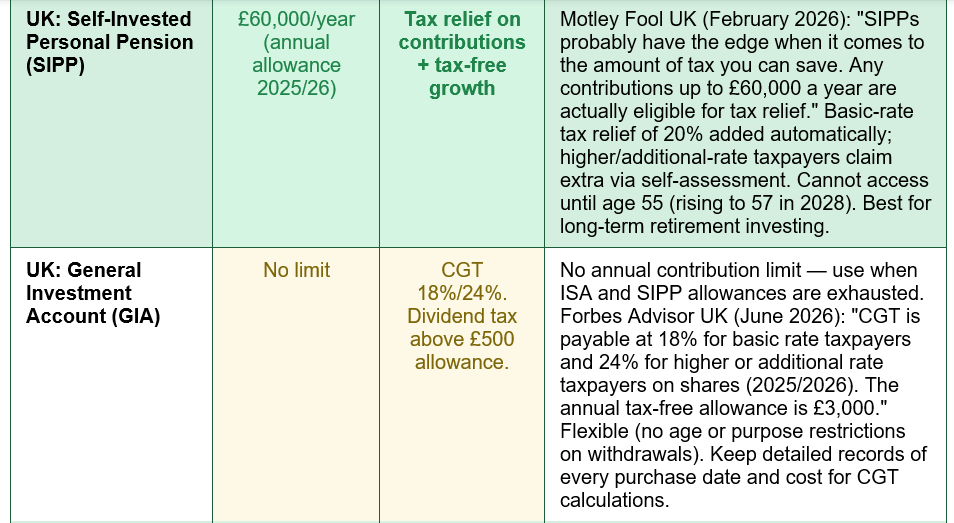
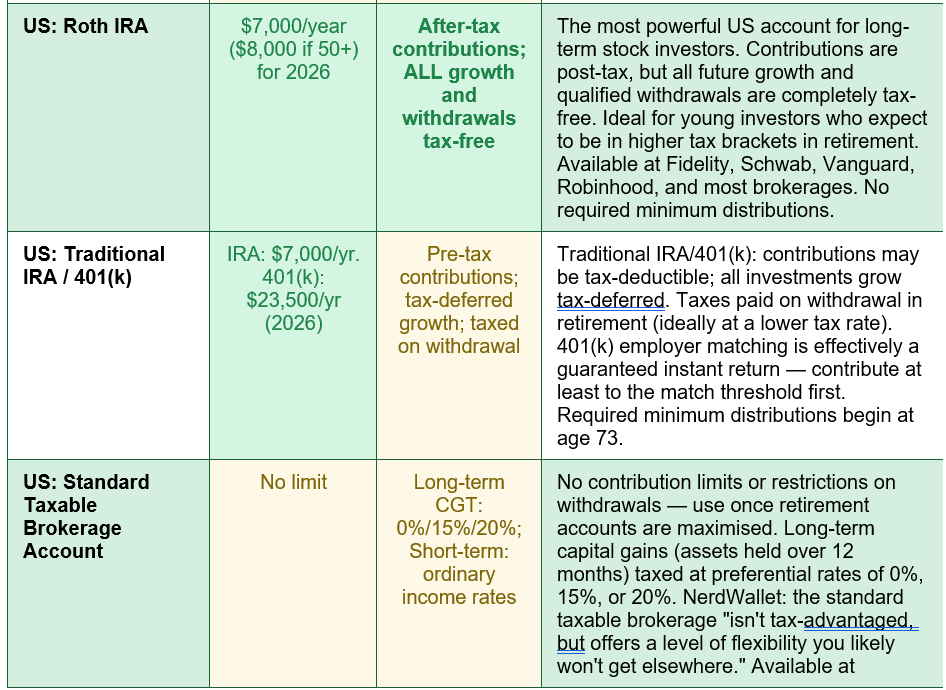
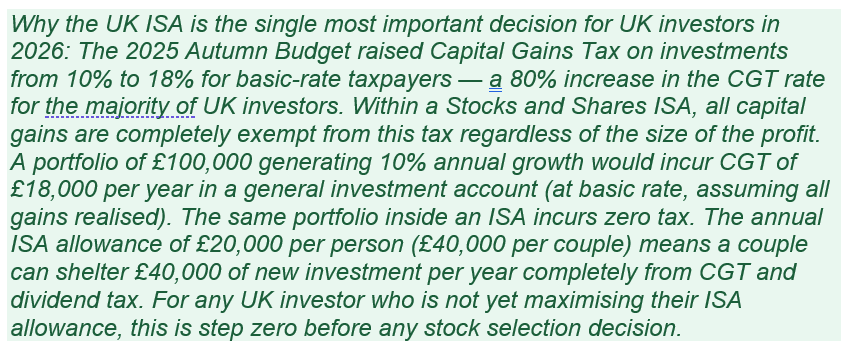
The account in which you hold your stocks determines the tax you pay on gains and dividends — and choosing the most tax-efficient wrapper available is one of the highest-value decisions any investor can make. The good news: in both the UK and US, genuinely excellent tax-advantaged account options are available to any investor regardless of income or wealth. The following table maps every major account type in both countries: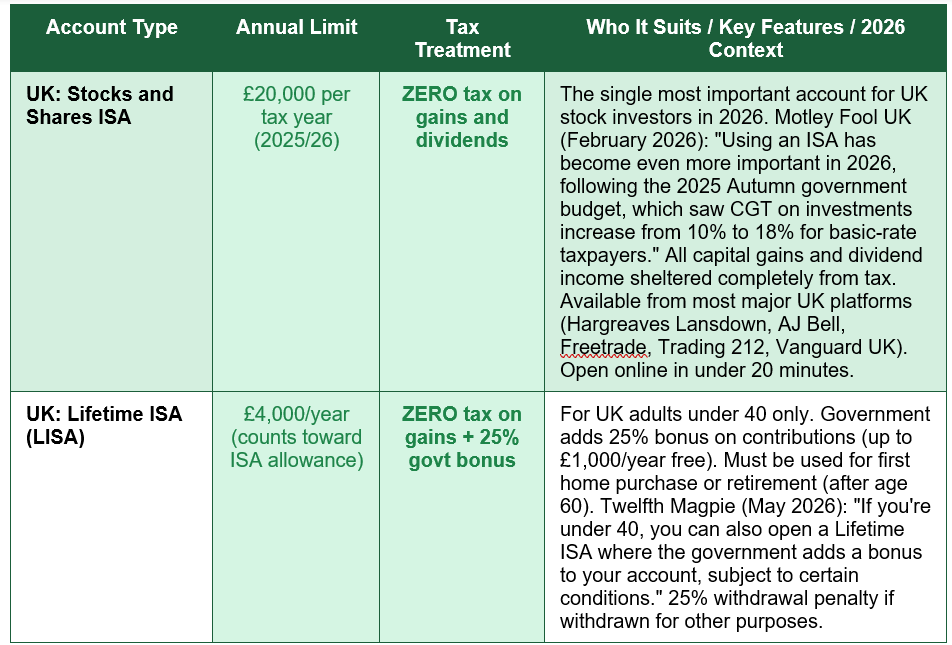

Step 3: Open and Fund Your Brokerage Account
Opening a brokerage account is faster and more straightforward than most first-time investors expect. Forbes Advisor UK (June 2026): 'Opening an account with your chosen platform should take no longer than 20 minutes. It involves sharing some personal details, including your National Insurance number.' The equivalent for US investors is a Social Security Number.For UK investors, the major platforms offering Stocks and Shares ISAs include Hargreaves Lansdown (the largest UK retail platform, widest asset coverage, higher fees), AJ Bell (competitive ISA and SIPP offering), Freetrade (commission-free, app-based, fractional shares, free ISA), Trading 212 (commission-free, fractional shares, ISA), and Vanguard UK (lowest-cost option for ETF-focused investors). For US investors: Fidelity, Charles Schwab, and Vanguard for full-service; Robinhood, SoFi, and Public for app-based commission-free trading; M1 Finance for automated portfolio investing.
Once the account is open, fund it by bank transfer or debit card. There is no obligation to invest immediately — the cash sits in the account until you choose to invest it. Most platforms allow you to set up a regular monthly transfer that automatically moves money from your bank account into your investing account, making the saving and investing process entirely automatic. Motley Fool UK: 'You can pretty much automate all your investing these days, making it simple and easy to grow your wealth.'
Step 4: Decide What to Buy — Stocks vs Funds
The most consequential investment decision for a new investor is not which individual stock to buy — it is whether to buy individual stocks at all, or to invest in funds that provide instant diversification across dozens, hundreds, or thousands of companies. This choice has profound implications for time commitment, risk management, and the likelihood of long-run success: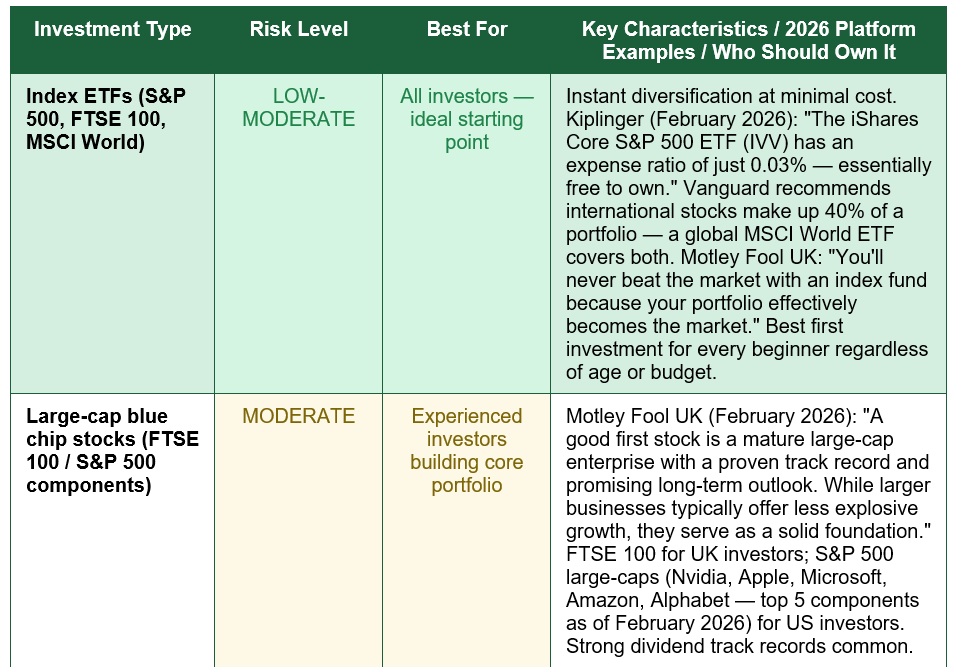
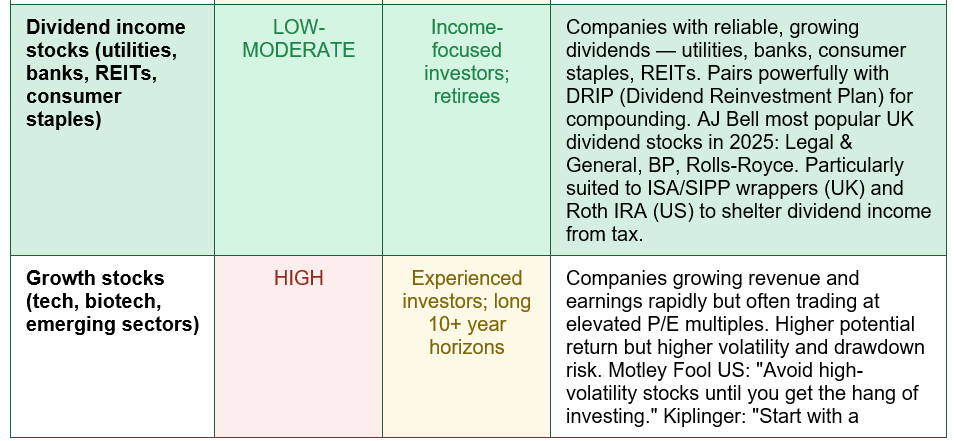
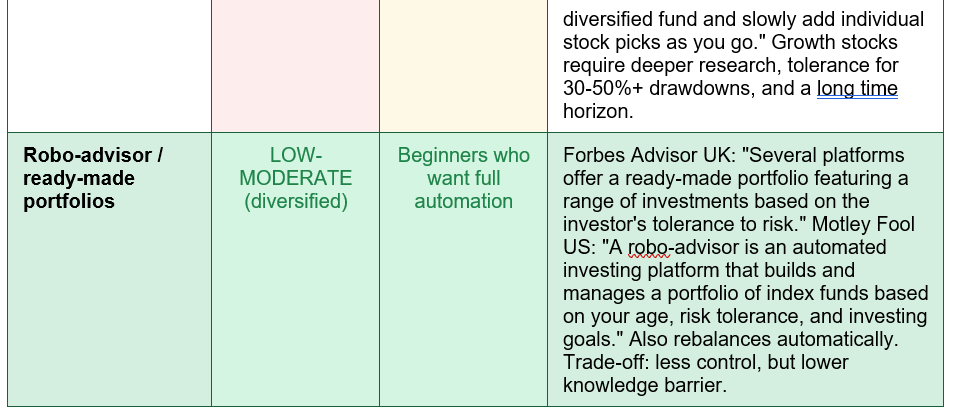
Kiplinger's February 2026 guide offers the clearest practical hierarchy: 'Start with a diversified fund — or, better, several diversified funds — and then slowly add individual stock picks to the mix as you go. That's where your real money should be, at least for the first few years. As you get more experienced, you can increase the size of your individual stock holdings. It's not a good idea to put your entire life savings in a small handful of stocks. Yes, Warren Buffett does it. But the Berkshire Hathaway portfolio is the product of about 75 years of work.'
Step 5: Research Your Investments Before Buying
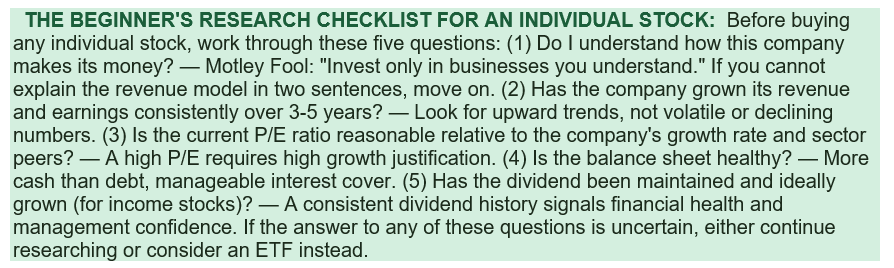
Whether buying individual stocks or ETFs, research is the essential step between decision and purchase. For ETFs and index funds, research is straightforward: check the fund's benchmark index (what it tracks), its total expense ratio (TER or expense ratio — lower is better), the fund size and liquidity, whether it is accumulating (reinvests dividends) or distributing (pays dividends as cash), and its historical tracking error relative to the benchmark.For individual stocks, the research process is more involved. The Motley Fool (July 2026) identifies the foundational stock evaluation principles: 'Diversify your portfolio across companies and industries. Invest only in businesses you understand. Avoid penny stocks. Learn the basic metrics and concepts for evaluating stocks. Learning the fundamentals of value investing is a great starting point, as it helps you identify stocks trading at attractive valuations.' The key financial metrics to assess for individual stocks: the Price-to-Earnings (P/E) ratio (current price divided by earnings per share — compare to sector peers and historical range); Earnings Per Share (EPS) growth rate over three to five years; dividend yield and payout ratio (for income stocks); free cash flow generation (cash from operations minus capex); balance sheet strength (debt-to-equity ratio, cash position); and the competitive position of the business in its industry.
Forbes Advisor UK advises using all information available on the platform: 'As part of your research on financial markets, you can check news and analysis from industry experts to stay updated on current economic events before you take a position.' Most major UK platforms (Hargreaves Lansdown, AJ Bell) provide free research including broker analyst ratings, earnings estimates, company news, and key financial ratios. In the US, Fidelity and Schwab provide similarly comprehensive research tools at no cost to account holders.
Step 6: Place Your First Stock Purchase Order
Once you have identified what to buy and your account is funded, placing the order is the most operationally straightforward step — though it involves several specific decisions that are worth understanding in advance: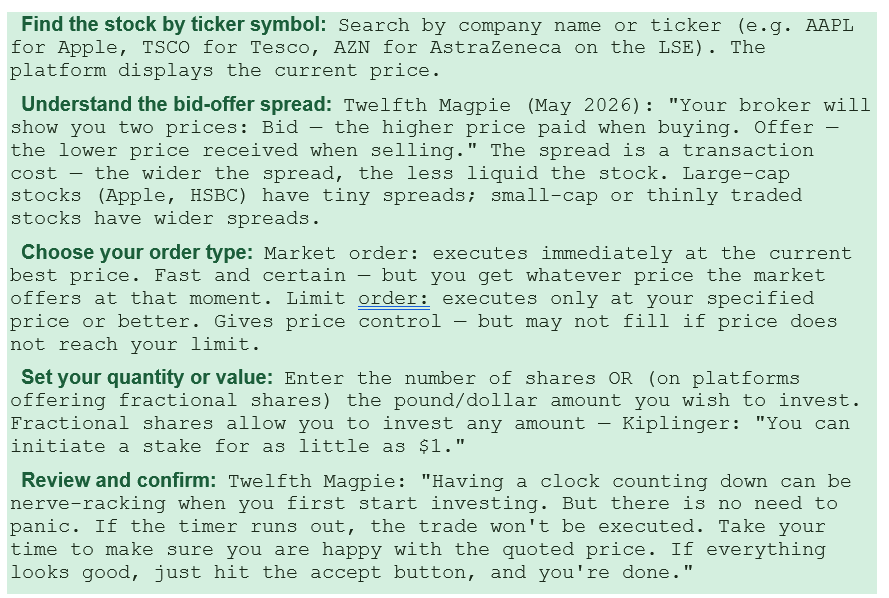

Step 7: Build a Diversified Portfolio Over Time
A single purchase is the start of a portfolio — not a complete portfolio in itself. Building genuine diversification across companies, sectors, and geographies is what transforms individual stock exposure into a resilient, long-term wealth-building machine. NerdWallet (March 2026): 'If your portfolio is heavily weighted in one sector or industry, consider buying stocks or funds in another sector to diversify. Pay attention to geographic diversification too. Vanguard recommends that international stocks make up as much as 40% of the stocks in your portfolio.'The most practical approach to portfolio construction for most investors is the core-satellite model. A core holding of low-cost diversified index ETFs (an S&P 500 tracker, a global equity tracker, or a FTSE All-World ETF) provides the broad market exposure and diversification foundation. Around this core, satellite holdings in individual company stocks, sector-specific ETFs, or dividend income stocks provide additional return potential and personalisation based on your specific research and views. Motley Fool: 'Diversification means owning a variety of companies, though too much diversification can dilute your returns.'
Regular, systematic investing — committing a fixed amount each month regardless of market conditions — applies pound-cost averaging (PCA) or dollar-cost averaging (DCA), which automatically buys more shares when prices are low and fewer when prices are high. This disciplined approach removes the timing problem that causes many investors to buy at peaks and sell at troughs, and is one of the most consistently evidence-supported investment practices available to retail investors.
Step 8: Manage, Review, and Rebalance Your Portfolio
Building a portfolio is not a one-time event — it requires periodic review and management to ensure it remains aligned with your goals, risk tolerance, and financial circumstances. NerdWallet identifies the key portfolio review triggers: 'If you're approaching retirement, you may want to move some of your stock investments over to more conservative fixed-income investments. If your portfolio is heavily weighted in one sector or industry, consider buying stocks or funds in another sector to diversify.'Rebalancing is the process of restoring a portfolio to its intended allocation when market movements cause individual positions to drift above or below target weights. If you set out with a 60% equities / 40% bonds target allocation and a strong equity market run takes equities to 75%, rebalancing involves selling some equities and buying bonds to restore the 60/40 split. Most financial planners recommend reviewing and rebalancing once or twice per year — more frequent rebalancing generates unnecessary trading costs and tax events without meaningfully improving outcomes.
For individual stock holdings, the review process also involves reassessing whether the original investment thesis remains intact. Has the company's competitive position improved or deteriorated? Have earnings trends changed? Has management quality changed? Has the valuation become stretched? Motley Fool: 'To succeed in buying individual stocks, you'll need the time, knowledge, and desire required to do it the right way. You'll need to evaluate companies on an ongoing basis, stay current with earnings reports, and periodically review your portfolio.'
THE FIVE MOST COMMON FIRST-TIME INVESTOR MISTAKES — AND HOW TO AVOID THEM: (1) INVESTING MONEY YOU MIGHT NEED SOON — only invest capital you can genuinely leave untouched for 5+ years; keep an emergency fund of 3-6 months' expenses in accessible cash. (2) CONCENTRATING IN TOO FEW STOCKS — The Motley Fool warns against putting your savings in a handful of stocks; start with diversified funds and add individual stocks only as experience grows. (3) TRYING TO TIME THE MARKET — Attempting to buy at the bottom and sell at the top consistently underperforms simply staying invested; time in the market beats timing the market over long periods. (4) IGNORING TAX-ADVANTAGED ACCOUNTS — Investing in a taxable account before maximising an ISA or SIPP (UK) / Roth IRA or 401(k) (US) is one of the most costly and most common mistakes. After the 2025 Autumn Budget raised CGT to 18%, this mistake is more expensive than ever for UK investors. (5) PANIC SELLING IN DOWNTURNS — Every stock market decline has been followed by recovery; selling in a crash locks in losses permanently. Forbes Advisor UK: 'Over longer periods of decades, money invested via the stock market has the potential to grow at a faster rate than cash held in savings accounts.'
Conclusion
Buying stocks for your investment portfolio is no longer a complex or expensive process — in 2026, any adult in the UK or US can open a tax-advantaged investment account in under 20 minutes, invest with as little as £1 or $1 through fractional shares, and access a diversified global portfolio for an ongoing cost of just 0.03-0.25% per year in ETF fees. The barrier to entry has never been lower. The wealth-building opportunity — the stock market's historical ~10% annual return, compounding quietly over decades — has never been more accessible.The eight steps covered in this guide provide the complete practical framework: define your goals and time horizon; choose the most tax-efficient account (prioritise the UK ISA and SIPP, the US Roth IRA and 401(k) above all else); open and fund your account online; decide between individual stocks and diversified funds (strongly favouring funds for most beginners); research thoroughly before buying; place your order with a clear understanding of bid-offer spreads and order types; build genuine diversification across companies, sectors, and geographies including international exposure; and review and rebalance regularly to stay aligned with your goals.
The statistics make the case for urgency: 58% of US adults and a minority of UK adults participate in the stock market. The wealthiest 1% hold 50% of all stocks. Every year that passes without starting is a year of compound growth unrealised. For the 42% of Americans and the majority of UK adults who have not yet begun — the process is simpler, cheaper, and more accessible than at any point in history. The only barrier left is starting.
0 Comments
Be the first to share your thoughts on this article.