
Investing
How to Choose an Investment Fund: 8 Things to Consider

Investing in funds is one of the most accessible ways to grow wealth over time. Funds let you spread your money across dozens or hundreds of companies in a single purchase, giving you instant diversification that would take years and significant capital to replicate by buying individual shares. But the choice of funds is enormous — thousands are available to UK investors alone. Making a good choice means asking the right questions, in the right order, before you commit any money. This article walks through the eight things you genuinely need to consider when choosing an investment fund, in the order they most logically apply. Not investment, financial, or tax advice. Past performance is not a reliable guide to future returns. The value of investments can fall as well as rise.
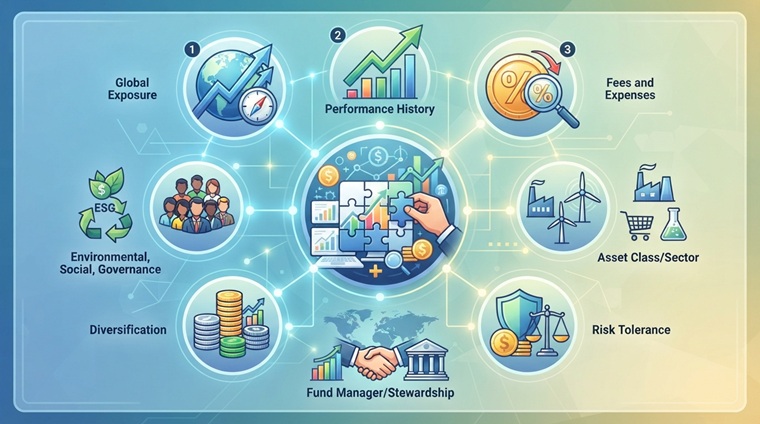
The eight considerations in this article are ordered deliberately. They start with the things that are entirely within your control and that do not require any prediction of the future — your goals, your risk tolerance, your time horizon. They move to the structural decisions — fund type, charges, diversification — that are knowable before you invest. They address the things that are informative but limited — past performance. And they close with the ongoing habits that turn a one-time good choice into a durable portfolio. Past performance is not a reliable guide to future returns. Not investment advice.
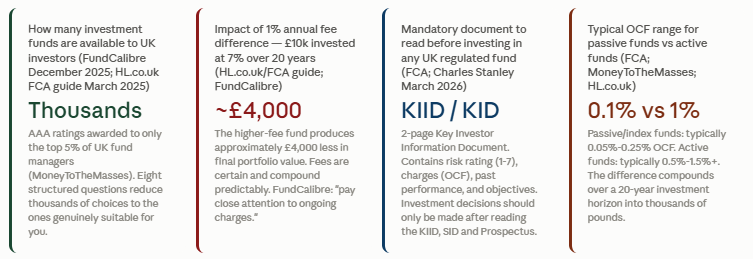
Thousands of investment funds are available to UK investors (FundCalibre December 2025; HL.co.uk FCA guide March 2025). AAA ratings are awarded to only the top 5% of UK fund managers (MoneyToTheMasses). A 1% annual fee difference on £10,000 invested over 20 years at 7% annual return costs approximately £4,000 in final portfolio value — the compound drag of higher fees accumulates silently but significantly over time (Hargreaves Lansdown fund guide; FCA). Investment decisions in funds should only be made after reading the KIID, SID, and Prospectus (FCA; Charles Stanley March 2026). Sources cited. Capital at risk.
The two main types of fund in the UK are unit trusts and open-ended investment companies (OEICs), both of which are priced based on the value of the underlying assets. Investment trusts are a different but related structure (closed-ended, with shares that can trade at a premium or discount to the net asset value). Exchange-traded funds (ETFs) are a further variant that trade on stock exchanges throughout the day. This article applies to all fund types, though some considerations — particularly around discounts/premiums — apply specifically to investment trusts. The FCA’s March 2025 guide to investing in funds covers these structures in detail (HL.co.uk). Not investment advice.
The FCA’s InvestSmart guidance states directly: ‘Your investment goals will help determine which investments you pick and how long you hold them.’ The difference between money you need in two years and money you are saving for retirement in twenty years is not just a difference in amount. It is a fundamental difference in what kind of risk is acceptable and what kind of fund is appropriate. Money needed within two to three years should generally not be in equity funds — stock markets can fall 20-30% in a given year, and that is a problem if you need the money next summer. Money that will not be touched for ten or more years can ride out those same falls and benefit from the long-term upward trend of equity markets.
Define your goal first: income (regular payments from dividends or coupons), growth (capital appreciation over time), capital preservation (limiting losses), or a combination. Then define your time horizon. These two answers act as the filter for every subsequent decision. Source: FCA InvestSmart; Charles Stanley March 2026; FundCalibre December 2025. Not investment advice.
Morningstar UK’s guide for new investors describes the spectrum clearly: risk-averse investors may opt for fixed income assets and steady dividend-paying funds, while those willing to take more risk might choose emerging market equities and smaller companies funds, which can be more volatile but offer the potential for greater returns. Charles Stanley’s March 2026 guide emphasises that choosing any investment involves striking the right balance between risk and potential reward. Every regulated fund is required to publish a Key Investor Information Document (KIID) that rates the fund on a 1–7 risk scale — 1 being the lowest risk (typically cash or short-dated government bonds) and 7 being the highest (typically specialist equity strategies, emerging markets, or leveraged funds).
Risk appetite questionnaires are available online and through financial advisers, and taking one before selecting any fund is worth the few minutes it takes. Your emotional tolerance for loss matters as much as your financial capacity for it: an investor who sells in panic during a market correction because they chose a fund too risky for their temperament has locked in losses that a more patient investor would have recovered from. Not investment advice.
Read the KIID risk rating (1-7) before investing in any fund. Consider separately: (a) your financial capacity for loss — can you afford for this investment to fall 30% without consequences to your life? And (b) your emotional tolerance — will you be able to stay invested through a significant market fall without selling in panic? Both matter. Sources: FCA; Charles Stanley March 2026; Morningstar UK. Not investment advice.
An active fund employs a fund manager and team of analysts who research investments, make decisions about what to buy and sell, and aim to beat a benchmark index. The case for active management is that skilled managers can outperform the market through research and judgement. The evidence on whether this is consistently achieved is mixed at best. MoneyToTheMasses cites research showing that active managers struggle to outperform simple indexed passive funds over the long term net of fees, and that active managers tend to take extra risk and follow trends when performance is lagging. The HL.co.uk FCA guide (March 2025) notes that determining how much of a manager’s performance is skill versus luck is genuinely difficult.
This does not mean active funds are never worth choosing. In specialist areas — smaller companies, specific sectors, markets where information asymmetry is greater — skilled active management may add value that justifies the higher fee. The decision is not categorical but should be made consciously, with eyes open to the evidence. Not investment advice.
Passive funds: lower fees (typically 0.05%-0.25% OCF), no manager risk, performance tracks the index. Active funds: higher fees (typically 0.5%-1.5%+ OCF), manager risk, potential for outperformance. The question to ask: does the evidence suggest this specific active manager in this specific area has a track record of outperformance that justifies the fee premium? Sources: MoneyToTheMasses; HL.co.uk FCA guide March 2025; FundCalibre December 2025. Not investment advice.
The key metric is the Ongoing Charges Figure (OCF), which appears in the KIID and on fund factsheets. For index funds and ETFs, OCFs of 0.05%-0.25% are typical. For active funds, 0.5%-1.5% is common, with some specialist or smaller company funds charging more. Some active funds also charge performance fees — an additional percentage of any returns that exceed a benchmark. Always check whether the OCF includes a performance fee or whether it is charged separately.
Morningstar UK’s guidance includes a specific practical tip: always choose the ‘clean’ or ‘unbundled’ share class, which is usually the cheapest option because it does not include embedded adviser commission. Many funds have multiple share classes with different fee structures; the difference can be 0.5% or more annually. The platform fee (the charge levied by the account or ISA/SIPP provider through which you hold the fund) is a separate cost that also compounds over time and should be factored into the total cost of ownership. Not investment advice.
The share class trap: many funds are available in multiple share classes (e.g., A, B, C, I, Z, R). The differences are primarily fee-based. The 'clean' or 'unbundled' share class excludes adviser commission and is usually the cheapest available to retail investors. Always check you are buying the correct share class before investing. Source: Morningstar UK; FCA. Not investment advice.
But diversification also applies at the portfolio level, not just within a single fund. MoneyToTheMasses makes the distinction clearly: ‘Diversification reduces a portfolio’s risk — duplication does not.’ If you hold three UK equity funds, you have paid for three funds but achieved no more diversification than one UK equity fund. The relevant question is whether a new fund adds something genuinely different: a different geography, a different asset class, a different sector exposure, a different market capitalisation range.
FundCalibre’s December 2025 guidance recommends ‘having a mix of UK and global equity funds in whatever ratio is most appropriate for your goals and attitude to risk.’ The asset classes to consider for diversification include equities (UK and international), fixed income (government and corporate bonds), property, alternative assets, and cash. Each behaves differently in different economic environments, and a portfolio that combines them thoughtfully should be less volatile than one concentrated in a single asset class. Not investment advice.
Before selecting any fund, ask: does this add genuine diversification to what I already hold? List your current funds and their primary asset classes and geographies. If the new fund duplicates an existing holding, the portfolio gains nothing from the addition. If it introduces a new geography, asset class, or sector, it may genuinely reduce portfolio risk. Sources: HL.co.uk FCA guide March 2025; MoneyToTheMasses; FundCalibre December 2025. Not investment advice.
FundCalibre’s December 2025 guide explains why this warning is not just regulatory boilerplate: different investment areas perform well at different times. A fund that topped performance tables during a technology bull market may underperform significantly when conditions shift. A manager who delivered strong returns by taking above-average risk looks skilled in good times and reckless in bad ones. The HL.co.uk FCA guide notes that if you look only at performance, you might think Fund A is the best fund — but a closer look might reveal it achieved those returns by taking significantly more risk.
Past performance is useful as context: how has the fund performed versus its stated benchmark and versus its peer group, over multiple market cycles? A fund that has consistently beaten its benchmark over 10 years through multiple different market conditions provides a more meaningful data point than one that topped the charts in a single strong year. But even this more sophisticated view of performance is secondary to the eight considerations in this article, not primary. Not investment advice.
The performance chasing trap: research consistently shows that investors who buy funds based on recent top-quartile performance often underperform investors who select funds based on fees, consistency, and manager quality. A fund at the top of the performance tables today has often already delivered its best returns — and the money flowing in pushes up the prices of its holdings, making future returns lower, not higher. Source: FCA; HL.co.uk guide March 2025; MoneyToTheMasses. Not investment advice.
FundCalibre’s December 2025 guidance raises a specific risk that investors in active funds often overlook: manager change. ‘A fund’s investment philosophy dictates how it’s run.’ If the manager who built the fund’s track record leaves or changes their approach, the historical performance numbers become much less relevant — they no longer reflect what the fund will do going forward. When a manager change is announced, the entire rationale for holding the fund should be revisited.
For passive funds, the fund manager question is less critical — the job is to track an index reliably and cheaply, and the relevant quality signals are operational: tracking error (how closely the fund follows its benchmark) and the OCF. Analyst ratings from independent research firms — FundCalibre Elite Rating, Morningstar Analyst Rating, or Hargreaves Lansdown Wealth Shortlist — can serve as useful starting points for identifying quality fund managers, though MoneyToTheMasses notes that an AAA rating is awarded only to the top 5% of UK fund managers. Not investment advice.
For any active fund: research the manager's investment philosophy, their tenure with the fund, their personal investment record (do they invest in their own fund?), and how the fund has performed vs its benchmark and peer group over at least 5 years. Set an alert for manager changes. For passive funds: check the tracking error and OCF. Sources: FundCalibre December 2025; MoneyToTheMasses; Charles Stanley March 2026; Morningstar UK. Not investment advice.
The monitoring questions to ask annually or whenever significant life changes occur: Has the fund’s manager changed? Has the fund’s investment philosophy drifted? Has the fund consistently beaten or lagged its peer group? Has my own risk tolerance or time horizon changed? Has a life event (new job, house purchase, inheritance, approaching retirement) changed my investment goals in a way that affects what kind of fund is appropriate? A fund that has underperformed does not automatically warrant replacing — as FundCalibre notes, ‘just because an investment fund hasn’t performed as expected doesn’t always mean it should be axed’ — but persistent, unexplained underperformance versus benchmark and peers is worth investigating.
Portfolio rebalancing is also part of monitoring. A portfolio that started as 60% equities and 40% bonds will drift over time as equities rise faster than bonds — becoming, say, 70% equities and 30% bonds without any active decision. Rebalancing back to the target allocation periodically maintains the risk level you originally chose. Not investment advice.
Annual fund review checklist: (1) Has the manager changed? (2) Is the fund still meeting its objective? (3) Has performance vs benchmark and peers been consistently poor for 3+ years? (4) Has the fund's OCF increased? (5) Have your own goals, time horizon, or risk tolerance changed? (6) Is the portfolio still appropriately diversified, or has it drifted? Source: FundCalibre; MoneyToTheMasses; FCA. Not investment advice.
These eight questions do not guarantee good outcomes — investment involves risk by its nature, and past performance is not a reliable guide to future returns. But they do eliminate the most common and most costly mistakes: buying because something has recently been up, holding because selling feels uncomfortable, paying too much in fees for too little return, and concentrating risk without realising it. The investors who do best over the long term are generally not the most sophisticated or the best at predicting markets. They are the ones who ask the right questions first, choose appropriately, pay attention to costs, and stay patient when markets are difficult. Not investment advice. Always read the KIID before investing. Consult a qualified independent financial adviser regulated by the FCA.
There is no single most important factor — the eight things in this article work together. But if forced to prioritise, goals and time horizon come first because they determine everything else. A fund that is perfect for a 20-year retirement savings goal may be entirely wrong for a 3-year house deposit fund. Before evaluating any specific fund, you need clarity on what you are investing for and when you will need the money. The second most commonly overlooked factor is fees: unlike market performance, fees are certain and compound predictably over time. A 1% annual fee difference on £10,000 over 20 years at 7% average return produces approximately £4,000 less in final portfolio value. Sources: FCA InvestSmart; Charles Stanley March 2026; HL.co.uk guide March 2025; FundCalibre December 2025. Not investment advice. Capital at risk.
What is a KIID and why do I need to read it?
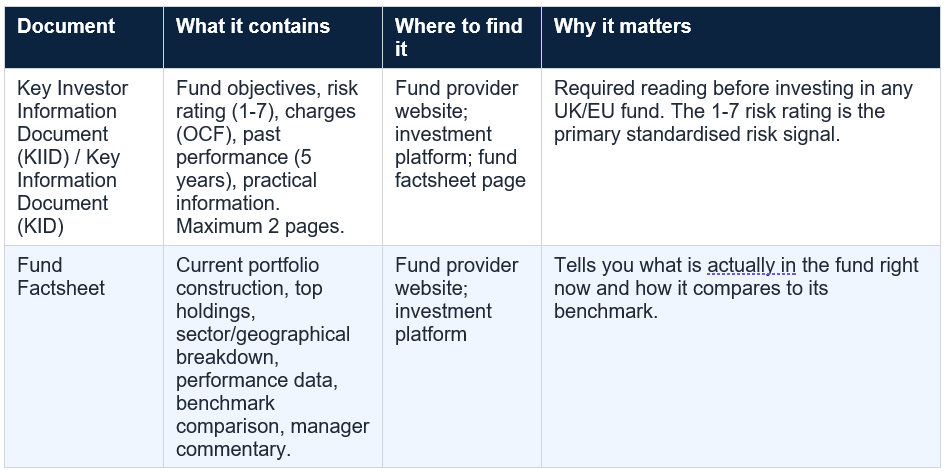
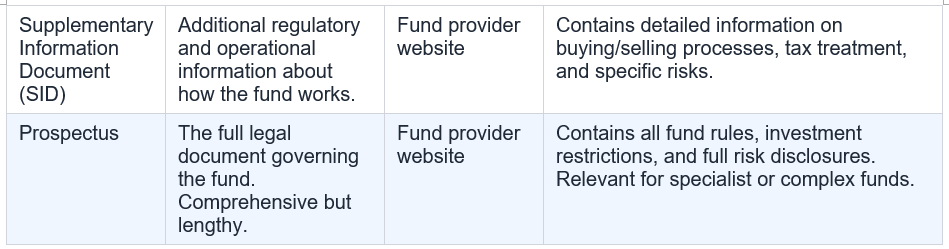
A Key Investor Information Document (KIID) — or Key Information Document (KID) for newer fund structures — is a mandatory 2-page document that every regulated fund in the UK and EU must produce. It contains: the fund's investment objective, a standardised risk rating on a 1-7 scale, the Ongoing Charges Figure (OCF), five years of past performance presented consistently, and practical information about buying and selling. The FCA requires investors to read the KIID before making any investment decision in a collective investment scheme. Charles Stanley's March 2026 guide states explicitly that investment decisions should only be made after reading the KIID, Supplementary Information Document, and Prospectus. The KIID is the most efficient way to understand the basics of any fund before doing further research. Always obtain the KIID from the fund provider directly or through an FCA-regulated investment platform. Sources: Charles Stanley March 2026; FCA; HL.co.uk guide March 2025. Not investment advice.
Should I invest in active or passive funds?
Both have a place in an investment portfolio, and the best choice depends on the specific asset class, your cost sensitivity, and your view on manager skill. The evidence for passive funds is compelling in large, liquid markets (US equities, UK large-cap equities) where information is widely available and quickly priced in — active managers consistently struggle to outperform simple index funds net of fees in these markets over the long term, according to MoneyToTheMasses and broader SPIVA scorecard research. In less efficient areas — smaller companies, specific regional markets, alternative assets — skilled active management may add value that justifies higher fees. The practical advice most sources converge on: passive funds for core broad-market exposure (lower cost, no manager risk), with selective use of active funds in areas where you have genuine conviction in manager skill. Always compare the OCF of any active fund against an equivalent passive alternative and ask what you are paying for. Sources: MoneyToTheMasses; HL.co.uk guide March 2025; FundCalibre December 2025. Not investment advice. Capital at risk.
How do investment fund fees work?
Fund fees come in several layers. The most important is the Ongoing Charges Figure (OCF), which is the annual percentage of your investment deducted to cover fund management, administration, and other costs. For passive index funds and ETFs, OCFs are typically 0.05%-0.25%. For active funds, 0.5%-1.5% is common. In addition to the OCF, you also pay a platform fee — the charge levied by the investment account or ISA/SIPP provider through which you hold the fund. Some active funds also charge a performance fee above and beyond the OCF when returns exceed a specified benchmark. There may also be dealing fees on some platforms when you buy or sell. Morningstar UK advises always choosing the 'clean' or 'unbundled' share class, which excludes adviser commission and is typically the cheapest retail option. The combined OCF plus platform fee is your total annual cost of ownership, and even a 0.5% difference compounds significantly over a 20-year investment horizon. Sources: FundCalibre December 2025; Morningstar UK; FCA InvestSmart guide; HL.co.uk. Not investment advice.
How often should I review my investment funds?
Most sources recommend a formal annual review as a minimum. FundCalibre's guide on how to pick an investment fund recommends regular monitoring to ensure you are not taking too much or too little risk over time. The triggers for an out-of-cycle review include: a fund manager change (the most important trigger for active fund holders — the manager is the product, and a change may fundamentally alter the fund's approach); significant personal life changes (new job, marriage, divorce, birth of a child, approaching retirement, inheritance); a major change in market conditions that has significantly altered your portfolio's actual risk level; persistent underperformance versus benchmark and peer group over 3+ years; or a material increase in the fund's OCF. What does not automatically warrant a fund change: a single year of underperformance (all funds underperform sometimes), a falling market (this is normal volatility, not a reason to sell), or a change in market sentiment towards a particular sector (this should have been assessed when you selected the fund). Sources: FundCalibre December 2025; MoneyToTheMasses; FCA. Not investment advice. Capital at risk.
Table of Contents
- Why Choosing the Right Fund Matters More Than Choosing the Right Market
- What Is an Investment Fund?
- Thing #1: Your Goals and Time Horizon
- Thing #2: Your Attitude to Risk
- Thing #3: Active vs Passive — Choosing the Fund Type
- Thing #4: Charges and Fees — The Silent Performance Killer
- Thing #5: Diversification and Asset Allocation
- Thing #6: Past Performance — Useful Context, Not a Crystal Ball
- Thing #7: The Fund Manager and Investment Philosophy
- Thing #8: Ongoing Monitoring and Portfolio Fit
- The Key Documents Every Fund Investor Must Read
- The Eight-Question Checklist Before You Invest
- Conclusion: Eight Questions, One Better Decision
- Frequently Asked Questions
Why Choosing the Right Fund Matters More Than Choosing the Right Market
There is a common misconception among new investors that the most important decision is which market to invest in. UK equities or global? Technology or healthcare? Emerging markets or developed? These questions matter, but they are secondary to a more fundamental set of decisions that occur before any market is selected. You can be right about which market will perform well and still lose money by choosing a fund that charges too much, concentrates too much risk, or fails to match your actual investment timeline. You can be wrong about the short-term direction of a market and still build wealth by choosing a fund with low fees, good management, and appropriate diversification that you hold patiently through the volatility.The eight considerations in this article are ordered deliberately. They start with the things that are entirely within your control and that do not require any prediction of the future — your goals, your risk tolerance, your time horizon. They move to the structural decisions — fund type, charges, diversification — that are knowable before you invest. They address the things that are informative but limited — past performance. And they close with the ongoing habits that turn a one-time good choice into a durable portfolio. Past performance is not a reliable guide to future returns. Not investment advice.
Thousands of investment funds are available to UK investors (FundCalibre December 2025; HL.co.uk FCA guide March 2025). AAA ratings are awarded to only the top 5% of UK fund managers (MoneyToTheMasses). A 1% annual fee difference on £10,000 invested over 20 years at 7% annual return costs approximately £4,000 in final portfolio value — the compound drag of higher fees accumulates silently but significantly over time (Hargreaves Lansdown fund guide; FCA). Investment decisions in funds should only be made after reading the KIID, SID, and Prospectus (FCA; Charles Stanley March 2026). Sources cited. Capital at risk.
What Is an Investment Fund?
An investment fund pools money from multiple investors and uses it to buy a collection of assets — typically shares, bonds, property, or a mix — managed according to a stated objective. When you invest in a fund, you are buying a slice of that collective investment, and your returns rise and fall with the performance of the underlying assets. The key advantages of funds over buying individual shares directly are: instant diversification across many holdings (reducing the risk that any single company’s failure devastates your investment); professional or systematic management; and access to asset classes and markets that would be impractical to access as an individual investor.The two main types of fund in the UK are unit trusts and open-ended investment companies (OEICs), both of which are priced based on the value of the underlying assets. Investment trusts are a different but related structure (closed-ended, with shares that can trade at a premium or discount to the net asset value). Exchange-traded funds (ETFs) are a further variant that trade on stock exchanges throughout the day. This article applies to all fund types, though some considerations — particularly around discounts/premiums — apply specifically to investment trusts. The FCA’s March 2025 guide to investing in funds covers these structures in detail (HL.co.uk). Not investment advice.
Thing #1: Your Goals and Time Horizon
The first question to answer before looking at any fund is not ‘what should I buy?’ It is ‘what am I trying to achieve, and when will I need the money?’ These two questions — your objective and your timeline — determine everything else. They determine which asset classes are appropriate, what level of volatility is tolerable, and how long a fund has to recover from any short-term setbacks.The FCA’s InvestSmart guidance states directly: ‘Your investment goals will help determine which investments you pick and how long you hold them.’ The difference between money you need in two years and money you are saving for retirement in twenty years is not just a difference in amount. It is a fundamental difference in what kind of risk is acceptable and what kind of fund is appropriate. Money needed within two to three years should generally not be in equity funds — stock markets can fall 20-30% in a given year, and that is a problem if you need the money next summer. Money that will not be touched for ten or more years can ride out those same falls and benefit from the long-term upward trend of equity markets.
Define your goal first: income (regular payments from dividends or coupons), growth (capital appreciation over time), capital preservation (limiting losses), or a combination. Then define your time horizon. These two answers act as the filter for every subsequent decision. Source: FCA InvestSmart; Charles Stanley March 2026; FundCalibre December 2025. Not investment advice.
Thing #2: Your Attitude to Risk
Risk in investing has a specific meaning: the possibility that the value of your investment will fall, temporarily or permanently. Every investment carries some risk. Even a cash savings account carries inflation risk — the possibility that prices rise faster than your savings earn interest, eroding the real value of your money. The question is not whether to take risk, but how much risk is appropriate for your goals, your timeline, and your personal capacity to tolerate losses without making poor decisions.Morningstar UK’s guide for new investors describes the spectrum clearly: risk-averse investors may opt for fixed income assets and steady dividend-paying funds, while those willing to take more risk might choose emerging market equities and smaller companies funds, which can be more volatile but offer the potential for greater returns. Charles Stanley’s March 2026 guide emphasises that choosing any investment involves striking the right balance between risk and potential reward. Every regulated fund is required to publish a Key Investor Information Document (KIID) that rates the fund on a 1–7 risk scale — 1 being the lowest risk (typically cash or short-dated government bonds) and 7 being the highest (typically specialist equity strategies, emerging markets, or leveraged funds).
Risk appetite questionnaires are available online and through financial advisers, and taking one before selecting any fund is worth the few minutes it takes. Your emotional tolerance for loss matters as much as your financial capacity for it: an investor who sells in panic during a market correction because they chose a fund too risky for their temperament has locked in losses that a more patient investor would have recovered from. Not investment advice.
Read the KIID risk rating (1-7) before investing in any fund. Consider separately: (a) your financial capacity for loss — can you afford for this investment to fall 30% without consequences to your life? And (b) your emotional tolerance — will you be able to stay invested through a significant market fall without selling in panic? Both matter. Sources: FCA; Charles Stanley March 2026; Morningstar UK. Not investment advice.
Thing #3: Active vs Passive — Choosing the Fund Type
One of the most consequential structural decisions in fund selection is the choice between active and passive management. A passive fund — also known as an index fund or tracker fund — aims to replicate the performance of a market index. An S&P 500 tracker, for example, buys the 500 largest US companies in the same proportions as the index. The manager’s job is to follow the index faithfully, not to make judgements about which companies to favour. The result: lower fees, no manager risk, and performance that matches the market (minus a small fee drag).An active fund employs a fund manager and team of analysts who research investments, make decisions about what to buy and sell, and aim to beat a benchmark index. The case for active management is that skilled managers can outperform the market through research and judgement. The evidence on whether this is consistently achieved is mixed at best. MoneyToTheMasses cites research showing that active managers struggle to outperform simple indexed passive funds over the long term net of fees, and that active managers tend to take extra risk and follow trends when performance is lagging. The HL.co.uk FCA guide (March 2025) notes that determining how much of a manager’s performance is skill versus luck is genuinely difficult.
This does not mean active funds are never worth choosing. In specialist areas — smaller companies, specific sectors, markets where information asymmetry is greater — skilled active management may add value that justifies the higher fee. The decision is not categorical but should be made consciously, with eyes open to the evidence. Not investment advice.
Passive funds: lower fees (typically 0.05%-0.25% OCF), no manager risk, performance tracks the index. Active funds: higher fees (typically 0.5%-1.5%+ OCF), manager risk, potential for outperformance. The question to ask: does the evidence suggest this specific active manager in this specific area has a track record of outperformance that justifies the fee premium? Sources: MoneyToTheMasses; HL.co.uk FCA guide March 2025; FundCalibre December 2025. Not investment advice.
Thing #4: Charges and Fees — The Silent Performance Killer
Fees are the one variable in investing you can control with certainty. You cannot control whether the market goes up or down. You cannot predict which sectors will outperform. But you can choose to pay 0.20% per year in fees rather than 1.20%, and that difference compounds into a meaningful sum over a typical investment horizon. FundCalibre’s December 2025 guide states it directly: ‘Pay close attention to the fund’s ongoing charges, as they can significantly impact your overall return.’The key metric is the Ongoing Charges Figure (OCF), which appears in the KIID and on fund factsheets. For index funds and ETFs, OCFs of 0.05%-0.25% are typical. For active funds, 0.5%-1.5% is common, with some specialist or smaller company funds charging more. Some active funds also charge performance fees — an additional percentage of any returns that exceed a benchmark. Always check whether the OCF includes a performance fee or whether it is charged separately.
Morningstar UK’s guidance includes a specific practical tip: always choose the ‘clean’ or ‘unbundled’ share class, which is usually the cheapest option because it does not include embedded adviser commission. Many funds have multiple share classes with different fee structures; the difference can be 0.5% or more annually. The platform fee (the charge levied by the account or ISA/SIPP provider through which you hold the fund) is a separate cost that also compounds over time and should be factored into the total cost of ownership. Not investment advice.
The share class trap: many funds are available in multiple share classes (e.g., A, B, C, I, Z, R). The differences are primarily fee-based. The 'clean' or 'unbundled' share class excludes adviser commission and is usually the cheapest available to retail investors. Always check you are buying the correct share class before investing. Source: Morningstar UK; FCA. Not investment advice.
Thing #5: Diversification and Asset Allocation
The purpose of a fund is to offer instant diversification — spreading your investment across many companies or assets, so that the poor performance of any single holding has a limited impact on the whole. This is one of the most tangible advantages of funds over direct share investing. As the HL.co.uk FCA guide (March 2025) notes, funds offer ‘instant diversification’ across dozens of companies in a single purchase, which is one of their primary appeals.But diversification also applies at the portfolio level, not just within a single fund. MoneyToTheMasses makes the distinction clearly: ‘Diversification reduces a portfolio’s risk — duplication does not.’ If you hold three UK equity funds, you have paid for three funds but achieved no more diversification than one UK equity fund. The relevant question is whether a new fund adds something genuinely different: a different geography, a different asset class, a different sector exposure, a different market capitalisation range.
FundCalibre’s December 2025 guidance recommends ‘having a mix of UK and global equity funds in whatever ratio is most appropriate for your goals and attitude to risk.’ The asset classes to consider for diversification include equities (UK and international), fixed income (government and corporate bonds), property, alternative assets, and cash. Each behaves differently in different economic environments, and a portfolio that combines them thoughtfully should be less volatile than one concentrated in a single asset class. Not investment advice.
Before selecting any fund, ask: does this add genuine diversification to what I already hold? List your current funds and their primary asset classes and geographies. If the new fund duplicates an existing holding, the portfolio gains nothing from the addition. If it introduces a new geography, asset class, or sector, it may genuinely reduce portfolio risk. Sources: HL.co.uk FCA guide March 2025; MoneyToTheMasses; FundCalibre December 2025. Not investment advice.
Thing #6: Past Performance — Useful Context, Not a Crystal Ball
Past performance is the most available and the most misused piece of information in investment fund selection. It is prominently displayed, easily compared, and intuitively appealing — of course you would rather invest in a fund that has returned 12% per year for the last five years than one that has returned 4%. The problem is that this logic frequently leads investors astray. The FCA, HL.co.uk, Charles Stanley, FundCalibre, and Morningstar UK all include the same explicit warning: past performance is not a reliable guide to future returns.FundCalibre’s December 2025 guide explains why this warning is not just regulatory boilerplate: different investment areas perform well at different times. A fund that topped performance tables during a technology bull market may underperform significantly when conditions shift. A manager who delivered strong returns by taking above-average risk looks skilled in good times and reckless in bad ones. The HL.co.uk FCA guide notes that if you look only at performance, you might think Fund A is the best fund — but a closer look might reveal it achieved those returns by taking significantly more risk.
Past performance is useful as context: how has the fund performed versus its stated benchmark and versus its peer group, over multiple market cycles? A fund that has consistently beaten its benchmark over 10 years through multiple different market conditions provides a more meaningful data point than one that topped the charts in a single strong year. But even this more sophisticated view of performance is secondary to the eight considerations in this article, not primary. Not investment advice.
The performance chasing trap: research consistently shows that investors who buy funds based on recent top-quartile performance often underperform investors who select funds based on fees, consistency, and manager quality. A fund at the top of the performance tables today has often already delivered its best returns — and the money flowing in pushes up the prices of its holdings, making future returns lower, not higher. Source: FCA; HL.co.uk guide March 2025; MoneyToTheMasses. Not investment advice.
Thing #7: The Fund Manager and Investment Philosophy
For an active fund, the fund manager is the product. The stated investment philosophy — value investing, growth at a reasonable price, quality compounding, contrarian positioning, quantitative screening — determines how the fund will behave in different market conditions, which risks it will take, and which it will avoid. The factsheet and KIID provide the official description of the philosophy, but looking at the manager’s track record across different market environments is more informative than any single document.FundCalibre’s December 2025 guidance raises a specific risk that investors in active funds often overlook: manager change. ‘A fund’s investment philosophy dictates how it’s run.’ If the manager who built the fund’s track record leaves or changes their approach, the historical performance numbers become much less relevant — they no longer reflect what the fund will do going forward. When a manager change is announced, the entire rationale for holding the fund should be revisited.
For passive funds, the fund manager question is less critical — the job is to track an index reliably and cheaply, and the relevant quality signals are operational: tracking error (how closely the fund follows its benchmark) and the OCF. Analyst ratings from independent research firms — FundCalibre Elite Rating, Morningstar Analyst Rating, or Hargreaves Lansdown Wealth Shortlist — can serve as useful starting points for identifying quality fund managers, though MoneyToTheMasses notes that an AAA rating is awarded only to the top 5% of UK fund managers. Not investment advice.
For any active fund: research the manager's investment philosophy, their tenure with the fund, their personal investment record (do they invest in their own fund?), and how the fund has performed vs its benchmark and peer group over at least 5 years. Set an alert for manager changes. For passive funds: check the tracking error and OCF. Sources: FundCalibre December 2025; MoneyToTheMasses; Charles Stanley March 2026; Morningstar UK. Not investment advice.
Thing #8: Ongoing Monitoring and Portfolio Fit
Selecting a fund is the beginning of an ongoing relationship, not a one-time transaction. Markets change. Your own circumstances change. Funds change — their managers, their focus, their fee structures. A fund that was the right choice two years ago may no longer be the right choice today. FundCalibre’s guide makes the point directly: ‘Regular monitoring ensures you won’t run the risk of taking on too much — or too little — risk over time.’The monitoring questions to ask annually or whenever significant life changes occur: Has the fund’s manager changed? Has the fund’s investment philosophy drifted? Has the fund consistently beaten or lagged its peer group? Has my own risk tolerance or time horizon changed? Has a life event (new job, house purchase, inheritance, approaching retirement) changed my investment goals in a way that affects what kind of fund is appropriate? A fund that has underperformed does not automatically warrant replacing — as FundCalibre notes, ‘just because an investment fund hasn’t performed as expected doesn’t always mean it should be axed’ — but persistent, unexplained underperformance versus benchmark and peers is worth investigating.
Portfolio rebalancing is also part of monitoring. A portfolio that started as 60% equities and 40% bonds will drift over time as equities rise faster than bonds — becoming, say, 70% equities and 30% bonds without any active decision. Rebalancing back to the target allocation periodically maintains the risk level you originally chose. Not investment advice.
Annual fund review checklist: (1) Has the manager changed? (2) Is the fund still meeting its objective? (3) Has performance vs benchmark and peers been consistently poor for 3+ years? (4) Has the fund's OCF increased? (5) Have your own goals, time horizon, or risk tolerance changed? (6) Is the portfolio still appropriately diversified, or has it drifted? Source: FundCalibre; MoneyToTheMasses; FCA. Not investment advice.
The Key Documents Every Fund Investor Must Read
UK and EU regulation requires every investment fund to produce specific documents that investors must read before investing. These documents are not optional reading — they are the primary source of material information about any fund, and Charles Stanley’s March 2026 guidance states explicitly that investment decisions in funds and other collective investments should only be made after reading the Key Investor Information Document (KIID) or Key Information Document (KID), the Supplementary Information Document (SID), and the Prospectus.
The Eight-Question Checklist Before You Invest
Conclusion
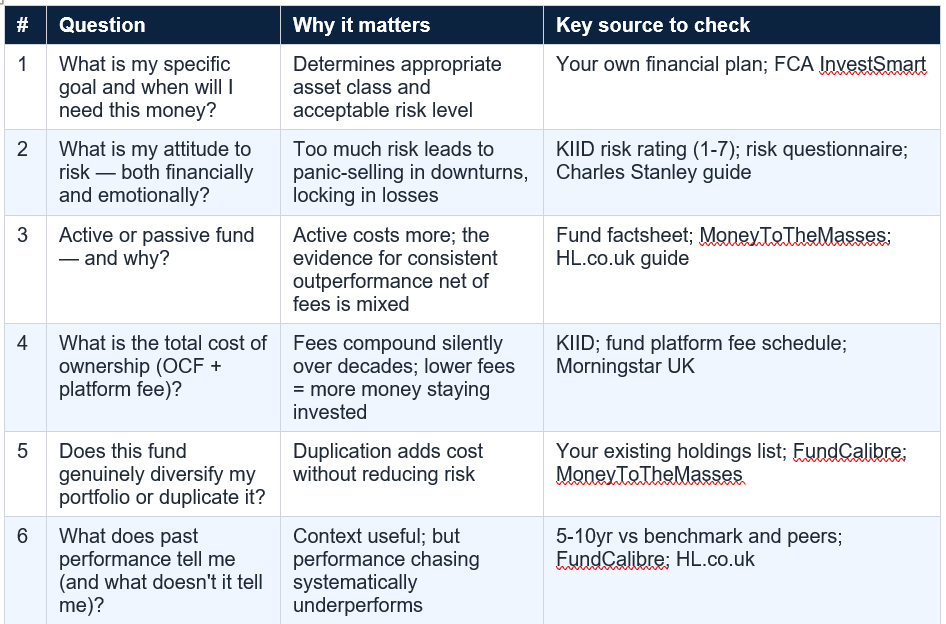
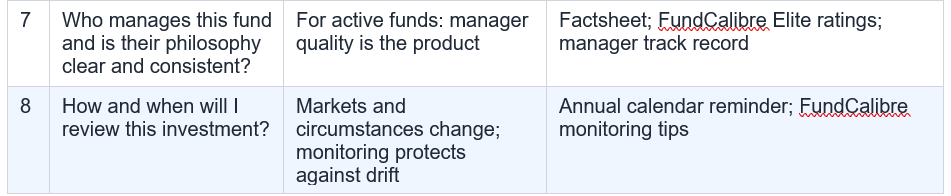
The funds available to UK investors number in the thousands. The path through them is not made by chasing last year’s performance tables or by guessing which sector will next outperform. It is made by answering eight structured questions honestly and in order. What am I trying to achieve? How much risk can I absorb? Active or passive? What does the total fee cost? Am I actually diversifying? What does performance tell me and not tell me? Who manages this fund and is their philosophy consistent? And how will I monitor all of this going forward?These eight questions do not guarantee good outcomes — investment involves risk by its nature, and past performance is not a reliable guide to future returns. But they do eliminate the most common and most costly mistakes: buying because something has recently been up, holding because selling feels uncomfortable, paying too much in fees for too little return, and concentrating risk without realising it. The investors who do best over the long term are generally not the most sophisticated or the best at predicting markets. They are the ones who ask the right questions first, choose appropriately, pay attention to costs, and stay patient when markets are difficult. Not investment advice. Always read the KIID before investing. Consult a qualified independent financial adviser regulated by the FCA.
Frequently Asked Questions
What is the most important thing to consider when choosing an investment fund?There is no single most important factor — the eight things in this article work together. But if forced to prioritise, goals and time horizon come first because they determine everything else. A fund that is perfect for a 20-year retirement savings goal may be entirely wrong for a 3-year house deposit fund. Before evaluating any specific fund, you need clarity on what you are investing for and when you will need the money. The second most commonly overlooked factor is fees: unlike market performance, fees are certain and compound predictably over time. A 1% annual fee difference on £10,000 over 20 years at 7% average return produces approximately £4,000 less in final portfolio value. Sources: FCA InvestSmart; Charles Stanley March 2026; HL.co.uk guide March 2025; FundCalibre December 2025. Not investment advice. Capital at risk.
What is a KIID and why do I need to read it?
A Key Investor Information Document (KIID) — or Key Information Document (KID) for newer fund structures — is a mandatory 2-page document that every regulated fund in the UK and EU must produce. It contains: the fund's investment objective, a standardised risk rating on a 1-7 scale, the Ongoing Charges Figure (OCF), five years of past performance presented consistently, and practical information about buying and selling. The FCA requires investors to read the KIID before making any investment decision in a collective investment scheme. Charles Stanley's March 2026 guide states explicitly that investment decisions should only be made after reading the KIID, Supplementary Information Document, and Prospectus. The KIID is the most efficient way to understand the basics of any fund before doing further research. Always obtain the KIID from the fund provider directly or through an FCA-regulated investment platform. Sources: Charles Stanley March 2026; FCA; HL.co.uk guide March 2025. Not investment advice.
Should I invest in active or passive funds?
Both have a place in an investment portfolio, and the best choice depends on the specific asset class, your cost sensitivity, and your view on manager skill. The evidence for passive funds is compelling in large, liquid markets (US equities, UK large-cap equities) where information is widely available and quickly priced in — active managers consistently struggle to outperform simple index funds net of fees in these markets over the long term, according to MoneyToTheMasses and broader SPIVA scorecard research. In less efficient areas — smaller companies, specific regional markets, alternative assets — skilled active management may add value that justifies higher fees. The practical advice most sources converge on: passive funds for core broad-market exposure (lower cost, no manager risk), with selective use of active funds in areas where you have genuine conviction in manager skill. Always compare the OCF of any active fund against an equivalent passive alternative and ask what you are paying for. Sources: MoneyToTheMasses; HL.co.uk guide March 2025; FundCalibre December 2025. Not investment advice. Capital at risk.
How do investment fund fees work?
Fund fees come in several layers. The most important is the Ongoing Charges Figure (OCF), which is the annual percentage of your investment deducted to cover fund management, administration, and other costs. For passive index funds and ETFs, OCFs are typically 0.05%-0.25%. For active funds, 0.5%-1.5% is common. In addition to the OCF, you also pay a platform fee — the charge levied by the investment account or ISA/SIPP provider through which you hold the fund. Some active funds also charge a performance fee above and beyond the OCF when returns exceed a specified benchmark. There may also be dealing fees on some platforms when you buy or sell. Morningstar UK advises always choosing the 'clean' or 'unbundled' share class, which excludes adviser commission and is typically the cheapest retail option. The combined OCF plus platform fee is your total annual cost of ownership, and even a 0.5% difference compounds significantly over a 20-year investment horizon. Sources: FundCalibre December 2025; Morningstar UK; FCA InvestSmart guide; HL.co.uk. Not investment advice.
How often should I review my investment funds?
Most sources recommend a formal annual review as a minimum. FundCalibre's guide on how to pick an investment fund recommends regular monitoring to ensure you are not taking too much or too little risk over time. The triggers for an out-of-cycle review include: a fund manager change (the most important trigger for active fund holders — the manager is the product, and a change may fundamentally alter the fund's approach); significant personal life changes (new job, marriage, divorce, birth of a child, approaching retirement, inheritance); a major change in market conditions that has significantly altered your portfolio's actual risk level; persistent underperformance versus benchmark and peer group over 3+ years; or a material increase in the fund's OCF. What does not automatically warrant a fund change: a single year of underperformance (all funds underperform sometimes), a falling market (this is normal volatility, not a reason to sell), or a change in market sentiment towards a particular sector (this should have been assessed when you selected the fund). Sources: FundCalibre December 2025; MoneyToTheMasses; FCA. Not investment advice. Capital at risk.
0 Comments
Be the first to share your thoughts on this article.