
Savings
How to Cut Your Water Bill in the UK: Complete Guide

Table of Contents
- The UK Water Bill Landscape in 2026: Key Statistics
- Step 1: Switch to a Water Meter (Free, and Often the Biggest Single Saving)
- Step 2: Check for Social Tariffs and Hardship Support
- Step 3: Claim Your Free Water-Saving Kit and Fix Leaks
- Step 4: Practical Daily Habits That Add Up
- Shower Habits
- In the Kitchen
- Garden and Outdoor Use
- Step 5: What to Do If You Cannot Pay
- Conclusion
- Frequently Asked Questions (FAQ)
- External References & Further Reading
UK water bills have risen sharply over the past two years, and they are still climbing. The national average combined water and sewerage bill reached approximately £603 in April 2025 — a 26% increase in a single year — and from April 2026 it has risen again to around £639, representing a further 5.4% increase as the second year of Ofwat's controversial five-year investment cycle takes effect. For households in the most expensive regions, annual bills are approaching or exceeding £700.
The reason for these increases is structural, not incidental: Ofwat has approved a £104 billion investment programme running from 2025 to 2030, designed to fund long-overdue infrastructure improvements including pipe replacement, upgraded sewage treatment, and a national smart meter rollout targeting eight million homes by April 2027. The investment is necessary, the regulator argues; the cost is unavoidable, at least at the industry level. But for the over three million UK households currently in water debt, and the many more who are finding water costs a meaningful pressure on tight household budgets, 'unavoidable' is cold comfort.
The good news is that water bills, unlike energy, offer a specific and underused set of reduction mechanisms that go far beyond simply 'using less.' Switching to a water meter, claiming a social tariff, applying for WaterSure, requesting a free water-saving kit, and addressing household leaks can, in combination, save eligible households hundreds of pounds annually — in some cases more than £100 from a free meter installation alone. This guide covers every available option, starting with the most impactful and working through to the behavioural habits that compound savings over time.
The UK Water Bill Landscape in 2026: Key Statistics
Understanding where your water bill sits relative to national and regional averages is the starting point for any cost-reduction strategy. The tables below provide both headline statistics and the regional comparison picture: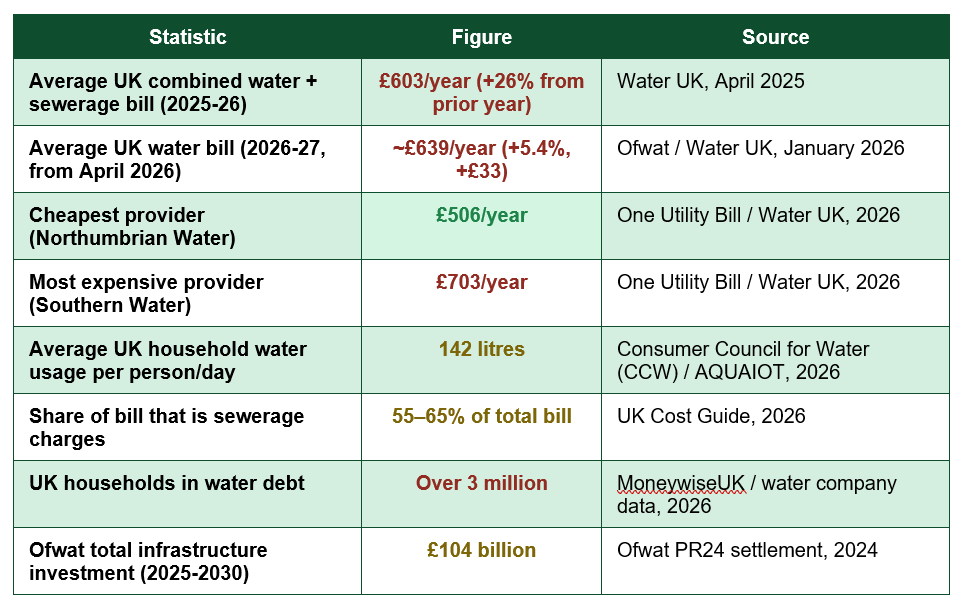
The 26% rise in perspective: £603 average in 2025-26, up from £480 in 2024-25 — the largest single-year water bill increase in modern UK regulatory history, driven by the first year of Ofwat's PR24 investment settlement — the 2026-27 increase of 5.4% is considerably smaller but still above general inflation for most UK households (Water UK / Ofwat, 2026)
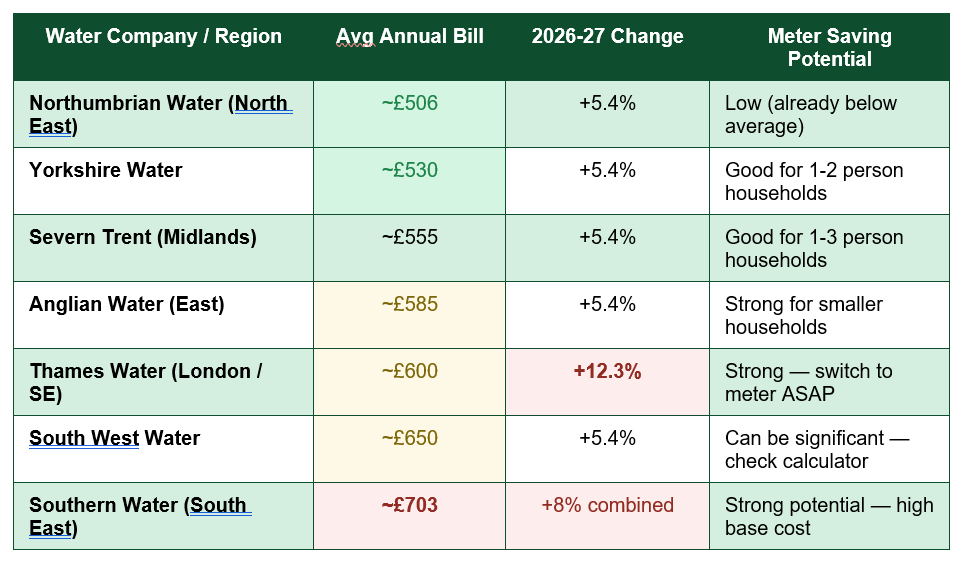
You cannot switch water supplier in the UK: unlike energy, water supply is provided by regional monopolies, and there is no consumer switching market. Your water company is determined entirely by where you live. What you can do — and what the rest of this guide covers — is influence your bill through metering, usage reduction, and claiming every available discount or support scheme regardless of which company supplies you.
Step 1: Switch to a Water Meter (Free, and Often the Biggest Single Saving)
For households with fewer people than bedrooms, switching from an unmetered rateable-value bill to a water meter is frequently the single largest saving available — and it costs nothing. Water companies in England and Wales are legally required to install a meter for free on request, in almost all circumstances (the exception is properties with shared pipes where installation is genuinely impractical). Ofwat is targeting eight million new meter installations by April 2027, with water companies actively promoting the switch.The mathematics of metered saving are straightforward: unmetered bills are calculated based on the rateable value of your property, a measure set by the government before 1990 that reflects the historical rental value of the property rather than how much water your household actually uses. If you live in a large or older property, your rateable value may be relatively high, meaning you pay significantly more than the water you actually consume. Switching to a meter means you pay only for what you use.
The rule of thumb, consistently stated by MoneySavingExpert, the Consumer Council for Water, and water companies themselves, is that households with fewer occupants than bedrooms will almost always save money on a meter. A single person in a two-bedroom flat, or a couple in a three-bedroom house, are the most likely beneficiaries. Wessex Water's own case study from 2026 showed a single occupant in Bristol with an unmetered annual bill of £375 estimating metered costs of just £295 based on average single-person consumption — a saving of £118 per year, secured simply by requesting a free meter installation.
Importantly, most water companies offer a trial period of typically 12 to 24 months after switching to a meter. If your metered bill turns out to be higher than your unmetered bill — which can happen in large households with high usage — you can switch back to unmetered billing within the trial period at no cost. The trial period removes the financial risk from trying a meter, making it a genuinely no-downside first step for most households.
How to check if you will save: Use your water company's free online meter calculator — all UK water companies offer an online calculator where you enter your household size, property type, and usage habits to estimate your likely metered bill before committing to the switch — Ofwat's Discover Water website links to all company calculators from one place
Step 2: Check for Social Tariffs and Hardship Support
Every water company in England and Wales is required to offer a social tariff — a reduced-rate bill for households on low incomes or receiving qualifying benefits. The specific eligibility criteria, discount levels, and application processes vary by company, which is why the Consumer Council for Water's chief executive Mike Keil has described the system as a 'postcode lottery of financial assistance' that creates unfair variation in support between regions. However, for eligible households, these tariffs can reduce annual water bills by 20-50% or more depending on the provider.Common eligibility criteria across most providers include receiving Universal Credit, Pension Credit, income-based Jobseeker's Allowance, income-related Employment and Support Allowance, Housing Benefit, or Child Tax Credit. Some companies also apply an income threshold — MoneySavingExpert's February 2026 table of social tariff eligibility shows several companies using an equivalised weekly household income after housing costs of less than £400 as the qualifying threshold.
The application process is typically simple: contact your water company directly, provide evidence of the qualifying benefit or income, and the discount is applied to your account. Many households who qualify are not receiving the discount simply because they have not applied or are unaware the scheme exists.
- WaterSure — the nationally available bill cap: In addition to company-specific social tariffs, the WaterSure scheme is available through all water companies and specifically benefits metered customers with exceptionally high water usage they cannot control. To qualify, you or someone in your household must receive at least one qualifying benefit AND either have three or more children under 19 in full-time education, or have a medical condition requiring high water use (such as kidney dialysis at home). If accepted, your bill is capped at your water company's average household charge regardless of how much water you actually use — a significant protection for families whose usage is structurally high.
- Single occupancy rates: Some water companies offer assessed charge options or single occupancy rates for households with one resident who cannot be metered. If you live alone and metering is not practical for your property, ask your water company about assessed charges based on occupancy rather than rateable value.
Step 3: Claim Your Free Water-Saving Kit and Fix Leaks
Most UK water companies offer free water-saving kits to household customers on request, and these kits can meaningfully reduce water consumption without any lifestyle sacrifice. The typical kit includes a water-efficient shower head that reduces flow rate from a standard eight to ten litres per minute down to approximately six litres per minute while maintaining water pressure, a shower timer to keep shower duration in check, aerators for kitchen and bathroom taps that reduce flow without reducing pressure, and sometimes a device to reduce the volume of water used per toilet flush.These items cost nothing to the customer because water companies are incentivised by Ofwat to reduce household consumption as part of their efficiency targets. Requesting a kit from your water company's website typically takes less than five minutes and does not require any commitment or account change. The Consumer Council for Water estimates that fitting an efficient shower head alone can save a metered household approximately £35 per year in water costs, on top of the energy saving from heating less water.
Checking for leaks is equally important and often overlooked. A dripping tap wasting one drip per second loses approximately 5,500 litres of water per year — which, for a metered household paying an average of around £1.50 per cubic metre for water supply and sewerage, represents a cost of approximately £8 per year for a single dripping tap. More significantly, a running toilet cistern — a common and frequently silent leak — can waste between 200 and 400 litres per day, adding £100 or more annually to a metered water bill. The 'dye test' for toilet leaks is free: place a few drops of food colouring in the cistern tank and wait 15 minutes without flushing — if colour appears in the bowl, the cistern seal is leaking and needs replacement, typically a cheap and straightforward repair.
Leak before the meter: If you are on a metered supply and suspect a leak between the water company's meter and your home (underground, on the supply pipe within your boundary), you may be able to apply to your water company for a 'leakage allowance' that credits back a portion of the water lost. You are responsible for supply pipe leaks within your boundary, but most companies will contribute to repair costs if you fix the leak promptly, and some offer free repairs under certain conditions. Contact your water company if your metered usage has risen unexpectedly without an obvious household reason.
Step 4: Practical Daily Habits That Add Up
For metered households, reduced consumption directly reduces the bill. The average UK person uses 142 litres per day, and most of that usage is concentrated in a small number of identifiable activities. Targeting those activities with simple behavioural changes produces savings that compound month after month. For unmetered households, these habits are still worth building ahead of any future meter installation, and they have environmental value regardless of financial incentive.Shower Habits
Showers account for approximately 25% of the average UK household's daily water use. A standard shower uses around 8-10 litres per minute; an eight-minute shower uses approximately 64-80 litres. Reducing from eight minutes to four — the goal promoted by most UK water companies and their free shower timers — halves that consumption to 32-40 litres per shower. For a household of two adults each showering daily, that change saves approximately 23,000 litres per year, worth roughly £35 at average metered rates. The Wessex Water case study from 2026 showed their customer cutting shower time in half alongside fitting a water-efficient shower head, compounding both flow-rate and duration savings simultaneously.In the Kitchen
Using a full load in the dishwasher rather than hand-washing or running partial loads saves both water and energy, since modern dishwashers use approximately 10-12 litres per cycle while hand-washing a full load typically uses 25-30 litres. Keeping a jug of cold water in the fridge eliminates the habit of running the tap until the water is cold — which wastes four to six litres per use. Defrosting food in the fridge overnight rather than under running water saves several litres per meal. Each individual change is modest; maintained consistently by a household, they collectively reduce daily consumption by 10-20 litres.Garden and Outdoor Use
Garden watering is one of the highest-volume discretionary water uses in UK households, with a hosepipe using approximately 1,000 litres per hour — more water in an hour than a typical person uses in an entire week. Water companies recommend watering gardens in the early morning or evening to reduce evaporation, using a watering can rather than a hosepipe for targeted watering, and installing a water butt to collect rainwater for garden use. A standard 200-litre water butt can be filled by rainfall off a typical roof within a few rainy days in most of the UK, and most water companies either sell water butts at subsidised prices through their websites or include them in water-saving kits or promotions.Step 5: What to Do If You Cannot Pay
Over three million UK households are currently in water debt, and the options available to those struggling are considerably better than most people know. Water companies in England and Wales cannot disconnect domestic customers for non-payment — this is a legal protection that does not apply to most other utilities. However, they can take legal action to recover debts, which makes engaging early with payment difficulties significantly better than ignoring them.- Contact your water company as soon as possible: All water companies are required to offer payment plans, and most have dedicated vulnerability or hardship teams with discretion to arrange manageable instalments. The earlier you contact them, the more flexible the options available.
- Ask about debt write-off schemes: Several water companies operate specific debt write-off programmes for long-standing or severe hardship cases, sometimes branded as 'Fresh Start' or similar. These are not universally advertised but are available on request from hardship teams.
- Apply for the WaterSure cap if eligible: If you are on a meter and qualify for WaterSure, your bill will be capped at the company average regardless of past arrears on future usage, providing immediate forward-looking protection.
- Contact the Consumer Council for Water (CCW): The CCW is the independent customer representative body for water consumers in England and Wales and can help if you are in a dispute with your water company or need guidance on accessing support schemes.
Conclusion
UK water bills have risen substantially over the past two years and will continue rising modestly as Ofwat's £104 billion investment cycle progresses to 2030. The average household now pays approximately £639 per year for combined water and sewerage, with the most expensive regions approaching or exceeding £700 annually. Unlike energy bills, where switching supplier and fixing a price are primary tools, water offers a different and largely underused set of cost-reduction mechanisms: switching to a meter, claiming a social tariff, applying for WaterSure, requesting a free water-saving kit, fixing leaks, and adjusting daily habits.The most impactful single step for most households — particularly smaller households — is checking whether a water meter would save money and, if so, requesting one. It is free to install, comes with a trial period so the switch can be reversed if it costs more, and can save eligible households £100 or more per year without any change in behaviour whatsoever. The social tariff check is the second essential step: over three million households are in water debt, and a meaningful share of eligible households are not claiming the reduced-rate tariffs they qualify for simply because they do not know the schemes exist.
The broader principle is that water bills, despite the absence of a switching market, are more controllable than most UK consumers currently recognise. Combining a meter, a social tariff where applicable, a free water-saving kit, leak detection, and the everyday habit changes described in this guide, a motivated household can realistically reduce their water bill by 20-30% or more relative to an unmetered, unoptimised position — meaningful savings at a time when household budgets are under sustained pressure from multiple directions.
Frequently Asked Questions (FAQ)
How much is the average UK water bill in 2026?
The average combined water and sewerage bill in England and Wales is approximately £639 for the 2026-27 billing year (April 2026 to March 2027), according to Water UK and Ofwat. This represents a 5.4% increase of approximately £33 from the 2025-26 average of £603, itself a 26% increase from the prior year. Bills vary significantly by region: Northumbrian Water customers pay around £506 annually, while Southern Water customers pay approximately £703. In Scotland, water charges are included in council tax rather than billed separately.Will a water meter save me money?
It depends on your household. The general rule is that households with fewer people than bedrooms are likely to save money on a meter, because their actual water consumption is lower than the rateable value used to calculate unmetered bills. Larger families with high water usage may pay more on a meter. All water companies offer a free online calculator to estimate your likely metered costs, and most provide a 12-24 month trial period after installation during which you can switch back if the metered bill is higher. Meter installation is free on request in England and Wales.What is the WaterSure scheme and who qualifies?
WaterSure is a national water bill cap scheme available through all water companies in England and Wales. It protects metered households with unavoidably high water usage by capping their bill at the company's average unmetered household charge — meaning you pay no more than the average regardless of actual consumption. To qualify, you or someone in your household must be receiving at least one qualifying benefit (such as Universal Credit, Pension Credit, or similar) AND either have three or more children under 19 in full-time education, or have a medical condition requiring high water use such as home kidney dialysis. Apply by contacting your water company directly.How do I get a free water-saving kit from my water company?
Most UK water companies offer free water-saving kits to household customers, typically including an efficient shower head, a shower timer, and tap aerators. To claim yours, visit your water company's website and search for 'water saving kit' or 'free water saving products' — most companies have a dedicated request form that takes a few minutes to complete. Some companies also offer free water butts or subsidised garden watering products. You can find your water company using the Ofwat Discover Water website.Can my water company cut me off if I cannot pay?
No. Water companies in England and Wales are legally prohibited from disconnecting domestic household customers for non-payment. However, they can take legal action to recover debt, and unpaid water debt can affect your credit file and result in county court judgments. If you are struggling to pay, the most important step is to contact your water company as soon as possible — all providers are required to offer payment plans, and many have hardship schemes including reduced tariffs, debt write-off programmes, and payment holidays. The Consumer Council for Water (CCW) can also help if you need independent guidance.
External References
The following authoritative sources were used in researching this article and are recommended for further reading:1. Ofwat — Response to Water UK Annual Average Bill Figures 2026-27 (January 2026)
https://www.ofwat.gov.uk/ofwat-responds-to-water-sector-average-bill-figures/
2. Water UK — Annual Average Bill Changes 2025-2026
https://www.water.org.uk/annual-average-bill-changes-2025-2026
3. MoneySavingExpert — Cheaper Water Bills: Should You Get a Water Meter?
https://www.moneysavingexpert.com/utilities/cut-water-bills/
4. Consumer Council for Water (CCW) — Help with Your Water Bill
https://www.ccwater.org.uk/households/billing-and-charges/
5. Discover Water (Ofwat) — Find Your Water Company and Compare Bills
https://www.discoverwater.co.uk/
6. One Utility Bill — Average Water Bill UK 2025/2026 (Regional Breakdown)
https://oneutilitybill.co/our-insights/average-water-bill
7. MoneywiseUK — Water Bill Increase 2026 UK: How Much and How to Save
https://moneywiseuk.co.uk/water-bill-increase-2026-uk/
8. PleaseConnectMe — Water Bills Set to Rise 2026-27: Calculate How Much You'll Pay
https://www.pleaseconnectme.co.uk/blog/water-bills-set-to-rise-calculate-how-much-youll-be-paying-this-year/
0 Comments
Be the first to share your thoughts on this article.