
Investing
How to Invest in an Index Fund: A Simple, Step-by-Step Guide

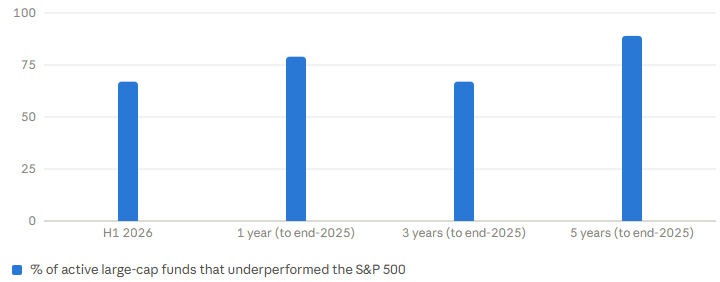
SPIVA: 79% of active large-cap US funds underperformed the S&P 500 in 2025 (67% over three years, 89% over five); 67% underperformed in the first half of 2026, when the S&P 500 rose 10%. Morningstar: over the decade through 2025, low-cost passive funds beat almost 80% of active funds (about 90% in US large-cap). Average fund expense ratio fell to 0.32% in 2025. Fees: top S&P 500 index funds 0.015%–0.04%; average active equity mutual fund 0.64% (ICI, via Walnut Invest). On $500 a month for 30 years at 7% gross: about $605,000 at 0.04%, $573,000 at 0.32%, $538,000 at 0.64% (illustrative). S&P 500 concentration: top 10 about 39.1% of the index, top three 21.59%; about 503 companies. Forward P/E about 20; CAPE about 41.6. Average equity investor about 6.8% a year vs 10.2% for the S&P 500 over 30 years ending 2023.
Most of the exciting things in investing lose to a dull one. In 2025, 79% of active large-cap US stock funds trailed the S&P 500, according to S&P Dow Jones Indices, the fourth-worst year in the 25-year history of its scorecard. In the first half of 2026, with the index up 10%, 67% still fell behind. A fund that simply copies the market, at almost no cost, beat most of the professionals trying to beat it.
That is the whole idea behind an index fund. It does not try to be clever. It buys the market, holds it cheaply and lets time do the work. This guide shows how to do it in eight steps, with the 2026 numbers that explain why it works and where the catches are.
The S&P 500 holds about 503 companies, but it weights them by size. As of September 30, its top 10 made up about 39.1% of the index, and the top three, Nvidia, Apple and Microsoft, were 21.59% on October 2, according to figures cited by KuCoin. So a "500-company" fund is broad but not evenly spread. Keep that in mind in Step 2.
In fairness, active managers are not hopeless everywhere. In the first half of 2026, only 38% of emerging-market funds and 49% of international funds underperformed, according to SPIVA. Even so, Morningstar’s June 2026 update found that only about one in four active strategies both survived and beat passive peers over ten years. Among the cheapest active funds, 31% beat their average passive peer over a decade, so low cost matters everywhere.
The numbers: Active large-cap funds that underperformed the S&P 500: 79% (2025), 67% (three years), 89% (five years); 67% in H1 2026. Morningstar: passive beat almost 80% of active funds over ten years.
Which index should you pick? An S&P 500 fund is a fine core, with a long record. If its concentration bothers you, a total-market fund spreads across more companies, and an international fund adds markets outside the US. Valuations are worth knowing: the S&P 500’s forward P/E is about 20, near its five-year average of 19.9, while CAPE is near 41.6, close to an all-time high. That is not a signal to avoid stocks, but a reminder that future returns need not match the past. One or two broad stock funds, plus bonds if your timeline calls for it, is enough for most people.
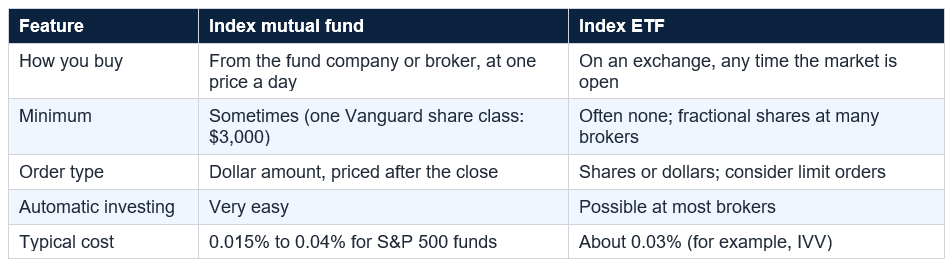
Neither wrapper is better in principle. Costs and the underlying index matter more. Pick whichever fits your broker and your habits.
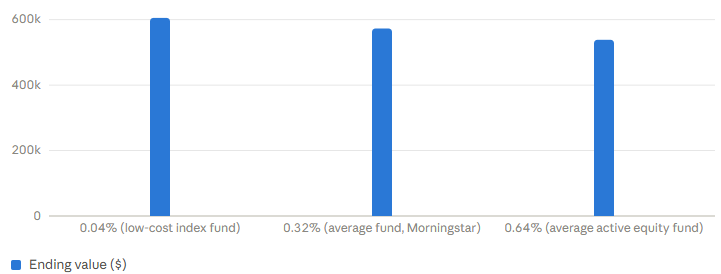
Here is my own illustration of what that means. Invest $500 a month for 30 years at a 7% return before fees. At 0.04%, you end with about $605,000. At the 0.32% industry average, about $573,000. At 0.64%, about $538,000. The difference between the cheapest and the active-fund average is about $67,000, from fees alone.

Keep in mind: Check the share class. Vanguard’s 500 Index Fund Investor Shares carried a 0.14% expense ratio in the March 2026 Vanguard data, while Admiral shares (VFIAX) charge 0.04%. The same index can cost very different amounts depending on the version you buy.
If your money is in a workplace 401(k), the process is even simpler: choose the index funds or a target-date fund from your plan menu, set your contribution percentage and you are done. Look for the lowest-cost index option in the menu, and capture any employer match first.
How much should you invest? As much as you can sustain, then a bit more over time. Vanguard recommends saving 12% to 15% of pay, including employer contributions. If that is out of reach today, start smaller and raise the amount whenever your income rises.
Decide in advance what you will do when the market falls, because it will. For long-term money, the answer is usually to keep investing automatically. Review once or twice a year, rebalance if your mix has drifted far from your plan, and ignore the daily noise.
Worth knowing: Only invest money you will not need for several years. Money needed soon belongs in cash-like options, not in a fund that can drop 20% or more in a bad year.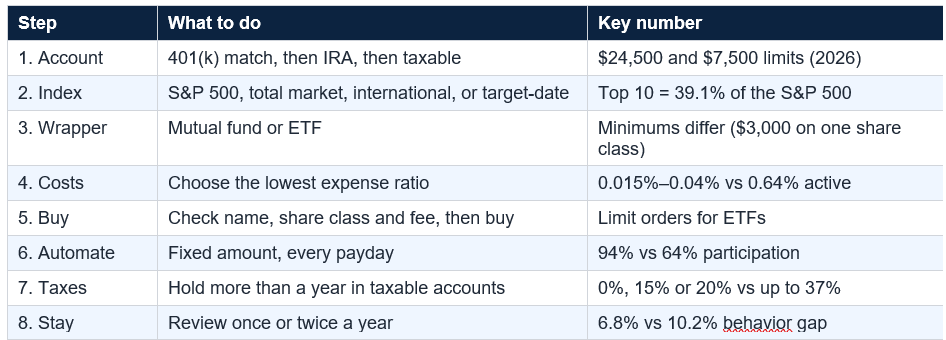
There are real caveats. The market is concentrated in a handful of giants, valuations are not cheap, and index funds fall when markets fall. None of that argues for something fancier. It argues for starting, diversifying sensibly and staying patient. Pick the step you can complete this week, whether that is checking your 401(k) menu or opening an account. A qualified adviser can help with your situation.
It is a fund that holds all, or a representative sample, of the investments in a market index, such as the S&P 500, instead of a manager choosing which to buy. When you buy one share of the fund you own a tiny slice of every company in the index. Because there is no stock picking, costs are very low.
How much money do I need to start?
It depends on the fund. Bankrate lists Schwab and Fidelity S&P 500 index funds with no minimum, while one Vanguard mutual fund share class requires $3,000. ETFs trade like stocks, and many brokers allow fractional shares, so you can often start with very little. Check the minimum before you open an account.
Should I choose an ETF or a mutual fund?
Both can track the same index. Mutual funds are priced once a day and may have minimums. ETFs trade throughout the day and often have no minimum. Costs and the index matter more than the wrapper, so compare expense ratios and choose whichever fits your account and broker.
Do index funds ever lose money?
Yes. They move with the market. The S&P 500 has averaged about 10.26% a year since 1928, but its worst calendar year was a 43.84% loss. Index funds do not remove market risk. They remove the risk of paying high fees and picking the wrong manager.
How often should I invest and check my fund?
Many investors contribute every paycheck or every month and review once or twice a year. Automatic investing reduces the chance of letting emotions drive decisions. Checking daily tends to encourage tinkering, which research on investor behavior links to lower returns.
Table of Contents
- Why “Boring” Keeps Winning
- What an Index Fund Actually Is
- The Evidence: Index Funds vs Active Funds
- Step 1: Choose Your Account
- Step 2: Choose Your Index
- Step 3: ETF or Mutual Fund?
- Step 4: Compare the Costs
- Step 5: Open the Account and Buy
- Step 6: Automate Your Investing
- Step 7: Know the Tax Basics
- Step 8: Stay the Course
- The Risks Nobody Should Skip
- The Eight Steps at a Glance
- Conclusion
- Frequently Asked Questions
Active large-cap funds that trailed the S&P 500 (%)
% underperforming by Period (SPIVA, S&P Dow Jones Indices)
Fees compound: $500 a month for 30 years at 7% before fees ($)
Ending portfolio value ($) by Annual expense ratio (illustration, constant return)
Why “Boring” Keeps Winning
Most of the exciting things in investing lose to a dull one. In 2025, 79% of active large-cap US stock funds trailed the S&P 500, according to S&P Dow Jones Indices, the fourth-worst year in the 25-year history of its scorecard. In the first half of 2026, with the index up 10%, 67% still fell behind. A fund that simply copies the market, at almost no cost, beat most of the professionals trying to beat it.That is the whole idea behind an index fund. It does not try to be clever. It buys the market, holds it cheaply and lets time do the work. This guide shows how to do it in eight steps, with the 2026 numbers that explain why it works and where the catches are.
What an Index Fund Actually Is
An index is a list of investments chosen by rules, such as the 500 large US companies in the S&P 500. An index fund buys the holdings on that list in roughly the same proportions, so its results closely follow the index. There is no manager picking winners, which is why the fees are so low. When you buy a share of the fund, you own a small slice of every company in it.The S&P 500 holds about 503 companies, but it weights them by size. As of September 30, its top 10 made up about 39.1% of the index, and the top three, Nvidia, Apple and Microsoft, were 21.59% on October 2, according to figures cited by KuCoin. So a "500-company" fund is broad but not evenly spread. Keep that in mind in Step 2.
The Evidence: Index Funds vs Active Funds
The case for index funds rests on two things: most active managers underperform, and costs compound. On the first, the SPIVA scorecard found that over the periods ending in 2025, 79% of active large-cap funds underperformed over one year, 67% over three years and 89% over five. Morningstar’s Active/Passive Barometer found that over the decade through 2025, low-cost passive funds earned higher returns than almost 80% of active funds, and index funds outperformed about 90% of their active rivals in US large caps.In fairness, active managers are not hopeless everywhere. In the first half of 2026, only 38% of emerging-market funds and 49% of international funds underperformed, according to SPIVA. Even so, Morningstar’s June 2026 update found that only about one in four active strategies both survived and beat passive peers over ten years. Among the cheapest active funds, 31% beat their average passive peer over a decade, so low cost matters everywhere.
The numbers: Active large-cap funds that underperformed the S&P 500: 79% (2025), 67% (three years), 89% (five years); 67% in H1 2026. Morningstar: passive beat almost 80% of active funds over ten years.
Step 1: Choose Your Account
Before you pick a fund, pick where it will live. For long-term money, tax-advantaged accounts usually come first: a 401(k), especially up to any employer match, then an IRA. The 2026 limits are $24,500 for a 401(k) and $7,500 for an IRA. A regular taxable brokerage account has no contribution limit, but you pay tax on dividends and on gains when you sell. Many people use a retirement account for long-term goals and a taxable account for flexibility.Step 2: Choose Your Index
This is the decision that matters most, and it is simpler than it looks. The most common choices are a US large-company fund tracking the S&P 500, a total US market fund that adds mid-sized and smaller companies, an international fund and a bond fund. A target-date fund bundles several of these and shifts toward bonds as your chosen year approaches. Morningstar found that the average target-date fund cost 0.27% in 2025, about half what investors paid a decade ago.Which index should you pick? An S&P 500 fund is a fine core, with a long record. If its concentration bothers you, a total-market fund spreads across more companies, and an international fund adds markets outside the US. Valuations are worth knowing: the S&P 500’s forward P/E is about 20, near its five-year average of 19.9, while CAPE is near 41.6, close to an all-time high. That is not a signal to avoid stocks, but a reminder that future returns need not match the past. One or two broad stock funds, plus bonds if your timeline calls for it, is enough for most people.
Step 3: ETF or Mutual Fund?
Index funds come in two wrappers. An index mutual fund is bought directly from the fund company or a broker at one price per day, and may have a minimum. An index ETF trades on an exchange like a stock, so the price moves during the day, and there is often no minimum. Many brokers allow fractional shares of ETFs, so you can invest small amounts. ETFs also tend to be tax-efficient, though that matters mainly in taxable accounts.Neither wrapper is better in principle. Costs and the underlying index matter more. Pick whichever fits your broker and your habits.
Step 4: Compare the Costs
The expense ratio is the annual fee, taken out of the fund automatically. Morningstar’s 2026 study found that the asset-weighted average fund fee fell to 0.32% in 2025, from 0.34% in 2024. Top S&P 500 index funds charge far less. Bankrate lists Fidelity’s FXAIX at 0.015%, Schwab’s SWPPX at 0.02% and Vanguard’s VFIAX at 0.04%, and ETF Trends notes that the iShares Core S&P 500 ETF charges 0.03%. The average index equity mutual fund charges 0.05%, versus 0.64% for the average active equity fund, according to ICI data cited by Walnut Invest.Here is my own illustration of what that means. Invest $500 a month for 30 years at a 7% return before fees. At 0.04%, you end with about $605,000. At the 0.32% industry average, about $573,000. At 0.64%, about $538,000. The difference between the cheapest and the active-fund average is about $67,000, from fees alone.
Keep in mind: Check the share class. Vanguard’s 500 Index Fund Investor Shares carried a 0.14% expense ratio in the March 2026 Vanguard data, while Admiral shares (VFIAX) charge 0.04%. The same index can cost very different amounts depending on the version you buy.
Step 5: Open the Account and Buy
Open your account with a broker, usually online in a few minutes. Link a bank account, transfer money and search for the fund by name or ticker. Double-check the full name, the share class and the expense ratio before you click buy. For a mutual fund, you enter a dollar amount and the purchase is priced at the end of the trading day. For an ETF, choose shares or dollars, and consider a limit order, which sets the most you are willing to pay, rather than a market order.If your money is in a workplace 401(k), the process is even simpler: choose the index funds or a target-date fund from your plan menu, set your contribution percentage and you are done. Look for the lowest-cost index option in the menu, and capture any employer match first.
Step 6: Automate Your Investing
The most effective habit is automatic investing. Set a fixed amount to move from your bank into your fund every payday or every month. This is called dollar-cost averaging, and it removes the need to guess when to buy. Vanguard’s How America Saves 2026 report shows how powerful automation is: employees who were enrolled automatically participated at 94%, compared with 64% when they had to sign up themselves.How much should you invest? As much as you can sustain, then a bit more over time. Vanguard recommends saving 12% to 15% of pay, including employer contributions. If that is out of reach today, start smaller and raise the amount whenever your income rises.
Step 7: Know the Tax Basics
Inside a 401(k) or IRA, you do not pay tax on trades each year. In a taxable account, you owe tax on dividends and on gains when you sell. Gains on shares held one year or less are taxed as ordinary income, up to 37%. Gains on shares held longer are taxed at 0%, 15% or 20%. For 2026, published figures put the 0% rate at taxable income up to $49,450 for single filers and $98,900 for married couples filing jointly. Index funds rarely trade, which tends to keep taxable distributions low. A tax professional can help with the details.Step 8: Stay the Course
This is where index investors win or lose. DALBAR research, cited by MyETFJourney, found that the average equity investor earned about 6.8% a year over the 30 years ending in 2023, while the S&P 500 returned about 10.2%. The gap came from buying and selling at the wrong times. An index fund cannot protect you from your own decisions.Decide in advance what you will do when the market falls, because it will. For long-term money, the answer is usually to keep investing automatically. Review once or twice a year, rebalance if your mix has drifted far from your plan, and ignore the daily noise.
The Risks Nobody Should Skip
Index funds are not risk-free. They fall when the market falls. The S&P 500 has averaged about 10.26% a year since 1928, according to Gitnux, but its worst calendar year was a loss of 43.84%. You also share in the market’s concentration: with the top 10 stocks at about 39% of the S&P 500, a setback in a few mega-cap companies would matter more than the "500" suggests. What an index fund removes is the risk of high fees and the wrong manager. It cannot remove the risk of the market itself.Worth knowing: Only invest money you will not need for several years. Money needed soon belongs in cash-like options, not in a fund that can drop 20% or more in a bad year.
The Eight Steps at a Glance
Conclusion
Investing in an index fund is one of the few things in finance where the simple option is also the well-supported one. In 2025, 79% of active large-cap funds lost to the S&P 500. Over a decade, low-cost passive funds beat almost 80% of active ones. And the fee difference alone can be worth tens of thousands of dollars over a career. The steps are short: choose an account, choose an index, pick a low-cost fund, buy it, automate it and leave it alone.There are real caveats. The market is concentrated in a handful of giants, valuations are not cheap, and index funds fall when markets fall. None of that argues for something fancier. It argues for starting, diversifying sensibly and staying patient. Pick the step you can complete this week, whether that is checking your 401(k) menu or opening an account. A qualified adviser can help with your situation.
Frequently Asked Questions
What is an index fund in simple terms?It is a fund that holds all, or a representative sample, of the investments in a market index, such as the S&P 500, instead of a manager choosing which to buy. When you buy one share of the fund you own a tiny slice of every company in the index. Because there is no stock picking, costs are very low.
How much money do I need to start?
It depends on the fund. Bankrate lists Schwab and Fidelity S&P 500 index funds with no minimum, while one Vanguard mutual fund share class requires $3,000. ETFs trade like stocks, and many brokers allow fractional shares, so you can often start with very little. Check the minimum before you open an account.
Should I choose an ETF or a mutual fund?
Both can track the same index. Mutual funds are priced once a day and may have minimums. ETFs trade throughout the day and often have no minimum. Costs and the index matter more than the wrapper, so compare expense ratios and choose whichever fits your account and broker.
Do index funds ever lose money?
Yes. They move with the market. The S&P 500 has averaged about 10.26% a year since 1928, but its worst calendar year was a 43.84% loss. Index funds do not remove market risk. They remove the risk of paying high fees and picking the wrong manager.
How often should I invest and check my fund?
Many investors contribute every paycheck or every month and review once or twice a year. Automatic investing reduces the chance of letting emotions drive decisions. Checking daily tends to encourage tinkering, which research on investor behavior links to lower returns.
0 Comments
Be the first to share your thoughts on this article.