

Savings
How to Save on Holiday Shopping Using AI in 2026

The complete 2026 guide: AI chatbots for gift ideas, price trackers, coupon stacking, fake-deal detection, and the exact prompts that save real money

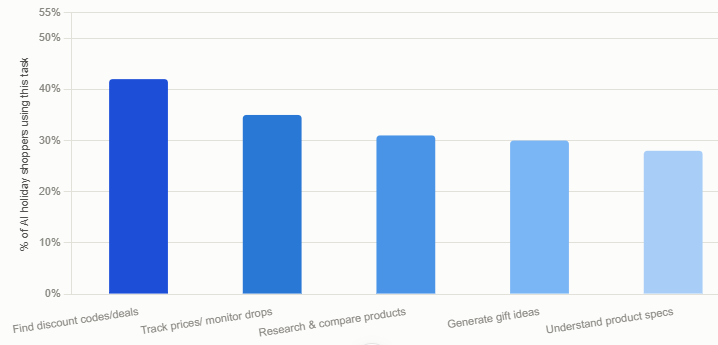
This is not a trend that is approaching. It is already here. The question for the remaining half of shoppers — and for AI-using shoppers who are not yet using the full toolkit — is whether they are saving money or simply shifting their browsing from one screen to another. Because AI does not automatically deliver savings. It delivers savings when used deliberately, with specific tools applied to specific stages of the shopping process.
This guide presents the complete 2026 AI holiday shopping strategy: a four-layer stack of tools and techniques that covers gift ideation, price research, price tracking, coupon stacking, cashback layering, and fake-deal detection. Applied together on a single significant purchase, these layers can save 20 to 40 percent versus unassisted shopping. Applied consistently across a holiday season’s worth of spending, the cumulative effect is measurable in hundreds of dollars.
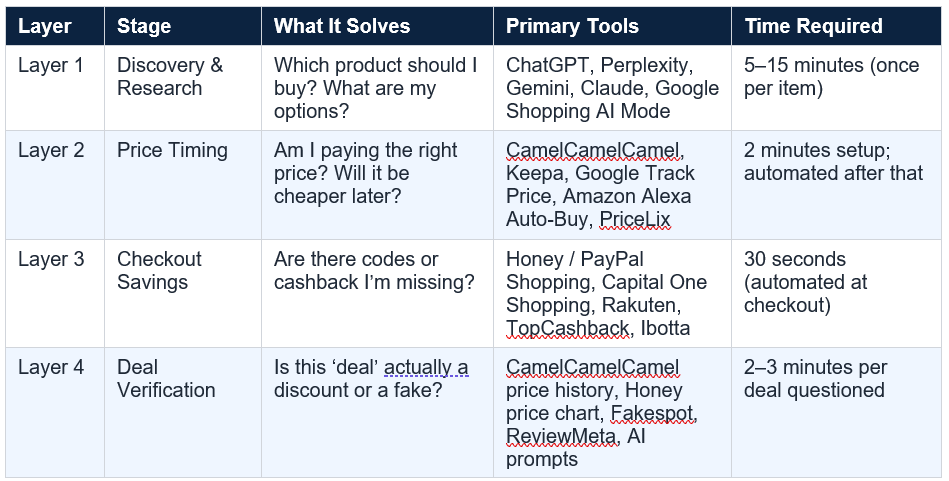
The logic of the stack: Layer 1 ensures you are buying the right product (AI research prevents the most expensive mistake: buying the wrong thing). Layer 2 ensures you are buying it at the right time (price tracking prevents the most common mistake: paying full price when a drop was imminent). Layer 3 ensures you are paying the lowest possible price at checkout. Layer 4 ensures the ‘deal’ you are accepting is genuine and not an artificially inflated price with a fake discount applied on top.
The Data: 47% of Americans use AI for holiday shopping. 64% of global consumers used AI for at least one holiday task in 2025. AI drove 21% of global holiday orders ($263 billion) according to Salesforce. 515% YoY increase in AI e-commerce traffic through the 2025 Black Friday period.
Pro Tip: When using AI chatbots for gift research, give maximum context about the recipient, not just budget. The most useful prompt includes age, interests, what they already own, what they have mentioned wanting, and your relationship. A vague prompt (‘gift for my mum’) produces generic results. A specific prompt produces specific, actionable recommendations.
This prompt does four things simultaneously: it establishes a price ceiling, requests cross-retailer comparison, filters out options you do not want, and asks for timing advice. The timing element is particularly valuable before Black Friday and Cyber Monday, when AI tools with web search capability (Perplexity, Gemini with Search) can access current information about retailer promotional calendars.
AI Super Simplified’s Black Friday edition tested this prompt specifically with ChatGPT-5, Perplexity, and Gemini. The output provided immediate, plain-English analysis of whether advertised Black Friday deals represented genuine discounts or prices inflated in the weeks before the sale to manufacture a larger-looking percentage reduction.
GOBankingRates’ November 2025 guide described this as its ‘second prompt’ — summarising cash-back portals and credit card rewards in one calculation, including the ability to stack a cashback portal on top of credit card rewards for the maximum combined saving.
This prompt, highlighted by AI Super Simplified, addresses the most common driver of holiday overspending: the accumulation of nice-to-have items that feel essential in the moment but lose their appeal shortly after purchase. AI applied as a critical filter before checkout rather than a discovery tool for more things to buy is one of the highest-return uses of the technology.
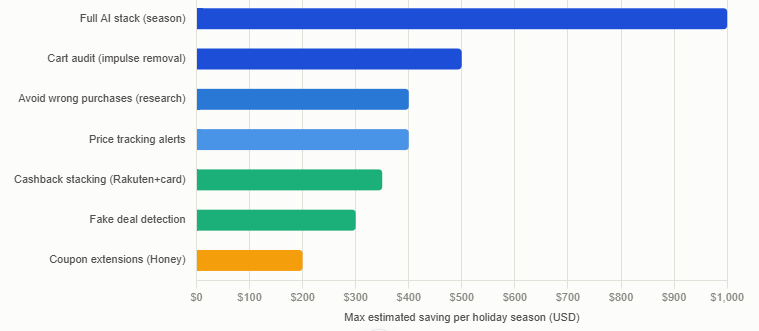
Saving Potential — Price tracking (CamelCamelCamel + Google Track Price on 5+ items): $150–$400/holiday season for a consistent user who tracks major purchase categories
Pro Tip: Before buying any ‘deal’ over $50 during the holiday season, run a two-minute check: (1) look at the 6-month price history on CamelCamelCamel or Honey. (2) Run the product name through Fakespot. If both checks pass, the deal is likely genuine. If either raises a red flag, wait or buy elsewhere.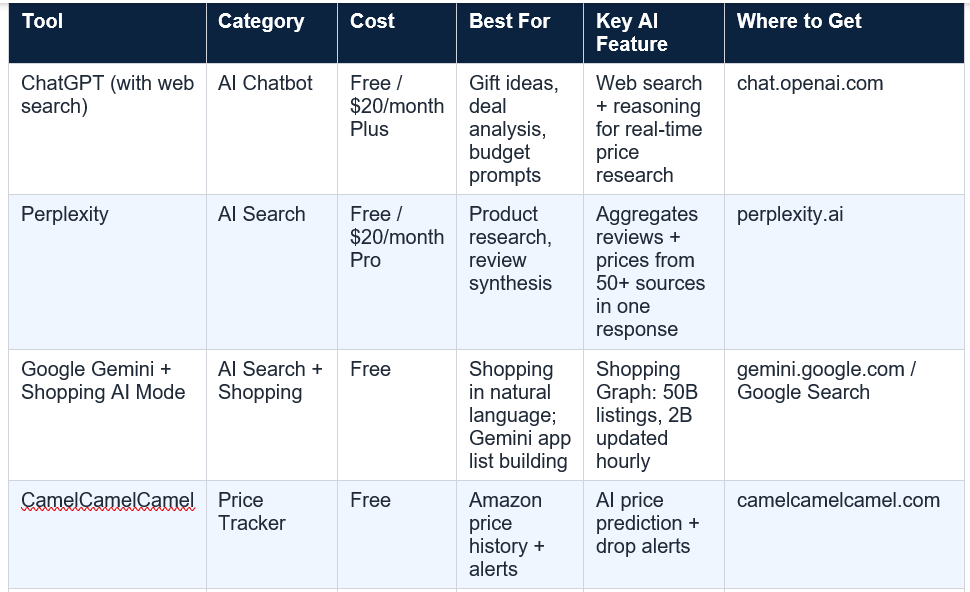
Google Blog, November 2025: We’re unwrapping our biggest upgrade to shopping in AI Mode in Search, so you can describe what you’re looking for just as you’d say it to a friend and get a thorough response with accurate shopping data you can trust — powered by the Shopping Graph with 50 billion product listings, 2 billion updated every hour.
Specific limitations to be aware of: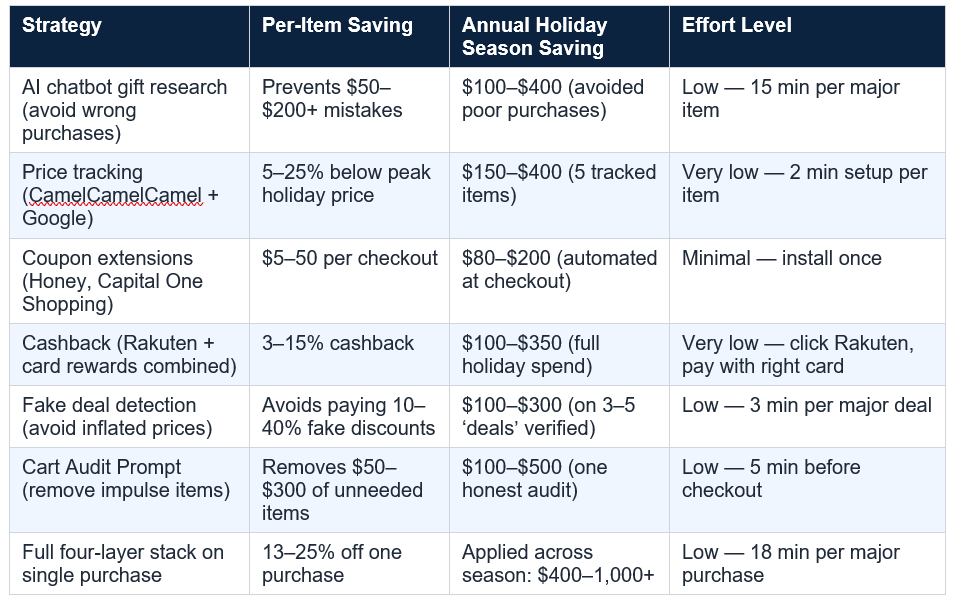
The combined saving potential for a household that applies the full AI shopping stack consistently across a holiday season with $1,000 to $1,200 in total gift spending is approximately $300 to $600 — equivalent to 25 to 50 percent of total holiday spending returned as savings. For higher-spending households, the proportional saving is similar and the dollar value is correspondingly larger.
Forty-seven percent of Americans are already using some form of AI for holiday shopping. The gap between the casual user who occasionally asks ChatGPT for gift ideas and the systematic user who runs the full four-layer stack on every significant purchase is the gap this guide is designed to close. The tools are free or inexpensive. The prompts are specific and repeatable. The saving potential across a holiday season is $300 to $600 for the average household, and significantly more for higher spenders.
The holiday shopper who uses AI most effectively is not the one who delegates every decision to a chatbot. It is the one who uses AI for the tasks it does better than humans — scanning 50 billion product listings, checking 12 months of price history, testing 50 coupon codes in two seconds, and calculating the stacked saving from three cashback sources — while remaining the one who decides what to buy, for whom, and why. That combination of AI efficiency and human judgement is the most powerful version of holiday shopping available in 2026.
According to Visa and PYMNTS data, 47% of Americans used AI tools for holiday shopping purposes in 2025, including finding gift ideas, researching products, and tracking prices. Separately, PYMNTS found 50% of shoppers used generative AI during the 2025 holiday season. Shopify’s 2025 Holiday Report found 64% of global consumers expected to use AI for at least one holiday shopping task. Among those aged 18 to 24, the figure was 84%. Salesforce forecast that AI would drive 21% of global holiday orders, estimated at $263 billion in sales.
What is the best free AI tool for holiday shopping?
The combination of Perplexity (for product research), CamelCamelCamel (for Amazon price history and alerts), Honey (for automatic coupon codes at checkout), and Rakuten (for cashback) provides the core of the four-layer stack at zero cost. All are free to use. For chatbot gift ideation, ChatGPT (free tier with limitations), Google Gemini (free), and Perplexity (free) are all effective. Google’s Shopping AI Mode and Track Price features are built into Google Search with no additional download required. CamelCamelCamel and Honey are browser extensions that install in under two minutes.
How do I detect fake holiday deals using AI?
Three methods: (1) Check the price history of the item on CamelCamelCamel or Keepa before accepting a stated Black Friday discount. If the ‘original price’ was only in effect for a few weeks before the sale, the deal is likely manufactured. (2) Honey’s price history chart, visible in the extension overlay on any product page, provides a quick visual check. (3) Use the Fake Deal Detector Prompt with ChatGPT, Perplexity, or Gemini (with web search enabled): paste your item list and ask the AI to compare current prices against the past 6 to 12 months and provide a Buy Now / Wait / Skip verdict for each.
What are the best AI prompts for holiday shopping?
Four specific prompts from current research: (1) Gift Research: ‘Find the best deals on [product] under [$X] this week. Compare across Amazon, Target, and Walmart. Tell me when these stores typically have their biggest sales and whether I should buy now or wait.’ (2) Fake Deal Detector: ‘Act as my price analyst. For these items: [list]. Compare today’s price vs the past 6-12 months. Is the discount real or inflated? Suggest alternatives. Verdict: Buy Now, Wait, or Skip.’ (3) Cashback Stack Calculator: ‘Compare cashback for shopping with [Card A] vs [Card B] at [Store]. Also check Rakuten and Capital One Shopping. Calculate my total stacked saving.’ (4) Cart Audit: ‘Act as a financial advisor. Here is my cart totalling $[X]: [items]. Tell me which I will stop using within 6 months, which solve real problems, and which 1-2 are actually worth buying.’
Can AI buy things automatically on my behalf?
Yes, two platforms offer automatic purchase features. Amazon’s Auto-Buy (accessed through Alexa for Shopping in the Amazon app) allows you to set a target price for any product; when the price drops to that level, Amazon completes the purchase using your default payment method. Google’s Agentic Checkout, launched November 2025, monitors tracked prices across retailers and automatically completes the purchase on the merchant’s website using Google Pay when the target price is reached. Both features require explicit opt-in per product and should be used with clearly defined price targets and reviewed default delivery settings.
How much can I realistically save using AI for holiday shopping?
Based on published research and user accounts, a household spending $1,000 to $1,200 on holiday gifts and applying the full four-layer AI stack (chatbot research, price tracking, coupon extensions, cashback) consistently can save $300 to $600 per holiday season — approximately 25 to 50 percent of total holiday spend. A NexaSphere user reported saving $800 in a single year from price tracking alone. Individual results depend significantly on what categories are purchased, how diligently the tools are applied, and whether cashback and coupon tools are activated on every qualifying purchase.
Table of Contents
- 1. Introduction: Half of America’s Holiday Shoppers Are Already Using AI
- 2. The Four-Layer AI Shopping Stack
- 3. Layer 1: Use AI Chatbots to Build Your Gift List and Budget
- 4. The Exact AI Prompts That Save Money
- 5. Layer 2: Price Trackers — The Set-and-Forget Saving Tool
- 6. Layer 3: Coupon Extensions and Cashback Apps
- 7. Layer 4: AI-Powered Fake Deal Detection
- 8. The Complete AI Shopping Tool Directory
- 9. Retailer-Embedded AI: Rufus, Sparky, and Google’s Agentic Checkout
- 10. The AI Shopping Calendar: When to Use Which Tool
- 11. How to Stack All Four Layers on One Purchase
- 12. AI Shopping for Specific Categories: Electronics, Toys, Apparel
- 13. What AI Shopping Tools Cannot Do
- 14. Privacy and Safety When Using AI Shopping Tools
- 15. How Much Can You Realistically Save?
- 16. Conclusion: The Holiday Shopper Who Uses AI Is Not the Smartest Person in the Room
- 17. Frequently Asked Questions
AI Shopping Adoption
Saving Strategy
Half of America’s Holiday Shoppers Are Already Using AI
Holiday shopping is changing faster than most consumers have noticed. According to Visa and PYMNTS data published in late 2025, 47 percent of Americans now use AI tools for holiday shopping — finding gift ideas, researching products, running AI-powered searches, and virtually trying items. Fifty percent of shoppers used generative AI during the 2025 holiday season. Among adults aged 18 to 24, the figure rises to 84 percent. Salesforce forecast that AI and agents would drive 21 percent of all global holiday orders in 2025, representing an estimated $263 billion in sales.This is not a trend that is approaching. It is already here. The question for the remaining half of shoppers — and for AI-using shoppers who are not yet using the full toolkit — is whether they are saving money or simply shifting their browsing from one screen to another. Because AI does not automatically deliver savings. It delivers savings when used deliberately, with specific tools applied to specific stages of the shopping process.
This guide presents the complete 2026 AI holiday shopping strategy: a four-layer stack of tools and techniques that covers gift ideation, price research, price tracking, coupon stacking, cashback layering, and fake-deal detection. Applied together on a single significant purchase, these layers can save 20 to 40 percent versus unassisted shopping. Applied consistently across a holiday season’s worth of spending, the cumulative effect is measurable in hundreds of dollars.
The Four-Layer AI Shopping Stack
The most effective AI holiday shopping strategy is a layered one. Each layer solves a different problem in the purchase journey, and they are most powerful when applied in sequence on the same item. Top3Picks and NexaSphere’s April 2026 analysis of deal-finding strategies described this as the full deal-finding pipeline:The logic of the stack: Layer 1 ensures you are buying the right product (AI research prevents the most expensive mistake: buying the wrong thing). Layer 2 ensures you are buying it at the right time (price tracking prevents the most common mistake: paying full price when a drop was imminent). Layer 3 ensures you are paying the lowest possible price at checkout. Layer 4 ensures the ‘deal’ you are accepting is genuine and not an artificially inflated price with a fake discount applied on top.
The Data: 47% of Americans use AI for holiday shopping. 64% of global consumers used AI for at least one holiday task in 2025. AI drove 21% of global holiday orders ($263 billion) according to Salesforce. 515% YoY increase in AI e-commerce traffic through the 2025 Black Friday period.
Layer 1: Use AI Chatbots to Build Your Gift List and Budget
The most accessible and immediately useful AI tool for holiday shopping is the conversational AI chatbot: ChatGPT, Google Gemini, Perplexity, or Claude. These tools have transformed the initial gift research process in ways that are particularly valuable for holiday shopping, where the challenge is often not finding a product but finding the right product for a specific person within a specific budget.Gift ideation at scale
The traditional holiday gift problem is that the person doing the shopping knows less about many of the recipients’ interests than they wish they did. An AI chatbot can rapidly generate specific, personalised gift ideas when given the right information. Shopping expert Lisa Lee Freeman, former editor-in-chief of Consumer Reports’ ShopSmart magazine, told KOMO News in November 2025 that she uses AI to compare prices, locate products, and suggest similar yet more affordable alternatives. ‘You can ask it to summarise reviews for, say, a pair of running sneakers, and find out what the reviewers are saying about whether it runs narrow or wide, or how much cushioning it has,’ she said.Budget allocation
AI chatbots can also serve as budget planning tools. Giving a chatbot your total holiday shopping budget, your gift list, and the context of each relationship allows it to suggest budget allocations across recipients, identify where you might be overallocating, and flag categories where lower-cost alternatives would likely be equally well-received.Perplexity for product research
Perplexity’s AI search engine, which aggregates product reviews, ratings, price history, user opinions, and expert reviews in a single response, is particularly valuable for complex or high-stakes holiday purchases. For electronics, home appliances, and major gift items where specification differences matter significantly, Perplexity’s synthesis of thousands of data points in a single query replaces hours of tab-switching between review sites.Google Shopping AI Mode
Google’s November 2025 update to its Shopping AI Mode allows shoppers to describe what they want in natural language — ‘a gift for a 60-year-old who loves cooking and hates clutter, budget under $100’ — and receive a structured response with product listings, price comparisons, and inventory information from across the web. Google’s Shopping Graph draws on 50 billion product listings, with 2 billion updated every hour.Pro Tip: When using AI chatbots for gift research, give maximum context about the recipient, not just budget. The most useful prompt includes age, interests, what they already own, what they have mentioned wanting, and your relationship. A vague prompt (‘gift for my mum’) produces generic results. A specific prompt produces specific, actionable recommendations.
The Exact AI Prompts That Save Money
GOBankingRates’ November 2025 holiday shopping guide and AI Super Simplified’s Black Friday edition published specific prompt templates that have been tested by their authors for real holiday shopping savings. The following prompts are adapted from those sources:Prompt 1: Gift Research with Price Constraint
This prompt does four things simultaneously: it establishes a price ceiling, requests cross-retailer comparison, filters out options you do not want, and asks for timing advice. The timing element is particularly valuable before Black Friday and Cyber Monday, when AI tools with web search capability (Perplexity, Gemini with Search) can access current information about retailer promotional calendars.
Prompt 2: Deal Authenticity Check
AI Super Simplified’s Black Friday edition tested this prompt specifically with ChatGPT-5, Perplexity, and Gemini. The output provided immediate, plain-English analysis of whether advertised Black Friday deals represented genuine discounts or prices inflated in the weeks before the sale to manufacture a larger-looking percentage reduction.
Prompt 3: Cashback Stack Calculator
GOBankingRates’ November 2025 guide described this as its ‘second prompt’ — summarising cash-back portals and credit card rewards in one calculation, including the ability to stack a cashback portal on top of credit card rewards for the maximum combined saving.
Prompt 4: Cart Rationalisation
This prompt, highlighted by AI Super Simplified, addresses the most common driver of holiday overspending: the accumulation of nice-to-have items that feel essential in the moment but lose their appeal shortly after purchase. AI applied as a critical filter before checkout rather than a discovery tool for more things to buy is one of the highest-return uses of the technology.
Layer 2: Price Trackers — The Set-and-Forget Saving Tool
Price tracking is the holiday shopping strategy that most consistently converts the most people into believers, because it produces a specific, documented saving with minimal ongoing effort. The NexaSphere author whose February 2026 account opened this guide saved $800 in a single year using AI-powered price tracking ‘without thinking about it.’CamelCamelCamel
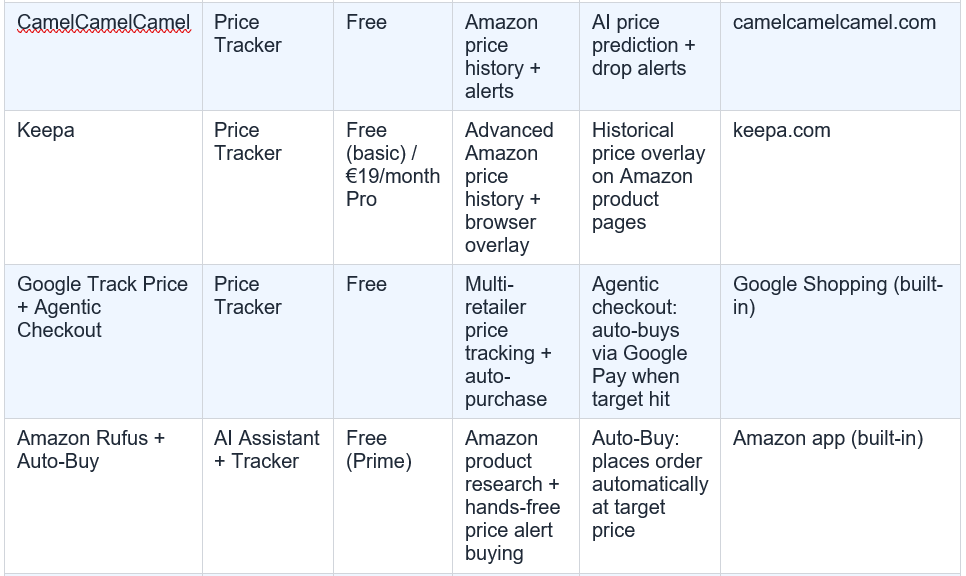
CamelCamelCamel is the most widely used Amazon price history tracker, monitoring over 1 billion product prices. Its core function is revealing the historical price of any Amazon product so that a shopper can determine whether the current price is genuinely low or artificially inflated. For holiday shopping, CamelCamelCamel’s price history charts — highlighted by Browse AI Tools’ Black Friday 2025 guide — are the most reliable tool for validating whether a Black Friday or Cyber Monday deal represents a real discount. As of 2026, CamelCamelCamel has also incorporated AI price prediction features that estimate the probability of a further price drop. Alerts can be set for any product and any target price, and are delivered by email when the price is reached.Keepa
Keepa is the professional-grade equivalent of CamelCamelCamel, used by resellers and serious deal hunters for its more detailed price history visualisations and its Amazon browser extension that overlays price history directly on Amazon product pages. Both tools are free.Google Track Price
Google Shopping’s ‘Track price’ feature, highlighted in Google’s November 2025 Black Friday and Cyber Monday guide, monitors any item found through Google Shopping across all retailers and sends a notification when the price falls to the user’s target. The November 2025 update added Google’s Agentic Checkout feature: when the tracked price drops to target, Google can complete the purchase automatically on the merchant’s site using Google Pay.Amazon Alexa for Shopping / Auto-Buy
Amazon’s built-in AI assistant (Rufus for search, Alexa for Shopping for alerts) allows users to set price alerts directly on any product page and — via the Auto-Buy feature — to instruct Amazon to complete the purchase automatically when the price hits a specified target. About Amazon’s June 2025 guide to Prime Day AI features described this as one of the most practically useful AI shopping capabilities available. The Auto-Buy feature eliminates the risk of waking up to find that a tracked deal sold out overnight while you were checking manually.Saving Potential — Price tracking (CamelCamelCamel + Google Track Price on 5+ items): $150–$400/holiday season for a consistent user who tracks major purchase categories
Layer 3: Coupon Extensions and Cashback Apps
The third layer of the AI holiday shopping stack operates at the checkout stage — automatically finding and applying discount codes and earning cashback on purchases that were already planned. This layer requires the least effort of any in the stack, because the tools operate autonomously once installed.Honey (PayPal)
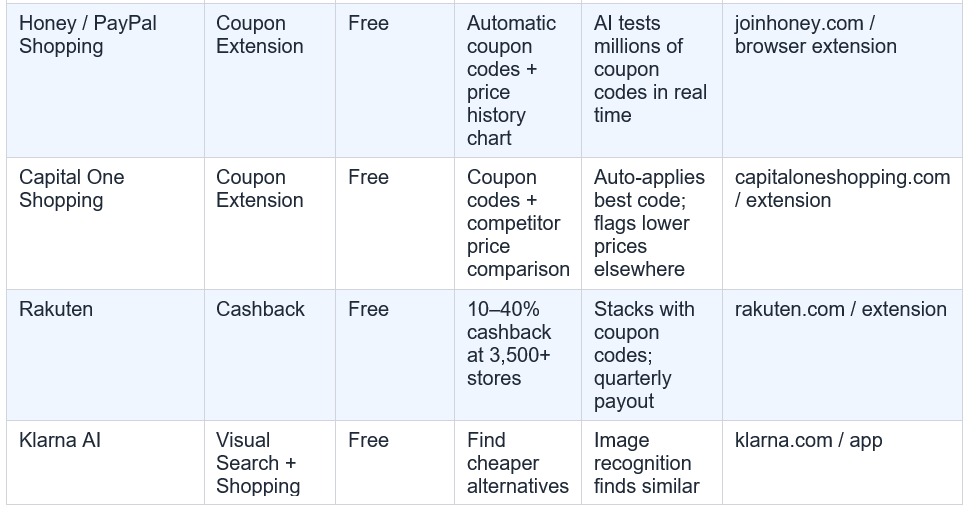
Honey, now owned by PayPal, is the best-known coupon-finding browser extension. As of 2026, Honey has evolved significantly from its original coupon-clipping function. Browse AI Tools’ November 2025 analysis described Honey’s 2026 capabilities: its AI algorithm analyses millions of coupon codes and price points in real time, tests available codes at checkout automatically, applies the best one, and displays price history charts for the current product that validate whether the listed price represents genuine value. Honey’s Droplist feature allows shoppers to add items and set price targets, receiving notifications when prices drop to the desired level. For Black Friday and Cyber Monday, the price history chart within Honey is the fastest way to check whether a stated discount is genuine.Capital One Shopping
Capital One Shopping is a direct Honey competitor that also automatically finds and applies coupon codes at checkout. Its notable additional feature is automatic comparison: it searches competing retailers for the same product and displays lower prices elsewhere if they exist, without the user having to take any action. Capital One Shopping does not require a Capital One card or account to use.Rakuten
Rakuten is the leading cashback shopping platform in the US, partnering with 3,500+ stores to pay cashback on purchases. Browse AI Tools’ analysis noted that Black Friday 2025 cashback rates at Rakuten often reached 10 to 40 percent at participating stores. Rakuten pays cashback quarterly by check or PayPal. Activating Rakuten before a purchase at a participating retailer adds a cashback layer that does not interfere with any other discount codes or loyalty programme savings.Capital One Shopping + Rakuten stacking
The most effective checkout combination is running Capital One Shopping (for automatic coupon codes) and Rakuten (for cashback) simultaneously. Both can be active as Chrome extensions on the same checkout. The coupon code reduces the purchase price; the cashback is calculated on the post-discount price. This combination is the ‘Layer 3’ of the stack as described by the deal-finding tools guide from April 2026.Layer 4: AI-Powered Fake Deal Detection
The most insidious feature of holiday retail in 2026 is the fake deal: a price that appears to be deeply discounted because the retailer artificially inflated the reference price in the weeks before the sale period. The Federal Trade Commission has issued repeated guidance on deceptive reference pricing, but the practice remains common. AI tools and browser extensions are the most effective defences against it.Price history as the primary defence
The most reliable test for a genuine deal is to check the price history of the item before accepting the stated discount. A product listed at ‘$199, was $399’ on Black Friday is only a genuine 50 percent discount if the product was actually sold at or near $399 for a meaningful period before the sale. CamelCamelCamel’s and Keepa’s price history charts reveal immediately whether the claimed prior price is genuine or manufactured. In many cases, the ‘original price’ was artificially elevated for only a few weeks to create the appearance of a larger discount.Honey’s price history chart
Honey’s integrated price history chart, visible in the extension’s overlay while viewing any product, provides a quick visual check for fake deals without leaving the product page. The chart shows price movement over the past 30, 60, 90, and 180 days, making it immediately apparent whether the ‘sale’ price is actually the product’s regular price or a genuine reduction.AI chatbot deal verification
The fake deal detector prompt described in Section 4 — feeding a list of items to ChatGPT, Perplexity, or Gemini with web search enabled — can verify whether a Black Friday price represents a genuine historical low, a regular promotional price dressed up as a sale, or an inflated reference price. AI Super Simplified’s Black Friday 2026 guide tested this prompt and found it produced plain-English verdicts (Buy Now / Wait / Skip) that matched independent price history analysis in the majority of cases.Fakespot and ReviewMeta for review authenticity
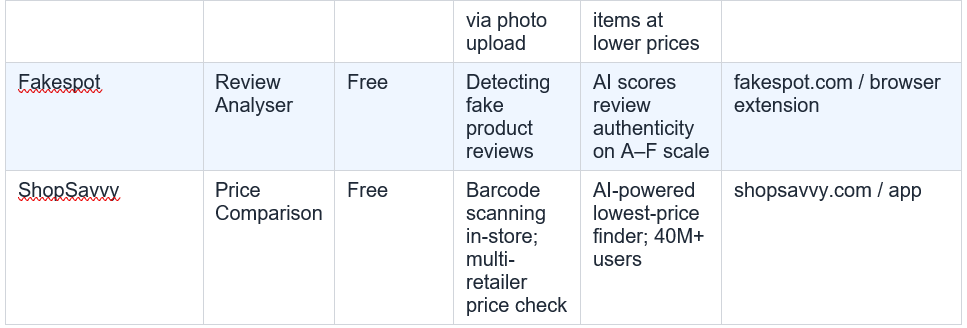
A final dimension of fake deal detection: verifying that the product reviews supporting the deal are themselves genuine. Fakespot and ReviewMeta are AI-powered tools that analyse the linguistic patterns, reviewer histories, and timing of product reviews to detect suspiciously inauthentic patterns. A product with a dramatic Black Friday discount and 4.8 stars from 2,000 reviews is a much less reliable bargain if Fakespot flags 60 percent of the reviews as potentially inauthentic.Pro Tip: Before buying any ‘deal’ over $50 during the holiday season, run a two-minute check: (1) look at the 6-month price history on CamelCamelCamel or Honey. (2) Run the product name through Fakespot. If both checks pass, the deal is likely genuine. If either raises a red flag, wait or buy elsewhere.
8. The Complete AI Shopping Tool Directory
Retailer-Embedded AI: Rufus, Sparky, and Google’s Agentic Checkout
The AI tools shoppers install themselves are only half the picture. In 2025 and 2026, the major retailers embedded AI deeply into their own shopping experiences, creating a second layer of AI capability that activates when you are already inside their ecosystems.Amazon Rufus
Amazon’s AI shopping assistant, Rufus, is built directly into the Amazon app and website. Shoppers can type or voice natural language queries — ‘What was the price last Black Friday?’ or ‘Which is better for a beginner, a Sony or Canon mirrorless camera?’ — and Rufus responds with structured research drawing on Amazon’s product catalogue, customer reviews, and pricing data. Rufus also supports price alert setting and Auto-Buy, allowing the assistant to complete a purchase automatically when a target price is reached.Walmart Sparky
Walmart’s AI assistant, Sparky, launched new holiday-specific features for 2025. EMarketer’s November 2025 coverage highlighted Sparky’s ability to generate curated shopping lists for holiday celebrations, find in-store sale items including Black Friday deals and rollbacks, and sort wish lists by store aisle for efficient in-store navigation. Sparky also provides AI-generated audio summaries of product descriptions and reviews for selected premium product categories.Google Agentic Checkout
Google’s most significant 2025 AI shopping innovation is the Agentic Checkout feature, launched in November 2025 and described by Google in its blog post as: ‘Behind the scenes, AI does the work for you, calling to see if stores nearby have what you’re looking for, how much it costs and if there are any special promos.’ When a tracked price drops to the user’s target, Google’s Agentic Checkout completes the purchase on the merchant’s website using Google Pay — without requiring the user to return to the product page, find the deal, and navigate through checkout. This eliminates the most common failure mode of price alert systems: the window between when the deal appears and when the stock sells out.Google Blog, November 2025: We’re unwrapping our biggest upgrade to shopping in AI Mode in Search, so you can describe what you’re looking for just as you’d say it to a friend and get a thorough response with accurate shopping data you can trust — powered by the Shopping Graph with 50 billion product listings, 2 billion updated every hour.
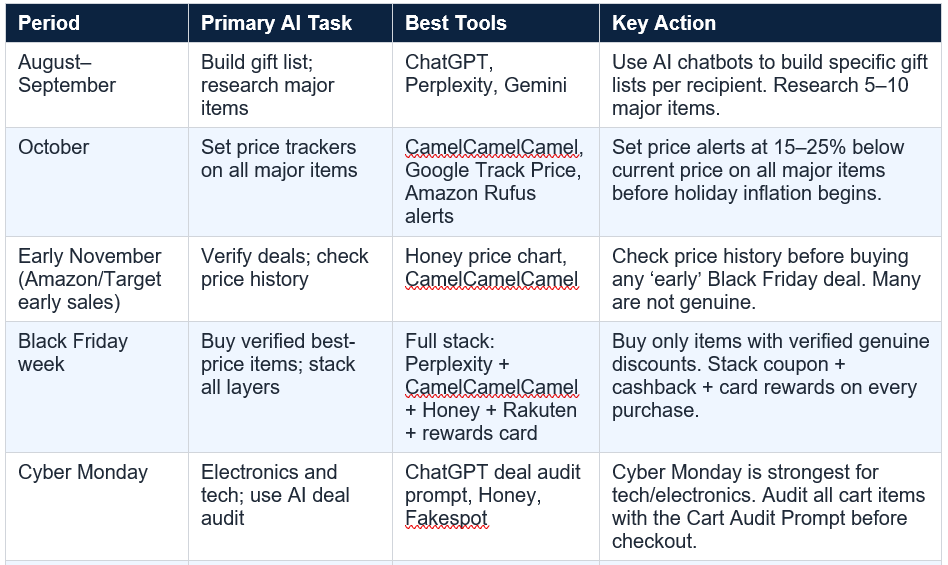
The AI Shopping Calendar: When to Use Which Tool
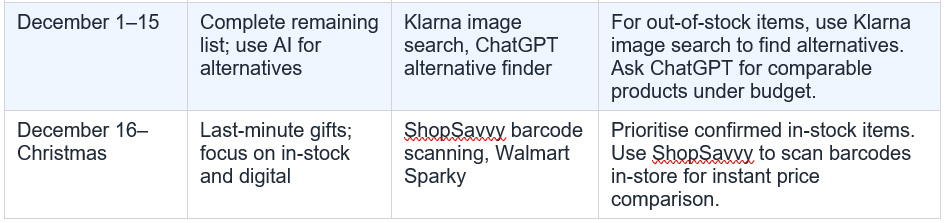
Holiday savings are not evenly distributed across the season. The timing of when specific AI tools are most effective maps onto the retail calendar:
How to Stack All Four Layers on One Purchase
The difference between a single-tool approach and the full stack is best illustrated by a concrete example. A television purchase in the $800 range during Black Friday week:- Layer 1 (Research): Ask Perplexity ‘Best 65-inch TV under $800 for a living room, comparing OLED and QLED options. Summarise the top three options with key trade-offs.’ Output: three specific models with verified specifications and typical price ranges. Time: 10 minutes.
- Layer 2 (Price Verification): Check each shortlisted model on CamelCamelCamel. Confirm that the Black Friday price is the historical low, not an artificially inflated reference. If one model’s ‘sale’ price is $799 but CamelCamelCamel shows it sold at $779 in September, the deal is a price increase dressed as a sale. Time: 3 minutes.
- Layer 3 (Checkout Stack): Navigate to the retailer through Rakuten to activate 5 percent cashback. Honey automatically tests all available coupon codes at checkout and applies the best ($40 off). Pay with a credit card offering 3 to 5 percent cashback on electronics. Time: 2 minutes.
- Layer 4 (Deal Audit): The Fake Deal Detector prompt confirms the television is at a genuine historical low. Fakespot grades the product reviews as B+ (mostly genuine). Decision: buy. Time: 3 minutes.
AI Shopping for Specific Categories: Electronics, Toys, Apparel
Electronics
Electronics are the category where AI shopping tools deliver the most consistent documented savings. Perplexity’s product research synthesis is most valuable here because specifications genuinely matter and the difference between similar-sounding products can be significant. CamelCamelCamel and Keepa are essential for verifying Amazon electronics pricing history. The NexaSphere author’s $800 annual saving came primarily from electronics price tracking. Use Rufus on Amazon to ask historical pricing questions directly.Toys and Games
Toy pricing is highly seasonal and highly volatile. Items on most-wanted toy lists can spike 50 to 100 percent above retail as Christmas approaches if stock is limited. Google Track Price set in October on popular toy items is the most effective strategy, combined with the Auto-Buy feature to secure items at a fair price before stock runs out. For items that sell out at retail, ShopSavvy’s barcode scanner can identify alternative retailers with stock.Apparel and Accessories
Klarna’s AI image recognition tool is particularly valuable for apparel. Uploading a photo of a desired item — a jacket seen in a store window, an accessory spotted on social media — instantly shows similar items across multiple retailers, often at significantly lower prices. Klarna’s image search has found cheaper alternatives for items where the user had previously assumed no substitute existed.What AI Shopping Tools Cannot Do
A complete guide to AI holiday shopping requires honesty about where AI falls short. NexaSphere’s February 2026 analysis described the limitation clearly: AI chatbots might find a ‘great deal’ on a laptop without understanding that the specific model found has a worse display or less RAM than what the shopper actually needs. For commodity products — batteries, phone cases, basic cables — AI deal-finding works well. For anything where specifications matter significantly, the AI’s recommendation requires verification.Specific limitations to be aware of:
- • Real-time pricing accuracy: AI chatbots without live web search (including some ChatGPT tiers that do not have web browsing enabled) do not have real-time pricing data. Always use a tool with live web access (Perplexity, Gemini with Search, ChatGPT with web browsing) for price research, not the base model.
- • AI platform bias: NewsNation’s December 2025 coverage of AI holiday shopping trends noted a concern raised by consumer advocates: AI platforms could nudge buyers toward certain merchants or products, effectively narrowing what people see. Retailer-embedded AI (Rufus, Sparky) is designed to keep shoppers within that retailer’s ecosystem. Use independent tools (CamelCamelCamel, Perplexity) as a check on retailer AI recommendations.
- • Agentic features require trust: tools that make purchases automatically (Amazon Auto-Buy, Google Agentic Checkout) require trusting the AI to complete a transaction correctly. Set strict price limits and review default payment and delivery settings before activating any auto-purchase feature.
Privacy and Safety When Using AI Shopping Tools
Browser extensions that access checkout pages — including Honey, Capital One Shopping, and Rakuten — operate by reading the contents of the pages you visit in order to apply coupons and track prices. Understanding what data they collect and how to manage it:- • Honey and Capital One Shopping collect browsing data: both extensions read page content to identify products and prices. Review the privacy policy before installing and consider using them only on shopping sites rather than as permanently active extensions on all sites.
- • Use guest mode for pricing fairness: some retailers implement dynamic pricing that shows higher prices to logged-in accounts based on browsing history. Clearing cookies or opening a new private browser window when comparison shopping prevents dynamic pricing from inflating the prices you see.
- • Verify AI chatbot sources: Ki-Ecke’s December 2025 AI shopping guide recommended always asking chatbots for their sources and clicking through to verify, rather than accepting a cited price or product recommendation at face value.
- • Prefer alerts over impulse buys: the most financially disciplined use of AI shopping tools is setting alerts and buying when the target is reached, rather than letting AI discovery tools create new purchase desire. The Cart Audit Prompt exists precisely to counter the impulse-buying tendency that AI product discovery can amplify.
How Much Can You Realistically Save?
The combined saving potential for a household that applies the full AI shopping stack consistently across a holiday season with $1,000 to $1,200 in total gift spending is approximately $300 to $600 — equivalent to 25 to 50 percent of total holiday spending returned as savings. For higher-spending households, the proportional saving is similar and the dollar value is correspondingly larger.
Conclusion
AI does not make holiday shopping decisions for you. It makes the information available to make better decisions much faster, at much lower cost in time and effort, than traditional comparison shopping ever allowed. The shopper who spends three hours in a store on Black Friday checking prices across four aisles is doing manually what CamelCamelCamel, Honey, and Rakuten can do automatically in the background of a ten-minute online purchase.Forty-seven percent of Americans are already using some form of AI for holiday shopping. The gap between the casual user who occasionally asks ChatGPT for gift ideas and the systematic user who runs the full four-layer stack on every significant purchase is the gap this guide is designed to close. The tools are free or inexpensive. The prompts are specific and repeatable. The saving potential across a holiday season is $300 to $600 for the average household, and significantly more for higher spenders.
The holiday shopper who uses AI most effectively is not the one who delegates every decision to a chatbot. It is the one who uses AI for the tasks it does better than humans — scanning 50 billion product listings, checking 12 months of price history, testing 50 coupon codes in two seconds, and calculating the stacked saving from three cashback sources — while remaining the one who decides what to buy, for whom, and why. That combination of AI efficiency and human judgement is the most powerful version of holiday shopping available in 2026.
Frequently Asked Questions
How many Americans use AI for holiday shopping?According to Visa and PYMNTS data, 47% of Americans used AI tools for holiday shopping purposes in 2025, including finding gift ideas, researching products, and tracking prices. Separately, PYMNTS found 50% of shoppers used generative AI during the 2025 holiday season. Shopify’s 2025 Holiday Report found 64% of global consumers expected to use AI for at least one holiday shopping task. Among those aged 18 to 24, the figure was 84%. Salesforce forecast that AI would drive 21% of global holiday orders, estimated at $263 billion in sales.
What is the best free AI tool for holiday shopping?
The combination of Perplexity (for product research), CamelCamelCamel (for Amazon price history and alerts), Honey (for automatic coupon codes at checkout), and Rakuten (for cashback) provides the core of the four-layer stack at zero cost. All are free to use. For chatbot gift ideation, ChatGPT (free tier with limitations), Google Gemini (free), and Perplexity (free) are all effective. Google’s Shopping AI Mode and Track Price features are built into Google Search with no additional download required. CamelCamelCamel and Honey are browser extensions that install in under two minutes.
How do I detect fake holiday deals using AI?
Three methods: (1) Check the price history of the item on CamelCamelCamel or Keepa before accepting a stated Black Friday discount. If the ‘original price’ was only in effect for a few weeks before the sale, the deal is likely manufactured. (2) Honey’s price history chart, visible in the extension overlay on any product page, provides a quick visual check. (3) Use the Fake Deal Detector Prompt with ChatGPT, Perplexity, or Gemini (with web search enabled): paste your item list and ask the AI to compare current prices against the past 6 to 12 months and provide a Buy Now / Wait / Skip verdict for each.
What are the best AI prompts for holiday shopping?
Four specific prompts from current research: (1) Gift Research: ‘Find the best deals on [product] under [$X] this week. Compare across Amazon, Target, and Walmart. Tell me when these stores typically have their biggest sales and whether I should buy now or wait.’ (2) Fake Deal Detector: ‘Act as my price analyst. For these items: [list]. Compare today’s price vs the past 6-12 months. Is the discount real or inflated? Suggest alternatives. Verdict: Buy Now, Wait, or Skip.’ (3) Cashback Stack Calculator: ‘Compare cashback for shopping with [Card A] vs [Card B] at [Store]. Also check Rakuten and Capital One Shopping. Calculate my total stacked saving.’ (4) Cart Audit: ‘Act as a financial advisor. Here is my cart totalling $[X]: [items]. Tell me which I will stop using within 6 months, which solve real problems, and which 1-2 are actually worth buying.’
Can AI buy things automatically on my behalf?
Yes, two platforms offer automatic purchase features. Amazon’s Auto-Buy (accessed through Alexa for Shopping in the Amazon app) allows you to set a target price for any product; when the price drops to that level, Amazon completes the purchase using your default payment method. Google’s Agentic Checkout, launched November 2025, monitors tracked prices across retailers and automatically completes the purchase on the merchant’s website using Google Pay when the target price is reached. Both features require explicit opt-in per product and should be used with clearly defined price targets and reviewed default delivery settings.
How much can I realistically save using AI for holiday shopping?
Based on published research and user accounts, a household spending $1,000 to $1,200 on holiday gifts and applying the full four-layer AI stack (chatbot research, price tracking, coupon extensions, cashback) consistently can save $300 to $600 per holiday season — approximately 25 to 50 percent of total holiday spend. A NexaSphere user reported saving $800 in a single year from price tracking alone. Individual results depend significantly on what categories are purchased, how diligently the tools are applied, and whether cashback and coupon tools are activated on every qualifying purchase.
0 Comments
Be the first to share your thoughts on this article.