

Real Estate
How to Sell Your Property: Complete Guide

Table of Contents
- What Selling a Property Actually Involves
- Step 1: Decide If Now Is the Right Time to Sell
- Step 2: Get an Accurate Valuation
- Step 3: Choose Your Selling Method
- Step 4: Instruct a Solicitor (Do This Early)
- Step 5: Prepare Your Legal Documents
- Step 6: Prepare the Property for Market
- Step 7: Market Your Property
- Step 8: Conduct Viewings
- Step 9: Receive and Negotiate Offers
- Step 10: From Offer Accepted to Exchange
- Step 11: Exchange to Completion
- The Full Cost of Selling: What You Will Actually Pay
- Common Mistakes That Cost Sellers Money
- Conclusion: Preparation Is the Difference Between a Good Sale and a Great One
- Frequently Asked Questions
Key Statistics: Average time from listing to completion: 3–6 months (GetAgent, May 2026). Average total selling costs: £5,000–£15,000 (Propelr, April 2026). Estate agent fee average: 1.42% including VAT (HomeOwners Alliance, August 2026). Estate agent fee range: 0.75%–3.5% (Purplebricks, April 2026). On a £300,000 property: agent fee £2,250–£10,500. Conveyancing/solicitor fees: £800–£2,000 (Propelr). HOA estimate: conveyancing £600–£900 (January 2026). EPC certificate: approximately £100. Removals: £350–£2,250. Zoopla 2026 Market Report: sellers currently accepting an average of 5% below asking price to secure a deal. First 2 weeks of listing generate most buyer interest (Property Passport UK, March 2026). Spring (March–May) and early autumn (September–October) have highest buyer activity. Capital Gains Tax: does not apply to your main home (Private Residence Relief); may apply to second homes or buy-to-let. Best time to instruct solicitor: when you list, not when you accept an offer.
What Selling a Property Actually Involves
Selling a property is one of the largest financial transactions most people make in their lifetime. It is also one of the most complex — involving legal documentation, regulated professionals, negotiation, survey results, conveyancing timelines, and the unpredictable behaviour of buyers, chains, and markets. In the UK, the process typically takes between three and six months from the day a property is listed to completion, according to GetAgent’s May 2026 guide. In some cases it takes longer. Very rarely is it faster.The total cost of selling a property in the UK typically ranges from £5,000 to £15,000, depending on the property value, the estate agent used, the solicitor chosen, and the complexity of the sale. These costs are not optional. They are the price of doing the transaction correctly, legally, and without the errors that can collapse a sale at a late and very expensive stage.
This guide walks through every step of the property-selling process in order, explains what each stage costs and how long it takes, identifies the most common mistakes that cost sellers time and money, and provides practical guidance drawn from current 2026 market data. Whether you are selling for the first time or returning to the market after years, this is the roadmap you need.
Step 1: Decide If Now Is the Right Time to Sell
Before approaching a single agent or making a single phone call, answer four foundational questions that will shape every decision that follows:- Why are you selling, and do you have a specific timeline? A forced sale (job relocation, divorce, financial difficulty) requires a different strategy from a voluntary one. If you need to sell by a specific date, you may need to price more aggressively than the ideal market position.
- Do you have enough equity to cover the costs? Check your outstanding mortgage balance and compare it to the estimated sale price. Ensure the gap is sufficient to cover the total selling costs (£5,000 to £15,000), any early repayment charges on your mortgage, stamp duty on your onward purchase, and your deposit if buying again.
- Where will you go after? Whether you are buying another property (creating a chain), renting temporarily, or moving in with family affects your attractiveness as a seller and your negotiating position with buyers.
- Is the market currently in your favour? In 2026, the Zoopla Market Report found that sellers are currently accepting an average of 5 percent below asking price to secure a deal — a buyer’s market environment that means pricing strategy is critical.
Step 2: Get an Accurate Valuation
The asking price is the single most consequential decision in the entire selling process. Overpricing is the most documented and most costly seller mistake. Properties that are overpriced sit on the market for longer, accumulate reduction history that signals weakness to buyers, and often ultimately achieve a lower final price than they would have achieved with a realistic opening price.How to value your property accurately:
- Get at least three valuations from local estate agents: invite three different local agents to provide an in-person valuation. Do not automatically choose the highest; choose the one that is best evidenced by comparable sales data. An agent who recommends a significantly higher asking price without specific comparable evidence is often seeking your instruction rather than your success.
- Check sold prices independently: HM Land Registry publishes all completed residential sales in England and Wales, accessible free at gov.uk or through Rightmove’s sold prices tool. Look at properties with the same number of bedrooms and in the same street or postcode that sold in the past six to twelve months. This is your true baseline — not asking prices, not valuations, but actual sale prices.
- Use an online instant valuation as a starting point: tools like GetAgent’s free online valuation provide an instant estimate based on comparable data before you invite agents round. Use this as a reference, not a decision.
Step 3: Choose Your Selling Method
There are three primary methods of selling a residential property in the UK, each with different cost, speed, and control trade-offs:Estate Agent (High Street or Hybrid)
The most common method. A traditional high-street agent markets the property, conducts viewings, manages offers, and coordinates the sale for a percentage fee (average 1.42% including VAT, per HomeOwners Alliance). A hybrid agent (such as Purplebricks or Strike) charges a fixed fee, typically lower than a percentage fee, but usually payable upfront regardless of whether the property sells. High-street agents operate on a no-sale-no-fee model. For most sellers, the marketing exposure, local knowledge, and aligned incentive of the traditional model justify the higher fee.Private Sale
Selling without an agent via platforms like OpenRent, HouseSimple, or Rightmove Unlocked. This avoids agent fees but requires the seller to manage marketing, viewings, negotiations, and buyer vetting independently. Suitable only for sellers with time, confidence, and knowledge of the market.Auction
Properties are sold at public auction with exchange and completion occurring simultaneously or within 28 days. Auction provides speed and certainty but typically achieves below-market prices. Best suited to unusual, unmortgageable, or distressed properties.Step 4: Instruct a Solicitor (Do This Early)
The single most consistent piece of advice from property professionals in 2026 is the same one that is most consistently ignored by sellers: instruct your solicitor when you list the property, not when you accept an offer.The conveyancing process — the legal transfer of a property from one owner to another — typically takes 12 to 16 weeks from instruction to completion, according to GetAgent. The earlier your solicitor begins gathering documents, reviewing the title, and preparing the contract pack, the less the timeline from offer accepted to exchange is driven by legal delays.
When choosing a solicitor or licensed conveyancer:
- Compare quotes from at least three firms. Propelr’s April 2026 guide gives a solicitor fee range of £800 to £2,000. HomeOwners Alliance estimates £600 to £900. The variation reflects experience, location, and workload. Cheaper is not always faster.
- Check they are registered with the Solicitors Regulation Authority (SRA) or the Council for Licensed Conveyancers (CLC). Do not use unregulated conveyancers.
- Prioritise responsiveness: the most common cause of sale fall-throughs after an offer is accepted is solicitor delays. Ask about their typical caseload and response times.
Step 5: Prepare Your Legal Documents
The legal documents required for a property sale in England and Wales include:- Title deeds: download official copies from HM Land Registry (cost: £3). These confirm your ownership of the property and the extent of the land.
- TA6 form (Property Information Form): a detailed questionnaire covering disputes, planning permissions, boundary ownership, flooding history, building works, and other property-specific information. Complete this thoroughly and honestly. Inaccurate or incomplete TA6 forms are a frequent source of claims after completion.
- TA10 form (Fittings and Contents Form): specifies what is included in the sale (fitted wardrobes, light fittings, garden furniture, white goods). Disputes over what was agreed to be left are among the most common post-completion complaints.
- Energy Performance Certificate (EPC): a legal requirement before listing. EPCs are valid for 10 years. If yours is expired or was issued when the property was in worse condition, order a new one (approximately £100) — a higher rating may improve buyer perception and, from 2025, has become increasingly important as buyers evaluate running costs.
- Planning permissions and building regulations certificates: any extension, loft conversion, garage conversion, or structural work requires documented evidence that planning permission and/or building regulations approval was obtained. Missing documentation is one of the most common causes of sale delays.
Step 6: Prepare the Property for Market
The first two weeks of listing generate most of the buyer interest, according to Property Passport UK’s March 2026 guide. The condition of the property in those first two weeks — particularly in photographs, which are the buyer’s first impression — determines how many viewings you receive and at what level of interest.Preparation that consistently delivers return on investment:
- Declutter thoroughly: remove surplus furniture, personal items, and anything that makes rooms look smaller or more personalised. Professional decluttering services are available from approximately £150 per day if needed.
- Deep clean: a professionally cleaned property photographs and presents significantly better than one that is merely tidy. Deep cleaning costs approximately £200 to £400 and is among the highest-ROI preparation investments available.
- Address minor defects: fix dripping taps, cracked tiles, peeling paint, stiff door handles, and broken light fittings. These small issues signal to buyers that the property has not been well-maintained, even if the underlying condition is sound.
- Professional photography and floor plan: insist on both. Poor photographs are one of the most significant and most avoidable causes of underperformance on property portals. A floor plan reduces the number of wasted viewings from buyers who discover a layout issue on arrival.
- Kerb appeal: the exterior is the buyer’s first physical impression. Clean windows, painted front doors, trimmed hedges, and clear pathways have an effect disproportionate to their cost.
Step 7: Market Your Property
In the UK, property marketing in 2026 is dominated by two portals: Rightmove and Zoopla. Both require estate agent instruction to list — private sellers typically access Rightmove via OnTheMarket or other platforms that accept direct listings. Your property will go live on the portals typically within 24 to 48 hours of photography.Marketing best practice in the current market:
- The listing description matters: descriptive, accurate, and specific text about the property’s best features outperforms generic language. Include specifics (south-facing garden, recently rewired, private parking, walking distance to specific station) that appear in buyer search behaviour.
- Rightmove and Zoopla enhanced listings: premium listing positions increase click-through rates and are worth discussing with your agent for properties where competition is strong.
- Social media reach: Property Passport UK notes that an agent’s social media presence and curated networks offer direct reach to buyers who may not actively be searching the main portals.
- Open houses in the first week: concentrating multiple viewings in a short period in the early listing window creates competitive pressure and can accelerate the offer timeline.
Step 8: Conduct Viewings
Viewing management has a direct effect on achieved price. Two specific recommendations from current best practice:- Vacate during viewings: buyers feel more comfortable exploring, opening wardrobes, and asking their agent questions freely when the seller is not present. Emotional attachment on both sides can complicate an otherwise rational process.
- Request feedback after every viewing: if multiple viewers raise the same concern (a particular room, a smell, a neighbouring property, a noise), that is actionable information. Address it if possible before the next viewing cycle.
Step 9: Receive and Negotiate Offers
In 2026, Zoopla’s market report data shows sellers are currently accepting an average of 5 percent below asking price. This is the real-world context in which offers should be evaluated. A first offer of 5 to 8 percent below asking in a buyer’s market is not necessarily a low offer; it may be a market-rate opening.When evaluating any offer, consider four factors — not just the price:
- The buyer’s financial position: are they chain-free? Do they have a mortgage in principle? Have they sold their own property? A chain-free buyer at 97% of asking price is usually preferable to a buyer with an unsold property at 102%.
- The buyer’s flexibility on timing: completion date matters. A buyer who can complete on your preferred date has real value over one who needs three more months.
- Their seriousness: have they viewed the property once or multiple times? Have they raised specific questions (suggesting genuine due diligence) or made a rapid offer (suggesting they may not have thought it through)?
- Counter-offer strategy: do not reject any serious offer outright without making a counter. Even a counter that is unlikely to be accepted signals willingness and keeps the conversation alive.
Step 10: From Offer Accepted to Exchange
Once an offer is accepted, the conveyancing process begins. This phase — from acceptance to exchange of contracts — is where most sales fall through, most delays occur, and most stress concentrates. The typical timeline is 8 to 12 weeks, though it can be longer in complex chains.Key actions immediately on accepting an offer:
- Instruct your solicitor the same day (or confirm instructions if already instructed): delays of even a few days at this point can add weeks to the overall timeline.
- Respond to all solicitor requests within 24 hours: every day of delay on your side adds approximately the same delay to the timeline, compounded by each party in the chain.
- Verify the buyer’s mortgage is progressing: your agent should be monitoring the buyer’s mortgage application. A buyer whose mortgage is delayed or declined can collapse a sale weeks after acceptance.
- Do not make other major financial commitments while the sale is in progress: new credit applications, large purchases, or employment changes can affect your own mortgage if you are buying simultaneously.
12. Step 11: Exchange to Completion
Exchange of contracts is the legal moment at which the sale becomes binding. Before exchange, either party can withdraw without penalty. After exchange, withdrawal incurs significant financial consequences.At exchange:
- Contracts are signed by both parties. Your solicitor holds the signed contract; the buyer’s solicitor holds theirs.
- The buyer pays their deposit (usually 10% of the purchase price) to your solicitor. This deposit is held until completion.
- A completion date is agreed. The period between exchange and completion is typically one to four weeks.
The Full Cost of Selling: What You Will Actually Pay
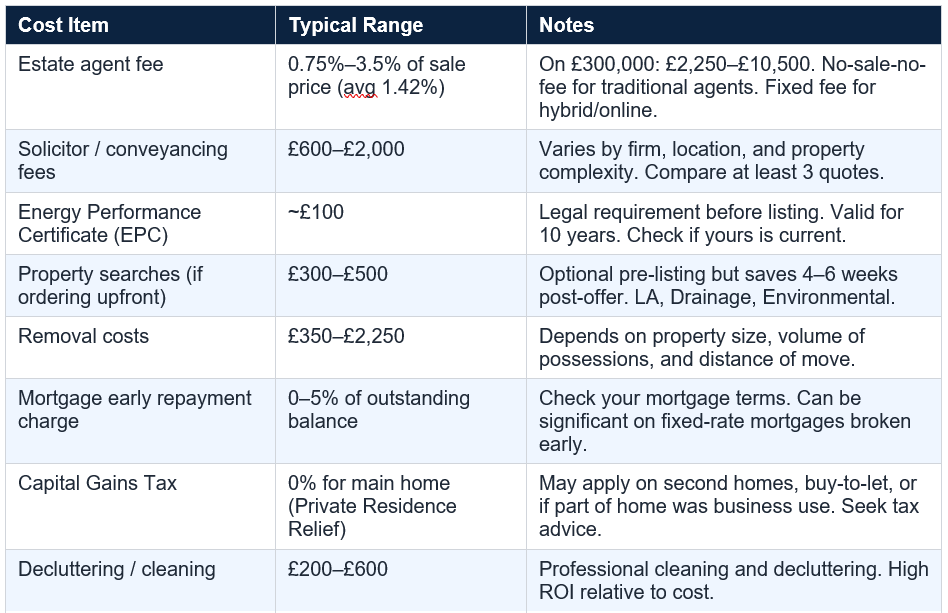

Common Mistakes That Cost Sellers Money
- Overpricing the asking price: the single most consistently documented mistake. Properties that are overpriced sit on market longer, accumulate reduction history, and often achieve lower final prices than a realistic opening price would have.
- Waiting to instruct a solicitor: instructing your solicitor the day an offer is accepted rather than when you list typically adds 4 to 8 weeks to the conveyancing timeline.
- Accepting the first offer without vetting the buyer: price is one factor; chain position, mortgage status, and completion timeline matter equally. A higher offer from a buyer whose chain is fragile is often worse than a lower offer from a chain-free buyer.
- Neglecting presentation before listing: poor photographs and an unclean, cluttered property reduce the number of viewings and the level of competing offers in the critical first two weeks.
- Incomplete TA6 form: missing or inaccurate property information forms cause delays, disputes, and occasionally sale collapses when discrepancies are discovered during the buyer’s legal process.
- Not gathering planning permission documents: extensions or structural works without documented building regulations approval are among the most common causes of conveyancing delays. Gather them before the property goes to market.
Conclusion
Selling a property in 2026 takes three to six months, costs between £5,000 and £15,000, and involves more complexity than most sellers anticipate when they first decide to move. The sellers who achieve the best outcomes are not necessarily those with the most valuable properties or the most favourable market conditions. They are those who prepare most thoroughly: who research their price carefully before listing, instruct their solicitor early, prepare their legal documents in advance, present the property at its best, and evaluate offers on their full merits rather than the headline number alone.The current market — in which buyers are achieving an average of 5 percent below asking price — rewards sellers who price accurately and present well over those who overprice and discount later. The 2026 property market is not one where enthusiasm alone moves properties. It is one where evidence, preparation, and professional execution are what distinguish a swift, well-priced sale from a prolonged, frustrating one.
Start with the four questions in Step 1. Work through each stage in order. Do not skip steps 4 and 5. The sellers who understand the process from the beginning are the ones who navigate it without expensive surprises.
Frequently Asked Questions
How long does it take to sell a property in the UK?The typical timeline from listing to completion is 3 to 6 months, according to GetAgent’s May 2026 guide. This includes the marketing period (time to find a buyer), followed by the conveyancing period (typically 12 to 16 weeks from offer accepted to completion). The timeline is affected by chain complexity, solicitor speed, mortgage processing, and survey outcomes. Properties without a chain at either end tend to complete faster.
How much does it cost to sell a house in the UK?
Total selling costs typically range from £5,000 to £15,000 (Propelr, April 2026). The largest items are: estate agent fees (average 1.42% of sale price including VAT; range 0.75% to 3.5%); solicitor/conveyancing fees (£600 to £2,000); EPC certificate (approximately £100); and removal costs (£350 to £2,250). Mortgage early repayment charges can be significant for sellers on fixed-rate deals. Capital Gains Tax does not apply to a main home but may apply to second properties or buy-to-let.
Do I need an estate agent to sell my property?
No. You can sell privately via platforms like OpenRent or HouseSimple, which allow private sellers to list on Rightmove without an agent. However, most sellers benefit from an agent’s marketing relationships, portal access, local knowledge, and negotiation experience. The average estate agent fee (1.42%) on a £300,000 property is approximately £4,260 — this cost should be evaluated against the potential benefit of professional marketing and negotiation.
When is the best time of year to sell a property?
Spring (March to May) and early autumn (September to October) consistently produce the highest buyer activity in the UK market. These periods see the most active buyer pools and tend to produce more competitive offers. Winter, particularly December and January, is typically the slowest period. If you have flexibility on timing, listing in early spring or September maximises exposure to active buyers.
What documents do I need to sell my property?
The main documents required are: title deeds (downloadable from HM Land Registry, £3); a TA6 form (Property Information Form); a TA10 form (Fittings and Contents Form); a valid Energy Performance Certificate; and any planning permissions or building regulations certificates for extensions or structural works. Your solicitor will coordinate the preparation and submission of these documents to the buyer’s solicitor.
What is the difference between exchange and completion?
Exchange of contracts is the legal moment at which the sale becomes binding. After exchange, withdrawal by either party incurs significant financial penalties. The buyer pays their deposit (usually 10%) at exchange, and a completion date is set. Completion is when the balance of the purchase price is transferred, your mortgage is redeemed from the proceeds, and keys are handed over. The period between exchange and completion is typically one to four weeks.
Should I accept the first offer I receive?
Not necessarily without evaluation. Consider the buyer’s financial position (chain-free, mortgage in principle held), their flexibility on completion date, and their seriousness. In 2026’s buyer’s market, where buyers are accepting an average of 5% below asking price (Zoopla 2026 Market Report), a first offer at 5 to 8% below asking is not automatically low. However, if you have multiple viewings scheduled and are in the first two weeks of listing, waiting for additional offers before accepting may produce better terms.
0 Comments
Be the first to share your thoughts on this article.