
Investing
I Bond Rate of 5.51%: Mildly Attractive or a Bargain?

Composite 5.51% for bonds issued Nov 1, 2026 to Apr 30, 2027 = 1.40% fixed + 2.04% six-month inflation (4.08% annualized) + a small cross term; previous rate 4.26% (0.90% fixed). The fixed rate is the highest since November 2006; the combined rate the highest since November 2022. Alternatives (October): 52-week T-bill about 4.46%; top savings 4.34%–4.50%; average savings 0.38%; 10-year Treasury about 4.93%; September inflation 3.7%. My arithmetic on $10,000: about $275 of interest in the first six months; about $558 over 12 months if the rate stayed at 5.51%; but redeeming at exactly 12 months, after the three-month interest penalty, nets about $417 (4.17%) vs about $446 for a T-bill; $10,000 at a 1.40% fixed real return grows to about $15,175 in today’s purchasing power over 30 years.
So which is it? That depends on what you compare it with and how long you can leave the money alone. This guide breaks down where the 5.51% comes from, why the fixed rate is the real prize, why the headline overstates what you will earn and how I bonds stack up against Treasury bills and savings accounts, including the one scenario, a 12-month hold, where the I bond loses.
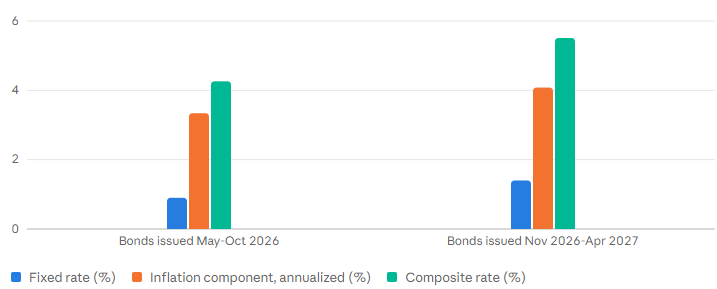
For this period, the fixed rate is 1.40% and the semiannual inflation rate is 2.04%, or 4.08% annualized. Plugging in gives 0.014 + 0.0408 + 0.0002856, about 5.51%. The previous rate, for bonds bought May through October, was 4.26% with a 0.90% fixed rate. One site reports the variable portion as 4.11%; I use TreasuryDirect’s figures.

TreasuryDirect: for I bonds issued November 1, 2026 to April 30, 2027, composite rate 5.51% = 1.40% fixed + 2.04% semiannual inflation (4.08% annualized) + cross term. Previous period: 4.26% with a 0.90% fixed rate. The fixed rate is the highest since November 2006; the combined rate the highest since November 2022.
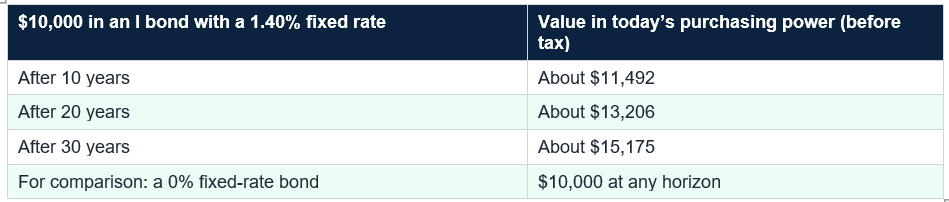
In my illustration, hold $10,000 for 30 years, whatever inflation does. A bond with a 0% fixed rate keeps the same purchasing power, no more. A bond with a 1.40% fixed rate grows to about $15,175 in today’s purchasing power, an extra 52%; after ten years the extra is about $1,490 and after twenty about $3,200. Most savings products cannot offer a guaranteed real return that lasts for decades.
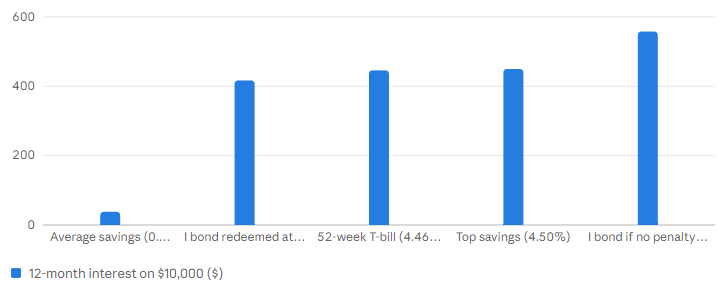
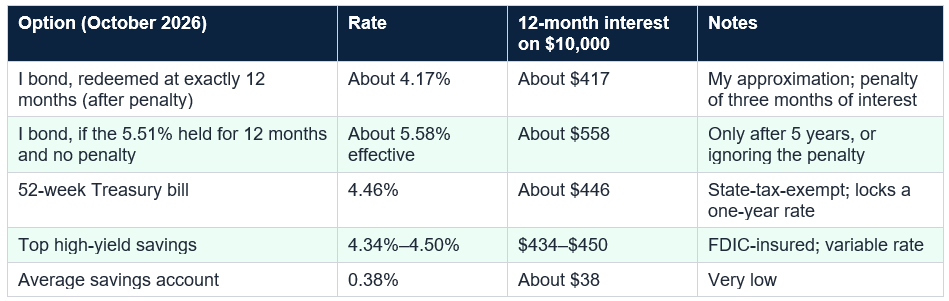
Second, the 5.51% is not what you collect if you cash out in year one. On $10,000, the first six months earn about $275 and a full 12 months at 5.51% would earn about $558. But redemption is only allowed after 12 months, and cashing out before five years forfeits the last three months of interest. After that penalty, a 12-month hold nets about $417, or 4.17%, less than the roughly $446 a 52-week Treasury bill pays. Before tax, at one year, the T-bill wins.
Keep in mind: The 5.51% is a six-month rate with a locked 1.40% portion. If you may need the money within a year or two, the lockup and penalty can make an I bond worse than a T-bill or savings account.
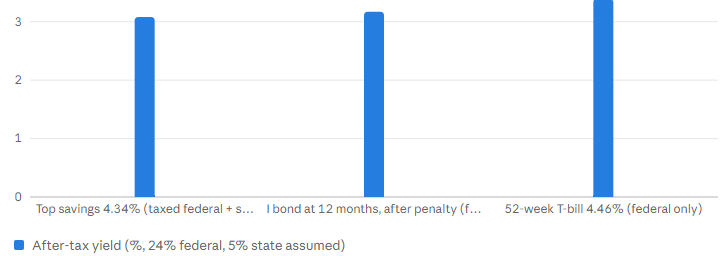
Taxes differ too. I bond interest is federally taxable but exempt from state and local tax, and you can defer federal tax until you redeem the bond or it matures. T-bill interest is also state-exempt, while savings interest is taxed at both levels. At a 24% federal and 5% state rate, in my illustration, savings at 4.34% nets about 3.08%, a T-bill 3.39% and an I bond held 12 months about 3.17% after the penalty. At one year they are close, so the real story is the holding period.
This calendar quirk matters. Because the limit resets in January and the 5.51% rate applies through April 2027, you can buy up to $10,000 in November or December 2026 and another $10,000 in January through April 2027 and still receive the 5.51% and the 1.40% fixed rate on both. A couple can double that. There is also a general way to buy up to $5,000 of paper I bonds with a tax refund and a possible education tax exclusion; confirm those with TreasuryDirect and the IRS before relying on them.
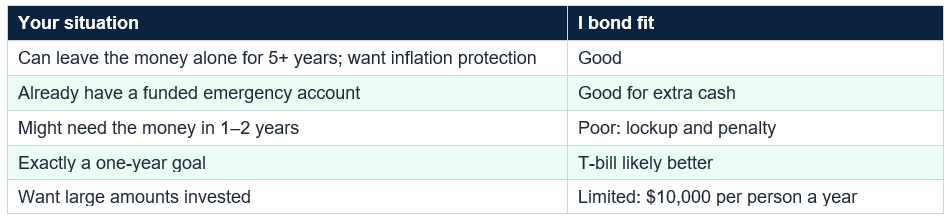
They are a poor fit for emergency money, since you cannot touch it for a year and lose interest if you cash out early, and Bankrate found only 46% of Americans could cover three months of expenses, so many people need liquid savings first. They are also less compelling for a one-year holding period, where a T-bill pays more, and at $10,000 a year they are a supplement, not a core holding.
The fixed rate is reset each May and November and can go up or down. Treasury does not disclose how it sets it, which makes it hard to predict, according to CNBC, and that argues for acting on a good fixed rate when you see one. Tipswatch notes the 1.40% fixed rate and 5.51% composite apply to purchases through late April 2027, so there is no rush to buy on November 1. If you have not bought any I bonds this year, you can buy in November or December and again in January.
Timing within the window matters little, since interest accrues monthly from the issue month. The real decision is whether you want the 1.40% fixed rate and, if so, whether to buy now or split purchases between this year’s limit and next year’s. Many buyers buy part now and part in January. None of that says anything about the May 2027 fixed rate.
Your move: Write down when you will need this money. If the answer is under five years, compare the I bond’s net return after the penalty with a T-bill or CD for the same period before you buy. If the answer is five years or more, the 1.40% fixed rate is probably worth locking in.
So the verdict is nuanced. For long-term, inflation-protected money you will not touch, the I bond is a strong, low-risk choice, and the fixed rate is the reason. For emergency cash or one-year goals, use a savings account or Treasury bill. And whatever you decide, remember the $10,000 annual limit, the TreasuryDirect-only rule and that rates can change every six months. This is general education, not personalized advice, and a qualified adviser can help you decide how I bonds fit your plan.
For I bonds issued from November 1, 2026 through April 30, 2027, the composite rate is 5.51%, according to TreasuryDirect. It combines a 1.40% fixed rate, which lasts for the life of the bond, with an inflation component of 2.04% for six months (4.08% annualized). The previous rate, for bonds bought from May through October, was 4.26% with a 0.90% fixed rate.
Is the 1.40% fixed rate good?
Yes, by recent standards. It is the highest fixed rate since November 2006, and no fixed rate in the years since has topped 1.30%. Because the fixed rate stays with the bond for up to 30 years, it guarantees a return above inflation (as measured by the CPI-U) of 1.40% a year, before taxes.
How much can I invest in I bonds?
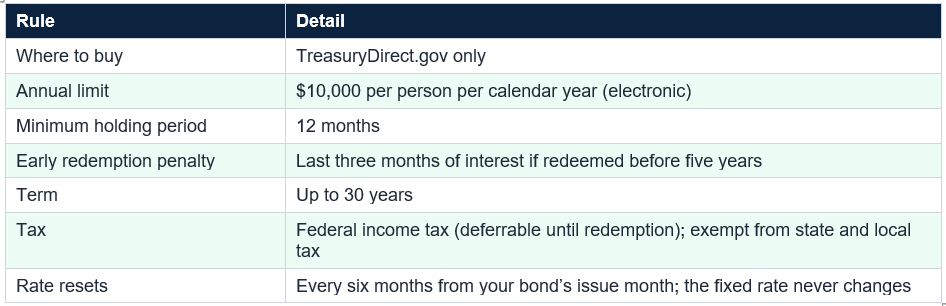
Each person can buy up to $10,000 of electronic I bonds per calendar year through TreasuryDirect. The cap resets each January, so you can buy in November or December 2026 and again in January through April 2027 and still receive the 5.51% rate and 1.40% fixed rate. A couple can buy $20,000 in total, because the limit is per person.
Can I take my money out early?
Not in the first 12 months. After a year you can redeem, but if you cash out before five years you lose the last three months of interest, according to Treasury’s rules. That penalty makes I bonds a poor home for an emergency fund or for money you may need within about a year.
Are I bonds better than Treasury bills or savings accounts?
It depends on how long you hold them. In my illustration, redeeming after exactly 12 months nets about 4.2% before tax versus about 4.46% for a 52-week T-bill, so the T-bill wins at one year. Over five years or more, the I bond’s 1.40% guaranteed real return and inflation protection can make it more valuable, but future inflation is unknown. This is general education, not personal advice.
Table of Contents
- Mildly Attractive? Let Us Look at the Evidence
- The Short Answer
- How the 5.51% Is Built
- Why the 1.40% Fixed Rate Matters Most
- Why 5.51% Is Less Generous Than It Looks
- I Bonds vs. T-Bills, Savings and CDs
- The Rules You Need to Know
- Who Should Buy and Who Should Not
- Buy Now or Wait?
- A Simple Buying Plan
- Conclusion
- Frequently Asked Questions
How the I bond rate is built: May-October 2026 vs. November 2026-April 2027 (%)
Rate (%) by TreasuryDirect; prior-period inflation component is my derivation from 4.26% and 0.90%; composite is not the simple sum (cross term)
The one-year reality: I bond after the penalty vs. T-bill and savings ($ on $10,000)
Interest in 12 months ($) by Author's approximation of the three-month penalty; MyMoneyBlog and Experian rates; penalty applies only before five years
After tax at a one-year horizon: savings vs. I bond vs. T-bill (%)
After-tax yield (%) by Author's illustration; over five years or more the I bond's guaranteed 1.40% real return changes the comparison
Mildly Attractive? Let Us Look at the Evidence
On October 30 the Treasury announced the new I bond rate: 5.51% for bonds bought from November 1, 2026 through April 30, 2027. Some commentators call that mildly attractive, a decent deal but not as thrilling as the peak rates of 2022, when inflation was running hot. It is a fair framing with a catch: the facts are better than the adjective. The 5.51% is the highest combined I bond rate since November 2022, and the 1.40% fixed part is the highest since 2006.So which is it? That depends on what you compare it with and how long you can leave the money alone. This guide breaks down where the 5.51% comes from, why the fixed rate is the real prize, why the headline overstates what you will earn and how I bonds stack up against Treasury bills and savings accounts, including the one scenario, a 12-month hold, where the I bond loses.
The Short Answer
The new I bond rate is attractive for money you can park for five years or more, because the 1.40% fixed rate guarantees a return above inflation for as long as you hold the bond, up to 30 years. It is much less attractive for money you might need within a year or two, because of a 12-month lockup and a three-month interest penalty before five years. The 5.51% headline beats a 4.46% Treasury bill, but its inflation part resets every six months and may fall. The honest label: attractive for the patient, merely average for everyone else.How the 5.51% Is Built
An I bond’s composite rate has two parts. The fixed rate is set by Treasury each May 1 and November 1 and locked in for the life of each bond issued in the following six months. The inflation rate is based on the six-month change in the non-seasonally adjusted CPI-U and resets every six months from your bond’s issue month. Treasury’s formula: composite rate = fixed rate + (2 × semiannual inflation) + (fixed rate × semiannual inflation).For this period, the fixed rate is 1.40% and the semiannual inflation rate is 2.04%, or 4.08% annualized. Plugging in gives 0.014 + 0.0408 + 0.0002856, about 5.51%. The previous rate, for bonds bought May through October, was 4.26% with a 0.90% fixed rate. One site reports the variable portion as 4.11%; I use TreasuryDirect’s figures.
TreasuryDirect: for I bonds issued November 1, 2026 to April 30, 2027, composite rate 5.51% = 1.40% fixed + 2.04% semiannual inflation (4.08% annualized) + cross term. Previous period: 4.26% with a 0.90% fixed rate. The fixed rate is the highest since November 2006; the combined rate the highest since November 2022.
Why the 1.40% Fixed Rate Matters Most
The fixed rate is the most valuable part of an I bond because it never changes. A bond bought now keeps the 1.40% fixed rate for as long as you hold it, up to 30 years, on top of whatever inflation does. Your money is guaranteed to grow 1.40% a year faster than inflation, as measured by the CPI-U, before taxes. Quartz notes it matches the fixed rates set in November and May 2006, and no fixed rate since has topped 1.30%.In my illustration, hold $10,000 for 30 years, whatever inflation does. A bond with a 0% fixed rate keeps the same purchasing power, no more. A bond with a 1.40% fixed rate grows to about $15,175 in today’s purchasing power, an extra 52%; after ten years the extra is about $1,490 and after twenty about $3,200. Most savings products cannot offer a guaranteed real return that lasts for decades.
Why 5.51% Is Less Generous Than It Looks
The headline rate overstates what you will earn for two reasons. First, it applies for only six months. The 4.08% annualized inflation component resets after that, based on the CPI-U change from September 2026 to March 2027, announced in May 2027. If inflation cools, the rate drops; if it heats up, it rises. Only the 1.40% is locked.Second, the 5.51% is not what you collect if you cash out in year one. On $10,000, the first six months earn about $275 and a full 12 months at 5.51% would earn about $558. But redemption is only allowed after 12 months, and cashing out before five years forfeits the last three months of interest. After that penalty, a 12-month hold nets about $417, or 4.17%, less than the roughly $446 a 52-week Treasury bill pays. Before tax, at one year, the T-bill wins.
Keep in mind: The 5.51% is a six-month rate with a locked 1.40% portion. If you may need the money within a year or two, the lockup and penalty can make an I bond worse than a T-bill or savings account.
I Bonds vs. T-Bills, Savings and CDs
In October 2026 a 52-week Treasury bill yielded about 4.46%, according to MyMoneyBlog, and top savings accounts paid 4.34% to 4.50%, versus an average of 0.38%. The 10-year Treasury yielded about 4.93% and inflation was 3.7% in September. A T-bill therefore earns about 0.7% above inflation, while an I bond promises a 1.40% real return, guaranteed, for as long as you hold it. The T-bill’s 4.46% is a one-year return; the I bond’s real return is long-term.Taxes differ too. I bond interest is federally taxable but exempt from state and local tax, and you can defer federal tax until you redeem the bond or it matures. T-bill interest is also state-exempt, while savings interest is taxed at both levels. At a 24% federal and 5% state rate, in my illustration, savings at 4.34% nets about 3.08%, a T-bill 3.39% and an I bond held 12 months about 3.17% after the penalty. At one year they are close, so the real story is the holding period.
The Rules You Need to Know
A handful of rules shape whether I bonds fit you. You can buy only through TreasuryDirect.gov. The limit is $10,000 of electronic I bonds per person per calendar year, resetting each January. You cannot redeem for the first 12 months, and redeeming before five years costs the last three months of interest. I bonds earn interest for up to 30 years, and an existing bond’s rate resets every six months from its own issue month.This calendar quirk matters. Because the limit resets in January and the 5.51% rate applies through April 2027, you can buy up to $10,000 in November or December 2026 and another $10,000 in January through April 2027 and still receive the 5.51% and the 1.40% fixed rate on both. A couple can double that. There is also a general way to buy up to $5,000 of paper I bonds with a tax refund and a possible education tax exclusion; confirm those with TreasuryDirect and the IRS before relying on them.
Who Should Buy and Who Should Not
I bonds suit people with money they will not need for at least five years who want protection from inflation: savers who would otherwise hold long-term CDs or Treasury bills, retirees building an inflation hedge and parents saving for a distant goal, once their emergency fund is full. If you want a risk-free, inflation-linked place for a few thousand dollars, the new 1.40% fixed rate is a good reason to use it.They are a poor fit for emergency money, since you cannot touch it for a year and lose interest if you cash out early, and Bankrate found only 46% of Americans could cover three months of expenses, so many people need liquid savings first. They are also less compelling for a one-year holding period, where a T-bill pays more, and at $10,000 a year they are a supplement, not a core holding.
9. Buy Now or Wait?
The fixed rate is reset each May and November and can go up or down. Treasury does not disclose how it sets it, which makes it hard to predict, according to CNBC, and that argues for acting on a good fixed rate when you see one. Tipswatch notes the 1.40% fixed rate and 5.51% composite apply to purchases through late April 2027, so there is no rush to buy on November 1. If you have not bought any I bonds this year, you can buy in November or December and again in January.Timing within the window matters little, since interest accrues monthly from the issue month. The real decision is whether you want the 1.40% fixed rate and, if so, whether to buy now or split purchases between this year’s limit and next year’s. Many buyers buy part now and part in January. None of that says anything about the May 2027 fixed rate.
1A Simple Buying Plan
Start by confirming that you have an emergency fund of three to six months of expenses in an insured savings account, since I bonds cannot serve that purpose. Next, decide how much you can leave untouched for at least five years. Open a TreasuryDirect account and buy up to $10,000 this year if you have the cash. Set a January reminder to buy again within the window and an April reminder to review the next fixed rate.Your move: Write down when you will need this money. If the answer is under five years, compare the I bond’s net return after the penalty with a T-bill or CD for the same period before you buy. If the answer is five years or more, the 1.40% fixed rate is probably worth locking in.
Conclusion
Is the 5.51% I bond rate mildly attractive? It depends on your horizon. The headline is the highest combined rate since November 2022, and the 1.40% fixed rate is the highest since 2006, a guaranteed return above inflation for up to 30 years. But the inflation component resets in six months, the 12-month lockup and three-month penalty hurt short-term holders and a 52-week T-bill still wins over exactly one year, about 4.46% versus about 4.17% in my illustration.So the verdict is nuanced. For long-term, inflation-protected money you will not touch, the I bond is a strong, low-risk choice, and the fixed rate is the reason. For emergency cash or one-year goals, use a savings account or Treasury bill. And whatever you decide, remember the $10,000 annual limit, the TreasuryDirect-only rule and that rates can change every six months. This is general education, not personalized advice, and a qualified adviser can help you decide how I bonds fit your plan.
Frequently Asked Questions
What is the current I bond rate?For I bonds issued from November 1, 2026 through April 30, 2027, the composite rate is 5.51%, according to TreasuryDirect. It combines a 1.40% fixed rate, which lasts for the life of the bond, with an inflation component of 2.04% for six months (4.08% annualized). The previous rate, for bonds bought from May through October, was 4.26% with a 0.90% fixed rate.
Is the 1.40% fixed rate good?
Yes, by recent standards. It is the highest fixed rate since November 2006, and no fixed rate in the years since has topped 1.30%. Because the fixed rate stays with the bond for up to 30 years, it guarantees a return above inflation (as measured by the CPI-U) of 1.40% a year, before taxes.
How much can I invest in I bonds?
Each person can buy up to $10,000 of electronic I bonds per calendar year through TreasuryDirect. The cap resets each January, so you can buy in November or December 2026 and again in January through April 2027 and still receive the 5.51% rate and 1.40% fixed rate. A couple can buy $20,000 in total, because the limit is per person.
Can I take my money out early?
Not in the first 12 months. After a year you can redeem, but if you cash out before five years you lose the last three months of interest, according to Treasury’s rules. That penalty makes I bonds a poor home for an emergency fund or for money you may need within about a year.
Are I bonds better than Treasury bills or savings accounts?
It depends on how long you hold them. In my illustration, redeeming after exactly 12 months nets about 4.2% before tax versus about 4.46% for a 52-week T-bill, so the T-bill wins at one year. Over five years or more, the I bond’s 1.40% guaranteed real return and inflation protection can make it more valuable, but future inflation is unknown. This is general education, not personal advice.
0 Comments
Be the first to share your thoughts on this article.