
Real Estate
Keep Your Contractor From Walking Off the Job (US)
Every year, thousands of US homeowners are left with unfinished projects, missing deposits, and no contractor in sight. This plain-English guide explains exactly how to structure your contract, manage payments, and use the right legal tools to make sure your contractor stays on the job until the last nail is in.

The most common reason contractors abandon projects is a payment dispute. According to a survey by Levelset, 49% of contractors are not paid on time per their contracts. When cash flow dries up, a contractor cannot pay their workers, purchase materials, or keep subcontractors on site. Rather than operate at a loss or absorb costs the homeowner has not yet covered, many contractors simply stop showing up. This is especially true for smaller operations with thin financial margins and no line of credit to fall back on.
Financial mismanagement is the second major cause. Some contractors underbid a project to win the job, then discover partway through that they cannot cover their costs at the agreed price. Rather than have a difficult conversation about a change order, they quietly walk away. Others get overwhelmed by juggling multiple projects and deprioritise the ones where they feel undervalued or where the homeowner relationship has become tense.
Poor communication plays a role too. When a homeowner makes constant scope changes without agreeing to cost adjustments, repeatedly questions the quality of work without giving the contractor a chance to respond, or withholds payment over minor disputes, the working relationship breaks down. Experienced construction attorney advice is consistent on this point: most contractor walk-offs are the end result of a relationship that deteriorated over weeks, not a sudden decision.
If you notice two or more of these signs at once, do not wait for the situation to resolve itself. Request a formal sit-down meeting with your contractor to discuss the project timeline, outstanding payments, and any issues they are facing. Catching problems early almost always results in a better outcome than trying to recover after the contractor has already left.
The contract should also include a dispute resolution clause specifying whether disagreements will go to mediation, arbitration, or small claims court. It should require the contractor to obtain all necessary permits before work begins, and confirm that the contractor carries general liability insurance and workers' compensation coverage. Ask for certificates of insurance and verify them — do not just take the contractor's word for it.
Document everything, seek assurances early, and consult counsel before walking off a job or terminating a contractor. In this market, a single breach can cascade into multimillion-dollar judgments.
— CONSTRUCTION ATTORNEY, JONES WALKER LLP (VIA MONDAQ, 2026)
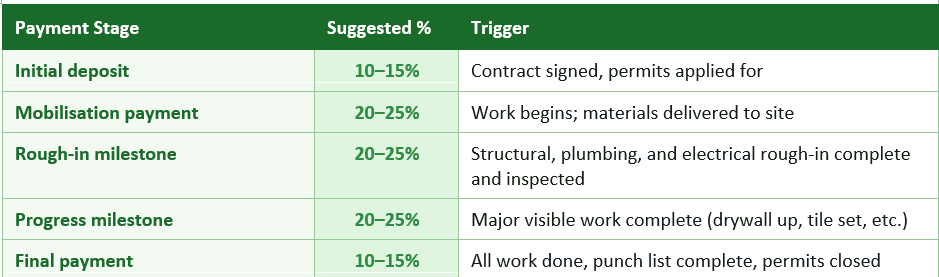
Be aware that some states limit the size of deposits a contractor can legally collect upfront. In California, the maximum initial deposit for a home improvement contract is 10% of the total price or $1,000, whichever is less. Check your own state's rules before agreeing to any payment structure.
Treat your contractor as a skilled professional, not a hired hand. That does not mean accepting poor workmanship without comment — it means raising concerns respectfully and giving the contractor a fair chance to address them before escalating. Hold a brief weekly check-in, either in person or by phone, to discuss what was completed that week, what is planned for the next, and any issues on either side. Keep a simple written log of these conversations.
When problems arise, put them in writing. An email or text message saying "As we discussed today, the tile in the master bathroom needs to be re-done before the final payment is released" creates a clear record that both parties can refer back to. Verbal agreements and informal understandings are where disputes most often begin.
Avoid making constant changes to the project while work is in progress. Every change disrupts the contractor's workflow, forces them to re-order or return materials, and creates uncertainty about how much money they will ultimately receive. If you want changes, agree to them early, get them in writing, and adjust the contract price accordingly.
Performance bonds are standard on most commercial and public construction projects in the US, where they are often legally required under the federal Miller Act and state equivalents. They are less common on residential projects, but there is nothing stopping a homeowner from requiring one. The cost of a performance bond is typically between 1% and 3% of the contract value, and it can be built into the contractor's bid price.
If a contractor refuses to provide a performance bond when asked, that is itself worth noting. Reputable, financially stable contractors who are confident they can complete the job generally have no objection to bonding. A contractor who is financially stretched, running multiple jobs simultaneously, or carrying existing debt from other projects may be reluctant to submit to the scrutiny that bonding requires.
For most standard residential projects, the combination of a solid written contract, a milestone payment schedule with retained final payment, and regular documented communication provides adequate protection without the cost of a bond. But for major extensions, whole-house renovations, or new builds, a performance bond is a sensible investment.
A mechanic's lien is a legal claim that a contractor, subcontractor, or materials supplier can file against your property if they are not paid for work they performed or materials they supplied. The right to file a mechanic's lien is protected in all 50 US states. Once a lien is recorded against your property, it becomes extremely difficult to sell or refinance your home until the lien is resolved. If the debt is not paid within the state's deadline, the contractor can go to court to force a sale of the property to recover what they are owed.
Here is the important nuance for homeowners: you can receive a mechanic's lien from a subcontractor or materials supplier even if you paid your general contractor in full. If your general contractor took your money but did not pay the tile installer, the electrician, or the lumber yard, those parties can still file a lien against your property. This is one of the key reasons that milestone payments, lien waivers, and verification of subcontractor payments are so important.
As a homeowner, you can protect yourself by requesting a conditional lien waiver from the contractor and each known subcontractor with every progress payment you make. A conditional lien waiver confirms that once the payment clears, the signing party waives their right to file a lien for the work covered by that payment. Your attorney or title company can provide standard lien waiver forms, and most states have specific requirements for what these waivers must say to be enforceable.
Be careful about terminating the contract too quickly. In most states, you need to give the contractor a formal written notice of default and a cure period (typically 5 to 14 days) before you can legally terminate the contract and hire someone else. Terminating too soon can actually expose you to a counterclaim from the contractor. Check your contract's termination clause and follow it exactly.
You have the right to sue for breach of contract in civil court. If your contractor left without completing the work, you can claim the difference between what you paid and what it will cost you to have someone else finish the job to the standard originally agreed. You can also claim consequential damages — for example, hotel costs if you had to move out during a renovation that is now running months over schedule.
You have the right to file a complaint with your state's contractor licensing board. If the contractor is licensed, the board has the power to investigate, mediate, fine, and discipline them. Some state boards also have recovery funds that can compensate homeowners directly in cases of contractor fraud or abandonment, up to a set limit. California's Contractors State License Board, for example, has a Contractors' State License Law that provides significant homeowner protections.
You have the right to pursue small claims court for disputes under your state's small claims limit, which ranges from $2,500 in some states to $25,000 in others. Small claims court is faster, cheaper, and does not require a lawyer.
Finally, if your homeowner's insurance policy includes a "home under construction" rider, or if you purchased builder's risk insurance for the project, you may be able to file a claim to cover some of the costs caused by the contractor's abandonment. Review your policy and speak to your insurance agent as soon as the contractor stops work.
You do not need to be a lawyer or a construction expert to protect yourself. You just need a solid written contract, a sensible payment schedule that holds back the final payment until the job is done, and the confidence to address problems in writing as soon as they arise. That combination, more than any other tool, is what keeps contractors on the job.
Wyman Legal Solutions — The Real Reason Contractors Abandon Projects https://wymanlegalsolutions.com/the-real-reason-contractors-abandon-projects-and-how-to-protect-yourself/
Mondaq / Jones Walker LLP — When Can a Contractor Stop Work? https://www.mondaq.com/unitedstates/construction-planning/1735594/when-can-a-contractor-stop-work
Boyes Legal — How to Legally Handle a Contractor Who Walks Off the Job (California) https://www.boyeslegal.com/how-to-legally-handle-a-contractor-who-walks-off-the-job/
Procore — A Contractor's Guide to Construction Bonds https://www.procore.com/library/construction-bonds-guide
SuretyBonds.com — How Liens and Bonds Work Together to Protect Contractor Payments https://www.suretybonds.com/blog/how-liens-and-bonds-work-together-to-protect-contractor-payments/
Angi — How to Get Contractors to Call You Back (and Keep Them) https://www.angi.com/articles/how-get-contractors-call-you-back.htm
Green Summit Contracting — Contractor Won't Finish the Job? 7 Steps to Take Control https://greensummitcontracting.com/contractor-wont-finish-the-job/
ExpertCE — Understanding Payment and Performance Bonds in Construction https://expertce.com/learn-articles/payment-performance-bonds-explained/
TABLE OF CONTENTS
- Why Contractors Walk Off the Job
- Warning Signs to Watch For
- Start With a Solid Written Contract
- Structure Payments the Right Way
- Keep Communication Clear and Consistent
- Use Performance Bonds for Bigger Projects
- Understand Mechanic's Liens — Before They Become a Problem
- What to Do If Your Contractor Does Walk Off
- Your Legal Rights in All 50 States
- Conclusion
- Frequently Asked Questions
- References
Why Contractors Walk Off the Job
A contractor who stops work mid-project is every homeowner's nightmare. The tools disappear, the calls go unanswered, and you are left with a half-finished kitchen or a roof open to the sky. But contractor walk-offs rarely happen without warning — and most of them stem from a small number of root causes that are well within a homeowner's power to prevent.The most common reason contractors abandon projects is a payment dispute. According to a survey by Levelset, 49% of contractors are not paid on time per their contracts. When cash flow dries up, a contractor cannot pay their workers, purchase materials, or keep subcontractors on site. Rather than operate at a loss or absorb costs the homeowner has not yet covered, many contractors simply stop showing up. This is especially true for smaller operations with thin financial margins and no line of credit to fall back on.
Financial mismanagement is the second major cause. Some contractors underbid a project to win the job, then discover partway through that they cannot cover their costs at the agreed price. Rather than have a difficult conversation about a change order, they quietly walk away. Others get overwhelmed by juggling multiple projects and deprioritise the ones where they feel undervalued or where the homeowner relationship has become tense.
Poor communication plays a role too. When a homeowner makes constant scope changes without agreeing to cost adjustments, repeatedly questions the quality of work without giving the contractor a chance to respond, or withholds payment over minor disputes, the working relationship breaks down. Experienced construction attorney advice is consistent on this point: most contractor walk-offs are the end result of a relationship that deteriorated over weeks, not a sudden decision.
Warning Signs to Watch For
Knowing the signs of a contractor in trouble can give you time to address the situation before it becomes a crisis. None of these signals on their own is conclusive, but a pattern of them should prompt a direct conversation.Early warning signs that a contractor may be about to walk off
- Work pace slows sharply or crew size drops with no explanation
- Materials fail to arrive on schedule and the contractor gives vague answers
- Phone calls and messages go unanswered for more than 24 hours
- The contractor starts asking for payment ahead of the agreed schedule
- Subcontractors show up less frequently or stop appearing entirely
- The contractor becomes irritable or defensive about the project's progress
- Permits have not been pulled, even though work has already started
- You find out the contractor has taken on another large project during yours
If you notice two or more of these signs at once, do not wait for the situation to resolve itself. Request a formal sit-down meeting with your contractor to discuss the project timeline, outstanding payments, and any issues they are facing. Catching problems early almost always results in a better outcome than trying to recover after the contractor has already left.
Start With a Solid Written Contract
The single most effective tool for keeping a contractor on the job is a well-drafted written contract signed by both parties before any work begins. In most US states, a written contract is required by law for home improvement projects above a certain dollar value — in California, for example, any project over $500 requires a written contract. But even where it is not legally required, a written contract is essential.What your contract must include
A proper construction contract should clearly describe the full scope of work, including materials to be used, brand names or specifications where relevant, and any exclusions. It should set a firm start date and expected completion date, with language that addresses what happens if either party causes a delay. Most importantly, it should spell out the payment schedule in detail — tied to specific milestones, not to arbitrary calendar dates.The contract should also include a dispute resolution clause specifying whether disagreements will go to mediation, arbitration, or small claims court. It should require the contractor to obtain all necessary permits before work begins, and confirm that the contractor carries general liability insurance and workers' compensation coverage. Ask for certificates of insurance and verify them — do not just take the contractor's word for it.
Change order procedures
Scope creep — additional work that is agreed verbally but never put in writing — is one of the most common causes of contractor disputes. Every change to the original scope, however small, should be documented in a written change order signed by both parties before the additional work begins. This protects the homeowner from being billed for work they did not authorise, and protects the contractor from being expected to do extra work for free.Document everything, seek assurances early, and consult counsel before walking off a job or terminating a contractor. In this market, a single breach can cascade into multimillion-dollar judgments.
— CONSTRUCTION ATTORNEY, JONES WALKER LLP (VIA MONDAQ, 2026)
Structure Payments the Right Way
How you pay your contractor is just as important as what you pay them. The payment schedule you agree to is one of the most powerful tools you have for keeping the project moving and keeping the contractor accountable.Never pay everything upfront
A large upfront payment — more than 10% to 15% of the total project cost — removes the contractor's financial incentive to finish the job. If they have already collected most of the money, walking away becomes a far less costly decision on their side. Most experienced homeowners and construction advisers recommend keeping the final 10% to 15% of the contract price unpaid until all work has been completed, all punch list items resolved, and all permits closed out.Use milestone-based payments
Rather than paying on a time-based schedule (for example, every two weeks), tie payments to the completion of specific, verifiable milestones. A kitchen renovation might have payments tied to demolition complete, rough plumbing and electrical inspected and approved, cabinets installed, countertops fitted, and final inspection passed. When money only changes hands after observable progress has been made, both parties have a clear shared interest in keeping the work moving forward.Be aware that some states limit the size of deposits a contractor can legally collect upfront. In California, the maximum initial deposit for a home improvement contract is 10% of the total price or $1,000, whichever is less. Check your own state's rules before agreeing to any payment structure.
Keep Communication Clear and Consistent
A surprising number of contractor walk-offs come down to a breakdown in the relationship between the homeowner and the contractor. The contractor feels disrespected, micromanaged, or taken advantage of, and eventually decides the job is not worth the aggravation.Treat your contractor as a skilled professional, not a hired hand. That does not mean accepting poor workmanship without comment — it means raising concerns respectfully and giving the contractor a fair chance to address them before escalating. Hold a brief weekly check-in, either in person or by phone, to discuss what was completed that week, what is planned for the next, and any issues on either side. Keep a simple written log of these conversations.
When problems arise, put them in writing. An email or text message saying "As we discussed today, the tile in the master bathroom needs to be re-done before the final payment is released" creates a clear record that both parties can refer back to. Verbal agreements and informal understandings are where disputes most often begin.
Avoid making constant changes to the project while work is in progress. Every change disrupts the contractor's workflow, forces them to re-order or return materials, and creates uncertainty about how much money they will ultimately receive. If you want changes, agree to them early, get them in writing, and adjust the contract price accordingly.
Use Performance Bonds for Bigger Projects
For larger renovation or construction projects — typically anything over $25,000 to $50,000 — it is worth asking your contractor to provide a performance bond before work begins. A performance bond is a three-party agreement between you (the project owner), the contractor (the principal), and a bonding company (the surety). The surety guarantees that if your contractor fails to complete the work as agreed, it will either arrange for the project to be finished or pay you the cost of doing so.Performance bonds are standard on most commercial and public construction projects in the US, where they are often legally required under the federal Miller Act and state equivalents. They are less common on residential projects, but there is nothing stopping a homeowner from requiring one. The cost of a performance bond is typically between 1% and 3% of the contract value, and it can be built into the contractor's bid price.
If a contractor refuses to provide a performance bond when asked, that is itself worth noting. Reputable, financially stable contractors who are confident they can complete the job generally have no objection to bonding. A contractor who is financially stretched, running multiple jobs simultaneously, or carrying existing debt from other projects may be reluctant to submit to the scrutiny that bonding requires.
For most standard residential projects, the combination of a solid written contract, a milestone payment schedule with retained final payment, and regular documented communication provides adequate protection without the cost of a bond. But for major extensions, whole-house renovations, or new builds, a performance bond is a sensible investment.
Understand Mechanic's Liens — Before They Become a Problem
This section is important for homeowners to understand, because a mechanic's lien is one of the most powerful tools in the construction industry — and it can be used against you if your project goes wrong.A mechanic's lien is a legal claim that a contractor, subcontractor, or materials supplier can file against your property if they are not paid for work they performed or materials they supplied. The right to file a mechanic's lien is protected in all 50 US states. Once a lien is recorded against your property, it becomes extremely difficult to sell or refinance your home until the lien is resolved. If the debt is not paid within the state's deadline, the contractor can go to court to force a sale of the property to recover what they are owed.
Here is the important nuance for homeowners: you can receive a mechanic's lien from a subcontractor or materials supplier even if you paid your general contractor in full. If your general contractor took your money but did not pay the tile installer, the electrician, or the lumber yard, those parties can still file a lien against your property. This is one of the key reasons that milestone payments, lien waivers, and verification of subcontractor payments are so important.
As a homeowner, you can protect yourself by requesting a conditional lien waiver from the contractor and each known subcontractor with every progress payment you make. A conditional lien waiver confirms that once the payment clears, the signing party waives their right to file a lien for the work covered by that payment. Your attorney or title company can provide standard lien waiver forms, and most states have specific requirements for what these waivers must say to be enforceable.
What to Do If Your Contractor Does Walk Off
If your contractor stops work despite your best efforts to prevent it, acting quickly and carefully is essential. The wrong moves in the first few days after abandonment can limit your legal options and make it harder to recover damages.Immediate steps if your contractor stops work
- Document everything right away: take dated photographs of all unfinished work, save every text message and email, and gather all contracts, receipts, and change orders.
- Do not make any further payments until the situation is resolved. Paying more money to a contractor who has abandoned the job rarely brings them back and reduces your leverage.
- Contact the contractor in writing by email or certified mail. State clearly that work has stopped and request a written explanation and a firm date for resuming. Give them a reasonable deadline to respond (typically 5 to 10 business days).
- Hire an independent third-party contractor or inspector to assess what has been completed and what work remains. Get a written estimate of the cost to complete the project. This is evidence you will need for any legal claim.
- File a complaint with your state's contractor licensing board if the contractor is licensed. The board can investigate, impose fines, and suspend or revoke the contractor's license.
- Consult a construction law attorney, especially for projects over $10,000. Many offer a free initial consultation and can advise you on whether to pursue mediation, arbitration, or a lawsuit in small claims or civil court.
Be careful about terminating the contract too quickly. In most states, you need to give the contractor a formal written notice of default and a cure period (typically 5 to 14 days) before you can legally terminate the contract and hire someone else. Terminating too soon can actually expose you to a counterclaim from the contractor. Check your contract's termination clause and follow it exactly.
Your Legal Rights in All 50 States
Every US state gives homeowners meaningful legal protections when a contractor abandons a project. While the specifics vary by state, the core rights are broadly similar across the country.You have the right to sue for breach of contract in civil court. If your contractor left without completing the work, you can claim the difference between what you paid and what it will cost you to have someone else finish the job to the standard originally agreed. You can also claim consequential damages — for example, hotel costs if you had to move out during a renovation that is now running months over schedule.
You have the right to file a complaint with your state's contractor licensing board. If the contractor is licensed, the board has the power to investigate, mediate, fine, and discipline them. Some state boards also have recovery funds that can compensate homeowners directly in cases of contractor fraud or abandonment, up to a set limit. California's Contractors State License Board, for example, has a Contractors' State License Law that provides significant homeowner protections.
You have the right to pursue small claims court for disputes under your state's small claims limit, which ranges from $2,500 in some states to $25,000 in others. Small claims court is faster, cheaper, and does not require a lawyer.
Finally, if your homeowner's insurance policy includes a "home under construction" rider, or if you purchased builder's risk insurance for the project, you may be able to file a claim to cover some of the costs caused by the contractor's abandonment. Review your policy and speak to your insurance agent as soon as the contractor stops work.
CONCLUSION
The fear of a contractor walking off your project is entirely understandable — but it is also largely preventable. The homeowners who end up with unfinished projects and missing deposits are usually the ones who skipped the written contract, paid too much upfront, and let problems fester without addressing them directly. The ones whose projects get finished on time and on budget are the ones who treated the process like the significant business transaction it is: clear agreements, documented communications, and payments tied to real progress.You do not need to be a lawyer or a construction expert to protect yourself. You just need a solid written contract, a sensible payment schedule that holds back the final payment until the job is done, and the confidence to address problems in writing as soon as they arise. That combination, more than any other tool, is what keeps contractors on the job.
Frequently Asked Questions
Can a contractor legally walk off a job in the US?
Yes, but only in limited circumstances. A contractor is generally entitled to stop work if the homeowner commits a material breach of contract — most commonly by withholding payment without justification. Simply being unhappy with how a project is going or deciding they underpriced the job is not a legal reason to walk off. A contractor who abandons a job without legal justification is in breach of contract and can be sued for the cost of completing the work and any related damages.How much of a deposit should I pay a contractor?
Most construction experts recommend keeping your initial deposit between 10% and 15% of the total project cost. Some states cap this by law — in California, the maximum upfront deposit for a home improvement contract is 10% of the total price or $1,000, whichever is less. Paying more than 15% upfront reduces your leverage and increases your risk if the contractor does not complete the work.What is a milestone payment schedule?
A milestone payment schedule ties each payment to the completion of a specific, verifiable stage of the project — for example, rough plumbing inspected and approved, or drywall installation complete. This is safer than paying on a time-based schedule because money only changes hands after observable progress has been made, keeping both parties motivated to keep the project moving.What is a mechanic's lien and how does it affect me as a homeowner?
A mechanic's lien is a legal claim that a contractor, subcontractor, or materials supplier can file against your property if they are not paid for work or materials. Once filed, a lien makes it very difficult to sell or refinance your home until the debt is settled. You can protect yourself by requesting a conditional lien waiver from the contractor and each known subcontractor every time you make a payment.Do I need a performance bond for a home renovation?
For most standard home improvement projects, a solid written contract and a milestone payment schedule provide adequate protection. For larger projects — typically over $25,000 to $50,000 — or for projects involving an unknown contractor, a performance bond is worth the 1% to 3% cost. If a contractor refuses to provide a bond when asked, treat that as a warning sign about their financial stability or willingness to be held accountable.What should I do if my contractor just disappeared?
Act immediately. Document everything with photographs and save all communications. Do not make any further payments. Send a formal written notice by email and certified mail asking the contractor to explain the work stoppage and commit to a return date. Hire an independent contractor to assess what is done and estimate what it will cost to finish. File a complaint with your state's licensing board. And speak to a construction attorney, especially if the project value is significant.References
Wyman Legal Solutions — What to Do When Your Contractor Walks Off the Job in Florida https://wymanlegalsolutions.com/what-to-do-when-your-contractor-walks-off-the-job-in-florida-2026/Wyman Legal Solutions — The Real Reason Contractors Abandon Projects https://wymanlegalsolutions.com/the-real-reason-contractors-abandon-projects-and-how-to-protect-yourself/
Mondaq / Jones Walker LLP — When Can a Contractor Stop Work? https://www.mondaq.com/unitedstates/construction-planning/1735594/when-can-a-contractor-stop-work
Boyes Legal — How to Legally Handle a Contractor Who Walks Off the Job (California) https://www.boyeslegal.com/how-to-legally-handle-a-contractor-who-walks-off-the-job/
Procore — A Contractor's Guide to Construction Bonds https://www.procore.com/library/construction-bonds-guide
SuretyBonds.com — How Liens and Bonds Work Together to Protect Contractor Payments https://www.suretybonds.com/blog/how-liens-and-bonds-work-together-to-protect-contractor-payments/
Angi — How to Get Contractors to Call You Back (and Keep Them) https://www.angi.com/articles/how-get-contractors-call-you-back.htm
Green Summit Contracting — Contractor Won't Finish the Job? 7 Steps to Take Control https://greensummitcontracting.com/contractor-wont-finish-the-job/
ExpertCE — Understanding Payment and Performance Bonds in Construction https://expertce.com/learn-articles/payment-performance-bonds-explained/

0 Comments Comments