

Vehicles & Cars
MBI vs Extended Car Warranty: Which Is Better in 2026?
The average unexpected major car repair bill reached $4,287 in 2026. One in three Americans couldn't cover an unexpected repair of even $1,000. Two products exist to protect against this: mechanical breakdown insurance (MBI) and extended car warranties. They look similar on the surface — but they work very differently, cost very differently, and suit very different drivers. This guide explains which is better for your situation — and what the FTC's December 2025 enforcement action reveals about the industry you're buying into.

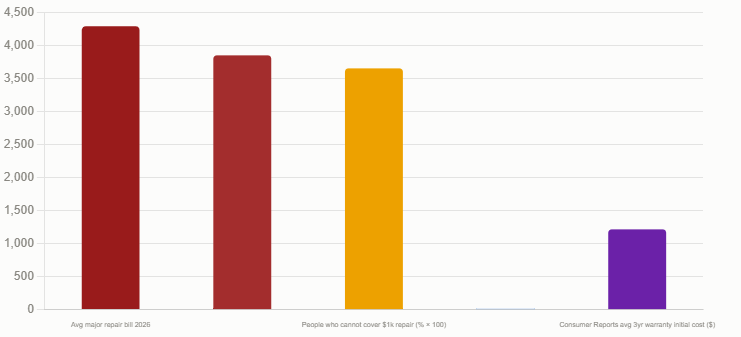
The problem they solve is real and growing. The average unexpected major car repair bill reached $4,287 in 2026 (CoverageX). Vehicle parts and equipment costs jumped 11% from 2019 to 2022 (BLS data cited ConsumerAffairs). And 36.5% of Americans say they could not cover an unexpected vehicle repair cost of $1,000 or more (ConsumerAffairs survey). For these drivers, an unexpected engine or transmission failure is not just inconvenient — it is financially catastrophic.
MBI and extended warranties address this vulnerability in different ways, at very different price points, with different eligibility requirements, and — critically — with very different regulatory oversight. Understanding the differences before signing anything is essential: in December 2025, the FTC began distributing $9.6 million in refunds to 168,179 consumers who paid for a vehicle service contract and had their claims denied.
Average major repair 2026: $4,287 (CoverageX). 67% of vehicles over 100,000 miles had a major repair costing $3,847+ within 12 months (Budget Seniors, June 2026). 36.5% of Americans can't cover a $1,000 unexpected repair (ConsumerAffairs). FTC refunds to CarShield customers Dec 2025: $9.6 million to 168,179 consumers. CarShield/American Auto Shield FTC settlement July 2024: $10 million.
MBI covers major vehicle components — typically the engine, transmission, drivetrain, electrical systems, air conditioning, and brakes — that are not covered by standard auto insurance (which covers accident damage, theft, and weather events, not mechanical failure). ConsumerAffairs (updated July 31, 2026) describes MBI as offering 'coverage for major car components like the powertrain and electrical systems, filling a protection gap that traditional car insurance does not address.'
Because MBI is a form of insurance, it is regulated by state insurance commissioners — the same regulatory body that oversees your car, home, and health insurance. This is a significant consumer protection distinction. Filing a claim, disputing a denial, or complaining about an MBI provider goes through the same established insurance regulatory channels as any other insurance dispute.
MBI does not cover: routine maintenance (oil changes, tire rotations, filters), normal wear and tear (tires, brake pads, wiper blades), damage from accidents (covered by collision/comprehensive), or cosmetic damage. It is specifically for unexpected mechanical failures of covered components.
The primary MBI provider in the US market is GEICO, which offers MBI nationwide for eligible vehicles. Some regional insurers offer MBI in specific states — notably California. Car Talk (March 2026) and ConsumerAffairs note that 'besides GEICO, not many car insurance companies currently offer MBI nationwide,' making it a less competitive market than extended warranties.
Extended warranties are available from three sources: the original vehicle manufacturer (e.g., Toyota Extended Care, Ford Protect — the most regulated and reliable), dealerships (which typically mark up manufacturer-backed products or sell third-party contracts at 100–200% mark-up per CoverageX), and independent third-party providers (Endurance, CarShield, CARCHEX, CoverageX, and dozens of others — ranging from reputable to fraudulent).
Extended warranties are not regulated as insurance products in most states. They are regulated as service contracts, which typically means less rigorous consumer protection than insurance regulation provides. This is why the FTC — rather than state insurance commissioners — is the primary federal enforcement body for extended warranty fraud.
Coverage ranges from basic 'powertrain only' plans (engine, transmission, drivetrain) to comprehensive 'bumper-to-bumper' plans that cover nearly everything. The more comprehensive the coverage, the higher the cost. Exclusions vary significantly by provider — the fine print determines what is actually covered, and as the FTC enforcement actions demonstrate, some providers are more liberal than others in denying claims.

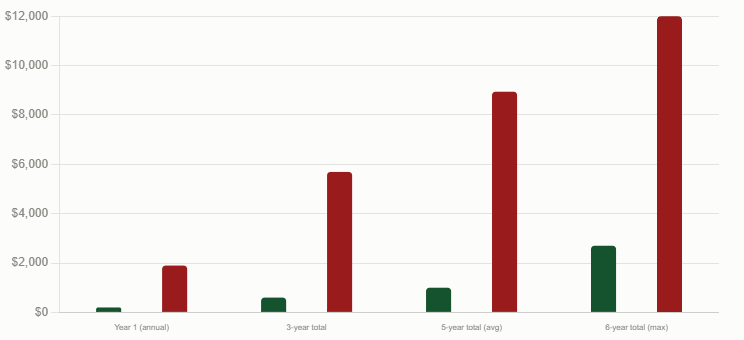
MBI is significantly cheaper. AutoInsurance.org puts the average at approximately $100 annually or $8 per month for a new vehicle. ValuePenguin's research found MBI costs of approximately $180 to $450 for six years — the full policy period — compared to an average initial extended warranty cost of $1,214 for a three-year plan (Consumer Reports, cited ValuePenguin). Car Talk (March 2026) reports that MBI plans for mainstream vehicles can cost as little as $30 to $100 per year.
Extended warranties cost dramatically more. ConsumerAffairs (updated September 4, 2026 — one week before this article) puts extended warranty costs at $600 to $1,000 per year depending on vehicle, coverage level, and provider, with monthly costs ranging from $50 to $125. The average in 2026 per CoverageX data is $1,897 per year. Total multi-year contract cost: typically $2,000 to $5,000 over the life of the plan, with comprehensive coverage reaching $8,000 or more.
The payment structure adds another cost dimension. Extended warranties often require a large upfront payment or monthly installments that cost 10–15% more over the contract life than paying annually or upfront (CoverageX). MBI operates as a premium within your existing auto insurance policy — paid monthly alongside other premiums, with no large lump sum required and the ability to cancel at any time.
One important cost caveat: extended warranties through vehicle manufacturers (Toyota Extended Care, Ford Protect, GM Protection Plans) are typically more competitively priced and more reliably honoured than dealership mark-ups or third-party contracts. If an extended warranty is the right choice, buying directly from the manufacturer or a highly rated direct provider is generally better value than a dealership add-on.
Industry surveys reveal that car owners typically paid more for extended warranty coverage than they received back in direct repair benefits (ConsumerVoice). This does not mean extended warranties are never worth it — for specific vehicles in specific circumstances, they clearly are. But it does mean the average purchaser is paying a premium. For an MBI purchaser on a new vehicle at $100–$200 per year, the break-even on a single major repair is considerably more favourable.
MBI typically covers: engine and all internal components; transmission; drivetrain (differentials, axles, drive shafts); air conditioning and heating; electrical systems; fuel systems; and brakes. It does not cover: routine maintenance, wear-and-tear items (tires, brake pads, wiper blades, filters), cosmetic damage, or accident-related damage (those go through regular auto insurance).
Extended warranties offer tiered coverage: powertrain-only plans (cheapest; covers engine, transmission, drivetrain); mid-level plans add air conditioning, electrical, fuel systems, steering; bumper-to-bumper plans approach factory warranty comprehensiveness. The key consumer protection risk with extended warranties is that the exclusions list (rather than the covered items list) can be more meaningful — some contracts are 'exclusionary' (everything is covered except listed exclusions) while others are 'inclusionary' (only listed components are covered). Inclusionary plans generally provide less comprehensive coverage despite appearing similar.
Read the fine print on exclusions before purchasing either product. Extended warranty exclusions in particular can be extensive: pre-existing conditions (any problem that existed before coverage begins), lack of maintenance (a claim can be denied if records showing oil changes are not provided), consequential damage (if one failed component damages another, some plans won't cover the second), and exclusions for specific high-cost components in your vehicle. The FTC's action against CarShield found that the company overstated coverage and denied claims on grounds not clearly stated in advertising. Always request the actual contract terms before payment.
MBI is generally only available for newer, lower-mileage vehicles. ConsumerAffairs puts the typical eligibility at vehicles under five years old with fewer than 100,000 miles. Some providers allow up to seven years old. Importantly, to ensure long-term coverage continuity, MBI typically needs to be purchased while the factory warranty is still active — meaning you are briefly paying for overlapping coverage. AutoInsurance.org notes: 'In order to ensure coverage for the long-term, you would need to begin paying for a MBI policy while your vehicle is already covered under the factory warranty.' Some MBI policies also cover used vehicles but require that coverage begin within 21 days of purchase.
High-value luxury vehicles (Tesla Model S, BMW X7, etc.) may be ineligible for MBI even if they are new — because the repair costs if a claim is made are too high for the MBI premium to be actuarially viable. Car Talk (March 2026) confirms: 'If you own a high-value vehicle, such as a Tesla Model S or BMW X7, you may not be able to purchase an MBI.'
Extended warranties accept a much broader range of vehicles. Older vehicles, higher-mileage vehicles, and luxury vehicles are all typically eligible — at higher prices. Budget Seniors (June 2026) notes that coverage is available for cars with up to 300,000 miles from some providers, though options narrow significantly above 100,000–125,000 miles and prices rise steeply. For drivers whose vehicles are already past the MBI eligibility window, an extended warranty is the only vehicle protection option available.
MBI allows you to take your vehicle to any licensed repair facility. ValuePenguin confirms: 'MBI plans tend to have more flexibility in where you can bring your car for repairs.' AutoInsurance.org adds: 'With MBI coverage, you can choose where to take your vehicle for repairs.' This means your trusted local mechanic, a dealer, or any other licensed shop can perform covered repairs.
Extended warranties often restrict repairs to an approved dealer network or authorised repair facilities. This matters most in emergency breakdown situations — if you break down in an unfamiliar area, being restricted to an approved shop list can mean a tow to a specific location rather than the nearest mechanic. Some premium extended warranty plans do offer 'use any licensed shop' flexibility, but this is not universal and should be confirmed before purchase.
The claims process also differs. MBI claims go through your insurance company — the same process as any other insurance claim. Extended warranty claims typically go through the warranty provider directly, which may require pre-authorisation before repairs can begin. Some extended warranty contracts require the mechanic to speak with an adjuster before proceeding, which can slow repair completion.
Extended warranties often offer deductibles of $0 to $200, with many manufacturer-backed contracts offering $0 or $50 deductibles. Endurance, per ConsumerAffairs, lists deductible options from $0 to $500 across different plan categories. For frequent small repairs, a lower deductible extended warranty could be more cost-efficient than MBI — but for major repairs (the scenario both products are primarily designed for), the deductible is a small fraction of the total claim and matters less than the coverage breadth and claim reliability.
Importantly: with MBI, if a claim is denied, you can file a complaint with your state insurance commissioner — the same well-established regulatory process used for all insurance disputes. With an extended warranty, dispute resolution is less clear-cut. You can file with the FTC (ftc.gov/complaint) or your state attorney general's office, but these processes are slower and less certain of outcome than insurance regulation. This is one of the consumer protection advantages of MBI over vehicle service contracts.
In July 2024, CarShield and American Auto Shield agreed to pay $10 million to settle FTC charges. The FTC found misleading claims about coverage, promises of free rental cars, and implications that consumers could use any repair shop — none of which were fully accurate. In December 2025, the FTC began distributing more than $9.6 million in refunds to 168,179 consumers whose CarShield claims had been denied despite paying up to $120 per month for coverage. That is nearly 170,000 people who paid for protection and did not receive it.
ConsumerVoice's analysis is direct: 'Industry surveys revealed that car owners typically paid more for extended warranty coverage than they received back in direct repair benefits.' The FTC advises consumers: 'If you receive an unsolicited offer, verify the company independently before sharing any personal or payment information.'
This does not mean all extended warranties are fraudulent or worthless. Manufacturer-backed plans (Toyota, Ford, GM) and established direct providers with transparent terms and strong customer review records do pay claims and provide genuine value. But the market for vehicle service contracts includes a significant number of providers with problematic practices. Due diligence is essential.
Before purchasing any extended warranty from a third-party provider: (1) search the company on the FTC's website (ftc.gov) and your state attorney general's website for enforcement actions; (2) check the BBB rating and BBB Accreditation status; (3) check ConsumerAffairs and the NAIC complaint database for consumer complaints; (4) request the actual contract — not just the brochure — before making any payment; (5) read the exclusions list carefully, not just the coverage list; (6) confirm repair shop flexibility, claim pre-authorisation requirements, and the exact dispute resolution process. A reputable provider will have clear answers to all of these.
MBI is the financially superior product for eligible vehicles. At $100–$450 per year versus $1,897 per year average for an extended warranty, MBI costs approximately one-fifth as much for broadly similar mechanical failure protection. The trade-off — a higher deductible ($100–$250 versus $0–$100 for some extended warranties) — is rarely material for major repair claims.
The critical timing issue: MBI eligibility is narrow, and it closes permanently once a vehicle exceeds the age or mileage threshold. For drivers approaching the end of their factory warranty period, the window to purchase MBI is closing. Act before the factory warranty expires and before the vehicle crosses the MBI eligibility boundary.
If choosing an extended warranty, the hierarchy of providers is important: manufacturer-backed plans (Toyota, Ford, GM) are the most reliable and the most clearly regulated; established direct providers with strong BBB ratings and transparent terms come next; dealership-sold third-party contracts are the most likely to involve mark-ups of 100–200% and should generally be avoided or negotiated down significantly.
The economic case for an extended warranty is strongest for vehicles with known reliability issues (certain European luxury brands, some high-mileage American vehicles, certain models with documented transmission or electrical problems) and weakest for historically reliable vehicles (Toyota, Honda, Mazda — which have among the lowest average repair frequencies in independent reliability surveys). For a Toyota Camry or Honda Civic, an extended warranty is rarely worth it statistically. For a European luxury SUV or a vehicle approaching 100,000 miles on a brand with a mixed reliability record, it may well be.
The logic: instead of paying $1,897 per year (extended warranty average) or even $200 per year (MBI average) into a provider's pool, deposit that amount monthly into a dedicated high-yield savings account earmarked for car repairs. Over three to five years, the fund builds to $600–$9,485 — enough to cover most major repairs — while earning interest and remaining fully accessible for any repair cost, not just those covered under the warranty's terms.
The self-insurance approach works best when: you own a vehicle with a strong reliability record; you have the financial discipline to maintain the fund and not spend it; and you can absorb a large repair bill in a bad year before the fund is fully established. It works least well when you own a vehicle with known reliability issues, when you have no existing financial buffer, or when the peace of mind value of a guaranteed repair coverage is important to you. Budget Seniors (June 2026) notes that for vehicles with the worst reliability records, 67% of vehicles over 100,000 miles experienced a major repair costing $3,847 on average within 12 months — a level at which self-insurance may be insufficient unless the fund is already well-established.
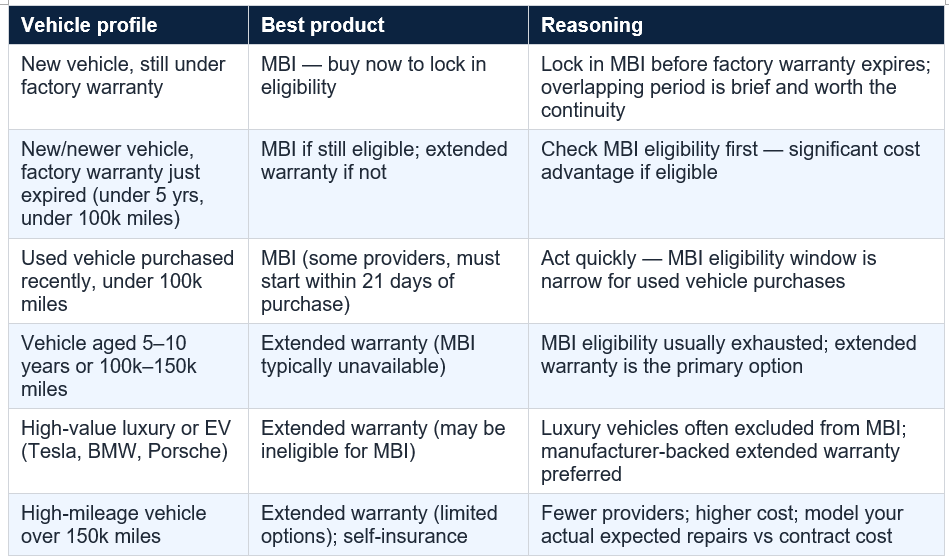
If you own a newer vehicle within MBI eligibility: MBI is almost certainly the better financial choice. It costs a fraction of an extended warranty, offers comparable protection for eligible major mechanical failures, provides greater repair shop flexibility, and is regulated as insurance — giving you stronger consumer protection. The window to purchase MBI is time-limited, so act before your vehicle ages out of eligibility.
If your vehicle is past MBI eligibility: an extended warranty from a reputable provider may provide genuine value, particularly for vehicles with reliability concerns. But read the contract carefully, understand the exclusions, verify the provider's FTC and BBB record, and compare the expected cost of the warranty against the statistical probability of the repairs you would actually claim for. For historically reliable vehicles, self-insurance through a dedicated savings fund may outperform both options financially.
The FTC's $9.6 million refund action in December 2025, covering 168,179 consumers whose CarShield claims were denied, is the most important data point in this comparison. Not because all extended warranties are fraudulent — they are not — but because it confirms that not all providers are equal, that marketing claims must be verified against actual contract terms, and that consumer protection for vehicle service contracts is weaker than for insurance products. When spending $2,000 to $8,000 on any protection product, that due diligence is not optional.
MBI (mechanical breakdown insurance) is an insurance product sold by car insurance companies and regulated by state insurance commissioners. An extended warranty (technically a vehicle service contract) is a service contract sold by vehicle manufacturers, dealerships, or third-party companies and regulated as a consumer product, not as insurance. This regulatory difference matters: MBI disputes go through established insurance regulatory channels, while extended warranty disputes rely on the FTC, state attorneys general, and contract law. MBI is typically much cheaper ($100–$450/year vs $1,897/year average for extended warranties in 2026) but has narrower eligibility — generally limited to newer vehicles under 100,000 miles. Extended warranties accept older, higher-mileage vehicles at proportionally higher prices.
How much does MBI cost compared to an extended warranty in 2026?
MBI typically costs $100–$450 per year for eligible vehicles — AutoInsurance.org puts the average at approximately $100 annually or $8 per month for a basic plan on a new vehicle. Car Talk (March 2026) reports that mainstream vehicles can pay as little as $30–$100 per year. Extended warranties cost significantly more: ConsumerAffairs (updated September 4, 2026) puts extended warranty costs at $600–$1,000 per year, with multi-year total contracts typically running $2,000–$5,000 and comprehensive plans reaching $8,000+. The 2026 average per CoverageX is $1,897 per year. For an eligible vehicle, MBI is approximately one-fifth to one-tenth the cost of an extended warranty for broadly similar mechanical failure protection.
What does MBI not cover?
MBI does not cover: routine maintenance (oil changes, tire rotations, air filters, wiper blades); normal wear-and-tear items (brake pads, clutch plates, tires); cosmetic damage; damage from accidents (covered by collision or comprehensive insurance); or damage from poor maintenance. It covers unexpected mechanical failures of covered major components — engine, transmission, drivetrain, air conditioning, electrical systems, and brakes are typically included. High-value luxury vehicles and EVs may be ineligible for MBI entirely, regardless of age or mileage.
Is GEICO the only provider of MBI?
GEICO is the primary nationwide MBI provider in the US market. Some regional car insurance companies offer MBI in specific states — notably California, where olive and some other providers offer MBI policies. Some insurance companies market comparable products under different names. The limited number of MBI providers contrasts sharply with the extended warranty market, which includes dozens of providers from manufacturer-backed plans (Toyota, Ford, GM) to large third-party companies (Endurance, CarShield, CARCHEX) to many smaller regional providers. The extended warranty market's competitive abundance is also part of why consumer protection varies so widely — there is significant variation in claim payment rates, coverage quality, and business practices across the provider landscape.
Should I buy an extended warranty at the dealership?
Generally, no — or at least not without significant scrutiny and price negotiation. Dealerships typically mark up extended warranties by 100–200% over the cost of the same product purchased directly from the manufacturer or provider (CoverageX). The same coverage purchased directly from Toyota Financial Services (for a Toyota), Ford Motor Company (for a Ford), or a reputable direct provider will typically cost significantly less than the dealership version. Additionally, dealership salespeople often present extended warranties as urgent additions at the point of sale, when you have the least time to research or compare. Always request the actual contract terms, take it home to review, and compare prices from multiple sources before committing. Saying no at the dealership and researching later is almost always the right approach.
Are extended warranties worth it in 2026?
It depends on your specific vehicle. Industry surveys cited by ConsumerVoice show that car owners typically paid more for extended warranty coverage than they received back in direct repair benefits — meaning the average extended warranty does not pay off financially for the average buyer. However, averages conceal wide variation: for a vehicle with a known reliability problem, a pending transmission or engine issue, or a repair record that suggests high future costs, an extended warranty may well pay for itself. The key factors: (1) your vehicle's reliability record (use independent sources like Consumer Reports); (2) the specific exclusions in the contract you are offered; (3) the provider's claim payment record (check FTC.gov, BBB, and ConsumerAffairs); (4) whether you can self-insure through a dedicated savings fund. For historically reliable vehicles (Toyota, Honda, Mazda), self-insurance typically outperforms an extended warranty financially. For vehicles with mixed reliability records, the calculation is more balanced.
Table of Contents
- Two Products, One Problem
- What Mechanical Breakdown Insurance (MBI) Is
- What an Extended Car Warranty (Vehicle Service Contract) Is
- The Critical Differences: A Side-by-Side Comparison
- Cost: MBI vs Extended Warranty in 2026
- Coverage: What Each Protects
- Eligibility: Who Can Get Each Product
- Repair Shop Flexibility: A Key Practical Difference
- Deductibles and Claims Process
- The FTC Warning: What the Industry's Enforcement Record Reveals
- Who Should Choose MBI?
- Who Should Choose an Extended Warranty?
- The Self-Insurance Alternative
- Conclusion: The Right Answer Depends on Your Car
- Frequently Asked Questions
Cost Comparison: MBI vs Extended Warranty 2026
The Repair Cost problem: Who Needs Protection Most
Two Products, One Problem
A new car comes with a manufacturer's warranty — typically three years or 36,000 miles for a basic bumper-to-bumper guarantee, and often five years or 60,000 miles for the powertrain. Once that coverage expires, drivers face a choice: absorb the full cost of any mechanical failure out of pocket, or purchase additional protection. Two distinct products exist for this purpose: mechanical breakdown insurance (MBI) and extended car warranties (technically called vehicle service contracts).The problem they solve is real and growing. The average unexpected major car repair bill reached $4,287 in 2026 (CoverageX). Vehicle parts and equipment costs jumped 11% from 2019 to 2022 (BLS data cited ConsumerAffairs). And 36.5% of Americans say they could not cover an unexpected vehicle repair cost of $1,000 or more (ConsumerAffairs survey). For these drivers, an unexpected engine or transmission failure is not just inconvenient — it is financially catastrophic.
MBI and extended warranties address this vulnerability in different ways, at very different price points, with different eligibility requirements, and — critically — with very different regulatory oversight. Understanding the differences before signing anything is essential: in December 2025, the FTC began distributing $9.6 million in refunds to 168,179 consumers who paid for a vehicle service contract and had their claims denied.
Average major repair 2026: $4,287 (CoverageX). 67% of vehicles over 100,000 miles had a major repair costing $3,847+ within 12 months (Budget Seniors, June 2026). 36.5% of Americans can't cover a $1,000 unexpected repair (ConsumerAffairs). FTC refunds to CarShield customers Dec 2025: $9.6 million to 168,179 consumers. CarShield/American Auto Shield FTC settlement July 2024: $10 million.
What Mechanical Breakdown Insurance (MBI) Is
Mechanical breakdown insurance is exactly what it sounds like: insurance that covers the cost of repairs when a vehicle breaks down due to a mechanical failure. It is sold by car insurance companies as an optional add-on to an existing auto insurance policy — not as a separate standalone product from a warranty company.MBI covers major vehicle components — typically the engine, transmission, drivetrain, electrical systems, air conditioning, and brakes — that are not covered by standard auto insurance (which covers accident damage, theft, and weather events, not mechanical failure). ConsumerAffairs (updated July 31, 2026) describes MBI as offering 'coverage for major car components like the powertrain and electrical systems, filling a protection gap that traditional car insurance does not address.'
Because MBI is a form of insurance, it is regulated by state insurance commissioners — the same regulatory body that oversees your car, home, and health insurance. This is a significant consumer protection distinction. Filing a claim, disputing a denial, or complaining about an MBI provider goes through the same established insurance regulatory channels as any other insurance dispute.
MBI does not cover: routine maintenance (oil changes, tire rotations, filters), normal wear and tear (tires, brake pads, wiper blades), damage from accidents (covered by collision/comprehensive), or cosmetic damage. It is specifically for unexpected mechanical failures of covered components.
The primary MBI provider in the US market is GEICO, which offers MBI nationwide for eligible vehicles. Some regional insurers offer MBI in specific states — notably California. Car Talk (March 2026) and ConsumerAffairs note that 'besides GEICO, not many car insurance companies currently offer MBI nationwide,' making it a less competitive market than extended warranties.
What an Extended Car Warranty (Vehicle Service Contract) Is
Despite being universally called an 'extended warranty,' what dealerships and third-party providers sell after a factory warranty expires is technically a vehicle service contract — not a warranty. This legal distinction matters: under the Magnuson-Moss Warranty Act, a warranty must be offered by the manufacturer. A vehicle service contract is a separate contract that a dealer or third party offers to pay for future repairs. The Federal Trade Commission advises consumers to understand this distinction.Extended warranties are available from three sources: the original vehicle manufacturer (e.g., Toyota Extended Care, Ford Protect — the most regulated and reliable), dealerships (which typically mark up manufacturer-backed products or sell third-party contracts at 100–200% mark-up per CoverageX), and independent third-party providers (Endurance, CarShield, CARCHEX, CoverageX, and dozens of others — ranging from reputable to fraudulent).
Extended warranties are not regulated as insurance products in most states. They are regulated as service contracts, which typically means less rigorous consumer protection than insurance regulation provides. This is why the FTC — rather than state insurance commissioners — is the primary federal enforcement body for extended warranty fraud.
Coverage ranges from basic 'powertrain only' plans (engine, transmission, drivetrain) to comprehensive 'bumper-to-bumper' plans that cover nearly everything. The more comprehensive the coverage, the higher the cost. Exclusions vary significantly by provider — the fine print determines what is actually covered, and as the FTC enforcement actions demonstrate, some providers are more liberal than others in denying claims.
The Critical Differences: A Side-by-Side Comparison
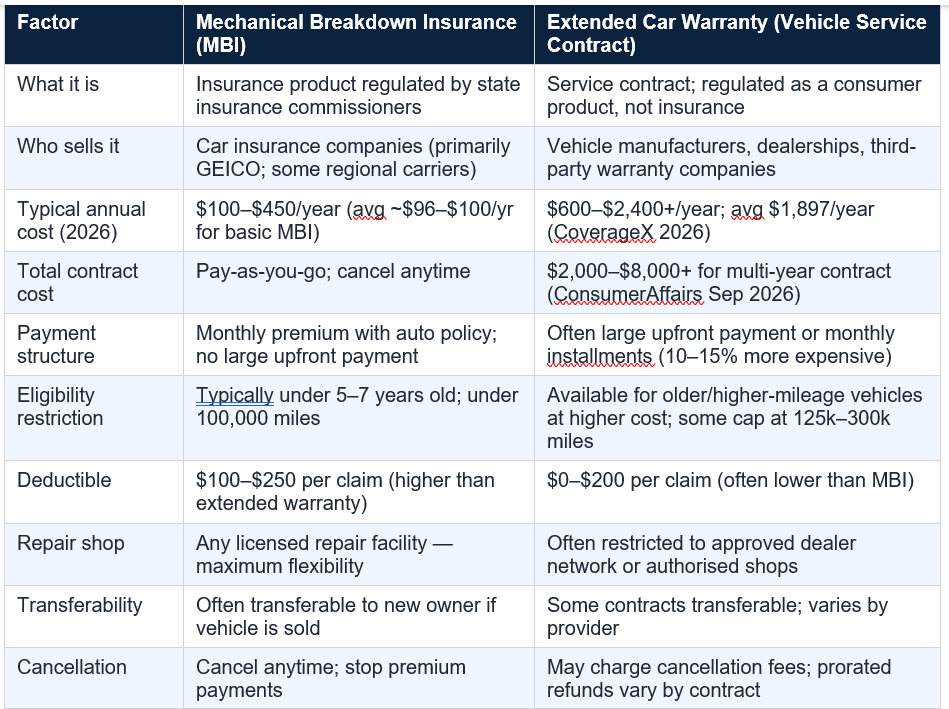
The following table summarises the key differences between MBI and extended warranties for a driver making the decision in 2026.
Cost: MBI vs Extended Warranty in 2026
The cost comparison between MBI and extended warranties is the most dramatic difference between the two products — and the one most likely to determine which is the better financial choice for most drivers.MBI is significantly cheaper. AutoInsurance.org puts the average at approximately $100 annually or $8 per month for a new vehicle. ValuePenguin's research found MBI costs of approximately $180 to $450 for six years — the full policy period — compared to an average initial extended warranty cost of $1,214 for a three-year plan (Consumer Reports, cited ValuePenguin). Car Talk (March 2026) reports that MBI plans for mainstream vehicles can cost as little as $30 to $100 per year.
Extended warranties cost dramatically more. ConsumerAffairs (updated September 4, 2026 — one week before this article) puts extended warranty costs at $600 to $1,000 per year depending on vehicle, coverage level, and provider, with monthly costs ranging from $50 to $125. The average in 2026 per CoverageX data is $1,897 per year. Total multi-year contract cost: typically $2,000 to $5,000 over the life of the plan, with comprehensive coverage reaching $8,000 or more.
The payment structure adds another cost dimension. Extended warranties often require a large upfront payment or monthly installments that cost 10–15% more over the contract life than paying annually or upfront (CoverageX). MBI operates as a premium within your existing auto insurance policy — paid monthly alongside other premiums, with no large lump sum required and the ability to cancel at any time.
One important cost caveat: extended warranties through vehicle manufacturers (Toyota Extended Care, Ford Protect, GM Protection Plans) are typically more competitively priced and more reliably honoured than dealership mark-ups or third-party contracts. If an extended warranty is the right choice, buying directly from the manufacturer or a highly rated direct provider is generally better value than a dealership add-on.
Industry surveys reveal that car owners typically paid more for extended warranty coverage than they received back in direct repair benefits (ConsumerVoice). This does not mean extended warranties are never worth it — for specific vehicles in specific circumstances, they clearly are. But it does mean the average purchaser is paying a premium. For an MBI purchaser on a new vehicle at $100–$200 per year, the break-even on a single major repair is considerably more favourable.
Coverage: What Each Protects
Coverage between MBI and extended warranties is broadly similar in scope for eligible vehicles — but differs in detail, exclusions, and the reliability with which claims are paid.MBI typically covers: engine and all internal components; transmission; drivetrain (differentials, axles, drive shafts); air conditioning and heating; electrical systems; fuel systems; and brakes. It does not cover: routine maintenance, wear-and-tear items (tires, brake pads, wiper blades, filters), cosmetic damage, or accident-related damage (those go through regular auto insurance).
Extended warranties offer tiered coverage: powertrain-only plans (cheapest; covers engine, transmission, drivetrain); mid-level plans add air conditioning, electrical, fuel systems, steering; bumper-to-bumper plans approach factory warranty comprehensiveness. The key consumer protection risk with extended warranties is that the exclusions list (rather than the covered items list) can be more meaningful — some contracts are 'exclusionary' (everything is covered except listed exclusions) while others are 'inclusionary' (only listed components are covered). Inclusionary plans generally provide less comprehensive coverage despite appearing similar.
Read the fine print on exclusions before purchasing either product. Extended warranty exclusions in particular can be extensive: pre-existing conditions (any problem that existed before coverage begins), lack of maintenance (a claim can be denied if records showing oil changes are not provided), consequential damage (if one failed component damages another, some plans won't cover the second), and exclusions for specific high-cost components in your vehicle. The FTC's action against CarShield found that the company overstated coverage and denied claims on grounds not clearly stated in advertising. Always request the actual contract terms before payment.
Eligibility: Who Can Get Each Product
The eligibility difference between MBI and extended warranties is one of the most important practical distinctions — and it largely determines which product is relevant for any given driver.MBI is generally only available for newer, lower-mileage vehicles. ConsumerAffairs puts the typical eligibility at vehicles under five years old with fewer than 100,000 miles. Some providers allow up to seven years old. Importantly, to ensure long-term coverage continuity, MBI typically needs to be purchased while the factory warranty is still active — meaning you are briefly paying for overlapping coverage. AutoInsurance.org notes: 'In order to ensure coverage for the long-term, you would need to begin paying for a MBI policy while your vehicle is already covered under the factory warranty.' Some MBI policies also cover used vehicles but require that coverage begin within 21 days of purchase.
High-value luxury vehicles (Tesla Model S, BMW X7, etc.) may be ineligible for MBI even if they are new — because the repair costs if a claim is made are too high for the MBI premium to be actuarially viable. Car Talk (March 2026) confirms: 'If you own a high-value vehicle, such as a Tesla Model S or BMW X7, you may not be able to purchase an MBI.'
Extended warranties accept a much broader range of vehicles. Older vehicles, higher-mileage vehicles, and luxury vehicles are all typically eligible — at higher prices. Budget Seniors (June 2026) notes that coverage is available for cars with up to 300,000 miles from some providers, though options narrow significantly above 100,000–125,000 miles and prices rise steeply. For drivers whose vehicles are already past the MBI eligibility window, an extended warranty is the only vehicle protection option available.
Repair Shop Flexibility: A Key Practical Difference
One practical difference that significantly affects day-to-day usability is repair shop flexibility.MBI allows you to take your vehicle to any licensed repair facility. ValuePenguin confirms: 'MBI plans tend to have more flexibility in where you can bring your car for repairs.' AutoInsurance.org adds: 'With MBI coverage, you can choose where to take your vehicle for repairs.' This means your trusted local mechanic, a dealer, or any other licensed shop can perform covered repairs.
Extended warranties often restrict repairs to an approved dealer network or authorised repair facilities. This matters most in emergency breakdown situations — if you break down in an unfamiliar area, being restricted to an approved shop list can mean a tow to a specific location rather than the nearest mechanic. Some premium extended warranty plans do offer 'use any licensed shop' flexibility, but this is not universal and should be confirmed before purchase.
The claims process also differs. MBI claims go through your insurance company — the same process as any other insurance claim. Extended warranty claims typically go through the warranty provider directly, which may require pre-authorisation before repairs can begin. Some extended warranty contracts require the mechanic to speak with an adjuster before proceeding, which can slow repair completion.
Deductibles and Claims Process
MBI deductibles are typically higher than extended warranty deductibles — a counterintuitive aspect of the cost comparison. MBI deductibles commonly range from $100 to $250 per repair visit, with some policies offering lower deductibles of $50. ValuePenguin notes that in their research, a GEICO MBI quote carried a $250 deductible that could not be adjusted.Extended warranties often offer deductibles of $0 to $200, with many manufacturer-backed contracts offering $0 or $50 deductibles. Endurance, per ConsumerAffairs, lists deductible options from $0 to $500 across different plan categories. For frequent small repairs, a lower deductible extended warranty could be more cost-efficient than MBI — but for major repairs (the scenario both products are primarily designed for), the deductible is a small fraction of the total claim and matters less than the coverage breadth and claim reliability.
Importantly: with MBI, if a claim is denied, you can file a complaint with your state insurance commissioner — the same well-established regulatory process used for all insurance disputes. With an extended warranty, dispute resolution is less clear-cut. You can file with the FTC (ftc.gov/complaint) or your state attorney general's office, but these processes are slower and less certain of outcome than insurance regulation. This is one of the consumer protection advantages of MBI over vehicle service contracts.
The FTC Warning: What the Industry's Enforcement Record Reveals
Before purchasing any extended warranty from a third-party provider, consumers should understand the enforcement record of the industry. The FTC has taken multiple significant enforcement actions against vehicle service contract companies in recent years, and the pattern reveals systemic issues that extend beyond individual bad actors.In July 2024, CarShield and American Auto Shield agreed to pay $10 million to settle FTC charges. The FTC found misleading claims about coverage, promises of free rental cars, and implications that consumers could use any repair shop — none of which were fully accurate. In December 2025, the FTC began distributing more than $9.6 million in refunds to 168,179 consumers whose CarShield claims had been denied despite paying up to $120 per month for coverage. That is nearly 170,000 people who paid for protection and did not receive it.
ConsumerVoice's analysis is direct: 'Industry surveys revealed that car owners typically paid more for extended warranty coverage than they received back in direct repair benefits.' The FTC advises consumers: 'If you receive an unsolicited offer, verify the company independently before sharing any personal or payment information.'
This does not mean all extended warranties are fraudulent or worthless. Manufacturer-backed plans (Toyota, Ford, GM) and established direct providers with transparent terms and strong customer review records do pay claims and provide genuine value. But the market for vehicle service contracts includes a significant number of providers with problematic practices. Due diligence is essential.
Before purchasing any extended warranty from a third-party provider: (1) search the company on the FTC's website (ftc.gov) and your state attorney general's website for enforcement actions; (2) check the BBB rating and BBB Accreditation status; (3) check ConsumerAffairs and the NAIC complaint database for consumer complaints; (4) request the actual contract — not just the brochure — before making any payment; (5) read the exclusions list carefully, not just the coverage list; (6) confirm repair shop flexibility, claim pre-authorisation requirements, and the exact dispute resolution process. A reputable provider will have clear answers to all of these.
Who Should Choose MBI?
MBI is the better choice IF:: You own a new or nearly new vehicle that is still within MBI eligibility (typically under 5–7 years old and under 100,000 miles). You want the lowest possible annual cost for mechanical failure protection. You want the flexibility to use any licensed repair facility. You prefer monthly premium payments over a large lump-sum or multi-year contract commitment. You value insurance regulatory protection over vehicle service contract regulation. You drive a mainstream vehicle (not a high-value luxury or EV that may be excluded). You are approaching the end of your factory warranty and want to secure continuity before the MBI eligibility window closes.MBI is the financially superior product for eligible vehicles. At $100–$450 per year versus $1,897 per year average for an extended warranty, MBI costs approximately one-fifth as much for broadly similar mechanical failure protection. The trade-off — a higher deductible ($100–$250 versus $0–$100 for some extended warranties) — is rarely material for major repair claims.
The critical timing issue: MBI eligibility is narrow, and it closes permanently once a vehicle exceeds the age or mileage threshold. For drivers approaching the end of their factory warranty period, the window to purchase MBI is closing. Act before the factory warranty expires and before the vehicle crosses the MBI eligibility boundary.
Who Should Choose an Extended Warranty?
An extended warranty is the better choice IF:: Your vehicle is outside MBI eligibility (over 5–7 years old or over 100,000 miles). You prefer a lower deductible per claim ($0–$100 is common for extended warranties). You drive a vehicle with a historically poor reliability record where significant repairs are genuinely likely. You are financing a vehicle and want to roll the warranty cost into the loan (though this adds interest cost over the loan term). You want coverage continuity for an older, out-of-warranty vehicle and are willing to pay the higher price.If choosing an extended warranty, the hierarchy of providers is important: manufacturer-backed plans (Toyota, Ford, GM) are the most reliable and the most clearly regulated; established direct providers with strong BBB ratings and transparent terms come next; dealership-sold third-party contracts are the most likely to involve mark-ups of 100–200% and should generally be avoided or negotiated down significantly.
The economic case for an extended warranty is strongest for vehicles with known reliability issues (certain European luxury brands, some high-mileage American vehicles, certain models with documented transmission or electrical problems) and weakest for historically reliable vehicles (Toyota, Honda, Mazda — which have among the lowest average repair frequencies in independent reliability surveys). For a Toyota Camry or Honda Civic, an extended warranty is rarely worth it statistically. For a European luxury SUV or a vehicle approaching 100,000 miles on a brand with a mixed reliability record, it may well be.
The Self-Insurance Alternative
Both MBI and extended warranties exist to solve the problem of unexpected large repair bills. But there is a third option that financial advisers sometimes recommend, particularly for owners of historically reliable vehicles: self-insurance through a dedicated repair savings fund.The logic: instead of paying $1,897 per year (extended warranty average) or even $200 per year (MBI average) into a provider's pool, deposit that amount monthly into a dedicated high-yield savings account earmarked for car repairs. Over three to five years, the fund builds to $600–$9,485 — enough to cover most major repairs — while earning interest and remaining fully accessible for any repair cost, not just those covered under the warranty's terms.
The self-insurance approach works best when: you own a vehicle with a strong reliability record; you have the financial discipline to maintain the fund and not spend it; and you can absorb a large repair bill in a bad year before the fund is fully established. It works least well when you own a vehicle with known reliability issues, when you have no existing financial buffer, or when the peace of mind value of a guaranteed repair coverage is important to you. Budget Seniors (June 2026) notes that for vehicles with the worst reliability records, 67% of vehicles over 100,000 miles experienced a major repair costing $3,847 on average within 12 months — a level at which self-insurance may be insufficient unless the fund is already well-established.
Conclusion
The comparison between MBI and extended warranties is not a contest where one product universally wins. The right answer depends almost entirely on your vehicle's age, mileage, value, and reliability record.If you own a newer vehicle within MBI eligibility: MBI is almost certainly the better financial choice. It costs a fraction of an extended warranty, offers comparable protection for eligible major mechanical failures, provides greater repair shop flexibility, and is regulated as insurance — giving you stronger consumer protection. The window to purchase MBI is time-limited, so act before your vehicle ages out of eligibility.
If your vehicle is past MBI eligibility: an extended warranty from a reputable provider may provide genuine value, particularly for vehicles with reliability concerns. But read the contract carefully, understand the exclusions, verify the provider's FTC and BBB record, and compare the expected cost of the warranty against the statistical probability of the repairs you would actually claim for. For historically reliable vehicles, self-insurance through a dedicated savings fund may outperform both options financially.
The FTC's $9.6 million refund action in December 2025, covering 168,179 consumers whose CarShield claims were denied, is the most important data point in this comparison. Not because all extended warranties are fraudulent — they are not — but because it confirms that not all providers are equal, that marketing claims must be verified against actual contract terms, and that consumer protection for vehicle service contracts is weaker than for insurance products. When spending $2,000 to $8,000 on any protection product, that due diligence is not optional.
Frequently Asked Questions
What is the main difference between MBI and an extended warranty?MBI (mechanical breakdown insurance) is an insurance product sold by car insurance companies and regulated by state insurance commissioners. An extended warranty (technically a vehicle service contract) is a service contract sold by vehicle manufacturers, dealerships, or third-party companies and regulated as a consumer product, not as insurance. This regulatory difference matters: MBI disputes go through established insurance regulatory channels, while extended warranty disputes rely on the FTC, state attorneys general, and contract law. MBI is typically much cheaper ($100–$450/year vs $1,897/year average for extended warranties in 2026) but has narrower eligibility — generally limited to newer vehicles under 100,000 miles. Extended warranties accept older, higher-mileage vehicles at proportionally higher prices.
How much does MBI cost compared to an extended warranty in 2026?
MBI typically costs $100–$450 per year for eligible vehicles — AutoInsurance.org puts the average at approximately $100 annually or $8 per month for a basic plan on a new vehicle. Car Talk (March 2026) reports that mainstream vehicles can pay as little as $30–$100 per year. Extended warranties cost significantly more: ConsumerAffairs (updated September 4, 2026) puts extended warranty costs at $600–$1,000 per year, with multi-year total contracts typically running $2,000–$5,000 and comprehensive plans reaching $8,000+. The 2026 average per CoverageX is $1,897 per year. For an eligible vehicle, MBI is approximately one-fifth to one-tenth the cost of an extended warranty for broadly similar mechanical failure protection.
What does MBI not cover?
MBI does not cover: routine maintenance (oil changes, tire rotations, air filters, wiper blades); normal wear-and-tear items (brake pads, clutch plates, tires); cosmetic damage; damage from accidents (covered by collision or comprehensive insurance); or damage from poor maintenance. It covers unexpected mechanical failures of covered major components — engine, transmission, drivetrain, air conditioning, electrical systems, and brakes are typically included. High-value luxury vehicles and EVs may be ineligible for MBI entirely, regardless of age or mileage.
Is GEICO the only provider of MBI?
GEICO is the primary nationwide MBI provider in the US market. Some regional car insurance companies offer MBI in specific states — notably California, where olive and some other providers offer MBI policies. Some insurance companies market comparable products under different names. The limited number of MBI providers contrasts sharply with the extended warranty market, which includes dozens of providers from manufacturer-backed plans (Toyota, Ford, GM) to large third-party companies (Endurance, CarShield, CARCHEX) to many smaller regional providers. The extended warranty market's competitive abundance is also part of why consumer protection varies so widely — there is significant variation in claim payment rates, coverage quality, and business practices across the provider landscape.
Should I buy an extended warranty at the dealership?
Generally, no — or at least not without significant scrutiny and price negotiation. Dealerships typically mark up extended warranties by 100–200% over the cost of the same product purchased directly from the manufacturer or provider (CoverageX). The same coverage purchased directly from Toyota Financial Services (for a Toyota), Ford Motor Company (for a Ford), or a reputable direct provider will typically cost significantly less than the dealership version. Additionally, dealership salespeople often present extended warranties as urgent additions at the point of sale, when you have the least time to research or compare. Always request the actual contract terms, take it home to review, and compare prices from multiple sources before committing. Saying no at the dealership and researching later is almost always the right approach.
Are extended warranties worth it in 2026?
It depends on your specific vehicle. Industry surveys cited by ConsumerVoice show that car owners typically paid more for extended warranty coverage than they received back in direct repair benefits — meaning the average extended warranty does not pay off financially for the average buyer. However, averages conceal wide variation: for a vehicle with a known reliability problem, a pending transmission or engine issue, or a repair record that suggests high future costs, an extended warranty may well pay for itself. The key factors: (1) your vehicle's reliability record (use independent sources like Consumer Reports); (2) the specific exclusions in the contract you are offered; (3) the provider's claim payment record (check FTC.gov, BBB, and ConsumerAffairs); (4) whether you can self-insure through a dedicated savings fund. For historically reliable vehicles (Toyota, Honda, Mazda), self-insurance typically outperforms an extended warranty financially. For vehicles with mixed reliability records, the calculation is more balanced.

0 Comments Comments