
Security
Nvidia Board Probes Jensen Huang: What Investors Should Know

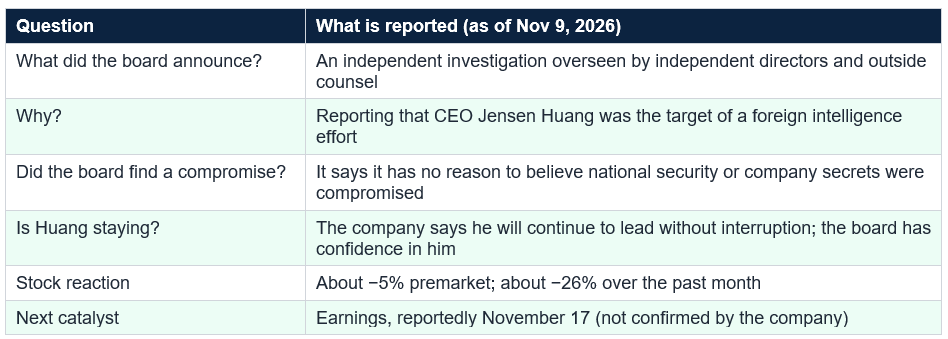
The announcement: on Sunday, November 8, 2026, Nvidia’s board said it was starting an independent investigation, overseen by a committee of independent directors with outside counsel, after reports that CEO Jensen Huang had been the target of a foreign intelligence effort; it said it has no reason to believe national security or company secrets were compromised and has confidence in Huang; the company said he will continue to lead without interruption. The market (November 9): Nvidia about $176.76 premarket, down about 5% and about 26% over the past month; AMD up about 4%, Broadcom 3%, TSMC 2% and Intel 0.4% in premarket trading; the stock had closed at $200.13 around November 5 (my arithmetic: about 11.7% lower); revenue guidance for the quarter is $108 billion, plus or minus 2%; earnings reportedly November 17 (unconfirmed). My arithmetic: a 5% drop on $10,000 costs $500 and needs a 5.3% gain to recover; 10% costs $1,000 and needs 11.1%; 26% costs $2,600 and needs 35.1%; the $108 billion guidance is about 58% above the $68.13 billion revenue of Q4 of fiscal 2026.
For an investor, a headline like that raises two questions at once: how serious is the underlying matter, and how much does it matter to the value of the company? This guide sets out what Nvidia and credible outlets have reported, what is not yet known, how the stock has reacted and how to think about key-person risk, without speculating about private lives or unproven allegations.
In his email to staff, obtained by CNBC, Huang wrote that leading Nvidia is the privilege of his life, said he supports the investigation and will cooperate fully, and apologized for a personal failing, saying he had fallen short of his responsibility to colleagues, the board, partners and shareholders. The company separately told CNBC that today’s news will not slow Nvidia and that Huang is committed to continuing to lead as CEO without interruption. I am not going to characterize the personal matter. For investors, the relevant facts are the board’s process and its stated confidence.
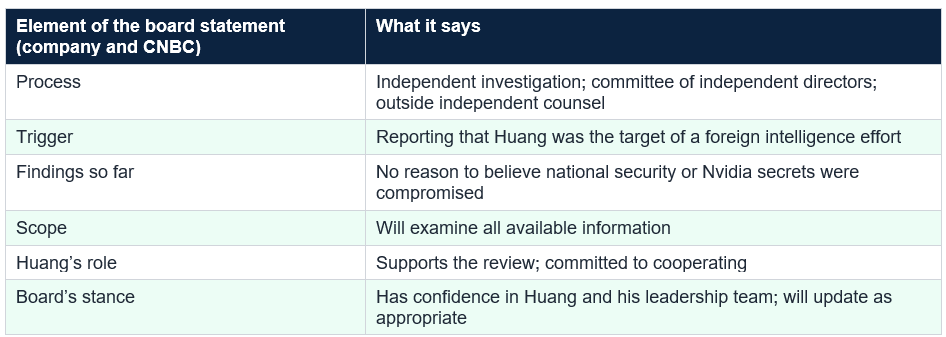
Nvidia board statement, November 8, 2026: independent investigation overseen by independent directors with outside counsel; no reason to believe national security or company secrets were compromised; confidence in Huang and his team. Shares: about −5% premarket on Nov 9, about −26% over the past month. Guidance: $108 billion ±2%. Earnings reportedly Nov 17.
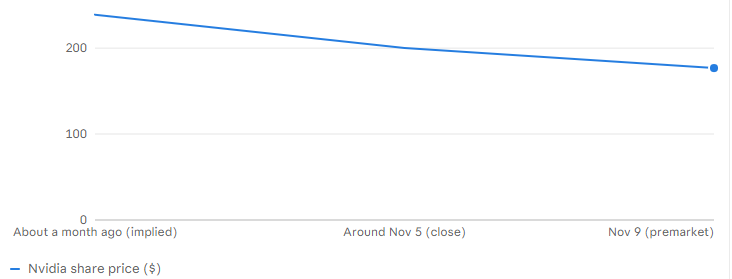
We also do not know whether any regulator will take an interest, or how customers, partners and governments will respond; none of the sources I retrieved report such steps. And we do not know how much of Monday’s fall reflects this story versus the broader chip-stock sell-off already underway: Nvidia had slipped below $200 around November 5 and was down about 26% over the month. Be wary of anyone who claims certainty.
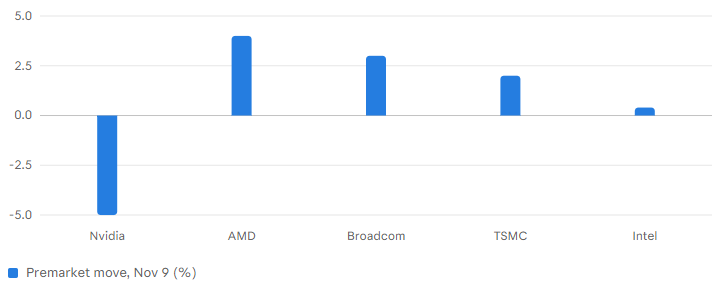
The reaction was specific to Nvidia. In premarket trading, AMD rose about 4%, Broadcom about 3%, TSMC about 2% and Intel about 0.4%, which 24/7 Wall St. read as evidence that the sell-off targeted Nvidia’s key-person risk, not the whole sector. Later quotes on the same page showed Nvidia down about 4.7% while AMD, Broadcom and TSMC were up much more strongly, and the broad market indexes shown were up 2% to 3%, though I do not know the time of those quotes. The pattern suggests investors were rotating within chips, not leaving them.

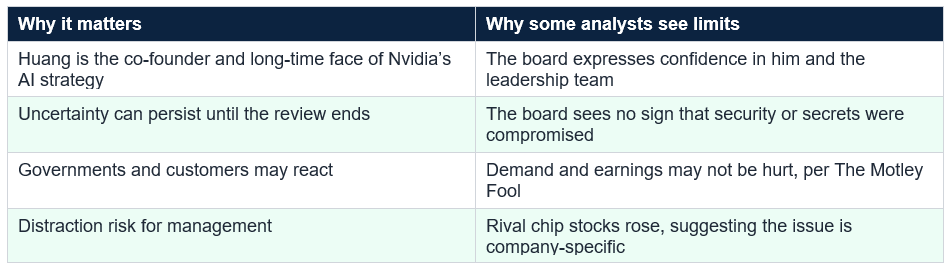
There are reasons for perspective. The board has said it has confidence in Huang and the leadership team, and although 24/7 Wall St. raised the hypothetical question of whether CFO Colette Kress would step in, nothing in the sources suggests a change is planned. Reasons for caution: a prolonged investigation can distract management, affect relationships with customers and governments and weigh on the valuation through a higher risk premium, and whether that is a temporary discount or a lasting one depends on facts we do not yet have.
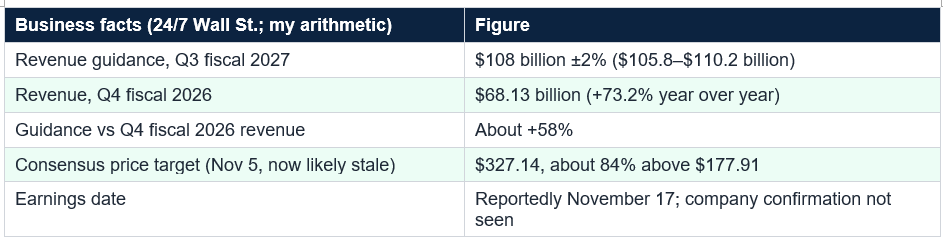
The report reportedly due November 17 will be the first chance for the company to address the investigation with shareholders. I would watch what management says about the review, any change in guidance, comments on China and export rules and the tone on demand. On November 5, before the news, the consensus price target was $327.14, about 84% above the current price in my arithmetic, though targets are slow to change. Fundamentals and sentiment can diverge for a while.
Nvidia already operates in a sensitive area: its chips are central to US export controls and to the AI competition with China, which I note from general knowledge. That is why a national security angle can matter beyond the personal story. For investors, the practical point is that the review could intersect with policy in ways that are hard to predict. Watch for any government statements and for what Nvidia says about its dealings in China at earnings.
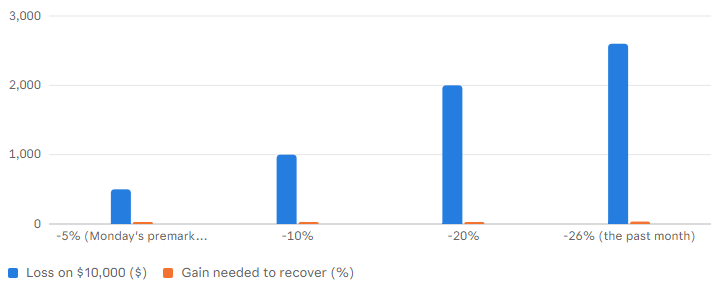
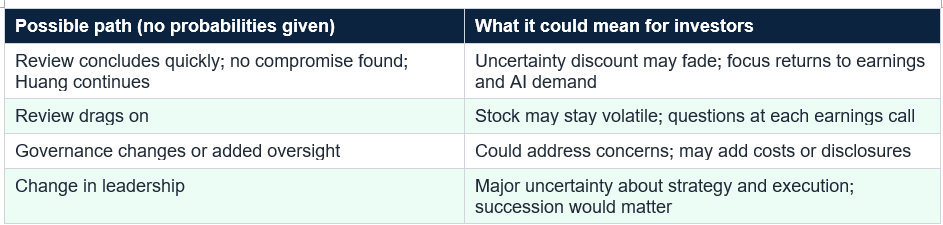
Each path has different implications and none is certain. Avoid assuming any particular outcome and ask which of your holdings and plans would be hurt by each: if a 10% or 20% decline in one stock would damage your finances, the lesson is about position size, not guessing the news.
Fourth, match your decision to your plan and time horizon, not the news cycle: if you invest for decades through a diversified fund, one stock’s week matters little, but if you hold a concentrated position, ask whether it is too large. Fifth, watch the catalysts: the earnings call, board updates and any government statements. And avoid assuming the worst because the headline is dramatic, or that nothing matters because the business is strong.

This is a developing story with real unknowns. A company’s strong guidance does not remove governance uncertainty, and an investigation’s outcome cannot be predicted. Never make decisions with money you cannot afford to see fall, and check for updates from the company before acting. Common mistakes include trading on a headline within minutes, treating allegations as findings, assuming a drop is a bargain or a sign of doom, forgetting how much Nvidia you hold through funds, ignoring position size, relying on stale price targets and spreading rumors. A leadership question is also not a demand problem, and the market may weigh them differently over time.
The business signals are separate and, so far, unchanged: guidance of about $108 billion of quarterly revenue, strong demand commentary and earnings reportedly due November 17. What is unknown is how long the review will last and what it will find. For investors, the answer is to stay informed, know how much Nvidia you really own, size positions so a further drop would not hurt and avoid decisions based on rumor.
In a statement dated November 8, 2026, the board said it is starting an independent investigation in light of reporting that CEO Jensen Huang has been the target of a foreign intelligence effort. A committee of independent directors, assisted by outside independent counsel, will oversee it. The board said it has no reason to believe national security or Nvidia secrets were compromised, that Huang supports the review and that it has confidence in him and his team.
Is Jensen Huang leaving Nvidia?
Nothing I found says so. The company told CNBC that Huang is committed to continuing to lead Nvidia as CEO without interruption, and the board has expressed confidence in him. But the investigation is open, and analysts quoted in the press describe his future as a source of uncertainty. I cannot predict the outcome, and this story is developing.
Did Nvidia’s stock fall because of the investigation?
Nvidia shares fell about 5% in premarket trading on Monday, November 9, according to 24/7 Wall St., and CNBC reported a drop of about 5% as investors weighed leadership risk. The stock had already fallen about 26% over the past month amid a broader chip-stock sell-off, so the investigation is one factor among several, and I cannot isolate its effect.
Is the stock a buy or a sell now?
I cannot tell you, and nobody can know how the investigation will end. What is knowable is that the company’s business guidance and the investigation are separate issues: Nvidia guided to about $108 billion of revenue for the quarter, while the board review adds uncertainty about leadership. Position size, time horizon and diversification matter more than any single call. This is general education, not personal advice.
When does Nvidia report earnings?
Nvidia’s next report is reportedly scheduled for November 17, according to 24/7 Wall St., though the company had not confirmed the date in the article I retrieved. Shareholders may press management on the board review and Huang’s role then. Check Nvidia’s investor relations site for the confirmed date and time.
Table of Contents
- What Happened
- The Short Answer
- What the Board and Huang Said
- What We Do Not Know
- How the Stock Reacted
- Why Key-Person Risk Matters
- The Business Behind the Headlines
- The China and Geopolitics Angle
- Possible Paths From Here
- What Investors Can Do
- Common Mistakes
- Conclusion
- Frequently Asked Questions
A company-specific reaction: premarket moves in chip stocks, November 9 (%)
Premarket change (%) by 24/7 Wall St. premarket quotes on the morning of Nov 9 (NVDA $176.76, AMD $464.96, AVGO $302.58, TSM $382, INTC $56.50); later quotes on the same page showed larger moves; prices have changed
Position sizing: the cost of a drop on a $10,000 holding and the gain needed to recover
Dollars lost ($) and gain needed (%) by Author's arithmetic: gain needed = 1 / (1 - loss) - 1; dollars and percent shown on one axis; illustrates why position size matters, not a forecast for Nvidia
Nvidia's slide: about a month ago (implied), around Nov 5 and Nov 9 premarket ($)
Share price ($) by Reported: $200.13 close (Nov 5) and $176.76 premarket (Nov 9), with the stock down about 26% over the month (24/7 Wall St.); the first point is the author's implied level: $176.76 / (1 - 0.26) = about $238.90; approximate
What Happened
On Sunday afternoon, November 8, Nvidia’s board of directors put out a short statement that landed hard on Wall Street. It said the board was starting an independent investigation in light of recent reporting that founder and CEO Jensen Huang had been the target of a foreign intelligence effort. Within hours, CNBC published an email Huang had sent to staff in which he apologized for a personal matter and said he would cooperate fully with the review. On Monday, the shares fell about 5% in early trading.For an investor, a headline like that raises two questions at once: how serious is the underlying matter, and how much does it matter to the value of the company? This guide sets out what Nvidia and credible outlets have reported, what is not yet known, how the stock has reacted and how to think about key-person risk, without speculating about private lives or unproven allegations.
The Short Answer
Nvidia’s board has opened an independent investigation, overseen by independent directors with outside counsel, into reports that CEO Jensen Huang was targeted by a foreign intelligence effort. The board says it has no reason to believe national security or company secrets were compromised and that it has confidence in Huang, who is cooperating. The shares fell about 5% premarket on November 9 and are down about 26% over the past month, though that decline also reflects a broader chip-stock sell-off. The immediate risk is uncertainty about leadership, not a change in demand, and the company’s guidance of $108 billion in quarterly revenue is unchanged. How long the review takes and what it finds are unknown.
What the Board and Huang Said
The board’s statement is brief, and its wording is worth reading closely. It says a committee of independent directors, assisted by outside independent counsel, will oversee the investigation. It says the board has no reason to believe that either national security or Nvidia secrets were compromised, but that the inquiry will examine all available information. It also says Huang fully supports the review and has committed to cooperating, and that the board has confidence in Huang and his leadership team and will provide further updates as appropriate.In his email to staff, obtained by CNBC, Huang wrote that leading Nvidia is the privilege of his life, said he supports the investigation and will cooperate fully, and apologized for a personal failing, saying he had fallen short of his responsibility to colleagues, the board, partners and shareholders. The company separately told CNBC that today’s news will not slow Nvidia and that Huang is committed to continuing to lead as CEO without interruption. I am not going to characterize the personal matter. For investors, the relevant facts are the board’s process and its stated confidence.
Nvidia board statement, November 8, 2026: independent investigation overseen by independent directors with outside counsel; no reason to believe national security or company secrets were compromised; confidence in Huang and his team. Shares: about −5% premarket on Nov 9, about −26% over the past month. Guidance: $108 billion ±2%. Earnings reportedly Nov 17.
What We Do Not Know
A lot is unknown, and it is better to say so. We do not know how long the investigation will take, what it will examine beyond the reports that triggered it, what it will conclude or whether it will change Huang’s role; the board will provide updates as appropriate. We do not know whether the reported allegations about the other person are accurate: China’s Foreign Ministry has called the spy allegation unsubstantiated, according to Bloomberg as cited by 24/7 Wall St., and I cannot verify either side.We also do not know whether any regulator will take an interest, or how customers, partners and governments will respond; none of the sources I retrieved report such steps. And we do not know how much of Monday’s fall reflects this story versus the broader chip-stock sell-off already underway: Nvidia had slipped below $200 around November 5 and was down about 26% over the month. Be wary of anyone who claims certainty.
How the Stock Reacted
Nvidia stock traded at about $176.76 premarket on Monday, down about 5%, according to 24/7 Wall St. In my arithmetic, that is about 11.7% below the $200.13 close reported around November 5, and the stock was down about 26% over the past month, according to the same outlet. Dan Ives of Yorkville Ives called it a black eye moment for Huang, according to CNBC. Deutsche Bank’s Jim Reid said concerns about the internal investigation were capping gains in Asian equities, as Fortune reported.The reaction was specific to Nvidia. In premarket trading, AMD rose about 4%, Broadcom about 3%, TSMC about 2% and Intel about 0.4%, which 24/7 Wall St. read as evidence that the sell-off targeted Nvidia’s key-person risk, not the whole sector. Later quotes on the same page showed Nvidia down about 4.7% while AMD, Broadcom and TSMC were up much more strongly, and the broad market indexes shown were up 2% to 3%, though I do not know the time of those quotes. The pattern suggests investors were rotating within chips, not leaving them.
Why Key-Person Risk Matters
Key-person risk is the chance that a company’s value depends on one individual whose departure or distraction would hurt. The Motley Fool notes that Nvidia’s successes are often seen as linked to one person, and Ives called Huang the core DNA of Nvidia and not replaceable, as reported. Huang co-founded the company and has led it as CEO throughout its rise, which is why the market treats a governance question about him differently than one about an ordinary executive.There are reasons for perspective. The board has said it has confidence in Huang and the leadership team, and although 24/7 Wall St. raised the hypothetical question of whether CFO Colette Kress would step in, nothing in the sources suggests a change is planned. Reasons for caution: a prolonged investigation can distract management, affect relationships with customers and governments and weigh on the valuation through a higher risk premium, and whether that is a temporary discount or a lasting one depends on facts we do not yet have.
The Business Behind the Headlines
It helps to separate the investigation from the operating business. Nvidia’s guidance for the third quarter of fiscal 2027 called for revenue of $108 billion, plus or minus 2%, which is a range of about $105.8 billion to $110.2 billion, and about 58% above the $68.13 billion it reported for the fourth quarter of fiscal 2026, when revenue was up 73.2% from a year earlier, according to 24/7 Wall St. On the August 26 earnings call, Huang said the entire supply chain is challenged and everybody is running flat out, a sign of strong demand that is not changed by the board review.The report reportedly due November 17 will be the first chance for the company to address the investigation with shareholders. I would watch what management says about the review, any change in guidance, comments on China and export rules and the tone on demand. On November 5, before the news, the consensus price target was $327.14, about 84% above the current price in my arithmetic, though targets are slow to change. Fundamentals and sentiment can diverge for a while.
The China and Geopolitics Angle
The story has a geopolitical edge. China’s Foreign Ministry spokesman called the allegation unsubstantiated and smears against China, according to Bloomberg as cited by 24/7 Wall St. Bloomberg also reported the episode could complicate a meeting between Chinese President Xi Jinping and President Trump at the APEC summit in Shenzhen next week, and Reuters reported a planned Korea event involving a senior Nvidia director was canceled for unavoidable internal circumstances, while Nvidia’s AI Day Seoul is proceeding. On November 9, Nvidia also announced a sovereign AI partnership with SK Telecom and Rebellions, showing that business continues.Nvidia already operates in a sensitive area: its chips are central to US export controls and to the AI competition with China, which I note from general knowledge. That is why a national security angle can matter beyond the personal story. For investors, the practical point is that the review could intersect with policy in ways that are hard to predict. Watch for any government statements and for what Nvidia says about its dealings in China at earnings.
Possible Paths From Here
Nobody knows how this ends, but it helps to think in scenarios without assigning probabilities. The review could conclude quickly with no finding of a compromise and Huang continuing as CEO, in which case the uncertainty discount might fade; it could take longer, leaving the stock under a cloud into earnings and beyond; it could lead to governance changes such as added oversight; or it could lead to a change in Huang’s role, which analysts quoted in the press describe as the clear worry.Each path has different implications and none is certain. Avoid assuming any particular outcome and ask which of your holdings and plans would be hurt by each: if a 10% or 20% decline in one stock would damage your finances, the lesson is about position size, not guessing the news.
What Investors Can Do
First, do not react to a headline alone: read the board statement and primary reporting, and treat commentary, including this article, as context. Second, know your exposure: many people own Nvidia through index and tech funds as well as directly, where it can be a large holding (general knowledge). Third, think about position size: in my arithmetic a 5% fall on $10,000 costs $500 and needs a 5.3% gain to recover, a 10% fall costs $1,000 and needs 11.1% and a 26% fall, like the past month, costs $2,600 and needs 35.1%.Fourth, match your decision to your plan and time horizon, not the news cycle: if you invest for decades through a diversified fund, one stock’s week matters little, but if you hold a concentrated position, ask whether it is too large. Fifth, watch the catalysts: the earnings call, board updates and any government statements. And avoid assuming the worst because the headline is dramatic, or that nothing matters because the business is strong.
This is a developing story with real unknowns. A company’s strong guidance does not remove governance uncertainty, and an investigation’s outcome cannot be predicted. Never make decisions with money you cannot afford to see fall, and check for updates from the company before acting. Common mistakes include trading on a headline within minutes, treating allegations as findings, assuming a drop is a bargain or a sign of doom, forgetting how much Nvidia you hold through funds, ignoring position size, relying on stale price targets and spreading rumors. A leadership question is also not a demand problem, and the market may weigh them differently over time.
Conclusion
Nvidia’s board has opened an independent investigation, overseen by independent directors with outside counsel, after reports that CEO Jensen Huang was targeted by a foreign intelligence effort. The board says it has no reason to believe national security or company secrets were compromised and that it has confidence in Huang, who is cooperating. Shares fell about 5% premarket on November 9, to roughly $177, and are down about 26% over the month, while AMD, Broadcom and TSMC rose, suggesting a company-specific concern about key-person risk.The business signals are separate and, so far, unchanged: guidance of about $108 billion of quarterly revenue, strong demand commentary and earnings reportedly due November 17. What is unknown is how long the review will last and what it will find. For investors, the answer is to stay informed, know how much Nvidia you really own, size positions so a further drop would not hurt and avoid decisions based on rumor.
Frequently Asked Questions
What has Nvidia’s board actually announced?In a statement dated November 8, 2026, the board said it is starting an independent investigation in light of reporting that CEO Jensen Huang has been the target of a foreign intelligence effort. A committee of independent directors, assisted by outside independent counsel, will oversee it. The board said it has no reason to believe national security or Nvidia secrets were compromised, that Huang supports the review and that it has confidence in him and his team.
Is Jensen Huang leaving Nvidia?
Nothing I found says so. The company told CNBC that Huang is committed to continuing to lead Nvidia as CEO without interruption, and the board has expressed confidence in him. But the investigation is open, and analysts quoted in the press describe his future as a source of uncertainty. I cannot predict the outcome, and this story is developing.
Did Nvidia’s stock fall because of the investigation?
Nvidia shares fell about 5% in premarket trading on Monday, November 9, according to 24/7 Wall St., and CNBC reported a drop of about 5% as investors weighed leadership risk. The stock had already fallen about 26% over the past month amid a broader chip-stock sell-off, so the investigation is one factor among several, and I cannot isolate its effect.
Is the stock a buy or a sell now?
I cannot tell you, and nobody can know how the investigation will end. What is knowable is that the company’s business guidance and the investigation are separate issues: Nvidia guided to about $108 billion of revenue for the quarter, while the board review adds uncertainty about leadership. Position size, time horizon and diversification matter more than any single call. This is general education, not personal advice.
When does Nvidia report earnings?
Nvidia’s next report is reportedly scheduled for November 17, according to 24/7 Wall St., though the company had not confirmed the date in the article I retrieved. Shareholders may press management on the board review and Huang’s role then. Check Nvidia’s investor relations site for the confirmed date and time.
0 Comments
Be the first to share your thoughts on this article.