
Spending
Overcharged at Checkout? How to Spot Pricing Errors

Most people do not check their receipt. They push the trolley to the car, toss the bag in the back seat, and drive home. Somewhere between the shelf and the statement, they paid more than they should have. Scanner pricing errors are far more common than retailers would like you to know about: the North Carolina Department of Agriculture and Consumer Services found that approximately 26% of price scanner inspections resulted in failures. In the same year its annual pricing-error fines went from $40,000–50,000 to half a million dollars. The agency’s own inspector described it as ‘a total explosion of price scanning mistakes.’ Auditors in Ohio found Dollar General stores overcharging on up to 88% of items at some locations. In a single grocery trip in New Zealand in 2026, a shopper found 26 pricing errors. And pricing errors at Kroger stores in Ohio were found to favour the retailer nearly three times as often as the shopper. This is not an edge case. It is a pattern. This article tells you exactly how to catch it, what you are owed when it happens, and what to do if the store pushes back.
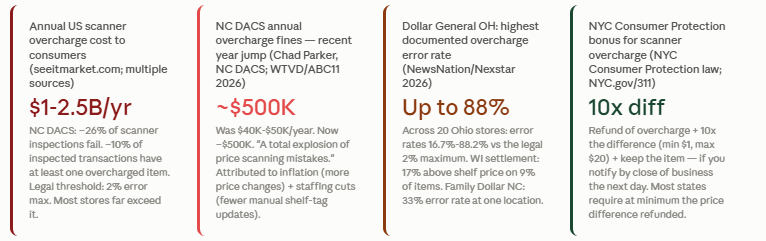
The scale of individual store non-compliance is striking. The NC Department of Agriculture and Consumer Services Standards Division — one of the few agencies that publishes detailed scanner accuracy enforcement data — found that approximately 26% of its price scanner inspections resulted in failures. In roughly 10% of all inspected cases, at least one item was overcharged. The agency’s own inspector, Chad Parker, described the recent trend as ‘a total explosion of price scanning mistakes,’ with annual fines jumping from a historic $40,000–50,000 per year to approximately half a million dollars in a recent enforcement year (WTVD/ABC11, 2026). And the NC agency is not alone: when New York City’s Department of Consumer Affairs conducted unannounced inspections of close to 2,000 supermarkets, 59% had violations that led to consumer overcharges.
The law in most US states requires stores to maintain a scanner accuracy rate of at least 98% — meaning no more than one overcharge in every 50 items purchased. The real-world numbers at many chains are dramatically worse. Not a legal analysis; verify current rules in your state or country.
Checkout pricing error scale: $1-$2.5B/year in US scanner overcharges (seeitmarket.com). 26% of NC DACS price scanner inspections: failures (NC DACS data). 10% of cases: at least one item overcharged (NC DACS). NC annual fines: jumped from $40K-$50K to ~$500K in one year — 'total explosion' (Chad Parker, NC DACS, WTVD/ABC11 2026). 59% of ~2,000 NYC supermarkets had overcharge violations (NYC DCA). Kroger OH: 644 incorrect prices in 389 inspections across 101 stores (ConsumerAffairs September 2026). Dollar General OH: 16.7%-88.2% error rates at 20 stores (NewsNation 2026). Legal threshold: 2% error rate (most US states). Sources cited. Not legal advice.
The most common cause in 2025 and 2026 is a digital price update that never makes it to the physical shelf. As Chad Parker from NC DACS explained to WTVD/ABC11 in 2026: ‘These prices are downloaded digitally automatically to their scanning system, and then it’s the manager or the employees’ job to go out there and manually pull the price tags off the shelf and put the new ones on, and if they don’t do it, then the system is updated, but those tags are old.’ The scanner charges you the new price; the shelf shows the old price. You see $2.99 on the shelf and pay $3.49 at the register. No one meant to cheat you. The update system and the physical tag update simply did not sync. The error is real, the overcharge is real, and the remedy is simple — if you catch it.
The other six root causes in order: sale prices not programmed into the scanner (the ad shows 30% off; the system still charges full price); double scanning (a single item scanned twice by a rushed cashier or a self-checkout sensor error); wrong product codes associated with items of similar appearance; app coupons that are clipped but not reliably applied at checkout; items sold by weight measured or coded incorrectly; and technical glitches during system updates, as documented in the July 2026 Consumer NZ case in which a single shopper found 26 errors in one transaction due to a software issue (Consumer NZ, July 2026).
The most significant self-checkout error vectors: items placed near but not fully on the scale can trigger an incorrect weight reading on produce and deli items; foreign objects left on the scale edge — a bag, a loyalty card, another item — can add phantom weight; app coupons require the app to have been correctly linked to the transaction before items are scanned (ConsumerAffairs September 2026); and without the natural scanning rhythm of a cashier, items can accidentally pass the scanner twice. Marin County officials in California specifically advise shoppers to check the edges of the self-checkout scale before placing items on it (NewsNation/Nexstar, 2026).
Consumer journalist Wendy Knowler, speaking on CapeTalk in April 2025, also flagged that the natural distraction of managing your own scanning and bagging reduces the likelihood of catching a price discrepancy in real time. The practical implication: self-checkout requires more active attention to the screen, not less, because the error safety net has been removed.
The LA County Department of Consumer and Business Affairs makes the baseline rule explicit: ‘Stores must honor a posted price, even if the price has expired.’ This is important: a shelf tag showing a sale price that the store claims ended yesterday is still the price you are owed, because it was the price posted when you selected the item. This applies whether the error was on the shelf side or the scanner side.
Your core legal entitlements (US — verify in your jurisdiction): (1) You are entitled to the LOWEST advertised or posted price. (2) A posted shelf price must be honoured, even if the sale has expired. (3) Legal scanner accuracy standard: 98% (2% error maximum). Most states require the difference to be refunded. Some states/cities require additional compensation. NYC: refund + 10x the difference (min $1, max $20) + keep the item. TX: stores face up to $500/day civil penalty per violation. Sources: LA County DCBA; Springfield MA; FTC; NYC Consumer Protection; AZ AG; NBC DFW. Not legal advice. Verify current law in your state.
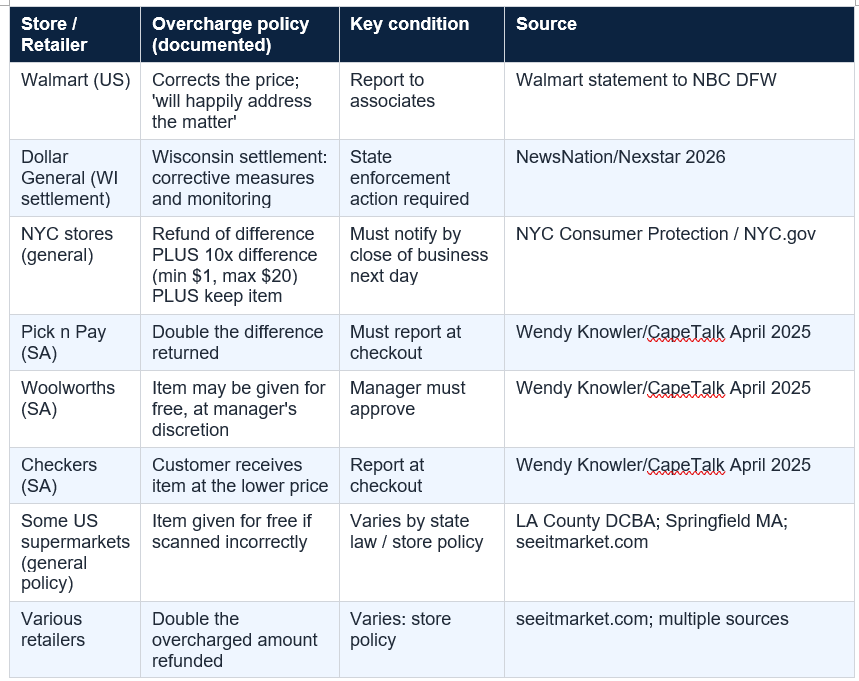
The practical takeaway: always ask the customer service desk about the store’s specific overcharge policy. The legal minimum is a refund of the difference. But many stores — especially when approached calmly and with a clear receipt and evidence of the correct price — offer more than the minimum to maintain goodwill. Not legal advice.
Dollar General’s record is particularly striking. Ohio auditors found error rates between 16.7% and 88.2% at 20 Dollar General stores in the state — well above the 2% legal standard. In Wisconsin, Dollar General entered a settlement with the state Department of Agriculture after being found to overcharge customers by an average of 17% above shelf price on 9% of items. In one Family Dollar location in North Carolina (Family Dollar is owned by Dollar Tree, a related chain), a single inspection found an overcharge error rate of 33% (NewsNation/Nexstar, 2026).
Walmart has also faced significant enforcement actions: North Carolina’s DACS collected fines from dozens of Walmart stores for pricing errors in 2022. A separate University of Illinois and University of California-Berkeley study found that Walmart stores in California, Illinois, Indiana, and Michigan scanned the wrong price as often as 8.3% of the time, with 87% of California Walmart locations exceeding the 2% error standard (Arizona AG, citing those studies). These are not isolated incidents; they reflect the systemic risk inherent in managing millions of SKUs across thousands of locations. Not a legal accusation; this describes documented enforcement actions.
In the past year there has been a total explosion of price scanning mistakes.' — Chad Parker, Standards Division, NC Department of Agriculture and Consumer Services, cited WTVD/ABC11 2026. Parker attributed the increase to inflation and staffing problems: higher product turnover and more frequent price changes require more shelf-tag updates, while reduced staffing makes manual updates less reliable. This structural problem is not going away.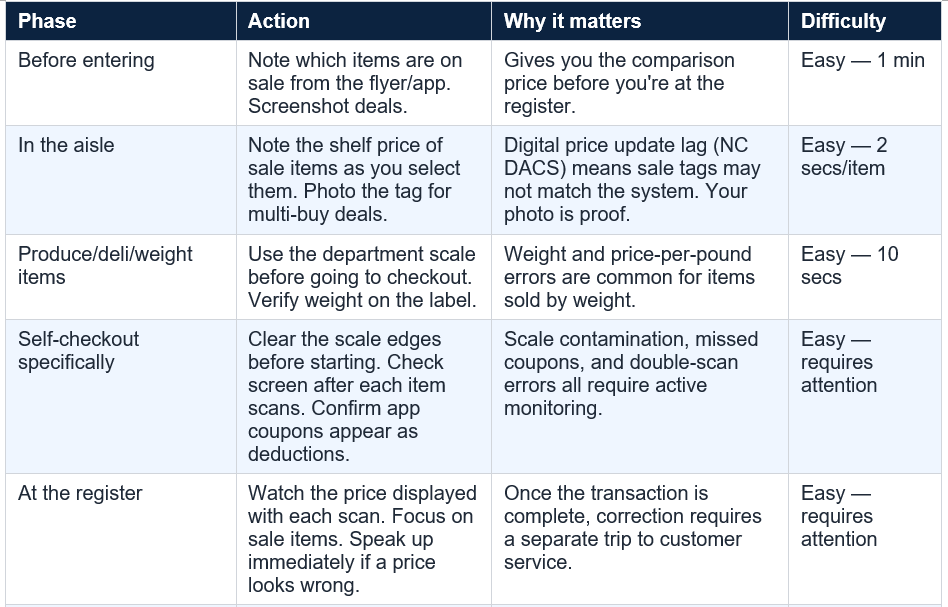
The good news is that this does not require paranoia, an itemised memory, or a degree in retail pricing. It requires watching the screen for a few seconds as your items are scanned, reviewing your receipt before you leave the store parking lot, and knowing that when you find an error, the law is on your side. You are entitled to the price that was posted. Most stores will correct it without drama. Some will offer more than the minimum. And if they do not, the regulatory agencies that fine stores half a million dollars for this kind of systemic error are exactly one phone call or online complaint away.
Take the receipt. Read it. The scanner is only as accurate as the humans and systems behind it — and right now, those humans and systems are making a lot of mistakes.
More common than most shoppers realise. The NC Department of Agriculture and Consumer Services Standards Division found that approximately 26% of its price scanner inspections resulted in failures, with at least one overcharged item in roughly 10% of all inspected transactions (NC DACS data, cited multiple 2026 sources). The agency's inspector described 2025-2026 as 'a total explosion of price scanning mistakes,' with annual fine totals jumping from $40,000-$50,000 to approximately $500,000. A New York City Department of Consumer Affairs inspection of close to 2,000 supermarkets found 59% had violations leading to consumer overcharges. Individual store error rates documented in enforcement actions have ranged from 4% (above the 2% legal standard) to over 33% (Family Dollar NC) and even 88% (Dollar General OH). Consumers are estimated to lose $1-$2.5 billion annually to scanner errors (seeitmarket.com). Sources: WTVD/ABC11 2026; NC DACS; NYC DCA; NewsNation 2026; seeitmarket.com.
Am I legally entitled to a refund if a store overcharges me at checkout?
Yes, as a baseline right in most US jurisdictions. You are entitled to be charged the lowest advertised or posted price (LA County DCBA; Springfield MA; FTC). Stores must honour a posted price even if the sale has technically expired (LA County DCBA). The legal minimum remedy is a refund of the difference between what you were charged and what the posted price was. Many jurisdictions require more: in New York City, the Consumer Protection law requires a refund of the overcharge plus ten times the difference (minimum $1, maximum $20) if you notify the store by close of business the day after the purchase (NYC Consumer Protection / NYC.gov). In Texas, stores can face civil penalties of up to $500 per violation per day for scanner errors (NBC DFW). The federal standard requires 98% scanner accuracy. Not legal advice — verify current rules with your state's Department of Agriculture, Weights and Measures, or Attorney General's office.
What should I do if I notice an overcharge at the register?
Speak up immediately — before the transaction is completed if possible. Say to the cashier: 'This item should be [price] — it's on sale. Can you check?' Most cashiers will pause the transaction, call a supervisor, or manually override the price. If you are at self-checkout, press the 'call for help' button and show the screen price versus what you saw on the shelf. If you have a shelf tag photo or the store's flyer on your phone, show it. If the cashier disputes it, ask to speak to a manager. Do not let the transaction complete without addressing the error if you can help it — correcting a completed transaction requires a separate trip to customer service. If the price is corrected during the transaction, you are done. If not, keep your receipt, note the price you were charged, and document the posted price (photo if possible) before you leave the store. Sources: FTC; Springfield MA; LA County DCBA; NC DACS/WTVD 2026.
Why do pricing errors happen so often?
The most common cause in 2025-2026, according to the NC Department of Agriculture's Standards Division, is a digital price update that does not sync with the physical shelf tag. As inspector Chad Parker explained: prices are downloaded digitally to the scanner system, but a manager or employee must then manually replace the physical shelf tags. If the manual step is not completed, the scanner charges the new (often higher) price while the shelf still shows the old (lower) price. Additional causes: sale prices not programmed into the scanner system; double scanning (an item scanned twice); wrong product codes; app coupons that are clipped but not applied; weight errors on items sold by the pound; and technical glitches during system updates. The Consumer NZ July 2026 case of 26 errors in a single shop was attributed to a 'technical issue during a Shop & Go transaction' (Foodstuffs statement). Sources: Chad Parker/WTVD/ABC11 2026; Consumer NZ July 2026; Retail Insider/Nelson Voice; ConsumerAffairs September 2026.
Which stores have the worst pricing error records?
Based on documented enforcement actions and inspection data: Dollar General: Ohio auditors found error rates between 16.7% and 88.2% at 20 Dollar General stores (NewsNation/Nexstar 2026); Wisconsin: Dollar General settled after being found to overcharge 17% above shelf price on 9% of items (NewsNation 2026). Family Dollar (Dollar Tree): at one NC location, a single inspection found a 33% error rate (NewsNation/Nexstar 2026). Kroger (Ohio): 644 documented pricing errors in 389 inspections of 101 stores from 2022 through mid-2026; errors favoured Kroger nearly 3x as often as shoppers; when overcharged, errors averaged 20%+ above shelf price (ConsumerAffairs September 2026). Walmart: NC DACS fined dozens of Walmart stores in 2022; separate university studies found error rates up to 8.3% at some stores; 87% of CA Walmart locations exceeded the 2% standard (AZ AG citing University of Illinois / UC-Berkeley studies). These are documented legal enforcement records, not editorial opinions. Every store can have errors. Sources: NewsNation/Nexstar 2026; ConsumerAffairs September 2026; NC DACS; WRAL; AZ AG.
Table of Contents
- The Scope of the Problem: How Often Are You Actually Overcharged?
- Why Pricing Errors Happen — The Seven Root Causes
- The Self-Checkout Factor: A Growing Error Zone
- How to Spot Pricing Errors: Before You Pay
- How to Spot Pricing Errors: At the Register
- How to Spot Pricing Errors: After You Pay
- What You Are Legally Entitled To
- Store Overcharge Policies: What Some Retailers Offer Beyond the Law
- The Worst Offenders: Retailers with Documented High Error Rates
- How to Report a Pricing Error That a Store Won’t Fix
- The Complete Spotting Checklist: Your Pre-, During-, and Post-Checkout Guide
- Conclusion: The Receipt Is Your Proof. Use It.
- Frequently Asked Questions
The Scope of the Problem: How Often Are You Actually Overcharged?
Let’s start with a number that should make you pause at every register from now on. Consumers in the United States are overcharged between $1 billion and $2.5 billion every year due to scanner pricing errors, according to multiple consumer advocacy analyses. That is not a rounding error in the retail economy — it is a systematic transfer of money from shoppers to stores through errors that are often repetitive, documented, and in many cases legally actionable.The scale of individual store non-compliance is striking. The NC Department of Agriculture and Consumer Services Standards Division — one of the few agencies that publishes detailed scanner accuracy enforcement data — found that approximately 26% of its price scanner inspections resulted in failures. In roughly 10% of all inspected cases, at least one item was overcharged. The agency’s own inspector, Chad Parker, described the recent trend as ‘a total explosion of price scanning mistakes,’ with annual fines jumping from a historic $40,000–50,000 per year to approximately half a million dollars in a recent enforcement year (WTVD/ABC11, 2026). And the NC agency is not alone: when New York City’s Department of Consumer Affairs conducted unannounced inspections of close to 2,000 supermarkets, 59% had violations that led to consumer overcharges.
The law in most US states requires stores to maintain a scanner accuracy rate of at least 98% — meaning no more than one overcharge in every 50 items purchased. The real-world numbers at many chains are dramatically worse. Not a legal analysis; verify current rules in your state or country.
Checkout pricing error scale: $1-$2.5B/year in US scanner overcharges (seeitmarket.com). 26% of NC DACS price scanner inspections: failures (NC DACS data). 10% of cases: at least one item overcharged (NC DACS). NC annual fines: jumped from $40K-$50K to ~$500K in one year — 'total explosion' (Chad Parker, NC DACS, WTVD/ABC11 2026). 59% of ~2,000 NYC supermarkets had overcharge violations (NYC DCA). Kroger OH: 644 incorrect prices in 389 inspections across 101 stores (ConsumerAffairs September 2026). Dollar General OH: 16.7%-88.2% error rates at 20 stores (NewsNation 2026). Legal threshold: 2% error rate (most US states). Sources cited. Not legal advice.
Why Pricing Errors Happen — The Seven Root Causes
Understanding why errors happen makes them much easier to catch, because you know exactly which types of items and scenarios carry the highest risk. There is no single cause — but there is one that accounts for the largest share of recent overcharges, according to the NC DACS inspector who monitors it in real time.The most common cause in 2025 and 2026 is a digital price update that never makes it to the physical shelf. As Chad Parker from NC DACS explained to WTVD/ABC11 in 2026: ‘These prices are downloaded digitally automatically to their scanning system, and then it’s the manager or the employees’ job to go out there and manually pull the price tags off the shelf and put the new ones on, and if they don’t do it, then the system is updated, but those tags are old.’ The scanner charges you the new price; the shelf shows the old price. You see $2.99 on the shelf and pay $3.49 at the register. No one meant to cheat you. The update system and the physical tag update simply did not sync. The error is real, the overcharge is real, and the remedy is simple — if you catch it.
The other six root causes in order: sale prices not programmed into the scanner (the ad shows 30% off; the system still charges full price); double scanning (a single item scanned twice by a rushed cashier or a self-checkout sensor error); wrong product codes associated with items of similar appearance; app coupons that are clipped but not reliably applied at checkout; items sold by weight measured or coded incorrectly; and technical glitches during system updates, as documented in the July 2026 Consumer NZ case in which a single shopper found 26 errors in one transaction due to a software issue (Consumer NZ, July 2026).
The Self-Checkout Factor: A Growing Error Zone
Self-checkout was widely adopted by retailers partly on the premise that it would reduce labour costs and give shoppers more control over their own transactions. In practice, it has created a new category of pricing error risk. With no trained staff member watching every item pass across the scanner, several error types that cashiers would often catch pass through unnoticed.The most significant self-checkout error vectors: items placed near but not fully on the scale can trigger an incorrect weight reading on produce and deli items; foreign objects left on the scale edge — a bag, a loyalty card, another item — can add phantom weight; app coupons require the app to have been correctly linked to the transaction before items are scanned (ConsumerAffairs September 2026); and without the natural scanning rhythm of a cashier, items can accidentally pass the scanner twice. Marin County officials in California specifically advise shoppers to check the edges of the self-checkout scale before placing items on it (NewsNation/Nexstar, 2026).
Consumer journalist Wendy Knowler, speaking on CapeTalk in April 2025, also flagged that the natural distraction of managing your own scanning and bagging reduces the likelihood of catching a price discrepancy in real time. The practical implication: self-checkout requires more active attention to the screen, not less, because the error safety net has been removed.
How to Spot Pricing Errors: Before You Pay
The easiest time to catch a pricing error is before the item reaches the register. This requires a small but specific habit change: pay attention to the price on the shelf, not just the product name.- Note the shelf price as you select items, particularly for sale items, multi-buy deals, and anything with a promotional tag. A quick mental note — or a note in your phone for a larger shop — of the sale price versus the regular price takes seconds and gives you the comparison point you need at checkout.
- Bring the store flyer, app screenshot, or printed ad to the checkout. As the FTC’s consumer scanner guidance advises: ‘Bring a copy of the store’s flyer or newspaper ad to the checkout counter to be sure you get the special deals.’ A screenshot on your phone is sufficient.
- For items sold by weight (produce, deli, meat, fish), use the store scales in the department before heading to checkout. The LA County Department of Consumer and Business Affairs and Springfield MA weights and measures both specifically recommend this step. Verify the weight shown on the label against the scale reading.
- At self-checkout specifically: check that the scale edges are clear before placing any items on the weighing surface (Marin County officials, NewsNation 2026). Clear the surface of any previous customer’s items, bags, or receipts.
How to Spot Pricing Errors: At the Register
The register display screen is your real-time pricing monitor, and watching it is the single most effective way to catch an error before it is completed. Most shoppers look at their phone, manage children, or chat with the cashier while items are being scanned. Doing any of those things has a cost: a mischarged item will scroll past without being caught.- Watch the price displayed on the screen as each item scans. You do not need to remember every price — you need to register when a price looks significantly higher than you expected. A $3 item scanning at $5 is visible if you are watching.
- If you are in a longer transaction, focus particularly on sale items. Full-price items on regular items are less likely to be wrong than promoted or sale-priced items, because those require a separate system update step (NC DACS; LA County DCBA).
- If a price looks wrong, say so immediately. Do not wait until the end of the transaction. Ask the cashier to check. Springfield MA weights and measures puts it directly: ‘Watch the display screen to make certain the price agrees with the posted price. If you’re overcharged let the clerk know.’
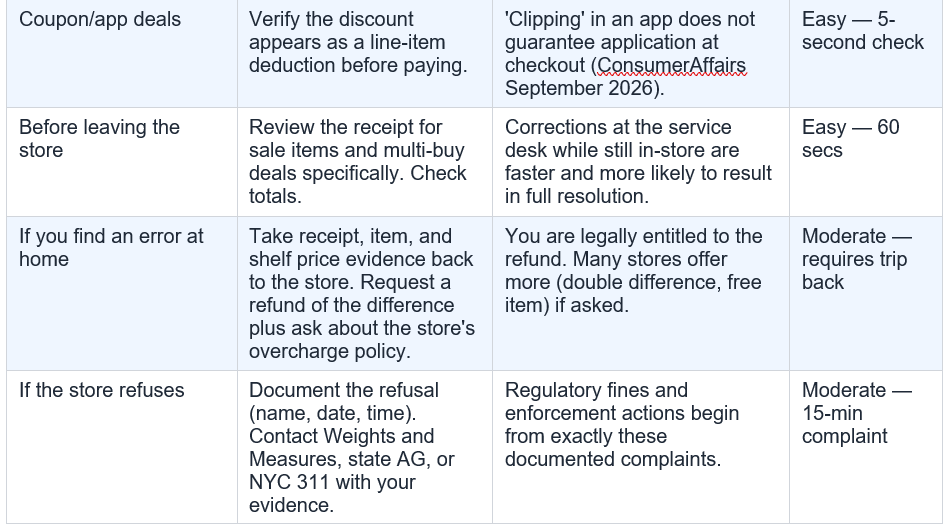
- For app coupons: verify that the discount has been applied before completing payment. ConsumerAffairs’ September 2026 Kroger analysis found that ‘clipping a coupon in an app doesn’t necessarily mean the discount was successfully applied at checkout.’ The coupon is only real once it appears as a line-item deduction.
How to Spot Pricing Errors: After You Pay
If you did not catch the error at the register, the receipt is your last line of defence. One minute spent reviewing your receipt before leaving the store parking lot can catch errors that would otherwise go unnoticed and unrefunded. Most people discover an overcharge hours or days later, at which point returning to the store becomes a deliberate trip — and many people decide the inconvenience is not worth the amount.- Review the receipt before leaving the store, or at minimum in the car before driving away. Checking it on the way home while it is still fresh is far more likely to result in action than finding it crumpled in a bag three days later.
- Match sale items specifically against the price you saw on the shelf. This is the most productive review point. Verifying every item in a 50-item shop is unnecessary; verifying the five items that were on sale takes 30 seconds.
- If you find an error after getting home: take your receipt, the overcharged item, and evidence of the correct price back to the store. As the NC DACS advises (WTVD/ABC11, 2026): ‘Take back your receipt and item to the store with proof of being overcharged.’ Proof means a shelf tag photo, the store’s own ad, or the app price.
- In New York City: notify the store by close of business the day after the purchase (NYC Consumer Protection law; NYC.gov/consumers / 311).
What You Are Legally Entitled To
Your basic legal right is clear and consistent across US jurisdictions: you are entitled to be charged the lowest advertised or posted price. If the shelf says $2.99 and the scanner charges $3.49, you are owed the difference and a refund of the overcharge. Beyond that fundamental entitlement, the specifics depend on your state, county, or city. Not legal advice — verify current rules with your state’s Department of Agriculture, Weights and Measures division, or Attorney General’s office.The LA County Department of Consumer and Business Affairs makes the baseline rule explicit: ‘Stores must honor a posted price, even if the price has expired.’ This is important: a shelf tag showing a sale price that the store claims ended yesterday is still the price you are owed, because it was the price posted when you selected the item. This applies whether the error was on the shelf side or the scanner side.
Your core legal entitlements (US — verify in your jurisdiction): (1) You are entitled to the LOWEST advertised or posted price. (2) A posted shelf price must be honoured, even if the sale has expired. (3) Legal scanner accuracy standard: 98% (2% error maximum). Most states require the difference to be refunded. Some states/cities require additional compensation. NYC: refund + 10x the difference (min $1, max $20) + keep the item. TX: stores face up to $500/day civil penalty per violation. Sources: LA County DCBA; Springfield MA; FTC; NYC Consumer Protection; AZ AG; NBC DFW. Not legal advice. Verify current law in your state.
Store Overcharge Policies: What Some Retailers Offer Beyond the Law
Some retailers go beyond the legal minimum when an overcharge is identified. These policies vary by store and country, are typically voluntary rather than legally mandated, and are worth asking about directly. Seeitmarket.com notes that ‘I shopped at my local grocery store for years before I found out that their policy was to return double the overcharged amount.’ The policy existed; the shopper simply did not know about it. Asking is free.The practical takeaway: always ask the customer service desk about the store’s specific overcharge policy. The legal minimum is a refund of the difference. But many stores — especially when approached calmly and with a clear receipt and evidence of the correct price — offer more than the minimum to maintain goodwill. Not legal advice.
The Worst Offenders: Retailers with Documented High Error Rates
The pattern across inspection data from multiple states is that the largest discount retailers and dollar store chains consistently show the highest error rates — and that errors at these stores disproportionately favour the retailer rather than the shopper. ConsumerAffairs’ September 2026 analysis of Kroger stores in Ohio found that of the 644 documented pricing errors across 101 stores, errors favoured Kroger nearly three times as often as they favoured shoppers. And when shoppers were overcharged, the errors averaged more than 20% above the advertised shelf price.Dollar General’s record is particularly striking. Ohio auditors found error rates between 16.7% and 88.2% at 20 Dollar General stores in the state — well above the 2% legal standard. In Wisconsin, Dollar General entered a settlement with the state Department of Agriculture after being found to overcharge customers by an average of 17% above shelf price on 9% of items. In one Family Dollar location in North Carolina (Family Dollar is owned by Dollar Tree, a related chain), a single inspection found an overcharge error rate of 33% (NewsNation/Nexstar, 2026).
Walmart has also faced significant enforcement actions: North Carolina’s DACS collected fines from dozens of Walmart stores for pricing errors in 2022. A separate University of Illinois and University of California-Berkeley study found that Walmart stores in California, Illinois, Indiana, and Michigan scanned the wrong price as often as 8.3% of the time, with 87% of California Walmart locations exceeding the 2% error standard (Arizona AG, citing those studies). These are not isolated incidents; they reflect the systemic risk inherent in managing millions of SKUs across thousands of locations. Not a legal accusation; this describes documented enforcement actions.
In the past year there has been a total explosion of price scanning mistakes.' — Chad Parker, Standards Division, NC Department of Agriculture and Consumer Services, cited WTVD/ABC11 2026. Parker attributed the increase to inflation and staffing problems: higher product turnover and more frequent price changes require more shelf-tag updates, while reduced staffing makes manual updates less reliable. This structural problem is not going away.
How to Report a Pricing Error That a Store Won’t Fix
Most overcharges are resolved at the customer service desk without escalation. But if a store refuses to correct a documented error, you have formal channels available. The key is having your evidence in order: your receipt, a photo of the shelf price (taken on your phone at the time of purchase or immediately after spotting the error), and a record of when you raised the issue and with whom.- Weights and Measures / Department of Agriculture: in most US states, this agency is responsible for scanner accuracy enforcement and accepts consumer complaints. NC: call the Standards Division at 984-236-4750. Texas: contact the TX Department of Agriculture. Los Angeles County: contact the LA County Agricultural Commissioner/Weights and Measures (LA County DCBA).
- NYC: file a complaint with NYC Consumer Affairs via nyc.gov/consumers or call 311. The NYC consumer protection law specifies the exact compensation you are owed and the store’s obligations.
- Federal: the Federal Trade Commission (FTC) maintains consumer guidance on scanner accuracy and accepts complaints at FTC.gov/complaint. While the FTC does not typically resolve individual disputes, documented patterns of complaints can trigger enforcement action.
- State Attorney General: in states where the AG has consumer protection authority, a formal complaint about repeated pricing errors — especially at a chain location where you have documented multiple incidents — can initiate an investigation.
The Complete Spotting Checklist: Your Pre-, During-, and Post-Checkout Guide
Conclusion
Pricing errors at checkout are not rare, they are not trivial, and they are not going away. The explosion of digital price updates that do not sync with physical shelf tags, the expansion of self-checkout without proportional staff oversight, and the high turnover of promotional pricing in an inflationary environment have created the conditions for systematic overcharging at scale. The agencies responsible for enforcement are busy and under-resourced. The stores responsible for accuracy are often under-staffed and stretched thin. The person best positioned to catch the error is you, at the moment it happens.The good news is that this does not require paranoia, an itemised memory, or a degree in retail pricing. It requires watching the screen for a few seconds as your items are scanned, reviewing your receipt before you leave the store parking lot, and knowing that when you find an error, the law is on your side. You are entitled to the price that was posted. Most stores will correct it without drama. Some will offer more than the minimum. And if they do not, the regulatory agencies that fine stores half a million dollars for this kind of systemic error are exactly one phone call or online complaint away.
Take the receipt. Read it. The scanner is only as accurate as the humans and systems behind it — and right now, those humans and systems are making a lot of mistakes.
Frequently Asked Questions
How common are checkout pricing errors at grocery stores?More common than most shoppers realise. The NC Department of Agriculture and Consumer Services Standards Division found that approximately 26% of its price scanner inspections resulted in failures, with at least one overcharged item in roughly 10% of all inspected transactions (NC DACS data, cited multiple 2026 sources). The agency's inspector described 2025-2026 as 'a total explosion of price scanning mistakes,' with annual fine totals jumping from $40,000-$50,000 to approximately $500,000. A New York City Department of Consumer Affairs inspection of close to 2,000 supermarkets found 59% had violations leading to consumer overcharges. Individual store error rates documented in enforcement actions have ranged from 4% (above the 2% legal standard) to over 33% (Family Dollar NC) and even 88% (Dollar General OH). Consumers are estimated to lose $1-$2.5 billion annually to scanner errors (seeitmarket.com). Sources: WTVD/ABC11 2026; NC DACS; NYC DCA; NewsNation 2026; seeitmarket.com.
Am I legally entitled to a refund if a store overcharges me at checkout?
Yes, as a baseline right in most US jurisdictions. You are entitled to be charged the lowest advertised or posted price (LA County DCBA; Springfield MA; FTC). Stores must honour a posted price even if the sale has technically expired (LA County DCBA). The legal minimum remedy is a refund of the difference between what you were charged and what the posted price was. Many jurisdictions require more: in New York City, the Consumer Protection law requires a refund of the overcharge plus ten times the difference (minimum $1, maximum $20) if you notify the store by close of business the day after the purchase (NYC Consumer Protection / NYC.gov). In Texas, stores can face civil penalties of up to $500 per violation per day for scanner errors (NBC DFW). The federal standard requires 98% scanner accuracy. Not legal advice — verify current rules with your state's Department of Agriculture, Weights and Measures, or Attorney General's office.
What should I do if I notice an overcharge at the register?
Speak up immediately — before the transaction is completed if possible. Say to the cashier: 'This item should be [price] — it's on sale. Can you check?' Most cashiers will pause the transaction, call a supervisor, or manually override the price. If you are at self-checkout, press the 'call for help' button and show the screen price versus what you saw on the shelf. If you have a shelf tag photo or the store's flyer on your phone, show it. If the cashier disputes it, ask to speak to a manager. Do not let the transaction complete without addressing the error if you can help it — correcting a completed transaction requires a separate trip to customer service. If the price is corrected during the transaction, you are done. If not, keep your receipt, note the price you were charged, and document the posted price (photo if possible) before you leave the store. Sources: FTC; Springfield MA; LA County DCBA; NC DACS/WTVD 2026.
Why do pricing errors happen so often?
The most common cause in 2025-2026, according to the NC Department of Agriculture's Standards Division, is a digital price update that does not sync with the physical shelf tag. As inspector Chad Parker explained: prices are downloaded digitally to the scanner system, but a manager or employee must then manually replace the physical shelf tags. If the manual step is not completed, the scanner charges the new (often higher) price while the shelf still shows the old (lower) price. Additional causes: sale prices not programmed into the scanner system; double scanning (an item scanned twice); wrong product codes; app coupons that are clipped but not applied; weight errors on items sold by the pound; and technical glitches during system updates. The Consumer NZ July 2026 case of 26 errors in a single shop was attributed to a 'technical issue during a Shop & Go transaction' (Foodstuffs statement). Sources: Chad Parker/WTVD/ABC11 2026; Consumer NZ July 2026; Retail Insider/Nelson Voice; ConsumerAffairs September 2026.
Which stores have the worst pricing error records?
Based on documented enforcement actions and inspection data: Dollar General: Ohio auditors found error rates between 16.7% and 88.2% at 20 Dollar General stores (NewsNation/Nexstar 2026); Wisconsin: Dollar General settled after being found to overcharge 17% above shelf price on 9% of items (NewsNation 2026). Family Dollar (Dollar Tree): at one NC location, a single inspection found a 33% error rate (NewsNation/Nexstar 2026). Kroger (Ohio): 644 documented pricing errors in 389 inspections of 101 stores from 2022 through mid-2026; errors favoured Kroger nearly 3x as often as shoppers; when overcharged, errors averaged 20%+ above shelf price (ConsumerAffairs September 2026). Walmart: NC DACS fined dozens of Walmart stores in 2022; separate university studies found error rates up to 8.3% at some stores; 87% of CA Walmart locations exceeded the 2% standard (AZ AG citing University of Illinois / UC-Berkeley studies). These are documented legal enforcement records, not editorial opinions. Every store can have errors. Sources: NewsNation/Nexstar 2026; ConsumerAffairs September 2026; NC DACS; WRAL; AZ AG.
0 Comments
Be the first to share your thoughts on this article.