

Credits
Paycheck Habits to Help You Avoid Credit Card Debt

53% of Americans carry credit card debt averaging $7,719. Most of it starts on payday — with money that was never given a job. Here are the eight habits that change the pattern.
Most credit card debt does not begin with a moment of recklessness. It begins on payday — the moment money arrives, spends without structure, and then runs short before the next payday. The bills that are due in three weeks feel manageable when the balance is full. By the time they actually arrive, the balance has been eroded by two weeks of untracked spending, and the credit card fills the gap. Clever Real Estate’s 2025 report found that 53% of Americans carry credit card debt, with an average balance of $7,719. Fifty-nine percent say credit card debt is the worst kind of debt. Eighty-eight percent of those in debt have regrets about it. Yet 75% believe they are more responsible than the average cardholder — including 64% of those who are currently in credit card debt. That gap between self-perception and reality is not a character flaw. It is a systems gap. The eight paycheck habits in this article are designed to close it — not by spending less, but by managing the timing and structure of spending in a way that makes credit card reliance progressively unnecessary. Not financial advice.
The eight habits in this article all address the payday moment specifically, because that is where the debt prevention happens. They are not about spending less in an absolute sense. They are about spending in a structure that ensures fixed obligations are covered, that a savings buffer is building, that discretionary spending happens within a known and bounded allocation, and that the credit card is never needed as an emergency mechanism. The data on what happens without these habits is stark.
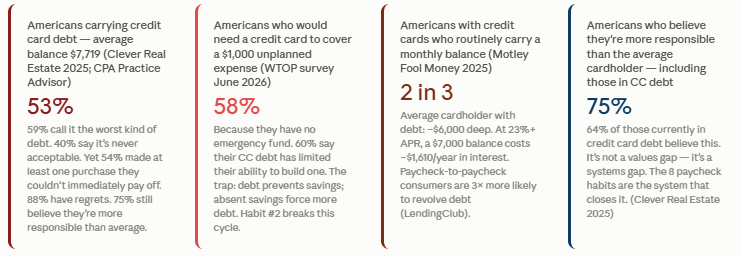
53% of Americans carry credit card debt with an average balance of $7,719 (Clever Real Estate 2025). 2 in 3 Americans with credit cards routinely carry a monthly balance (Motley Fool Money 2025). 58% would need a credit card to cover a $1,000 unplanned expense (WTOP June 2026). Paycheck-to-paycheck consumers are 3x more likely to revolve credit card debt (LendingClub/PYMNTS.com).
What makes the data particularly striking is the contrast between attitude and behaviour. Clever Real Estate found that 59% of Americans view credit card debt as the worst kind of debt, and 40% say it is never acceptable — yet 54% make at least one purchase per year they cannot immediately pay off. Eighty-eight percent of those in debt have regrets about it. And perhaps most revealing: 75% believe they are more responsible than the average cardholder, including 64% of those who are currently in credit card debt. This is not a knowledge problem or a values problem. It is a systems problem. The habits below are the system.
The debt trap cycle: 60% of Americans with credit card debt say it has limited their ability to build an emergency savings fund (WTOP June 2026). Without an emergency fund, 58% would need a credit card for a $1,000 unplanned expense (WTOP June 2026). The absence of savings forces more credit card use; the credit card balance prevents savings from growing. The only exit is building both simultaneously — automating savings while managing the balance. Sources: WTOP June 2026; Clever Real Estate 2025.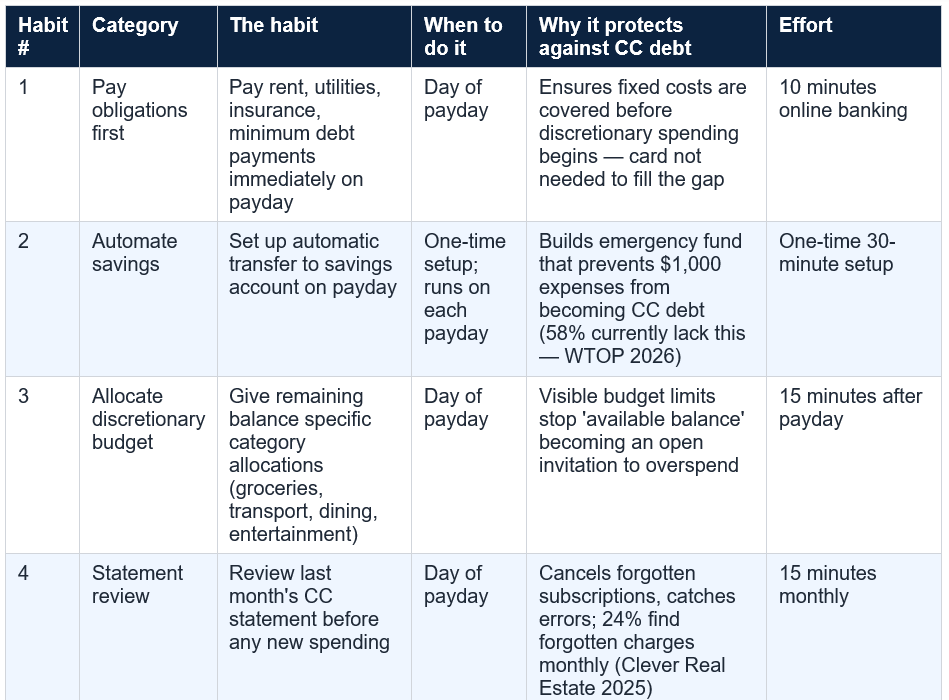
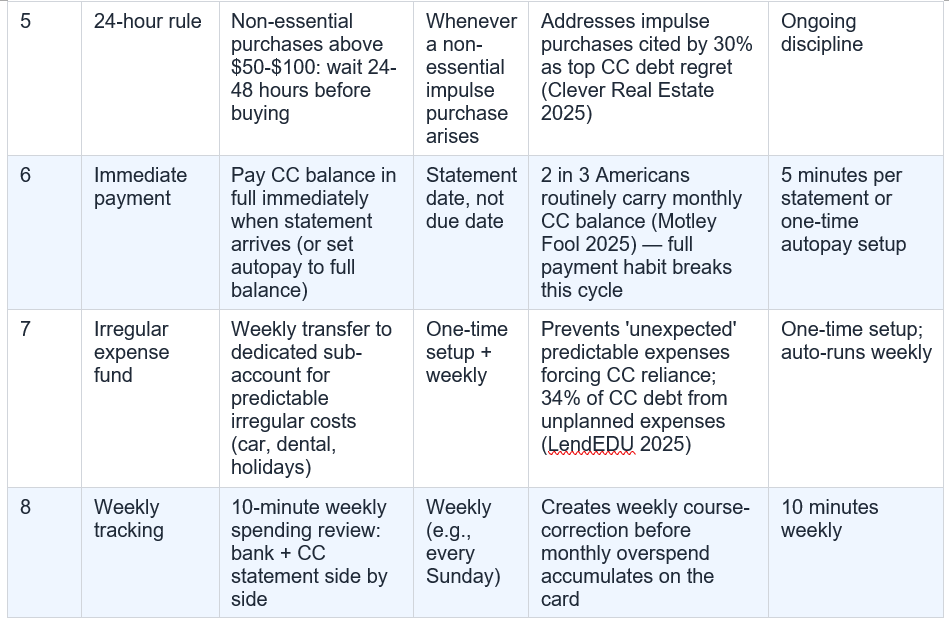
The eight habits in this article are a system. They do not require earning more money, cutting all discretionary spending, or making dramatic lifestyle changes. They require spending in a specific sequence on the day money arrives: obligations first, savings second, discretionary third. They require reviewing the statement you carry before adding to it. They require a brief pause before impulse purchases. They require weekly awareness rather than monthly surprise. None of these habits is difficult. Together, they create the conditions where credit cards are a convenience rather than a necessity — and where the 23%+ APR cycle has no opportunity to begin. Not financial advice. Consult a qualified financial adviser or credit counsellor for guidance specific to your situation.
Clever Real Estate's 2025 report, cited by CPA Practice Advisor on November 18, 2025, found that 53% of Americans carry credit card debt with an average balance of $7,719. A separate WTOP survey from June 2026 put the carrying rate at 57%. Motley Fool Money's survey found the average cardholder with debt is approximately $6,000 deep, with 2 out of 3 Americans with credit cards routinely carrying a monthly balance. At the average credit card APR of 23%+, a $7,000 balance costs approximately $1,610 per year in interest — money paid to the card issuer before any principal is reduced. Bankrate's data shows 1 in 3 Americans now has more credit card debt than emergency savings, up 10 percentage points from 2011. Sources: CPA Practice Advisor/Clever Real Estate November 2025; WTOP June 2026; Motley Fool Money 2025; Bankrate/Statista.
What is the connection between living paycheck to paycheck and credit card debt?
The connection is direct and measurable. LendingClub's research found that paycheck-to-paycheck consumers are three times as likely to revolve credit card debt. LendEDU's January 2025 survey (n=1,000) found that 53% of Americans are living paycheck to paycheck, and among those, 34% turn to credit cards when unexpected expenses arise. LendingClub's data found that 29% of credit card holders 'always' or 'usually' revolve their balances. The mechanism is clear: when there is no buffer between income and obligations, any gap between the paycheck and the next expenses is filled by credit. The solution the eight habits provide is to build that buffer structurally — automating savings on payday, paying obligations first, and building an irregular expense fund — so that the gap the credit card would otherwise fill is closed before it opens. Sources: LendEDU January 2025; LendingClub/PYMNTS.com/Benzinga 2025.
Why do so many people carry credit card debt even though they regret it?
Clever Real Estate's 2025 report provides the clearest data on this paradox: 59% view credit card debt as the worst kind of debt, 88% of those in debt have regrets about it — yet 75% believe they are more responsible than the average cardholder, including 64% who are currently in credit card debt. The explanation is a systems gap rather than a values gap. Most people do not decide to accumulate credit card debt; they make a series of individually reasonable decisions in a system that has no structure to prevent accumulation. The credit card makes spending marginally easier than not spending at every decision point, and without a paycheck-day allocation framework, the balance grows incrementally. The eight habits in this article address the system, not the values — because the values are already correct for most people who carry debt. Source: Clever Real Estate/CPA Practice Advisor 2025.
What is the fastest way to stop relying on a credit card?
The most direct structural change is building an emergency fund in a high-yield savings account, because the WTOP June 2026 survey found that 58% of Americans would need a credit card to cover a $1,000 unplanned expense — meaning the absence of emergency savings is the primary driver of credit card necessity for unexpected expenses. Automating a savings transfer on payday (Habit #2), however small, begins building this buffer immediately. Simultaneously, paying fixed obligations first (Habit #1) and reviewing the credit card statement monthly (Habit #4) closes the two most common gaps that force credit card use: the gap between incoming expenses and available balance, and the gap created by unnoticed recurring charges. For households already carrying a balance, the debt avalanche method — applying extra payments to the highest-APR balance first — is the most cost-effective payoff strategy. Consult a qualified financial adviser or credit counsellor for personalised debt management guidance. Sources: WTOP June 2026; Clever Real Estate 2025; LendEDU 2025.
Is credit card debt worse than other types of debt?
Among Americans, 59% view it as the worst kind of debt, according to Clever Real Estate's 2025 report. The financial case for this view is strong: credit card APRs average 23%+ (Federal Reserve data), which is materially higher than mortgage rates, auto loan rates, student loan rates, or personal loan rates. At 23% APR, a $5,000 balance that is never reduced costs $1,150 per year in interest and will take approximately 27 years to pay off with minimum payments alone. Motley Fool Money notes that while 86% of people with mortgage debt and 75% with credit card debt say they are satisfied with their lives, credit card debt uniquely limits other financial goals: WTOP's June 2026 survey found it has prevented emergency savings (60%), impacted vehicle purchases (35%), reduced investing (31%), and delayed homeownership (23%). Credit card debt is expensive, flexible (in the wrong direction), and has the highest interest rate of any common consumer debt product. Source: CPA Practice Advisor/Clever Real Estate 2025; Motley Fool Money 2025; WTOP June 2026.
Most credit card debt does not begin with a moment of recklessness. It begins on payday — the moment money arrives, spends without structure, and then runs short before the next payday. The bills that are due in three weeks feel manageable when the balance is full. By the time they actually arrive, the balance has been eroded by two weeks of untracked spending, and the credit card fills the gap. Clever Real Estate’s 2025 report found that 53% of Americans carry credit card debt, with an average balance of $7,719. Fifty-nine percent say credit card debt is the worst kind of debt. Eighty-eight percent of those in debt have regrets about it. Yet 75% believe they are more responsible than the average cardholder — including 64% of those who are currently in credit card debt. That gap between self-perception and reality is not a character flaw. It is a systems gap. The eight paycheck habits in this article are designed to close it — not by spending less, but by managing the timing and structure of spending in a way that makes credit card reliance progressively unnecessary. Not financial advice.
Table of Contents
- Why Payday Is the Most Important Financial Moment of the Month
- The Credit Card Debt Picture in America: What the Data Shows
- Habit #1 [PAY OBLIGATIONS FIRST]: Pay Fixed Obligations the Day Your Paycheck Arrives
- Habit #2 [AUTOMATE SAVINGS BEFORE SPENDING]: Automate a Savings Transfer on the Same Day As Your Paycheck
- Habit #3 [ALLOCATE DISCRETIONARY BUDGET]: Give Every Remaining Dollar a Job Immediately After Payday
- Habit #4 [MONTHLY STATEMENT REVIEW]: Review Your Credit Card Statement the Day Your Paycheck Arrives
- Habit #5 [SLEEP-ON-IT RULE]: Implement a 24-48 Hour Rule for All Non-Essential Purchases
- Habit #6 [IMMEDIATE STATEMENT PAYMENT]: Pay the Credit Card Statement Balance When It Arrives, Not on the Due Date
- Habit #7 [IRREGULAR EXPENSE FUND]: Set Up a Dedicated ‘Irregular Expenses’ Fund Funded Weekly
- Habit #8 [SPENDING AWARENESS]: Track Spending Weekly — Not Monthly, Not Annually
- The Paycheck Habit Tracker: A Summary Table
- Conclusion: The Debt Wasn’t Your Fault. The System Is.
- Frequently Asked Questions
Why Payday Is the Most Important Financial Moment of the Month
In the architecture of personal finance, payday is the point of maximum leverage. It is the moment when money enters the system — and how it is managed in the first hours and days after arrival largely determines whether credit cards become a tool or a trap for the rest of the month. Most credit card debt is not the product of a single bad decision. It is the product of dozens of small, uncstructured spending choices made in the days after payday, which gradually erode the balance until predictable expenses — bills, insurance, upcoming irregular costs — arrive in a partially depleted account. The credit card fills the gap. The balance accumulates. The interest compounds.The eight habits in this article all address the payday moment specifically, because that is where the debt prevention happens. They are not about spending less in an absolute sense. They are about spending in a structure that ensures fixed obligations are covered, that a savings buffer is building, that discretionary spending happens within a known and bounded allocation, and that the credit card is never needed as an emergency mechanism. The data on what happens without these habits is stark.
53% of Americans carry credit card debt with an average balance of $7,719 (Clever Real Estate 2025). 2 in 3 Americans with credit cards routinely carry a monthly balance (Motley Fool Money 2025). 58% would need a credit card to cover a $1,000 unplanned expense (WTOP June 2026). Paycheck-to-paycheck consumers are 3x more likely to revolve credit card debt (LendingClub/PYMNTS.com).
The Credit Card Debt Picture in America: What the Data Shows
The credit card debt data from 2025 and 2026 paints a picture that is simultaneously widespread and deeply regretted. Clever Real Estate’s 2025 report found that 53% of Americans carry credit card debt, with an average balance of $7,719. A separate WTOP survey from June 2026 put the figure at 57% carrying a balance. Motley Fool Money’s survey found that the average cardholder with debt is approximately $6,000 deep, and that two out of three Americans with credit cards routinely carry a monthly balance. At the average APR of 23%+, a $7,000 balance costs approximately $1,610 per year in interest alone — money that pays for nothing, builds nothing, and goes entirely to the card issuer.What makes the data particularly striking is the contrast between attitude and behaviour. Clever Real Estate found that 59% of Americans view credit card debt as the worst kind of debt, and 40% say it is never acceptable — yet 54% make at least one purchase per year they cannot immediately pay off. Eighty-eight percent of those in debt have regrets about it. And perhaps most revealing: 75% believe they are more responsible than the average cardholder, including 64% of those who are currently in credit card debt. This is not a knowledge problem or a values problem. It is a systems problem. The habits below are the system.
The debt trap cycle: 60% of Americans with credit card debt say it has limited their ability to build an emergency savings fund (WTOP June 2026). Without an emergency fund, 58% would need a credit card for a $1,000 unplanned expense (WTOP June 2026). The absence of savings forces more credit card use; the credit card balance prevents savings from growing. The only exit is building both simultaneously — automating savings while managing the balance. Sources: WTOP June 2026; Clever Real Estate 2025.
#1 PAY OBLIGATIONS FIRST: Pay Fixed Obligations the Day Your Paycheck Arrives
The most common pathway into credit card debt is not extravagance — it is disorganisation. Money arrives in the account, daily spending begins, and by the time the rent, the insurance, and the utilities are due, the balance has been eroded by discretionary purchases that felt affordable in the moment. The fix is structural and immediate: on the day your paycheck arrives, the fixed obligations go out first. Rent or mortgage. Utilities, Insurance premiums and Minimum debt payments. Once those are confirmed paid, you know exactly what remains — and that remaining balance is what you have for everything else. This one change transforms the credit card from a gap-filler into a choice. When you know your obligations are covered, the card is no longer plugging a hole; it is a discretionary tool that can be paid off in full. LendEDU's January 2025 survey found that 34% of people living paycheck to paycheck turn to credit cards when unexpected expenses arise — but many of those unexpected expenses are not genuinely unexpected. They are predictable bills that arrive at inconvenient times because the paycheck has already been partially spent. Paying obligations first removes that problem at the root.#2 AUTOMATE SAVINGS BEFORE SPENDING: Automate a Savings Transfer on the Same Day As Your Paycheck
The single strongest predictor of avoiding credit card debt is having an emergency fund — and WTOP's June 2026 survey found that 58% of Americans would need a credit card to cover a $1,000 unplanned expense precisely because no emergency fund exists. The same survey found that 60% of those with credit card debt say it has limited their ability to build emergency savings — creating the debt trap cycle where debt prevents savings and absent savings force more debt. The way to break this cycle is to treat savings as an obligation, not an afterthought. Set up an automatic transfer to a high-yield savings account that executes on the same day as your paycheck, before any discretionary spending is possible. Start with whatever is achievable — even $25 or $50 per payday — and increase it as obligations are paid down. The emergency fund is not a luxury. It is the mechanism that allows you to absorb unexpected expenses without reaching for the credit card. Bankrate's data shows 1 in 3 Americans now has more credit card debt than emergency savings. Automating savings first is the structural change that reverses this ratio over time.#3 ALLOCATE DISCRETIONARY BUDGET: Give Every Remaining Dollar a Job Immediately After Payday
After fixed obligations are paid and savings are set aside, the remaining balance should be allocated — not left as a vague 'available balance' that gets spent through a combination of convenience and inattention. The 50/30/20 framework (50% needs, 30% wants, 20% savings/debt) is a widely cited starting structure, but what matters more than the specific percentages is the act of allocation itself. When money has been designated for groceries, for transport, for dining out, for clothing, and for entertainment, each purchase happens within a defined container. When spending approaches the container limit, the credit card is not the answer — the activity is. Most people who carry credit card balances are not aware, in real time, that they are overspending in specific categories. Clever Real Estate's 2025 report found that 75% of those with credit card debt believe they are more responsible than the average cardholder — the overconfidence problem that allocation directly addresses by making the reality visible. A budget is not a restriction. It is a truthful description of the choices you have already made. Giving dollars their jobs on payday means those choices happen consciously, not by default.#4 MONTHLY STATEMENT REVIEW: Review Your Credit Card Statement the Day Your Paycheck Arrives
Only 50% of Americans review their credit card statements monthly for accuracy, according to Clever Real Estate's 2025 report — and 24% of Americans discover forgotten subscriptions each month. The cost of not reviewing is concrete: forgotten subscriptions, fraudulent charges, and recurring payments for services no longer used all accumulate invisibly and erode the balance available for legitimate expenses. The psychological effect is equally damaging: a credit card balance that contains charges you cannot account for feels larger and more demoralising than one you can explain. Payday is the natural moment for this review because it is the moment you are most financially engaged. Before any new spending begins, open last month's statement. Identify every recurring charge. For each one, ask: do I recognise this? Am I using this service? Is this still the best rate? Cancel or renegotiate anything that fails either test. This 15-minute exercise not only reduces invisible spending — it creates a cleaner mental map of the balance and strengthens your ability to make informed decisions about new spending before it happens.#5 SLEEP-ON-IT RULE: Implement a 24-48 Hour Rule for All Non-Essential Purchases
Impulse purchases are the second most commonly cited source of credit card regret after interest payments. Clever Real Estate's 2025 report found that 30% of those with credit card debt specifically cite impulse purchases as a regret. The behavioural economics research on this is consistent: a waiting period between the desire to buy something and the act of buying it dramatically reduces impulsive purchases, because the emotional urgency that drives them fades within 24-48 hours. The mechanism is simple to implement: any non-emergency purchase above a personally defined threshold — $50, $100, whatever makes sense for your circumstances — gets added to a list and reconsidered at least 24 hours later. If you still want it the next day, it belongs in your discretionary budget. If it no longer feels urgent, it was an impulse. The Motley Fool Money survey noted that impulse shopping and dining out are the most cited wasteful habits among those reviewing their own spending. The 24-48 hour rule does not prevent spending — it makes spending a deliberate choice rather than a reflexive one. On a credit card where the average APR is 23%+, the cost of impulsive purchases compounds quickly. A $200 impulse purchase carried for 12 months at 23% costs approximately $46 in interest.#6 IMMEDIATE STATEMENT PAYMENT: Pay the Credit Card Statement Balance When It Arrives, Not on the Due Date
Credit cards are designed to create maximum friction between the statement date and the payment. The due date is often 25-30 days after the statement date, which gives the card company the maximum possible time to accumulate interest from partial payers and the maximum possible opportunity for cardholders to forget or defer the payment. The habit of paying when the statement arrives rather than waiting for the due date eliminates both risks. It eliminates the forgetting risk because the payment is triggered by a visible event (the statement) rather than a future date that requires remembering. It eliminates the deferral risk because immediate payment leaves no room for 'I'll deal with it later.' It also eliminates any possibility of carrying a partial balance, because the full statement balance is paid before any subsequent spending adds to it. Two out of three Americans with credit cards routinely carry a monthly balance (Motley Fool Money 2025). The habit of immediate full payment is what separates those who use credit cards as a convenience tool from those who are paying 23%+ APR to borrow money they already spent. Most credit card apps support autopay for the full statement balance — setting this up once eliminates the need for any ongoing decision.#7 IRREGULAR EXPENSE FUND: Set Up a Dedicated ‘Irregular Expenses’ Fund Funded Weekly
The category of expenses most responsible for credit card reliance is not the genuinely unexpected — it is the irregular-but-predictable. Car maintenance. Annual insurance premiums. Dental appointments. School supplies. Holiday gifts. These events are not surprising. They arrive at predictable intervals but are rarely budgeted for because they do not appear in the monthly fixed expenses list. The result: when they arrive, the only available resource is the credit card, and the debt begins to accumulate. LendEDU's 2025 survey found that emergency/unexpected expenses made up 34% of credit card debt formation — and a large share of those 'unexpected' expenses would have been predictable with a broader view of annual spending. The solution is a dedicated irregular expenses sub-account or envelope: calculate the total annual cost of all predictable irregular expenses (car registration, annual insurance, holiday budget, vehicle maintenance allowance, medical co-pays), divide by 52, and transfer that amount to a dedicated account every week. When the car registration arrives in November, the money is already there. The credit card is never needed for it.#8 SPENDING AWARENESS: Track Spending Weekly — Not Monthly, Not Annually
Monthly budgets reviewed monthly have a fundamental timing problem: by the time you discover you have overspent in a category, the damage is done and the credit card has already absorbed the excess. Weekly spending reviews allow course-correction before the problem compounds. The practical implementation is minimal: once a week, open your bank account and your credit card statement side by side and review the past seven days of transactions. Are you on track for the month in each category? Are there any charges you do not recognise? Is there any category that has already consumed most of its monthly allocation with two weeks still to go? Weekly tracking does not require a complex system. A three-column note on your phone (category, budgeted, spent so far this month) updated once a week is sufficient. Motley Fool Money's survey found that 2 in 3 Americans with credit cards routinely carry a monthly balance — a figure that consistent weekly awareness directly addresses by creating decision points before the balance becomes unmanageable. The goal of weekly tracking is not accounting. It is awareness. Awareness is what converts an automatic behaviour (reaching for the card) into a conscious choice.The Paycheck Habit Tracker: A Summary Table
Conclusion
Seventy-five percent of Americans with credit card debt believe they are more responsible than the average cardholder. Sixty-four percent of those who are currently in credit card debt believe this about themselves. And in a real sense, they are right. Most people with credit card debt are not reckless. They are people operating without a system, in a financial environment designed to make spending easier than not spending, in a gap created by the structural misalignment between when income arrives and when expenses are due.The eight habits in this article are a system. They do not require earning more money, cutting all discretionary spending, or making dramatic lifestyle changes. They require spending in a specific sequence on the day money arrives: obligations first, savings second, discretionary third. They require reviewing the statement you carry before adding to it. They require a brief pause before impulse purchases. They require weekly awareness rather than monthly surprise. None of these habits is difficult. Together, they create the conditions where credit cards are a convenience rather than a necessity — and where the 23%+ APR cycle has no opportunity to begin. Not financial advice. Consult a qualified financial adviser or credit counsellor for guidance specific to your situation.
Frequently Asked Questions
How much credit card debt does the average American carry?Clever Real Estate's 2025 report, cited by CPA Practice Advisor on November 18, 2025, found that 53% of Americans carry credit card debt with an average balance of $7,719. A separate WTOP survey from June 2026 put the carrying rate at 57%. Motley Fool Money's survey found the average cardholder with debt is approximately $6,000 deep, with 2 out of 3 Americans with credit cards routinely carrying a monthly balance. At the average credit card APR of 23%+, a $7,000 balance costs approximately $1,610 per year in interest — money paid to the card issuer before any principal is reduced. Bankrate's data shows 1 in 3 Americans now has more credit card debt than emergency savings, up 10 percentage points from 2011. Sources: CPA Practice Advisor/Clever Real Estate November 2025; WTOP June 2026; Motley Fool Money 2025; Bankrate/Statista.
What is the connection between living paycheck to paycheck and credit card debt?
The connection is direct and measurable. LendingClub's research found that paycheck-to-paycheck consumers are three times as likely to revolve credit card debt. LendEDU's January 2025 survey (n=1,000) found that 53% of Americans are living paycheck to paycheck, and among those, 34% turn to credit cards when unexpected expenses arise. LendingClub's data found that 29% of credit card holders 'always' or 'usually' revolve their balances. The mechanism is clear: when there is no buffer between income and obligations, any gap between the paycheck and the next expenses is filled by credit. The solution the eight habits provide is to build that buffer structurally — automating savings on payday, paying obligations first, and building an irregular expense fund — so that the gap the credit card would otherwise fill is closed before it opens. Sources: LendEDU January 2025; LendingClub/PYMNTS.com/Benzinga 2025.
Why do so many people carry credit card debt even though they regret it?
Clever Real Estate's 2025 report provides the clearest data on this paradox: 59% view credit card debt as the worst kind of debt, 88% of those in debt have regrets about it — yet 75% believe they are more responsible than the average cardholder, including 64% who are currently in credit card debt. The explanation is a systems gap rather than a values gap. Most people do not decide to accumulate credit card debt; they make a series of individually reasonable decisions in a system that has no structure to prevent accumulation. The credit card makes spending marginally easier than not spending at every decision point, and without a paycheck-day allocation framework, the balance grows incrementally. The eight habits in this article address the system, not the values — because the values are already correct for most people who carry debt. Source: Clever Real Estate/CPA Practice Advisor 2025.
What is the fastest way to stop relying on a credit card?
The most direct structural change is building an emergency fund in a high-yield savings account, because the WTOP June 2026 survey found that 58% of Americans would need a credit card to cover a $1,000 unplanned expense — meaning the absence of emergency savings is the primary driver of credit card necessity for unexpected expenses. Automating a savings transfer on payday (Habit #2), however small, begins building this buffer immediately. Simultaneously, paying fixed obligations first (Habit #1) and reviewing the credit card statement monthly (Habit #4) closes the two most common gaps that force credit card use: the gap between incoming expenses and available balance, and the gap created by unnoticed recurring charges. For households already carrying a balance, the debt avalanche method — applying extra payments to the highest-APR balance first — is the most cost-effective payoff strategy. Consult a qualified financial adviser or credit counsellor for personalised debt management guidance. Sources: WTOP June 2026; Clever Real Estate 2025; LendEDU 2025.
Is credit card debt worse than other types of debt?
Among Americans, 59% view it as the worst kind of debt, according to Clever Real Estate's 2025 report. The financial case for this view is strong: credit card APRs average 23%+ (Federal Reserve data), which is materially higher than mortgage rates, auto loan rates, student loan rates, or personal loan rates. At 23% APR, a $5,000 balance that is never reduced costs $1,150 per year in interest and will take approximately 27 years to pay off with minimum payments alone. Motley Fool Money notes that while 86% of people with mortgage debt and 75% with credit card debt say they are satisfied with their lives, credit card debt uniquely limits other financial goals: WTOP's June 2026 survey found it has prevented emergency savings (60%), impacted vehicle purchases (35%), reduced investing (31%), and delayed homeownership (23%). Credit card debt is expensive, flexible (in the wrong direction), and has the highest interest rate of any common consumer debt product. Source: CPA Practice Advisor/Clever Real Estate 2025; Motley Fool Money 2025; WTOP June 2026.
0 Comments
Be the first to share your thoughts on this article.