
Finance
Ray Dalio's Debt Warning: America's Economic Heart Attack

$37.86 trillion in debt. $970 billion in annual interest. The dollar down 10% in 2025. The founder of the world’s largest hedge fund is on record. Ray Dalio has been warning about American debt for years. But something shifted in 2025. The founder of Bridgewater Associates — the world’s largest hedge fund — stopped speaking in academic frameworks and started speaking in visceral metaphors. An ‘economic heart attack.’ Grandchildren paying off debt in devalued dollars. The 1956 Suez Crisis as a model for what happens when a great power’s finances collapse. Crises that develop ‘slowly until they happen all at once.’ This article is built entirely on what Dalio has actually said, verified through Fortune, The Block, Barchart, and his own Financial Times responses. There is no invented timeline, no fabricated prediction, and no exaggerated framing. The documented record is alarming enough. What follows is a complete picture of Dalio’s documented 2025-2026 warnings, the fiscal data behind them, his specific investment recommendations, and the most important question for every individual investor: what does any of this mean for the money you hold right now?
Fortune July 24, 2025: Dalio described America's deficit as an 'economic heart attack.' Fortune January 9, 2026: 'My grandchildren and great grandchildren not yet born are going to be paying off this debt in devalued dollars.' Fortune May 8, 2026: 'heart attack' is only part of a broader 'great turbulence' reshaping the country. National debt nearing $37 trillion at time of warnings.
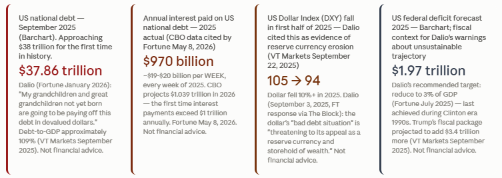
US national debt: $37.86 trillion (September 2025, Barchart). Debt-to-GDP: ~109% (VT Markets September 2025). Interest paid on debt 2025: $970 billion (~$19-20 billion/week) (CBO via Fortune May 2026). CBO projects 2026 interest: $1.039 trillion. Federal deficit forecast 2025: $1.97 trillion (Barchart). Dalio's recommended target: 3% of GDP deficit (Fortune July 2025).
DXY (Dollar Index): fell from ~105 to ~94 in H1 2025 (VT Markets September 2025). Dollar fell 10%+ in 2025. Gold rose significantly. Dalio (September 3, 2025 FT responses via The Block): dollar's 'bad debt situation' threatening its appeal as reserve currency and store of wealth — contributing to gold and crypto price rises. Dalio: dollar 'will remain dominant' but China's rising trade influence acknowledged.
Fortune May 8, 2026: Dalio invokes 1956 Suez Crisis as cautionary parallel for the dollar. Britain's imperial overreach permanently shattered sterling's reserve status. Dalio's framework: debt crisis + military risk are 'mutually reinforcing' — a military stumble could accelerate dollar confidence loss. 'Great turbulence that will reshape the country' — Dalio May 2026.
Dalio (Fortune January 2026): 'look at the value of your portfolio in inflation-adjusted terms.' Fortune May 2026: Dalio's advice is to 'diversify, and hedge against dollar devaluation.' Dalio recommended bitcoin as 'hard money' in December 2024 (The Block). September 2025: Dalio described crypto as 'established' as a viable alternative. Gold identified as a major reserve currency. Structural fix: reduce deficit to 3% of GDP.
No — this specific claim is not documented in any verified source. Dalio has issued serious, escalating warnings about the US debt trajectory, the dollar's reserve currency status, and the risk of what he calls an 'economic heart attack.' But he has not given a specific three-year — or any specific — timeline for a collapse event. Dalio's actual documented framing (Fortune January 2026) is that debt crises develop 'slowly until it happens all at once,' deliberately avoiding a specific prediction. Headlines that attribute a precise timeline to him should be verified against primary sources. What he has verifiably said — citing $970 billion in 2025 interest payments, warning about the 1956 Suez parallel, and calling this 'great turbulence that will reshape the country' (Fortune May 8, 2026) — is serious enough without invented precision.
What has Dalio actually said about the US national debt?
Dalio has issued several verified warnings. On the David Rubenstein Show (Fortune January 9, 2026), he said: 'My grandchildren and great grandchildren not yet born are going to be paying off this debt in devalued dollars.' In July 2025 (Fortune), he described America's deficit spiral as an 'economic heart attack.' In September 2025, in written responses to the Financial Times (The Block), he said the dollar's 'bad debt situation' is threatening its appeal as a reserve currency, contributing to gold and crypto price rises. He has consistently warned that the fiscal trajectory is 'arguably unsustainable' and that the federal deficit should be reduced to 3% of GDP — a level last seen in the Clinton era 1990s. He has noted the US paid $970 billion in interest in 2025, with the CBO projecting over $1 trillion in 2026 (Fortune May 2026).
What does Dalio recommend investors do about it?
Dalio's documented investment recommendations are specific. Fortune's May 2026 coverage summarises his advice as: 'diversify, and hedge against dollar devaluation.' His specific documented asset preferences: (1) Gold — which he views as a major reserve currency in its own right; (2) Bitcoin / crypto — which he recommended as 'hard money' in December 2024 and described in September 2025 as 'an alternative currency that has its supply limited'; (3) International assets — as a hedge against dollar-specific exposure; (4) Inflation-adjusted thinking — Fortune January 2026: 'look at the value of your portfolio in inflation-adjusted terms' rather than nominal dollar returns. These are Dalio's documented positions. They are not financial advice from this article. Always consult a qualified, regulated financial adviser before changing your investment strategy.
Is the Suez Crisis really a valid parallel for the dollar?
Dalio invoked the Suez Crisis parallel in Fortune's May 8, 2026 coverage. The historical facts: in 1956, Britain attempted a military operation in Egypt to reassert control of the Suez Canal. The US (and financial markets) effectively forced Britain to withdraw by declining to support sterling. The crisis exposed that Britain's military commitments had outrun its economic capacity, permanently shattering confidence in sterling as a global reserve currency. The pound lost its reserve status within roughly a decade. Dalio's framework (Fortune May 2026) is that 'the debt crisis and a potential Hormuz confrontation are not separate risks but mutually reinforcing ones.' The parallel is not that the US is Britain. It is that any great power that overextends militarily while running unsustainable deficits creates conditions for an accelerated loss of currency confidence. Historical analogies are inherently imperfect — the US economy remains the world's largest and the dollar retains dominant reserve status. But Dalio is a credible macro analyst who has studied reserve currency cycles across centuries of data.
Should I be worried about my savings and investments because of Dalio's warnings?
Dalio's warnings are about macro-level structural trends — sovereign debt sustainability, reserve currency dynamics, geopolitical risk — that unfold over years and decades, not days or months. For most individual investors, the practical implications Dalio draws are: (1) Review whether your portfolio is appropriately diversified internationally, not just domestically; (2) Calculate your real (inflation-adjusted) returns, not just nominal ones; (3) Consider whether you have appropriate exposure to assets that hold value independently of government fiscal decisions (gold, certain hard assets). These are portfolio-management considerations, not emergency actions. Dalio has not said the system will collapse tomorrow. He has said the trajectory is unsustainable and the risks are rising. The appropriate individual response is thoughtful review with a qualified financial adviser — not panic or wholesale portfolio restructuring based on any single commentator's views.
Table of Contents
- The ‘Economic Heart Attack’ — Dalio’s Own Words
- The Numbers Behind the Warning
- The Dollar’s Slide and What Dalio Sees Behind It
- The Suez Crisis Parallel — Why Dalio Thinks This Is Different
- What Dalio Actually Recommends: Protecting Yourself
- Dalio’s Documented Warning Timeline: 2024-2026
- What Dalio Has NOT Said: An Accuracy Check
- What This Means for Ordinary Investors
- Conclusion: The Warning Is Real. The Timeline Is Not Fixed.
- Frequently Asked Questions
The 'Economic Heart Attack' — Dalio's Own Words
Ray Dalio has been issuing warnings about the United States’ debt trajectory for years. But in 2025 and 2026, the language intensified. Fortune’s coverage from July 24, 2025 introduced the phrase that would define his recent public commentary: Dalio described America’s deficit spiral in ‘dramatic and visceral terms,’ likening the nation’s mounting debt crisis to an impending ‘economic heart attack.’ The warning, delivered through a series of social media posts and interviews including with Fortune’s Diane Brady, came as the national debt was approaching $37 trillion and the federal deficit was continuing to swell. By January 2026, Dalio had made his most personal public statement on the subject. On the David Rubenstein Show, he said: ‘My grandchildren and great grandchildren not yet born are going to be paying off this debt in devalued dollars.’ That is not a technical forecast about yields or central bank policy. It is a generational warning from a man who has spent fifty years studying debt cycles. And by May 2026, he had escalated the framing again. Fortune’s May 8 coverage reported that Dalio was now saying the ‘heart attack’ warning ‘is only part of the story’ — and that the fiscal crisis is embedded in a broader framework of ‘great turbulence that will reshape the country.’ These are his documented positions. Not extrapolations. Not exaggerations. The man building the world’s largest hedge fund is saying, on the record, that America’s debt trajectory is generationally dangerous.Fortune July 24, 2025: Dalio described America's deficit as an 'economic heart attack.' Fortune January 9, 2026: 'My grandchildren and great grandchildren not yet born are going to be paying off this debt in devalued dollars.' Fortune May 8, 2026: 'heart attack' is only part of a broader 'great turbulence' reshaping the country. National debt nearing $37 trillion at time of warnings.
The Numbers Behind the Warning
To understand why Dalio is alarmed, the fiscal numbers themselves need examination. The US national debt surpassed $37.86 trillion as of September 2025, according to Barchart’s analysis. The debt-to-GDP ratio has reached approximately 109% — described by VT Markets’ September 2025 analysis as ‘arguably unsustainable.’ But the debt stock is not the most immediate problem in Dalio’s framing. The flow is. The United States paid $970 billion in interest on its national debt in 2025, according to Fortune’s May 2026 coverage citing Congressional Budget Office data. That is approximately $19 to $20 billion per week, every week of the year, simply to service existing debt. The CBO projects that interest payments will exceed $1.039 trillion in 2026 — meaning interest on the national debt will consume more than one trillion dollars annually, more than the entire defence budget. The federal deficit for 2025 was forecast at $1.97 trillion, according to Barchart. Every dollar of that deficit is borrowed. VT Markets’ September 2025 analysis notes that Dalio suggests Washington may have to issue $12 trillion in new debt to cover its obligations, and that he has advised lawmakers to reduce the deficit to 3% of GDP — levels last seen during the Clinton-era 1990s. Dalio explicitly acknowledged the obstacle: ‘political barriers’ and, specifically, fiscal packages passing through Congress that were projected to ‘exacerbate debt by $3.4 trillion.’ When asked by Fortune why the bond market had not yet revolted against this accumulation, Dalio described what he called a ‘paralysis in Washington.US national debt: $37.86 trillion (September 2025, Barchart). Debt-to-GDP: ~109% (VT Markets September 2025). Interest paid on debt 2025: $970 billion (~$19-20 billion/week) (CBO via Fortune May 2026). CBO projects 2026 interest: $1.039 trillion. Federal deficit forecast 2025: $1.97 trillion (Barchart). Dalio's recommended target: 3% of GDP deficit (Fortune July 2025).
The Dollar’s Slide and What Dalio Sees Behind It
One of the most concrete data points in Dalio’s warning framework is the dollar’s actual performance in 2025. VT Markets’ September 2025 analysis of his comments confirms: the dollar fell over 10% in 2025, with the Dollar Index (DXY) falling from approximately 105 to 94 in the first half of the year alone. Dalio connects this directly to the debt situation. In written responses to the Financial Times — responses he published himself after accusing the outlet of mischaracterising his views — Dalio made his argument precisely: ‘The dollar and the other reserve currency governments’ bad debt situations are threatening to their appeals as reserve currencies and storeholds of wealth, which is what has been contributing to the rises in gold and cryptocurrency prices.’ This was published by The Block on September 3, 2025. His argument is structural: when a government accumulates debt at a rate that exceeds economic growth, lenders and savers worldwide begin seeking alternatives to that government’s currency as a store of value. Gold rises because it is not anyone’s liability. Bitcoin rises because its supply is capped. The dollar falls because its implicit backing — the full faith and credit of a fiscally solvent US government — becomes less credible with each additional trillion in deficit spending. Dalio stopped short of predicting the dollar’s imminent collapse. He explicitly stated the dollar ‘will remain dominant.’ But he acknowledged China’s rising trade influence and said crypto has ‘established itself as a viable alternative.DXY (Dollar Index): fell from ~105 to ~94 in H1 2025 (VT Markets September 2025). Dollar fell 10%+ in 2025. Gold rose significantly. Dalio (September 3, 2025 FT responses via The Block): dollar's 'bad debt situation' threatening its appeal as reserve currency and store of wealth — contributing to gold and crypto price rises. Dalio: dollar 'will remain dominant' but China's rising trade influence acknowledged.
The Suez Crisis Parallel — Why Dalio Thinks This Is Different
The most historically striking element of Dalio’s May 2026 warnings, as covered by Fortune on May 8, is the specific historical parallel he invokes: the 1956 Suez Crisis. This was the moment, Dalio argues, when Britain’s imperial overreach became undeniable and permanently shattered confidence in sterling as a global reserve currency. Within a decade of Suez, the pound had lost its global reserve status entirely. The US dollar inherited that role. Dalio’s framework, as reported by Fortune, suggests a structural parallel: a great power that overextends militarily and fiscally, accumulates unsustainable debt, and loses the trust of global creditors and allies undergoes a permanent reduction in its currency’s global role. The parallel is not that the US will lose reserve status tomorrow. It is that the conditions that ended sterling’s dominance — fiscal excess, military overextension, loss of creditor confidence — are structurally present again today. Fortune’s May 2026 analysis notes that Dalio’s framework ‘suggests the debt crisis and a potential Hormuz confrontation are not separate risks but mutually reinforcing ones: a military stumble could accelerate the very loss of dollar confidence that makes the fiscal math even harder to sustain.’ This is the context that elevates Dalio’s 2025-2026 warnings beyond his earlier fiscal cautions. It is not just about the debt number. It is about what high debt combined with geopolitical risk does to the perceived safety of holding dollars.Fortune May 8, 2026: Dalio invokes 1956 Suez Crisis as cautionary parallel for the dollar. Britain's imperial overreach permanently shattered sterling's reserve status. Dalio's framework: debt crisis + military risk are 'mutually reinforcing' — a military stumble could accelerate dollar confidence loss. 'Great turbulence that will reshape the country' — Dalio May 2026.
What Dalio Actually Recommends: Protecting Yourself
Dalio’s warnings would be incomplete without his documented recommendations for investors navigating what he calls the late-stage big debt cycle. Fortune’s January 2026 coverage of his David Rubenstein Show interview is specific about his advice: on navigating a stagflationary environment, Dalio urged investors to stop viewing their wealth in nominal terms — the dollar amount — and instead ‘look at the value of your portfolio in inflation-adjusted terms.’ This is a fundamental reframing. A portfolio that grew 5% in dollar terms during a year when inflation was 7% did not grow — it shrank in real purchasing power. Dalio’s broader protective framework, summarised by Fortune’s May 2026 coverage, is captured in two words: ‘diversify, and hedge against dollar devaluation.’ In practice, Dalio has documented his specific asset preferences in this environment. He recommended bitcoin as ‘hard money’ amid national debt increases in December 2024 — a position he elaborated on in September 2025, telling the Financial Times that crypto has ‘established itself as a viable alternative’ to the dollar. He identified gold as a major reserve currency in its own right, noting that both the dollar and other currencies ‘have weakened against gold.’ Barchart’s analysis of his position is direct: Dalio is ‘advising investors to ditch the dollar’ in the sense of reducing dollar-denominated exposure and diversifying into real assets and alternative currencies. Dalio also advocated for reducing the federal deficit to 3% of GDP — the Clinton-era level — as the structural fix, though he acknowledged the political barriers to achieving this. This is what the founder of the world’s largest hedge fund is doing with his own analytical framework. Not financial advice. Always consult a qualified, regulated adviser before changing your investment strategy.Dalio (Fortune January 2026): 'look at the value of your portfolio in inflation-adjusted terms.' Fortune May 2026: Dalio's advice is to 'diversify, and hedge against dollar devaluation.' Dalio recommended bitcoin as 'hard money' in December 2024 (The Block). September 2025: Dalio described crypto as 'established' as a viable alternative. Gold identified as a major reserve currency. Structural fix: reduce deficit to 3% of GDP.
Dalio’s Documented Warning Timeline: 2024–2026
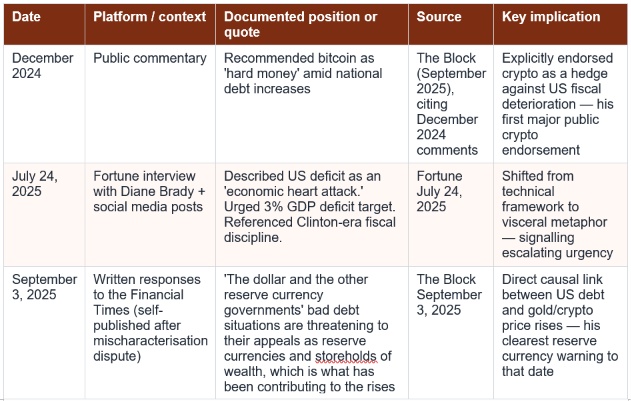
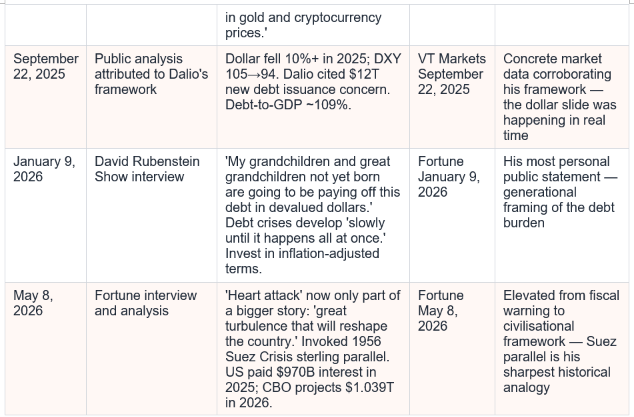
The following table consolidates Dalio’s verified public statements in chronological order, with sources. Each entry reflects documented quotes or attributed positions — not paraphrases, headlines, or social media extrapolations. Not financial advice.
What Dalio Has NOT Said: An Accuracy Check
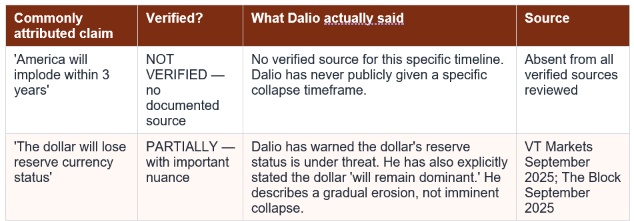
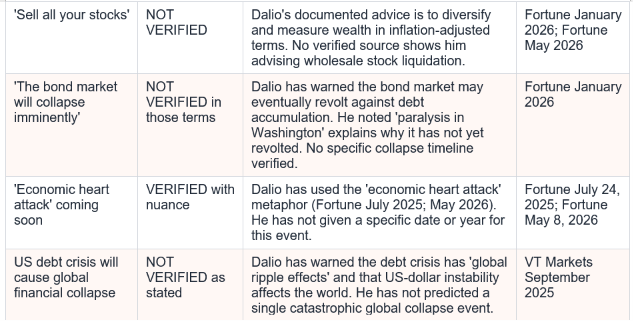
A significant volume of content circulates online attributing specific claims to Dalio that he has not made in any verified source. In the interest of accuracy, the following table distinguishes what Dalio has documented said from what is commonly attributed to him without verification. Not all Dalio-attributed content online reflects his actual positions.
What This Means for Ordinary Investors
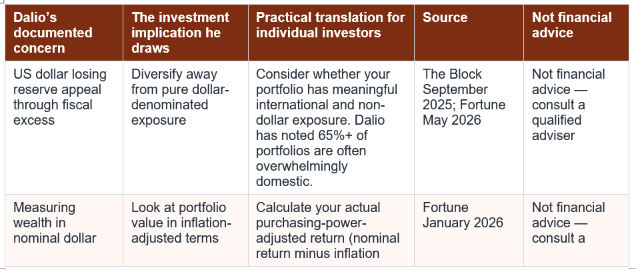
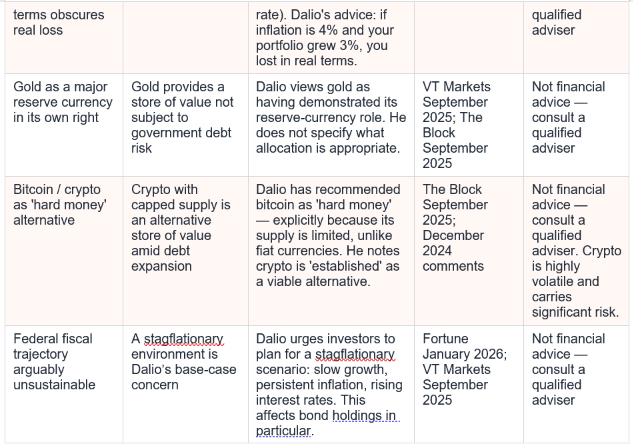
Dalio’s warnings are directed at the systemic level — reserve currency dynamics, sovereign debt sustainability, geopolitical risk. But his investment advice translates to practical individual-level implications that every investor can consider. Not financial advice. These reflect Dalio’s documented positions, not recommendations from this article.
Conclusion
The headline that sent you to this article — some version of ‘Dalio’s final warning’ or ‘America’s debt spiral imploding within three years’ — is a social media exaggeration of what is already a serious documented warning. The exaggeration is not necessary. Dalio comparing America’s debt trajectory to an ‘economic heart attack,’ invoking the 1956 Suez Crisis as a parallel for dollar confidence collapse, saying his grandchildren will pay off this debt in devalued dollars, citing $970 billion in annual interest payments and a trajectory toward $1.039 trillion — these are alarming enough without embellishment. What Dalio has consistently avoided — and it is worth noting because it is a sign of intellectual seriousness — is giving a specific timeline. He paraphrased Hemingway on bankruptcy: it happens ‘slowly until it happens all at once.’ That is exactly the nature of reserve-currency transitions and sovereign debt crises historically. They are not events on a calendar. They are processes whose pace is determined by the decisions of hundreds of millions of individual actors — investors, central banks, foreign governments — all making judgements about confidence simultaneously. What Dalio’s documented 2025-2026 warnings suggest, taken together, is that the United States is further along that process than most people appreciate — and that the decisions made in the next few years about fiscal deficits, monetary policy, and geopolitical commitments will determine how quickly or slowly it progresses. This is not financial, investment, or economic advice. What you do with any of this depends on your own circumstances, time horizon, and risk tolerance. Always consult a qualified financial adviser.Frequently Asked Questions
Did Ray Dalio actually say America will 'implode within 3 years'?No — this specific claim is not documented in any verified source. Dalio has issued serious, escalating warnings about the US debt trajectory, the dollar's reserve currency status, and the risk of what he calls an 'economic heart attack.' But he has not given a specific three-year — or any specific — timeline for a collapse event. Dalio's actual documented framing (Fortune January 2026) is that debt crises develop 'slowly until it happens all at once,' deliberately avoiding a specific prediction. Headlines that attribute a precise timeline to him should be verified against primary sources. What he has verifiably said — citing $970 billion in 2025 interest payments, warning about the 1956 Suez parallel, and calling this 'great turbulence that will reshape the country' (Fortune May 8, 2026) — is serious enough without invented precision.
What has Dalio actually said about the US national debt?
Dalio has issued several verified warnings. On the David Rubenstein Show (Fortune January 9, 2026), he said: 'My grandchildren and great grandchildren not yet born are going to be paying off this debt in devalued dollars.' In July 2025 (Fortune), he described America's deficit spiral as an 'economic heart attack.' In September 2025, in written responses to the Financial Times (The Block), he said the dollar's 'bad debt situation' is threatening its appeal as a reserve currency, contributing to gold and crypto price rises. He has consistently warned that the fiscal trajectory is 'arguably unsustainable' and that the federal deficit should be reduced to 3% of GDP — a level last seen in the Clinton era 1990s. He has noted the US paid $970 billion in interest in 2025, with the CBO projecting over $1 trillion in 2026 (Fortune May 2026).
What does Dalio recommend investors do about it?
Dalio's documented investment recommendations are specific. Fortune's May 2026 coverage summarises his advice as: 'diversify, and hedge against dollar devaluation.' His specific documented asset preferences: (1) Gold — which he views as a major reserve currency in its own right; (2) Bitcoin / crypto — which he recommended as 'hard money' in December 2024 and described in September 2025 as 'an alternative currency that has its supply limited'; (3) International assets — as a hedge against dollar-specific exposure; (4) Inflation-adjusted thinking — Fortune January 2026: 'look at the value of your portfolio in inflation-adjusted terms' rather than nominal dollar returns. These are Dalio's documented positions. They are not financial advice from this article. Always consult a qualified, regulated financial adviser before changing your investment strategy.
Is the Suez Crisis really a valid parallel for the dollar?
Dalio invoked the Suez Crisis parallel in Fortune's May 8, 2026 coverage. The historical facts: in 1956, Britain attempted a military operation in Egypt to reassert control of the Suez Canal. The US (and financial markets) effectively forced Britain to withdraw by declining to support sterling. The crisis exposed that Britain's military commitments had outrun its economic capacity, permanently shattering confidence in sterling as a global reserve currency. The pound lost its reserve status within roughly a decade. Dalio's framework (Fortune May 2026) is that 'the debt crisis and a potential Hormuz confrontation are not separate risks but mutually reinforcing ones.' The parallel is not that the US is Britain. It is that any great power that overextends militarily while running unsustainable deficits creates conditions for an accelerated loss of currency confidence. Historical analogies are inherently imperfect — the US economy remains the world's largest and the dollar retains dominant reserve status. But Dalio is a credible macro analyst who has studied reserve currency cycles across centuries of data.
Should I be worried about my savings and investments because of Dalio's warnings?
Dalio's warnings are about macro-level structural trends — sovereign debt sustainability, reserve currency dynamics, geopolitical risk — that unfold over years and decades, not days or months. For most individual investors, the practical implications Dalio draws are: (1) Review whether your portfolio is appropriately diversified internationally, not just domestically; (2) Calculate your real (inflation-adjusted) returns, not just nominal ones; (3) Consider whether you have appropriate exposure to assets that hold value independently of government fiscal decisions (gold, certain hard assets). These are portfolio-management considerations, not emergency actions. Dalio has not said the system will collapse tomorrow. He has said the trajectory is unsustainable and the risks are rising. The appropriate individual response is thoughtful review with a qualified financial adviser — not panic or wholesale portfolio restructuring based on any single commentator's views.
0 Comments
Be the first to share your thoughts on this article.