
Savings
Stop Overpaying for Gas With 3 Smart Habits

The habits that can stack 30–60¢ per gallon in savings every fill-up — using apps, loyalty programmes, and one timing trick most drivers never bother with

The national average gas price as of July 14, 2026 stands at approximately $3.86 per gallon, according to AAA data cited by The Penny Hoarder — elevated by the ongoing conflict in the Middle East that pushed prices to a peak of $4.52 nationally in May 2026. That price point is painful. But it is also the backdrop against which a growing toolkit of apps, loyalty programmes, membership discounts, and timing strategies have been specifically designed to save drivers real money at the pump. One former The Points Guy staffer saved more than $1,000 on gas in a single year using a version of the approach described in this article.
This guide focuses on three habits that individually produce meaningful savings and together — stacked on the same fill-up — can reduce the per-gallon price by 30 to 60 cents. For the average driver filling up 40 gallons per month, that represents $14 to $29 in monthly savings, or $170 to $350 per year from habit alone. For heavier drivers or those in high-price markets, the annual saving is significantly higher.
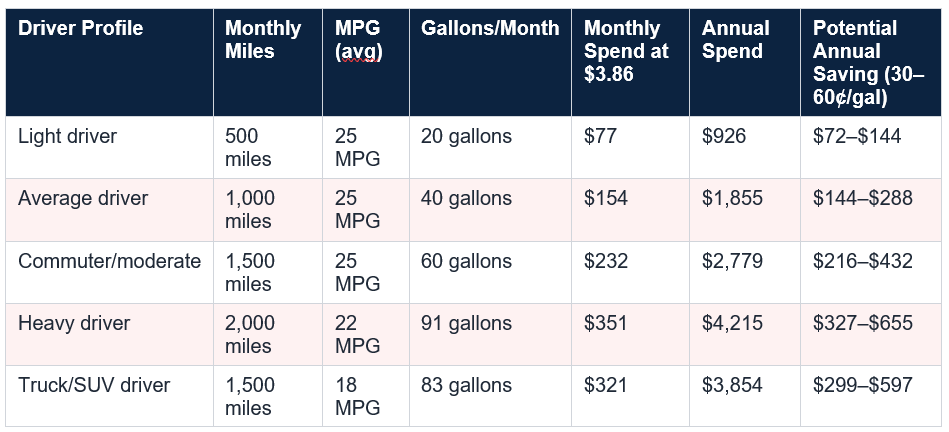
The Numbers: Average US driver spends approximately $1,855/year on gas at $3.86/gallon (AAA, July 2026). At the May 2026 peak of $4.52/gallon, the same driver spent $2,170/year. Stacking 30–60¢ per gallon in savings generates $144–$288 annually for the average driver — and significantly more for heavy drivers.
The table illustrates why gas is worth taking seriously as a savings opportunity. Even a light driver saving 30 cents per gallon across their fill-ups generates $72 per year from zero additional effort beyond three simple habits. A heavy driver or a household with two vehicles can realistically save $600 to $1,200 per year.
GasBuddy also offers Pay with GasBuddy+, a premium card-linked product that saves more than 20 cents per gallon at most national chains. It costs $9.99 per month for the premium version — but even at the paid tier, a driver filling up 40 gallons per month saves approximately $96 annually from the GasBuddy discount alone, comfortably covering the subscription cost. The free tier still saves by directing you to the cheapest nearby station before you drive past the expensive one.
The key advantage of Upside: it stacks on top of your existing payment method, including credit cards. You claim the Upside offer in the app, pump your gas, pay with your gas rewards credit card, and earn both the Upside cashback and the credit card rewards on the same transaction. This is the Layer 2 + Layer 4 combination from the stack described above.
Annual Saving — Habit #1: Price-finding apps: $72–$200+/year for the average driver (based on consistently choosing the cheapest station within reasonable distance and using Upside cashback)
Pro Tip: Never drive more than half a mile out of your way to reach a cheaper station. If you have to burn extra gas to get to the cheap gas, you eat the saving. The break-even rule: the extra distance is worth it only if the saving per gallon times your tank size exceeds the fuel cost of the detour.
Annual Saving — Habit #2: Loyalty stacking: $150–$500+/year for a driver who consistently uses one or two programmes (Shell Fuel Rewards, Walmart+ if already a member, Costco gas if on route)
Habit #3: Efficient driving and maintenance: $100–$300/year from a combination of correct tyre pressure, smoother driving habits, and annual maintenance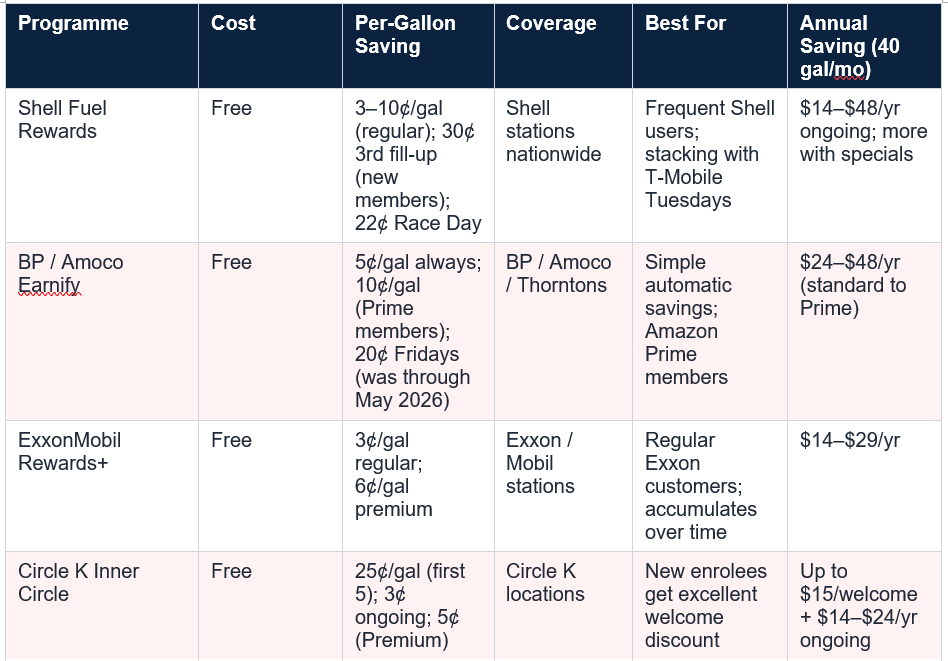
The mechanics: chains like Kroger, Safeway, and their affiliated banners (Fred Meyer, Ralphs, Fry’s, King Soopers, etc.) award fuel points for every grocery dollar spent. The standard rate is 1 fuel point per dollar, with 100 points redeeming for 10 cents per gallon at the partner fuel station. Spend $100 on groceries, earn 10 cents off per gallon on your next fill-up.
This sounds modest, but it compounds significantly with regular grocery spending:
Annual Saving — Grocery fuel rewards: $60–$150/year for a household spending $300–$500/month on groceries at a participating chain
The Men’s Journal March 2026 analysis, citing GasBuddy data, found that Sunday is also statistically among the cheapest days in many markets. The pattern makes structural sense: gas prices are set by local stations in anticipation of demand. Weekend demand is higher as people travel and run errands, so prices tend to be elevated Friday through Sunday in many markets. Monday and Tuesday see lower demand and correspondingly lower prices at many stations.
The practical application is modest but adds up: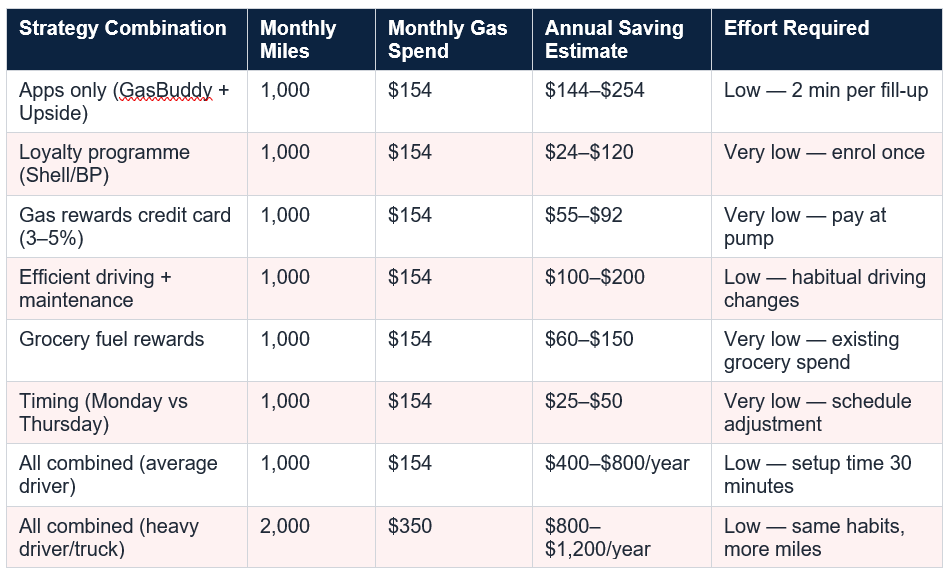
All estimates are based on publicly available 2026 research from GasBuddy, Upside, BestMoney, Firstcard, ConsumerAffairs, and The Points Guy. Individual results vary by local gas prices, fill-up frequency, station availability, and consistency of habit application. The combined row represents a realistic household that consistently applies all strategies without significantly altering its driving or shopping behaviour.
The three habits in this article — using a price-finding app before every fill-up, building a loyalty stack that earns discounts automatically on every purchase, and driving and maintaining the vehicle to maximise every gallon — are not complex, time-intensive, or expensive to establish. The initial setup time for Habits 1 and 2 combined is approximately 30 minutes. After that, each fill-up takes an extra two minutes to execute all three layers.
The return on those two minutes is $400 to $800 per year for the average driver. For the heavy driver, the truck owner, or the two-car household, the return is $800 to $1,200. One Points Guy staffer saved more than $1,000 in a year. Firstcard’s calculation shows that stacking all four payment layers generates 8 to 12 percent off total gas spend indefinitely — regardless of what happens to the global oil price. That is a significant, permanent reduction in one of the most unavoidable household expenses most Americans face. The pump is the problem. The habit is the solution.
According to GasBuddy’s study of pricing patterns across millions of fill-ups, Monday is consistently the cheapest day of the week nationally, typically 3 to 7 cents per gallon lower than Thursday, which is the most expensive day. Sunday is also among the cheaper days in many markets. Gas prices tend to rise ahead of peak weekend demand (Friday through Sunday) and fall on Monday and Tuesday when demand drops. Regional variation is significant: check GasBuddy price history for your local market to identify the cheapest day in your specific area.
How much does the Upside app save on gas?
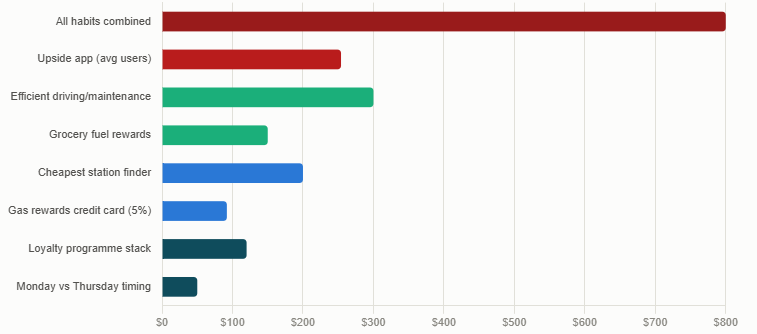
Upside’s company data reports average annual savings of $254 for regular app users. The app pays 10 to 25 cents per gallon in cashback at 50,000+ participating US gas stations. You claim the offer in the app before pumping, pay with any debit or linked credit card, and the cashback is deposited in your Upside account after the transaction. Upside is stackable with gas rewards credit cards: pay with your 3 to 5% cashback credit card and earn both the Upside per-gallon cashback and the credit card reward on the same fill-up.
What are the best gas loyalty programmes in 2026?
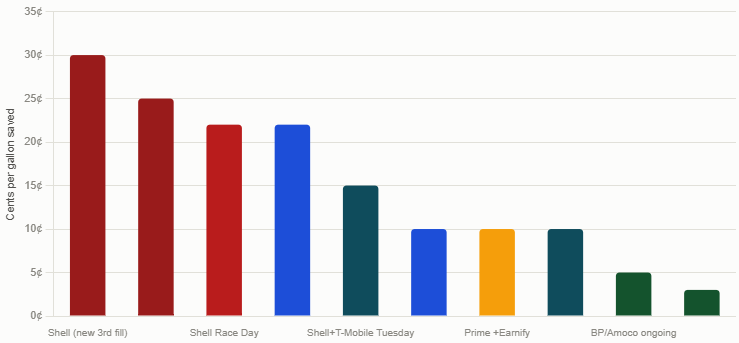
The top programmes by per-gallon savings are: (1) Shell Fuel Rewards — 30 cents off for new members on third fill-up; 3 to 10 cents ongoing; 22 cents on Race Day events through November 2026; stackable with T-Mobile Tuesdays for up to 15 cents on Tuesdays. (2) Circle K Inner Circle — 25 cents off first five fill-ups after enrolment; 3 to 5 cents ongoing. (3) Costco/Sam’s gas stations — consistently 20 to 25 cents below street price for members. (4) Walmart+ — 10 cents off at 13,000+ stations for members. (5) BP/Amoco Earnify — 5 cents per gallon guaranteed; 10 cents for Amazon Prime members.
Can I stack a gas app with a loyalty programme and a credit card?
Yes, and this stacking is the most efficient way to maximise savings per fill-up. The optimal stack: (1) use GasBuddy to find the cheapest nearby station; (2) claim an Upside cashback offer for that station before pumping; (3) use your enrolled station loyalty card (Shell Fuel Rewards, Earnify, etc.) for the per-gallon discount at the pump; (4) pay with a gas rewards credit card (3 to 5% back) to earn cashback on the total transaction. Each layer operates independently on the same fill-up. BestMoney’s April 2026 analysis found that combining all four layers can save 30 to 60 cents per gallon on qualifying fill-ups.
Does tyre pressure really affect fuel economy?
Yes. The US Department of Energy has documented that keeping tyres properly inflated improves fuel economy by up to 3 percent. Under-inflated tyres increase rolling resistance, meaning the engine works harder and burns more fuel to maintain the same speed. Checking and correcting tyre pressure takes two minutes with a standard gauge (available for $5 to $15) and should be done monthly and whenever the vehicle sits in significantly colder temperatures (which cause tyre pressure to drop). For a driver spending $1,855/year on gas, 3% fuel economy improvement saves approximately $55 per year with no other behaviour change.
What gas credit card gives the best cashback?
The best gas credit card in 2026 depends on your spending profile. For maximum flexibility: the Citi Custom Cash earns 5% cashback automatically on your top spend category each month, which for most drivers is gas. For Costco members: the Costco Anywhere Visa by Citi earns 4% on gas with a $7,000 annual limit. For a no-fee option: the Bank of America Customized Cash Rewards earns 3% on gas with no annual fee (and up to 5.25% for Preferred Rewards members). Critical rule: these rewards only produce net savings if the balance is paid in full monthly. Credit card interest at 20 to 25% APR eliminates any cashback benefit if balances are carried.
Table of Contents
- Gasoline Is One of the Most Hackable Expenses You Have
- The Real Cost of Doing Nothing
- How the Savings Stack Works
- Habit #1: Use a Price-Finding App Before Every Fill-Up
- Habit #2: Stack Loyalty Programmes and Membership Discounts
- Habit #3: Drive and Maintain Your Car to Maximise Every Gallon
- The Full Loyalty Programme Comparison Table
- The Four Best Gas Credit Cards for 2026
- Grocery Store Fuel Rewards: The Overlooked Double Win
- The Timing Strategy: When to Buy Gas During the Week
- The Stacking Formula: Putting All Three Habits Together
- What Not to Do: The Six Mistakes That Erase Your Savings
- How Much Can You Realistically Save Per Year?
- Conclusion: The Pump Is the Problem. The Habit Is the Solution.
- Frequently Asked Questions
- External References and Further Reading
Loyalty Programme Discounts
Annual Savings By Strategy
Gasoline Is One of the Most Hackable Expenses You Have
Most household expenses have limited room for manoeuvre. Your rent or mortgage is what it is. Your insurance premium is set annually. Your utility bills fluctuate but within a narrow range. Gasoline is different. The average US driver is spending approximately $154 per month at the pump in 2026 — but the amount they pay per gallon is highly variable, highly responsive to where and how they buy it, and meaningfully reducible through a small number of consistent habits that most drivers either do not know about or have not yet bothered to establish.The national average gas price as of July 14, 2026 stands at approximately $3.86 per gallon, according to AAA data cited by The Penny Hoarder — elevated by the ongoing conflict in the Middle East that pushed prices to a peak of $4.52 nationally in May 2026. That price point is painful. But it is also the backdrop against which a growing toolkit of apps, loyalty programmes, membership discounts, and timing strategies have been specifically designed to save drivers real money at the pump. One former The Points Guy staffer saved more than $1,000 on gas in a single year using a version of the approach described in this article.
This guide focuses on three habits that individually produce meaningful savings and together — stacked on the same fill-up — can reduce the per-gallon price by 30 to 60 cents. For the average driver filling up 40 gallons per month, that represents $14 to $29 in monthly savings, or $170 to $350 per year from habit alone. For heavier drivers or those in high-price markets, the annual saving is significantly higher.
The Real Cost of Doing Nothing
Before building the case for what to do, it is worth understanding precisely what doing nothing costs. The mathematics of default gas purchasing in 2026:The Numbers: Average US driver spends approximately $1,855/year on gas at $3.86/gallon (AAA, July 2026). At the May 2026 peak of $4.52/gallon, the same driver spent $2,170/year. Stacking 30–60¢ per gallon in savings generates $144–$288 annually for the average driver — and significantly more for heavy drivers.
The table illustrates why gas is worth taking seriously as a savings opportunity. Even a light driver saving 30 cents per gallon across their fill-ups generates $72 per year from zero additional effort beyond three simple habits. A heavy driver or a household with two vehicles can realistically save $600 to $1,200 per year.
How the Savings Stack Works
The most important concept for gas savings in 2026 is the stack: combining multiple savings mechanisms on the same fill-up to compound their individual effects. Firstcard’s April 2026 analysis described this clearly: there are four distinct savings layers available at the pump, each independently valuable and collectively powerful.- Layer 1 — Find the cheapest nearby station: using apps like GasBuddy, Waze, or Google Maps to locate the lowest-price station within a reasonable distance. This layer is free and requires no programme enrolment.
- Layer 2 — Earn cashback on the purchase: apps like Upside and Checkout 51 pay cashback rewards of 10 to 25 cents per gallon on qualifying fill-ups. This layer operates regardless of where you pay.
- Layer 3 — Pay-at-pump discount via loyalty programme: using a station’s own rewards programme (Shell Fuel Rewards, BP/Amoco Earnify, ExxonMobil Rewards+, Circle K Inner Circle) to reduce the per-gallon price at the moment of payment.
- Layer 4 — Credit card cashback: paying with a gas rewards credit card that earns 3 to 5 percent cashback on fuel purchases, on top of everything above.
Habit #1: Use a Price-Finding App Before Every Fill-Up
The first and most immediately actionable habit is the simplest: check a price-finding app before you need gas, not after the warning light has been on for 20 miles. When you are in panic-fill mode, you stop at the nearest station. The nearest station is almost never the cheapest nearby station. GasBuddy’s data consistently shows price differences of 10 to 30 cents per gallon between the cheapest and most expensive stations within a two-mile radius.GasBuddy: the market leader
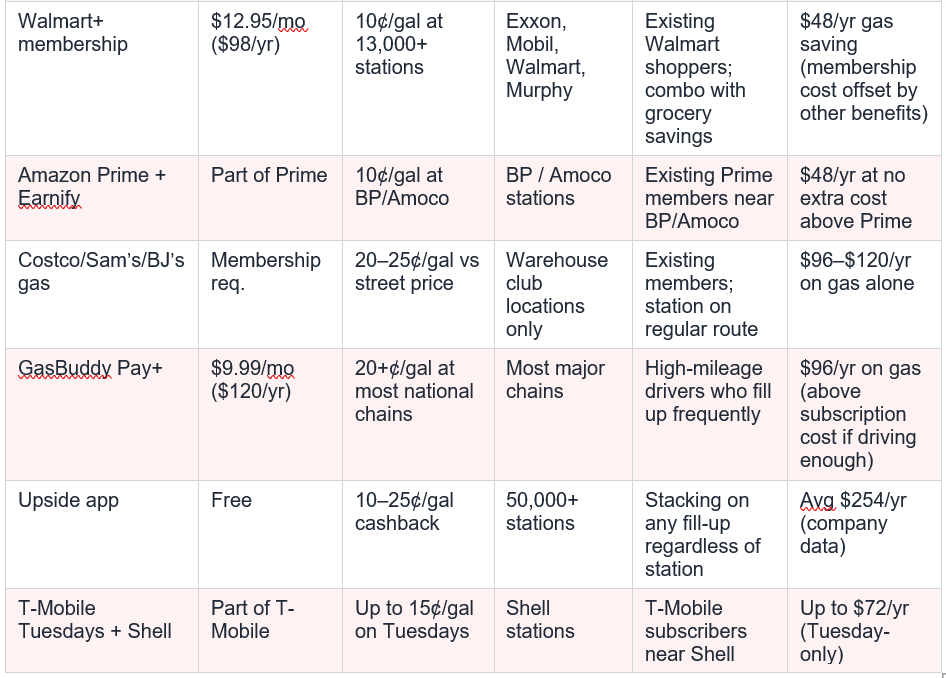
GasBuddy is the most widely used price-comparison app for gas in the US and also offers its own discount product. The free version of the app crowdsources price data from users, showing real-time prices at nearby stations. Its accuracy has improved significantly: most stations in major metro areas are updated at least once daily. The Points Guy’s March 2026 guide recommends using the map view for a quick visual of the cheapest stations on your route.GasBuddy also offers Pay with GasBuddy+, a premium card-linked product that saves more than 20 cents per gallon at most national chains. It costs $9.99 per month for the premium version — but even at the paid tier, a driver filling up 40 gallons per month saves approximately $96 annually from the GasBuddy discount alone, comfortably covering the subscription cost. The free tier still saves by directing you to the cheapest nearby station before you drive past the expensive one.
Upside: the cashback specialist
Upside (formerly GetUpside) approaches gas savings differently from GasBuddy. Rather than showing you which station is cheapest, it shows you where you can earn the most cashback. Upside pays 10 to 25 cents per gallon in cashback at 50,000+ participating stations, which you claim in the app before pumping and receive in your account after. BestMoney’s April 2026 guide identifies Upside as the ‘heavyweight for cashback’ among gas saving apps, with average annual savings of $254 for regular users.The key advantage of Upside: it stacks on top of your existing payment method, including credit cards. You claim the Upside offer in the app, pump your gas, pay with your gas rewards credit card, and earn both the Upside cashback and the credit card rewards on the same transaction. This is the Layer 2 + Layer 4 combination from the stack described above.
Other useful apps
- Waze: integrates gas prices into its navigation map, showing prices at stations along your route as you drive. Useful for finding cheap gas on familiar commutes where you know which stations Waze will route you near.
- Google Maps: as of 2025, displays gas prices at nearby stations within the search results when you search for gas stations. No additional download required for existing Google Maps users.
- AAA Mobile: shows AAA-discounted gas prices at participating stations for AAA members. Particularly useful for AAA members who may not be using their membership discount at the pump.
Annual Saving — Habit #1: Price-finding apps: $72–$200+/year for the average driver (based on consistently choosing the cheapest station within reasonable distance and using Upside cashback)
Pro Tip: Never drive more than half a mile out of your way to reach a cheaper station. If you have to burn extra gas to get to the cheap gas, you eat the saving. The break-even rule: the extra distance is worth it only if the saving per gallon times your tank size exceeds the fuel cost of the detour.
Habit #2: Stack Loyalty Programmes and Membership Discounts
The second habit is building a personal loyalty stack — a combination of station-specific rewards programmes, membership discounts, and credit card rewards that collectively reduce every gallon you pump. Done correctly, this habit requires no ongoing effort after the initial setup: you enrol once, link your payment methods, and the savings apply automatically every time you fill up.Station loyalty programmes
Every major US fuel brand now operates a free loyalty programme with per-gallon discounts:- Shell Fuel Rewards: the most generous of the major fuel loyalty programmes. New members earn 30 cents off per gallon on their third fill-up. Regular members earn 3 to 10 cents per gallon depending on status; Platinum status (achieved after 12 fill-ups of 10 or more gallons) earns 10 cents per gallon. Shell also runs Race Day Rewards through November 8, 2026, offering 22 cents per gallon on NASCAR Cup race days for app-enrolled members (up to 20 gallons, opt-in required). Additional savings stack from restaurant partners, grocery partner programmes, and in-store purchases.
- BP / Amoco Earnify: the simplest loyalty programme by design. Members save 5 cents per gallon on every fill-up, guaranteed, with no status requirements and no minimum spend. Amazon Prime members who link their accounts via Earnify save 10 cents per gallon (which increased to 20 cents on Fridays through May 2026). ABC News’ May 2026 coverage confirmed these are among the most straightforward and reliable per-gallon discounts available.
- ExxonMobil Rewards+: earns 3 cents per gallon on regular fuel and 6 cents per gallon on premium fuel, plus 2 cents per dollar spent in the convenience store. Points accumulate and are redeemable in dollar amounts once you reach 100 points. Less immediately impactful than Shell’s per-gallon discount, but consistent for regular Exxon/Mobil customers.
- Circle K Inner Circle: 25 cents off per gallon on the first five fill-ups after enrolment, then 3 cents per gallon on an ongoing basis. Premium status (achieved after $500 annual spend) unlocks 5 cents per gallon. The Current Member Challenge through June 2026 offered 40 cents per gallon for completing four fill-ups in a month.
Membership discounts
- Walmart+: members save 10 cents per gallon at more than 13,000 US gas stations, including Exxon, Mobil, Walmart, and Murphy stations. Walmart+ membership costs $12.95 per month or $98 per year. The 10-cent-per-gallon discount alone saves $48 per year for a driver buying 40 gallons per month, meaning the membership pays for itself primarily through grocery and delivery benefits rather than gas savings alone — but the gas discount is a meaningful and stackable bonus.
- Amazon Prime: 10 cents per gallon at BP and Amoco via Earnify for Prime members, with promotional increases available. For existing Prime members who use BP or Amoco stations, enrolling in Earnify and linking Prime adds an automatic 10 cents per gallon discount at no additional cost.
- Costco, Sam’s Club, BJ’s: the warehouse club gas station is one of the most consistent and reliable sources of below-market gas prices. Consumer Reports found these clubs selling gas for up to 25 cents per gallon less than comparable stations. WalletHub’s March 2026 guide confirmed this figure. The membership fee ($65 per year for Costco Gold Star) is offset by warehouse shopping savings, with the gas discount as an additional benefit for members who have a club station on their regular route.
T-Mobile Tuesdays stacking trick
The Points Guy’s June 2026 guide highlighted a specific stacking opportunity for T-Mobile customers: T-Mobile Tuesdays offers a discount code worth 5 cents off per gallon (up to 20 gallons) at Shell each week. Combined with Shell Fuel Rewards status of 10 cents per gallon, this produces a 15-cents-per-gallon discount every Tuesday for T-Mobile subscribers with Shell Fuel Rewards accounts — at zero additional cost beyond the existing T-Mobile and Shell programme memberships.Annual Saving — Habit #2: Loyalty stacking: $150–$500+/year for a driver who consistently uses one or two programmes (Shell Fuel Rewards, Walmart+ if already a member, Costco gas if on route)
Habit #3: Drive and Maintain Your Car to Maximise Every Gallon
The first two habits attack the price per gallon. The third habit reduces how many gallons you buy in the first place. Fuel-efficient driving and basic vehicle maintenance are unglamorous but consistently documented contributors to fuel cost reduction — and they apply to every trip, regardless of which loyalty programmes you have enrolled in.Tyre pressure
The US Department of Energy’s documented finding: keeping tyres properly inflated improves fuel economy by up to 3 percent. This sounds modest but is free, takes two minutes per month with a standard pressure gauge, and applies continuously across every mile you drive. For a driver spending $1,855 per year on gas, 3 percent improvement reduces annual spend by approximately $55.Speed: the most impactful driving habit
The Department of Energy’s research shows that fuel economy decreases significantly at speeds above 50 mph. Driving at 70 mph instead of 55 mph can reduce fuel efficiency by 10 to 15 percent. On interstate driving and long commutes where speed is a meaningful variable, this single habit compounds quickly: a driver who moderates their highway speed from 75 to 65 mph on a regular 30-mile highway commute can meaningfully extend their miles-per-gallon and reduce monthly fill-up frequency.Smooth acceleration and braking
Aggressive driving — rapid acceleration from stops and hard braking before them — is one of the most fuel-consumptive behaviours available to any driver. The simple habit of anticipating traffic flow and coasting to slowdowns rather than accelerating and then braking improves fuel economy by 10 to 40 percent in city driving conditions, according to DOE data. This is the habit that on its own can move a car from the lower end to the upper end of its EPA fuel economy rating.Engine maintenance
WalletHub’s March 2026 guide cited the DOE’s finding that routine maintenance — replacing worn spark plugs and clogged air filters — prevents fuel economy from dropping. A misfiring spark plug reduces engine efficiency by up to 4 percent per plug. An engine running on worn plugs across four or six cylinders is meaningfully less fuel-efficient than the same engine properly maintained. Annual maintenance checks that include spark plugs and air filters cost $50 to $150 and pay for themselves in improved fuel economy over the following 12 months.Habit #3: Efficient driving and maintenance: $100–$300/year from a combination of correct tyre pressure, smoother driving habits, and annual maintenance
The Full Loyalty Programme Comparison Table
The Four Best Gas Credit Cards for 2026
A gas rewards credit card is Layer 4 of the savings stack — and unlike the other layers, it earns on top of any loyalty programme or cashback app you are already using. The credit card reward is earned on the total transaction amount, meaning it applies to every dollar you spend at the pump regardless of which other discounts you have already stacked.- Citi Custom Cash Card: earns 5% cash back on your top spend category each billing cycle, automatically. For drivers whose largest recurring expense is gas, this card automatically applies its 5% rate to all gas purchases up to $500 per month. Above that limit, the rate drops to 1%. For average drivers spending $154/month on gas, the 5% rate applies for the full monthly spend, generating $92/year in gas cashback alone.
- Costco Anywhere Visa Card by Citi: earns 4% cashback on eligible gas worldwide (including Costco gas) for the first $7,000 per year, then 1%. For a driver spending $154/month ($1,848/year) on gas, the 4% rate generates $74/year. Best for existing Costco members who already shop and fill up at Costco.
- Blue Cash Preferred from American Express: earns 3% on US gas station purchases with no upper limit. $95 annual fee (offset by 6% at US supermarkets). For a driver spending $154/month on gas, earns $55/year in gas cashback.
- Bank of America Customized Cash Rewards: earns 3% on gas (or other chosen category) with no annual fee. Up to $2,500 per quarter at the 3% rate. An excellent no-fee option for moderate drivers. Bank of America Preferred Rewards members can earn up to 5.25% on gas.
Grocery Store Fuel Rewards: The Overlooked Double Win
One of the most underused gas savings tools for many American drivers is the grocery store fuel rewards programme. These programmes allow shoppers to earn fuel discounts simply by spending on groceries they were already going to buy. The result is a double win: every grocery dollar both buys food and earns future fuel savings.The mechanics: chains like Kroger, Safeway, and their affiliated banners (Fred Meyer, Ralphs, Fry’s, King Soopers, etc.) award fuel points for every grocery dollar spent. The standard rate is 1 fuel point per dollar, with 100 points redeeming for 10 cents per gallon at the partner fuel station. Spend $100 on groceries, earn 10 cents off per gallon on your next fill-up.
This sounds modest, but it compounds significantly with regular grocery spending:
- A household spending $400/month on groceries at Kroger earns 400 fuel points per month — enough to take 40 cents per gallon off a fill-up. At 15 gallons, that is $6 off one fill-up, or $72 per year.
- Double and triple fuel point promotions (common on gift cards and specific products) can accelerate accumulation dramatically. Spending $100 on a gift card during a double-points promotion earns 200 fuel points instead of 100.
- Some chains have no maximum redemption per fill-up; others cap it at 35 gallons or 100 gallons per redemption period. Check your specific chain’s terms.
Annual Saving — Grocery fuel rewards: $60–$150/year for a household spending $300–$500/month on groceries at a participating chain
The Timing Strategy: When to Buy Gas During the Week
Gasoline prices fluctuate on a weekly cycle, and the timing of your fill-up affects what you pay even at the same station. GasBuddy’s 2025 study, which analysed pricing patterns across millions of fill-ups, found a consistent national pattern: Monday is the cheapest day of the week for gas purchases, and Thursday is consistently the most expensive. The difference is typically 3 to 7 cents per gallon nationally, though regional variation is significant.The Men’s Journal March 2026 analysis, citing GasBuddy data, found that Sunday is also statistically among the cheapest days in many markets. The pattern makes structural sense: gas prices are set by local stations in anticipation of demand. Weekend demand is higher as people travel and run errands, so prices tend to be elevated Friday through Sunday in many markets. Monday and Tuesday see lower demand and correspondingly lower prices at many stations.
The practical application is modest but adds up:
- At 7 cents per gallon saving on a 15-gallon fill-up, filling up on Monday instead of Thursday saves $1.05 per fill-up — approximately $25 to $50 per year for an average driver.
- Combining the Monday timing with a price-finding app and a loyalty programme means you are consistently targeting the lowest available per-gallon price across station, timing, and payment method simultaneously.
The Stacking Formula: Putting All Three Habits Together
The three habits work independently. They work better together. Here is what an optimised fill-up looks like when all three are combined:- Day of week: Monday morning, before the week’s commuting begins. 3 to 7 cents below Thursday’s average.
- Station selection: GasBuddy app checked the night before. Cheapest station within half a mile of the Monday morning route. 10 to 30 cents per gallon below the nearby premium station.
- App cashback: Upside offer claimed before arriving at the pump. 10 to 25 cents per gallon cashback deposited post-fill.
- Station loyalty programme: Shell Fuel Rewards card linked for 3 to 10 cents off per gallon (with T-Mobile Tuesdays code if filling up Tuesday instead of Monday for 5 cents extra).
- Credit card: Citi Custom Cash or equivalent 3 to 5% gas rewards card used for payment.
- Vehicle: tyres inflated to spec that morning. Smooth driving on the route to the station.
What Not to Do: The Six Mistakes That Erase Your Savings
The strategies above are straightforward. These mistakes undo them:- Driving out of your way for cheap gas: if you drive two miles further to save 10 cents per gallon on a 15-gallon fill-up ($1.50 saving), but the two-mile detour uses 0.1 gallons ($0.39), the net saving is $1.11 — reasonable. If the detour is 10 miles, you spent more on the drive than you saved on the discount. Never drive more than about a mile out of your way per 5 to 10 cents per gallon saved on a standard tank.
- Carrying a credit card balance: a 3% cashback reward on a $154 gas bill earns $4.62 per month. One month of carrying that balance at 22% APR costs more than $2 in interest. Rewards credit cards only generate net savings when paid in full monthly.
- Forgetting to cash out app balances: Upside, Checkout 51, and similar apps accumulate cashback that must be actively redeemed. Balances that sit unredeemed are not savings. Set a monthly reminder to cash out any balances above $10.
- Enrolling in a loyalty programme but not activating offers: Shell Fuel Rewards requires offer activation for some bonus savings. Race Day Rewards require app opt-in. Automatically applied discounts (BP’s 5 cents per gallon, Walmart+) are simpler but also require account linking. Failing to complete the setup means the discount does not apply at the pump.
- Buying premium fuel for an engine that does not require it: most passenger vehicles are designed for regular unleaded. Paying 30 to 50 cents more per gallon for premium fuel in a car whose manual specifies regular provides zero performance or economy benefit. Check your owner’s manual.
- Topping off the tank: many drivers add extra fuel after the pump clicks off automatically. This is wasteful: fuel vapour recovery systems draw back any overfilled fuel into the vapour recovery canister, meaning you paid for fuel that goes back into the station’s system. Stop when the pump clicks.
How Much Can You Realistically Save Per Year?
All estimates are based on publicly available 2026 research from GasBuddy, Upside, BestMoney, Firstcard, ConsumerAffairs, and The Points Guy. Individual results vary by local gas prices, fill-up frequency, station availability, and consistency of habit application. The combined row represents a realistic household that consistently applies all strategies without significantly altering its driving or shopping behaviour.
Conclusion
Gas at $3.86 per gallon in July 2026 — elevated by Middle East tensions and the residual inflationary pressure of the past five years — is a real and recurring household cost. The average driver spending $1,855 per year on fuel has no ability to change the global oil price. But they have significant ability to change how much of that price they personally pay.The three habits in this article — using a price-finding app before every fill-up, building a loyalty stack that earns discounts automatically on every purchase, and driving and maintaining the vehicle to maximise every gallon — are not complex, time-intensive, or expensive to establish. The initial setup time for Habits 1 and 2 combined is approximately 30 minutes. After that, each fill-up takes an extra two minutes to execute all three layers.
The return on those two minutes is $400 to $800 per year for the average driver. For the heavy driver, the truck owner, or the two-car household, the return is $800 to $1,200. One Points Guy staffer saved more than $1,000 in a year. Firstcard’s calculation shows that stacking all four payment layers generates 8 to 12 percent off total gas spend indefinitely — regardless of what happens to the global oil price. That is a significant, permanent reduction in one of the most unavoidable household expenses most Americans face. The pump is the problem. The habit is the solution.
Frequently Asked Questions
What is the cheapest day to buy gas in 2026?According to GasBuddy’s study of pricing patterns across millions of fill-ups, Monday is consistently the cheapest day of the week nationally, typically 3 to 7 cents per gallon lower than Thursday, which is the most expensive day. Sunday is also among the cheaper days in many markets. Gas prices tend to rise ahead of peak weekend demand (Friday through Sunday) and fall on Monday and Tuesday when demand drops. Regional variation is significant: check GasBuddy price history for your local market to identify the cheapest day in your specific area.
How much does the Upside app save on gas?
Upside’s company data reports average annual savings of $254 for regular app users. The app pays 10 to 25 cents per gallon in cashback at 50,000+ participating US gas stations. You claim the offer in the app before pumping, pay with any debit or linked credit card, and the cashback is deposited in your Upside account after the transaction. Upside is stackable with gas rewards credit cards: pay with your 3 to 5% cashback credit card and earn both the Upside per-gallon cashback and the credit card reward on the same fill-up.
What are the best gas loyalty programmes in 2026?
The top programmes by per-gallon savings are: (1) Shell Fuel Rewards — 30 cents off for new members on third fill-up; 3 to 10 cents ongoing; 22 cents on Race Day events through November 2026; stackable with T-Mobile Tuesdays for up to 15 cents on Tuesdays. (2) Circle K Inner Circle — 25 cents off first five fill-ups after enrolment; 3 to 5 cents ongoing. (3) Costco/Sam’s gas stations — consistently 20 to 25 cents below street price for members. (4) Walmart+ — 10 cents off at 13,000+ stations for members. (5) BP/Amoco Earnify — 5 cents per gallon guaranteed; 10 cents for Amazon Prime members.
Can I stack a gas app with a loyalty programme and a credit card?
Yes, and this stacking is the most efficient way to maximise savings per fill-up. The optimal stack: (1) use GasBuddy to find the cheapest nearby station; (2) claim an Upside cashback offer for that station before pumping; (3) use your enrolled station loyalty card (Shell Fuel Rewards, Earnify, etc.) for the per-gallon discount at the pump; (4) pay with a gas rewards credit card (3 to 5% back) to earn cashback on the total transaction. Each layer operates independently on the same fill-up. BestMoney’s April 2026 analysis found that combining all four layers can save 30 to 60 cents per gallon on qualifying fill-ups.
Does tyre pressure really affect fuel economy?
Yes. The US Department of Energy has documented that keeping tyres properly inflated improves fuel economy by up to 3 percent. Under-inflated tyres increase rolling resistance, meaning the engine works harder and burns more fuel to maintain the same speed. Checking and correcting tyre pressure takes two minutes with a standard gauge (available for $5 to $15) and should be done monthly and whenever the vehicle sits in significantly colder temperatures (which cause tyre pressure to drop). For a driver spending $1,855/year on gas, 3% fuel economy improvement saves approximately $55 per year with no other behaviour change.
What gas credit card gives the best cashback?
The best gas credit card in 2026 depends on your spending profile. For maximum flexibility: the Citi Custom Cash earns 5% cashback automatically on your top spend category each month, which for most drivers is gas. For Costco members: the Costco Anywhere Visa by Citi earns 4% on gas with a $7,000 annual limit. For a no-fee option: the Bank of America Customized Cash Rewards earns 3% on gas with no annual fee (and up to 5.25% for Preferred Rewards members). Critical rule: these rewards only produce net savings if the balance is paid in full monthly. Credit card interest at 20 to 25% APR eliminates any cashback benefit if balances are carried.
0 Comments
Be the first to share your thoughts on this article.