

Investing
The Best Low-Risk ETFs to Replace CDs: Yields, Risks And More

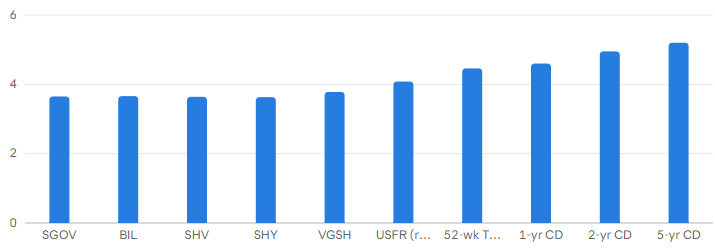
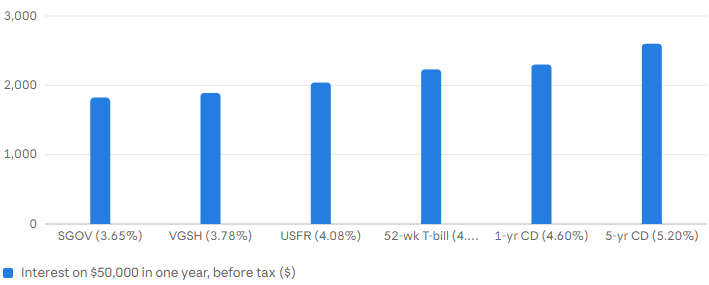
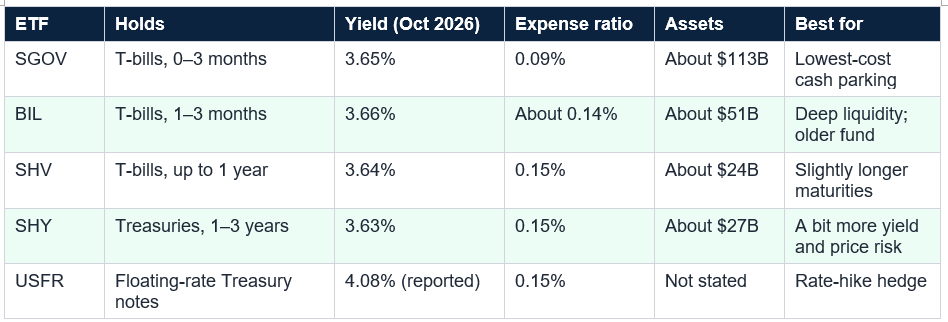
ETF yields: SGOV 3.65% (0.09% fee; about $113 billion); BIL 3.66% (0.14%); SHV 3.64% (0.15%); SHY 3.63% (0.15%); VGSH 3.78% (0.03%); VBIL 3.68% (0.06%); USFR reported 4.08% (0.15%). Alternatives: 52-week T-bill 4.46%; brokered CDs 4.60% (1-year), 4.95% (2-year), 5.20% (5-year); money market funds 3.5%–3.9%; inflation 3.7%. Interest on $50,000 in a year (before tax): about $1,825 in SGOV; $2,230 in a 52-week T-bill; $2,300 in a 1-year CD; $2,600 in a 5-year CD (author’s arithmetic). Risk check: SHY fell about 1.65% year to date and returned about +1.6% over one year, versus about +3.8% for SGOV; duration about 1.8 years vs about 0.08.
So many investors now ask whether an exchange-traded fund holding Treasuries can do the same job. Treasury bill ETFs promise safety, daily liquidity and rates that adjust, but the numbers show a trade-off. This guide compares the leading low-risk ETFs with CDs using October 2026 data.
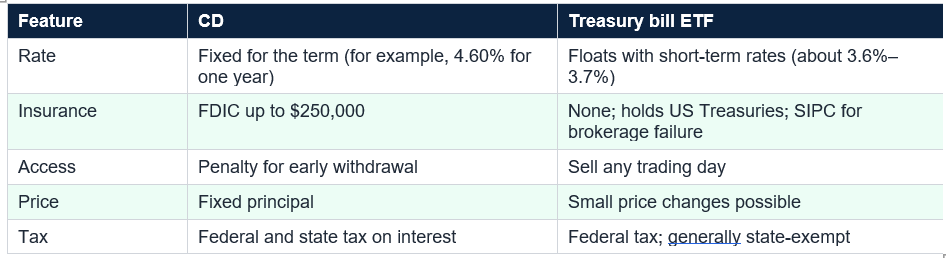
For most people who want a CD alternative for cash they might need soon, SGOV is the default choice. Its interest is generally exempt from state and local income tax, which matters in higher-tax states.
BIL’s edge is its long track record and that some brokerages offer it commission-free when they do not offer SGOV, in which case BIL can be cheaper in practice. Otherwise cost decides.
SHV may suit someone with a six-to-twelve-month horizon. The trade-off is slightly more price sensitivity, still small: with a duration of about 0.25 years, a one-point rise in rates would reduce the price by roughly 0.25%.
The difference shows up in returns. Over one year, SHY returned about 1.6% against about 3.8% for SGOV, and SHY and VGSH were down about 1.65% year to date in an October listing while SGOV was slightly up. A duration of about 1.8 years means a one-point rise in rates could lower the price by roughly 1.8%: modest, but not a CD that returns your principal.
Keep in mind: Low risk is not no risk. SHY’s duration of about 1.8 years is roughly 20 times SGOV’s, so a rate rise that barely touches SGOV can dent SHY.
Two cautions: the 4.08% comes from one source and may be computed differently, and floating-rate notes can still see small price moves. USFR is a more specialized product than SGOV.
Traditional money market funds are another alternative: Vanguard’s VUSXX yielded about 3.82% with a 0.07% fee in early October, with no trading needed. For many investors a low-cost money market fund and a T-bill ETF are close substitutes.
The ETF’s advantage is flexibility, not yield. If you might need the money, or expect rates to rise, selling any trading day and earning more as rates climb has real value. If you will not need the money for a year or more, a CD or Treasury note simply pays more today.
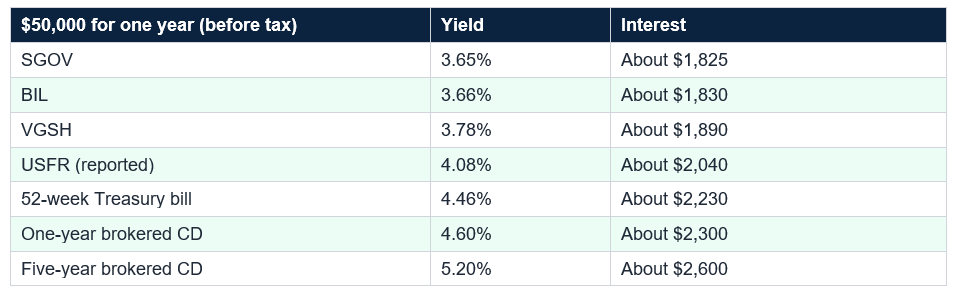
On $50,000: SGOV about $1,825 a year; 52-week T-bill about $2,230; one-year CD about $2,300; five-year CD about $2,600. The ETF trails the one-year CD by about $475 a year but offers daily liquidity and no early withdrawal penalty.
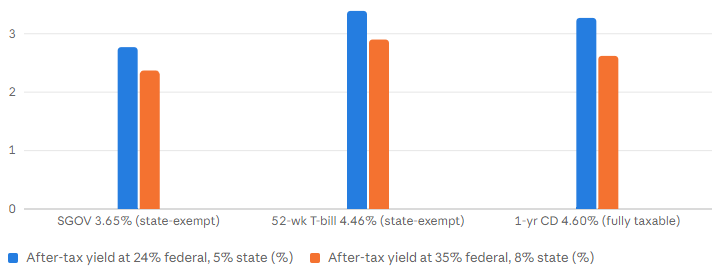
At 35% federal and 8% state, the CD nets about 2.62% against 2.37% for SGOV. The state-tax exemption helps, but it does not overcome a yield gap of nearly a full point, so the ETF’s case rests on flexibility, not tax.

Fourth, trading: ETFs can trade at a small premium or discount and carry a bid-ask spread, so use limit orders. Fifth, inflation: with inflation at 3.7% in September, a 3.65% yield only keeps pace. These ETFs are cash-like, not cash.
In other words, the CD wins on income in both scenarios unless short rates jump by about a full point or more soon after you buy, because its starting yield is so much higher. The ETF’s case is liquidity and optionality, not outperformance. If you expect rates to rise sharply, a floating-rate fund such as USFR may be the better hedge.
They make less sense if you have a known date and can lock a higher rate, need FDIC insurance or want a fixed return. Right now, with CDs paying well above the ETFs, a CD or Treasury note simply pays more for money you can leave alone.
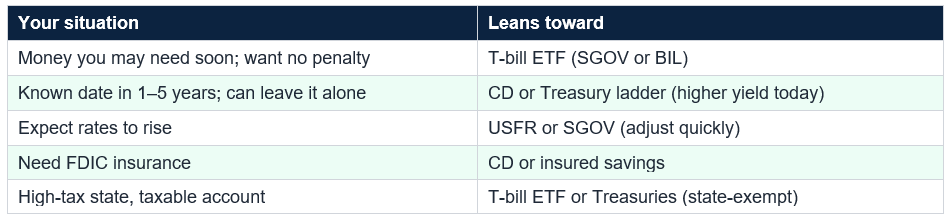
Common mistakes include assuming an ETF is insured, chasing the highest yield without checking duration, using market orders in thin trading, holding emergency money in a long-duration fund and forgetting that yields are not fixed. A mix of insured savings, T-bill ETFs and locked CDs balances safety, flexibility and income.
The right choice depends on whether you value flexibility or yield. Use ETFs for money you may need and for rate-hike protection, and lock CDs or Treasuries for money you can leave alone. Compare after-tax yields and remember that ETFs are not FDIC-insured. A qualified adviser can help you decide.
It can replace a CD’s job of holding safe cash, but not its guaranteed rate or insurance. T-bill ETFs are liquid, have no early withdrawal penalty and hold short-term US Treasuries, but their yield floats and they are not FDIC-insured. In October they yielded about 3.6% to 3.7%, versus 4.60% for a one-year brokered CD.
Why do T-bill ETFs yield less than CDs right now?
Because they hold bills maturing in 0 to 3 months, the short end of the yield curve. A 13-week bill paid about 3.78% in one source, a 52-week bill about 4.46% and brokered CDs 4.60% to 5.20%. Longer maturities currently pay more, so you give up yield for flexibility.
Are T-bill ETFs safe?
They are among the lowest-risk ETFs, because they hold short-term US government debt. But they are not risk-free: they are not FDIC-insured, their price can move slightly, and their income changes when rates change. Funds holding 1 to 3 year Treasuries, such as SHY, carry more price risk and fell about 1.65% year to date in one October listing.
Is SGOV or BIL better?
SGOV is cheaper, at 0.09% versus about 0.14% for BIL, and larger, with about $113 billion versus about $51 billion. BIL launched in 2007. Yields are almost identical, so cost usually decides, though some brokers offer commission-free trading on one but not the other.
Is the interest from T-bill ETFs tax-free?
Not federally. T-bill interest is federally taxable but generally exempt from state and local income tax, and funds pass that through, subject to each state’s rules. That can make a T-bill ETF worth more after tax than its headline yield suggests in a high-tax state. This is not tax advice.
Table of Contents
- Why People Are Looking Beyond CDs
- The Short Answer
- ETFs vs. CDs: The Key Differences
- Pick 1: SGOV
- Pick 2: BIL
- Pick 3: SHV
- Pick 4: SHY and VGSH
- Pick 5: USFR (Floating-Rate Treasuries)
- Other Options: VBIL and Money Market ETFs
- The Yield Reality Check
- Taxes: Where ETFs Can Help
- The Risks, Honestly
- If Rates Rise or Fall
- Who Should Switch, and Who Should Not
- How to Buy and Mistakes to Avoid
- Conclusion
- Frequently Asked Questions
The yield reality check: low-risk ETFs vs. T-bills and CDs, October 2026 (%)
Yield (%) by RiskStock, ETF Beacon, Dividend Vision (ETFs); MyMoneyBlog (T-bill); DepositAccounts (brokered CDs, Oct 15)
What $50,000 earns in a year: Treasury ETFs vs. T-bill and CDs ($)
Interest per year ($) by Author's arithmetic at constant yields; the ETF trails the one-year CD by about $475 a year but offers daily liquidity
Taxes narrow but do not close the gap: after-tax yields (%)
After-tax yield (%) by Author's illustration; state-tax treatment of ETF income varies by stateWhy People Are Looking Beyond CDs
CDs were the comfort food of savers for decades: a fixed rate, a fixed date, FDIC insurance and nothing to monitor. But in a rising-rate year the money is locked up and a rate that looked good in March can look stale by October. The Federal Reserve raised its target range to 3.75%–4.00% in September, and Reuters reported in mid-October that another hike was back on the table.So many investors now ask whether an exchange-traded fund holding Treasuries can do the same job. Treasury bill ETFs promise safety, daily liquidity and rates that adjust, but the numbers show a trade-off. This guide compares the leading low-risk ETFs with CDs using October 2026 data.
The Short Answer
The best low-risk ETFs for replacing CDs are Treasury bill funds: the iShares 0-3 Month Treasury Bond ETF (SGOV), the SPDR 1-3 Month T-Bill ETF (BIL), the iShares Short Treasury Bond ETF (SHV), the iShares 1-3 Year Treasury Bond ETF (SHY) for slightly more yield and risk, and the WisdomTree Floating Rate Treasury Fund (USFR). The honest headline is that these ETFs yield about 3.6% to 3.7%, while a one-year brokered CD paid 4.60% and a five-year 5.20%. They replace a CD’s purpose, not its yield.
ETFs vs. CDs: The Key Differences
A CD gives you a guaranteed rate for a set term and FDIC insurance up to $250,000 per depositor, per bank, per ownership category, in exchange for a penalty if you leave early. A Treasury ETF gives you daily liquidity and no penalty, backed by US government debt, but the rate floats, the price can move slightly and the fund is not FDIC-insured. If the brokerage fails, SIPC protects your securities but not against investment losses.
Pick 1: SGOV
The iShares 0-3 Month Treasury Bond ETF is the biggest and cheapest of the T-bill funds. It charges 0.09%, held about $113 billion in early October and holds bills maturing in zero to three months, a duration of about one month. It yielded about 3.65%, and its one-year return was about 3.8% to 3.95% depending on the source. Its yield adjusts quickly when the Fed moves and its price barely budges.For most people who want a CD alternative for cash they might need soon, SGOV is the default choice. Its interest is generally exempt from state and local income tax, which matters in higher-tax states.
Pick 2: BIL
The SPDR Bloomberg 1-3 Month T-Bill ETF holds bills maturing in one to three months, has been around since 2007 and holds about $51 billion. It charges about 0.14%, roughly $5 a year more than SGOV on $10,000. Yields are almost identical: 3.66% versus 3.65% in one October listing.BIL’s edge is its long track record and that some brokerages offer it commission-free when they do not offer SGOV, in which case BIL can be cheaper in practice. Otherwise cost decides.
Pick 3: SHV
The iShares Short Treasury Bond ETF holds bills with maturities up to a year, a duration of about three months. It charges 0.15%, holds about $24 billion and yielded about 3.64% in October. Longer maturities should capture more yield when the curve slopes upward, but one comparison noted that SHV’s higher fee largely offsets that advantage.SHV may suit someone with a six-to-twelve-month horizon. The trade-off is slightly more price sensitivity, still small: with a duration of about 0.25 years, a one-point rise in rates would reduce the price by roughly 0.25%.
Pick 4: SHY and VGSH
If you accept some price movement for a little more yield, funds holding one-to-three-year Treasuries are the next step. The iShares 1-3 Year Treasury Bond ETF (SHY) charges 0.15% and yielded about 3.63%, while Vanguard’s Short-Term Treasury ETF (VGSH) charges 0.03% and showed 3.78% in one listing. They are high-quality Treasuries, not T-bill funds.The difference shows up in returns. Over one year, SHY returned about 1.6% against about 3.8% for SGOV, and SHY and VGSH were down about 1.65% year to date in an October listing while SGOV was slightly up. A duration of about 1.8 years means a one-point rise in rates could lower the price by roughly 1.8%: modest, but not a CD that returns your principal.
Keep in mind: Low risk is not no risk. SHY’s duration of about 1.8 years is roughly 20 times SGOV’s, so a rate rise that barely touches SGOV can dent SHY.
Pick 5: USFR (Floating-Rate Treasuries)
The WisdomTree Floating Rate Treasury Fund holds floating-rate notes issued by the US Treasury, whose interest rate resets weekly based on the 13-week bill. It charges 0.15% and showed the group’s highest reported yield, 4.08%. Because coupons adjust, it can capture rate increases quickly, a natural hedge if the Fed keeps raising rates.Two cautions: the 4.08% comes from one source and may be computed differently, and floating-rate notes can still see small price moves. USFR is a more specialized product than SGOV.
Other Options: VBIL and Money Market ETFs
Two other products deserve a mention. Vanguard’s 0-3 Month Treasury Bill ETF (VBIL) charges 0.06% and yielded about 3.68%, according to ETF Beacon, cheaper than SGOV for similar exposure but newer and smaller at about $12.8 billion. Money market ETFs such as State Street’s MMK (about 3.9%, 0.18% fee), MMKT (3.7%) and JMMF (3.7%) trade like stocks while holding money market assets.Traditional money market funds are another alternative: Vanguard’s VUSXX yielded about 3.82% with a 0.07% fee in early October, with no trading needed. For many investors a low-cost money market fund and a T-bill ETF are close substitutes.
The Yield Reality Check
Here is the uncomfortable truth. T-bill ETFs yield about 3.6% to 3.7% because they hold bills maturing in 0 to 3 months, the short end of the yield curve. A 13-week bill paid about 3.78% in one source, a 52-week bill about 4.46% in MyMoneyBlog’s survey and brokered CDs 4.60% for one year and 5.20% for five. On $50,000, that is about $1,825 a year in SGOV, $2,230 in a 52-week bill and $2,300 in a one-year CD, a gap of about $475; a five-year CD pays about $2,600, or $775 more.The ETF’s advantage is flexibility, not yield. If you might need the money, or expect rates to rise, selling any trading day and earning more as rates climb has real value. If you will not need the money for a year or more, a CD or Treasury note simply pays more today.
On $50,000: SGOV about $1,825 a year; 52-week T-bill about $2,230; one-year CD about $2,300; five-year CD about $2,600. The ETF trails the one-year CD by about $475 a year but offers daily liquidity and no early withdrawal penalty.
Taxes: Where ETFs Can Help
Taxes can narrow the gap. CD interest is taxable federally and by states, while Treasury bill interest is generally exempt from state and local income tax, and T-bill ETFs pass that through, subject to each state’s rules. In my illustration at 24% federal and 5% state, a 4.60% CD nets about 3.27% and SGOV’s 3.65% about 2.77%, so the CD still wins by half a point; a 52-week bill at 4.46% would net about 3.39%.At 35% federal and 8% state, the CD nets about 2.62% against 2.37% for SGOV. The state-tax exemption helps, but it does not overcome a yield gap of nearly a full point, so the ETF’s case rests on flexibility, not tax.
The Risks, Honestly
The risks are small but real. First, no FDIC insurance: the holdings are US Treasuries, but the fund is not insured. Second, price changes: T-bill ETFs can move a little and funds such as SHY more. Third, income changes: if the Fed cuts rates, the ETF’s yield will fall within weeks while a CD would have locked the higher rate.Fourth, trading: ETFs can trade at a small premium or discount and carry a bid-ask spread, so use limit orders. Fifth, inflation: with inflation at 3.7% in September, a 3.65% yield only keeps pace. These ETFs are cash-like, not cash.
If Rates Rise or Fall
Think of the choice as a bet on direction. If the Fed hikes again, a T-bill ETF’s yield will rise quickly. In my illustration, a half-point rise in short-term rates would lift income on $50,000 from about $1,825 to about $2,075 a year, still below the $2,300 of a one-year CD locked at 4.60%. If rates instead fall a point, the ETF’s income would drop to about $1,325 while the locked CD still pays $2,300.In other words, the CD wins on income in both scenarios unless short rates jump by about a full point or more soon after you buy, because its starting yield is so much higher. The ETF’s case is liquidity and optionality, not outperformance. If you expect rates to rise sharply, a floating-rate fund such as USFR may be the better hedge.
Who Should Switch, and Who Should Not
T-bill ETFs make sense for money you may need on short notice: an emergency fund held in a brokerage account, a house deposit with an uncertain date or cash waiting to be invested. A common approach is to split: a core in an ETF for liquidity and part locked in CDs or a Treasury ladder for yield.They make less sense if you have a known date and can lock a higher rate, need FDIC insurance or want a fixed return. Right now, with CDs paying well above the ETFs, a CD or Treasury note simply pays more for money you can leave alone.
How to Buy and Mistakes to Avoid
Buy these ETFs through any brokerage account by searching for the ticker and placing a limit order; many brokers offer fractional shares. Check the expense ratio and distribution frequency, since most pay monthly. Compare the fund’s yield with the one-year CD and Treasury bill rate before deciding, and consider an IRA to shelter the income.Common mistakes include assuming an ETF is insured, chasing the highest yield without checking duration, using market orders in thin trading, holding emergency money in a long-duration fund and forgetting that yields are not fixed. A mix of insured savings, T-bill ETFs and locked CDs balances safety, flexibility and income.
Conclusion
Treasury ETFs can replace a CD’s job, but not its yield. SGOV, BIL and SHV hold safe, short-term bills and yielded about 3.6% to 3.7% in October, with SGOV the cheapest at 0.09%. SHY and VGSH add a little yield and price risk, and USFR offers a floating-rate hedge at a reported 4.08%. A one-year CD paid 4.60%, a 52-week T-bill 4.46% and a five-year CD 5.20%.The right choice depends on whether you value flexibility or yield. Use ETFs for money you may need and for rate-hike protection, and lock CDs or Treasuries for money you can leave alone. Compare after-tax yields and remember that ETFs are not FDIC-insured. A qualified adviser can help you decide.
Frequently Asked Questions
Can a Treasury bill ETF really replace a CD?It can replace a CD’s job of holding safe cash, but not its guaranteed rate or insurance. T-bill ETFs are liquid, have no early withdrawal penalty and hold short-term US Treasuries, but their yield floats and they are not FDIC-insured. In October they yielded about 3.6% to 3.7%, versus 4.60% for a one-year brokered CD.
Why do T-bill ETFs yield less than CDs right now?
Because they hold bills maturing in 0 to 3 months, the short end of the yield curve. A 13-week bill paid about 3.78% in one source, a 52-week bill about 4.46% and brokered CDs 4.60% to 5.20%. Longer maturities currently pay more, so you give up yield for flexibility.
Are T-bill ETFs safe?
They are among the lowest-risk ETFs, because they hold short-term US government debt. But they are not risk-free: they are not FDIC-insured, their price can move slightly, and their income changes when rates change. Funds holding 1 to 3 year Treasuries, such as SHY, carry more price risk and fell about 1.65% year to date in one October listing.
Is SGOV or BIL better?
SGOV is cheaper, at 0.09% versus about 0.14% for BIL, and larger, with about $113 billion versus about $51 billion. BIL launched in 2007. Yields are almost identical, so cost usually decides, though some brokers offer commission-free trading on one but not the other.
Is the interest from T-bill ETFs tax-free?
Not federally. T-bill interest is federally taxable but generally exempt from state and local income tax, and funds pass that through, subject to each state’s rules. That can make a T-bill ETF worth more after tax than its headline yield suggests in a high-tax state. This is not tax advice.
0 Comments
Be the first to share your thoughts on this article.