

Investing
The Best Money Market Funds to Buy Today: Explained

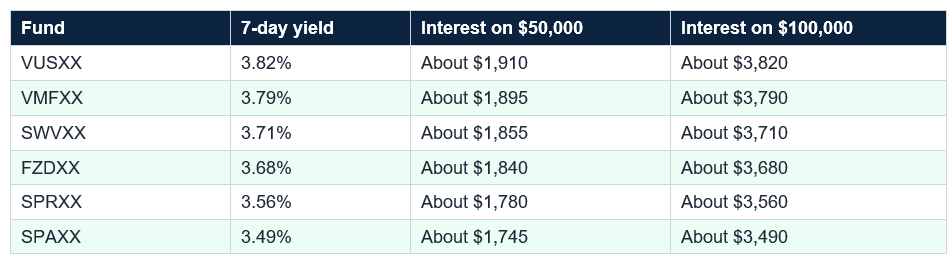
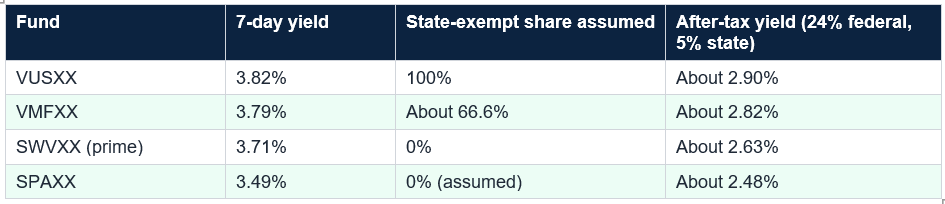
Seven-day yields (Oct 2, 2026): VUSXX 3.82% (0.07% expense); VMFXX 3.79% (0.11%); SWVXX 3.71% (0.34%); FZDXX 3.68% (0.30% net, $100,000 minimum); SPRXX 3.56% (0.42%); SPAXX 3.49% (0.42%). Mid-October readings were slightly higher after the Fed’s September hike. Cost: on $100,000, VUSXX would pay about $3,820 a year and SPAXX about $3,490, a $330 gap that is mostly the 0.35-point difference in expense ratios. After tax (author’s illustration, 24% federal and 5% state): VUSXX about 2.90%; VMFXX about 2.82%; SWVXX about 2.63%; SPAXX about 2.48% if none of its income is state-exempt. Context: $7.92 trillion held in money market funds (ICI, mid-October); top savings accounts 3.50%–4.50%; 52-week T-bill 4.46%; inflation 3.7%.
But “money market fund” is not one product. Funds range from about 3.9% to about 3.5% depending on what they hold and charge, and the default fund your broker picks for your cash is often near the bottom. Choosing well can add a few hundred dollars a year on $100,000. This guide explains what to look for and ranks the leading funds using October 2026 data.
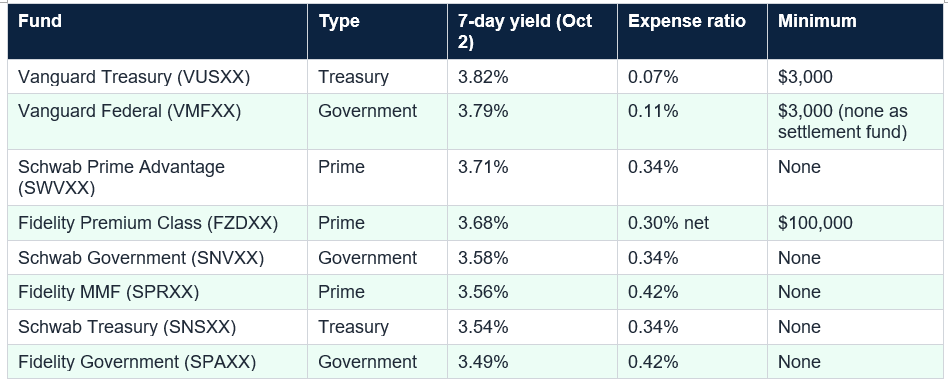
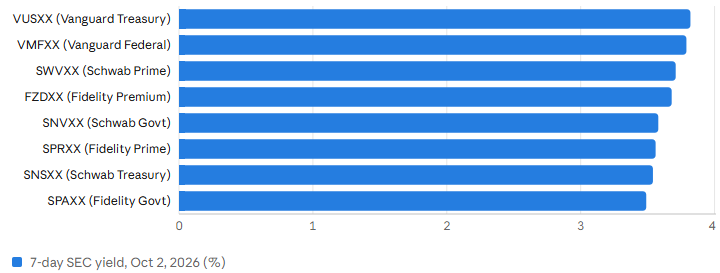
Seven-day yields, Oct 2, 2026: VUSXX 3.82%; VMFXX 3.79%; SWVXX 3.71%; FZDXX 3.68%; SNVXX 3.58%; SPRXX 3.56%; SNSXX 3.54%; SPAXX 3.49%. The ranking tracks expense ratios closely. $7.92 trillion is held in money market funds (ICI, mid-October).
Those five questions usually narrow the field to two or three funds. After that, small yield differences matter less than staying in a low-cost fund and not leaving cash in a lower-paying default.
Schwab’s funds charge 0.34% on SWVXX, SNVXX and SNSXX but have no minimums. SWVXX is a prime fund, so it can hold commercial paper and certificates of deposit and takes slightly more credit risk for a higher yield. Fidelity’s lineup includes the government fund SPAXX, which holds $461.3 billion according to one source and charges 0.42%, a prime fund SPRXX at the same fee and FZDXX at 0.30% net for $100,000 and up. The default funds at the big brokerages are convenient but rarely the best-paying.
Municipal money market funds suit high-bracket investors in taxable accounts. Schwab’s SWTXX yielded about 2.9% and Vanguard’s VMSXX about 2.7%, with income generally exempt from federal income tax. For someone in the 24% federal bracket, a 2.9% tax-exempt yield equals about 3.8% taxable, my arithmetic, making it competitive with the top taxable funds. In a retirement account, a municipal fund would waste its tax advantage.
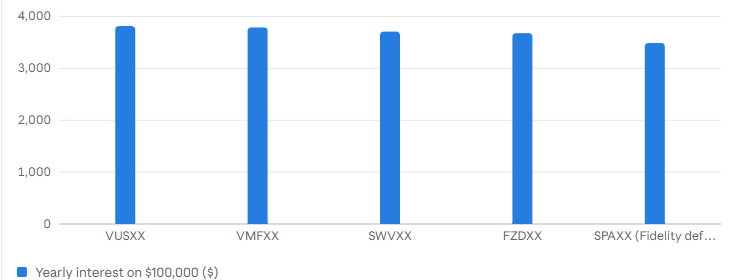
In my illustration, $100,000 earns about $3,820 a year in VUSXX and about $3,490 in SPAXX, a gap of about $330 a year, or roughly $4,800 over ten years if the gap persisted and compounded. On $50,000, the gap is about $165 a year. That is not life-changing, but it is free money for a few minutes of work, which makes the default sweep one of the most common small mistakes in personal finance.
As an illustration, assume a 24% federal and 5% state tax rate. After tax, VUSXX would yield about 2.90%, VMFXX about 2.82%, SWVXX about 2.63% and SPAXX about 2.48%, if none of SPAXX’s income were state-exempt. On $100,000, VUSXX would keep about $2,903 versus about $2,634 for SWVXX. In a state with no income tax, the gap narrows to the difference in yields. Your own rates matter, so check the fund’s tax supplement.
Risk is low but not zero. Money funds have occasionally come under stress, including in 2008 and March 2020, which led regulators to tighten the rules, including liquidity-fee requirements for some funds. For emergency cash, government or Treasury funds are the most conservative choice, but a money fund is not a substitute for FDIC-insured deposits.
A money market fund is a great home for cash you may need soon and want to hold with your investments, but it is not always the highest-paying option. If you can accept a lock-up, a Treasury bill or CD may pay more. Inflation was 3.7% in September, so even the best money funds only roughly keep pace in real terms.
But it cuts both ways. If the Fed lowers rates, money fund yields will fall within days, while a CD or Treasury note would have locked in the higher rate. If you want certainty for a specific period, lock it; if you want flexibility, a money market fund is hard to beat. For larger balances, consider splitting: a core in a low-cost fund for liquidity and some in a Treasury or CD ladder.
Common mistakes include leaving cash in a low-paying default, chasing a tiny yield difference without checking costs, ignoring the state-tax exemption, holding a municipal fund in a retirement account and treating a money fund like an insured deposit. And remember it is a place for cash, not a growth investment: over long periods, diversified stocks have historically beaten cash, with more risk. Find out which fund your cash is in, look up its seven-day yield and expense ratio and compare it with VUSXX, VMFXX or your broker’s best option. If the gap is 0.2 points or more on a large balance, consider switching.
Match the fund to your situation: your broker, your balance, your state tax rate and your appetite for risk. Prefer government or Treasury funds for safety, consider Treasury funds for state-tax savings and remember that money funds are not FDIC-insured and that their yields will fall when the Fed cuts. This is general education, not personalized advice, and a qualified adviser can help you decide.
For most savers who can use Vanguard, the Treasury Money Market Fund (VUSXX) led major retail funds on October 2, 2026 with a 3.82% seven-day yield and a 0.07% expense ratio, followed by Vanguard Federal (VMFXX) at 3.79%. At Schwab, the Prime Advantage fund (SWVXX) paid 3.71%. Yields change daily, so check the current figure.
Are money market funds safe?
They are low risk but not risk-free. Unlike bank deposits, money market funds are not FDIC-insured. Government funds, which must invest at least 99.5% of assets in cash, government securities or repurchase agreements backed by them, are considered the safest. Prime funds hold commercial paper and carry a little more credit risk. Rarely, a fund can fall below its $1.00 share price.
Is a money market fund better than a high-yield savings account?
It depends. In early October, Sallie Mae’s savings account paid 3.85% APY and Marcus 3.50%, while VMFXX yielded 3.79%. Other surveys found top savings accounts at 4.34% to 4.50%. Savings accounts are FDIC-insured; money funds are not, but they can be easier to hold inside a brokerage account and some offer state-tax advantages.
Will money market fund yields fall if the Fed cuts rates?
Yes, and quickly. Money market funds hold very short-term securities, so their yields follow short-term rates closely, in both directions. The Fed raised rates in September, which is why yields have crept up this fall. A CD or Treasury note can lock a rate for longer, while a money market fund resets continuously.
How do I buy a money market fund?
Open or use a brokerage account at Vanguard, Fidelity, Schwab or another broker, search for the fund’s ticker and buy it like any fund. Some require minimums, such as $3,000 for Vanguard’s VUSXX and VMFXX outside a settlement account, or $100,000 for Fidelity’s Premium Class (FZDXX). Check what your default cash sweep earns, because it may pay less.
Table of Contents
- Why Money Market Funds Are Back
- The Short Answer
- The Leaderboard
- How to Choose: Five Questions
- The Fund Families
- Money Market ETFs and Municipal Funds
- Cost Is the Quiet Winner
- Taxes Can Change the Ranking
- How Safe Are They?
- Money Market Funds vs. Savings, CDs and T-Bills
- What Happens When Rates Change
- How to Buy and Mistakes to Avoid
- Conclusion
- Frequently Asked Questions
Money market fund yields ranked: 7-day SEC yield, October 2, 2026 (%)
7-day SEC yield (%) by Source: Hans Goldstein compilation of fund-company data; yields change daily
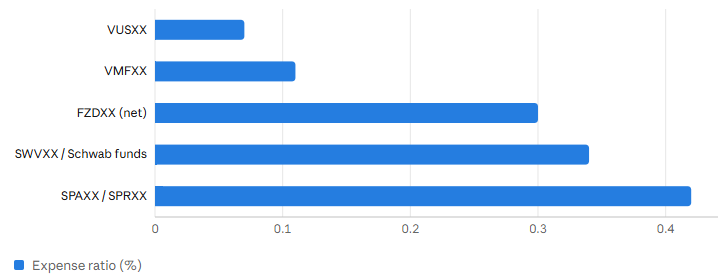
The quiet winner: expense ratios of leading money market funds (%)
Annual expense ratio (%) by Expense ratios as reported by Hans Goldstein, U.S. News and Young and the Invested (2026)
What the choice is worth: yearly interest on $100,000 at October 2 yields ($)
Interest per year ($) by Author's arithmetic at constant yields; VUSXX vs SPAXX gap is about $330 a year
Why Money Market Funds Are Back
For years, money market funds were the boring corner of investing, the place your brokerage parked cash while you decided what to buy. Then interest rates rose, and that parking spot started paying real money. The Investment Company Institute reported $7.92 trillion in money market funds in mid-October.But “money market fund” is not one product. Funds range from about 3.9% to about 3.5% depending on what they hold and charge, and the default fund your broker picks for your cash is often near the bottom. Choosing well can add a few hundred dollars a year on $100,000. This guide explains what to look for and ranks the leading funds using October 2026 data.
The Short Answer
For most savers with a Vanguard account, the Treasury Money Market Fund (VUSXX) is the cheapest way to hold cash, with a 3.82% seven-day yield and a 0.07% expense ratio on October 2, according to Hans Goldstein’s ranking of fund-company data. Vanguard’s Federal Money Market Fund (VMFXX) was close behind at 3.79%. Schwab’s Prime Advantage fund (SWVXX) paid 3.71%, and Fidelity’s Premium Class (FZDXX) 3.68% for balances of $100,000 or more. Fidelity’s default government fund (SPAXX) paid 3.49%, among the lowest of the big funds. The best fund for you depends on where you hold your cash, your state tax rate, your balance and your risk tolerance.The Leaderboard
Here is how the major retail funds ranked by seven-day yield on October 2, 2026. Yields move daily and edged higher by mid-October after the Fed’s September hike: MyMoneyBlog and DepositAccounts reported VMFXX at 3.81% and Vanguard’s Treasury fund at 3.87%. Use this as a guide to relative ranking, not a quote.Seven-day yields, Oct 2, 2026: VUSXX 3.82%; VMFXX 3.79%; SWVXX 3.71%; FZDXX 3.68%; SNVXX 3.58%; SPRXX 3.56%; SNSXX 3.54%; SPAXX 3.49%. The ranking tracks expense ratios closely. $7.92 trillion is held in money market funds (ICI, mid-October).
How to Choose: Five Questions
First, where is your cash held? The easiest funds are the ones at your broker. Second, what does it cost? The expense ratio comes straight out of your yield. Third, what does it hold: Treasuries, government securities or a prime mix with commercial paper? Fourth, what are your taxes? Treasury-heavy funds can have state-tax advantages. Fifth, what is the minimum? Some top-yielding funds require $3,000 or $100,000.Those five questions usually narrow the field to two or three funds. After that, small yield differences matter less than staying in a low-cost fund and not leaving cash in a lower-paying default.
The Fund Families
Vanguard has the cheapest funds. VUSXX invests only in Treasuries and charges 0.07%; VMFXX invests in government securities and charges 0.11%. VMFXX is Vanguard’s settlement fund, with no minimum in that role but $3,000 if bought standalone. One source puts about 66.6% of VMFXX’s holdings in state-exempt Treasury-type obligations versus 100% for VUSXX, which matters for state tax.Schwab’s funds charge 0.34% on SWVXX, SNVXX and SNSXX but have no minimums. SWVXX is a prime fund, so it can hold commercial paper and certificates of deposit and takes slightly more credit risk for a higher yield. Fidelity’s lineup includes the government fund SPAXX, which holds $461.3 billion according to one source and charges 0.42%, a prime fund SPRXX at the same fee and FZDXX at 0.30% net for $100,000 and up. The default funds at the big brokerages are convenient but rarely the best-paying.
Money Market ETFs and Municipal Funds
Two other corners deserve a mention. Money market ETFs, a newer product, trade like stocks. U.S. News lists State Street’s Prime Money Market ETF (MMK) at a 3.9% yield and 0.18% expense ratio, the Texas Capital Government Money Market ETF (MMKT) at 3.7% and 0.20% and the JPMorgan 100% U.S. Treasury Securities ETF (JMMF) at 3.7% and 0.16%. They can be useful if your broker charges nothing to trade ETFs, but they are not identical to traditional funds.Municipal money market funds suit high-bracket investors in taxable accounts. Schwab’s SWTXX yielded about 2.9% and Vanguard’s VMSXX about 2.7%, with income generally exempt from federal income tax. For someone in the 24% federal bracket, a 2.9% tax-exempt yield equals about 3.8% taxable, my arithmetic, making it competitive with the top taxable funds. In a retirement account, a municipal fund would waste its tax advantage.
Cost Is the Quiet Winner
The pattern in the table is striking: the highest yields mostly belong to the lowest-cost funds. Hans Goldstein notes that VUSXX beat Schwab’s SNSXX (3.54%) and Fidelity’s SPAXX (3.49%) on the same day mostly because it costs far less to own: 0.07% versus 0.34% and 0.42%. On $100,000, that is $270 to $350 a year in fees, according to the same analysis.In my illustration, $100,000 earns about $3,820 a year in VUSXX and about $3,490 in SPAXX, a gap of about $330 a year, or roughly $4,800 over ten years if the gap persisted and compounded. On $50,000, the gap is about $165 a year. That is not life-changing, but it is free money for a few minutes of work, which makes the default sweep one of the most common small mistakes in personal finance.
Taxes Can Change the Ranking
Money market fund income is generally taxed as ordinary income federally. But interest from US Treasury securities is exempt from state and local income tax, so a fund holding mostly Treasuries can be worth more after tax in a high-tax state. Prime funds, which hold commercial paper, generally get no state exemption. Vanguard publishes each fund’s state-exempt share, and in one source VUSXX was 100% and VMFXX about 66.6%.As an illustration, assume a 24% federal and 5% state tax rate. After tax, VUSXX would yield about 2.90%, VMFXX about 2.82%, SWVXX about 2.63% and SPAXX about 2.48%, if none of SPAXX’s income were state-exempt. On $100,000, VUSXX would keep about $2,903 versus about $2,634 for SWVXX. In a state with no income tax, the gap narrows to the difference in yields. Your own rates matter, so check the fund’s tax supplement.
How Safe Are They?
Money market funds are designed to hold a stable $1.00 share price, but they are not insured the way bank deposits are. The FDIC does not cover them. Government money market funds must invest at least 99.5% of assets in cash, US government securities or repurchase agreements collateralized by them, which makes them the lowest-risk type. Treasury funds are the most conservative of those. Prime funds hold commercial paper and bank debt and take a bit more credit risk. Municipal funds hold short-term municipal debt.Risk is low but not zero. Money funds have occasionally come under stress, including in 2008 and March 2020, which led regulators to tighten the rules, including liquidity-fee requirements for some funds. For emergency cash, government or Treasury funds are the most conservative choice, but a money fund is not a substitute for FDIC-insured deposits.
Money Market Funds vs. Savings, CDs and T-Bills
Money market funds sit between savings accounts and Treasury bills. In early October, Sallie Mae’s high-yield savings account paid 3.85% APY and Marcus 3.50%, close to VMFXX’s 3.79%, while MyMoneyBlog found the best savings accounts at 4.34% to 4.50% and a 52-week T-bill at 4.46%. Savings accounts are FDIC-insured. Money funds are easier to buy and sell inside a brokerage account and can be tax-advantaged in some states. T-bills pay more, lock your rate and are exempt from state tax.A money market fund is a great home for cash you may need soon and want to hold with your investments, but it is not always the highest-paying option. If you can accept a lock-up, a Treasury bill or CD may pay more. Inflation was 3.7% in September, so even the best money funds only roughly keep pace in real terms.
What Happens When Rates Change
Money market fund yields reset continuously, because the funds hold very short-term securities. That is a feature when rates rise. The Fed raised its target range to 3.75%–4.00% in September, and yields have drifted up since, with VUSXX moving from 3.76% on September 23 to 3.82% on October 2, according to Hans Goldstein. Reuters reported in mid-October that another hike was back on the table, which could push yields higher.But it cuts both ways. If the Fed lowers rates, money fund yields will fall within days, while a CD or Treasury note would have locked in the higher rate. If you want certainty for a specific period, lock it; if you want flexibility, a money market fund is hard to beat. For larger balances, consider splitting: a core in a low-cost fund for liquidity and some in a Treasury or CD ladder.
How to Buy and Mistakes to Avoid
To buy, use a brokerage account at Vanguard, Fidelity, Schwab or another broker, search for the ticker and buy it like any fund. Check the minimum: $3,000 for VUSXX and VMFXX outside a settlement account, $100,000 for FZDXX, none for most others. Then check what your account’s default sweep earns. Fidelity’s SPAXX at 3.49% and the bank sweeps at some brokers can pay noticeably less than the best funds.Common mistakes include leaving cash in a low-paying default, chasing a tiny yield difference without checking costs, ignoring the state-tax exemption, holding a municipal fund in a retirement account and treating a money fund like an insured deposit. And remember it is a place for cash, not a growth investment: over long periods, diversified stocks have historically beaten cash, with more risk. Find out which fund your cash is in, look up its seven-day yield and expense ratio and compare it with VUSXX, VMFXX or your broker’s best option. If the gap is 0.2 points or more on a large balance, consider switching.
Conclusion
The best money market funds to buy today are mostly the cheapest ones. On October 2, Vanguard’s Treasury fund (VUSXX) led at 3.82% with a 0.07% expense ratio, followed by Vanguard Federal (VMFXX) at 3.79%, Schwab’s Prime Advantage (SWVXX) at 3.71% and Fidelity’s Premium Class (FZDXX) at 3.68%. Fidelity’s default SPAXX paid 3.49%, a gap worth about $330 a year on $100,000.Match the fund to your situation: your broker, your balance, your state tax rate and your appetite for risk. Prefer government or Treasury funds for safety, consider Treasury funds for state-tax savings and remember that money funds are not FDIC-insured and that their yields will fall when the Fed cuts. This is general education, not personalized advice, and a qualified adviser can help you decide.
Frequently Asked Questions
What is the best money market fund right now?For most savers who can use Vanguard, the Treasury Money Market Fund (VUSXX) led major retail funds on October 2, 2026 with a 3.82% seven-day yield and a 0.07% expense ratio, followed by Vanguard Federal (VMFXX) at 3.79%. At Schwab, the Prime Advantage fund (SWVXX) paid 3.71%. Yields change daily, so check the current figure.
Are money market funds safe?
They are low risk but not risk-free. Unlike bank deposits, money market funds are not FDIC-insured. Government funds, which must invest at least 99.5% of assets in cash, government securities or repurchase agreements backed by them, are considered the safest. Prime funds hold commercial paper and carry a little more credit risk. Rarely, a fund can fall below its $1.00 share price.
Is a money market fund better than a high-yield savings account?
It depends. In early October, Sallie Mae’s savings account paid 3.85% APY and Marcus 3.50%, while VMFXX yielded 3.79%. Other surveys found top savings accounts at 4.34% to 4.50%. Savings accounts are FDIC-insured; money funds are not, but they can be easier to hold inside a brokerage account and some offer state-tax advantages.
Will money market fund yields fall if the Fed cuts rates?
Yes, and quickly. Money market funds hold very short-term securities, so their yields follow short-term rates closely, in both directions. The Fed raised rates in September, which is why yields have crept up this fall. A CD or Treasury note can lock a rate for longer, while a money market fund resets continuously.
How do I buy a money market fund?
Open or use a brokerage account at Vanguard, Fidelity, Schwab or another broker, search for the fund’s ticker and buy it like any fund. Some require minimums, such as $3,000 for Vanguard’s VUSXX and VMFXX outside a settlement account, or $100,000 for Fidelity’s Premium Class (FZDXX). Check what your default cash sweep earns, because it may pay less.
0 Comments
Be the first to share your thoughts on this article.